
This article by renowned Indian journalist and author M.R. Narayan Swamy, known for his wide-ranging reporting on subjects from politics to insurgencies and best known for his definitive works on the LTTE, was originally published in Jaffna Monitor.
It was close to midnight on July 28, 1987, when I got a tip I had been waiting for: Velupillai Prabhakaran and Anton Balasingham were in a meeting with Prime Minister Rajiv Gandhi, ahead of his trip to Colombo to sign the India-Sri Lanka Agreement. My source was the indefatigable Shankar Rajee of EROS.
This was breaking news. The Tamil Tigers, we knew, were unhappy with the proposed accord and were avoiding Gandhi. The TULF and other militants had given their approval, even if with reservations. The last person holding out was Prabhakaran. Now he, too, was talking to Gandhi.
I immediately called Ashoka Hotel, where Prabhakaran was put up, to know if the LTTE leaders had returned to their room. They hadn’t. The meeting was still on. I kept telephoning every 12-15 minutes. On the fifth or sixth try, I struck gold.
Balasingham came on the line. He did not want to talk at length. Will it be correct to say that the LTTE has accepted the India-Sri Lanka Agreement, I asked him. “You may say that,” he said. AFP became the first to report that the Liberation Tigers of Tamil Eelam (LTTE) had given their approval to the pact.
It would emerge much later that not only had Prabhakaran given the thumbs up to the agreement after pointing out his reservations, but he sought – and got – money from India to “rehabilitate” his fighters (this was kept under wraps). Just before he left, a grateful Gandhi gifted a bulletproof jacket to the Tiger boss.
Little did Gandhi – and the rest of the world – realise that Prabhakaran had played a trick. Indian External Affairs Minister P.V. Narasimha Rao (who would later become the prime minister) had told Gandhi that the accord should be signed by Colombo and the LTTE, not India. Rao’s junior, Minister of State K. Natwar Singh, insisted that Prabhakaran should be kept in Delhi till his men began to surrender their weapons in line with the accord.
It is clear in retrospect that Prabhakaran realised that the only way to return safely and quickly to Jaffna, his lair, was to say “yes” – for now. He did that. The rest, as they say, is history.
When we journalists flew into Jaffna soon after the first of Indian troops, ordinary Tamils were brimming with unconcealed joy. As far as they were concerned, this was the best thing to happen. It gave them respite from fighting – and the overlordship of armed actors. Ordinary men and women ran after slow-moving Indian military trucks, offering tender coconut water and bananas to startled Indian soldiers, most of whom knew no Tamil. Namaste! Namaste! Many on the streets shouted, using the only Hindi word they probably knew.
Prabhakaran was furious when the wildest clapping for his August 4 speech at Suthumalai in Jaffna was triggered by his announcement that the Tigers had agreed to lay down their weapons. The disappointment showed on his face. Nanrikatta sanam (Ungrateful people), one of his lieutenants snapped.
The LTTE’s arms surrender the next day was a farce, although the Indian media, goaded by the establishment, made a song and drama over it. It must be granted to Prabhakaran that he did not hide what he was scheming. He told Indian journalist P.S. Suryanarayana, whom he knew from his Chennai days, that he would play “games” with India that would shatter the peace process. He did that.
Prabhakaran had once fasted in Chennai after the authorities seized his communication equipment. But in Jaffna, he told a junior cadre to undertake a fast because he was expected to die. Tamil supporters were encouraged to stage noisy protests outside and stone Indian military camps. As former LTTE guerrilla Niromi de Soyza revealed, after ordering LTTE leaders trapped at sea to take cyanide and die, Prabhakaran reacted with explosive anger—as if whatever had happened had come as a surprise to him. The LTTE-India war erupted. Four years later, Prabhakaran ordered the assassination of the very man who had once presented him with a bulletproof jacket.
India was unprepared for what turned out to be a painful and bloody showdown. Among other things, it is evident that the Indian government had not conducted an exhaustive study of the man known as Prabhakaran. Could he be trusted? Should he be trusted? Would he agree to explore peace? Would he allow India to guide him after having spent long years underground with the singular aim of breaking up Sri Lanka? This was a colossal blunder, all the more so because Prabhakaran had spent more than three years in Tamil Nadu.
The 1987 agreement sparked unprecedented protests across much of southern Sri Lanka, areas populated by the majority Sinhalese community. The nihilist JVP decided this was the best chance to take another violent jab at power. The opposition to the accord was on two fronts: one, India had deployed its military in the northeast (while Sri Lankan soldiers were confined to barracks); two, the bilateral pact was a “sell-out” to New Delhi and “Tamil terrorists”.
As the war expanded, the LTTE changed its tune. Its “yes” of July 29, 1987, turned into an outright rejection of the India-Sri Lanka Agreement. As the Tigers made peace with Colombo, lulling President Ranasinghe Premadasa, and Gandhi lost elections in India, the Indian Army, badly bruised, returned home. The Tigers and their supporters celebrated, in Sri Lanka and everywhere.
Today, in circa 2026, I hear many Tamils say that Prabhakaran should have built on the 1987 pact for a better future for the Tamil-speaking population, brick by brick, with New Delhi’s additional backing. The LTTE, one of its former leaders recalls telling Prabhakaran, was not formed to make an enemy of India. As for Sri Lanka, the war for Tamil Eelam would have ended in 1987. Tens of thousands of lives on all sides that were lost subsequently could have been saved.
I agree. My rider: Prabhakaran’s thinking was such that he would have never agreed to any peace that did not include a separate homeland. (I conveyed this to Erik Solheim, too, in late 2003.) The insurgents’ political immaturity would have ensured that. It did, until he was killed with select loyalists while some 12,000 of his guerrillas and sympathisers of all ages surrendered to a regime they had vowed to destroy. The larger Tamil society lay in bloody ruins in 2009 – and it still limps.
July 1987 was the first solid opportunity Tamils in Sri Lanka got to achieve a semblance of autonomy. Was it the ideal solution? Perhaps not, but it was the best under the circumstances. Yes, it did not give them Tamil Eelam, but there was no Tamil Eelam in 2009, either.
Tamil society was largely intact in 1987, even though the preceding four years had brought considerable turmoil, civilian suffering, strained Tamil-Sinhalese relations, and divisions within the Tamil community. Most Tamil leaders who could have contributed to the betterment of their people were still alive. Tamil-Muslim bonds had not yet been destroyed.
Unfortunately, some on the Tamil side spat on the 1987 agreement, probably in fear of the LTTE, not realising the amount of work which went into making it a reality. Many of them are now hungry for the 13th Amendment and the Provincial Councils which flowed from that very accord.
In 1987, rightly or wrongly, India gave the northeast administration in Sri Lanka on a platter to Prabhakaran. It was a last-ditch attempt to appease him – amid his “games”. He rejected it with contempt. Those under his sway lauded him for his “revolutionary” credentials.
What Sri Lanka gave in 2009 was death, destruction, defeat, and despair – and a verdict that the Tamil Tigers were not invincible. 1987, in my view, was far better. But those who make history often think differently. In Prabhakaran’s case, he himself became history.
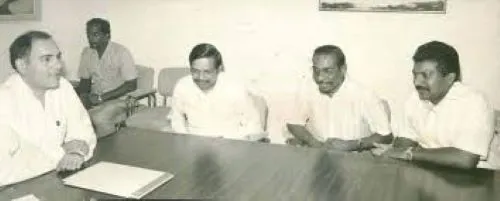
Banner Image: Velupillai Prabhakaran (right) with Indian Prime Minister Rajiv Gandhi (left). Also pictured are LTTE political adviser Anton Balasingham (second from right) and Indian Tamil politician Pandrutti Ramachandran. Image courtesy of Jaffna Monitor.