A shift to AI-generated search results will decrease the traffic that Google sends to publishers’ sites, as more people get what they need straight from the Google search page instead.
At its annual I/O conference on Wednesday, Google announced a slew of “experiments” and changes that are coming to search.
It’s early days. But if these changes are rolled out widely, they’ll be the most significant overhaul of some of the important space on the internet in quite awhile. The shift could significantly decrease the traffic that Google sends to publishers’ sites, as more people get what they need right from the Google search page instead. They could also do some damage to the affiliate revenue that publishers derive from product recommendations.
On the bright side, a new search filter aimed at highlighting humans could help highlight individual journalists, columnists, and newsletters — maybe.
“Search Generative Experience”
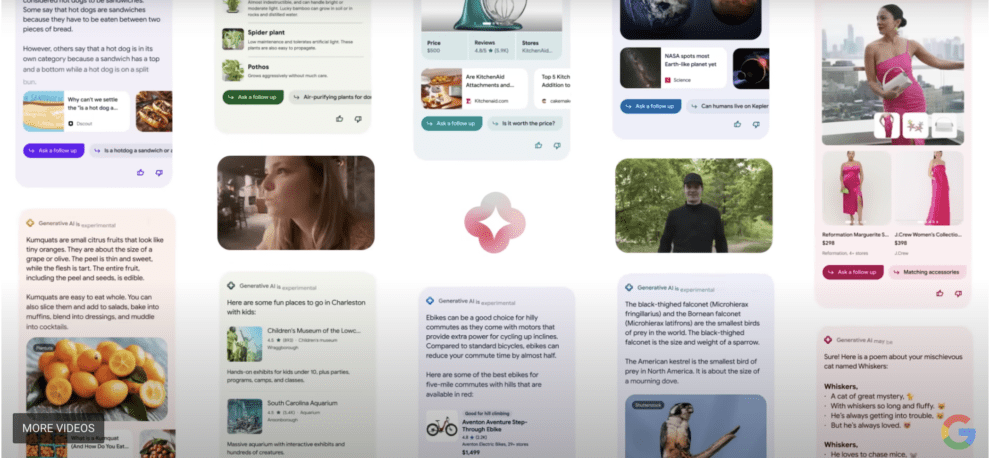
Google will place AI-generated answers right at the top of some search pages. Here’s how the company describes it:
Let’s take a question like “what’s better for a family with kids under 3 and a dog, bryce canyon or arches.” Normally, you might break this one question down into smaller ones, sort through the vast information available, and start to piece things together yourself. With generative AI, Search can do some of that heavy lifting for you.
You’ll see an AI-powered snapshot of key information to consider, with links to dig deeper.
The Washington Post’s Geoffrey Fowler tested the feature and describes the way that SGE cites its sources:
When Google’s SGE answers a question, it includes corroboration: prominent links to several of its sources along the left side. Tap on an icon in the upper right corner, and the view expands to offer source sites sentence by sentence in the AI’s response.
There are two ways to view this: It could save me a click and having to slog through a site filled with extraneous information. But it could also mean I never go to that other site to discover something new or an important bit of context.
You see the top three sources by default, but can toggle for more.
AI-generated content will also be incorporated heavily into shopping results. Search something like “bluetooth speaker for a pool party under $100,” or “good bike for a 5 mile commute with hills,” and up pops an AI-powered list of recommended products to buy. I haven’t tested this feature, but in addition to keeping users off publishers’ pages altogether, it also seems as though it’s not great news for any publishers that make money from affiliate links.
Google cautions that SGE is still an experiment, and it’s not widely available yet. (If you want to try it and are in the U.S., you can add yourself to the waitlist here from the Chrome browser or Google app.) In addition to that limited access, The Verge’s David Pierce notes that there are supposed to be limits to what Google will use AI to answer
Not all searches will spark an AI answer — the AI only appears when Google’s algorithms think it’s more useful than standard results, and sensitive subjects like health and finances are currently set to avoid AI interference altogether. But in my brief demos and testing, it showed up whether I searched for chocolate chip cookies, Adele, nearby coffee shops, or the best movies of 2022.
For instance, when Wired’s Will Knight asked “if Joe Biden is a good president or for information about different US states’ abortion laws, for example, Google’s generative AI product declined to answer.” But even though Google’s AI is not supposed to have opinions, it seems as if they slip in sometimes. The Verge again:
At one point in our demo, I asked [Liz Reid, Google’s VP of search] to search only the word “Adele.” The AI snapshot contained more or less what you’d expect — some information about her past, her accolades as a singer, a note about her recent weight loss — and then threw in that “her live performances are even better than her recorded albums.” Google’s AI has opinions! Reid quickly clicked the bear claw and sourced that sentence to a music blog but also acknowledged that this was something of a system failure.
so in a world where search goes fully GenAI (which is still a big if), pages of links go away and you get a handful of citations
i would imagine/guess this theoretically destroys small publisher traffic while rewarding the big outlets which may be weighted w/more authority https://t.co/7CyPj2JthQ
I, for one, look forward to generating IP that helps Google generate more advertising revenue in exchange for less referral traffic. #cjpahttps://t.co/6muq3S6KRT
One thing this definitely kills is the easy-click stories like "what time is the Super Bowl" — which you may hate, but because they do viral traffic every time, pay the bills in many newsrooms. https://t.co/GdNvzUVWAW
2004: Let’s build our websites to make Yahoo happy! 2008: Let’s build our websites to make Google happy! 2014: Actually let’s focus on Facebook. 2019: Uh, actually let’s go back to Google. Good ol’ Google. 2023: Would you believe me if I said homepages are the new search? No? https://t.co/RPuu3Hre8a
It’s wild how this only doesn’t constitute plagiarism or copyright violation by mere technicality. Like they can copyright strike you like the day is long on YouTube, but if you write on the internet for a living, your shit is just theirs now https://t.co/FrPNssjagG
“In the coming weeks, when you search for something that might benefit from the experiences of others, you may see a Perspectives filter appear at the top of search results. Tap the filter, and you’ll exclusively see long- and short-form videos, images and written posts that people have shared on discussion boards, Q&A sites and social media platforms. We’ll also show more details about the creators of this content, such as their name, profile photo or information about the popularity of their content.
Helpful information can often live in unexpected or hard-to-find places: a comment in a forum thread, a post on a little-known blog, or an article with unique expertise on a topic. Our helpful content ranking system will soon show more of these “hidden gems” on Search, particularly when we think they’ll improve the results.”
“We’re finding that often our users, particularly some of our younger users, want to hear from other people,” Liz Reid, Google’s VP of search, told The Verge. “They don’t just want to hear from institutions or big brands. So how do we make that easy for people to access?”
As Perspectives rolls out, it’ll be interesting to see how Google defines “other people”: Do journalists or opinion columnists who work for newspapers count? Will Substacks be surfaced? The feature could potentially benefit larger news publishers as well as journalists going it alone, but we’ll see.