Home Blog Page 29

New Tools to Monitor Social Media Platforms – GIJN

Social media platforms are among the most difficult sites to scrape for data across the internet.

Yet this is a crucial function for data and investigative story leads if you want to, for instance, see who is behind harmful ads on those platforms, or track TikTok’s recommendation algorithm, or identify the conspiracy groups or influencers who are spreading disinformation. Junkipedia was designed by, and for, investigative journalists and researchers — and it’s free.

One reason for this problem, experts say, is because some platforms’ security teams deliberately make scraping difficult, in a claimed effort to deter bad actors. But this tactic also stymies investigative journalists seeking to track toxic accounts or suspicious individuals.

So, in recent years, journalists have come to rely on platform-owned insight tools like CrowdTangle to track content from Facebook and Instagram posts, and Twitter’s application programming interface, or API, to dig into tweets. But there are looming problems for journalists with these dashboards, too.

“Their future is cloudy,” warns Jeremy Merrill, data reporter at The Washington Post. “CrowdTangle is an important tool, but it has been reported to be going away. Likewise, Twitter API has historically been super-open. However, Elon Musk has promised to make the API paid-for, and has made conflicting statements about what data will even be available to researchers.” In fact, Twitter rolled out new paid tiers for API access in early March that priced out nearly everyone except large corporations. 

Meanwhile, no such content access tool even exists for major platforms like TikTok.

In response, the recent NICAR23 conference — the annual data journalism summit organized by Investigative Reporters & Editors — devoted a major session to an increasingly popular tool that monitors public accounts across numerous platforms for the benefit of journalists and researchers — Junkipedia.Junkipedia now allows users to track and build lists of social media accounts from a dozen different platforms.

Junkipedia was developed by the Algorithmic Transparency Institute, a project of the US-based National Conference on Citizenship, a Congressionally-chartered nonprofit  “dedicated to strengthening civic life in America.” Originally designed to monitor disinformation and “junk news,” Junkipedia has developed to the point where the tool will change its name this year, to reflect its new global, all-purpose digging role.

Junkipedia was designed by, and for, investigative journalists and researchers — and it’s free.

Some caveats: It does not have the most comprehensive datasets, or access to every public Facebook page, as CrowdTangle does — and its user interface has been described by some researchers as “clunky” compared to the big, well-funded social insight tools.
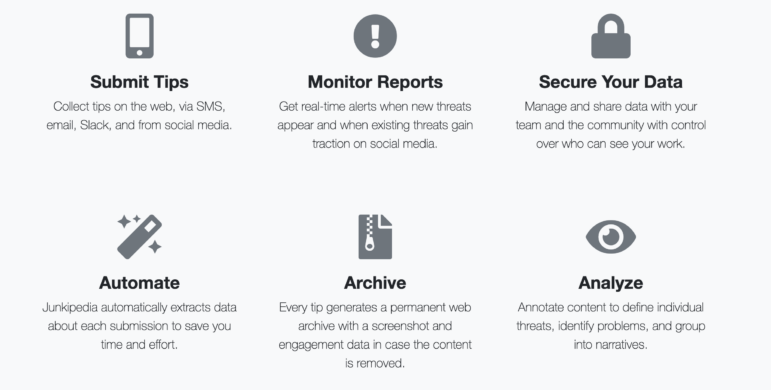
Image: Screenshot, Junkipedia

But its advantages are notable. At NICAR, there was a murmur of excitement from the panel audience when veteran journalist Cameron Hickey — CEO of the National Conference on Citizenship — declared that Junkipedia seeks to be “the CrowdTangle for everything!”

In addition to its shared database of problematic social media content, Hickey said Junkipedia now allows users to track and build lists of social media accounts from a dozen different platforms — including fringe sites like GETTR and Gab, as well as major sites like TikTok, Facebook, and Telegram.

Remarkably, Junkipedia can also automatically transcribe and search English-language podcasts.

“We’ve significantly expanded what the tool does — so it is a platform in search of a new name,” said Hickey. “You can build a list of accounts on the platform from any of these 12 social media platforms, and from podcasts, and the system will automatically surface all of the posts from those accounts. For some of those, it can also show you posts from search queries.”

He added: “For example, for Youtube, you can enter the terms ‘ballot’ and ‘fraud,’ and it will search for where those terms appear in the title or description of a video, and show you data about all of those videos. You can also view lots of metadata about accounts.”

Hickey invited investigative journalists and data reporters to apply to use the tool using their institutional email.

Image: Screenshot, Junkipedia

In addition to monitoring 12 social media platforms, Hickey explained that Junkipedia can also:

  • Dig into messaging on the same topic on multiple platforms through its new “actor” database. “Actors are usually human beings, but sometimes companies — and often have many social media accounts, so associating all those accounts across different platforms can be very helpful,” said Hickey. Merrill added: “So, kind of with one click, you can see everything that, say, Democratic candidates for office in the state of Georgia have said about marijuana.” 
  • Show engagement statistics about social media content you’re investigating. “You can look at a breakdown of any engagement metric that social media platforms provide – how many posts there are; the likes and comments and views,” Hickey pointed out. “Notably, since Elon Musk took over, Twitter added views to tweets, which hadn’t been there before, so our system now collects the views from Twitter posts.”
  • Expose corporate “greenwashing” and “woke-washing,” by showing politically virtuous social messaging campaigns designed to disguise core polluting or exploitative activities. “Frequently, fossil fuel emitters use social issues to cleanse or elevate their brand in some way – car or energy companies focusing on Black Lives Matter, LGBTQIA+, or the gender identifies of individuals in ads — that researchers view as a form of woke-washing or greenwashing,” said Hickey.
  • Be used as a front-end monitoring dashboard, where you can search and filter content.
  • Automatically transcribe English-language audio on TikTok, Youtube, Telegram, and podcasts. “Podcasts have absolutely been a black box for years,” said Merrill. “Do you want to listen for hours to Steve Bannon (on a podcast) every day? – No. Because of Junkipedia, we now have those podcasts transcribed.” Hickey added: “You can also extract meaningful topics or identify frequently used terms.”
  • Build public social media lists — including lists already built and shared about, say, white supremacists in Australia, or vaccine conspiracists in Europe.
  • Create a database of annotated accounts — like accounts for politicians and their respective parties.
  • Annotate your live projects via a built-in labeling tool.

Recent Investigative Case Studies

Hickey was joined on a NICAR panel by Merrill and a Wall Street Journal reporter, Andrea Fuller.

Merrill said Junkipedia was a crucial tool in his 2022 investigation “Trump’s ‘big lie’ fueled a new generation of social media influencers,” which showed how social platforms allowed false claims about fraud in the 2020 US presidential election to give influencers an outsized role in promoting other disinformation afterwards. To pursue the investigation, Merrill sought to examine posts and podcasts by 77 influential election fraud claimants after December 7, 2020, when Joe Biden had been clearly established as the winner.

“They used the clout they gained from those lies to talk about other divisive issues, so the permission they were given by these platforms was a reward for them,” Merrill explained. “I wasn’t particularly relishing building a scraper for fringe platforms like Gab or GETTR, or looking at everything right wingers were saying on podcasts. To solve that problem, I turned to Junkipedia.”

For a recent exposé on how misleading marketing boosted metal health companies, Fuller said her team used Junkipedia to help analyze 1,800 social media ads from 15 telehealth firms that ran without risk warnings, or promoted drugs for unapproved uses.

Fuller revealed that some company executives even posed as customers in certain ads, in violation of US drug marketing regulations.

“The Facebook Ad Library has an API, but it’s only for political ads, and we were interested in corporate ads, for a story on telehealth companies, and the ways they distribute controlled substances,” Fuller explained. “Junkipedia gave us all the data from the ads we were collecting, and the links to the images they were hosting, and collected the data for about 30 companies we were interested in. We got about 4,000 ads, and coded them for things like: ‘this ad names a controlled substance; this ad has an actor pretending to be a customer.’”

Junkipedia’s Limits — and Alternatives

Hickey said the tool’s global reach relies on inputs from its users. “It’s been used in a German election, in a recent Australian election — it can be used almost everywhere, but the power lies with the users,” he noted.Scraping is generally not considered a crime in much of the world, but the ethics of it can be complicated.

However, he also warned that Junkipedia is not a comprehensive tool for all social monitoring.

“There are other tools out there that gather more comprehensive datasets,” Hickey acknowledged. “For instance, CrowdTangle also has some other data that doesn’t come out of their API, so we don’t capture that.”

“In some cases, the questions we’re trying to ask are not ones Junkipedia can answer,” Merrill said. 

For social media scraping that Junkipedia cannot do, Merrill suggested that reporters consider:

  • Snscrape: a command-line tool that can act like a logged-out user of Twitter to scrape all the content from a particular Twitter page. “It’s open source, so you can modify it if you need to do something fancy,” said Merrill. “As long as Twitter allows logged-out users to see stuff, snscrape is great.”
  • SMAT app: which can search and analyze posts in fringe social media sites that Junkipedia doesn’t cover, like 4chan, 8kun, and Parler.
  • Waybackpack: a command-line tool that can download the entire Wayback Machine archive for a particular URL. Merrill said an updated feature – “Waybackpack2” – can also find numbers on social media that change retroactively, such as claimed followers on an account suddenly jumping to a much higher number.

Hickey added that journalists with scraping tools should consider how they are using them. Scraping is generally not considered a crime in much of the world, but the ethics of it can be complicated. “Scraping all of Donald Trump’s Truth Social account seems to carry a low level of ethical risk, but if we scraped a bunch of TikTok videos of teenagers, and scraped all their comments, it’s a different ethical question,” Hickey said. The key is determining when scraping is a needed tool. “We should not bow to the pressures and the threats out there.”

Additional Resources

Tips for Mining Social Media Platforms with Henk van Ess

Maximizing Social Media in Your Newsroom: A Tipsheet on Distribution and Engaging Audiences

GIJN Toolbox: CrowdTangle, Echosec, and Searching Social Media


Rowan Philp, senior reporter, GIJN

Rowan Philp is a reporter for GIJN. He was formerly chief reporter for South Africa’s Sunday Times. As a foreign correspondent, he has reported on news, politics, corruption, and conflict from more than two dozen countries around the world.

Original Link – New Tools to Monitor Social Media Platforms – GIJN

Making an Impact: Measuring and Increasing the Effects of Investigative Journalism

Watchdog reporting makes a critical contribution to society by exposing wrongdoing, fighting corruption, and promoting accountability. But how do we measure this, and explain to a skeptical public the value of investigative reporting? At a time of unprecedented attacks on the press, a broken financial model, and low public trust, it is critical to understand what impact means, why it matters, and how journalists can increase it.  

The impact of in-depth, systematic reporting may not always be obvious, but at times can be quite visible, such as when a government official resigns or a company’s stock price collapses. It can be measured in metrics like dollars saved, assets frozen or seized, or reforms passed. Journalists working in countries with authoritarian governments or in exile face special challenges, yet many have found ways to make an impact. What can we learn from them?  

In this GIJN webinar, we bring together an expert in impact strategy and senior journalists with broad experience in building audiences and ensuring that investigative stories make impact both during and after publication. 

  • Wahyu Dhyatmika is editor-in-chief for Tempo Magazine, the flagship outlet of Tempo Media Group, a leading source of independent news in Indonesia. He helped lead Tempo’s transformation into a digital newsroom. He also helped found CekFakta.com, Indonesia’s first fact-checking collaboration platform, and IndonesiaLeaks.id, the country’s only whistle-blower secure platform.
     
  • Lindsay Green-Barber is the principal and founder of Impact Architects. She is an expert in media impact strategy and measurement. She has worked with media organizations, nonprofits, and funders to develop custom impact frameworks, design strategies for maximizing impact, and conduct research to assess success.
     
  • Grace Murray is Acting Impact Editor & Environment Impact Producer at The Bureau of Investigative Journalism, working to ensure that investigations have tangible impact beyond publication. Grace has more than 10 years of experience in environmental politics, policy, and television production.

The moderator is Anya Schiffrin. She is director of the Technology, Media, and Communications specialization at Columbia University’s School of International and Public Affairs and a senior lecturer on global media, innovation, and human rights.

NOTE: Many countries across the world begin observing Daylight Savings Time this month, so be sure to double check the time of the webinar in your city here.

Watch our Twitter feed @gijn and newsletter for details on future events.

Sign up for the webinar here!
Date: Friday, 24 March 2023

Time:
(What time is it in my city?)
9:00 (Washington DC, Toronto)
13:00 (London)
14:00 (Berlin, Paris)
16:00 (Amman, Kampala, Istanbul)
18:30 (Delhi)
19:00 (Dhaka)
20:00 (Jakarta)
21:00 (Hong Kong)

Original Link – Friday March 24 – GIJN Webinar: Measuring and Increasing the Effects of Investigative Journalism (mailchi.mp)

Social media policies are failing journalists

Plus: The trouble with journalists’ involvement in news literacy programs, soft news as a gateway to propaganda, and social media editors between news and marketing.

By MARK CODDINGTON AND SETH LEWIS March 7, 2023, 12:50 p.m. 

Editor’s note: Longtime Nieman Lab readers know the bylines of Mark Coddington and Seth Lewis. Mark wrote the weekly This Week in Review column for us from 2010 to 2014; Seth’s written for us off and on since 2010. Together they’ve launched a monthly newsletter on recent academic research around journalism. It’s called RQ1 and we’re happy to bring each issue to you here at Nieman Lab.

Social media platforms present a conundrum for journalists.

On the one hand, journalists rely on social media for so many helpful aspects of their jobs. To name just a few: to connect with potential sources, to interact with audiences, to promote their work, and to find solidarity among fellow journalists.

On the other hand, platforms such as Twitter and Facebook present a dizzying array of problems, from the growing variety and intensity of online harassment — hostility, trolling, doxing, etc. — that especially targets women and journalists of color, to the constant threat that one wrong tweet might incite a mob or cost a journalist their job.

It’s important to ask: What are newsroom leaders doing to support and protect their journalists facing the increasing risks and challenges of social media?

A new study in Digital Journalism examines this question. Its author, Jacob L. Nelson, conducted in-depth interviews with 37 U.S.-based reporters, editors, publishers, freelancers, and social media/audience engagement managers, covering current and former employees at a wide array of outlets (local and national, for-profit and nonprofit, legacy media and digital media). Interviews focused on journalists’ experiences with and thoughts about their newsroom’s social media policies. Women and journalists of color made up a large share of interviewees because such journalists are more likely to encounter online harassment.

So, what did the journalists interviewed say about the value of social media policies and their organizations’ support mechanisms? The research article’s title provides a hint: “Worse than the harassment itself.”

“I find that although journalists face both external and internal pressure to devote considerable time and effort to social media platforms — primarily Twitter — they encounter little in the way of guidance or support when it comes to navigating the dangers inherent within those platforms,” Nelson writes. “On the contrary, journalists feel newsroom social media policies tend to make matters worse, by offering difficult to follow guidelines focused primarily on maintaining an ‘objective’ perception of the organization among the public rather than on protecting journalists from the harassment that many will inevitably receive.”

[ Click here to see the future of news in your inbox daily ]

Journalists interviewed for this study seemed to be “one step ahead of their newsroom managers,” argued Nelson (who, full disclosure, does collaborative research with Seth, though not on this project). The journalists realized, in a way their bosses didn’t, that “the very behavior that social media most encourages and rewards — being active and personal — is the same kind of behavior that brings journalists their biggest frustrations.”

That is, journalists understood that being authentic and acting like a “real” person on social media was more likely to bring more professional opportunities and improved interactions with the public. Sounds good, right? But, at the same time, such an approach to social media, journalists realized, also made them more vulnerable to recurring personal attacks from harassers, and it increased the odds that they would inadvertently say something that would get them accused of bias and thus punished by their managers for failing to abide by strict policies on neutrality.

The overall result is that journalists feel they are walking what Nelson has elsewhere called a “Twitter tightrope”: “They spend a great deal of time engaging with the public on social media platforms, while constantly wondering if and when that engagement will come at their professional peril.” So, what do journalists want? For their managers to do more to help them mitigate the challenges and risks endemic to this work. (Indeed, as other research has found recently, news organizations are doing little to protect their journalists from online harassment.)

The “fluidity” of the social media audience — its unpredictability, particularly when some posts “go viral” and spread widely while others get little attention — was a key part of journalists’ frustrations with their managers.

“Traditional journalistic values privilege audience perceptions of professionalism, independence, and neutrality,” Nelson writes, “each of which is easier to predict when focused on a fixed audience for a specific news outlet than for the much larger, more amorphous audiences found on social media platforms.”

On top of that, some of the study’s interviewees questioned whether audiences were really so firmly committed to old-school ideas about total objectivity and neutrality, “which many journalists see not only as impossible aspirations on their own, but also as wholly inconsistent with the performed authenticity privileged by social media.” Future research could help untangle this puzzle. Because while research suggests that people generally want journalists to present the news without a point of view, it’s still unclear whether rules and expectations apply the same to social media postings as they might, say, for news articles on legacy platforms.

As Nelson writes, “Perhaps news audiences hold seemingly contradictory preferences, where they value both accurate, opinion-free news stories, as well as the political opinions of the journalists behind them. If this is indeed the case, then it might be in newsroom managers’ best interests to give the public a bit more credit when deciding what those audiences want not only from journalism, but from journalists as well.”

Research roundup

“The place of media organizations in the drive for post-pandemic news literacy.” By Fran Yeoman and Kate Morris, in Journalism Practice. How involved should news organizations be in news literacy efforts? And what are the benefits and drawbacks of their involvement? Those have been crucial questions as educators, news industry leaders, nonprofits and governments have implemented news literacy programs over the past decade. Through these programs, journalists can provide distinct insight into the news production process and humanize their work for people. But journalists’ involvement also risks these programs becoming little more than PR disguised as education.

Yeoman and Morris bring an education lens to this question by looking at five news literacy initiatives for children in the U.K. that incorporate news organizations in some form. They observed lessons and interviewed program leaders and the teachers in whose classrooms they ran. They found that there was some element of “pedagogical public relations” throughout the programs, as their leaders expressed desires to revitalize news by capturing young audiences and frequently contrasted the work of trained professional journalists with other forms of news in their sessions.

The program leaders were wary of the perception of this self-interested motive and were careful not to promote their own news organizations specifically. But they still promoted a largely uncritical view of the work of professional journalists. Yeoman and Morris instead advocated a news literacy approach of “informed skepticism” as part of a national curriculum. Journalists should have a role in such programs, they argued, but we need to be cognizant of news organizations’ self-promotional motivations lest we turn news literacy programs into little more than advertisements for traditional news media.

“How propaganda works in the digital era: Soft news as a gateway.” By Yuner Zhu and King-wa Fu, in Digital Journalism. Zhu and Fu’s study is organized around a fascinating conundrum: If we’re in a high-choice media environment in which a more trusted (or at least more entertaining) news source is a tap away, how is authoritarian propaganda still effective? Zhu and Fu note in particular the online success of People’s Daily and CCTV News, China’s premier Communist Party news sources, which each have more than 100 million followers on Sina Weibo (China’s dominant social media platform), garnering unprecedented popularity in an environment where we might think consumer choice might leave them behind.

The authors were especially interested in whether soft news plays a role in maintaining propaganda’s popularity. Does soft news offer an escape to avoid propaganda, or help capture an entertainment-seeking audience to increase the reach and palatability of propaganda? They tested their hypothesis with 5.7 million Sina Weibo posts over seven years from 103 Chinese newspapers.

The answer, in short, was that yes, soft news does serve as an effective gateway to authoritarian propaganda. More than half (58%) of the news that party daily newspapers published on Sina Weibo was soft news — less than than their non-party counterparts, but enough to have a measurable effect on the popularity of propaganda news (in this study, news about Chinese premier Xi Jinping). An increase in the popularity of soft news one month led to a significant increase in the popularity of propaganda in the next. (And notably, that effect didn’t occur in the reverse.)

There were limits to this strategy — softening the propaganda stories themselves with things like videos actually undermined their effectiveness. But on the whole, the authors conclude, “These batches of human-interest content are devoid of propaganda in text yet are instrumental to propaganda in effect,” as party media uses infotainment to lure in an otherwise politically uninterested audience.

“Now hiring social media editors.” By Tai Neilson, Timothy A. Gibson, and Kara Ortiga, in Journalism Studies. The notion that the boundaries are blurring between news and marketing within news organizations — and even within journalists’ own jobs — is hardly news to anyone at this point. Yet few feel the tension between these two realms quite as acutely as social media editors. It’s not clear there’s much difference on social media between publishing news and promoting it, and social media editors are staking out a home in the newsroom on that fault line.

Neilson and his co-authors explored that defining tension of the work of social media editors by looking at 291 American journalism job postings for social media editors (as well as engagement editors, community managers, audience strategists, and other similar titles). They also interviewed 11 social media editors working at American news organizations.

Among the job postings, they found an interesting dichotomy. Job postings rarely explicitly mentioned marketing as a desire skill or part of the job — rather, journalism experience was the top form of experience sought, almost nine times more than marketing experience. But social media editors’ primary tasks, such as analyzing audience data and helping with audience growth, “could only be classified as marketing.” Those jobs, the authors concluded, were being publicly framed as news jobs, but were in fact more commercially oriented jobs in practice.

In the interviews, though, the authors noted that editors didn’t find many of these day-to-day audience (and metrics) monitoring tasks rewarding. Instead, they were working to redefine their own roles as being oriented around newsroom strategy and decision-making, using their data analysis skills as an attempted avenue into more active newsroom leadership. The boundaries between editorial and marketing work for social media editors, the authors conclude, have not so much been blurred as simply redrawn to include marketing functions as central — and as a potential path to a more managerial role.

Want more? Subscribe to our newsletter here and have Nieman Lab’s daily look at the changing world of digital journalism sent straight to your inbox.

Information flows from local to national: Evidence from 21 major U.S. cities. By Lei Guo and Yiyan Zhang, in Journalism. It’s become a truism that news, especially in the U.S., has become increasingly national as local journalism has been hollowed out and political dynamics have pushed most debates to the national level. The national media’s preeminence over local media in determining what issues get covered has been demonstrated for decades. But Guo and Zhang’s study tests that notion on local media’s turf, with coverage of urban issues.

Using an automated analysis of thousands of news articles from 21 of the largest cities in the U.S., Guo and Zhang measured coverage over time of 16 locally based issues ranging from taxes to the environment to religion and morality. They found that in only three cities the local media predominantly led the national media in covering these urban issues — Chicago, Seattle, and Washington, D.C. (In about half the cities, there was no significant relationship between local and national coverage.) Across all cities, local media tended to lead on taxes, politics, and media and the internet, and national media led on gun control and crime.

Larger cities were not more likely than smaller ones to lead the national media in coverage of urban issues. Instead, cities’ GDP and number of local news organizations were the strongest factors in predicting whether a city’s local media would lead national media. “Affluent cities with more journalistic resources are more likely to control the information flows,” the authors concluded. This leads to more power for those cities to control their images while leaving less affluent cities even more marginalized.

The push to reinvigorate local news, they said, should center more on those less affluent (and therefore less powerful) cities, though of course their relative lack of wealth makes it more difficult for them to support new or expanded local news initiatives.

“‘Voices from the island’: Informational annexation of Crimea and transformations of journalistic practices.” By Ksenia Ermoshina, in Journalism. / “‘Keeping an eye on the other side’: RT, Sputnik, and their peculiar appeal in democratic societies.” By Charlotte Wagnsson, Torsten Blad, and Aiden Hoyle, in The International Journal of Press/Politics. The power of Russian media has been widely observed, particularly since Russia’s invasion of Ukraine began last year. But two notable recent studies have given us insight into Russia’s media influence through some less-understood avenues. The first of those studies, by Ksenia Ermoshina, examines the process by which Russia asserted its dominance in the media sphere after it began occupying the Ukrainian peninsula of Crimea in 2014.

Along with a year of fieldwork in Crimea, Ermoshina interviewed 45 Crimean journalists, NGO workers, information security experts, and others. She found that while they all engaged in individual strategies to adapt to Russian rule, those strategies are best understood against the background of infrastructural changes — the ownership of cables and cell towers, and the quality of internet connections. She coins the term “informational annexation” to refer to the process of controlling access and circulation of information that occurred.

While policing content was certainly involved in Russia’s information control strategy, Ermoshina draws attention to the structural elements involved, like choking off internet traffic to turn Crimea into an “informational island” and by making it much more burdensome to travel to and from Crimea, cutting off institutional support and increasing journalists’ perception of the risk involved with reporting.

In the second study, Charlotte Wagnsson and her colleagues sought to determine who watches the Russian state-sponsored propaganda outlets RT and Sputnik outside of Russia and why. They interviewed 43 Swedish consumers of RT or Sputnik and found that while there were many who fit what might be the stereotypical Russian propaganda consumer — right-wing, with strong anti-establishment media beliefs — there were even more who didn’t fit that profile.

Some were more centrist pragmatists, and others were progressive and directly disagreed with views put forward by RT and Sputnik. So why were they consuming that media? The authors broke down a typology of four types of motivations, three of which involved some distance from RT and Sputnik’s positions.

Some (“media nihilists”) distrusted establishment and alternative media but were confident in their ability to consume them skeptically. Others (“reluctant consumers” and “distant observers”) consume media counter to their own ideas more out of curiosity or a pride in keeping tabs on opposing ideas. But all types, the authors concluded, contribute to those organizations’ goal of establishing international influence, since RT and Sputnik “do not need to be seen as legitimate; only as legitimate enough.”

Original Link – https://www.niemanlab.org/2023/03/social-media-policies-are-failing-journalists/?utm_source=whatsapp

Vacancy Announcement – Finance Executive

Center for Investigative Reporting

We are Sri Lanka’s first center dedicated to promote excellence in investigative journalism within Sri Lanka and the South Asia.

Our key objectives include: produce high quality investigative stories; contribute to development of a highly skilled and ethical community of investigative journalists; support investigative journalists and investigative journalism initiatives; undertake collaborative investigative storytelling in partnership with South Asia’s IJ centers and journalists; and deliver investigative journalism training.

Finance Executive

Key Tasks

  • Undertake all fiancial and general admin tasks linked to programs and institutional budgets.
  • Seamless maintenance of program and accounting records, generation of monthly financial forecasts, filing of financial documents, preparation of payment vouchers, collection of supporting documents, timely payments, attend to banking activities, general ledger maintenance, journal entries and accounts reconciliations.
  • Assist in grant management, preparation of organizational budgets and annual auditing process.
  • Preparation of letters, notices, meeting minutes.

We are looking for:

  • Degree/ Diploma or similar academic/ professional qualifications on accounting and finance.
  • At least 2 years experience in related field. Previous experience in the development sector will be an added advantage.
  • Sound conceptual and communication skills, interpersonal skills, ability to work independently, teamwork, meeting of deadlines.
  • Proficient in computer skills including QuickBooks and MS Office packages.

CIR is an equal opportunity employer. Selected candidates will be paid competitive remuneration.

Send in your CVs to hr@cir.lk mentioning the post applied for in the subject line on or before 17 March 2023.

Center for Investigative Reporting | https://cir.lk/

Join our exciting new investigative reporting initiative

Are you a school leaver or someone under 23 years of age with a passion for storytelling? Are you tech-savvy, and keen to learn new trends in journalism and practice new skills?

If you are excited by the prospect of telling stories that goes missing in the media, of people and issues that are often overlooked, willing to learn, research-oriented and keen to produce in- depth, text-based and/or multimedia stories as part of an independent investigative reporting desk and fact-check, we want to hear from you.

The Center for Investigative Reporting (CIR), a member of the Global Investigative Journalism Network (GIJN), is looking for full-time trainee journalists and interns with fire in the belly and a love for investigative reporting to join Sri Lanka’s first independent investigative reporting desk and fact-check starting from late March.

CIR is looking for:

· Youth between 19-23 years

· Language skills (being bilingual or trilingual will be advantageous)

· Ability to work as part of a dynamic team

· Sound conceptual and communication skills

· Eager to learn and goal-oriented

· Be willing to travel

· Self-driven and flexible

· Willing to dig deep

What CIR can offer?

· A non-discriminatory, supportive learning space

· A year-long paid internship

· Editorial guidance from experienced investigative journalists and editors

· Regular training and mentoring support towards professional development

· Opportunities to attend media briefings and news reporting experience

· Guidance to handle complex stories

· Developing writing skills

· Developing interviewing skills

· Research and fact checking skills

· Multi-media content development skills

· Resume building

· CIR letters of reference and personal recommendations

Applications

Applications must be submitted in English, Sinhala or Tamil via our application form on or before 14 March 2023. Application should include:

1. Resume

2. Cover letter

3. At least two work samples (Written pieces should not exceed 500 words and videos should be less than 5 minutes.)

4. Two non-related referees

Selection process

CIR is an equal opportunity employer.

Applicants are required to submit all required documents and any incomplete application will not be considered.

Applicants will be notified in mid March 2023.

And canvassing will result in the applicant being disqualified.

අපගේ නව්‍ය සහ ආකර්ෂණීය විමර්ශනාත්මක වාර්තාකරණ වැඩසටහන සමඟ සම්බන්ධ වීමට අවස්ථාවක්…

ඔබ පාසල් අධ්‍යාපනය අවසන් කළ අයෙක් හෝ වාර්තාකරණය සඳහා උනන්දුවක් දක්වන වයස අවුරුදු 23ට අඩු අයෙක්ද? තාක්ෂණික දැනුමින් හෙබි ඔබ ජනමාධ්‍ය නව ප්‍රවණතා ඉගෙනුමට සහ කුසලතා වර්ධනයට කැමැත්තක් දක්වන්නේද?

මාධ්‍ය තුළදී මග හැරෙන වාර්තාකරණයන් මෙන්ම නොසලකා හැරෙන ජනතාව සහ ඔවුන්ගේ ගැටළු පිළිබඳව ඔබ උනන්දුවක් දක්වන්නේනම් සහ ස්වාධීන විමර්ශනාත්මක වාර්තාකරණ සහ තොරතුරු සත්‍යාපන ව්‍යායාමයක කොටසක් ලෙස අධ්‍යයනයට, පර්යේෂණයන්ට සහ ලිඛිත/ බහුමාධ්‍ය වාර්තාකරණයේ නියැලීමට කැමැත්තක් දක්වන්නේ නම් ඔබට සවන්දීමට අප සූදානම්.

ගෝලීය විමර්ශනාත්මක මාධ්‍යජාලයේ (GIJN) සාමාජිකයෙකු වන විමර්ශනාත්මක වාර්තාකරණ මධ්‍යස්ථානය (CIR) විසින් මෙහෙයවනු ශ්‍රී ලංකාවේ පළමු ස්වාධීන විමර්ශනාත්මක වාර්තාකරණ සහ සත්‍යාපන වැඩසටහන සමඟ සම්බන්ධ වීමට සුදුසු විමර්ශනාත්මක වාර්තාකරණයට ඇල්මක් ඇති ජවසම්පන්න හා උද්‍යෝගීමත් පූර්ණ කාලීන පුහුණු මාධ්‍යවේදීන් සහ සීමාවාසිකයින් කණ්ඩායමක් මාර්තු මස අවසානයේදී බඳවා ගැනේ.

අප සොයන්නේ ඔබයි:

· වයස අවුරුදු 19-23 අතර තරුණ තරුණියන්

· භාෂා කුසලතාව (ද්විභාෂා හෝ ත්‍රිභාෂා හැකියාව වාසිදායක වනු ඇත)

· කණ්ඩායමක කොටසක් ලෙස වැඩ කිරීමේ හැකියාව

· ඉහළ සංකල්පීය සහ සන්නිවේදන කුසලතාව

· ඉගෙනුමට ලොල් සහ ඉලක්කගත චර්යාව

· සංචාරයට ඇති කැමැත්ත

· ස්වයං-ක්‍රියාකාරී සහ නම්‍යශීලී

· ගැඹුරින් විමර්ශනය කිරීමට කැමත්ත

අපෙන් ඔබට ලැබෙන්නේ;

· වෙනස් කොට සැලකීමකින් තොර, සහයෝගී ඉගෙනුම් අවකාශයක්

· වසරක වැටුප් සහිත සීමාවාසික පුහුණුවක්

· පළපුරුදු විමර්ශනාත්මක මාධ්‍යවේදීන් සහ සංස්කාරකවරුන්ගේ මඟ පෙන්වීම

· වෘත්තීය සංවර්ධනය සඳහා නිතිපතා පුහුණුව සහ උපදේශන සහය

· මාධ්‍ය හමු වලට සහභාගී වීමේ අවස්ථා සහ ප්‍රවෘත්ති වාර්තා කිරීමේ අත්දැකීම්

· සංකීර්ණ වාර්තාවන් සම්පාදනය සඳහා මඟ පෙන්වීම්

· ලේඛන කුසලතා සංවර්ධනය

· සම්මුඛ සාකච්ඡාවන් මෙහෙයවීමේ හැකියාව වර්ධනය

· පර්යේෂණ සහ සත්‍යාපන කුසලතා

· බහු මාධ්‍ය වාර්තා සම්පාදන කුසලතා

· ජීව දත්ත පත්‍රිකා සැකැස්ම

· ආයතනික සහ පුද්ගලික නිර්දේශ

අයදුම්පත්

2023 මාර්තු 14 හෝ ඊට පෙර අපගේ අන්තර්ජාල අයදුම්පත්‍රය හරහා ඉංග්‍රීසි, සිංහල හෝ දෙමළ භාෂාවෙන් අයදුම්පත් ඉදිරිපත් කළ යුතුය. අයදුම්පතට ඇතුළත් විය යුත්තේ:

1. ජීව දත්ත පත්‍රිකාව

2. ආවරණ ලිපිය

3. පෙර සම්පාදිත වාර්තා/ නිර්මාණ නියැදි දෙකක් (ලිඛිත නියැදි වචන 500 නොඉක්මවිය යුතු අතර වීඩියෝ විනාඩි 5 ට අඩු විය යුතුය.)

4. ඥාතීන් නොවන නිර්දේශකරුවන් දෙදෙනකුගේ විස්තර

තෝරා ගැනීමේ ක්‍රියාවලිය

විමර්ශනාත්මක වාර්තාකරණ මධ්‍යස්ථානය යනු සමාන අවස්ථා සේවායෝජකයෙකි.

අයදුම්කරුවන් අවශ්‍ය සියලුම ලියකියවිලි අයදුම්පත්‍රය සමග ඉදිරිපත් කළ යුතු අතර අසම්පූර්ණ අයදුම්පත් සලකා බලනු නොලැබේ.

2023 මාර්තු මැද භාගයේදී අයදුම්කරුවන්ට දැනුම් දෙනු ලැබේ.

තෝරා ගැනීමේ ක්‍රියාවලිය තුළ සිදු කෙරෙන අනිසි පෙළඹවීම් හෝ විමසීම් අයදුම්කරු නුසුදුස්සෙකු වීමට හේතු වේ.

எங்களது புதிய புலனாய்வு அறிக்கையிடல் முயற்சியில் நீங்களும் இணையலாம்.

நீங்கள் பாடசாலை கல்வியை நிறைவுசெய்தவரா?

அல்லது 23 வயதுக்குட்பட்ட கதை கூறும் ஆர்வமுள்ளவரா?

நீங்கள் தொழில்நுட்ப துறையில் ஆர்வமுள்ள மற்றும் ஊடகத்துறையின் புதிய பரிணாமங்களை கற்றுக்கொள்வதற்கும் புதிய திறன்களை விருத்தி செய்வதற்கும் ஆர்வமுள்ளவரா?

நீங்கள் ஊடகங்களில் கவனத்திற்கொள்ளப்படாத கதைகள், பெரும்பாலும் கவனத்திற்கொள்ளப்படாத மனிதர்கள் மற்றும் பிரச்சினைகள் தொடர்பாக கற்றுக்கொள்ள விரும்பும், ஆய்வு அடிப்படையில், எழுத்தாக்கம் அல்லது பல்லூடக கதைகளை சுயாதீன புலனாய்வு அறிக்கையிடல் மற்றும் தகவல் சரிபார்த்தலில் ஒரு அங்கத்தவராக பணிபுரிய ஆர்வமுள்ளவராக இருந்தால், உங்களிடம் இருந்து செவிமடுக்க ஆர்வமாக இருக்கிறோம்.

உலகளாவிய புலனாய்வு ஊடகவியல் வலையமைப்பின் (GIJN) உறுப்பினரான புலனாய்வு அறிக்கையிடல் மையம் (CIR) இனால் மார்ச் மதம் இறுதியில் ஆரம்பிக்கப்படவுள்ள இலங்கையின் முதல் சுயாதீன புலனாய்வு அறிக்கையிடல் சேவை மற்றும் தகவல் சரிபார்த்தலில் இணைத்துக்கொள்வதற்கு, முழுநேர பயிற்சி ஊடகவியலாளர்கள் மற்றும் புலனாய்வு அறிக்கையிடலில் ஆர்வம் கொண்ட பொருத்தமானவர்களை எதிர்பார்க்கிறது.

CIR எதிர்பார்ப்பது:

• 19-23 வயதுக்கு இடைப்பட்ட இளைஞர் யுவதிகள்

• மொழித் திறன் (இருமொழி அல்லது மும்மொழித்திறன் சிறந்தது)

• குழுவின் ஒரு அங்கத்தவராக செயற்படும் திறன்

• சிறந்த தொடர்பாடல் திறன்

• கற்றுக்கொள்ள ஆர்வம் மற்றும் இலக்கு சார்ந்திருத்தல்

• பயணம் செய்ய தயாராக இருத்தல்

• சுயமாக இயங்கும் மற்றும் நெகிழ்வான

• ஆழமான தேடல் கொண்திருத்தல்

எங்களால் உங்களுக்கு கிடைப்பன:

• பாரபட்சமற்ற, ஆதரவான கற்கை சூழல்

• ஒரு வருட கால ஊதியத்துடன் கூடிய பயிற்சிக்காலம்

• அனுபவம் வாய்ந்த புலனாய்வு ஊடகவியலாளர்கள் மற்றும் தலைமைஆசிரியர்களிடமிருந்து வழிகாட்டல்கள்

• வழக்கமான தொழில்முறை வளர்ச்சிக்கான பயிற்சி மற்றும் வழிகாட்டுதல்

• ஊடக சந்திப்புகள் மற்றும் செய்தி அறிக்கையிடல் அனுபவத்தில் கலந்து கொள்வதற்கான வாய்ப்புகள்

• சிக்கலான கதைகளைக் கையாள வழிகாட்டுதல்

• எழுத்து திறனை வளர்த்தல்

• நேர்காணல் திறன்களை வளர்த்தல்

• ஆய்வு மற்றும் தகவல் சரிபார்க்கும் திறன்களை வளர்த்தல்

• பல்லூடக உள்ளடக்க திறன்களை மேம்படுத்தல்

• சுயவிபரக்கோவையை மெருகூட்டல்

• CIR பரிந்துரை கடிதங்கள் மற்றும் தனிப்பட்ட பரிந்துரைகள்

விண்ணப்பங்கள்

விண்ணப்பங்கள் ஆங்கிலம், சிங்களம் அல்லது தமிழ் மொழியில் 2023 மார்ச் மாதம் 14ம் திகதி அன்று அல்லது அதற்கு முன் சமர்ப்பிக்கப்பட வேண்டும்.

விண்ணப்பத்தில் உள்ளடக்கப்படவேண்டியவை:

1. சுயவிபரக்கோவை

2. முகவுரைக் கடிதம்

3. குறைந்தது இரண்டு ஆக்க மாதிரிகள் (எழுதாக்கங்கள், 500 வார்த்தைகளுக்கு மிகாமல் இருக்க வேண்டும் மற்றும் காணொளிகள், 5 நிமிடங்களுக்கு குறைவாக இருக்க வேண்டும்.)

4. உங்களை பரிந்துரை செய்யும் தொடர்பற்ற இருநபர்கள்

தெரிவுசெய்யும் முறை:

CIR சமனான வாய்ப்பை வழங்கும் நிறுவனம் ஆகும்.

விண்ணப்பதாரர்கள் குறிப்பிடப்பட்ட அனைத்து ஆவணங்களையும் சமர்ப்பிக்க வேண்டும் மற்றும் எந்த முழுமையற்ற விண்ணப்பமும் பரிசீலிக்கப்படமாட்டாது.

விண்ணப்பதாரர்களுக்கு மார்ச் 2023 நடுப்பகுதியில் அறியத்தரப்படும்.

தெரிவு செயற்பாட்டின் போது மேற்கொள்ளப்படும் முறையற்ற தூண்டுதல்கள் அல்லது சாதகமாக செல்வாக்கை பெறுவதற்கு முயற்சித்தல் விண்ணப்பதாரரின் தகுதியிழப்புக்கு வழிவகுக்கும்.

Reporting on Disasters

Earth Journalism Network|09 June 2016

INTRODUCTION
Disasters include natural events such as earthquakes, volcanic eruptions and hurricanes, and situations sparked by human actions, such as oil spills, radiation leaks and chemical accidents.

When a disaster strikes, the most important story that journalists can tell their audiences in the first instance will be about safety -– what they should do to ensure they are safe, where they can go if they need help, and who they should listen to (see Communicating Risk).

In describing what has happened, where, how and why, journalists may need to take complex scientific information and explain it in a way that broad audiences will understand.

If the situation is new then journalists will need to rapidly educate themselves about what is known about this kind of disaster, and which expert sources they should consult (see Sources of Stories).

There are two main phases to disaster reporting – the initial breaking news period, and the longer-term aftermath.

Journalists who go to the site of a disaster to report on it, must take care to stay safe and not to get in the way of any emergency relief activities. Disaster zones are potentially dangerous because whatever caused the problem could happen again, because infrastructure may be damaged and because people there may be in a highly stressed state. There may be no normal public security or regular ways to request help.

Reporters should bring in their own food, water, fuel and first-aid kit so they don’t place a burden on the limited supplies that are there. They should wear appropriate clothing for the climate and avoid risks such as sunstroke, dehydration and hypothermia and avoid drinking dirty water.

It is important for reporters to stay in close contact with colleagues back at the newsroom and to have a clear plan for what to do if anything goes wrong. Additionally, it is best to back up as much information as possible back in the newsroom in case information is lost.

Some key things for reporters to report from the scene are the number of casualties and types of injury; any damage to buildings and infrastructure (and an idea of the cost); what the scene looks like (the sights and sounds and even smells, along with what people there are doing; any rescue efforts and what is helping or hindering them.

It is useful to report the chronology of events to create an accurate picture of what has happened, and it is important to avoid laying the blame for any disaster without having strong reasons to do so.

Journalists can interview eyewitnesses, casualties and relief workers about what caused the problem, how and when it began, and what has happened since. Quotations from these sources can be highly compelling but journalists must remember aware that people may be scared, in shock or working in stressful, dangerous conditions.

Interviewees may have survived a trauma or may be related to people who have died, been injured or are missing so it is imperative for journalists to be sensitive and respectful during interviews and reporting. While it is better to name people rather than treating them as anonymous victims, journalists should avoid printing or broadcasting the identities of people who have been hurt or killed before their families know.

Aid agencies and emergency services depend on media coverage to raise awareness of the need for help, and journalists benefit from the cooperation of aid agency staff. But each side of this relationship can have very different expectations and it is important to be aware of this during a crisis.

People managing the response to a disaster might expect journalists to be there only to provide a public service and may not understand how the media works and that journalists have a job to do to. At the same time journalists should respect the need for relief workers to do their job. A quick introduction and a promise not to take up valuable time can help.

Online social networks such as Twitter or Ushahidi allow people to use mobile phones to share life-saving information during a crisis, and journalists can also use this tools to get a better picture of what is happening (see Using Social Media).

After the initial breaking-news phase of a disaster, journalists can focus on more detailed reporting about whether the disaster could have been prevented and how its impacts will be dealt with. Were there, for instance, any early warning systems in place, did they work, and could they work better?

Long after a disaster strikes there will still be many stories to report. Journalists can revisit the scenes of disasters to find out what the lasting impacts have been, whether life is returning to normal and what — if any — lessons there are for the future.

For instance, when the Asian tsunami struck in 2004, coastal mangrove forests helped to protect some communities by acting as natural barriers that absorbed the energy of the tsunami’s waves. This has prompted some countries to replant mangrove forests in areas where they had been cut down for coastal development.

Of course all of this implies that journalists can also do more to report on disaster-related issues before they happen. With climate change set to increase the number of extreme weather events, including floods, droughts and powerful storms such as hurricanes, this kind of journalism will become increasingly important.

Original Link – https://earthjournalism.net/resources/reporting-on-disasters

More and more, trolls and haters attack female journalists

When the tantalizing concept of an “information superhighway” first appeared in 1993, it was held out as rivaling the railroads and airlines in revolutionizing and connecting the world. In many ways, it has, creating previously unimaginable opportunities for journalists to have their work reach a global audience. But a report published Feb. 14 by the International Center for Journalists shows in graphic terms that the internet also created dark alleys of hate, misogyny and violenceaimed at female journalists.

The ICFJ report details two case studies involving online threats against Rana Ayyub, a Post Opinions contributor and courageous investigative journalist in India, and Ghada Oueiss, a no-nonsense Al Jazeera Arabic anchor. The studies, carried out by the center’s research team in cooperation with computer scientists at the University of Sheffield, examined about 13 million tweets involving Ms. Ayyub that were sent between Dec. 12, 2019, and March 1, 2022, and more than 150,000 tweets involving Ms. Oueiss sent between Sept. 3, 2021, and March 1, 2022, as well as other disturbing evidence.

Ms. Ayyub is known for her undercover investigation of the Gujarat riots of 2002, in which some 800 Muslims were killed, and extrajudicial killings implicating the current Indian prime minister, Narendra Modi, who was then chief minister of Gujarat, and his associates. Today, “an army of trolls” from Mr. Modi’s ruling Hindu nationalist Bharatiya Janata Party “threaten Ayyub at scale; on a daily basis,” the report says. Her sharp criticism of the BJP and Hindu nationalism trigger “viral smear campaigns” that target her “at a deeply personal level,” threatening death and rape; they are “deeply misogynistic and redolent of religious bigotry.” The onslaught creates a major risk of “morphing into physical violence,” the report says, and is intended to “undercut public trust in her journalism.”

Some 222 Nicaraguan political prisoners left that Central American country for the United States in February. President Daniel Ortega released and sent them into exile in a single motion. Nevertheless, it appears that Mr. Ortega let them go under pressure from economic sanctions the United States imposed on his regime when he launched a wave of repression in 2018. The Biden administration should keep the pressure on. Read recent editorials about the situation in Nicaragua.

Inflation remains stubbornly high at 6.4 percent in January. The Federal Reserve’s job is not done in this fight. More interest rate hikes are needed. Read a recent editorial about inflation and the Fed.

Afghanistan’s rulers had promised that barring women from universities was only temporary. But private universities got a letter on Jan. 28 warning them that women are prohibited from taking university entrance examinations. Afghanistan has 140 private universities across 24 provinces, with around 200,000 students. Out of those, some 60,000 to 70,000 are women, the AP reports. Read a recent editorial on women’s rights in Afghanistan.

A new study finds that half the world’s mountain glaciers and ice caps will melt even if global warming is restrained to 1.5 degrees Celsius — which it won’t be. This would feed sea-level rise and imperil water sources for hundreds of millions. Read a recent editorial on how to cope with rising seas, and another on the policies needed to fight climate change.

A court in mid-December sentenced Istanbul’s popular mayor, Ekrem Imamoglu, a political rival of the president, to more than two years in prison on the charge of “insulting public figures.” If confirmed on appeal, his conviction would bar Mr. Imamoglu from seeking public office. Mr. Erdogan has a long history of suppressing critics and competition. Read our recent editorial.

Twitter “is the main vector” for the attacks, and the platform “has utterly failed to protect the journalist,” the report says. Theonline strafing comes “at a very high speed, sometimes within seconds of her posting a tweet” and is “highly unusual,” possibly signaling “coordinated campaigns of abuse.” Twitter did not answer our request for an explanation of why the platform allows this to happen.

Ms. Oueiss, too, is subject to this relentless abuse for her hard-hitting reporting. “Over one third of the clear personal abuse we detected being directed at Oueiss on Twitter over a six-month period was misogynistic, sexist or sexually explicit,” the report says. “She lives in fear of ending up like her brutally murdered colleague Jamal Khashoggi,” also a Post contributor, who received “online threats prior to his assassination in 2018,” the report says. Forty-seven percent “of the abuse hurled at Oueiss in our dataset is designed to discredit her professionally,” which the authors said was the highest in seven case studies they have made of gender-based online violence.

The ICFJ report was published in coordination with “Story Killers,” a reporting project led by the Paris-based journalism nonprofit Forbidden Stories, which seeks to complete the work of journalists who have been killed. The Post is a participant in the project.

Exposing these smear campaigns to public view is just a first step. Next, Twitter and other platforms should redouble their efforts to filter out and block the flood of abuse aimed at these fine journalists. To recover at least some of the high-road aspirations of the early internet age, the roving crowd of trolls and haters should be identified and banished.

Original link – https://www.washingtonpost.com/opinions/2023/02/20/women-journalists-online-attacks-report/?fbclid=IwAR3Jnj4IY378NO7xIA7hl1Ak2a_DVPNgA9H2-su_5m3pnmIzt5EGCa2MKTA

CIR sets up dedicated investigative reporting desk

The Center for Investigative Reporting (CIR) has set up a dedicated investigative reporting desk this week with a view to bringing out evidence-based, in-depth reports on issues of public importance.

The first of its kind in Sri Lanka, the independent investigative reporting desk will undertake both long-form and multimedia reporting to bring out stories that are hidden from the public produced by a group of skilled journalists and fresh talent.

Founded in 2019, CIR is a member of the Global Investigative Journalist Network (GIJN) and the island’s first dedicated center promoting excellence in investigative journalism in Sri Lanka and South Asia.

The new initiative will also create an opportunity for youth with a passion for mission- driven journalism to join CIR for a year-long, extensive training and content development program, specially designed to harness young talent. This program will be run by international award-winning senior editors and journalists trained in investigative reporting.

The center has run highly successful training initiatives both for Sri Lankan and South Asian journalists, covering a range of topics including investigative journalism, news literacy, fact-checking, media ethics, media law, environmental investigations, conflict sensitive reporting, RTI-based investigations, data journalism and digital safety. To promote greater interactions with experts and knowledge enhancement among journalists, the center has convened discussion forums on specific subjects.

In the past three years, CIR has extended its work beyond Sri Lanka to collaborate with other centers and media institutions in India, Maldives, Nepal and Pakistan, fulfilling its role as a center with a regional focus.

Concerned citizens too will have an opportunity to engage with CIR by sharing any information on any issue of public importance that deserves to be probed. Please reach out to us at cir@cir.lk.

Stemming the Tide of Intolerance: A Network of South Asian Journalists to Promote Religious Freedom

South Asia has a vibrant media landscape; however, coverage of religion is often limited and only explored within the framework of major political events. Journalists are regularly censored by the government and often targeted by extremist and secularist groups for their work, preventing them from shining a light on issues affecting religious minorities.

ICFJ will bring together a group of journalists and digital influencers in India, Pakistan and Sri Lanka and enable them to illuminate the underlying factors fueling religious persecution. 

The program aims to create a lasting regional network dedicated to engaging audiences around news perspectives that embrace diversity and advance religious freedoms.

About the Program

The program offers a combination of virtual in-person trainings, mentorship and grant opportunities to journalists, digital influencers, bloggers, social media activists, and citizen journalists in India, Pakistan and Sri Lanka. 

The program activities will include the following as they relate to covering religious freedom:

  • Eight-week online course focused on the fundamentals of reporting on religion
  • Five-day workshop for training on practical skill-building 
  • Virtual mentorship for participants of online course and workshop
  • Reporting grants for program participants
  • Webinars on religious freedom featuring participant stories
  • Creation of a Reporting on Religion Toolkit

The online training course will be offered in five languages: English, Urdu, Hindi, Tamil and Sinhalese. The deadline to apply to participate in this course is March, 1 2023.

Apply through the Original Link – https://www.icfj.org/our-work/stemming-tide-intolerance-network-south-asian-journalists-promote-religious-freedom?fbclid=IwAR2JykGbgC3sPlkw2qRwJRVwR6vqbs51pVZ3Cxun68MEIA2h9vTmwPLUYoA