Home Blog Page 19

Sri Lanka Presidential Elections 2024 – The call to balance domestic crises and competing regional superpowers

By Pamodi Waravita

The candidate who wins at the September 21 presidential elections will have a daunting task in his hand – to lead Sri Lanka out of the economic morass while introducing urgent democratic reforms. Besides the punishing domestic needs, the next leader will have to also balance competing geo-strategic interests to prevent the island becoming a veritable battleground for India, China and the United States of America. With all that, there will be the compulsive priority of finding ways to service multilateral debt and keep things afloat for 22 million people.

A September 3 online discussion brought together four expert South Asian speakers to unpack the hurdles before Sri Lanka, how to navigate the crises in the short and medium terms while laying the necessary foundation for long-term systematic overhaul and strengthening of the island’s economy and its democracy.

‘The Road Ahead: What Sri Lanka’s Presidential Elections Means for the World?’ was  jointly organized by the Delhi-based Asian Dispatch, a pan Asia media platform and the Colomb-based Centre for Investigative Reporting (CIR).

Moderating the discussion, CIR Founder/Director Dilrukshi Handunetti said that many were considering 21st September to be a “game changer” as analysts were predicting that the island would be compelled to have a foreign policy reset and make tough economic choices while navigating strategic interests.

Centre for Policy Alternatives Executive Director Dr. P. Saravanamuttu set the context for the discussion by noting that the election was happening “amidst the near total collapse of the social contract in Sri Lanka”.

“It’s a crisis of governance – not something started by the previous regime, but they did take it to a fine art,” he added.

He outlined the differences between the three frontrunning Presidential candidates as follows: “The current President is seen as a neoliberal, as establishing a certain amount of political stability, and working with well with the International Monetary Fund (IMF). But he faces criticism for the disproportionate burden that has been placed on the middle class and the poor due to the debt crisis and for showing very little empathy. On the economic front, Opposition Leader Sajith Premadasa is seen as ‘Ranil Wickremesinghe lite’ while the JVP-NPP Leader Anura Kumara Dissanayake is more left-centre. He’s probably the most reformist of all the JVP leaders but they don’t go into detail about how they plan to find the money for their policies.”

India and the US

Sri Lanka is often compelled to walk a tight rope between three major superpowers: India, China, and the US. In their ever-looming presence, Sri Lanka’s foreign policy has been largely dependent on the individual holding executive power at any given time.

Dr. Saravanamuttu said that the major international players who were focused on Sri Lanka presently were India, China, and the US, and added that Sri Lanka must both “work with them and between them”.  

He noted that the consequences on these working relationships due to the election result remained to be seen. 

“Internationally, the major players are India, China, and the US. India is here to stay despite the love-hate relationship. Regarding China, it’s the same as Sri Lanka relies on China for loans and infrastructure projects. The US remains obsessed with China, and it’ll work through India to maintain Sri Lankan relations.”

India’s Business Standard Political Editor Aditi Phadnis highlighted that there was “a lot of concern in India among certain circles about the elections”.

She further emphasized that India would not be favorable towards another Aragalaya as India wanted a stable Sri Lanka.

“We have in India are own economic trajectory. Indian corporates will invest in Sri Lanka if invited to do so but like all capitalist groups, they will negotiate hard and tough. If asked to leave, like in the Maldives, or to become part of some complicated power nexus, I fear Sri Lanka will not get the kind of capital it requires. India is now neoliberal and neoliberal capitalism is here to stay so Indian State will not be in a position to extend the kind of help that Sri Lanka needs in the future,” said Phadnis.

‘Secession and Eelam no longer threats’

Drawing on historical relations between Sri Lanka and India, Phadnis said that although the relationship was about to enter “a period of great challenge and great discontent”, sources of the discontent in the relationship remained the same.

“I really don’t see any political parties’ campaigns which are addressing this in any meaningful way.”

She pointed out that the problem for India was the non-implementation of the 13th Amendment to the Constitution which was brought about by the Indo-Lanka Accord and provides for the devolution of powers to the provinces.

“India sees its enforcement as crucial for justice, equality, and peace and by extension to secure India itself from any potential spillover of any conflict. But mainstream leaders continue to be hesitant about the full implementation, especially land and police powers. Only Premadasa has agreed to complete implement it.”

However, she said that the Dravidian movement — “the ideological background for the Eelam movement” — had undergone many fractures.

“Now, the challenge is the threat from Hinduism imported from North India. The issue of cultural consolidation and identification with Jaffna is no longer the reason for the existence of the Dravidian movement and we must factor this in. Secession and Eelam are not threats anymore. However, the powerlessness of an ethnic language minority continues to be, so confused about why we are being so hesitant to fix it.”

China’s silence

In contrast to India, China has been silent over the past two years, since the Aragalaya, according to The Island’s Deputy News Editor and China commentator Rathindra Kuruwita.

“China has virtually done nothing in Sri Lanka and has been silent. Many are perplexed by this. Historically, the level of Chinese activity in the country has changed depending on whether Sri Lanka was run by the United National Party (UNP) or the Sri Lanka Freedom Party (SLFP).”

He further said that China was not favorable towards President Ranil Wickremesinghe’s administration and until it changed, there would not be much activity from them.

However, he noted that the JVP, which currently leads the NPP that has emerged as a frontrunner this election, has had a “soft spot” for the People’s Republic of China which had been reciprocated.

Kuruwita also touched on key foreign policy changes that China has taken over the past decade.

“Initially China made bad investments overseas as they are bad at area studies. Big Chinese universities started looking at area studies only in the last decade. Now they’ve become wiser and the money they’ve dispersed has gone down significantly. During the last year they’ve been very focused on the Maldives – most staffers from the embassy in Sri Lanka are in the Maldives most of the time so the capacity they have for engagement with Sri Lankan leaders has been less.”

Good governance changes   

While navigating the geopolitical interests in this manner, any newly elected leader will also have to give the Sri Lankan people the ‘system change’ they’ve been asking for since 2022. This would mean taking the first steps towards long-term democratic progress in the country.

Dr. Saravanamuttu proposed key changes that a new government must implement, including abolishing the Executive Presidency and having a Prime Minister who is accountable to Parliament.

“A pivotal change is the abolition of the Executive Presidency as it has so much unimaginable power without checks and balances,” he said, noting that corruption often began when the Executive President appoints ministry secretaries who in turn appoints financial heads, all of whom owed their allegiances to the president.

“Secondly, we have a situation in which the Attorney General is simultaneously the Government’s chief legal advisor, defends the Government in court, and is the chief prosecutor. There is obviously a conflict of interest there. We need to get rid of that and have the AG as the Government’s legal advisor and a separate public prosecutor.”

A case study out of Pakistan

Meanwhile, The Diplomat Pakistan Correspondent Kunwar Khuldune Shahid said that Pakistan could serve as a case study for Sri Lanka as both were having “identical” economic problems.

“In both strategically significant places, global neoliberal powers are also seeking to impose their own neoliberal agenda.”

Rocky Road Ahead: What Sri Lanka’s Unpredictable Elections Mean For the World

As the island nation’s 16-million registered voters head to the polls this September 21, a webinar hosted by Asian Dispatch and Centre for Investigative Reporting dissects how the nail-biter election will unfold, and the role its South Asian neighbours and global partners like China will play.

 Rukshana Rizwie, Edited by: Pallavi Pundir  | 04 September 2024

If the economic crisis of 2022 sent shockwaves through Sri Lanka and altered its political trajectory, the upcoming presidential election – scheduled for September 21– promises to do more than just shift the course. Experts say it will chart an entirely new direction for the island nation.

As 16-million registered voters head to the polls, their choices will draw from the hard lessons learned from the events of 2022, ranging from the country’s bankruptcy to the lingering shadows of a decades-long armed ethnic conflict.

Sri Lankans will choose from 38 candidates vying for the presidency. Current President Ranil Wickremesinghe managed to stabilise the situation with loans and aid from the International Monetary Fund after taking charge of the country in 2022 when former president Gotabaya Rajapaksa fled the country after protesters took over his official residence – a moment quite similar to last month’s events in Bangladesh. However, his government continues to face high inflation and  shortages of essential goods and medicines. The opposition calls it an “economic Armageddon” while Wickremesinghe asserts that this is the only way forward for Sri Lanka. 

Now, the questions that loom large on the island nation’s psyche are: Will Sri Lanka slide further over the economic edge? Or is it capable of finding a progressive leader to steer it forward? In the larger scheme of things, what implications will these election results have on the world, and specifically South Asia? 

Sri Lanka's mass anti-government protests in 2022 ushered in a change in the country's leadership. But not much has changed. Photo: AntanO/Wikimedia

Sri Lanka’s mass anti-government protests in 2022 ushered in a change in the country’s leadership. But not much has changed. Photo: AntanO/Wikimedia (Image Credit – Asian Dispatch.net)

On September 3, Asian Dispatch collaborated with Sri Lanka’s Center for Investigative Reporting (CIR) to host a webinar and seek answers to these compelling questions. 

Titled ‘The Road Ahead: What Sri Lanka’s Presidential Elections Means for the World’, the webinar had an esteemed guest panel of Dr Paikiasothy Saravanamuttu, the Executive Director of Center for Policy Alternatives; Rathindra Kuruwita, the Deputy News Editor at The Island; Aditi Phadnis, Political Editor at Business Standard; and Kunwar Khuldune Shahid, Pakistan Correspondent at The Diplomat. 

The conversation was moderated by Dilrukshi Handunnetti, Co-founder/Director of CIR. 

Dilrukshi Handunnetti moderates the September 3 webinar on Sri Lanka's elections. The webinar was co-presented by Asian Dispatch and Centre for Investigative Reporting.

Image – Dilrukshi Handunnetti moderates the September 3 webinar on Sri Lanka’s elections. The webinar was co-presented by Asian Dispatch and Centre for Investigative Reporting. (Image Credit – Asian Dispatch.net)

Here are some highlights from the conversation: 


The Sri Lankan Perspective

Dr Saravanamuttu, of the Center for Policy Alternatives, offered a sobering assessment. 

“This election comes in the wake of the near-total collapse, signifying not just an economic crisis, but a crisis of governance. It’s the first election since the 2022 protests that ousted the Rajapaksas from government—though not from Sri Lankan politics.”

Dr. Paikiasothy Saravanamuttu, centre, addresses the speakers and audiences on September 3 webinar.

Dr. Paikiasothy Saravanamuttu, centre, addresses the speakers and audiences on September 3 webinar (Image Credit – Asian Dispatch.net).

He emphasised that while the ballot is long, the real contest lies between three major contenders: The incumbent President Wickremesinghe, Sajith Premadasa and National People’s Power (NPP) leader Anura Kumara Dissanayake. Wickremesinghe is credited for stabilising the country but remains unpopular due to tax policies that disproportionately burden the middle and lower classes. The competition is fierce. 

Internationally, Sri Lanka’s political landscape has significant ramifications. Early this year, India, with its complex history of engagement with Sri Lanka, met with leaders of the NPP to discuss bilateral initiatives and development. 

The Election Commission of Sri Lanka has published tough guidelines for the 38 candidates – who are all men – who are competing for the role of Sri Lanka's next president. Photo: Election Commission of Sri Lanka/Facebook

The Election Commission of Sri Lanka has published tough guidelines for the 38 candidates – who are all men – who are competing for the role of Sri Lanka’s next president. Photo: Election Commission of Sri Lanka/Facebook (Image Credit – Asian Dispatch.net)

China remains deeply invested in the country too due to its financial backing of the Rajapaksa regime. 

Meanwhile, the U.S. is cautiously monitoring developments in the strategically critical Indian Ocean region for its own interests.


India’s Perspective

Phadnis of India’s Business Standard newspaper highlights the growing concerns within Indian political circles about the upcoming Sri Lankan elections. 

“We are entering a period of great challenge and great disconnect,” Phadnis notes, reflecting on the longstanding issues that continue to strain the relationship between the two countries. “Many of the challenges and cause of discontent in the relationship between India and Sri Lanka remain the same. I don’t see any political parties in Sri Lanka addressing this in any meaningful way.”

Aditi Phadnis, a senior political journalist from India, talks about the challenges that Sri Lankan elections outcomes can pose for India.

Aditi Phadnis, a senior political journalist from India, talks about the challenges that Sri Lankan elections outcomes can pose for India (Image Credit – Asian Dispatch.net).

One of the most contentious issues that Phadnis raised during the webinar is the 13th Amendment of the Sri Lankan Constitution, a key point of tension between India and Sri Lanka. The 13th Amendment, borne out of the Indo-Sri Lanka Accord of 1987, calls for the devolution of central powers to provincial councils, a move toward federalism which is intended to empower Sri Lanka’s provinces, particularly in the Tamil-majority northern and eastern regions. 

Phadnis says that for India, the full implementation of this amendment is seen as crucial, not only for the empowerment of the Tamil minority in Sri Lanka but also as a means to secure itself from any spillover of conflict that could destabilise the region.

However, she notes that mainstream Sri Lankan leaders have been hesitant to fully implement the 13th Amendment, especially concerning land and police powers, which are seen as critical components of true devolution. This hesitancy has perpetuated a sense of disenfranchisement among the Tamil community here, creating further complications in the already complex relationship between the two nations.

Phadnis also points out the fractures within the Tamil political landscape, noting the split between Tamil parties such as the Tamil National Alliance (TNA) and the Ilankai Tamil Arasu Kachchi (ITAK) over their choice of presidential candidate. This division has not only weakened the Tamil political front but has also complicated the broader issue of devolution of power. The ideological underpinnings of the Tamil Eelam movement, once driven by India’s Dravidian movement, have undergone significant fractures, leaving the Tamil cause fragmented.

Reflecting on India’s stance on the Tamil representation in the election, Phadnis says: “There will be no effort by India to prop up any candidate that tempers the demand for a separate homeland. That is all in the past, and India will not make the same mistake again.” She references the Indian Peace Keeping Force (IPKF), which operated in Sri Lanka from 1987 to 1990, noting that even today, it struggles to be recognised as an out-of-area peacekeeping force within India.

Phadnis further noted that no one in India would want to see a repeat of the Easter bombings or the Aragalaya (as the 2022 protests is popularly called in Sri Lanka), underscoring the deep concerns over Sri Lanka’s stability and the broader implications for regional security.


Pakistan’s Perspective

Shahid from The Diplomat offered a nuanced perspective on his country’s relationship with its South Asian neighbors, particularly Sri Lanka. 

“Pakistan finds itself in a paradoxical position in the region — it has little to offer its South Asian neighbors in many respects. However, with Sri Lanka, the relationship is different,” Shahid explains. “Pakistan seeks a more balanced diplomatic approach with Sri Lanka, especially vis a vis India. Together, Sri Lanka and Pakistan share a long history of security and military cooperation.”

Kunwar Khuldune Shahid talks about Pakistan's diplomatic relations with Sri Lanka and the opportunities therein.

Kunwar Khuldune Shahid talks about Pakistan’s diplomatic relations with Sri Lanka and the opportunities therein(Image Credit – Asian Dispatch.net).

Despite Pakistan’s limited trade agreements — limited to only four countries so far — Sri Lanka stands out an exceptional and positive trade partner. However, Shahid points out that this trade, while positive, pales in comparison to Sri Lanka’s trade with India, which is 10 times more in scale. Pakistan aspires to expand this aspect, seeking collaboration not just in economic and defense sectors but also on issues related to minorities.

Shahid acknowledges that the relationship between Pakistan and Sri Lanka has been somewhat lukewarm, largely because both countries have historically maintained non-aligned stances on key regional issues. Sri Lanka, for example, has consistently maintained neutrality on sensitive issues like Kashmir, which has helped sustain diplomatic balance with India. 

“This neutrality, this diplomatic balance, has been beneficial [for Sri Lanka],” Shahid notes.

Pakistan has, in turn, supported Sri Lanka on the international stage, notably by voting against the 2021 UNHRC resolution that called for international investigations into the country’s war crimes, at the United Nations Human Rights Council in Geneva. This solidarity has strengthened the security collaboration between the two countries, with military drills, intelligence sharing, and arms supplies reaching unprecedented levels. “It is in the realm of security that Pakistan has something tangible to offer Sri Lanka, and Sri Lanka values this assistance,” Shahid explains.


The Elephant in the Room: China

Kuruwita of The Island sheds light on the big source of global curiosity, which is China’s engagement in Sri Lanka. 

“There are many questions surrounding what China has been doing in Sri Lanka for the last 2 years, and the answer – quite simply – is ‘Almost nothing,’” Kuruwita states. “Over the last two years, China has been virtually silent, with minimal economic activity. The reasons for this are multifaceted, but one stands out: China’s engagement in Sri Lanka has historically varied depending on which political party is in power.”

Kuruwita elaborates on the long-standing relationship between Sri Lanka and China, dating back to 1950 when Sri Lanka became one of the first countries to recognise the People’s Republic of China. “This relationship has seen fluctuations based on the ruling party in Sri Lanka,” he explains. “When the Sri Lanka Freedom Party (SLFP) is in power, China typically provides more loans, aid, and political support as compared to when the United National Party (UNP) governs the country.”

Rathindra Kuruwita of Sri Lanka's The Island newspaper addresses the elephant in the room: China

Rathindra Kuruwita of Sri Lanka’s The Island newspaper addresses the elephant in the room: China(Image Credit – Asian Dispatch.net)

According to Kuruwita, the current administration under President Wickremesinghe is not favoured by China, which explains the noticeable lack of Chinese activity in the country. “China clearly doesn’t like Ranil’s administration, and until there’s a change in leadership, we shouldn’t expect much from China in terms of engagement,” he notes.

Looking ahead, Kuruwita says the outcome of September 21 election could significantly impact China’s involvement in Sri Lanka. 

“If JVP comes to power – despite their criticism of foreign engagement – China might find a soft spot for them. On the other hand, Sajith Premadasa, often seen as UNP 2.0, would likely continue the current trend of limited Chinese activity. It’s clear under whose leadership we can expect a shift in Chinese engagement after September 21.”

In conclusion, all four panelists agreed that the aftermath of the September 21 election will have profound and long-lasting implications for the broader region. As both Delhi and Beijing adopt a cautious wait-and-watch approach, the stakes are quite high in what is clearly a nail-biting electoral contest.

This was originally published on Asian Dispatch.net on 04 September 2024.

Become a Teen Fact-Checker in Sri Lanka

BOOM is thrilled to announce that the Teen Fact-Checking Network (TFCN) is now in Sri Lanka!

Calling Sri Lankan teenagers (13-19 years) to join us in fighting misinformation and spreading the truth. Check the details and fill out the application form here: https://tinyurl.com/tfcnsrilanka

Webinar on The Road Ahead: What Sri Lanka’s Presidential Elections Means for the World

As Sri Lanka prepares for its critical presidential elections on September 21, all eyes are on its 16.3-million registered voting population as the nation still reels from the economic collapse and the protest movement of 2022. There are 39 presidential contenders – all men – one of whom will decide the future of reforms in a largely unpredictable elections. 

Asian Dispatch and Centre for Investigative Reporting (Sri Lanka) presents ‘The Road Ahead: What Sri Lanka’s Presidential Elections Means for the World’, a webinar that will dissect how the elections will unfold, its implications for other South Asian nations, and why the future of the country matters to the world. 

We will be joined by [TAG] Paikiasothy Saravanamuttu, Executive Director, Center for Policy Alternatives; Rathindra Kuruwita, Deputy News Editor, The Island; Aditi Phadnis, Political Editor, Business Standard; and Kunwar Khuldune Shahid, Pakistan Correspondent, The Diplomat. The conversation will be moderated by Dilrukshi Handunnetti, Co-founder/Director, Center for Investigative Reporting Sri Lanka.

DATE: Tuesday, September 3
TIME: 10.30 AM (Colombo/India time)
REGISTRATION LINK:https://docs.google.com/forms/d/e/1FAIpQLSeC1-4ArdQ3j21joGV1xkZmau9VpSXIaMOHJKXLsrMROoljbg/viewform

Sri Lanka Graduate  Mentorship Programme 2024-25 

🚨 APPLICATIONS CLOSE SOON 🚨

Project EduAccess is currently accepting mentee applications for the Sri Lanka Graduate Mentorship Programme 2024-25! Through this programme, we hope to help Sri Lankan individuals apply to universities abroad (particularly in the UK, USA, Europe and Asia-Pacific) for postgraduate studies (masters and PhD) in any discipline.

🔈 Applications close on Saturday, 31 August 2024.

All interested individuals from Sri Lanka, particularly those from disadvantaged or marginalised backgrounds, are encouraged to apply by the above deadline!

Application form available here: https://www.projecteduaccess.com/sri-lanka-graduate-mentorship

The Open Climate Reporting Initiative: Climate Investigations Course

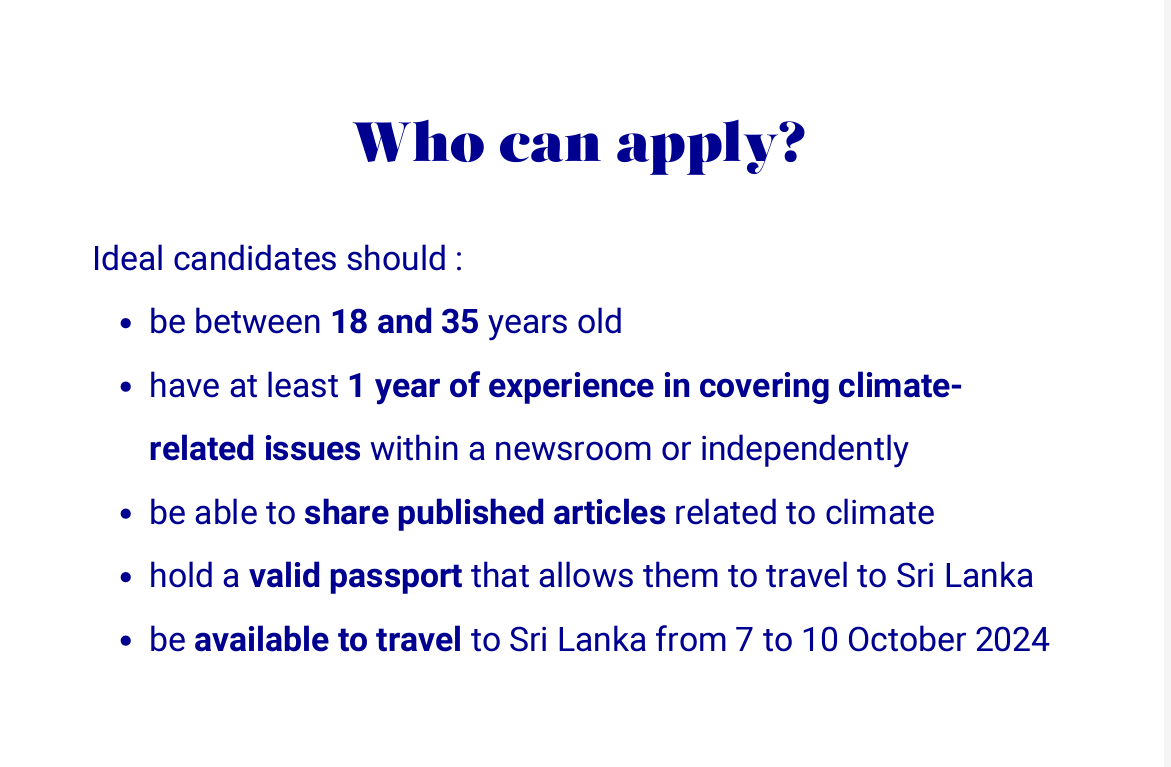
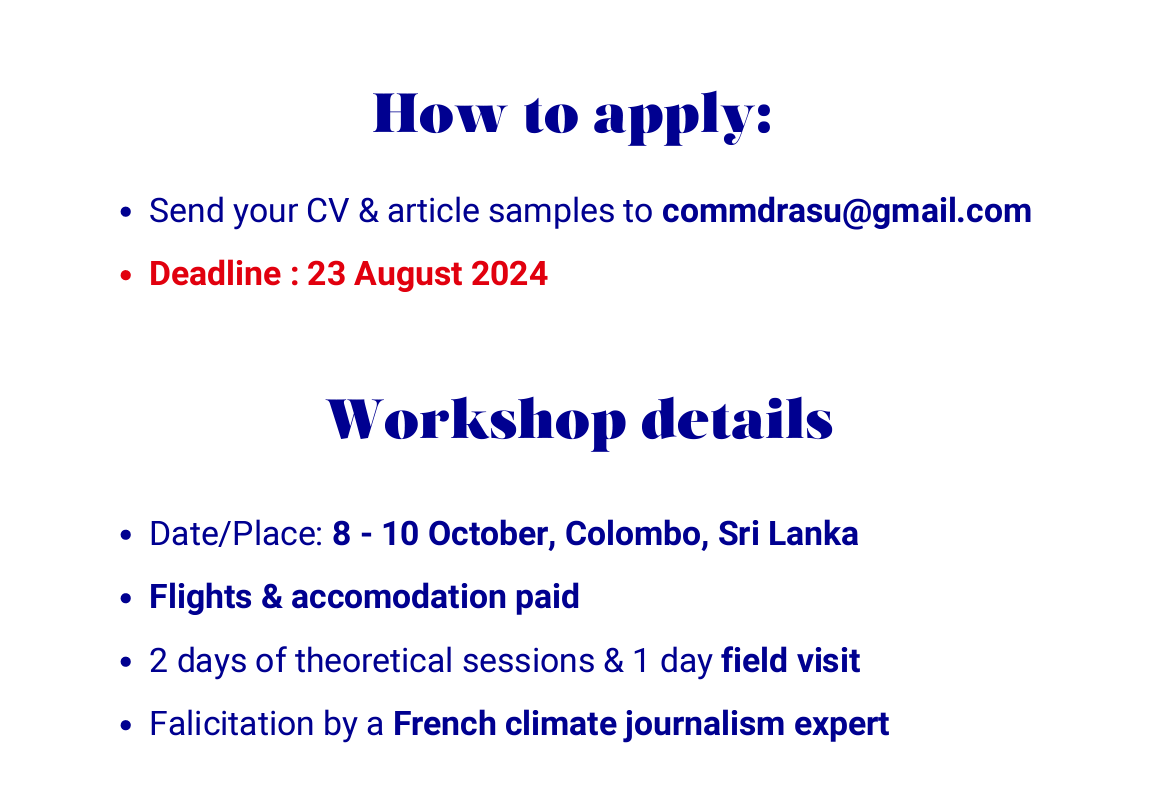
DataLEADS in partnership with the CENTRE FOR INVESTIGATIVE JOURNALISM (CIJ) Goldsmiths, University of London, invites applications for “The Open Climate Reporting Initiative: Climate Investigations Course”. The four-day investigative course will support journalists from newsrooms across the South Asian region to enhance their understanding, skills, and tools in reporting on climate change and its impact. Selected journalists will get six months to work on a cross-border investigative story related to climate change. The applications are open to journalists from Bangladesh, Bhutan, India, Maldives, Nepal, Pakistan, and Sri Lanka.

Interested journalists may apply here: https://docs.google.com/forms/d/e/1FAIpQLSd8jXEvFpux5g4POFLog8FR2IUJVKuwd1nFyeTUxLj4iGk5Ug/viewform

For more details, visit- https://dataleads.co.in/ocri/

South Asia Journalism Fellowship (SAJP)

Applications for #Chevening Fellowships – South Asia Journalism Programme (SAJP) and Chevening Research, Science, and Innovation Leadership Fellowship (CRISP) open tomorrow! ⏰

If you’re a mid-career professional looking to study a fully funded short course in the UK, this could be the opportunity you’ve been waiting for!

For more information 👉http://chevening.org/fellowships/find-a-programme/

Cross Border Stories : Climate Investigations Course for South Asian Journalists 

Call for applications

Climate change is exacerbating existing challenges such as hunger, poverty, and food insecurity in the region. South Asia is already home to a significant portion of the world’s undernourished population, and climate change is expected to reduce food availability and increase food insecurity. The economic costs of climate change in South Asia are significant. While there are initiatives and declarations in place, the implementation of climate change policies in South Asia remains deficient due to a lack of readiness and resources, insufficient institutional capacity, and inadequate budget allocation. Strengthening climate reporting in the journalism community is critical to raising awareness, establishing accountability and advocating for action.

DataLEADSin partnership with the Centre for Investigative Journalism, Goldsmith University, London, invites applications for “The Open Climate Reporting Initiative: Climate Investigations Course”. Thefour day investigative course  will support journalists from newsrooms across the South Asian region to enhance their understanding, skills, and tools in reporting on climate change and its impact.  Selected journalists will get six months to work on a cross border investigative story related to climate change. 

The applications are open to journalists from Bangladesh, India, Pakistan, Nepal, Bhutan, Maldives and  Sri Lanka. South Asian region continues to bear the brunt of climate change with rising sea levels, increasing temperatures, heatwaves, melting ice caps, forest fires, floods and landslides.  Climate Investigations Course will help South Asian journalists gain an understanding of how to report effectively on climate change and create compelling cross border stories through a hands-on practical story lab workshop approach.

If you are an investigative journalists who wants to tell a story on climate change in South Asia, this programme is for you! 

The programme will take place in Colombo in the month of November, 2024. 

Application closing date: 1st September 2024

Registration – https://docs.google.com/forms/d/e/1FAIpQLSd8jXEvFpux5g4POFLog8FR2IUJVKuwd1nFyeTUxLj4iGk5Ug/viewform

2024 ஜனாதிபதித் தேர்தல்; ‘றோ’ கருத்துக்கணிப்புக்களை மேற்கொண்டதா?

2019ஆம் ஆண்டும் ஜனாதிபதித் தேர்தல் தொடர்பில் கருத்துக்கணிப்புக்களை இந்தியாவின் புலனாய்வு அமைப்பான  ‘றோ’ மேற்கொண்டதாகவும் இதன்படி அப்போதைய ஜனாதிபதி வேட்பாளர் சஜித் பிரேமதாஸவே வெற்றிபெறுவார் எனவும் போலியான தகவல்கள் பரப்பப்பட்டிருந்தன.

2024 ஆண்டு ஒன்பதாவது ஜனாதிபதித் தேர்தலுக்கு நாடு தயாராகிக் கொண்டிருக்கும் நேரத்தில், அதனை இலக்கு வைத்து அதிகளவான போலியான அல்லது மக்களை தவறாக வழிநடத்தக்கூடிய வகையிலான திரிபுபடுத்தப்பட்ட செய்திகள் பகிரப்பட்டு வருவது அவதானிக்கப்பட்டுள்ளது.

குறிப்பாக உள்நாட்டுப் புலனாய்வு அமைப்பு அல்லது ‘றோ’ போன்ற வெளிநாட்டு புலனாய்வு அமைப்பு ஜனாதிபதித் தேர்தல் தொடர்பான கருத்துக்கணிப்புக்களை மேற்கொண்டதாகத் தெரிவித்து தேர்தல் காலங்களில் மக்களை தவறாக வழிநடத்தக்கூடிய தகவல்கள் பகிரப்பபடும் செயற்பாடு தொடர்ச்சியாக இடம்பெற்று வருகின்றமையும் அவதானிக்கப்பட்டுள்ளது.

“கோட்டாபய ராஜபக்ஷவைவிட இரண்டு இலட்சம் வாக்குகள் வித்தியாசத்தில் சஜித் பிரேமதாஸ வெற்றிபெறுவாரென  ‘றோ’ மேற்கொண்ட கருத்துக்கணிப்பில் தெரியவந்துள்ளது” என்று  குறிப்பிட்டு கடந்த 2019ஆம் ஆண்டு நடைபெற்ற ஜனாதிபதித் தேர்தலின்போதும்  செய்திகள் வெளியிடப்பட்டிருந்தன.

மேலும், ‘றோ’ அமைப்பு திரட்டிய தகவல்கள் எமக்கு கிடைத்துள்ளதாகக் கூறி ஆவணம் ஒன்றும் 2019ஆம் ஆண்டு ஜனாதிபதித் தேர்தலின்போது பகிரப்பட்டிருந்தது.

2019ஆம் ஆண்டு ‘றோ’வின் கருத்து கணிப்பின்படி, அப்போது ஜனாதிபதி வேட்பாளராக போட்டியிட்ட சஜித் பிரேமதாஸ வெற்றிபெறுவார் என்று தகவல்கள் வெளிப்படுத்தப்பட்டாலும் கோட்டாபய ராஜபக்ஷவே ஜனாதிபதித் தேர்தலில் வெற்றிபெற்றிருந்தார். 

இந்நிலையில் 2024ஆம் ஆண்டு செம்டெம்பர் 21ஆம் திகதி நடைபெறவுள்ள  ஜனாதிபதித் தேர்தல் தொடர்பில் ‘றோ’ மேற்கொண்ட  கருத்துக்கணிப்பில் ஐக்கிய மக்கள் சக்தியின் தலைவர் பாராளுமன்ற உறுப்பினர் சஜித் பிரேமதாஸ முன்னிலையில் இருப்பதாக அக்கட்சியின் குருநாகல் மாவட்ட பாராளுமன்ற உறுப்பினர் அசோக அபேசிங்க அண்மையில் தெரிவித்திருந்தார்.

அசோக அபேசிங்கவின் கருத்தை சுட்டிக்காட்டி தமிழ் சிங்கள ஊடகங்கள் செய்திகளை வெளியிட்டிருந்ததோடு, முகநூலிலும் (Facebook) இது தொடர்பான பதிவுகள் அதிகளவில் பகிரப்பட்டிருந்தன.

பாராளுமன்ற உறுப்பினர் அசோக அபேசிங்க தெரிவித்த கருத்துக்கள் வருமாறு,

“ஜனாதிபதித் தேர்தலில் நிச்சியமாக சஜித் பிரேமதாஸ போட்டியிடுவார். அனைத்து கருத்துக் கணிப்புகளிலும் அவரே முன்னிலையில் இருக்கிறார். நான் நினைக்கிறேன், இந்திய உளவு பிரிவான ‘றோ’ அமைப்பு செய்த கருத்துக்கணிப்பிலும் சஜித் பிரேமதாஸவே முன்னிலையில் இருக்கிறார் எனக் கூறப்பட்டுள்ளது. தற்போதைய ஜனாதிபதி மூன்றாவது இடத்திலேயே இருக்கிறார். அதனாலேயே தேர்தலை காலந்தாழ்த்த சதி செய்கிறார்….” எனக் கூறியிருந்தார்.

Keyword Search ஊடாக இது தொடர்பான தகவல்களை தேடியபோது, ஹிரு செய்திகள் வெளியிட்டிருந்த மேற்குறித்த செய்தியை SJB News  என்கிற முகநூல் (Facebook) பக்கத்திலும் பதிவேற்றப்பட்டிருந்தது.

 “ஜனாதிபதி தேர்தலில் சஜித் பிரேமதாசவே வெற்றிபெறுவாரென இந்திய உளவு பிரிவான ‘றோ’ அமைப்புக்கூட தெரிவித்துள்ளது என தகவல் கிடைத்துள்ளது.” எனக் குறிப்பிட்டு Malayaga Kuruvi என்கிற செய்தி இணையத்தளத்திலும் செய்தி வெளியிடப்பட்டிருந்தது.

”சஜித் வெற்றிபெறுவார் – ‘றோ’ தெரிவித்தது என்கிறார் அசோக அபேசிங்க!” என்று tamilnews.lk இணையத்தளமும் செய்தி வெளியிட்டிருந்தது.

அதுபோல, Upul Devapriya, A5 News Sri Lanka என்கிற முகநூல் (Facebook) பக்கங்களிலும் மேற்குறித்த செய்தி பகிரப்பட்டிருந்ததை நாம் அவதானித்தோம்.

எவ்வாறாயினும், ஐக்கிய மக்கள் சக்தியின் பாராளுமன்ற உறுப்பினர் அசோக அபேசிங்கவிடம் இது பற்றி நாம் வினவியபோது, ”ஹிருனிக்காவை சிறைச்சாலையில் பார்த்துவிட்டு வெளியில் வரும்போது ஊடகங்களுக்கு நான் தெரிவித்த கருத்துக்களே பரப்பப்பட்டு வருகிறது.

இந்தியாவின் புலனாய்வு அமைப்பு ஒன்று மேற்கொண்ட கருத்துக் கணிப்பிலேயே சஜித் பிரேமதாஸ வெற்றிபெறுவார் என்று தெரிவிக்கப்பட்டுள்ளது. றோ கருத்து கணிப்புகளை மேற்கொண்டமைக்கான எந்த ஆவணங்களும் என்னிடம் இல்லை. எனது நெருங்கிய நண்பர் கூறிய கருத்தையே நான் ஊடகங்களுக்குக் கூறியிருந்தேன்.” என்றார்.

இது தொடர்பில் “இந்திய உயர்ஸ்தானிகராலயத்தை நாம் தொடர்புகொண்டபோது, ”அவ்விடயம் தொடர்பில் எந்தவிதமான கருத்துக்களை தெரிவிக்க முடியாது. அது தொடர்பில் தாம் அறிந்திருக்கவில்லை.“ உயர்ஸ்தானிகராலயத்தின் பேச்சாளர் நவிய சிங்லா எமக்கு தெரிவித்தார்.

‘றோ’ என்று அறியப்பட்ட மற்றும் அழைக்கப்படுகின்ற இந்தியாவின் வெளிநாட்டுப் புலனாய்வு அமைப்பான ‘ஆராய்ச்சி மற்றும் பகுப்பாய்வு அமைப்பு (Research and Analysis Wing)’ அந்நாட்டு நலனைக் கருத்திற்கொண்டு வெளிநாடுகளில் இந்தியாவின் நலனுக்கு அல்லது பாதுகாப்புக்கு எதிராக நடக்கும் சதிச் செயல்களை கண்காணிப்பதற்கும் அது தொடர்பான நடவடிக்கைகளில் ஈடுபடுவதற்குமான புலனாய்வுப் பணிகளில் ஈடுபட்டுள்ள அமைப்பாக இருக்கிறது.

‘றோ’வின் கருத்துக்கணிப்புக்களோ அந்த அமைப்பு மேற்கொள்ளும் புலனாய்வு நடவடிக்கைகள் தொடர்பிலோ பொதுவெளியில் எந்தவொரு தகவல்களும் பகிரப்படுவதில்லை,  அந்த அமைப்பின் செயற்பாடுகள் மிகுந்த இரகசியத்தன்மை கொண்டதாகவே இருக்கும்

எனினும், 2019ஆம் ஆண்டும் அதாவது, கடந்த ஜனாதிபதித் தேர்தலின்போதும்  சஜித் பிரேமதாஸ வெற்றிபெறுவார் என ‘றோ’ கருத்துக்கணிப்பை மேற்கொண்டதாக எவ்வாறு போலியான தகவல்கள் பரப்பப்பட்டனவோ அதேபோல இம்முறையும் ஜனாதிபதித் தேர்தலின்போது போலியான தகவல்கள் பரப்பப்படுகின்றனவா? என்கிற சந்தேகம் எழுகிறது.

ஜனாதிபதித் தேர்தல் தொடர்பில் அரச புலனாய்வு பிரிவு (SIS) கருத்துக்கணிப்புகளை மேற்கொண்டிருந்ததாக போலியான தகவல் பகிரப்பட்டிருந்ததை சுயாதீன உண்மை சரிபார்ப்பு தளமொன்று உறுதி செய்திருந்தது.

அதுபோல ஜனாதிபதித் தேர்தல் தொடர்பில் தாம் எந்தவிதமான கருத்துக்கணிப்புகளையும் மேற்கொள்ளவில்லை என ஐரோப்பிய ஒன்றியமும் தனது ‘எக்ஸ்’ தளத்தில் பதிவிட்டிருந்ததையும் அவதானிக்க முடிந்தது.

அவ்விதமான நிலையில், ‘றோ’ ஜனாதிபதித் தேர்தல் குறித்து கருத்துக்கணிப்பு செய்மைக்கான எந்தவொரு மூல ஆதாரங்களும் இல்லை.

Bullet Points :

  • ”இது தொடர்பில் எந்தவிதமான கருத்துக்களை தெரிவிக்க முடியாது. இது தொடர்பில் தாம் அறிந்திருக்கவில்லை.“ என்று இந்திய உயர்ஸ்தானிகராலயத்தின் பேச்சாளர் நவிய சிங்லா தெரிவித்தார்.
  • “றோ’ கருத்து கணிப்புக்களை மேற்கொண்டமைக்கான எந்த ஆவணங்களும் என்னிடம் இல்லை. எனது நெருங்கிய நண்பர் கூறிய கருத்தையே நான் ஊடகங்களுக்குக் கூறியிருந்தேன்.”
  • 2019ஆம் ஆண்டு ஜனாதிபதித் தேர்தல் தொடர்பில் ‘றோ’ கருத்து கணிப்புக்களை மேற்கொண்டதாகவும் அப்போது ஜனாதிபதி வேட்பாளராக போட்டியிட்ட சஜித் பிரேமதாஸ வெற்றிபெறுவார் என்று தெரிவிக்கப்பட்டிருந்தாலும் கோட்டாபய ராஜபக்ஷவே ஜனாதிபதி தேர்தலில் வெற்றிபெற்றிருந்தார்.