Home Blog Page 18

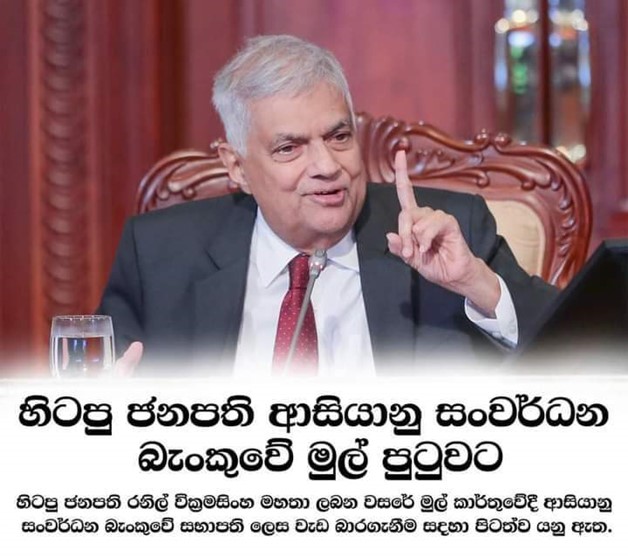
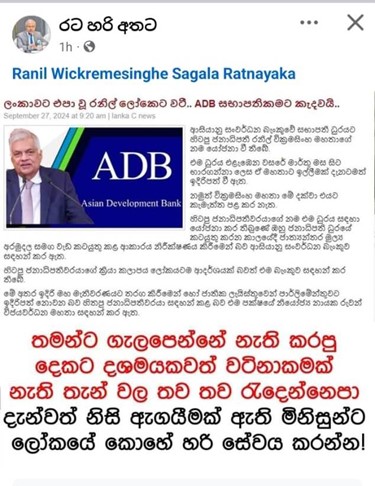
හිටපු ජනපති රනිල් ආසියානු සංවර්ධන බැංකුවේ සභාපති ධූරයට පත්වූවායැයි කියන සමාජ ජාලා ප්‍රචාරය සත්‍ය නොවේ.

කරුණු-පිරික්සුම් වාර්තාව: 2024 ඔක්තෝම්බර් 4 – වේලාව පස්වරු 5:00

ජනාධිපතිවරණයෙන් පරාජය වීමෙන් අනතුරුව හිටපු ජනාධිපති රනිල් වික්‍රමසිංහ මහතා ආසියානු සංවර්ධන බැංකුවේ සභාපති ලෙස පත්ව ඇති බවට සමාජ මාධ්‍ය ඔස්සේ පැතිරුනු පුවතේ සත්‍යතාවක් නොමැති බවට තහවුරු වී ඇත.

මූලිකවම මෙවැනි මතවාදයක් සමාජගත කෙරුණේ කුමන පාර්ශව හරහාද යන්න සම්බන්ධයෙන් කළ සොයා බැලීමේදී ජනාධිපතිවරණය අවසන් වීමත් සමගම හිටපු ජනාධිපතිවරයාගේ සමීපතමයින් සහ ඔහුගේ මැතිවරණ ව්‍යාපාරයට ආධාර අනුබල ලබාදුන් පාර්ශවයන්ගේ සමාජ මාධ්‍ය ගිණුම් හරහා මෙන්ම පුවත් වෙබ් අඩවි තුළින්ද මෙම මතය පැතිරුණු බව පෙනී යන ලදී.

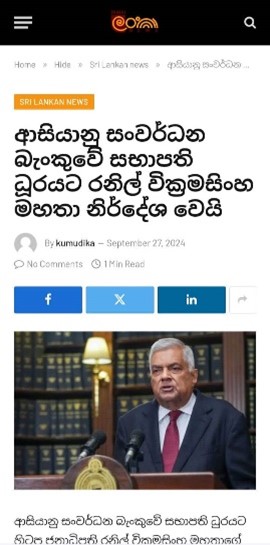
ඩුබායි ලංකා නිව්ස් (dubailankanews.com) වෙබ් අඩවියේ මේ සම්බන්ධයෙන් පලකර තිබුණේ මෙවන් සටහනකි.

“ආසියානු සංවර්ධන බැංකුවේ සභාපති ධූරයට රනිල් වික්‍රමසිංහ මහතා නිර්දේශ වෙයි”

“ආසියානු සංවර්ධන බැංකුවේ සභාපති ධුරයට හිටපු ජනාධිපති රනිල් වික්‍රමසිංහ මහතාගේ නම යෝජනා වී තිබේ. එම ධුරය එළැඹෙන වසරේ මාර්තු මස සිට භාරගන්නා ලෙස ඒ මහතාට ඉල්ලීමක් දැනටමත් ඉදිරිපත් වී ඇත. නමුත් වික්‍රමසිංහ මහතා මේ දක්වා එයට කැමැත්ත පළ කර නැත. හිටපු ජනාධිපතිවරයාගේ නම එම ධුරය සඳහා යෝජනා කර තිබුණේ ඔහු ජනාධිපති ධුරයේ කටයුතු කරන කාලයේදී ජාත්‍යන්තර මුල්‍ය අරමුදල සමග වැඩ කටයුතු කළ ආකාරය නිරීක්ෂණය කිරීමෙන් බව ආසියානු සංවර්ධන බැංකුව සඳහන් කර ඇත. හිටපු ජනාධිපතිවරයාගේ ක්‍රියා කලාපය ලෝකයටම ආදර්ශයක් බවත් එම බැංකුව සඳහන් කර තිබේ.”

(https://dubailankanews.com/archives/24435)

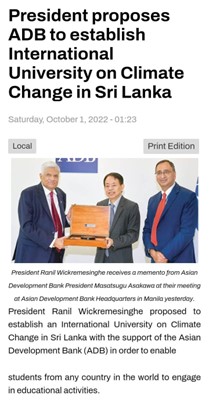
එම පුවතම, කලම්බු ටුඩේ වෙබ් අඩවියේ (colombotoday.com) “රනිල් ආසියානු සංවර්ධන බැංකුවට” යන ශීර්ෂපාඨයෙන් රනිල් වික්‍රමසිංහ සහ ආසියානු සංවර්ධන බැංකුවේ සභාපති Masatsugu Asakawa සමග සිටින ඡායාරූපයක් සහිතව පලකර තිබුනි. (එම ඡායාරූපය ((2022) වසරේ රනිල් වික්‍රමසිංහ ආසියානු සංවර්ධන බැංකු මූලස්ථානයේ කල සංචාරයකදී ඔහුට සමරු තිලිණයක් පිරිනමන අවස්ථාවේ ගත් ඡායාරූපයක් බව කරුණු පරීක්ෂාවේදී තහවුරු විය. ඒ සම්බන්ධයෙන් වූ පුවත් වාර්තාවක් ඩේලි නිව්ස් වෙබ් අඩවියේ පලකර තිබුණි.

https://archives1.dailynews.lk/2022/10/01/local/288298/president-proposes-adb-establish-international-university-climate-change-sri?page=2

ඉහත ඡායාරූපයම යොදාගෙන ද ස්‍රී ග්‍රැග් (TheSriGAGs) නම් ඉන්ස්ටර්ග්‍රැම් පුවත් සේවයේ සහ ෆේස් බුක් පිටුවලද මෙම පුවතම පලකර තිබුණි.

(https://facebook.com/share/p/7gKUjnh7zEpXaPBP/)

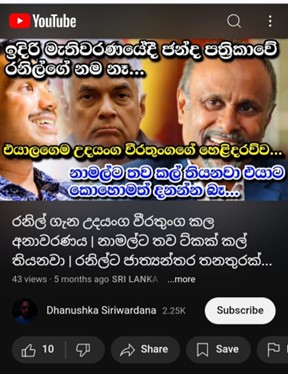
මේ සම්බන්ධයෙන් තවදුරටත් විමර්ශණය කිරීමේදී රනිල් වික්‍රමසිංහ සම්බන්ධයෙන් මෙයට පෙරත් මෙවැනි ආකාරයේ පුද්ගල ප්‍රතිරූපය ඉහළ නැංවීම අරමුණු කරගත් පුවතක් “රනිල්ට ජාත්‍යන්තර තනතුරක්” යන මාතෘකාවෙන් හිටපු රුසියානු තානාපති හා රාජපක්ෂ පවුලේ ඥාතියෙකු වන උදයංග වීරතුංග කල හෙලිදරව්වක් ලෙසට ධනුෂ්ක සිරිවර්ධන යූ ටියුබ් නාලිකාවේ (youtube.com/@Dhanushka_siriwardana) සදහන් කර තිබුණේ රනිල් වික්‍රමසිංහ මහතාට එක්සත් ජාතීන්ගේ සංවිධානයේ තනතුරක් ලැබෙන බවකි.

(https://youtu.be/8NX73LhRwEY?feature=shared)

මෙම පුවත ගැන විමර්ශනය කිරීමේදී මූලිකවම ආසියානු සංවර්ධන බැංකුව හා එහි ප්‍රධාන තනතුරට පත්වීමේ ක්‍රමවේදය සම්බන්ධයෙන් කරුණු සොයා බලන ලදී.

එහිදී හෙළිවූයේ, ආසියානු සංවර්ධන බැංකුව වර්ෂ 1966 දෙසැම්බර් 19 දින රටවල් 31 ක එකතුවෙන් පිලිපීනයේ මැනිලා නුවර කේන්ද්‍ර කරගෙන පිහිටුවන ලද අතර ශ්‍රී ලංකාවද එහි ආරම්භක සාමාජිකයෙක් බවයි. වර්තමානය වන විට සාමාජික රටවල් 68 ක් සහිත ආසියානු සංවර්ධන බැංකුවේ ව්‍යූහයද ලෝක බැංකුවට සමාන ලෙසට හැඩගැසී ඇති අතර සාමාජිකයින්ගේ ප්‍රාග්ධන දායකත්වයට සමානුපාතිකව ඡන්ද බලය ලබාදීම කරනු ලබයි. (https://www.adb.org/sites/default/files/institutional-document/959761/adb-annual-report-2023.pdf) ඒ අනුව 2023 ආසියානු සංවර්ධන බැංකුවේ වාර්ෂික වාර්තාවේ පරිදි ශ්‍රී ලංකාවට ඇත්තේ 0.757 ඡන්ද බලයකි. 

සභාපතිවරයාට වසර පහක ධුර කාලයක් පවතින අතර, ඔහුට නැවත තේරී පත් විය හැකිය. සාම්ප්‍රදායිකව සහ ජපානය 12.751% ලෙසට බැංකුවේ විශාලතම කොටස් හිමියෙකු වන නිසා සභාපතිවරයා සැමවිටම ජපන් ජාතිකයෙකු වීම ආරම්භයේ සිට මේ දක්වාම පැවත එන්නකි.

ආරම්භයේ සිට මේ දක්වා පත්වූ සභාපතිවරුන් වන්නේ,

නම  ධූර කාලය                                                                 
Takeshi Watanabe(24 November 1966 – 24 November 1972)      
Shiro Inoue                 (25 November 1972 – 23 November 1976)               
Taroichi Yoshida(24 November 1976 – 23 November 1981)        
Masao Fujioka(24 November 1981 – 23 November 1989)           
Kimimasa Tarumizu(24 November 1989 – 23 November 1993)     
Mitsuo Sato(24 November 1993 – 15 January 1999)   
Tadao Chino(16 January 1999 – 31 January 2005)                    
Haruhiko Kuroda(1 February 2005 – 18 March 2013)                 
Takehiko Nakao         (28 April 2013 – 16 January 2020)       
Masatsugu Asakawa17 January 2020 –present)    

(sources : www.adb.org)

විශේෂයෙන්ම ආසියානු සංවර්ධන බැංකුවේ සභාපති තෝරා ගැනීම සදහා ඡන්දය භාවිතා කිරීමට අවකාශ ඇති රටවල් ගැන සැලකීමේදී එහි ප්‍රාග්ධන යොදා ඇති ආකාරය අනුව රටවල් 20 ක් සදහා ඡන්ද බලය හිමි ව ඇත.

RankCountrySubscribed capital (% of total)         Voting power (% of total)
1Japan15.57112.751
1United States15.57112.751
3China6.429                      5.437
4India6.3175.347
5Australia5.7734.913
6Indonesia5.4344.641
7Canada5.2194.469
8South Korea5.0264.315
9Germany4.3163.747
10Malaysia2.7172.468
11Philippines2.3772.196
12France2.3222.152
13Pakistan2.1742.033
14United Kingdom2.0381.924
15Italy1.8031.737
16New Zealand1.5321.520
17Thailand1.3581.381
18Taiwan1.0871.164
19Netherlands1.0231.113
20Bangladesh1.0191.109
All Remaining Members 10.89422.832

එයට අමතරව ආසියානු සංවර්ධන බැංකුව පිහිටුවීමේ ගිවිසුම, ADB ප්‍රඥප්තිය ලෙස හැඳින්වෙන අතර, ආයතනයේ සියලුම බලතල පාලක මණ්ඩලයක් වෙත පැවරෙයි. එකී බලතලවලින් කොටසක් අධ්‍යක්ෂ මණ්ඩලය වෙත පවරනු ලැබේ. මෙහි, අධ්‍යක්ෂ මණ්ඩලයේ සභාපතිවරයා වන සහ ADB කළමනාකරණය කරන බැංකුවේ සභාපතිවරයා ද පාලක මණ්ඩලය විසින් තෝරා ගනු ලැබේ. එහි පත්වීම් සිදුවන ආකාරය සම්බන්ධයෙන් කළ විමසුමේදී හෙලිවූයේ, ADB අධ්‍යක්ෂ මණ්ඩලයේ අධ්‍යක්ෂවරුන් 12 දෙනා තෝරා පත් කර ගනු ලබන්නේ පාලක මණ්ඩලය විසින් වන අතර එම 12 දෙනාගෙන් අට දෙනෙක් ආසියා සහ පැසිෆික් කලාපයෙන් ද ඉතිරි හතර දෙනා කලාපයෙන් පිටතින් ද තේරී පත් වේ. අධ්‍යක්ෂ මණ්ඩලය පිලිපීනයේ මැනිලා හි ADB මූලස්ථානයේ පූර්ණ කාලීනව සිය රාජකාරි ඉටු කරන අතර, ADB හි සභාපතිවරයා අධ්‍යක්ෂ මණ්ඩලයේ මුලසුන හොබවයි.

මෙයට අමතරව සාමාජික රටවල් නියෝජනය කිරීම සදහා අධිපති සහ විකල්ප අධිපති ලෙස දෙදෙනකු සෑම රටකින්ම පත් කර ඇති අතර ශ්‍රී ලංකාවේ ජනාධිපතිවරණය අවසන්වීමෙන් පසුව මේ වනවිටදී එහි මෙරට නියෝජනය ලෙස අධිපති වශයෙන් ජනාධිපති අනුර කුමාර දිසානායක සහ විකල්ප අධිපති ලෙස මුදල් අමාත්‍යාංශ ලේකම් මහින්ද සිරිවර්ධන ද නම් කර ඇත. (https://www.adb.org/who-we-are/organization/board-governors)

එමෙන්ම අධ්‍යක්ෂවරු 12 දෙනා අතරටත් ශ්‍රී ලංකාවේ කිසිවෙකුත් පත්වි නොමැති අතර අප රට නියෝජනය කරමින් අධ්‍යක්ෂ මණ්ඩලයේ සිටිනුයේ Sangmin Ryu බවත් ADB නිළ වෙබ් අඩවියේ සදහන් වෙයි. (https://www.adb.org/who-we-are/organization/board-directors)

මෙවන් තත්වයක් මත ශ්‍රී ලංකාවේ නියෝජනයකට ආසියානු සංවර්ධන බැංකුවේ සභාපති තනතුරක් තබා අවම වශයෙන් අධ්‍යක්ෂ මණ්ඩලයේ තනතුරක් හෝ ලබා ගැනීමට ඇති ඉඩකඩ ඉතාම සීමීත මෙන්ම ඉතා අපහසු බවත් පෙනී යයි.

මේ සම්බන්ධයෙන් අප විසින් හිටපු ජනාධිපති මාධ්‍ය අධ්‍යක්ෂ ජනරාල් ධනුෂ්ක රාමනායක ගෙන් කල විමසීමකදී සදහන් කළේ තමන් දැනුවත්ව එවන් තනතුරකට රනිල් වික්‍රමසිංහ මහතා පත්ව නැති බවයි.

එසේ නම් රනිල් වික්‍රමසිංහ ජනාධිපතිවරයාගේ කාර්යමණ්ඩල ප්‍රධානී මෙන්ම ජනාධිපති ජේයෂ්ඨ උපදේශක සාගල රත්නායක මහතා පවා තම සමාජ මාධ්‍යය ගිණුම හරහා මෙවැනි මතයක් ඉදිරිපත් කළේ ඇයි ?

මෙය හුදෙක්ම පැවති මැතිවරණයේදී හිටපු ජනපති ලද පරාජයේ උණුසුම අඩුකරමින් ජනතාවගේ දේශපාලන අවධානය සහ මතය වෙනත් මගකට යොමුකර ඒ හරහා යම් ජනප්‍රිය බවක් ලබා ගැනීම උදෙසා සිදුකරන ලද්දක් බව පෙනී යයි.

මේ අනුව නිගමනය කළ හැක්කේ ඉහත පුවත සම්පූර්ණයෙන්ම සාවද්‍ය ප්‍රකාශයක් බවත් හිටපු ජනාධිපතිවරයාට ආසියානු සංවර්ධන බැංකුවේ එවන් කිසිදු තනතුරක් ලැබී නොමැති බවත්ය.

Call for Applications: Internews Regional Hackathon “Media Xcelerate”

Indo-Pacific Media Advancement Program (IPMAP)

September 30, 2024

Introduction

Internews is implementing the Indo-Pacific Media Advancement Program (IPMAP), designed to contribute to the overall goal of strengthening the capacity of media outlets and journalists in the Indo-Pacific region – to develop their business strategies, enhance their ability to conduct independent journalism and contribute towards strengthening information integrity in the region. 

Internews intends to identify 50 – 65 journalists who investigate and report on public interest issues to participate in two hackathon events to be held in January 2025 – one in South Asia (for journalists in South Asia) and the second in Southeast Asia (for journalists in Southeast Asia and the Pacific Islands) in December 2024/January 2025. The four-day in-person sessions are organized by Internews as part of IPMAP and will be conducted by Internews’ partners Centre for Information Resilience (CIR) and Doublethink Lab (DTL). CIR and DTL will provide mentoring support to participants following the hackathons. Travel and accommodation costs for participation in the Hackathons will be borne by Internews.

Applications are open to journalists from the following countries: South Asia (Bangladesh, India, Nepal, Maldives, Sri Lanka, Pakistan, Bhutan); Southeast Asia (Cambodia, Indonesia, Laos, Philippines, Malaysia, Thailand, Timor Leste) and the Pacific Islands (Fiji, Kiribati, Papua New Guinea, Samoa, Solomon Islands, Tonga, Vanuatu, Marshall Islands, Federated States of Micronesia, Palau and Tuvalu).

Objective

The objective of the regional hackathons – Media Xcelerate – is to bring together journalists from South Asia, Southeast Asia and the Pacific Islands to build critical skills and contribute towards countering influence operations and disinformation and strengthening information integrity in the region. The two hackathon events in South Asia and Southeast Asia also aim to foster collaboration and network-building, by connecting organizations and journalists whose work is focused on increasing accountability in the region. The hackathons will increase journalists’ knowledge and technical skills in the following:

  • Gather, verify and analyze videos and images
  • Geolocation and Chronolocation techniques
  • Conduct mapping of online information and influence operations
  • Tools to identify and counter disinformation

Participating journalists will be eligible to apply for story grants following the hackathon, to allow them to research and produce investigations relevant to their countries or regions, including on cross-border issues. Recipients of story grants will be expected to produce and publish their reports within three months of the completion of the hackathon.

Selection of Applicants

Media Xcelerate is designed for journalists with experience in investigating and reporting on public interest issues. Journalists working in print, electronic, digital are encouraged to apply. Basic experience in open-source investigation techniques including social media analysis, fact-checking is desirable. The following criteria will be used by Internews to select participants:

  • Experience in investigating and reporting on public interest issues
  • Relevance of the training for the applicant’s future work as a journalist  
  • Basic/Previous experience in open-source investigation techniques
  • Awareness of foreign influence operations and interest in international geopolitical news
  • Good level of digital literacy, including digital security
  • Fluency in English
  • Availability for the entire duration of the activity including participation at the in-person session, post hackathon mentoring (approx. 8 weeks) and the process of producing and disseminating an investigation report.
  • All applicants should have access to a distribution platform for work produced as part of this activity

Interested journalists are welcome to submit their applications here, by 25th October 2024. Participants will be selected on a rolling basis.

 ‘පඩි කපන කොළ’ නිසා ඡන්ද අයිතිය අහිමි වන ලක්ෂයකට ආසන්න ඇඟලුම් සේවිකාවෝ

රදිකා ගුණරත්න   

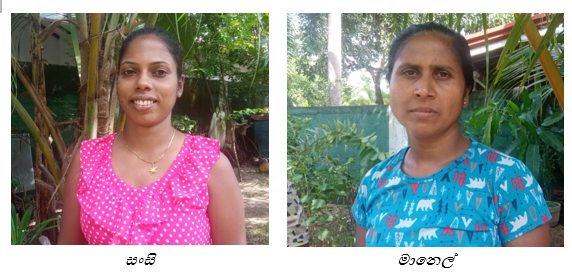
‘‘අවුරුදු 15 කට විතර කලින්, මම ගමේ ස්ථිර පදිංචිය නෑ කියල ග්‍රාම සේවක මහත්තයා ඡන්ද හිමි නාම ලේඛනයෙන් නම අයින් කරල තිබුණා. කටුනායක ආපු අලුත දීමනා කැපෙයි කියන බයට ගමේ ගියෙ නෑ. ඡන්දය දාන්නෙ කොහොමද කියලවත් මම දන්නෙ නෑ, දැන් මට ස්ථිර පදිංචියකුත් නෑ, ගමේ ඡන්දෙත් නෑ‘‘ යැයි සංසි පවසයි.  

39 හැවිරිදි සංසි වයස 19 දී ගාල්ලේ දුෂ්කර ගම්මානයක සිට කටුනායකට පැමිණ මේ වන විට ලංකාවේ ප්‍රමුඛතම ඇඟලුම් කම්හලක මැෂින් ඔපරේටර්වරියක් ලෙස සේවය කරයි. ඇය ඇඟලුම් ක්ෂේත්‍රයේ වසර 20 ක අත්දැකීම් සහිත ස්ථිර සේවිකාවකි.

‘‘පුරවැසියො විදිහට අපි ඡන්දෙ දාන්න ඕනෙ. අපට ගමේ ඡන්දෙ තිබුණත් නිවාඩු දාල ගමට යන එක තමයි ප්‍රශ්නෙ..‘‘ යැයි වයස 48 ක් වන, වසර 20 ක් කටුනායක ආයෝජන කලාපයේ වැඩකරන හපුතලේ මානෙල් පැවසුවා ය. මැෂින් ඔපරේටර්වරියක් ලෙස ඇගේ ස්ථිර සේවා කාලය වසර 17 කි.

ඡායාරූප අයිතිය – රදිකා ගුණරත්න

වාර්ෂිකව දළ වශයෙන් ඇමරිකානු ඩොලර් බිලියන 5 ඉක්මවා විදේශ විනිමය ගෙන දෙන, ශ්‍රී ලංකාවේ ආර්ථිකයේ කොඳු නාරටිය ලෙස සැලකෙන්නේ ඇඟලුම් ක්ෂේත්‍රයයි. ඒ අතරින් ද ඇඟලුම් කම්හල්වල ස්ථානගත වීම් සහ වැඩිම සේවක පිරිසක් ස්ථානගත වී සිටිනුයේ කටුනායක නිදහස් වෙළඳ කලාපය තුළ ය. එහි සේවය කරන ලක්ෂ එකහමාරකට අධික සේවිකාවන්ගෙන් අති බහුතරය ස්ථිර පදනමින් සේවය කරන අය වන අතර, ඔවුන්ගෙන් 70%කට පමණ සේවා ගිවිසුම් ද තිබෙන බව ඇඟලුම් ක්ෂේත්‍රයේ නියුතු කම්කරුවන්ගේ අයිතිවාසිකම් සම්බන්ධයෙන් කටයුතු කරන සහයෝගිතා මධ්‍යස්ථානයේ (Solidarity Centre) 2021 වසරේ පර්යේෂණ වාර්තාවක් සඳහන් කරයි. ඒ අනුව කටුනායක ඇඟලුම් කම්හල්වල ස්ථිර සේවයේ නියුතු, සේවා ගිවිසුම් හිමි සංඛ්‍යාව 105,000 ක් පමණ වන අතර, එයින් අති බහුතරය කාන්තාවන් ය.  වෘත්තීය සමිති ද සඳහන් කරන්නේ කටුනායක කර්මාන්ත කලාපයේ ස්ථිර සේවිකාවන් 80,000-100,000 අතර ප්‍රමාණයක් සිටින බව ය.

කටුනායක නිදහස් වෙළඳ කලාපයේ ස්ථිර සේවිකාවන්ගේ ඡන්දය ප්‍රකාශ කිරීමේ හැකියාව පිළිබඳ සොයා බැලීමේ අරමුණ වෙනුවෙන් මෙම ලිපිය සඳහා කටුනායක නිදහස් වෙළඳ කලාපයෙන් ඇඟලුම් කම්හල් 25 ක් නියෝජනය වන පරිදි අහඹු ලෙස තෝරාගත් ස්ථිර සේවිකාවන් 60 දෙනෙකු ඇසුරෙන් පර්යේෂණය සිදුකළ අතර,  එහිදී හෙළි වූයේ එම 60 දෙනා අතරින් ඡන්දය ප්‍රකාශ කර තිබෙන්නේ 14 දෙනෙක් පමණක් බව ය. ඉතිරි 46 දෙනා  හෙවත් නියැදියෙන් 76.3%ක් දෙනා ඡන්දය ප්‍රකාශ කිරීමෙන් වැළකී තිබිණි.

ඇඳිරි නීතිය මැදින්  ඡන්දය දමා එන අතළොස්ස  

සාමාන්‍යයෙන් මැතිවරණ දිනය ලෙස යෙදෙන්නේ සති අන්තයේ සෙනසුරාදා දිනයකි. කෙසේ නමුත් ලංකාවේ අවසන් වරට මහ මැතිවරණය පැවති 2020 අගෝස්තු 05 වැනිදා බදාදා දිනයක් වූ අතර,  ඇඟලුම් සේවිකාවන්ට වරුවක් වැඩ කර ගමට යාම සඳහා අඟහරුවාදා දිනයේ නිවාඩු ලබා දී තිබිණි.

නමුත් කාන්තාවන් වශයෙන් රාත්‍රී ගමනාගමනයේදී මුහුණ දෙන අනාරක්ෂිත බව හා අපහසුතා නිසා ඔවුන්ගෙන් අති බහුතරය ඡන්දය ප්‍රකාශ කිරීමට ගමේ යාම සඳහා තෝරාගෙන තිබුණේ බදාදා උදෑසනයි.

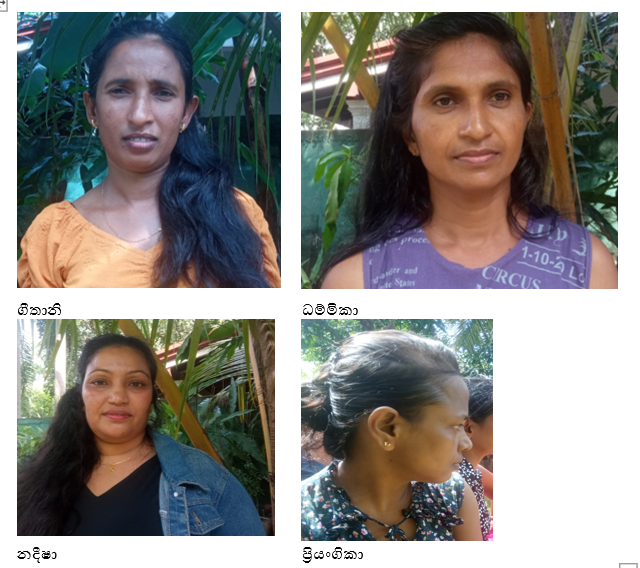
‘‘බදාදා උදේ 6 වෙද්දි කටුනායකින් පිටත් වුණා. ගෙදර යද්දි දවල් 12.30 යි. බදාදා ම ආපහු ආවා. ‘‘ගලේවෙල සිට කටුනායක ආ 41 හැවිරිදි ගීතානි කීවාය. 34 හැවිරිදි ධම්මිකා ද ඡන්දය ප්‍රකාශ කිරීම සඳහා සිය ගම්පළාත වන කුලියාපිටියට ගියේ බදාදා උදේ ය. ඔවුන් දෙදෙනා ෆැක්ටරි දෙකක ය.

‘අපිට ඕනෙම් වැඩ කරල යන්නත් පුළුවන් නැතිනම් පහුවදා උදේ යන්නත් පුළුවන්. ‘‘  

ඡන්දයට පසු දිනය වූ බැවින් එම බ්‍රහස්පතින්දා දිනය ඇඳිරි නීතිය දිනයක් විය.

‘‘ඇඳිරි නීතිය දැම්මොත් එදාම එන්න පුළුවන්. නැතිනම් පාස් පෙන්නලා එනවා.‘‘ යැයි යතුරුපැදියෙන් ගමේ යන 38 හැවිරිදි කුලියාපිටියේ නදීෂා කීවා ය. නමුත් අති බහුතරය භාවිතා කරන්නේ පොදු ප්‍රවාහන සේවයයි. ‘‘ඡන්දෙ දාල බස් එකට නගිනවා උදෙන්ම. ගෙවල්වල අය බයයි. ඇඳිරි නීතිය මැද බස් එක ඉතින් නතර කරන්නෙ නැතිව ආවා. බස් නැති වුණොත් එන්න වෙන්නෙ නෑ කොහොමත්‘‘ යැයි අම්පාර, මහඔය සිට පැමිණ, වසර 8 ක් ස්ථිර සේවිකාවක ලෙස කටයුතු කරන ප්‍රියංගිකා පැවසුවා ය. ‘‘එන්න බැරි වුණොත් පඩියෙන් කපනවා‘‘.

රුපියල් 7000 සිට 12,000 දක්වා වැටුප් කපා හැරීමක්!

සාමාන්‍යයෙන් ඇඟලුම් සේවිකාවන් නිතිපතා සේවයට වාර්තා කළ විට රුපියල් 7000 ක හෝ රුපියල් 8000 ක  පැමිණීමේ දීමනාවක් ලැබේ. කෙසේ නමුත් ප්‍රියංගිකා හට රුපියල් 7000 ට අමතරව, සේවක සුබසාධන ප්‍රතිලාභයක් වශයෙන් බෝඩිං ගාස්තු ලෙස රුපියල් 5000 ක මුදලක් ද එම කම්හල මගින් මාසිකව පඩිපතට එකතු කිරීම සිදු කරයි. ඡන්දය දැමීමට යාම නිසා එම රු. 5000 ක බෝඩිං කුලිය ද එවර පඩිපතෙන් කපා දමා තිබිණි.  ඒ අනුව 2020 අගෝස්තු මාසයේ පඩිය වශයෙන් ඇගේ අතට ලැබුණේ මූලික වැටුප වන රුපියල් 32,000 පමණි. ඒ ද ඇය වසර 8 ක් පමණ කාලයක් එම කම්හලේ සේවය කර තිබූ නිසා ය. සාමාන්‍යයෙන් ඇඟලුම් සේවිකාවන්ගේ මූලික වැටුප රු. 22,500 ක් වන අතර, සේවා කාලය අනුව වාර්ෂික වැටුප් වැඩිකිරීම් සිදුකරන ආකාරය ද කම්හලෙන් කම්හලට විෂමාකාර ය.  

‘‘මම ඡන්දෙ දාන්න ගියෙ මොකටද කියල හිතුණා.‘‘ යැයි ද ප්‍රියංගිකා පැවසුවා ය.

ඡායාරූප අයිතිය – රදිකා ගුණරත්න

කොලපාට, රෝස පාට සහ කහපාට කොල

ඡන්දය ප්‍රකාශ කිරීම සඳහා ගමේ යන්නේ නම්, කලින් නිවාඩු දමා යාමේ හැකියාව ද සේවිකාවන් කම්හල් විසින් සපයා තිබේ. එහිදී මානව සම්පත් අංශයෙන් සාමාන්‍ය නිවාඩු ඉල්ලා සිටින ක්‍රමවේදය ම  අනුගමනය කෙරේ. එය අදාළ වන්නේ ඡන්දය ප්‍රකාශ කිරීම සඳහා ලබාදෙන, කිලෝමීටර 150 දක්වා වූ එක්දින විශේෂ නිවාඩුව සහ කිලෝමීටර 150ට වැඩි අය සඳහා ලබාදෙන දින 2 ක විශේෂ නිවාඩුවට අමතරව නිවාඩු ලබාගැනීමට බලාපොරොත්තු වන අය සඳහා ය.

‘‘අපිට ගෙදර යද්දි කොළ දාල යන්න පුළුවන්. කලින්ම නිවාඩු දාල යනව නම් කොල පාට කොළේ පුරවනවා. එදා උදේ ඇවිත් නිවාඩු දාල වරුවෙන් යනව නම් කහපාට කොළේ පුරවනවා. එන දවස හරියට කියන්න බැරි නම් රෝස පාට කොළේ පුරවන්න ඕනෙ. රෝස පාට කොළේ පුරවන අයගෙ පැමිණීමේ දීමනාව සම්පූර්ණයෙන් ම කපනවා‘‘ යැයි නිකවැරටියේ සිට කටුනායකට පැමිණි, තත්ව පාලිකාවක ලෙස සේවය කරන 37 හැවිරිදි දිල්රුක්ෂි පැවසුවා ය. ‘‘රෝස පාට කොළේට අපි කියන්නෙ ‘පඩි කපන කොළේ‘ කියලා..‘‘

‘‘අපේ ගොඩක් අය යන්නෙ පාරෙ බස් එකේ. බස් එකෙන් බැහැලත් ගොඩක් පිටිසර පැතිවලට යන්න ඕනෙ. එ් නිසා විශේෂ නිවාඩුව ෆැක්ටරි එකෙන් දුන්නත්, අමතර නිවාඩුත් ගන්න වෙන නිසා ගොඩක් අය ඡන්දෙ දාන්න යන්නෙ නෑ.‘‘ යැයි ඇය තවදුරටත් සඳහන් කළාය.

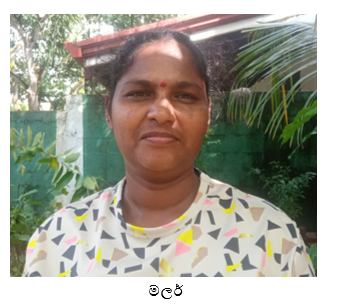
මඩකලපුවේ සිට පැමිණ, වසර 10 ක් මුළුල්ලේ ස්ථිර සේවිකාවක් ලෙස කටයුතු කරන 32 හැවිරිදි මලර්, කටුනායකට පැමිණි පසු ඡන්දය ප්‍රකාශ කර තිබෙන්නේ 2020 වසරේ පමණි. ‘‘එදා බදාදා දවසක් නිසා අඟහරුවාදා දවල් ගෙදර ගියා. ඡන්දෙ දාල ආපස්සට බස් එකේ නැගල ආවා. හරිම මහන්සියි. පහුවදා ආපහු වැඩට යන්නත් ඕනෙ, නැත්නම් පඩිය කැපෙනවා‘‘. ඒ ඇගේ අත්දැකීමයි.

ඡායාරූප අයිතිය – රදිකා ගුණරත්න

උපයාගත් නිවාඩුව අහිමි වන හැටි

‘‘ඡන්දෙට පහුවදා වැඩට ගියෙ නැත්නම් ඉතිරි කර ගත්ත නිවාඩුවලින් අඩු කරනවා, පැමිණීමේ දීමනාවත් කපනවා‘‘ යැයි මලර් පැවසුවාය. වෙනත් වචනවලින් මෙය සාරාංශ කරන්නේ නම් මෙහිදී සිදු වන්නේ උපයාගත් නිවාඩුව අහිමි වීමකි.

කටුනායක විවිධ ඇඟලුම් කම්හල්වල මෙම පැමිණීමේ දීමනාව සහ උපයාගත් නිවාඩුව අහිමි වන්නේ ද සමාකාර ලෙස නොවේ. මාසයට නිවාඩු එකහමාරක් ගත්තොත් පැමිණීමේ දීමනාව එක් කම්හලක කපා දමන අතර, තවත් කම්හලක දින එකහමාරක් ගත්තොත් පැමිණීමේ දීමනාව භාගයකින් කපා හැරීමත්, දින 2 ක් හෝ ඊට වැඩි වුවහොත් සම්පූර්ණ දීමනාවම කපා හැරීමත් සිදු කෙරේ.

‘‘උපයාගත් නිවාඩු නැති වුණාම දවසක වැටුප 1500 ක් වගේ කපනවා. පැමිණීමේ දීමනාවත් කපනවා. මාසෙට නිවාඩු එකහමාරක් ගත්තොත් පැමිණීමේ දීමනාවෙන් බාගයක් දෙනවා.‘‘ යැයි එක් ඇඟලුම් සේවිකාවක් පැවසූ අතර, වෙනස් ඇඟලුම් කම්හල් දෙකක සේවිකාවන් දෙදෙනෙක් එය විස්තර කළේ පැමිණීමේ දීමනාව කපා හැරීම, එක් දිනක් නිවාඩු ගත්ත ත් සිදුවන බවයි. මේ අනුව විවිධ ඇඟලුම් කම්හල්වල ක්‍රියාත්මක වන්නේ විවිධාකාර නිවාඩු ප්‍රතිපත්ති ය.

කම්කරු නිවාඩු පිළිබඳ පොදු ප්‍රතිපත්තිය අදාළ නැති වන හැටි   

එකම කම්කරු නීතියක් යටතේ පාලනය වුවත්ඇඟලුම් ක්ෂේත්‍රයේ සේවිකාවන් ඡන්දය ප්‍රකාශ කිරීමට යාමේදී සෙසු කම්කරුවන්ට වඩා සුවිශේෂී ගැළුවකට හා අවදානමකට මුහුණ දෙන බව ඇඟලුම් ක්ෂේත්‍රයේ සේවිකාවන්ගේ කම්කරු අයිතීන් පිළිබඳ සක්‍රිය මැදිහත්වීමක් කරන නීතීඥ ස්වස්තිකා අරුලිංගම් පවසයි. ඇය වෘත්තීය සමිති නායිකාවක ද වේ. ‘‘ඇඟලුම් ක්ෂේත්‍රයේ අප දකින විශේෂිතම හිමිකම් උල්ලංඝනයක් වන්නේ ඡන්ද නිවාඩුව ට අමතරව වෙනත් තමන්ට හිමි නිවාඩු ගත්තත්, පැමිණී‌මේ දීමනාව කපා හැරීමයි’’ යැයි ඇය පැවසුවාය. ‘’ඇඟලුම් සේවිකාවන් ගේ මූලික වැටුප අඩු නිසා ලබාදෙන මාසික දීමනා ඔවුන්ට ඉතාම වැදගත් සාධකයක් වෙනවා. ඡන්දය ප්‍රකාශ කිරීමට යාම නිසා අමතර නිවාඩු ගැනීමට සිදුවීම සේවිකාවන් මුහුණ දෙන යථාර්ථයක්. යැයි ඇය පැහැදිලි කළාය.  

ඇඟලුම් කම්හල්වල මෙම ක්‍රමවේද හේතුවෙන් සිදුවන්නේ ස්ථිර සේවිකාවන් ව ඡන්දය ප්‍රකාශ කිරීමට වක්‍රාකාරයෙන් අධෛර්යමත් කිරීම බව වෙළඳ කලාපය තුළ සේවිකාවන්ගේ අයිතිවාසිකම් වෙනුවෙන් කටයුතු කරන ඩාබිඳු සාමූහිකයේ සම්බන්ධීකාරකවරිය මෙන්ම වෘත්තීය සමිති නායිකාවක ද වන චමිලා තුෂාරි පැවසුවා ය.  

ඡායාරූප අයිතිය – රදිකා ගුණරත්න

‘‘ඒ අවදානම අරන් ඡන්දෙ දාන්න ගමට යන්න සේවිකාවො කැමති නෑ. ගෙදර ගියත්, ගිහින් ගෙදර අයගෙ මූණ බලල ඊළඟ බස් එකේ ආපහු එන්න ඕනෙ. මාස්පතා ගමට යන්න තරම් වත්කමක් ඔවුන් ට නෑ. සමහරු සල්ලි ටිකක් එකතු කරන් ගමේ යන්නෙ අවුරුද්දටම එක පාරයි. උපයාගත් නිවාඩුව පාවිච්චි කරන්නෙ ඒකට. ඡන්දෙ නිසා පඩියෙන් රුපියල් හත් අට දාහක් අඩු කරගන්න කැමති කවුද? .‘‘ යැයි ඇය විමසයි. 

ඇය තවදුරටත් පෙන්වා දෙන්නේ බොහෝ ඇඟලුම් සේවිකාවන් සිය ගෙදර දොර ගැටළු විසඳීම සඳහා මූලික වැටුපෙන් කපා හැරෙන සේ බැංකු ණය ආදිය ලබාගෙන ඇති බවයි. ‘ඡන්දෙ දාන්න ගෙදර ගියා වගේ නෙවෙයි, එක දවසක් හරි වැඩිපුර නිවාඩු ගත්තොත් පැමිණීමේ බෝනස් නැති වුණාම මාසෙ ජීවත් වෙන්නෙ කොහොමද?’’

නිවාඩු ප්‍රතිපත්තිය සම්බන්ධයෙන් කම්හල් තුළ තත්වය

‍‘‘අපි අනිවාර්යයෙන් සේවිකාවන්ට ඡන්දෙ දාන්න ගමට යන්න කියලා විශේෂ නිවාඩුව ලබාදෙනවා. ආයතන පැත්තෙන් අපි කිසිම බාධාවක් කරන්නෙ නෑ‘‘ යැයි සිය නම සඳහන් නොකරන ලෙස ඉල්ලා සිටි කටුනායක ආයෝජන හා නිදහස් වෙළඳ කලාපයේ ප්‍රධාන පෙළේ ඇඟලුම් කම්හලක මානව සම්පත් කළමනාකාරවරයෙක් කියා සිටියේය. ‘‘අපි මෙගාෆෝන් හරහා නිවේදනය කරනවා, ඡන්දයට ගෙදර යන්න නිවාඩු අවශ්‍ය අය කොළ පුරවන්න කියලා. සුපවයිසර්වලවත් දැනුවත් කරනවා‘‘.

කෙසේ නමුත් සුපවයිසර්ලා හෙවත් වැඩ පරීක්ෂකවරුන්, ඡන්දය දැමීම සඳහා සේවිකාවන් නිවාඩු දමා ගමට යාම අධෛර්යමත් කරන්නේ ද යන පැනයට බොහෝ කම්හල් සේවිකාවෝ පිළිතුරු දීමෙන් වැළකී සිටියහ. එක් අයෙක් පමණක් මෙසේ කීය. ‘‘ඡන්දෙට පහුවෙනිදා නොවරදවාම වැඩට එන්න කියලා අපිට නොකියා කියනවා. එයාලගෙ වැඩි කැමැත්තක් නෑ ඉතින්! ‘‘

වැඩ පරීක්ෂකවරයෙකුගේ අදහස ද මෙම ලිපිය සඳහා ලබාගැනීමට උත්සාහ කළත් එය සාර්ථක වූයේ නැත.

‘‘අපේ ළමයි ගොඩක් වෙලාවට කරන්නෙ ඡන්දෙ දවසට බෝඩිමට වෙලා ඉන්න එක. කැමති නම් වැඩ කරන්නත් පුළුවන්‘‘ යැයි මහියංගනය හසලක ගම් පළාත වන 42 හැවිරිදි කුමාරි පවසන්නීය. ‘‘අපේ බෝඩිමේ ළමයි දහදෙනෙක් විතර ඉන්නවා. අන්තිම ඡන්දෙට ගමේ ගියෙ මමයි තව එක්කෙනෙකුයි විතරයි‘‘.

ගම් පළාත් බලා යාමට නොමිලේ පහසුකම් දෙනවා !- යොහාන් ලෝරන්ස්

මේ අතර, Joint Apparel Association Forum Sri Lanka (JAAFSL) හි යොහාන් ලෝරන්ස් මහතා පවසන්නේ, කටුනායක ඇතුළු ඇඟලුම් කම්හල් සේවිකාවන්ට ඡන්දය ප්‍රකාශ කිරීමේ කාර්යය පහසුකරණය සඳහා සියල්ල සපයා ඇති බවයි. ඡන්දය ප්‍රකාශ කිරීමේ ඉහළ ප්‍රතිශතය පිළිබඳ අප ආඩම්බර විය යුතු බව ද ඔහු පැවසුවේය. ‘’ බොහෝ කම්හල් ඡන්දය ප්‍රකාශ කිරීම සඳහා ගම් පළාත් බලා යාමට නොමිලේ ප්‍රවාහන පහසුකම් ලබාදෙනවා’’ යැයි ද ඔහු කීය.

කෙසේ නමුත් එසේ කම්හල් මගින් නොමිලේ සපයන ප්‍රවාහන පහසුකම් මගින් ඡන්දය ප්‍රකාශ කිරීම සඳහා ගමේ ගිය කිසිවෙකු නියැදිය තුළ හමු නොවූ අතර, ඔවුහු එම පහසුකම ලබාගත් අයෙකු ගැන ද අසා නොතිබුණහ.  

මෙම තත්වය තුළ කටුනායක ස්ථිර සේවිකාවන්ගෙන් අතිබහුතරය, ඡන්දය ප්‍රකාශ නොකිරීම තෝරාගැනීම අරුමයක් නොවේ. voter suppression හෙවත්, ඡන්ද දායකයන් ඡන්දය ප්‍රකාශ කිරීමෙන් ඉවත්වී සිටීම හෝ වැළකී සිටීම ද මැතිවරණයක නිදහස් හා සාධාරණ භාවයට බරපතළ ගැටළුවක් බව පැෆරල් ආයතනයේ විධායක අධ්‍යක්ෂ රෝහණ හෙට්ටිආරච්චි මහතා පවසයි.

නූතන වහල් සේවයක්

2021 වසරේ ශ්‍රී ලංකාවට පැමිණි නූතන වහල් සේවය පිළිබද සොයාබැලීමේ එක්සත් ජාතීන්ගේ විශේෂ නියෝජිතයා, ලංකාවේ අතිශය සමාජභාවීකරණය (highly gendered) වූ ක්ෂේත්‍ර 4 න් එකක් වශයෙන් ඇඟලුම් ක්ෂේත්‍රය නම් කළේය. ලංකාවේ ඇඟලුම් ක්ෂේත්‍රයේ නියැළෙන්නන්ගෙන් 80%ක් කාන්තාවන් වේ. ඔවුන් කාන්තාවන් වන නිසාම, පොදු ප්‍රවාහන සේවයේ දී මුහුණ දෙන දුෂ්කරතා සහ පවුලේ උපයන්නිය බවට පත්වීම ඇතුළු ඔවුන්ටම අනන්‍ය වූ ගැටළු රාශියක් ද පැන නගින අතර, එයට ඔවුන්ගේ ඇඟලුම් කම්හල්වල ක්‍රියාත්මක වන විෂමාකාර නිවාඩු දීමනා ප්‍රතිපත්ති ද එක් වූ විට ඡන්ද අයිතිය භාවිතා කිරීම ඔවුන්ට නොවැදගත් දෙයක් බවට පත් කර ඇති සෙයකි. ස්ථිර සේවිකාවන් බවට පත් වූ විට අත්සන් කරන සේවා ගිවිසුම්වලින් ඔවුහු ආයතනයේ නිවාඩු ප්‍රතිපත්තියට නිරායාසයෙන් බැඳෙති. රැකියාවේ සුරක්ෂිතතාවයට සබැඳි මානසික සුවතාවය වෙනුවෙන් වැඩපරීක්ෂකවරුන්ගේ හොඳ හිත නඩත්තු කිරීම, උපයාගත් නිවාඩුව පරිස්සම් කරගෙන එය නිදහසේ ගමේ යාමට යෙදවීම වැනි වගකීම් ද පසුව එයට එක් වන බව පැහැදිලි ය.

නිදහස් වෙළඳ කලාපය තුළ ඡන්ද පෙට්ටි ස්ථාපනය කිරීම

ඇඟලුම් කර්මාන්තයේ සේවක සේවිකාවන් සඳහා  සිය වැඩබිම තුළම ඡන්ද පෙට්ටි ස්ථාපනය කිරීමේ අවශ්‍යතාවය දැන් වසර කිහිපයක පටන් පවතියි. අප කළ විමසීමේදී ද ඇඟලුම් සේවිකාවන් කියා සිටියේ ගමට නොගොස් වැඩබිම තුළ විශේෂ ඡන්ද මධ්‍යස්ථාන පිහිටවන්නේ නම් එය අතිශය ප්‍රායෝගික බවයි.

‘‘එහෙනං අපි හැමෝම ඡන්දෙ දානවා‘‘ යැයි දිනූෂා කීවා ය. එය එසේ වීමට නම් ඔවුන් සඳහා තාවකාලික පදිංචි සහතික නිකුත් කළ යුතු ය.

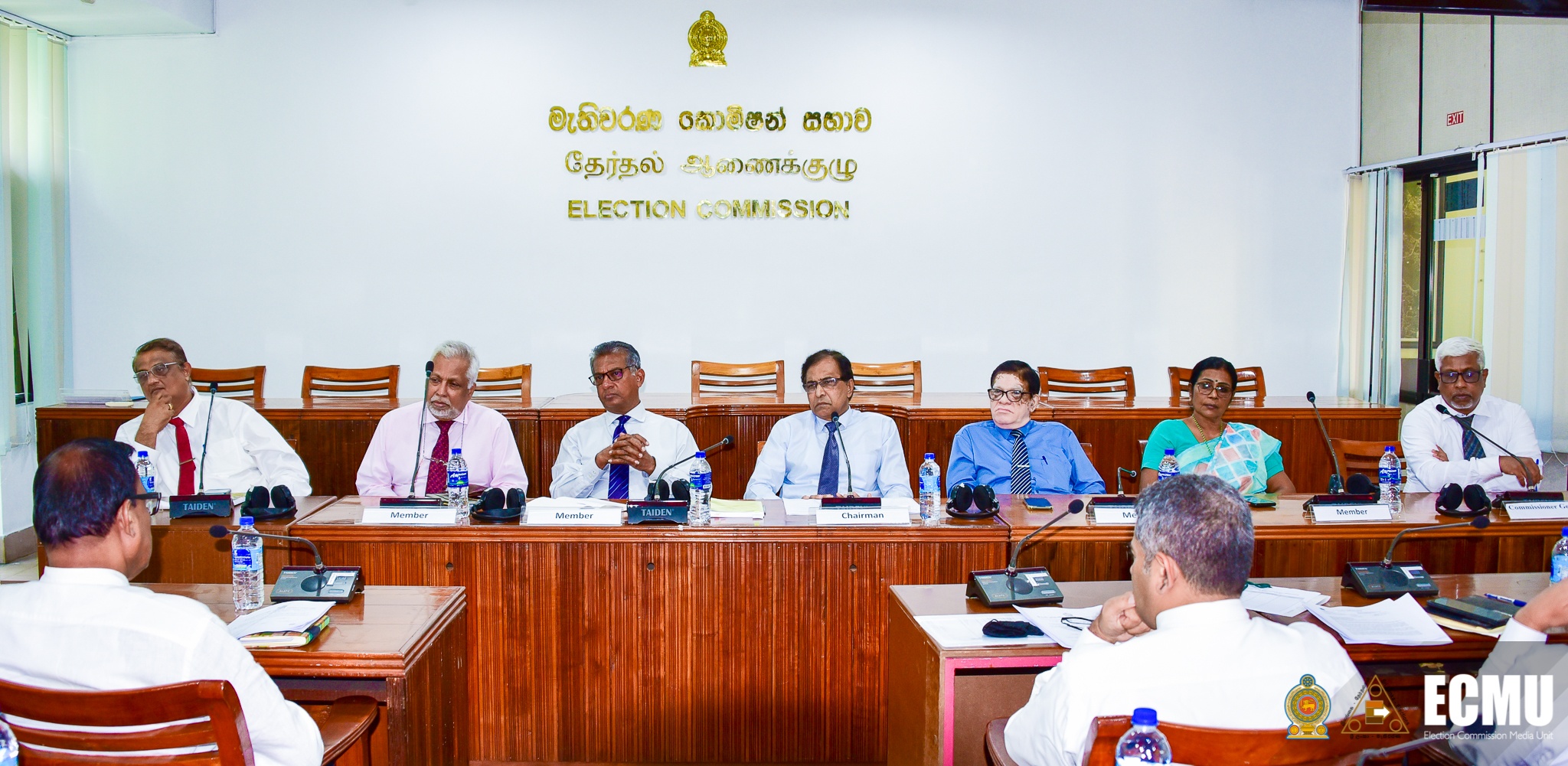
තාවකාලික පදිංචි සහතික යටතේ විශේෂ ඡන්ද මධ්‍යස්ථාන ඇඟලුම් කලාප තුළ පිහිටුවීම සඳහා මැතිවරණ කොමිෂන් සභාව සූදානමින් සිටින බව මැතිවරණ කොමිෂන් සභාවේ සභාපති සමන් ශ්‍රී රත්නායක මහතා පැවසුවේය.

‘‘අපි ලෑස්තියි. නමුත් අපිට ඒ සඳහා වැඩ කරන්න නීති සම්පාදනය වෙන්න අවශ්‍යයි. ඒක දේශපාලන අධිකාරිය විසින් කළ යුතු දෙයක්. තාවකාලික පදිංචි සහතික යටතේ ඡන්දය ප්‍රකාශ කිරීමේ අයිතිය සහ විශේෂ ඡන්ද මධ්‍යස්ථාන පිහිටුවීමේ විධිවිධාන පිළිබඳ යෝජනා සහ නිර්දේශ සියල්ල අපි ලබාදී තිබෙනවා. ඇඟලුම් කර්මාන්තශාලා කලාප ද එයට අයත්‘‘ යැයි ඔහු පැවසුවේය.

‘‘නමුත් මේ යන විදිහට නම්, මේ අවුරුද්දෙත් ඔවුන්ට ඡන්දය පාවිච්චි කරන්න ලැබෙන එකක් නෑ..‘‘  

මෙම වාර්තාව ප්‍රථමයෙන් ප්‍රකාශයට පත් කරන ලද්දේ 2024 ජුනි 23 වන දින ‘අනිද්දා’ පුවත්පතේ වන අතර එය, නෙදර්ලන්ත තානාපති කාර්යාලයේ සහාය ඇතිව විමර්ශනාත්මක වාර්තාකරණ මධ්‍යස්ථානය විසින් පවත්වන ලද මැතිවරණ වාර්තාකරණ අවස්ථා යටතේ සම්පාදනය කරන ලද්දකි.     

Journalists training on mindful story capturing

Calling all dedicated journalists and writers! Are you ready to make a tangible impact in the realm of human rights? Join our exclusive training program focused on mindful story capturing, specifically tailored for citizen and regular journalists. Through this program, you’ll gain the expertise needed to effectively report on enforced disappearances and human rights violations, amplifying their significance and impact. Upon completion, you’ll have the opportunity to contribute directly to our mission by capturing and uploading stories that will shape narratives and inspire change. Seize this opportunity to drive meaningful progress. Apply now to become a catalyst for justice and accountability.


Deadline to apply – October 10th 2024

Please select the appropriate application form based on your preferred language:
Application for Sinhala: https://shorturl.at/DKL19
Application form Tamil: https://shorturl.at/qtHS5
Application form English: https://shorturl.at/wLVX6

Boost: Reporting Grants for Journalists

ICFJ’s Reporting Grants program is designed to expand ICFJ’s offering to its global network by introducing individual reporting grants for projects that might not fit under existing programs.

They are delighted to announce a brand-new reporting grants initiative open to all journalists in their global network. ICFJ will award  $2,000 – $3,000 grants and possibly mentorship to at least two winning proposals. The deadline to submit a proposal is 11.59pm EST on Friday, November 1.

A review committee will select the best proposals. The reporting period will run for three months. Journalists who reside in a country where ICFJ does not currently offer an active program are especially encouraged to apply.

The first call for applications is focused on climate and climate change. ICFJ is looking for high-quality reporting that explores this topic in the Global South.

Apply Now – https://www.icfj.org/our-work/boost-reporting-grants-journalists?fbclid=IwY2xjawFfF8VleHRuA2FlbQIxMAABHYNULAEZi8n4iH_Tnk5z0DcXKlepMQGAgleQTgLb6zdqGG8ahjQcj7-8_Q_aem_mvFE3pzWCbZfMkC6bDTkjA

Media Fellowships Open for Reporting on Non-Economic Loss and Damage from Environmental Disasters

Colombo, Sri Lanka – The Center for Investigative Reporting (CIR), in collaboration with Climate Action Network South Asia (CANSA), is calling for applications from journalists with experience in climate change/ environment reporting for a media fellowship program. The fellowship aims to support the production of in-depth stories on non-economic loss and damage (NELD) resulting from environmental disasters.

The fellowship program seeks to highlight the less-discussed impacts of climate change, such as cultural loss, health impacts, and the loss of biodiversity. Selected fellows will be tasked with producing two detailed reports over a four-month period, focusing on the non-economic repercussions of both extreme weather events and slow-onset environmental changes in Sri Lanka.

Areas of focus include non-economic losses related to extreme weather events such as storms, floods, and heatwaves, as well as slow-onset changes like sea-level rise, biodiversity loss, and desertification. NELD, unlike economic damage to infrastructure or crops, addresses harm to human health, cultural heritage, local knowledge, and ecosystems.

The increasing frequency of extreme weather events and slow-onset climate changes in Sri Lanka makes this fellowship timely. With NELD now recognized in key international agreements such as the Paris Agreement and the Warsaw International Mechanism, there is a growing need to raise public awareness and influence policy around these crucial yet often overlooked consequences of climate change.

The selection process for the fellowship will be merit-based, with chosen candidates working independently under the guidance of a senior mentor. Complete applications should include a minimum of five high quality published/broadcast previous work samples. Deadline for applications: 7 October 2024 at 6 00 pm.

Selected fellows are required to attend an orientation session in mid-October 2024.

Through this fellowship, CIR and CANSA aim to shed light on the non-economic impacts of environmental disasters, urging policy reform and collective action to address the multifaceted consequences of climate change.

Application Form – https://forms.gle/U56XBFLLGTxCzDU49

All eyes on the game: How horse race journalism impacts elections 

By Pamodi Waravita

COLOMBO – As millions of Sri Lankans wait to cast their vote in the first election since the 2022 economic collapse, we take a step back to look inwards at election reporting. This year, the spotlight has increasingly been on voter preference polls, presidential debates, and other ‘competitive’ aspects of the election, which raises questions about how the public is engaging with the election on mainstream and social media.

‘Horse race journalism’ is an approach to election reporting that focuses on polling and campaign strategy so that the election is framed as a competition instead of candidates’ policies and eligibility which would help the public to make a more informed choice.

As Sri Lankans prepare to vote their 9th executive president on Saturday (21), the Center for Investigative Reporting (CIR) spoke with senior journalists and editors to understand how horse race journalism is affecting election coverage.

Anthony David, Deputy Editor (News) at The Sunday Times says that although print media tends to go in-depth into political coverages, “these days a small voice cut or snippet gets huge attention”.

“Then, things get taken out of context and when people start following that, they miss out on the bigger picture of whether we are getting a president who can really run the country. We miss these opportunities in the process. Voters are ultimately not guided by the actual policies of the party but last-minute comments.”

Lakshman Gunasekara, former editor-in-chief of The Sunday Observer and media educator and strategist notes that this manner of journalism is a competition between journalists themselves where they attempt to “out race” each other in reporting the elections.

“They’re reporting the intensity of the election’s competition and I’m a strong critic of it.”

Running with opinion polls

Senior journalist Chandani Kirinde remembers that when the paper commissioned a voter preference poll in the early 2000s ahead of an election with an international pollster, it was a “novel” idea at the time.

This year voter preference polls about candidates, especially published on various social media and YouTube accounts, have attracted significant attention.

“We did a lot of ground reporting at the time where we went to different areas and gauged their mood. We used old fashioned systems to speak to people on the ground. Now they go with cameras and microphones and use social media platforms for publication,” said Kirinde, noting that this method of understanding preferences of the voters doesn’t consider that sometimes voters don’t want to speak about their secret ballot.

“They speak more openly with print journalists as we can say we won’t put their photograph and casually talk to them. We also must differentiate between journalists and others who use the elections to focus on polling and other similar things.”

David too points out that this year, although they have received voter preference polls from various corners, the majority lacks credibility.

“We see they also promote some candidates alone,” he said, adding that they refrain from publishing such polling data.  

Kalani Kumarasinghe, Editor at the Newswire – an online publication – says that she has observed social media being heavily focused on polling data this year as opposed to mainstream media.

“I don’t know if mainstream media isn’t reporting on these voter preference polls due to ethics or because the polls don’t reflect well on any candidate. We don’t report on voter preference polls as we haven’t seen any with the scale or authenticity we are looking for. It is naive to think voters aren’t influenced by how we report an election. If the election result turns out very different to the reportage on the voter preference polls, it may add to the mistrust of media which we saw in India where the result was nothing like what the polls had led people to believe,” she added.

Voter preference polls, presidential debates, and other ‘competitive’ aspects of the election are running themes in election coverage this year Credit: Election Commission of Sri Lanka

Political consequences

Gunasekara too suspects that social media and the “vast information warfare that is ongoing” are having an impact on elections and voting patterns as well.

“Citizen participatory communication is now the bulk of public communication, and we cannot speak about changes in media without speaking about that. Professional journalism itself caters to social media networks and content. Professional journalism has changed profoundly, like it or not, due to the compulsion of social media, including commercial compulsion.”

Kirinde says there is a “real shift away” from the traditional campaigning that happened 10 to 15 years ago where politicians were heavily dependent on print to get their message across.

 Voters are often influenced by how an election is covered on mainstream and social media Credit: Pixabay 

Journalism ethics

Commenting on best practices when reporting an election, David said that providing a balanced to the candidates was key while not getting “distracted” by polling data.

He also cautioned about ensuring accurate reporting during the last few days of the campaign as the audiences would have no time to fact check: “False information during the last few days may be a dangerous tend so we may end up with a president who’s not fit to run the country.”

Rathindra Kuruwita, the Deputy News Editor at The Island notes that frontpage news doesn’t focus heavily on policy.

“We carry more in-depth articles in the inside pages, but the news pages tend to focus on what people say, etc.”

He believes that journalists shouldn’t be too opinionated when reporting and should refrain from interpreting the news for readers.

“We also try to give balanced coverage and coverage for all candidates, although this time there are 39 candidates.”

He further criticized “blatantly false reporting” saying that “in this age of the internet, you can’t fool people unless they really want to be fooled”.


Sri Lanka Presidential Elections 2024 – When over a million votes don’t count

By Pamodi Waravita

COLOMBO – Seventeen million people are eligible to vote on September 21 to elect their next president. Exactly one tenth of this population – or 1.7 million voters are migrant workers. Unless they travelled home, they have no opportunity to cast their votes. Despite the island’s remittance economy, Sri Lanka’s migrant worker community is still to be facilitated to vote from their current location.   

“In my 20 years as a migrant worker, I have never voted during a single election. During COVID-19, when migrant workers were trying to return home amidst border closures, some politicians called us “COVID bombs,” but when the economy crashed in 2022, they wanted our dollars to save the country,” says Nilu Athukorala, 40, a domestic worker based in Kuwait.

At the age of 18, Athukorala left her village near Kurunegala, a district in North Western Sri Lanka. She obtained her national identity card with the intention of going abroad.

“I have a son in Sri Lanka. I have sent every cent I earned back home.  It was only last year that I opened a bank account for myself. I have sent my earnings home for 20 years, but have never depended on any government welfare scheme,” Athukorala told the Center for Investigative Reporting (CIR).  

Remittances reached over US$ 1,500 million (approximately 452 billion LKR) in the first quarter of 2024, according to the Central Bank of Sri Lanka (CBSL). Yet, over a million Sri Lankans working abroad will not be voting this year too. Nearly a million of them are working in the Middle East on short-term contracts with plans to return home unlike those in the Global North where obtaining permanent residency remains an aspiration.   

Senarath Yapa, Additional General Manager (International Affairs), Sri Lanka Bureau of Foreign Employment (SLBFE), said that ahead of the September 21 Presidential Election, the bureau has received three separate requests from Qatar-based workers to facilitate them to vote.  

“These requests were duly forwarded to the Election Commission through the Ministry of Labour and Foreign Employment,” Yapa told CIR.

“We have received many such requests before. This time, requests came from three worker groups,” said Saman Sri Rathnayake, Commissioner General of Elections.

There had been no satisfactory response from the authorities to the demand for facilitating voting from abroad.   

Migrant workers, especially those working in the Middle East as low-skilled workers face serious problems, their plight is largely seen as a distant struggle. However, when the economy crashed, it was the migrant workers the government called upon to help revive the economy.     

Votes with no value

Athukorala argues that migrant workers are not facilitated because politicians fear their power due to the large number of workers. “They cannot predict how we would vote and are possibly worried about having to cater to our demands. We get little or no help from the Sri Lankan authorities when we encounter problems. My calls to the embassies in 20 years have always gone unanswered,” she said.

The Centre for Working Women (CFWW) has been advocating for migrant workers’ voting rights since 1996. CFWW agrees that enabling workers to vote would exert pressure on the authorities to focus on migrant workers’ rights.

“Article 14 of the United Nations Convention on the Rights of All Migrant Workers and Members of their Families specifically refers to their voting rights. Sri Lanka ratified the Convention in 1996 but has not introduced an enabling law. Successive governments have shown no interest in enacting domestic laws to address these issues,” says Amali Kalupahana, President of the CFWW.

“Migrant workers face multiple problems in destination countries. They are abused and sometimes abandoned without help or resources. If they are facilitated to vote, them some of these issues will come to the fore and might get addressed through government-to-government labour agreements,” she says.

 D.M.V. Dissanayake, an independent election analyst  who has observed elections for two decades insists the non-facilitation of migrant workers to vote amounts to a violation of their fundamental rights.

“Migrant workers in the Middle East are among the most marginalised people yet they line Sri Lanka’s economy,” Dissanayake told.

Meanwhile, the three frontrunning presidential hopefuls this year have included migrant workers’ concerns in their manifestos. Samagi Jana Balawegeya (SJB) candidate Sajith Premadasa has promised to amend the election law to allow workers to vote from abroad while the National People’s Power (NPP) candidate Anura Kumara Dissanayake has pledged to safeguard the voting rights of international labour migrants Incumbent President Ranil Wickremesinghe’s manifesto promises to amend the Foreign Employment Bureau Act to provide workers with “better facilities and working conditions”.

According to Priyantha Weerasekara, AGM (Local Affairs) and Information Officer, SLBFE, the estimated number of migrant workers in the Middle East is around 878,510. However, the total number of Sri Lankan migrant workers around the world is much higher as the bureau has statistics on only those who have registered with the SLBFE.

“We base this number on the data we get from embassies or interior ministries in destination countries – that’s mainly the Middle East and low-skilled workers. We don’t have the numbers from countries like Canada and the United States,” he told CIR, explaining existing data gaps.

Weerasekara added that an estimated 300,000 migrant workers were based in the United Arab Emirates (UAE) – data also reflected in CBSL’s quarterly bulletin on labour migration. The bulletin states that even out of the 75,175 labour migrants in the first quarter of 2024, nearly 81% headed to a Middle Eastern destination.

Out-of-country voting

Chandana Sanjeewa Perera, 50, who currently works in Germany terms the lack of facilitation to vote a “human rights violation”.

“We understand the lack of funds to facilitate migrant workers to vote this time. When Gotabaya Rajapaksa ran for presidency in 2019, many workers returned to Sri Lanka to vote, but this time, workers may not do that. Although we work in countries like Australia, the US and Canada, many cannot bear the travel expenses. We prefer an online voting or similar process. Post election, we plan to exert some pressure on the new administration to address this issue,” said Perera, who had worked in the UK, Italy, and Germany.  

In the 2019 Presidential Election, out of 15,992,096 registered voters, only 13,387,951 voters had cast their vote, raising questions as to why over 2.6 million eligible voters did not vote.

Manjula Gajanayake, Executive Director, Institute for Democratic Reforms and Electoral Studies (IRES) told the CIR that out-of-country voting, if facilitated, would allow registered voters living abroad including students and workers.

“Everyone has the right to vote even though some may be living abroad. The problem is facilitation. There are many advance voting systems like voting through embassies but unfortunately, Sri Lanka only uses postal voting as an advance voting mechanism. This results in the exclusion of migrant our worker population.”

Kalupahana adds that since 2008, workers have advocated for the national policy and action plan on migration for employment, finally released in 2023. The policy recognises: “The right to vote as a fundamental right of all citizens. Ensuring voting rights for migrant workers will ensure migrant workers’ voices are reflected in national politics, are recognised by the political system and their contribution to national and socio-economic development.”

To move forward, a greater contribution from migrant workers is necessary, Kalupahana added.

“We need to help organise migrant workers as a pressure group,” she said.

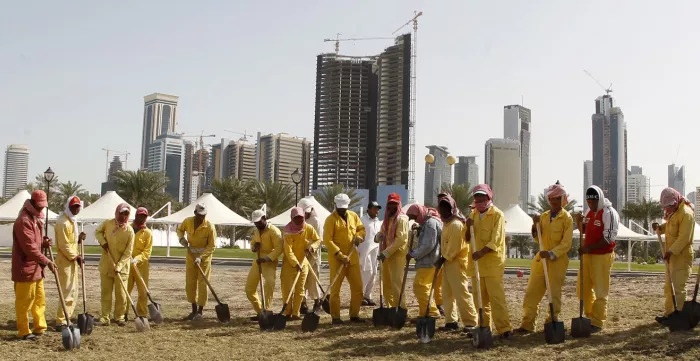
Migrant Workers – Image Credit – ILO

Concerns

Kalupahana says that the authorities should ensure any voting process does not result in vote buying and exploitation.

People’s Action for Free and Fair Elections (PAFFREL) Executive Director Rohana Hettiarachchi has similar concerns and speaks of two main problems in an out-of-country voting system.  

“Our diplomatic missions are politicised and include political appointees. This means, workers may be influenced when voting, especially when they are unskilled and voiceless. It is possible to pressurise workers to vote in a certain way and use forms of threat or financial bribes. Workers may be living or working far away from the missions abroad. Can domestic workers spend and travel to embassies for voting? Will they secure leave to facilitate voting?” asks Hettiarachchi.

Hettiarachchi adds that securing the right to vote does not only involve the introduction of a new law but also a proper mechanism with checks and balances: “Measures should be taken to prevent the integrity of the electoral result being questioned. There shouldn’t be any allegations of influence from political parties once results are announced. People should be able to trust the election result and an improper mechanism to facilitate out-of-country voting may prove disastrous.”

SLBFE’s AGM (Local Affairs) Weerasekara notes that another option could be to allow migrant workers to vote for their own representative, instead of the other district representatives during the parliamentary elections.

Yet, Commissioner General of Elections, Saman Sri Rathnayake, says their hands will remain tied until the Parliament passes a law to enable migrant workers to vote from their destination states.

CountryEstimated number of Sri Lankan migrant workers
United Arab Emirates (UAE)300,000
Saudi Arabia180,000
Qatar113,000

Source: Sri Lanka Bureau of Foreign Employment (SLBFE)

Migrant Workers – SLBFE

Call for Application – Bay Bridges: A Science Communication Residency in the Sundarbans

Hello, early career researchers (pursuing a PhD or Postdoctorates), and communicators (journalists/multimedia and social media enthusiasts/science writers).

If you’re passionate about the ecosystem of the Sundarbans, or communicating stories about science and research in accessible and understandable ways to a wide range of audiences, then we’re looking for you to be a part of the Bay Bridges residency.

What is Bay Bridges?

We are a unique science communication project centered on the Bay of Bengal. The program will bring together eight communicators and eight scientists for an extraordinary skills exchange residency and experiential learning in the Sundarbans in mid-January 2025. Virtual engagements with the 16-member cohort begin in October 2024 and conclude in March-April 2025.

Why are we excited about it?

Despite consensus among scientists about the seriousness of climate change, its complexity and multifaceted nature continue to make it a difficult topic to discuss. The use of ‘subject-specific’ terms to explain climate change often discourages conversation with the larger audience. Scientists have now realized the need for inclusive, plain-language conversations. Given that climate change is an ‘everybody’ problem, discussion around it should not remain confined to the scientific community. 

Bay Bridges aims to bring together climate scientists and science communicators to indulge in deep conversations around the subject. Our goal is to instigate contextualized climate reporting and communication as a partnership between climate scientists and communicators, encouraging creative responses to science and building awareness about the interconnectedness of science, law, and policy to conserve the Sundarbans. 

We aim to focus on the climate-related stories of Sundarbans. We will discuss ‘what to say’, and ‘how to say it’. We will focus on the charm of storytelling. We will also try to demystify and clarify many climate aspects to explain the underlying scientific theories. 

Residency Overview

The residency will take place in Kolkata and the Sundarbans, the world’s largest contiguous mangrove forest, which lies at the intersection of complex ecosystems, climate change challenges, and cultural heritage. During the residency, participants will share best practices and knowledge from their respective fields, pair up and engage in hands-on collaborative projects, and gain a deeper understanding of the ecological and socio-cultural significance of the Bay of Bengal. 

​Residency Objectives

  • Skills Exchange: Facilitate co-learning between scientists and communicators/journalists. 
  • Experiential Learning: Provide a unique opportunity to explore the Sundarbans through guided fieldwork and informal discussions, gaining firsthand insights into its rich biodiversity and conservation efforts grounded in science and evidence.
  • Collaboration: Foster long-term partnerships between communicators and scientists that can amplify the reach and impact of research on the Bay of Bengal and related environmental issues.

Who Should Apply?

Communicators with 3 to 10 years of experience in journalism (including science journalism), storytelling, or public engagement, who are interested in translating complex scientific ideas into accessible and impactful narratives. Applications from West Bengal will be given preference. We encourage Bangla/Hindi communicators.

Early-career researchers (PhD, Postdoctorates) with expertise in mangrove ecology (mangrove forest/soil biology/aquatic biology, etc.) and a keen interest in sharing their knowledge with a wider non-scientific community.

What We Offer

  • Hands-On Learning: Workshops on inclusive science communication, storytelling, science and policy, and immersive science-related field activities in the Sundarbans.
  • Collaborations: A chance to co-create content as a communicator-scientist pair, which will be published on Prameya Foundation’s website. In addition, you can also create content separately for your organization/own work/channel with attribution to the project.
  • Mentorship: Opportunities to be mentored by leading science communicators, science editors, and researchers. Opportunities for peer-to-peer learning and editorial guidance on content ideation and execution.
  • Networking: Build lasting professional relationships with fellow participants and facilitators, creating opportunities for future collaborations.

Eligibility Criteria

Communicators/journalists must demonstrate a strong interest or experience in science communication or in using science and data in reporting/communication. 

Early career researchers (ECRs) enrolled in PhD program in India and working in the Sundarbans. Postdocs with a PhD degree with current or previous work experience in the Sundarbans. Preference will go to ECRs with a demonstrated interest in writing popular science articles.

Residency Details

​In-person residency dates: Jan 11-15, 2025 (Tentative)

Location: Kolkata and  Sundarbans, West Bengal, India

​Online sessions: Once a month (October, November, December, February and March)

​How to Apply

To apply, please submit the following:

  • CV/Resume (maximum of 2 pages)
  • Statement of Interest: A 1,200-character statement explaining your motivation to participate in the residency and how you hope to contribute (what skills would you want to share with your peers, for example, insights into podcasting or basics of mangroves and their conservation). (non-AI generated, please!)
  • Portfolio (Communicators/Journalists only): 3 samples of published work showcasing your experience in journalism or communication.
  • Research Summary (Scientists only): A brief summary (200 words max) of your research related to the Sundarbans and the Bay of Bengal and how you envision communicating it to a non-specialist audience (non-AI generated, please!)

​By submitting the application, you express commitment to attend at least three online meetings/trainings and surveys and be present in person for five days for the residency and engagement after the residency (October 2024 to March 2025). You also commit to collaborating and co-developing content to be published on Prameya’s website.

​Important Dates

​The application submission deadline is September 25.

​​Selected participants will be notified by October 11.

​​For any inquiries, please contact baybengalbridges@gmail.com

​Join us in the Sundarbans for this unique opportunity to shape the future of science communication in the Bay of Bengal!

Apply Now – https://docs.google.com/forms/d/e/1FAIpQLSfEgNEsejoGBYl2qVfzCJDBpdMZrjr9uRF_035s8dsg2j_xDQ/viewform

Original Link – https://www.prameyafoundation.org/baybridges

The cost of being a woman in politics

In male-headed political structures, women candidates are not considered ‘winning horses’

By Pamodi Waravita

Female politicians continue to face an uphill battle in politics, especially when obtaining nominations from their mainstream political parties and spending money on their election campaigns. Women representing the current Parliament note that structural and financial barriers are forcing them to reckon with their future in politics as they still only have one foot in the door.

A case in point is Samagi Jana Balawegaya (SJB) MP Rohini Wijeratne Kavirathna, who first entered Parliament in 2015, and says that she has sold four lands in the past 10 years to fund her political career and educate her children. In such a context, she questioned how women could even “put their head through the door”. 

She said that despite coming from a family with a strong political background (her father was a Deputy Minister while her late husband was a Member of Parliament), the United National Party (UNP) had been reluctant to give her nominations in 2015. 

“Other party members were against it – they thought I couldn’t do it due to various reasons such as a lack of financial means. I had my strength of mind and that’s what allowed me to get in. 

“The electorate supported me because I was a teacher and due to the political backgrounds of my husband and father. I didn’t have a lot of support in 2015 from the party,” said Wijeratne, adding that if parties did not perceive a female candidate as popular or as a “winning candidate,” they would receive less internal backing. 

“I received some financial support in 2015 [from the UNP], but I did hear that others received more support than me. After I entered Parliament in 2015 I worked hard, so at the next General Elections in 2019, I was considered an essential candidate. I was more reluctant to contest in 2019 as the UNP had split in two, but the SJB promised me its backing. The SJB provided me with Rs. 1 million in financial support for the 2020 campaign,” she said. 

Patronage politics and female candidates 

“Women don’t have as much of a chance to connect with private well-wishers and donors either, to help them with their campaigns. Even the business community will support male candidates because they can open a bottle together and become friends. We don’t have that opportunity to receive support, so it is very difficult for a woman to even enter the political system,” said Wijeratne.  

Women Parliamentarians’ Caucus Chair and Parliamentarian Dr. Sudarshini Fernandopulle, who first entered Parliament in 2010, noted too that for female candidates, raising campaign finances was difficult as they did not tend to support illicit deals. “So people think there is no point in supporting us.” 

However, Gender and Election Working Group (GEWG) Voluntary Convenor Kanaka Abeygunawardana observed that even female politicians could benefit from the existing patronage system in the country if the political party they represented presented them as a “winning horse”. 

“Our political system is based on patronage so you bet on the winning horse. How the party presents the candidate is how they receive prominence in this patronage system. Women are on a sticky wicket because if they’re not dominating or represented as equal to the men in the area, people won’t bet on them. The electorate is not for clean politics, transparency, or accountability either. We need to change the electorate too,” said Abeygunawardana. 

Questionable nomination processes

Dr. Fernandopulle said that the issue mainly lay with the leadership bodies of political parties that did not consider women as being ‘suitable’ for politics due to its violent and expensive nature. 

“I didn’t have a problem with the nomination process as I came in after the assassination of my husband. However, for other women, receiving a nomination is a tough game as there is no clear system through which they can enter. It depends on the party leaders and general secretaries, and their consent. There is no clear nomination process for any candidate – male or female.” 

Adding that some political parties did not have women even on their nomination boards, she said that women were only considered as ‘suitable’ by parties after the loss of their male family members: “There is a ready-made electorate there.” 

Dr. Fernandopulle contested with the Sri Lanka Podujana Peramuna (SLPP) in 2020. “I didn’t receive any financial backing for my campaign then. I think this was the same for the other candidates as well.” 

SLPP MP Muditha Prishanthi too said she had been granted a nomination to contest the 2020 General Elections immediately after the death of her husband, who had been a parliamentarian.

“Prior to that I was involved politically in women’s organisations and in my husband’s politics. The party did not provide me with money to contest, but it did support me in organising in other ways. I was already known in the district due to my husband’s popularity. But someone who enters politics newly would find it difficult. There are financial issues and many women are scared of the campaign trail because they face more ‘kapili’ (sabotage),” said Prishanthi. 

Meanwhile, SLPP MP Rajika Wickramasinghe said that when she first contested in 2015, she had received the opportunity to do so because she had been politically involved in women’s organisations and because her husband was in politics. She had lost in 2015 but won in 2020. “I am not from Kegalle, I came to Kegalle due to my marriage so there was a lot of criticism against me, with people saying that someone from Colombo shouldn’t get the vote.” 

Abeygunawardana pointed to other social and structural barriers that existed during an election. 

“Caste plays a major role in most parts of Sri Lanka. If the man representing a particular caste from a district dies, then the best thing for a political party to do is to find his wife. Women are affected because of the perceptions of society – we are not supposed to be talking, we are supposed to be pleasing to the eye. Due to that, we are not given positions within parties as well. 

“Selection procedures are also mainly done by men – sometimes, there is not a single woman. Unless we change those structures slowly, it is very difficult for women to be in politics,” she said.  

On the other hand, actress-turned-politician Women’s Affairs State Minister Geetha Kumarasinghe, who currently represents the SLPP, noted that it was her “famous name, wealth, and business income” that had helped her in her political journey. 

“I am not from a political family – many women come to politics after their husband or father dies. That is the procedure in Sri Lanka, otherwise women don’t engage in politics. But I was someone who had an established name – that made it easy for me to enter politics. A woman who doesn’t have that can’t even think of coming in. That is wrong, that is not what should happen in politics. 

“How can people be committed to politics if they don’t have money? I don’t have any personal problems or many personal expenses, so I can spend on politics. But that is a problem in our political system,” she said. 

Kumarasinghe further said that she had not received a “single cent” in financial support from the political parties she had represented since 2010 and little support otherwise. 

“There was no support from the party – especially no special support due to my being a woman. The first time I contested, I lost because there were two people contesting from the same seat: Sagara Kariyawasam and me. That was one reason for me to lose that election, yet I campaigned heavily for President Mahinda Rajapaksa at the time. 

“During the elections, there were a lot of false rumours about me. The party did ask me whether I could spend on a campaign – that was all they asked. I did hear that men received more financial support than me at the time, in 2010, from the party,” said Kumarasinghe.  

Meanwhile, National People’s Power (NPP) MP Dr. Harini Amarasuriya said that the NPP campaigned centrally, as a party, as opposed to running individual campaigns. 

“Individual candidates are not expected to spend since local organisers in charge will handle whatever financials are necessary so they are not given money individually. We are not expected to raise funds or spend on our own. Funds are collected by the party’s central fund to organise meetings and print pamphlets,” said Amarasuriya, adding that therefore, the NPP did not consider financial capabilities when handing out nominations. 

Meanwhile, Samanmalee Gunasinghe, who contested from the NPP in 2020 and who has been part of the Janatha Vimukthi Peramuna (JVP) for the past 25 years, said that she had witnessed the JVP/NPP change over the years. 

“With the political background in the past, there was no chance for women to engage in politics. Politics was done by criminals, drug traffickers, or thugs. In that system, it is unlikely that women would enter politics. Even though our women comrades were willing to enter politics, that environment impacted their entry. 

“However, in the past few years we have been forming women’s groups that could face those challenges. Parallel to that, the political background also changed, where more progressive politics became more popular. Our organising and awareness-raising became more strengthened, and with that, women are now ready to face that challenge,” she said, adding that it was unfair to ask women to contest in an election without providing them with the necessary understanding and support so that they would be willing to do so. 

Recognising this need, Gunasinghe said that in the past two years the NPP had been involved with women in three ways: awareness-raising about political rights amongst women in a non-partisan manner at the village level, programmes for grassroots NPP women leaders on contesting elections, and forming district women leaders for the party. 

Minority women

Former United People’s Freedom Alliance (UPFA) MP Ferial Ismail Ashraff, one of just two Muslim women to have contested in an election in Sri Lanka and entered Parliament, said that her political career was a “swim against the current”. 

Ashraff said that she had received the nomination after her husband passed away as party members had seen how closely she had worked with him. “But there was a bigger half of people saying that a Muslim woman shouldn’t be in politics. The community was not willing to accept it and it was difficult to convince even women to support me. But now, 20 years later, when I speak with young Muslim women and see that they accept what I have done, I consider it as a step forward.” 

She added that “nothing much has changed as far as the men are concerned,” but noted the positive development that came after the 25% quota for Local Government (LG) authorities was introduced, which mandated that 25% of LG bodies must be represented by women. 

“Even when the quota was being introduced, Muslim parties protested saying that they would not be able to find women to represent them. However, Muslim women activists stepped forward saying that they could find women for the parties. I assume there will be some change that seeps through to the Parliament system too as a result,” she said. 

Ambika Satkunanathan, who had been part of the Tamil National Alliance (TNA) National List in 2020, said that she had “zero interest” in entering politics. 

“In 2020, I turned down the invitation to contest but was later included in the National List. Throughout this entire process I faced sexist, misogynistic, and abusive personal hate campaigns directed at me, especially on social media, by sections of the TNA itself. There were even claims of being in an inappropriate romantic relationship with a Tamil politician, and a Tamil TV channel telecast a skit alluding to this rumour,” Satkunanathan said, recounting her experience. 

She noted that similar to other political parties in the country, Tamil parties too rarely had women holding positions of power within the parties. “Historically, Tamil women have been active in politics and were seen on political stages, even though they didn’t hold positions of power within political parties. Their participation has become less visible and we don’t commonly see women on political stages. The conservative nature of the Tamil community exacerbates the general challenges that women entering politics face.” 

Women’s Caucus attempts 

Female MPs said that if the system were to change to increase female representation in Parliament, then the change should come from party leaders themselves.

“The first step should come from the party leaders – they should have the will to increase female representation in Parliament. We can attempt to bring in laws for representation, but those decisions will also be finally taken by men, which means they will get delayed. The decision-making rooms are filled with men. Equality is only there as a sentence in the Constitution,” said MP Wijeratne. 

Dr. Fernandopulle said that women unfortunately did not have an equal opportunity as male colleagues to enter politics, as almost all parties were headed by men: “Even within the decision-making bodies of parties, there are very few women.”

She said that on behalf of the Women’s Caucus, she had brought in two private member’s bills – one to mandate parties to provide 50% of the National List seats to women and one to ensure that 30% of party leadership is represented by women. 

“We lobbied parties and asked to make voluntary amendments, but we didn’t receive any response. Only the NPP has a manifesto of 50-50 for the National List. But none of the other parties have a plan to increase women’s representation,” she said. 

The 25% quota

Local Government councillors who contested in 2018 noted that the question of financial means was an important one during the interview process conducted by their respective political parties, prior to granting them nominations. 

“They asked us to come to Colombo for interviews and asked how much we can spend,” said Achala Rajakaruna Kularatne, an LG Councillor who contested from the UNP in 2018, adding that this meant that “talented ones” rarely got the opportunity to contest in an election. 

“We all went through the interview process in 2018. If the husbands of the potential candidates have been involved in politics, they are then prioritised. This happens from the party headquarters, yet some women fight for their spot by showing they have paddy fields and lands to support them during an election,” said Kularatne. 

She added that she had supported herself in politics with the income of her husband, who was working abroad, and income obtained through her other assets. 

Accordingly, elections researcher and analyst Attorney-At-Law (AAL) D.M. Dissanayake said that this led to only ‘upper-class’ women even stepping up to ask for nominations from their parties, as land rights were mostly only enjoyed by such women. 

Dissanayake pointed out that the question of money was a common one that was asked by most parties when determining their nominations for any election. “If they don’t have that financial backing, the chances of them getting the nomination really decrease.”

Sujeewani Nanayakkara, another UNP LG Councillor, also said that she had been asked about her financial means to support an election run during the nomination interview at the party headquarters, while pointing out that the interview panels rarely included women. 

Institute for Democratic Reforms and Electoral Studies (IRES) Executive Director (ED) Manjula Gajanayake said that political parties were reluctant to give nominations for women candidates as they did not consider them to be “winning horses”. 

“Political parties are constantly treating female candidates as second citizens. Women candidates often pawn their land or other assets to cover the cost of a campaign,” he said. 

Party promises

SJB General Secretary Ranjith Madduma Bandara, noting that they had been part of the Government which had introduced the 25% women’s quota for LG bodies, said that more women needed to come forward for nominations. “We are offering training these days to encourage more women to come forward. The SJB Executive Council is prepared to increase female representation in the coming elections.” 

NPP General Secretary Dr. Nihal Abeysinghe said that the party hoped to ensure that each district would have female representation at the next General Elections. “We just haven’t decided on the numbers from each district for women as we still haven’t discussed the General Elections yet. However, we can say with certainty that each district will have female representation.”

SLPP General Secretary Sagara Kariyawasam said that of the current female SLPP MPs in Parliament, only Wildlife and Forest Resources Conservation Minister Pavithra Wanniarachchi had funds: “We selected based on who was with the people.” 

“We treat everyone as a candidate and we don’t discriminate based on gender,” Kariyawasam said in response to whether money was being unfairly allocated to male candidates over female ones when campaigning. “We help the way we can and people who don’t need that help do not take it.” 

He added: “We have always been of the stance that talented persons should be given a chance. Our party allocated two National List seats to women and has the largest representation of women from any party in the current Parliament.”

The Story was originally published on The Sunday Morning on 23 June 2024 under the Electoral Integrity Fellowship of Center for Investigative Reporting, Supported by the Netherlands Embassy.