Global Press is offering a two-year reporting fellowship for women journalists from 15 selected countries, to examine changing governance structures in their countries and how those shifts are interconnected.
During this two-year, full-time fellowship, fellows will produce investigative and explanatory journalism, participate in advanced skills training and be part of an international cohort of women journalists, while working and living in their home countries.
As Sri Lanka prepares to elect parliament representatives, women candidates are conspicuous by their absence
The main political parties in Sri Lanka, the UNP, UPFA/SLFP, ITAK, SLMC, and JVP, have allocated only about 5% of their nominations for women during 2010 and 2015 parliamentary elections
Data shows that the highest number of female nominees were from the Western Province districts of Colombo and Gampaha
Batticaloa and Badulla districts in the Eastern and Uva Provinces have not seen a single woman nominee from a major party from 2010 to 2020
Women candidates face many structural barriers, including ad hoc nomination processes, all-male nomination boards, and less support for campaigns
By Pamodi Waravita
COLOMBO – When Mohamed Butto Fathima Bisliya, former provincial councillor from the Sri Lanka Muslim Congress (SLMC), Sri Lanka’s premier Muslim political party, attended the candidate-selection meeting by the party ahead of the 2020 Parliamentary Election, she had to travel from Puttalam in the North-West of Sri Lanka to Colombo, the commercial capital, where the meeting was held at 10.30 pm in the night.
“My friend and I were the only women in a hall full of 100 plus men. We requested at the meeting to nominate at least one woman and a former organiser for Puttalam used foul language on us. He wanted to know who had asked us to come into politics. In that hall, no man stopped him,” recounted Bisliya, highlighting the hurdles women must overcome even to secure nomination from a political party to contest in an election.
Butto entered local government politics as a provincial councillor in 2018 due to the 25% quota. Yet, in 2020 the SLMC didn’t nominate a single woman candidate for the parliamentary elections. This is not a problem limited to one party – an analysis of the nomination patterns of all major parties from 2010 to 2020 show little to no space given to women candidates in their nomination lists.
As such, although women make up for more than 52% of Sri Lanka’s population and 56% of registered voters, they accounted for barely 5% of legislators in the State’s top decision-making body between 2020 and 2024. To improve women’s representation in politics, the country passed a law in 2017 which mandated a 25% quota for women in local government.
Although the quota saw a historic change in Sri Lanka’s local government authorities in terms of women’s representation, it also highlighted the “unpreparedness” of parties at the time to nominate women for the local government elections which showed the poor gender capital of political parties themselves, said Prof. Prabha Manuratne, Director, Centre for Gender Equity and Equality at the University Grants Commission (UGC). She was part of an assessment of the impact of the 25% quota jointly implemented by Murugala, Centre for Progressive Politics and Policy and the International Foundation for Electoral Systems (IFES).
Shy to nominate women
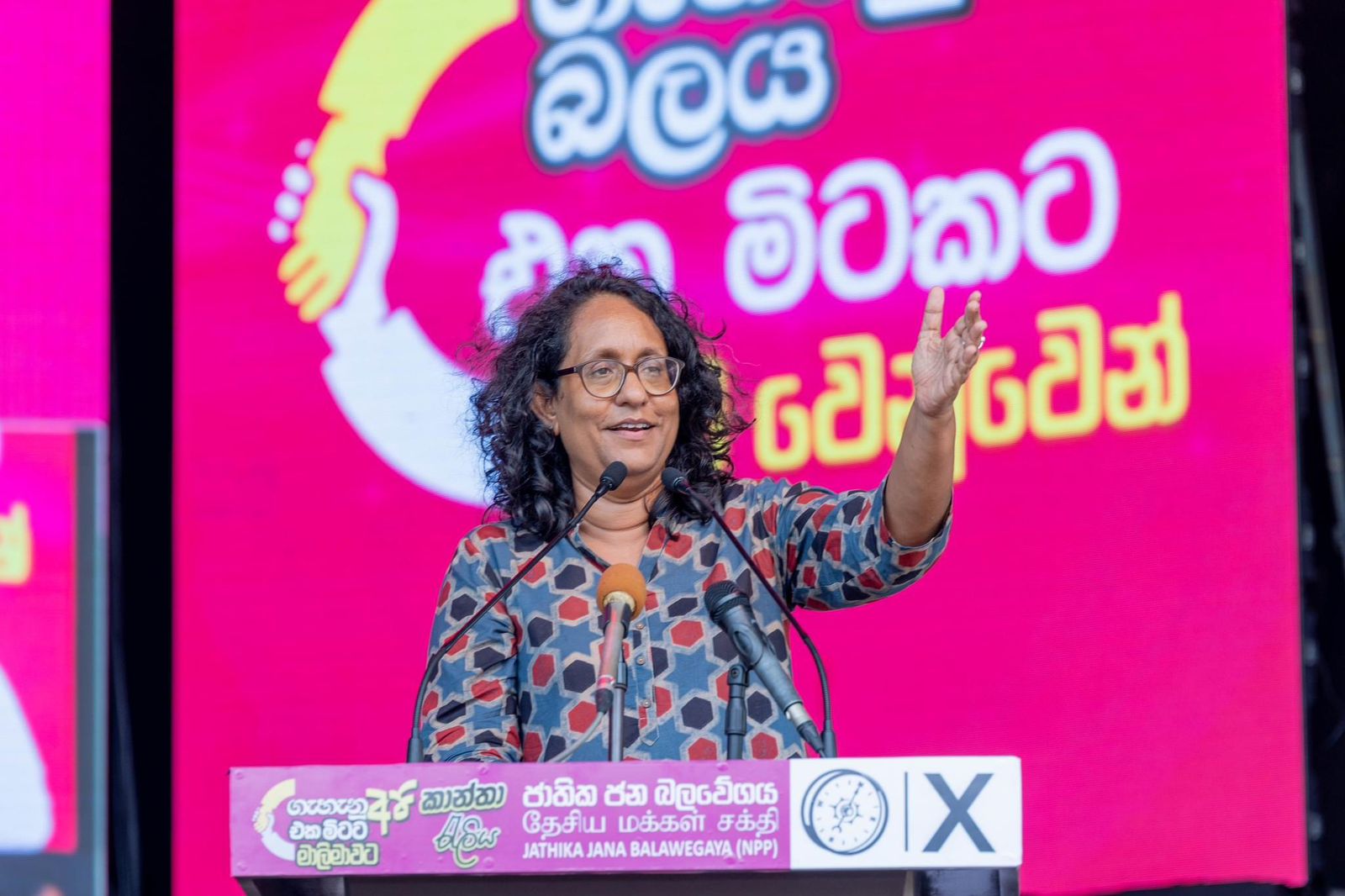
The woefully inadequate women’s representation is a systemic problem, with political parties being reluctant to nominate women and further, nomination boards generally being all-male, showing their structural indifference towards including women. When it comes to the parliamentary election, there is no quota mandating women’s representation. This year, for the November parliamentary Election, the National People’s Party (NPP), has nominated 32 women while the Samagi Jana Balawegeya (SJB) has nominated 15 women. Both the NPP and the SJB have additionally allocated four seats for women respectively in their National Lists.
According to the final nomination lists released by the EC, in 2020, the Sri Lanka Podujana Peramuna (SLPP) which formed the government made room for just 10 women in their nomination list for the parliamentary election – 4% from the total 252 nominees they put forward. In the same year – the SJB nominated only nine women in total to make up 3.4% of their 262-long nomination list while the NPP nominated 16 women (6% of the 262 people they nominated).
The Ilankai Tamil Arasu Katchchi (ITAK) – Sri Lanka’s largest Tamil political party – nominated three women in the same year from a total of 44 nominees. This year, the ITAK has nominated six women in total this year; two from Batticaloa, two from Ampara, one from Vanni, and two from Jaffna.
The nomination lists from 2015 and 2010 show that the main political parties have allocated only about 5% of their nominations for women. In 2015, the United People’s Freedom Alliance (UPFA) which split to form the majority SLPP in 2020) nominated only 17 women from 241 nominees. The United National Party (UNP) – which split to form the SJB in 2020) nominated 16 women to their 262-person list while the Janatha Vimukthi Peramuna (JVP), the largest party in the present NPP grouping of activists, academics, and interest groups) nominated only nine women. The ITAK nominated two women in 2015 to their 44-person list while the SLMC didn’t nominate any.
In 2010, the UPFA nominated eight women, the UNP 15 women, and the ITAK one woman. The JVP and the SLMC contested under coalitions that year.
The nomination lists further highlight that the women nominees have largely represented Colombo and Gampaha in the Western Province while Batticaloa in the East and Badulla in Uva have not seen a single woman nominee in the past three elections. On average, Colombo has seen about five-woman nominees in the last three elections while other districts have just seen one. Most districts have repeat nominees showing a trend of women being nominated when they already have established voter bases in their electorates as opposed to parties encouraging new politicians to take the helm.
Decoding the past nomination lists, Manjula Gajanayake, the Executive Director of the Institute for Democratic Reforms and Electoral Studies (IRES) told CIR that there were two key patterns: key political parties had nominated very few women while independent groups had nominated many women.
“There were nearly 320 independent groups in the last election, and they nominate more women to fill up their nomination lists. But, occasionally we have received complaints that the women who have been included were not even aware of their nomination,” said Gajanayake.
Caption: The Samagi Vanitha Balawegaya, the women’s wing of the SJB, has demanded the inclusion of at least one woman from each district on the nomination list. The SJB has given a total of 15 women nominations this year. Credit: Parliament media (parliament.lk)
“This year, I’m on the SJB nomination board, alongside another woman” SJB member Rohini Kumari Wijeratne
Male-only nomination boards
Abysmal nominations for women reflect the male-centric nomination boards that fail to consider the inclusion of women. Hirunika Premachandra, an SJB opposition parliamentarian from the recently dissolved 16th Parliament of Sri Lanka, recalls consistently facing male-only nomination boards, first as part of the UPFA and then the UNP. Now, as part of the SJB, she has received nomination without too much hassle as she is a former MP.
“As Samagi Vanitha Balawegeya, the women’s wing of the SJB, we requested the party leaders to at least nominate one woman from each district, making a total of 25 women in the list,” says Premachandra, who entered politics after the 2011 assassination of her politician-father, Bharatha Lakshman Premachandra.
She adds that it is a “difficult task” for a newcomer-woman to even secure nomination, let alone battle the challenges that come with the current electoral system: “Even if you’re talented, you won’t get in – you have to either be from a popular background or have a lot of money. This applies to men too.”
“This year, I’m on the SJB nomination board, alongside another woman,” says Rohini Kumari Wijerathne, a former SJB MP and whose father and husband have been in politics and represented Matale, a district in Sri Lanka’s Central Province. Although they had asked for at least one woman from each district to be nominated, the SJB had only ended up nominating 15 women in total.
Former legislator Shanthi Sriskandarasa was nominated from the ITAK in 2015 to contest in the Parliamentary Election from Vanni in the island’s North. She says that she faced a very ad hoc process as there had been “no criteria” for the nominations and she was nominated as the party had wished for at least one woman to be included on the list
Raviraj Sasikala, also was nominated from ITAK in 2020, echoed the same concern about the lack of selection criteria impacting women who had been in the party for a long period not receiving nominations. Her entry to politics followed her husband, Nadarajah Raviraj’s assassination in 2006. He had represented Parliament from 1988 to 2006. This year, she is contesting from the Democratic Tamil National Alliance (TDNA).
Kaushalya Ariyarathne, an Executive Committee member of the NPP and first time candidate, says that the NPP’s nomination panel does include women this time around and that the panel would consider women, youth, people with disabilities, and people from different ethnicities for the nomination list.
Caption: For the November parliamentary election, the National People’s Party (NPP) has given nomination to 32 women Credit: NPP/Facebook (Official Facebook page of the National Peoples’ Power)
“There is a lot of support for women from the NPP as we consider little things like how transport is arranged for women during late night meetings” NPP Executive Committee member Kaushalya Ariyarathne
Male-centric political culture
Ariyarathne, an inclusion specialist who holds a PhD in gender studies, notes that a huge responsibility of increasing women’s representation in Parliament lies with the political parties’ decision-making bodies. She says that parties ought to consider how “women-friendly” they are, including proactive measures being taken to accommodate women who are breastfeeding or need care work when they come for political meetings.
“There is a lot of support for women from the NPP as we consider little things like how transport is arranged for women during late night meetings,” she said, explaining measures taken by the NPP to ensure women’s political engagement.
Raviraj further says that although times have changed now so that more women wish to come forward in politics, a lack of support from political parties was preventing their progression.
Premachandra says that she received Rs. 500,000 (approx. USD 1,700) from the UPFA and Rs. 1 million (approx. USD 3,400) from the UNP for her former campaigns.
“I haven’t received funds from the SJB for the previous election. In my first election, my father’s friends helped me. I only spent around Rs. 2.7 million (approx. USD 9,200). It was soon after my father’s death, so I didn’t have to spend too much money. Compared to others, I had a lot of support from the people. As a candidate during the 2015 UNP-led government, I spent Rs. 3.7 million (approx. USD 12,600). I never spent too much money because I had support from the media. This time we’re in the opposition and we have to spend for social media campaigning for which I don’t have the budget right now. For a woman, it’s difficult. Men can go and ask for money and find sponsors easily.”
Lihini Fernando, an SJB-er and a candidate on the National list, too said that funding for the campaign, especially if the candidate is running from Colombo, was difficult, as it required “very large budgets” as most traditional parties did not campaign centrally.
Caption: Former Samagi Jana Balawegaya parliamentarian Hirunika Premachandra says she has consistently faced male-only nomination boards, first as part of the UPFA and then the UNP Credit: Hirunika Premachandra/Facebook
Still an uphill battle
The answer to the problem of poor representation of women in the country’s top decision-making body lies with the patriarchal political parties, according to Sudarshani Fernandopulle, a medical doctor turned politician, and former Chair of the Women Parliamentarians’ Caucus.
During her tenure as Caucus Chair, Fernandopulle tabled two private member bills – one to mandate parties to allocate 50% of National List seats to women and the second, to ensure that 30% of party leadership is represented by women. The draft bills are pending approval, and Fernandopulle is hopeful that the next Parliament would ensure their passage.
Shiromi Indika Cooray, an SJB-er who represented the Western Province Council (WPC) following the introduction of the 25% quota told CIR that despite the quota indicating the availability of an opportunity and political parties’ readiness, the parties were reluctant to nominate women.
Manuratne defines this problem as a structural issue within “undemocratic, unprofessional” political parties.
“Power is concentrated on a few people. The system produces more of the same. To overcome this, women should take a different route to enter politics or climb the ranks. Due to the haphazard processes in political parties that are run by a few people at the top, it falls upon the candidates to mobilise funding and access networks. This is the challenge before candidates who don’t come into politics with other forms of social capital. That’s why actresses and those with popular political family backgrounds get the ticket – they’re regarded as being able to win.”
“Although we speak proudly about democracy in this country, there is very little democracy inside our political parties,” says Kanaka Abeygunawardena, Convenor of the Gender and Elections Working Group which advocates for women’s participation in politics.
Undemocratic and patriatchal political party structures, a preferential vote-focused electoral system that requires more financial resources to run campaigns, stereotypical roles imposed on women and deeply ingrained socio-cultural barriers hold women away from politics.
Women make up more than 50% of the student population across all universities in Sri Lanka. Even after such efforts to educate women, confining them to the kitchen would be a waste of the country’s resources, says Abeygunawardena.
She unpacks the issue of poor women’s representation in politics here, in the first of CIR’s four-part series on women’s representation and election disinformation with SHE Digital.
On the occasion of the tenth anniversary of the Protocol of 2014 to the Forced Labour Convention, the Competition will award a special prize dedicated to reporting on forced labour and trafficking in persons.
10 September 2024
GENEVA (ILO News) – The International Labour Organization (ILO) is launching the tenth edition of its annual Global Media Competition. Its aim is to distinguish fair and balanced media reports on labour migration. This is especially important because of the impact that negative and stereotypical public narratives can have in terms of fueling discrimination and abusive practices towards migrant workers.
The competition is open to professional and student journalists and will be judged by a panel of international migration, forced labour and journalism experts. The winning entries will be selected according to a range of criteria that takes into account creativity, accuracy, balance and the positive portrayal of labour migration, including the multidimensional aspects of migrant workers’ lives.
For 10 years, the Global Media Competition has celebrated the crucial role of journalists in shaping Labour Migration narratives, highlighting migrant workers’ contributions, while also shining a light on the risks of forced labour and exploitation that persistsays Gladys Cisneros, Chief of the ILO Labour Migration Branch and one of the competition judges.
To celebrate the tenth anniversary of both the Global Media Competition and the Protocol of 2014 to the Forced Labour Convention, the Competition will award one additional winner with a special prize dedicated to reporting on forced labour and trafficking in persons.
How to enter
Complete the online entry form and submit your piece in the following formats: written press, photo essay, multimedia, podcast, video or radio. A submission in any language is welcome. However, an English, French or Spanish translation must be included. Students are allowed to submit a published or unpublished media piece.
Key dates
31 October 2024 (23:59, Central European Time): Deadline for submissions, via the online entry form.
December 2024: Competition winners will be announced to celebrate International Migrants Day.
Awards
Four professional prizes (including one special prize dedicated to forced labour and trafficking in person) and one student prize will be awarded. Winners can choose between a cash prize of US$1,200 in the professional category and US$500 in the student category, or a paid fellowship to participate in an online ITC-Turin fair recruitment or forced labour or labour migration course in 2025.
The competition is organized in partnership with the International Trade Union Confederation, the International Organisation of Employers, the Office of the High Commissioner for Human Rights, the International Federation of Journalists, Equal Times, Solidarity Centre, and Migrant Forum in Asia. The competition is supported by the ‘Integrated Programme on Fair Recruitment – Phase III‘ (FAIR III) and the Bridge Project – Phase II.
During the COVID-19 pandemic, media labels such as “Wuhan virus,” “China virus” and “Chinese virus” to refer to SARS-CoV-2, the virus that causes COVID-19, fueled the stigmatization of people of Asian descent around the world.
The stigmatization of Asian people during the pandemic is an example of unconscious, or implicit, bias – the unconscious act of discriminating and stereotyping based on gender, sexual orientation, ethnicity, ability, age and other identity traits.
Media professionals, influenced by their own or societal prejudices, can perpetuate these biases through their choice of words, images, interview subjects, stories and sequencing of events in news coverage, ultimately shaping public perception.
To address our unconscious biases as journalists, we need to understand them first. Here’s what journalists need to know, and how they can address their own biases:
Confirmation bias refers to our tendency to seek and interpret information in a way that validates our preexisting beliefs.
For example, in 2011, WBBM-TV, a television station in Chicago, interviewed a four-year-old Black boy after a drive-by shooting. “When asked if he would stay away from guns, he replied he would get one in the future because he aspired to become a police officer. The part about his aspirations was not aired, reinforcing the stereotype that African-American males are violent. WBBM-TV later apologized,” said Howard Ross, author ofReinventing Diversity,Everyday Bias andOur Search for Belonging.
In the newscast, stereotypes about Black males served as the basis for judging the boy who said he wanted a gun. By omitting his aspiration to become a policeman, the station reinforced existing biases.
Algorithms also contribute to confirmation bias. Journalists using platforms like Google, which relies on algorithms to provide personalized results based on factors such as past searches and location, can receive different results for the same query. The tendency to connect with people like us and follow accounts that align with our interests on social media can further reinforce our biases.
Closely related to confirmation bias is anchoring bias – our tendency to rely too heavily on the first piece of information we receive.
Bandwagon effect
Bandwagoning occurs when journalists cover a story because others are doing so, rather than based on its newsworthiness or factual accuracy.
A prominent example is the Pizzagate conspiracy theory. In November 2016, WikiLeaks published the emails of Hillary Clinton’s campaign chair, John Podesta. Right-wing journalists and other internet users propagated a false narrative on social media claiming that the emails contained coded messages that linked several Democratic Party officials and U.S. restaurants, including Comet Ping Pong pizzeria in Washington, D.C., to a human trafficking and child sex ring.
Influenced by these claims, a man visited Comet Ping Pong and fired shots as he tried to “self-investigate.” No evidence of the alleged crimes was ever found and, fortunately, no one was harmed.
Internalized oppression
Internalized oppression occurs when people internalize prejudices about their identity. They may self-sabotage as a result, such as by subconsciously excluding themselves or others in their identity group from opportunities.
“For example, a wheelchair user might talk themselves out of applying for promotion to a television host position, despite their qualifications. They might also downplay their need for accommodations, such as accessible studio setups, fearing it could be seen as a weakness,” said Dr. Hamira Riaz, a chartered clinical and coaching psychologist based in the U.K.
Other types of bias include but are not limited to: affinity bias, or the preference for people similar to ourselves; ageism, orstereotyping based on age; and negativity bias, or the tendency to pay more attention to negative news.
Educate yourself on implicit biases and reflect on your own
Everyone has biases. Understanding that unconscious biases exist and assessing the ones you hold can help you manage them effectively while working on an assignment.
Take the Implicit Association Test (IAT)
Harvard University’s IAT test is an online tool that measures the strength of associations a person might have between identity traits (like Black or gay), evaluations (like good or bad) or stereotypes (like athletic or clumsy). Combining the IAT with other methods below can help identify unconscious biases you may have.
Pay attention to external influences
Subtle cues, or behavioral nudges, can influence you to be biased when covering a story.
“For example, if your editor has a particular point of view and you are interviewing someone [for that story], that might affect you as much as if you held that point of view. Similarly, knowing that your readers have a particular perspective might influence your reporting,” Ross said.
Look for patterns in your behavior
It can be challenging to immediately recognize your unconscious biases. Observing repetitive behavioral patterns can provide insights.
“If you have written 10 articles and in nine of them you present a particular point of view, that could indicate a bias. You can put some of your work in an artificial intelligence (AI) tool and ask it to look for patterns in your writing that reveal biases in how you approach things,” said Ross.
How to tackle unconscious bias
Rethink your assumptions
Our brains process huge amounts of information. To save time and energy during interactions, our brains often take shortcuts by perceiving people similar to us positively and those who are different negatively (affinity bias). Furthermore, a negative encounter with someone from a particular identity group can lead people to develop stereotypes about the entire group.
“If we don’t analyze our thoughts and become aware of the potential for inaccuracies, this can lead to false judgments, disruptions to our relationships, macroaggressions and overt discrimination,” said Danya Braunstein, a media psychologist at Connected Psychology.
Seek diverse perspectives
Surrounding yourself with similar people or following accounts online that are only aligned with your interests can create echo chambers. To counter this, seek a diversity of perspectives.
“Gaining greater exposure to a range of different persons within your personal life can assist with dismantling generalizations and attitudes you may hold about a group of people. Additionally, include a variety of backgrounds, cultures and experiences in media narratives,” Braunstein noted.
You can also train algorithms to provide a diversity of perspectives in your search results or news feed by actively seeking content that promotes differing viewpoints, said Ross.
Research and seek feedback
The urgency to make quick decisions can lead to biased conclusions based on limited information. Slowing down, when possible, can help counteract this.
“Wherever possible, take time in researching, writing and creating stories. Ask other people, such as editors, for feedback about what might be missing or incorrect before publishing or broadcasting,” advised Braunstein.
Choose your words carefully
Consider the implications of your word choices, as well as the associations and meanings that others may interpret. For example, terms like “anti-aging” are popular, but may imply that aging is a negative condition.
Know that some words that were once benign may no longer be considered so, too. “Language changes over time and with it, social norms about what we consider to be acceptable when referring to other people,” Braunstein said.
While biases are inevitable, by following steps like these, media professionals can work to understand and tackle their own to better deliver factual, accurate and reliable information that is meaningful and useful for their audiences.
Sri Lanka’s lack of an advance voting system will deprive over 20,000 remanded prisoners from voting in the next Presidential Election – a right that even Taliban prisoners enjoy in Afghanistan, prisoners’ rights activists and election monitors said. This was acknowledged by the Election Commission (EC) as well.
Sudesh Nandimal was remanded on the allegation of ‘rioting’ against the Government in 2008 and remained in remand prison as a suspect until he was released in 2013. He was deprived of voting in at least three consecutive elections held during that time including the 2010 General Election and Presidential Elections.
“Myself and a few other remanded suspects requested from the prison superintendents and the Prisons Department in 2010 to secure our right to vote. We were told that they had no authority to let us vote. Once we were released, we reached out to the then-Election Commissioner to discuss securing prisoners’ voting rights. We also requested him, in writing, to secure the voting rights of all the remanded prisoners and those serving a jail term of less than three years. While the Commissioner agreed to our requests, he also told us that the Commission didn’t have the authority to take action to make our requests happen. He said the eligible prisoners could have been given voting rights if the Commission had the authority to organise polling booths within the prison,” Nandimal said.
Nandimal, the Chairman of the Director Board of the Committee for Protecting Prisoners’ Rights (CPPR), also said the numbers in remand prison – those who will not be able to vote despite being eligible may increase by few more hundreds with ongoing operations like Yukthiya.
Every vote matters
With Nandimal stand nearly 20,000 prisoners eligible to vote, put behind bars on suspicion of various offences and the number, according to Prisons Department statistics may vary between 15,000 to 20,000.
As per Prisons Department data as of May 2024, there are 19,867 remand prisoners / pre-trial detainees, accounting for 64.7% of the total prison population. They, in addition to other prisoners eligible to vote, are deprived of the right due to the unavailability of a proper system. According to the latest statistics, the number of unconvicted prisoners in Sri Lanka in 2021 was 62,426.
According to election monitors, approximately 22,000 eligible voters in prison could not cast their vote in the 2020 General Election.
Improbable as it may seem, a single vote can decide who the winners and who the losers are. A practical example of this is the 2011 Local Government Election of Kolonne Pradeshiya Sabha, Ratnapura District where the UPFA received 10,075 votes while the UNP received one less, 10,074. With an advantage of the smallest possible margin – a single solitary vote – UPFA won Kolonne seat. Conversely, in the last election to be held in the country, the August 2020 General Election, the number of registered votes that weren’t cast was 3,920,576, revealed Executive Director, Institute for Democratic Reforms and Electoral Studies (IRES) Manjula Gajanayake during a recent panel discussion on electoral integrity and transparency by Centre for Investigative Reporting (CIR).
It is in this context that the need to protect the right of each eligible vote is emphasised.
Prisoners with voting rights are prevented from voting due to the obvious difficulty in accessibility. If a person is remanded or in prison when an election is being held, under usual circumstances, he or she will not be able to vote, even if the person is eligible to vote. However, the need for securing the voting rights of prisoners has been emphasised on numerous occasions, not just by civil society organisations but by the EC as well.
Executive Director of the Committee for Protecting the Rights of Prisoners, Senaka Perera, revealed, the reason why the political parties aren’t keen on providing voting rights for prisoners is because prisoners are still a marginalised community in Sri Lanka –despite the popular slogan, ‘Prisoners are human beings too’ – which makes association with such a group disadvantageous for political parties.
How can prisoner’s voting rights be secured?
First and foremost, a policy decision has to be taken enabling the EC to take necessary action to facilitate prisoners who are eligible to vote. Once the legal barrier is overcome, it is just a matter of establishing advance voting facilities in 18 remand prisons, 10 work camps, 2 open prison camps, the training school, two correctional centres and the 23 lockups; depending on the need. Once the eligible prisoners are sorted, the voting can be carried out on a day before the election with the advance voting facility, and the names of the prisoners who have voted will then be removed from the electoral voter lists to avoid repetition; opined Commissioner General of Elections, Saman Sri Ratnayake.
Advance voting
According to Ratnayake, securing eligible prisoners’ voting rights can be secured via the introduction of an ‘advance voting system.’ The Sri Lankan electoral system provides for a restricted form of advance voting, essentially allowing polling officials and public servants engaged in election duties or emergency services on Election Day to cast early votes via postal voting. However, the groups who would be disenfranchised due to accessibility issues on Election Day are much broader than the aforementioned groups who are eligible to cast postal votes. In 2019 Presidential Election, the number of postal votes applications received by the EC was 720,135 while 8.49% of the applications (61,106) were rejected, states the Election Observation Report prepared by Centre for Monitoring Election Violence.
By establishing an advance voting system, the voting rights of all the otherwise disenfranchised groups, can be secured. However, determining which groups should be eligible to cast advance votes should be determined after much consideration since opening up postal votes facilities rather limitlessly might lead to fraud and unlawful acts; warns the Chairman of Association of Election Professionals of Ceylon and former EC Chairman Mahinda Deshapriya in a letter of recommendations on amending election laws to the EC.
The advance voting system can broaden the existing postal votes system to include more groups of voters as well as allow the selected voters to vote at a convenient election centre before Election Day. In the cases of prisoners with voting rights and those who are hospitalised on Election Day, special polling booths should be established in prisons and hospitals to ensure their franchise. However, experts, including the likes of Ratnayake and Deshapriya, warn that advance voting on a different poll should be allowed on Election Day itself, the day before or on a much closer day to avoid fraudulent and unlawful activities.
Discussed in Parliament
Commissioner General of Elections Ratnayake said on numerous occasions, the Commission has made suggestions to relevant Government commissions appointed to amend election laws. Among the suggestions submitted to the Select Committee of Parliament to Identify Appropriate Reforms of the Election Laws and the Electoral System in 2021, is the proposal to implement advance voting and special polling stations for the benefit of voters who are eligible to vote but don’t have postal voting and can’t go to voting centres on Election Day due to various reasons. Among these groups are prisoners eligible to vote.
The issue was discussed in Parliament as well, as the report of the special select committee was presented to Parliament in June 2022 by Prime Minister Dinesh Gunawardena. However, a special Gazette Notification or an amendment to an existing act about securing voting rights for prisoners is yet to be passed in Parliament. According to Ratnayake, the EC is more than capable of taking actions that secure the voting rights for all but the powers of the commission are limited and a decision of this nature has to come from the Legislature.
Groups benefiting from advance voting
In the letter of recommendations sent by the Association of Election Professionals of Ceylon to the Chairman of the EC to propose revisions to election laws, Deshapriya lists out several groups who should receive advance voting facilities other than eligible prisoners. Government servants who have official duties on election days but are not eligible for postal voting, healthcare workers, harbour, airport and highway workers, journalists, employees in the transport sector, private security officers, employees in trade zones, employees in the hospitality sector, and voters who, under special circumstances, can’t visit their registered polls or cast votes.
Legal framework
However, the topic of advance voting has been discussed by civil society organisations for over two decades.
The current legal provisions allow advance voting only for a few selected groups. According to Section 26 of the 1981 Parliamentary Elections Act and Section 23 of the 1981 Presidential Elections Act, Government staff engaged in election duties on Election Day, some Government workers who are in essential work, those serving in Security Forces and candidates contesting outside their registered constituency can vote in advance. However, in 2020 Parliamentary Elections, the EC adopted a special decision to include frontline healthcare workers as well.
The current electoral legal framework effectively disenfranchises a large number of eligible voters which amounts to a breach of international standards that guarantee voting rights.
According to Ratnayake, the Commission has already conceptualised the whole advance voting system and is poised to implement it once the green light is given, the only delay being at parliamentary level.
In other words, securing voting rights for prisoners is solely in the hands of political parties.
Political inertia
Meanwhile, when asked if the Ministry is planning to draft laws to bring advance voting into action – which can secure voting rights of not just prisoners but any other sectors of society – Justice Minister Wijeyadasa Rajapakshe said his Ministry has not received any written request regarding enabling advance voting. While acknowledging the matter has been spoken about in Parliament and suggestions have been submitted in writing by civil society organisations, he said no such written request has reached the Ministry while alleging that they must be stuck at the Presidential Secretariat.
When questioned about taking a policy decision to make advance voting happen, the Minister said the possibility of any election-related policy decision materialising before the next election is very low as he has instructed the Ministry to not take any such policy decisions at this juncture and wait until the next Parliament is formed following the elections.
As for bringing in the advance voting system to secure voting rights for many sections of society who are unable to vote under regular circumstances, Executive Director of People’s Action for Free and Fair Elections (PAFFREL) Rohana Hettiarachchi said activists, civil society organisations and election monitoring bodies have, for over 10 years, talked about bringing in advance voting systems. “PAFFREL has even researched the matter and handed the report to the EC, which was well-received. The EC is much-interested in bringing in advance voting systems and the suggestions have now reached the Cabinet level and legal drafting level,” Hettiarachchi said.
When asked how the Justice Minister was unaware of such election law suggestions reaching the Justice Ministry and how they perhaps are still stuck at the Presidential Secretariat, Hettiarachchi said it simply can’t be. “However, the suggestions were sent back to the Presidential Secretariat to make a few more amendments. Perhaps, what the Minister is talking about could be this delay,” Hettiarachchi further said.
“The suggestions we presented didn’t however explicitly talk about securing voting rights for prisoners but rather talked about bringing in an advance voting system to include almost all the voters who are unable to vote on Election Day due to various issues. If the suggestions can be made into a legally binding document and get Cabinet approval, based on that, securing voting rights for prisoners isn’t that big of a leap,” Hettiarachchi said.
In many other parts of the world, prisoners have their voting rights secured, even in Afghanistan. Even the Taliban prisoners are allowed to vote via a mobile voting system, he said.
In Thailand, even farmers can vote in advance if they are unable to visit the polling booth on Election Day. We need a system like that to allow people who can’t go to the polling booth on Election Day such as economic zone workers, expressway workers, members in healthcare sector, security personnel, and so on. That way, we can secure the voting rights of approximately a million voters who are unable to vote at present, Hettiarachchi added.
Speaking about the legal provisions for advance voting systems and assigning alternative polling centres to secure voting, Hettiarachchi said both old and new amendments to the Election Law include provisions to facilitate these under special circumstances. Thanks to these legal provisions, politicians were able to vote from their homes during the internal conflict and the Jaffna Tamils who had fled the North during war were able to vote from Colombo. Hettiarachchi said it is just a matter of extending the advance voting and voting at an alternative polling centre to the laypeople who are having genuine troubles to vote on Election Day.
“Establishing an advance voting system was much talked-about during the pandemic when the country was in a lockdown and many were in quarantine camps. However, that interest slowly faded. If an advance voting system is to be introduced, the upcoming Presidential Election is the most ideal to do so since the votes of the whole country is considered one division. It becomes a bit complicated in a General Election and much more complicated in a Provincial Election since there are multiple electoral divisions. However, it is not impossible,” Hettiarachchi said.
The Story was originally published on The Ceylon Today on 26 May 2024 under the Electoral Integrity Fellowship of Center for Investigative Reporting, Supported by the Netherlands Embassy.
“Even if we use powder, we’re humiliated on Facebook,” says Ananthy Sasitharan, an Ilankai Tamil Arasu Kachchi (ITAK) politician.
In any field, women face many challenges, and this is no different in the field of politics. As modern-day politics adapts to the harsh realities of technology of trolling, sexualisation, ‘hate engine optimisation’, and misinformation, women politicians are encountering fresh problems. This is shown through the experiences of women politicians in the North and the East who faced serious social media harassment following the 2020 parliamentary election.
On social media, women politicians are forced to battle attacks on their dignity, being disregarded by their male counterparts, subsequent interruptions to their career progression, and the reality that this ‘new age harassment’ would push even the few women in politics out of it completely. Watch their story here.
The visual story was originally published on MoJo News.lk on 11 October 2024 under 𝐃𝐢𝐠𝐢𝐭𝐚𝐥 𝐃𝐢𝐜𝐭𝐚𝐭𝐨𝐫𝐬𝐡𝐢𝐩, 𝐎𝐧𝐥𝐢𝐧𝐞 𝐓𝐡𝐫𝐞𝐚𝐭𝐬, 𝐚𝐧𝐝 𝐖
Every monsoon season, the people of Ratnapura city and surrounding areas brace themselves for the inevitable: flooding. For residents like Isuru Dassanayake from the Hangamuwa area, this annual ordeal has been a relentless reality since childhood. “As soon as there is rainy weather in the country, people start talking about Ratnapura on social media platforms,” he laments. The connection between Ratnapura and floods is so well-known that it has become a grim routine. Dassanayake and thousands of others continue to live in fear of the next deluge, watching helplessly as the lack of decisive action leaves them submerged, year after year.
Located in the Sabaragamuwa Province, the geographical location of Ratnapura exacerbates its flooding issues; the city is situated at the confluence of the Wey River (Ganga) and the Kalu River (Ganga). Both of these river catchments include regions with steep slopes, causing the city to flood rapidly, often within a few hours, during periods of heavy rainfall. Ratnapura often experiences two major flood events during the year, with one occurring between May and June and the other between September and October. Primarily caused by heavy rainfall and the overflow of the Kalu River, these floods often lead to significant damage in both the city and the surrounding areas.
Geographical Vulnerability
The recurring flood issue in Ratnapura is fundamentally a technical, yet manageable, issue exacerbated by the region’s unique geographical features, as explained by an official from the National Building Research Organisation’s (NBRO) Ratnapura District Office. He said that Ratnapura’s location at about 130 metres (m) above sea level plays a critical role in the occurrence of floods. “Ratnapura is only 130 m above sea level, and the distance from Ratnapura to Kalutara is about 43 kilometres (km) to the point where the Kalu Ganga falls into the sea. All that water has to flow from a mere height of 130 m,”
He further said that the region surrounding Ratnapura, including areas like Rakwana Mountains, Kalawana, Sinharaja rainforest, Weligepola, Opanayake, Balangoda, Adam’s Peak, and Erathna, receives significantly high rainfall. “All that water, flowing from these areas which are about 500 to 600 m above sea level, flows down to Ratnapura and surrounding areas at a high speed, creating floods within an hour or two at time of high rainfall.” However, the NBRO official emphasised that this issue is manageable with strategic interventions. “If the water is released little by little, this problem can be mitigated,”
Sri Lankan Map
Development Missteps
Dr. Ajantha Perera, a prominent environmentalist, expressed her concerns about the adverse effects of unplanned development activities on natural water flow systems. She said that natural channels such as canals, streams, and rivers form a crucial part of a basin system, allowing rainwater to flow seamlessly, adding various unplanned development projects however often obstruct these natural routes, leading to floods during the rainy seasons. “In our country, development projects often proceed whenever funds become available, without adhering to proper standards. This leads to natural water channels being blocked or occupied by buildings. To prevent adverse consequences from development activities, there should be regional, city, and provincial plans. Unfortunately, such plans are currently lacking, and politicians implement development projects in ways that serve their interests.”
Impact of Gem Mining
Engineer Dr. Tissa Liyanage, who is constantly researching the gem industry and related issues, highlighted that unregulated gem mining activities have exacerbated the flood problem in Ratnapura. He said that gem mining has surged in popularity recently due to the extensive use of machinery for rapid, mass-scale gem extraction. However, he said that the machinery and methods currently employed are not environmentally sustainable. “Unlike traditional gem mining, which incorporated numerous protective measures to safeguard the environment, modern high-tech extraction methods lack such precautions. Consequently, the sensitive soil layers become destroyed and water ways get blocked, leading to a host of adverse consequences including flood.”
In contemporary times, he said that the majority of individuals involved in gem mining focus solely on excavating, identifying gem-bearing layers, washing them using machinery, and extracting gems. “They demonstrate little concern for the broader consequences of their actions. Despite the recognised environmental risks associated with machinery-driven gem mining, along with suggested alternative approaches, industry participants show a disinterest in implementing these measures. Following their mining activities, they typically abandon the land without taking steps to address the resulting environmental degradation.”
Community Voices
Dassanayake, a resident of Hangamuwa area, located in Elapatha Divisional Secretariat (DS) Division of Ratnapura District, shared that since his childhood, they (Hangamuwa residents) have been impacted by floods almost every year. He remarked that none of the politicians who entered Parliament or other political structures, such as the Provincial Council (PC) and Local Government (LG) bodies, with promises to address the issues faced by the people of Ratnapura District, including the issue of flooding, have managed to provide a permanent solution to the flood problem. “Politicians claim they will solve the people’s issues, yet the most serious and pressing issue we face in Ratnapura is flooding. The people have been suffering from this problem for generations, and generations to come will continue to suffer. Yet, the politicians have consistently failed to fulfill their promises and provide effective solutions,” he said.
A Statistical View of Floods
In retrospect, Ratnapura experienced one of the most catastrophic floods in its history in 2003. The sheer scale of the 2003 floods is evident from the figures: 34,473 families were affected, and 122 lives were lost. A total of 2,544 houses were fully damaged, and another 8,683 were partially damaged. Schools and wells were also significantly impacted, with 47 schools and 4,452 wells damaged. The economic toll was immense, with total damages estimated at Rs 1,140 million. The housing sector damages alone accounted for Rs 600 million. Other significant damages included rural roads (Rs 144 million), the electricity network (Rs 62 million), and various irrigation schemes (Rs 33 million).
Subsequent floods continued to ravage Ratnapura. When considering some recent years, in May 2016, the floods affected 4,564 families in the District, comprising 18,035 members, and resulted in 2 deaths. A total of 66 houses were fully damaged, and another 473 houses were partially damaged. There were 40 safety centres set up, accommodating 4,754 people from 1,287 families.
The floods of May 2017 were also devastating, affecting a total of 60,094 families with 235,709 members. There were 86 deaths and 99 incidents of people sustaining injuries. The floods fully damaged 932 houses and partially damaged 14,386. Additionally, 2,977 small and medium enterprises (SMEs) were impacted. The disaster led to the establishment of 213 safety centres, sheltering 38,868 people belonging to 10,713 families.
During the flood in May 2020, 9,716 persons were affected, and there were 2 deaths. The floods in March 2021 affected 2,501 families, comprising 9,764 persons, and resulted in 4 fully damaged houses and 690 partially damaged houses. A total of 67 SMEs were also affected.
The April 2022 flood saw 3,873 families affected, including 15,252 persons. There were 2 deaths and injuries each. The floods partially damaged 1,042 houses and 132 SMEs, and critical infrastructure suffered 9 instances of damage.
The June 2023 floods affected 508 families, totaling 1,896 members, and resulted in 2 deaths. A total of 176 houses were partially damaged, and 15 SMEs were affected.
The most recent floods in Ratnapura early this month (June) were particularly severe, affecting 15,633 families with 59,782 members. There were 7 deaths and 19 injuries. The floods fully damaged 31 houses and partially damaged 2,734. Additionally, 336 SMEs were impacted, and 74 instances of critical infrastructure damage were recorded.
Economic and Social Costs of Flood Relief
The Disaster Management Centre’s (DMC) Ratnapura District Office stated that the Government is allocating funds almost every year to provide relief to those affected by natural disasters in Ratnapura District, mainly floods and landslides. The relief efforts have included various programmes such as providing cooked food, distributing dry rations, compensating families for deaths and injuries, donating kitchen utensils, and supplying drinking water. The reports available on the National Disaster Relief Service Centre (NDRSC) official website reveal that in 2014, Rs. 6.48 million was spent on proving relief to those affected by flood in Ratnapura, followed by Rs. 2.5 million in 2015, and Rs. 3.67 million in 2016. The expenditure surged to Rs. 286.28 million in 2017 and Rs. 77.79 million in 2018. In 2019, an approximate sum of Rs. 199 million was allocated to provide relief to those affected due to natural disasters including flood and landslides in the Ratnapura District. The following year, 2020, saw Rs. 57.00 million allocated for Ratnapura District, and in 2021, an approximate sum of Rs. 20 million was allocated. Accordingly, a sum of about Rs. 6.5 billion was spent by the Government to provide relief to flood-affected people in Ratnapura during the course of 7 years.
The impact of floods extends beyond the Government’s expenditure, as per the annual reports prepared by the NDRSC, encompassing widespread damage to houses, businesses, infrastructure, roads and bridges, and educational facilities. Such damages result in an estimated annual loss about Rs. 3 billion. Moreover, flood-affected communities endure profound social and psychological challenges, including disruptions to livelihoods, educational setbacks for children, and increased health risks due to post-flood disease outbreaks.
Image Credit – Buddhika Samaraweera
Barring Investments?
Susantha Gamlath, a medium-scale gem merchant based in Ratnapura, remarked that despite the potential to transform Ratnapura into a well-developed area through its gem resources, this opportunity has been undermined by frequent flooding. He explained that people avoid purchasing land and constructing business premises in flood-prone areas and refrain from making investments. “Although Ratnapura is the source of 90% of Sri Lanka’s gemstones, it lacks sufficient globally recognized laboratories. In contrast, Beruwala, where there are no gems at all, serves as the primary gem trade point in Sri Lanka. The persistent risk of flooding in Ratnapura contributes significantly to this disparity.” He further noted that Ratnapura city lacks luxury housing schemes and manufacturing plants for the same reason.
An Unfinished Vision
S.G. Karunaratne, a former gem miner from the Malwala area in Ratnapura, now residing in Godakawela, recalled that slain MP Nalanda Ellawala had proposed a progressive plan in the early 1990s to tackle the flooding issue. However, this plan never came to fruition due to his (Ellawala) untimely demise in February, 1997. “He had this plan of blocking the Kalu Ganga in Palabaddala area and redirecting the excess water to the dry zone areas. I vividly remember him presenting this proposal in Parliament. They had even started some initial work, but everything came to a halt after his demise. I’m no expert, but I believe his plan could have brought some relief to many people.”
When contacted to inquire more about the attempt, Lakshman Peiris, who used to be a private staff member to Ellawala, said that Ellawala’s father, late MP Nanda Sydney Ellawala first proposed a solution to address the persistent flooding issue in Ratnapura. “His proposal included straightening a significant bend in the Kalu Ganga near the market. This bend had been a major cause of flooding, and straightening it was seen as a crucial step in mitigating flood risks. Unfortunately, the Government of 1970s halted these efforts, leaving the project incomplete.”
He further said that Nalanda Ellawala revived his father’s initiative in the 1990s, with a detailed proposal being submitted to Parliament. “Following his proposal, a survey was conducted in Palabaddala area, and it was proposed to block Kalu Ganga in Palabaddala area. If that project was completed, the existing Palabaddala-Ratnapura road would have been lost. As a solution to that, an alternative road was constructed, linking Kuruwita and Palabaddala. That road is still in use. Despite these successes, the project remained unfinished with Ellawala’s death and subsequent Government changes.”
The ‘Dried’ Dry Dam
Flood issue in Ratnapura has a solution that has been long overlooked: the construction of a dry dam, a type of dam constructed specifically for flood control. Unlike traditional dams, dry dams typically contain no gates or turbines and are designed to allow the channel to flow freely under normal conditions. During periods of intense rainfall, which would otherwise lead to flooding, it holds back the excess water and releases it downstream at a controlled level. However, the project has been stalled due to a contentious issue involving about 600 houses located in Malwala, Kalawana and Ayagama areas, which would need to be relocated to make way for the dam.
When contacted, Ratnapura District MP and Chairman of the Sectoral Oversight Committee on Alleviating the Impact of the Economic Crisis, Gamini Waleboda, emphasized that solutions to the flood issue in Ratnapura exist, but none of the political leaders representing the district have adopted a long-term approach to flood prevention or management. “Plans were made to temporarily dam the rivers to hold back the water. Various proposals made since the 1960s included building reservoirs, generating hydropower, and directing water to areas like Hambantota and Colombo. However, these solutions are very costly. The practical approach is to temporarily contain the water in rivers and release it gradually. Floods occur because a large volume of water flows through within a short span of time,” he explained.
Waleboda highlighted that the construction of a dry dam has been identified as the most feasible and effective solution to the issue, but progress has stalled due to a lack of funds and political apathy. “The latest proposal was submitted and approved by the Ratnapura District Coordination Committee in 2020. About Rs. 200 million is needed to study its feasibility. Government agencies can handle that, but a request for that sum from former President Gotabaya Rajapaksa was not granted. Later, President Ranil Wickremesinghe allocated Rs. 50 million in 2023, with a plan to allocate the remaining Rs. 150 million in 2024, but this did not happen either. Ironically, this has occurred when the Minister of Irrigation, Pavithra Devi Wanniarachchi, is also from Ratnapura.”
In addition to the lack of funds, Waleboda pointed out that political disinterest is partly due to local opposition to the project. “If this project is implemented, the rivers should be dammed in areas like Malwala, Ayagama, and Kalawana. There are about 600 houses that would need to be relocated during the construction. The residents are opposing the project, and politicians are afraid of losing votes,” he said.
“The best ever solution to the issue of flooding in Ratnapura is to construct a dry dam. There is even a specific location identified for constructing this dry dam, but the reluctance of political leaders to facilitate its execution has been a significant barrier. Some of them are not interested in the issue, while others fear losing votes if they do. Relocating the residents of the would-affect houses is absolutely doable. In the past, there have been instances where entire villages were relocated for the construction of dams. Yet now, the entire community of Ratnapura continues to suffer from severe flooding to save those.” a former Ratnapura Divisional Secretary also said.
Challenges of Long-Term Project Implementation
Commenting on the efforts made during the 2015-2019 period to resolve the flood issue in Ratnapura, then-Minister of Megapolis and Western Development and incumbent Opposition MP Patali Champika Ranawaka said that it was planned to redirect excess water of the Kalu Ganga to the Udawalawa area through a tributary, and from there to the Hambantota and Monaragala areas. “The people opposed the implementation of this project, and certain politicians were also behind it. There is another issue. That is, there projects can’t be completed in one or two years. It takes at least 10 years, but a Government is in power for only five years, so how can the project which needs 10 years be completed within five years?”
Successive Governments often lacking interest in the continuous implementation and completion of long-term projects that benefit the people is a serious issue in the country. Most of such projects are either abandoned or left incomplete, depriving the community of their potential benefits. Politicians often prioritise short-term gains that can be realised within their tenure, aiming to secure immediate public approval and votes. For genuine progress, it is however imperative that political authorities adopt a more visionary approach. They must prioritise the welfare of the people over political gains and ensure that projects, especially those with significant long-term benefits, are carried forward seamlessly across different administrations.
Image Credit – Buddhika Samaraweera
Potential Benefits of a Lasting Solution
The residents of Ratnapura are not asking for miracles. They seek committed political leadership that prioritises the well-being of the many over the interests of a few. Transparent communication, collaborative problem-solving, and the courage to take necessary but potentially unpopular decisions are crucial. As Ratnapura continues to suffer from frequent floods, the call for responsible leadership grows louder. Going beyond a mere technical solution, the proposed construction of the dry dam also represents a litmus test for political will and integrity. The people of Ratnapura deserve politicians who act not just for the next election but for the next generation.
Claiming that Ratnapura remains one of the poorest districts in Sri Lanka despite generating substantial wealth, MP Waleboda emphasised that political leaders of the District must bear full responsibility for this situation. “They lacked vision in the past and continue to lack it today. These leaders have perpetuated poverty as a means to maintain their power. Ratnapura is a gem, contributing significantly to Sri Lanka’s economy with approximately US $500 million worth of gems exported annually. Despite this, none of the revenue is reinvested into Ratnapura. The city, which is the commercial hub of the district, is the most vulnerable to frequent flooding, so how can economic growth be achieved?”
Addressing the flooding issue in Ratnapura with a lasting solution would save the country about Rs. 4 billion annually including an approximate sum of Rs. 1 billion spent annually by the Government on flood relief, allowing these funds to be redirected towards more forward-looking initiatives, such as improving the education sector. With rising school dropout rates, parents struggling to provide necessary educational resources, children fainting at school due to lack of food, and education sector professionals including teachers and principals are lamenting insufficient salaries, it is crucial for the Government to prioritise long-term solutions for chronic issues. It would not only solve the immediate problem but also allow for investments in critical areas like education, ultimately fostering a more prosperous future for the entire nation.
Attempts to contact several politicians representing the Ratnapura District including Irrigation Minister Pavithra Devi Wanniarachchi and State Minister of Environment Janaka Wakkumbura, and MPs Vasudewa Nanayakkara and W.D.J. Seneviratne proved futile.
The Story was originally published on The Daily Morning on 25 June 2024 under the Electoral Integrity Fellowship of Center for Investigative Reporting, Supported by the Netherlands Embassy.
Al comparar casinos en línea, teniendo en cuenta la variedad de juegos, pensando en un uso regular, una plataforma que puede revisarse de forma independiente es chicken subway juego , mientras una revisión independiente también puede abarcar la experiencia móvil y la navegación, junto con las reglas de retirada y los límites antes de registrarse.
Vor der Entscheidung, welche Seite näher geprüft werden soll, beim Vergleich von Navigation und Bedienkomfort, als Teil eines unabhängigen Vergleichs, eine Option für den direkten Vergleich ist fugu casino 5 , separat kann man auch betrachten die aktuellen Aktionsbedingungen, zusammen mit den wichtigsten Bedienungsdetails ohne die endgültige Wahl zu überstürzen.
Før man beslutter hvilken side der bør undersøges nærmere, ved vurdering af mobil brug, fra et praktisk brugerperspektiv, en platform der kan vurderes uafhængigt er https://spinlander-casino.dk/ , mens en uafhængig vurdering også kan omfatte registrerings- og verifikationsprocessen, med kundesupportens tilgængelighed i tankerne uden at forhaste den endelige beslutning.
Dla użytkowników zestawiających kilka platform jednocześnie, z uwzględnieniem metod wpłat i wypłat, na potrzeby wstępnej oceny, jednym z punktów odniesienia może być kasyno na prawdziwe pieniadze jeśli jednocześnie ocenia się najważniejsze warunki korzystania z serwisu, wraz z zasadami dotyczącymi wypłat w ramach szerszego porównania podobnych serwisów.