Home Blog Page 33

Online climate fellowship offers story grants [East & South Asia]

Early-career journalists from South Asia and East Asia can apply for this virtual fellowship.

Global Alliance for Incinerator Alternatives (GAIA) is hosting a five-month media fellowship from August to October with twice-a-month online sessions.

Selected fellows will learn about climate issues, policies, and conferences, the connections between climate and waste, and hear from environment experts and top-notch journalists in the workshops. Fellows will also receive mentorship and engage in regular consultations.

Early-career journalists, with at least three years of experience, from print, radio, or television with a keen interest in climate, environmental, and developmental journalism are encouraged to apply. Interested applicants must have experience in covering and engaging with civil society organizations.

Story grants will be available to selected fellows.

Apply by Aug. 1.

Learn More and Apply

Free training in digital investigation from AFP [Worldwide]

ournalists wishing to develop their online investigative skills can sign up for this training.

AFP, with the support of the Google News Initiative, has launched “Become a digital investigative pro”, a free online training for all journalists and journalism students, in English and French.

Start the course now.

More Information

Panama Papers Whistleblower Speaks Out: “Shell Companies are Putin’s Best Friend”

The anonymous whistleblower behind the bombshell leak known as the Panama Papers has emerged anew to warn how offshore companies are enabling Russia’s war machine.

John Doe, as the whistleblower insisted on being called, had only spoken out publicly once before, but reached out recently to the two German journalists who had received the leak of documents in 2015 concerning the Panamanian law firm Mossack Fonseca.

Those two reporters from Suddeutsche Zeitung, Frederik Obermaier and Bastian Obermayer, now work for Germany’s Der Spiegel. They agreed to share the transcript of their John Doe interview with OCCRP and other media groups that participated in the award-winning investigation under the umbrella of the International Consortium of Investigative Journalists (ICIJ).

John Doe issued a manifesto weeks after the publication of the Panama Papers in 2016, decrying global inequality and calling on governments to do more to curb the use of offshore companies that hide fortunes of the rich and often of the corrupt.

The reporting, which was rewarded with a Pulitzer Prize, led the leaders of Iceland and Pakistan to resign and sparked global protests.

Governments have since recovered at least $1.3 billion in tax revenues as a result, but John Doe is concerned that rising nationalistic and authoritarian governments are looking to overturn advances in transparency. The interview comes also as the U.S. Congress debates legislation that would make it harder to hide behind shell companies in the United States.

Since 2015, the Panama Papers have spawned books, podcasts, documentaries, and even a Hollywood movie starring Meryl Streep. But the whistleblower has remained silent — until now.

To ensure anonymity, the Der Spiegel reporters spoke to John Doe on an internet call, using software that read out the whistleblower’s answers. The interview, which took place in the presence of a witness, has been shortened for readability, lightly edited and, as is standard practice in German journalism, submitted to the interview subject for authorization prior to publication.

How are you doing? Are you safe?

I am safe, to the best of my knowledge. We live in a perilous world, and that weighs on me sometimes. But overall I am doing quite well, and I consider myself very fortunate.

You stayed silent for six years. Haven’t you been tempted to reveal that it was you who made the secret offshore dealings of heads of states and heads of governments, drug cartels, and criminals public?

I have often wrestled, as I think many people do, with issues of being credited for my work. Fame was never part of the equation. At that stage, the only concern was staying alive long enough for someone to tell the story. Making the decision to compile the data available to me at Mossack Fonseca took days and felt like looking down the barrel of a loaded gun, but ultimately, I had to do it.

You reached out to the German daily Süddeutsche Zeitung, which initiated a collaboration of more than 400 journalists, coordinated by the International Consortium of Investigative Journalists (ICIJ). When you reached out to us, what did you have in mind?

When I contacted you, I had absolutely no idea what would happen or if you would even respond. I corresponded with many journalists who were uninterested, including at the New York Times and Wall Street Journal. Wikileaks, for its part, did not even bother answering when I reached out to them later on. (Editor’s note: the New York Times and Wall Street Journal did not want to comment, and Wikileaks did not respond to a request for comment.)

The global team started to publish the Panama Papers on April 3, 2016. What was that day like for you?

I recall it being like most Sundays. I met some friends for a meal and was stunned to learn that Edward Snowden had supercharged interest by discussing the project on Twitter.

The NSA whistleblower, who now lives in exile in Russia, had somehow found out about the investigation and tweeted even before we had published about the “biggest leak in the history of data journalism.”

I remember seeing the posts fly by on social media by the thousands. It was like nothing I had ever seen. A literal information explosion. The people I was with were talking about it as soon as they heard. I did my best to act the way anyone else hearing about it for the first time would have.

Many experts compare the Panama Papers with Watergate. The most important Watergate source was Associate FBI Director Mark Felt, who went under the name “Deep Throat” and finally revealed his identity 33 years after Watergate …

I have thought about Mark Felt from time to time and the types of risks he faced. My risk profile looks a bit different than his. I may have to wait until I’m on my deathbed.

“The Panama Papers involve so many different transnational criminal organizations, some of them with links to governments, that it’s difficult to imagine how it could ever be safe to identify myself.”

– John Doe

Why is that?

The Panama Papers involve so many different transnational criminal organizations, some of them with links to governments, that it’s difficult to imagine how it could ever be safe to identify myself. Felt primarily had to worry about Richard Nixon and his cronies, and Nixon resigned just a little more than two years after the break-in, rendering him powerless. Even in 50 years, it’s likely some of the groups I worry about will still be with us.

Did you tell anyone at all about your role in the Panama Papers?

After the news broke, I told only a few of the people I care about most.

So, you have remained silent now for six years. Why do you want to speak up now?

There have been several occasions over the past six years where I have been tempted to speak up. At each one of those points, it has seemed like the world was careening closer and closer toward catastrophe, and so the need to attempt to intervene has always seemed increasingly urgent. At the same time, however, I have had to balance a few factors.

What exactly are you referring to?

First, of course, is my own physical safety, and that of my family. And second is the fact that the world is a big place with a cacophony of voices all trying to get their point across. I wanted my words to carry meaning, not to get lost before the next Donald Trump tweet. In 2016, I wrote of my fear based on what I was witnessing, “that severe instability could be just around the corner.” I am afraid that instability has finally arrived.

What kind of instability do you mean?

The rise of fascism and authoritarianism globally, from China to Russia to Brazil to the Philippines, but especially now in the United States.

America has made some terrible blunders in its history, but it has served as a balancing force against the absolute worst regimes when needed most. That balance has functionally ceased to exist.

Tax havens seem to be of crucial importance for strongmen in autocratic regimes.

Putin is more of a threat to the United States than Hitler ever was, and shell companies are his best friend. Shell companies funding the Russian military are what kill innocent civilians in Ukraine as Putin’s missiles target shopping centers. Shell companies masking Chinese conglomerates are what kill underage cobalt miners in the Congo. Shell companies make these horrors and more possible by removing accountability from society. But without accountability, society cannot function.

“Shell companies funding the Russian military are what kill innocent civilians in Ukraine.”

– John Doe

The Panama Papers seem to be more relevant than ever, due to the Russian aggression in Ukraine. For example, one of the oldest and closest friends of Vladimir Putin, the cellist Sergei Roldugin, got sanctioned at the end of February. The main reason for that has been found in the Panama Papers, which showed that Roldugin seems to have acted as a proxy for his powerful friend and owns billions — at least on paper. Are you pleased about that twist of events?

I was glad to see Roldugin sanctioned. I think it’s brilliant.

Do you fear Russia might seek revenge?

It’s a risk that I live with, given that the Russian government has expressed the fact that it wants me dead. Before Russia Today’s media presence was curtailed due to Russia’s attack against Ukraine, it aired a two-part Panama Papers docudrama featuring a “John Doe” character who suffered a torture-induced head injury during the opening credits, after which a cartoon boat sailed through the pool of his blood, as though it were the Panama Canal. However bizarre and tacky, it was not subtle. We have seen others with connections to offshore accounts and tax justice resort to murder, as with the tragedies involving Daphne Caruana Galizia and Ján Kuciak. Their deaths affected me deeply, and I call upon the European Union to deliver justice for Daphne and Ján and their families. And to deliver rule of law in Malta, one of Mossack Fonseca’s former jurisdictions.

In 2017, the German Federal Police got a ton of documents from Mossack Fonseca, also from an anonymous source.

Yes, that was me. From the beginning, I was willing to work with government authorities because it seemed quite clear to me that there needed to be prosecutions for the crimes described in the Panama Papers. More than any other, the German government assured me that it would keep me and my family safe; and after some time, we were able to work out an arrangement that seemed fair. Unfortunately, the German government violated its agreement soon after, and from my vantage point, put my safety at risk. Regrettably, I would not recommend that others trust the assurances of the German state.

According to media reports, you were rewarded with 5 million euros. Why are you unhappy with the German Federal Police?

There were three major problems. First, once the German Federal Police had the data, I was essentially left on my own to defend myself with no protection of any sort. I felt this was unwise as the threat to my safety did not diminish at all, and, if anything, increased. Not long after, there was an FSB-linked murder in Berlin in broad daylight. That could have been me. Second, the German government did not actually honor the financial arrangement that we agreed to. That caused additional problems that jeopardized my safety. Third, the German Federal Police have repeatedly turned down the opportunity to analyze more data about the offshore world beyond the Panama Papers, which is frankly shocking. (Editor’s note: the German Federal Police declined to comment.)

So, you don’t think the German authorities did enough to keep you safe?

I want to be fair to them. They did offer some small degree of protection, but this is a type of situation where it only takes one mistake to yield a disastrous and irreversible result. For a number of reasons, I was not comfortable with their overall approach, especially as time went on. If the German government had truly appreciated the importance of the Panama Papers, I am confident that it would have been handled much differently.

What exactly did you want from the German Federal Police? Witness protection? A new identity? Or more money?

I can only say that they have not honored the financial arrangements we agreed to.

German police have shared Mossack Fonseca data with dozens of countries, but they limited it to data about citizens of the country in question. According to this logic, data about oligarchs could only be shared with Russian authorities, unless there are criminal investigations in other countries — an absurd situation, especially given that these men have recently been sanctioned in response to the Russian invasion of Ukraine.

Unfortunately, neither the governments of Germany nor the United States have expressed much interest in the Panama Papers. Instead, they are focused on yachts. Frankly, yachts do not matter very much, beyond symbolic value. Offshore companies and trusts matter. Sanctions are one important tool but there are others. For example, the United States could raid some of the offshore incorporators’ offices on American soil to send the signal that this type of activity is no longer acceptable. It would be easy for them to do. But it hasn’t happened.

The Russian elite routinely hides ownership of luxury homes, yachts, jets and other assets through complex offshore arrangements. How can this be stopped?

I think the Western world viewed Vladimir Putin as a nuisance for a long time, but one that they could control with economic incentives. Obviously, that has not worked. It would take a truly extraordinary effort, a kind of modern-day Manhattan Project, where the goal would be the untangling of the enigmas of the offshore world. Certainly, the computational capacity to do this exists. The question is whether the political will does. So far, I have not seen much evidence.

Why do you think we haven’t seen a major Russian whistleblower yet?

Even given some requisite amount of bravery, it also takes a certain degree of freedom to become a whistleblower. Someone has to be there to listen and there must be at least some desire to make change. Apart from the fact that Putin murders and imprisons the brave, it’s very hard to find that kind of freedom in a place like Russia.

Edward Snowden is trapped in Russia. Even though he criticizes Putin’s government as being corrupt, he cannot leave the country because he would face trial in the U.S.

Snowden is just one puzzle piece in an information war Russia has been waging against the United States for most of the past century. If the American intelligence community has evidence against him, it should lay it out for all to see. If they do not, President Biden should pardon him and welcome him home. It’s really that simple.

How satisfied are you with the impact of the leak?

I am astounded with the outcome of the Panama Papers. What ICIJ accomplished was unprecedented, and I am extremely pleased, and even proud, that major reforms have taken place as a result of the Panama Papers. The fact that there have been subsequent journalistic collaborations of similar scale is also a real triumph. Sadly, it is still not enough. I never thought that releasing one law firm’s data would solve global corruption full stop, let alone change human nature. Politicians must act.

We need publicly accessible corporate registries in every jurisdiction, from the British Virgin Islands to Anguilla to the Seychelles to Labuan to Delaware. Now. And if you hear resistance, that sound you hear is the sound of a politician who must be sacked.

Since 2016, thousands of Panama Papers stories have been published. Are there any you think the world still needs to see?

There are so many untold stories. One that comes to mind is a trust with yellow paper checks that was likely set up for a drug cartel by a Colombian consulting firm, in which a large American bank appears to have allowed direct use of its correspondent bank account with a bank in Panama. Payees’ names were typed on these checks with a typewriter. To call this arrangement unusual would be an understatement – they might as well have issued checks made out of actual red flags.

Edward Snowden once mentioned your case as being the best-case scenario for a whistleblower: You created big impact and are still unknown and free. Is that also how you see your role?

I count myself as incredibly lucky that everything has worked out as well as it has, even if nothing is perfect. Remaining unknown has had the obvious benefit of keeping me relatively safe, but there has been a cost as well, which is that I have not been able to keep the issue in the public eye the way that Edward Snowden did regarding the NSA wiretapping revelations. Of course, he paid with his freedom to some degree. There are always trade-offs.

What has your leak taught you about whistleblowing?

I would say the most important thing is that my example shows that it is possible, although perhaps rare, to make a major difference and still maintain a good life. But it takes a lot of work and a lot of luck to stay one step ahead.

Is there anything you would recommend to potential whistleblowers?

Telling the truth about sensitive matters is never easy. I would say that an underappreciated factor is just how difficult it is to keep a level head. Whether you are talking to journalists or government authorities, be prepared for everything to move very slowly. It’s important to just breathe and find other things to think about from time to time.

If you could turn back time, would you blow the whistle again?

In a heartbeat.

OCCRP Link: https://www.occrp.org/en/panamapapers/panama-papers-whistleblower-speaks-out-shell-companies-are-putins-best-friend

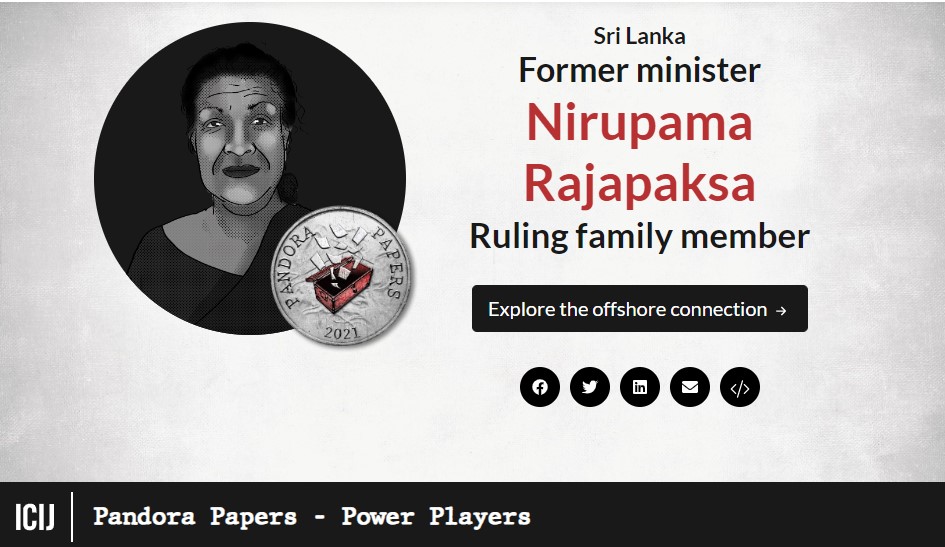
As Sri Lanka’s ruling Rajapaksa’s flee, Pandora Papers reveal ties to UAE properties

With furor over the powerful family’s riches at a fever pitch, foiled escape to Dubai spotlights special relationship to the emirate.

By Scilla Alecci

When embattled Sri Lankan President Gotabaya Rajapaksa attempted to flee his country in the face of economic and political crisis this week, he chose the United Arab Emirates as his preferred destination, underscoring the ruling Rajapaksa family’s ties to the Persian Gulf financial hub.

Rajapaksa and some of his relatives, including a former finance minister, were stopped from boarding flights to Dubai, the UAE’s commercial center, on Tuesday as protesters surrounded the airport, CNN reported. Rajapaksa was expected to resign today, but instead fled to the Maldives on a military jet, with some media speculating that he may head to Dubai at a later stage.

The vast wealth of the Rajapaksa family, who have dominated the country’s politics for nearly two decades, became a flashpoint in massive protests that have engulfed the country since March as Sri Lanka faces critical shortages of fuel, medicines and other goods partly triggered by years of mismanagement of state funds. A series of top political resignations left the president and his brother, then-Prime Minister Mahinda Rajapaksa, further isolated. The mass demonstrations culminated in hundreds of protesters occupying the palaces of the president and prime minister on Saturday, partying at the estates and setting the latter on fire in recent days.

The hidden assets of some Rajapaksa family members were revealed last fall in the Pandora Papers, a global investigation of offshore finance led by the International Consortium of Investigative Journalists. The documents revealed how Nirupama Rajapaksa, a scion of the ruling family, and her husband, businessman Thirukumar Nadesan, had used secretive shell companies and trusts to accumulate more than $18 million in tax havens, and own artworks and luxury properties in London and Sydney.

Thirukumar Nadesan’s UAE resident identity card. Image: Pandora Papers

The Pandora Papers documents, leaked from 14 offshore service providers, show that the couple has secret ownership ties to UAE properties as well.

Included in the leak of 11.9 million confidential files are utility bills, a UAE resident identity card and other records showing that, as of 2019, Nadesan and the couple’s two children were residents of Dubai. The documents link them to an apartment in a luxury residential skyscraper but don’t say whether the family owns the property.

Nadesan, identified in the files as the manager of a Dubai-based asphalt trader in 2016, also listed another Dubai address as his residence in an application to open a bank account for one of his shell companies.

Nirupama Rajapaksa is related to both Gotabaya Rajapaksa and his brother, Mahinda, who over the years have exchanged top posts, including president and prime minister until recently, when both were forced to step down amid the economic crisis

Following the Pandora Papers revelations about the couple’s offshore holdings last October, President Rajapaksa announced his government will look into the matter and the Commission to Investigate Allegations of Bribery or Corruption launched an investigation. But the probe stalled, according to Sri Lankan media which cited banks’ delay in providing information about Nadesan and Nirupama Rajapaksa’s accounts.

In the meantime, she has traveled to Dubai at least once, Sri Lankan newspapers reported. Their son, who resides in the emirate according to the leaked records, often parades his luxurious lifestyle in the Gulf in selfies published on his Instagram channel.

Images captured on a blog show the young man dining on a rooftop against the backdrop of Dubai’s night skyline.

Nirupama Rajapaksa, Nadesan and their son did not respond to ICIJ’s requests for comments sent via email and Instagram.

A rising hideaway for powerful exiles

In recent years, the UAE has become a popular destination for oligarchs and criminals who seek a safe haven to hide their wealth after other offshore jurisdictions introduced more controls under pressure from the international community.

As part of the Pandora Papers investigation, ICIJ documented how the confederation of seven sheikdoms offers shell companies that mask their real owners’ identities, dozens of internal free-trade zones that provide even more shadows for them to hide in, and a regulatory system known for what anti-corruption advocates call its “ask-no-questions, see-no-evil approach” to dealing with money tied to gold smuggling, arms trafficking and other crimes.

Researchers at the EU Tax Observatory, a think tank, estimate that about 27% of Dubai’s real estate market is owned by foreigners, including individuals from conflict-ridden countries and countries under autocratic rule.

As of 2020, at least 408 Sri Lankan nationals owned 590 properties in Dubai valued at $205 million in total, according to the Observatory’s report based on confidential property data.

In March, the world’s main anti-money laundering watchdog placed the UAE on its “gray list” of countries that need extra monitoring. The Paris-based Financial Action Task Force said the country needed to strengthen its ability to pursue high-risk money laundering threats and demonstrate a “sustained increase” in effective money laundering investigations and prosecutions.

Investigators working for previous Sri Lankan administrations, which briefly replaced the Rajapaksas’ rule between 2015 and 2019, accused members of the Rajapaksa family and associates of stashing hundreds of millions of dollars in Dubai bank accounts. They have denied the allegations.

Original Link – International Consortium of Investigative Journalists

https://www.icij.org/investigations/pandora-papers/as-sri-lankas-ruling-rajapaksas-flee-pandora-papers-reveal-ties-to-uae-properties/

NIMJN in collaboration with CIR trained three Sri Lankan investigative journalists on mobile storytelling

NIMJN – Nepal Investigative Multimedia Journalism Network in collaboration with the Center for Investigative Reporting Sri Lanka trained three Sri Lankan investigative journalists on mobile storytelling earlier this year.

DCAP Sri Lanka Trauma Reporting Support Program | 16-18 September 2022 | Singapore

Dart Centre for Journalism and Trauma, Asia Pacific (DCAP) will hold a two-day trauma reporting support program for Sri Lankan journalists in Singapore. The program is designed to build resilience during traumatic reporting situations. It will be held between September 16-18th, 2022.

The program is part of DCAP’s ongoing engagement with the Sri Lankan journalism community to enhance safe reporting skills. The Sri Lankan journalism community has faced unprecedented turmoil in their professional and personal lives since public protests erupted in April. This program will create the opportunity to take a step back from the day-to-day deadlines and reporting routines. It will also give the DCAP and the Sri Lanka journalism community a chance to build on its ongoing engagements to setup an effective peer support network for journalists in Sri Lanka.

Details/Application form – https://docs.google.com/forms/d/e/1FAIpQLSekM-K652xXoeEyAySa0nGf07MPebOA-PNTKXsf1TaEOblFrw/viewform

The Future of Journalism in South Asia – Empowering journalists digitally to push back

Journalists and media workers are already grappling with the shrinking free and safe places to do their job. Offline and online platforms mirror each other and often leads to online threats having offline consequences, and vice versa. They deal with different threats on different digital and social media platforms, including but not restricted to cyberbullying, deadly threats, doxing, harassment including sexual harassment for doing their job.

The situation is worse and alarming if the world’s top social media platforms are unable to cope especially in the region. In such a dangerous scenario, many journalists and media workers are unable to continue doing their job. The main reasons for this include lack of awareness; training and remedies to protect oneself and data online.

To cope with the situation and help journalists and media workers to push back, the Center for Investigative Reporting (CIR) and Media Unlimited, supported by Meta Journalism Project, have organized a four-part webinar series titled “The Future of Journalism in South Asia” commencing from July 2022.

The webinar series has been developed keeping in mind the needs of journalists and media and how to help them cope and work efficiently do journalism in the digital world. The webinars will provide participants an opportunity to connect with digital experts, journalists, and media workers – from Bangladesh, Nepal, Pakistan, and Sri Lanka – who will guide them on how to deal with multilayered threats online; keep safe online, and do better journalism in safer digital spaces.

This is a unique opportunity for participants to get insights from the experts in the field to learn how to maximize their Facebook presence as conversation starters, and influencers and to promote their journalism content in the most ethical and effective manner. Experts will also talk about journalist safety, elevating journalism standards, and engaging the next generation of journalists. The virtual workshop will look at journalists’ safety with a hands-on approach.

The first webinar of the series themed ‘Protect yourself online’ is scheduled for 14 July 2022 from 4 – 6 pm (Pakistan Time) via Zoom. Four experts from diverse fields will join the webinar to share their knowledge and experience with you.

Join us with your colleagues and comrades – leave no one behind.

Call for Applications: South and Southeast Asia Gender and Digital Rights Fellowship

EngageMedia is now accepting applications for the South and Southeast Asia Gender and Digital Rights Fellowship, a new opportunity for changemakers in these regions through our work on the Greater Internet Freedom program.

The two-month fellowship is designed to empower advocates in Bangladesh, Cambodia, Indonesia, Maldives, Nepal, Philippines, and Sri Lanka to do work around the intersection of gender rights and digital rights, with a focus on key issues in their respective countries and within the region. The program aims to increase the number of digital rights defenders in the region that implement a gender lens in their advocacy work, as gender-based issues and threats have increased in recent years.

The deadline for applications is on Sunday, July 24, 2022, 23:59 Bangkok time (UTC+7).

The fellowship program includes the following key activities:

  • Four online learning sessions that will cover the following topics:
    • Gender rights landscape in South and Southeast Asia;
    • Introduction to digital rights and safety;
    • Gender and digital rights movement in South and Southeast Asia; and,
    • Key gender and digital rights issues in South and Southeast Asia.
  • A two-month mentoring period between EngageMedia and the fellows, where specific fellowship goals agreed upon will be worked on, based on the needs of the selected participants and their organisations.
  • Technical and content support for the fellows, to be provided by EngageMedia, in the event that they want to conduct campaigns or produce content about gender and digital rights during the fellowship.

Selected fellows will be given a modest allowance to cover the cost of communications for their participation during the program.

The opportunity is open for gender and digital rights advocates in the following countries: Bangladesh, Cambodia, Indonesia, Maldives, Nepal, Philippines, and Sri Lanka. Examples of eligible individuals include (but are not limited to):

  • Staff members of civil society organisations who are interested to do advocacy work on gender and digital rights;
  • Students and young leaders who are interested to do advocacy work on gender and digital rights within their school, university, or organisation;
  • Community leaders who are interested to do advocacy work on gender and digital rights within their area or locality; and,
  • Other advocates interested in engaging an organisation or a community about gender and digital rights.

Interested parties may apply through the form below on or before Sunday, July 24, 2022, 23:59 Bangkok time (UTC+7). For further inquiries about this opportunity, please reach out to EngageMedia Project and Communications Manager Vino Lucero at vino@engagemedia.org.

Registration link: https://engagemedia.org/2022/fellowship-gender-digital-rights/

The Future of Journalism in South Asia – Webinar 1 – Protecting Yourself Online

Digital Journalism is the new normal and connectivity is key to journalism. Many journalists use digital tools and platforms to work and connect.

The Centre for Investigative Reporting, Sri Lanka and Media Unlimited, Pakistan, supported by the META Journalism Project, will be conducting a series of webinars for journalists and media professionals from Bangladesh, Nepal, Pakistan and Sri Lanka where challenges to digital media will be discussed.

If you are a journalist or media professional and want to learn new skills or better understand issues relating to the digital media, please register for this informative series of training webinars starting with “Protecting Yourself Online” on July 14, 2022.

To register please follow the link below:

https://docs.google.com/…/1nRkHu…/edit

Living the story: Reporting civil unrest safely, empathically and ethically, a conversation on trauma literate reporting with Sri Lankan journalists

Date July 4 (9.00 am Colombo time)

The Dart Centre Asia Pacific invites you to a virtual dialogue with journalism and trauma experts on safe psychosocial skills for reporting civil unrest in your community. Top journalism and trauma experts will take part in this session tailormade and only open to Sri Lankan journalists.

Resource personnel – Dr Erin Smith (CEO DCAP), Dr. Kimina Lyall (Deputy CEO DCAP), Amantha Perera (Project Lead, DCAP)

Registration/Details – https://forms.gle/mkNoMesGSJQgYXQ37