
By Niresh Eliatamby
Sri Lanka, thrown unwittingly into the spotlight of the 2026 West Asia Conflict, has provided an abject lesson to the world in maintaining neutrality while prioritizing its own national interests.
The legendary French President Charles De Gaulle once said, “France has no friends, only interests.” De Gaulle was known for his cold pragmatism, considering international relations as a supremacy battle, and not based on sentimental friendships. This has become a truism in global international relations.
What are Sri Lanka’s interests in the ongoing war? The U.S. is a major market for Sri Lanka’s apparel and rubber products. Iran is a significant buyer of the famed Ceylon Tea. The Gulf Arab States employ a massive number of Sri Lankan migrant workers who send vital forex. India is Sri Lanka’s closest neighbor, and the island needs to stay loosely aligned with India’s policies. Aside from these geopolitical factors, Sri Lanka, after enduring a devastating 27-year war, should not be involved in the disputes of other nations. The island should prioritize its own strategic interests.
Global applause for Sri Lanka
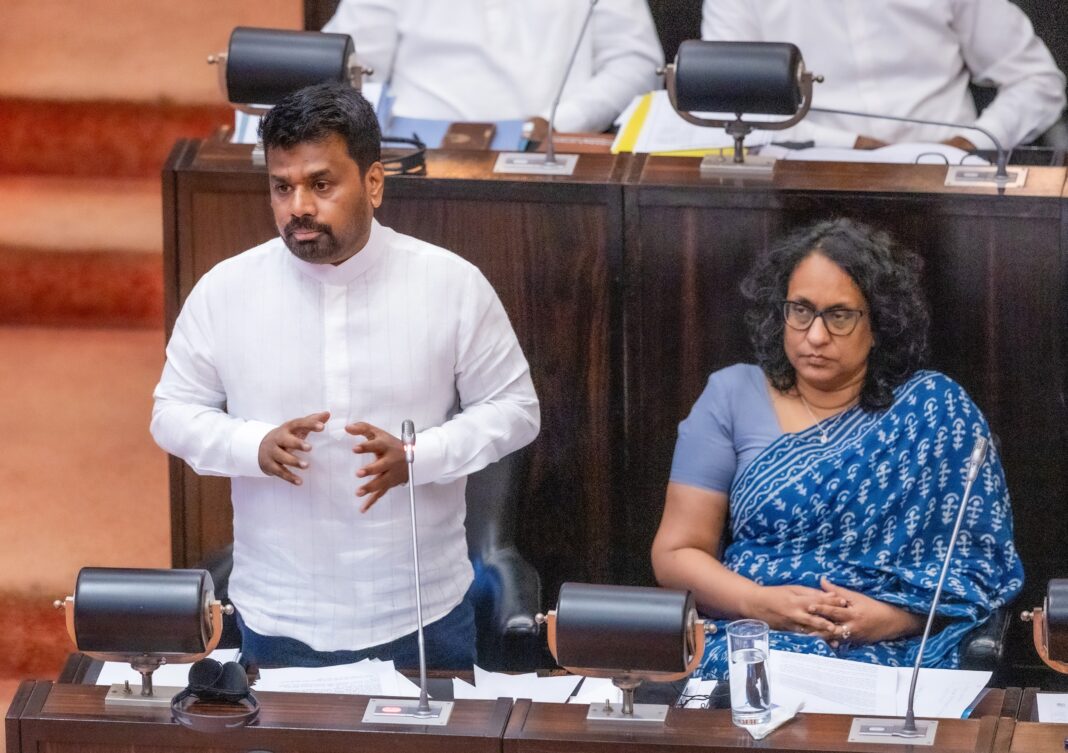
President Anura Kumara Dissanayake is receiving global applause for standing up to the U.S. and declining to allow U.S. military aircraft to be refueled in Sri Lanka. The U.S. reportedly requested permission for two U.S. Navy warfare aircraft to land at the Mattala Rajapaksa International Airport (MRIA) on
February 26, just two days before the U.S. and Israel launched their military offensive against Iran. What Dissanayake did in fact, was to carefully place the country’s interests first. In his doing so, Sri Lanka appears to have avoided a potentially explosive situation for the Indian Ocean island.
The island of Diego Garcia, in the Chagos Islands south of the Maldives, is home to one of the largest U.S. military bases in the world. The outside world hardly ever hears of it because outsiders are not allowed there. This is the only base near the Middle East believed to be out of range of Iranian missiles, although Iran has attempted missile strikes against it that did not reach the American facility. During last year’s 12-day war, B2 stealth bombers flew missions out of Diego Garcia against Iran, and U.S. Navy warships operated out of the base.
But there is just one snag to Diego Garcia. It’s a British island, and the UK Government must approve any offensive operations from it. This January, when the Trump regime asked for approval to use it for operations against Iran, British Prime Minister, Sir Keir Starmer, said no. This is the cause of a massive public rift between Trump and Starmer.
American warplanes had to operate from Gulf bases that are easily accessible to Iranian missiles, or alternatively, from distant European bases, requiring mid-air refueling—a challenging procedure. In this backdrop, the request came to refuel a couple of aircraft if Sri Lanka. Seems innocent enough. But why would the U.S. need to do that when they can do so at Diego Garcia? Unless these planes were meant to be used against Iran. A complex conundrum indeed.
In the middle of all this came the request from Iran for its warships to enter Colombo, complicating matters further.
President Dissanayake took the wise approach of not rushing in to decide, which is a prudent approach. The matter was further compounded by the sinking of an Iranian warship, the frigate IRIS Dena, 20 nautical miles off Galle, in southern Sri Lanka. It was in international waters, but within the Search And Rescue (SAR) region that Sri Lanka is responsible for. To the immense credit of Sri Lanka, the navy rushed to answer the distress call, rescued 32 sailors, and recovered 84 bodies.
Meanwhile, Colombo politely declined the U.S. request. One Iranian auxiliary ship, the IRIS Bushehr, was allowed to enter our waters, and its crew taken off. It is likely to be returned to Iran after the conflict ends. The third vessel, the IRIS Lavan docked in Kochi.
President Dissanayake’s handling of the situation is in stark contrast to a similar situation that Sri Lanka was involved in during 1971.During the Bangladesh War of Independence, after East Pakistan seceded from Pakistan and declared itself as Bangladesh, military forces from West Pakistan rushed to quell the uprising. India closed its airspace to Pakistani aircraft, and the only route left was around India, for which Pakistani air force planes did not have the range. Inexplicably, Sirimavo Bandaranaike’s government agreed for Pakistani air force aircraft to refuel at the Bandaranaike International Airport (BIA).
Given that India is strategically and geographically more important to Sri Lanka than Pakistan, the decision was questionable, especially as India entered the war and crushed Pakistani forces within a few days, resulting in the birth of Bangladesh.
Watching national interest
It is fundamental that every country must identify its own interests. Economic interests often drive it. There are other considerations too. A country’s interests also include factors such as geographic closeness, shared languages, cultural similarities, religious beliefs, and more. But they are of secondary interest. Money talks: countries walk. Governments form alliances with partners that provide the most economic advantages, but these relationships often end when conditions change.
The 2026 West Asia conflict is forcing countries to choose sides, making it extremely difficult to stay neutral. Old alliances collapse as new ones are formed. Europe, Russia, China and India have opted to stay out of the war. But nations in proximity to the conflict have been drawn in deliberately by the primary combatants – the U.S., Israel and Iran. These include Azerbaijan, Turkiye, Lebanon, Jordan, Iraq, Saudi Arabia, Kuwait, Qatar, Oman, the United Arab Emirates, and even Cyprus. Meanwhile, the Houthis of Yemen, longtime allies of Iran, have chosen to stay silent, in a volte face that is dictated by their national interests.
Staying neutral is not without risks, however. Sri Lanka risks drawing the ire of Iran, Israel, and more significantly the irrational Trump administration. Although it is still uncertain, the balancing act has been successful up to this point.
Does non-alignment work?
Sri Lanka has for decades clung to the quaint notion that it is non-aligned. This is all genuinely nice on paper. Sri Lanka has frequently been aligned, either by choice or circumstance. Given independence in 1948 as the Dominion of Ceylon, we became a founding member of the Non-Aligned Movement (NAM) in 1961. Yet, the island continued to be a significant military base for the colonial masters the British, until we declared ourselves a republic in 1972.
The friendship between Prime Minister Sirimavo Bandaranaike and her Indian counterpart Indira Gandhi brought the neighbors closer in the 1970s. But with the 1977 victory of the United National Party (UNP), President J.R. Jayewardene shifted the foreign policy towards the West, where major markets existed for Sri Lankan products. India’s meddling in the ethnic issue led to much animosity through the 1980s raising serious suspicions of India’s interventionist attitude, creating a gulf.
Following the assassination of Indian Premier Rajiv Gandhi by the Liberation Tigers of Tamil Eelam (LTTE), India and Sri Lanka moved closer in the 1990s as they faced a common enemy. But the rise of the Rajapaksa dynasty led to the island aligning itself openly with China, and virtually ignoring the rest of the world, another inexplicable geopolitical decision.
However, the economic rise of India, coupled with the 2022 financial disaster of the Gotabaya Rajapaksa administration, has placed Sri Lanka once again firmly within India’s sphere of influence.
Where do Colombo’s interests lie?
Sri Lanka finds itself in a unique geographical location, with just one immediate neighbor, India. Since India has 75 times the population of Sri Lanka, there is no logic in expending resources for a military tussle with our neigbour. Indeed, Sri Lanka is under India’s military protection.
This leaves Sri Lanka solely with the task of taking care of the island’s economic security. As for imports, the island needs to ensure steady supplies of fuel, coal, food, and medicines. Given the current circumstances, it is necessary to develop international partnerships that can be relied on during times of crisis.
Sri Lanka also needs to take care of her revenue streams. This starts with labor, which means we need to ensure excellent relations with the Gulld countries where we have a significant migrant labor population. Tourism is another key industry, and it is vital to ensure that nothing internal disturbs the industry. Innovative approaches are essential for handling external disruptions, like losing airline connections during the current crisis.
Finally, Sri Lanka must carefully manage her export markets for apparel, tea, rubber, and other products. This calls for maintaining strong relationships with our existing markets. This may prove difficult when the same countries are at war with each other.
Meanwhile, it is hoped that the IRIS Dena and the US aircraft incidents will remain isolated ones. There are no more Iranian warships outside of Iran and the Persian Gulf. The chances of an air and naval battle 1,500 miles (2414 kilometers) away spreading to our shores is unlikely.
Life is about lessons learned, and Sri Lanka needs to examine the events that took place off our shores and plan our strategies for international relations according to the island’s geopolitical and economic priorities.
About the Author:
Niresh Eliatamby is a long-time investigative journalist based in Colombo, who has significant experience in journalism across a wide range of social media platforms, as well as television, radio, and print media. Views are strictly personal and do not represent the views of the organization.
This story was produced with support from Report for the World, a global media service strengthening local independent journalism.