
Speed read
- Sri Lanka’s fuel system is constrained by limited storage capacity, not supply, with only about 150,000 metric tons available across key terminals.
- Absence of a strategic fuel reserve forces reliance on operational stocks, leaving little buffer against global disruptions.
- Major infrastructure projects including new tanks, pipelines and expanded facilities will not deliver relief until the late 2020s.
- Financial constraints, fossil fuel dependence, policy inconsistency and underused renewable energy continue to compound long-term energy insecurity.
COLOMBO – Sri Lanka is not running out of fuel but, it is running out of space to store it.
As global volatility strains supply chains, the country’s limited storage capacity is emerging as a critical weakness, raising the risk of an energy crisis driven not by availability, but by infrastructure constraints.
Excluding facilities operated by Lanka Indian Oil Corporation (LIOC) in Trincomalee, the country’s main storage hubs at Kolonnawa and Muthurajawela provide a combined capacity of about 150,000 metric tons. However, these facilities cannot operate at full capacity at all times, as stocks must be carefully managed in line with shipment schedules and distribution cycles.
According to Ceylon Petroleum Corporation (CPC), at the onset of the current crisis, only around 103,000 metric tons were in storage—well below maximum capacity. Meanwhile, daily fuel demand stands at approximately 1,800 metric tons, including aviation fuel, while the Sapugaskanda refinery supplies about 1,080 metric tons per day. The remaining requirement must be met through imports, leaving the system exposed to logistical disruptions.
Petrol storage capacity stands at 161,087 metric tons, with 136,270 metric tons available at the start of the crisis. Yet Sri Lanka does not maintain a separate strategic reserve. Operational and buffer stocks are held within the same facilities, requiring tight coordination to avoid shortages.
Aviation fuel stocks currently provide a buffer of 49 days, while crude oil inventories are sufficient for 26 days, extendable to 44 days with shipments already at sea. Despite these margins, officials and industry sources acknowledge that the real constraint is not procurement, but storage and unloading capacity.
Infrastructure plans offer long-term relief
In March, President Anura Kumara Dissanayake outlined a series of infrastructure projects aimed at addressing these constraints, though most are years from completion.
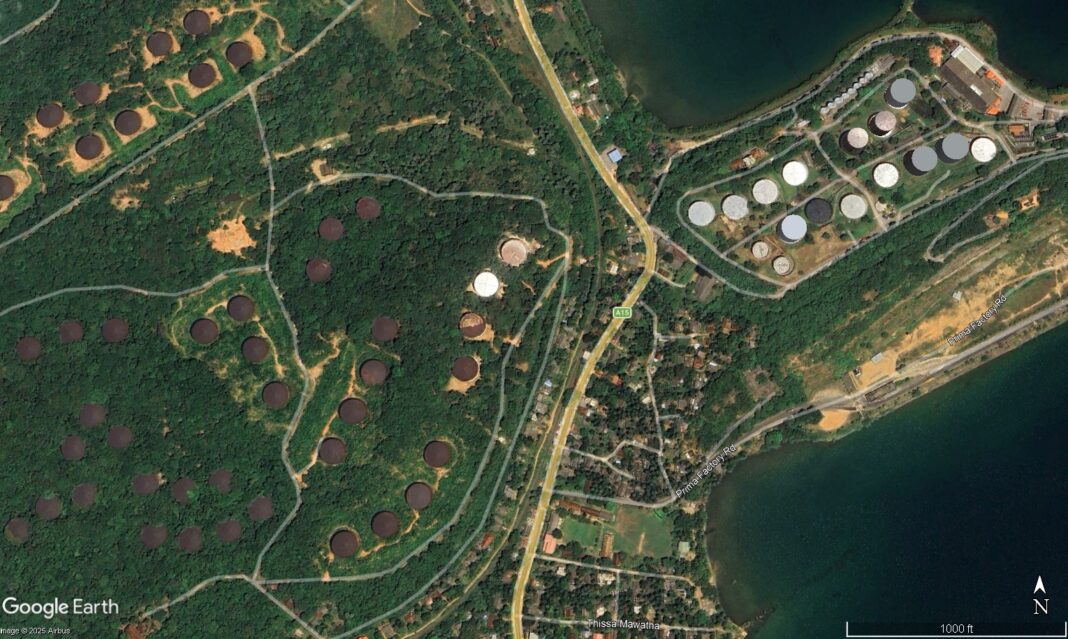
In Trincomalee, 24 tanks are available, with 21 under government control after allocations to Prima. Each tank holds 10,000 metric tons, totaling 210,000 metric tons. However, only a portion is currently operational. Four tanks have been selected for refurbishment under the first phase, with two already completed.
President Dissanayake also said: “A new pipeline system linking the port to storage facilities estimated at Rs. 7.37 billion ($116,911,596.56) is expected to enable an initial operational capacity of 40,000 metric tons.
At Kolonnawa, an 86,000-metric-tonne storage complex is under construction, with completion scheduled for January 2028. The project, comprising eight new tanks, is expected to extend national fuel coverage by approximately 10 days.
Muthurajawela is also set for expansion, with an additional 40,000 metric tons of storage planned at a cost of Rs. 3.5 billion ($10,953,200.20). A further 63,000 metric tons of dedicated aviation fuel storage is proposed, alongside a pipeline connecting Muthurajawela to Katunayake.”
Legacy infrastructure also remains a critical weakness. The 90-year-old pipeline from the Kolonnawa storage facility to the Colombo Port is to be replaced with modern 14-inch (35.56 cm) and 18-inch (45.72 cm) lines at a cost of Rs 12.8 billion ($ 40,058,631.86), while the naphtha (a flammable liquid hydrocarbon mixture) pipeline to Kelanitissa power station will be replaced at a cost of Rs. 1.5 billion ($ 694,110.11). In total, the government has allocated approximately Rs. 30 billion ($ 93,881,683.10) for energy infrastructure upgrades.
Storage limits shape supply strategy
Industry officials say the country’s storage ceiling directly shapes its fuel procurement strategy.
“We have storages in Kolonnawa, Muthurajawela and 10 other sub locations to store refined fuel,” said Mayura Neththikumarage, managing director of the CPC. “Sapugaskanda refinery stores crude oil enough for 45 days.”
He noted that refined fuel storage capacity allows for roughly 25 days of supply, underscoring the system’s reliance on continuous imports and tightly managed inventories.
On the Trincomalee oil tank farm, Neththikumarage highlighted long-standing underutilization. Of the 99 tanks at the facility, only a fraction has historically been in use. While some were transferred to the Indian Oil Corporation (IOC) in the early 2000s, others remain under joint or state control, with refurbishment efforts ongoing.
Gas shortages mirror storage constraints
Liquefied petroleum gas (LPG) storage presents a similar challenge. National capacity stands at just 8,000 metric tons, against a daily demand of between 1,000 and 1,200 metric tons.
To bridge the gap, President Dissanayake told parliament, authorities are considering temporary use of 15,000 metric tons from a privately owned 30,000-metric-tonne terminal. Additional measures include the import of 100,000 new Litro gas cylinders to stabilize domestic supply.
For sustainability expert Vidura Ralapanawe, the storage problem is as much about economics as infrastructure.
Maintaining strategic reserves, potentially covering two months of demand, requires significant working capital, tying up scarce financial resources in inventory that may remain unused for extended periods.
“Wealthier economies can afford to maintain large reserves, but for Sri Lanka, the question is not just whether we can store fuel, but whether we can afford to,” he told CIR.
This financial constraint feeds into broader energy insecurity. Sri Lanka remains heavily dependent on imported fossil fuels, leaving it exposed to global price shocks and supply disruptions.
Seasonal dynamics further complicate the picture. Between February and May, reduced hydropower output increases reliance on oil-based power generation. When global price spikes coincide with this period, the strain on both fuel supplies and public finances intensifies.
Despite these vulnerabilities, progress toward energy diversification has been uneven.
“Policy reversals have slowed initiatives such as electric vehicle adoption and renewable energy expansion, while investment continues in fossil fuel infrastructure. At the same time, limited battery storage capacity forces the grid to curtail significant volumes of solar power during the day. Up to 1.3 gigawatt-hours (GWh) of renewable energy is wasted daily—energy that could otherwise offset costly diesel generation during peak evening demand. The result is a system that remains both inefficient and expensive, with diesel-based electricity generation costing around Rs. 100 per unit,” he pointed out.
Crisis risk extends beyond fuel
Looking ahead, climate variability is expected to intensify these risks. A potential El Niño event could reduce rainfall, limiting hydropower output while increasing electricity demand during heatwaves.
Operational risks at coal-fired plants, including the Norochcholai facility, add another layer of uncertainty.
Ralapanawe cautioned that these overlapping pressures, fuel storage constraints, climate shocks and policy delays, could converge into a high-risk scenario for power shortages. Even without widespread blackouts, increased reliance on diesel generation would impose significant economic costs.
As a precautionary measure, the government has introduced remote work guidelines to maintain public services during potential energy disruptions.
Meanwhile, the ministries of Digital Economy and Public Administration have issued interim protocols enabling government institutions to operate remotely, supported by legally recognized electronic documentation under the Electronic Transactions Act.
The initiative reflects a broader effort to mitigate the impact of energy constraints on public administration, as global instability, particularly unrest in West Asia since late February, continues to influence fuel markets.
President Dissanayake meanwhile has assured the absence of an immediate fuel shortage. However, he has acknowledged the potential impact of an escalating global conflict could force the government to reassess its response.
Sri Lanka’s challenge, then, is not simply securing fuel but building the capacity to store, manage and deploy it effectively.
Without that, the country risks entering an energy crisis not because fuel is unavailable, but because it has nowhere to store it.
This story was written and edited by Gagani Weerakoon. She leads the editorial at the Center for Investigative Reporting (CIR).
This story was produced with support from Report for the World, a global media service strengthening local independent journalism.