
CIR launches South Asia series with a dialogue on self-care and community care for journalists during and post-COVID-19

Bringing together a diverse group of journalists from across the region, CIR kicked off its South Asia series #1: “Self-care and community care for journalists during and post-COVID-19” on 6 May 2020.

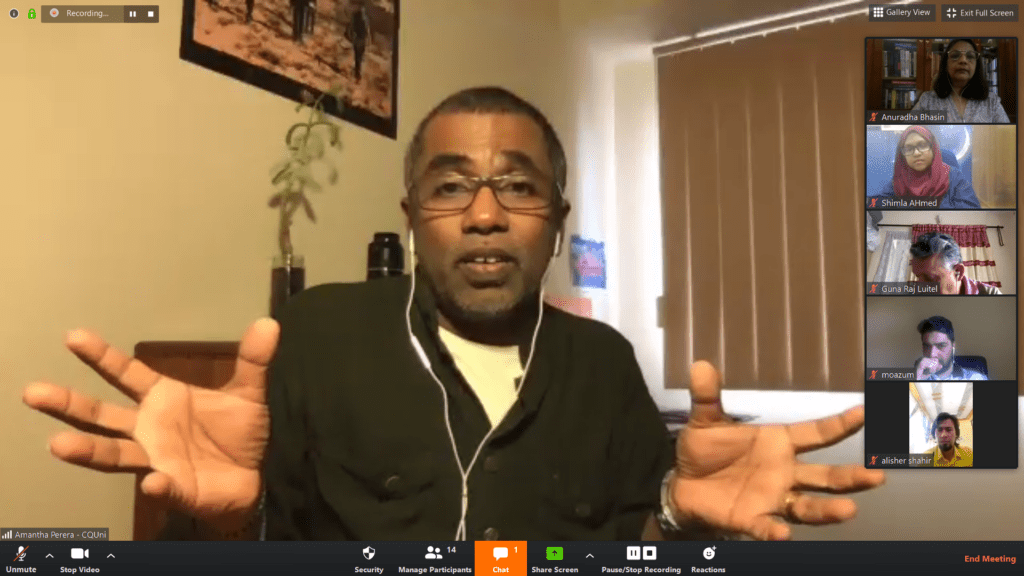
Resource Person Amantha Perera explains during the South Asian Dialogue on Self-care and community care for journalists during and post-COVID-19 on 06 May 2020 via Zoom.

As the world battles against a global pandemic, journalists are in the forefront, telling the COVID-19 story. They are first responders themselves, dealing with multiple challenges, ranging from screaming deadlines, domestic crises, restricted mobility and having to deal with personal safety and well-being.

In these challenging times, journalists play a critical role in keeping their communities informed. COVID-19 has made everyone a health reporter.

But how can journalists cover the global pandemic effectively when they often have to consider self-care and deal with psychological stress, challenges to their own health and safety and an uncertain future? What are the best practices we can draw from?

A section of participants at the South Asian Dialogue on Self-care and community care for journalists during and post-COVID-19 on 06 May 2020 via Zoom

Amantha Perera, senior journalist, media researcher and trainer engaged with the group during 90 minutes of conversation, looking at self-care, community care, dealing with general, specific and anticipatory anxiety in different settings, developing individual self-care plans, how to ensure post trauma growth and the importance of circles of trust and solidarity building.

Amantha is a researcher with the Creative Arts Research Training Academy, CQUniversity, Australia. His main area of expertise is journalism and online trauma threats. He also works as the Asia-Pacific Coordinator for the DART Center for Journalism and Trauma, Columbia University, USA.
Hot this week

Belgian students take to the streets to make their voices heard 

Speed Read Thousands of students in French-speaking Belgium have been...

Were the Detentions During Anti-CEC Protests in India Legal?

Experts call out the legality of detentions, which they...

Applications are now open for the 2026 cohort of the MSF Without Borders Media Fellowship

Médecins Sans Frontières (MSF) South Asia, in partnership with...

Sri Lankan worker Anojan’s death sentence overturned, but release from Saudi detention remains uncertain

Speed Read Saudi Arabia’s Supreme Court set aside the death...

In some part of Sri Lanka, Malaiyaha Tamil children fight for equal access to education

Speed Read A grade 4 student’s mastery of the periodic...

Topics

Belgian students take to the streets to make their voices heard 

Speed Read Thousands of students in French-speaking Belgium have been...

Were the Detentions During Anti-CEC Protests in India Legal?

Experts call out the legality of detentions, which they...

Applications are now open for the 2026 cohort of the MSF Without Borders Media Fellowship

Médecins Sans Frontières (MSF) South Asia, in partnership with...

In some part of Sri Lanka, Malaiyaha Tamil children fight for equal access to education

Speed Read A grade 4 student’s mastery of the periodic...

Why Buddhist monks may have to wear lay clothes in court?

COLOMBO— Controversial Sri Lankan Buddhist monk and Bodu Bala...

DBS Jeyaraj, the journalist who explained one Sri Lanka to another

Speed Read Jeyaraj reported on Sri Lankan politics and the...

Why so many of Dhaka’s children remain on the streets

Hunger and violence push children from home. Drugs, criminal...

Related Articles

Popular Categories