Sri Lanka faces a medium to high overall disaster risk and ranked 31st globally on the INFORM Risk Index and is highly vulnerable to annual monsoon floods, landslides, cyclones and droughts. Increased urbanization and infrastructure development in high-risk zones such as floodplains and coastal regions have escalated the country’s vulnerability. Frequently ranked among the top countries vulnerable to extreme weather, over 80 & of Sri Lanka’s population remains vulnerable to climate change impacts.
the Center for Investigative Reporting (CIR) is convening an expert discussion on crisis reporting titled “Frontlines of Truth: Reporting in Times of Crisis” on 30 January 2026, from 9.00 am to 11.30 am at the Sri Lanka Press Institute (SLPI).
Two featured speakers, Rajneesh Bhandari, a multimedia journalist of international repute and Founder/Chief Editor of the Nepal Investigative Multimedia Journalism Network (NIMJN) and Dr. Sanjana Hattotuwa, a globally- renowned expert on information disorder, new media literacy and digital security will share insights and highlight the need for professional disaster journalism that prioritizes public safety and crisis communications.
A panel discussion will follow the expert presentations.
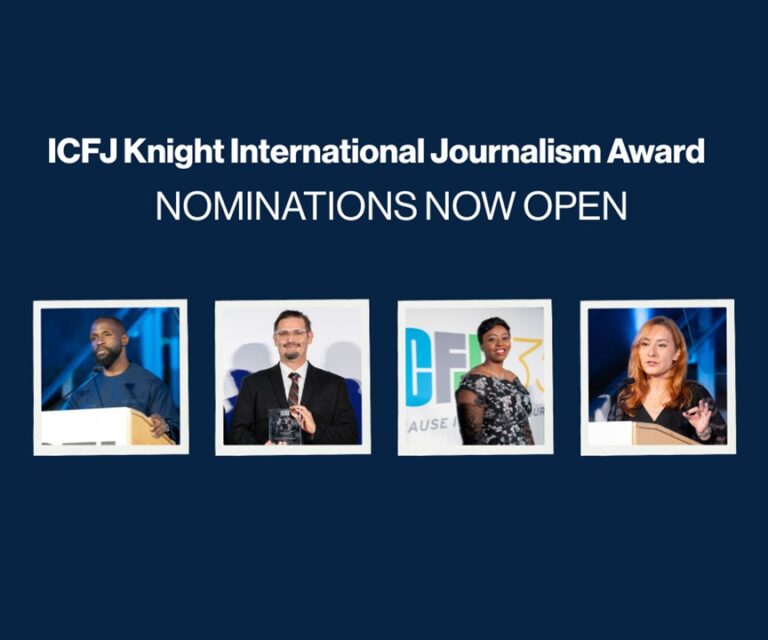
Each year, the International Center for Journalists honors outstanding colleagues with the ICFJ Knight International Journalism Award at our Awards Dinner. We are now seeking nominees whose pioneering coverage or media innovations have made an impacton the lives of people in their countries or regions.
Candidates can be reporters, editors, technologists or citizen journalists from countries where they face major challenges doing their work. Those who meet the award’s criteria may nominate themselves. The deadline is Feb. 8.
Winners will be honored in November at ICFJ’s Awards Dinner 2026 in Washington, D.C.
In 2025, ICFJ Knight International Awardees were Philip Obaji Jr. and César Batiz. Obaji is one of the foremost journalists reporting for international audiences on massacres, torture and resource extraction by Russian paramilitaries in Central and West Africa. Batiz is the co-founder and director of El Pitazo, a pioneering media outlet that has developed innovative ways to reach and involve Venezuelans in a restrictive information environment. Learn more about past awardees here.
2025 ICFJ Knight Award winners Philip Obaji Jr. and César Batiz (center) with (from left to right) Knight Foundation Director of Journalism Marisa Kwiatkowski, ICFJ President Sharon Moshavi, NBC News and Telemundo Anchor José Díaz-Balart and ICFJ Board Chair Carrie Budoff Brown – ICFJ
With the passing away of Iqbal Athas (81), a glittering era in Sri Lankan journalism comes to an end. He belongs to a generation of journalists that relied on rigorous information verification before the availability of digital verification tools and worked with a highly reliable and large network of human sources to tell stories unimpeachable accuracy. “Situation Report by Iqbal Athas” was a must read on a Sunday and through his column, Iqbal kept an entire country informed of defence matters and offered rare insights.
His death marks not only the passing away of an iconic journalist but a brand of high-quality journalism Sri Lanka is fast losing, that required great effort and time. A pioneering journalist and the long-serving Consultant Editor of The Sunday Times, Athas was among the most influential figures in the country’s media landscape and beyond.
For decades, he was closely associated with the principle that power must be subjected to public scrutiny. His career was marked by a sustained commitment to fact-based reporting, often carried out in challenging and, at times, threatening circumstances. Through investigations that raised serious questions about governance, transparency, and accountability, Athas came to occupy a distinctive place in Sri Lankan journalism.
Sri Lanka’s civil war, which lasted nearly three decades, unfolded in a climate where defence matters, particularly military expenditure and procurement, were frequently treated as matters beyond public scrutiny on grounds of national security. It was within this sensitive environment that Iqbal Athas established himself as a specialist reporter on defence and security affairs. Athas consistently argued, through his reporting, that independent scrutiny of the defence establishment was essential in a democratic society, particularly during periods of prolonged conflict. His work sought to examine decisions taken within opaque institutional structures, emphasizing the public interest dimension of defence related governance.
His primary platform was The Sunday Times, where he served at different times as defence correspondent, political editor, and consultant editor. Reporting extensively on the prolonged conflict, he developed detailed knowledge of military procurement processes, operational decisions, and the institutional actors involved. This specialization informed many of the investigations for which he became widely known.
Although his reporting focused on Sri Lanka, Athas also maintained a strong international presence. He was the Sri Lanka-based contributor to CNN and earlier worked with Worldwide Television News (WTN) and United Press International (UPI). Iqbal was a regular contributor to Jane’s Defence Weekly, a globally recognized publication reporting on military and corporate affairs. This international exposure brought him distinction and global attention to his work and, at critical moments, drew international scrutiny to the many pressures he faced.
The professional trajectory of Iqbal Athas cannot be separated from the risks he encountered during his reporting. Over time, responses to his work escalated from public criticism and intimidation to more serious incidents that drew concern from press freedom organizations. A notable early episode followed his reporting in 1997–98 on the disappearance of a consignment of 70,000 mortar shells purchased from Zimbabwe. While official statements at the time attributed the loss to an alleged hijacking by the LTTE, Athas reported that independent experts had questioned the evidentiary basis of that claim. His coverage was met with hostility and physical intimidation.
In 1998, after a series of articles examining alleged irregularities in aircraft procurement by the Sri Lankan Air Force, armed individuals entered Athas’s residence. According to court proceedings, his family was threatened and he was held at gunpoint. The incident led to the provision of police security, and several years later two Air Force officers were convicted in connection with the attack. In delivering judgment, the presiding judge affirmed the role of the press in exposing corruption and underscored the need for firm action when violence is used to suppress journalistic activity.
In 2005, Athas had faced the prospect of legal action after then-President Chandrika Kumaratunga publicly indicated that he could be charged under the Official Secrets Act following a column on a naval procurement issue. The Committee to Protect Journalists publicly expressed concern, stating that the threat appeared to target legitimate reporting on matters of public interest.
Another major flashpoint emerged in 2007 following Athas’s reporting on the acquisition of second-hand MiG-27 fighter aircraft from Ukraine. In an article titled “MiGs loaded with millions in mega frauds,” he examined procurement documentation and raised questions about payments made to a company identified as Belimissa Holdings, which he reported was not listed in official United Kingdom company registries. The reporting generated intense controversy and heightened pressure on journalists reporting on military procurements.
Following the MiG-27 reporting, Athas’s State-provided security was withdrawn. Demonstrations subsequently took place outside his residence, and threats were reported, including one conveyed to a journalist involved in translating his articles. International organizations such as Reporters Without Borders and the Committee to Protect Journalists issued statements expressing concern and calling on the authorities to ensure his safety, describing the developments as damaging to press freedom in Sri Lanka.
While Athas faced sustained pressure at home, his work received significant recognition internationally. This contrast between domestic controversy and international respect highlighted the standards of investigative journalism by which his work was often assessed abroad.
The many honours he received during his illustrious career include the International Press Freedom Award (1994) from the Committee to Protect Journalists, Journalist of the Year (1998), from the Editors’ Guild of Sri Lanka, Columnist of the Year (2001)from the Editors’ Guild of Sri Lanka and Alfred I. duPont–Columbia University Award (2007) awarded to a CNN team for the media coverage of the 2004 Asian tsunami.
Athas was regularly invited to speak at international forums on journalism and security, including events in Hawaii and Washington, D.C. In a notable development, he was included in Sri Lanka’s official delegation to the 71st Session of the United Nations General Assembly in 2018, reflecting the international standing he had attained over the course of his career.
Iqbal Athas’s career reflected a consistent belief that public institutions, including those operating under conditions of conflict, must remain subject to scrutiny. His reporting sought to raise questions about governance, accountability, and the use of public resources, often at considerable personal cost. His legacy lies not only in the investigations he pursued, but in the professional standard he represented. He demonstrated that careful, evidence-based journalism can endure even in restrictive environments. While Iqbal Athas has written his final column, his body of work remains a lasting testament to the role of the press in a democratic society.
An image of deceased victims in Gampola that users mistook for AI-generated content. Faces and bodies blurred/ Daily FT
A wave of social media posts hamper Ditwah disaster response while police prepares for combative action
CCID investigating online disinformation during Cyclone Ditwah under emergency regulations
False claims included villages buried, dam cracked, and expired aid shipments
Dam breach rumours overwhelmed DMC hotlines, diverting resources from relief
*Experts claim slow, uneven, and inaccessible official communication fuelled panic, while fear, and uncertainty amplified misinformation
Fact-checkers say that the rise of AI-generated visuals eroding public trust, making it harder to verify real images during crises
By Divya Thotawatte
My grandfather came shouting that the dam was cracking. We got up and ran straight out onto the road. Everyone in our lane was already outside
– Usitha Thisum Ilangakoon, a young man (21) from Pupuressa in Gampola
Screenshot of a misleading social media post analysed and debunked by Fact Crescendo shortly after landfall of Cyclone Ditwah/ Daily FT
When Cyclone Ditwah hit Sri Lanka, people were caught unawares. Warnings were woefully inadequate or entirely missing, depending on where and in which language one received information. The resulting uncertainty triggered panic, fuelling a quick surge of alarmist misinformation.
While 22 districts in the island were gazetted as disaster zones – indicative of Ditwah’s scale, with deaths, missing persons and mass displacement – rumours beat relief operations in speed.
According to the Police Department, at least 57 false social media posts linked to Cyclone Ditwah have been identified and a special unit at the Criminal Investigation Division (CID) has commenced reviewing them under emergency regulations.
Police Spokesperson F. U. Wootler told the Daily FT that the Cybercrimes Investigation Division (CCID), which operates under the CID, was inquiring into these posts. The unit was still gathering “digital, video, forensic, and cyber evidence”, and a comprehensive report would be submitted to court once investigations were completed.
Several posts circulated exaggerating the local impact of Cyclone Ditwah, like claims that entire villages had been buried by landslides, or that key infrastructure such as bridges and dams had cracked. Official agencies were also targeted, including claims that the Disaster Management Centre (DMC) had been deactivated. Other posts falsely alleged that international relief shipments, such as food aid from Pakistan, were expired, fuelling public criticism and diplomatic embarrassment. Fact Crescendo noted that such content heightened public anxiety and weakened trust in authorities and institutions at a time when clear and credible information was critical.
On 29 November, a state of emergency was declared by President Anura Kumara Dissanayake under the provisions of the Public Security Ordinance No. 8 of 1959 to better respond to the national emergency. The extraordinary gazette limited its scope to: Protect public safety and national stability during the prevailing crisis and enable rapid disaster response and coordination across all sectors. President Dissanayake, who also declared 22 districts as disaster zones, assured the nation that the regulations would be used only to deal with the national disaster.
The institutional inability to communicate coherently led to and directly created the space for disinformation to flourish
– Disinformation expert and Groundviews Founder Dr. Sanjana Hattotuwa
However, the same regulations are now being used by the Police Department to probe “inciting” social media posts that misinformed the public during a disaster.
Police response aside, the DMC too was overwhelmed by the rumour mill. The DMC was inundated with anxious callers seeking information or to verify rumours. DMC was compelled to spend valuable time and resources to counter a surge of false information spreading online, diverting attention from lifesaving response efforts.
“Time is precious for disaster response,” said DMC Media Assistant Director Janake Hadunpathiraja, who recalled having to field hundreds of calls unnecessarily engaging the DMC hotline following false claims on social media related to the cyclone. A particularly damaging viral claim was the purported breach of the Kotmale dam. Each call required operators to calm panic and verify falsehoods, taking up time that could have been utilised to guide people at risk.
Cyclone Ditwah first hit Sri Lanka’s Eastern coast on 28 November, bringing heavy rainfall, flooding, and landslides across several districts, displacing over 233,000 during the peak of the emergency, according to the United Nations (UN) Sri Lanka.
Fact-checkers and disinformation researchers monitoring online content during the cyclone noted the majority of false claims centered around floods and landslides. They noted that old videos, including floods in Indonesia, Nicaragua and India, were reshared and falsely presented as footage from Cyclone Ditwah-affected areas in Sri Lanka.
“Initially, there were many content claims on the potential damage, especially about the bridges and some dams being breached,” Fact Crescendo’s Research Consultant Prabuddha Athukorala said. “Most of this content was shared in panic and often in good faith. None of the dams were breached, and many of the claims were effectively debunked.”
Among the most visibly damaging was the false news that the Kotmale dam had breached on 30 November. Posts went viral on November 30, luring hundreds of residents out of their homes in fear.
Usitha Thisum Ilangakoon (21) from Pupuressa in Gampola recalled being jolted awake around midnight. “My grandfather came shouting that the dam was cracking,” he said. “We got up and ran straight out onto the road. Everyone in our lane was already outside.”
Because their home sits near the Pupuressa mountain, a quick exit was not possible. They waited outside for about 15 minutes, trying to reach people and verify what was happening. During that time, around 40 vehicles had sped past, and a motorcyclist had also ridden through, warning people that they were fleeing Gampola fearing their homes would be destroyed. Ilangakoon felt the warning was suspicious, prompting him to call the police. Officers confirmed it was a falsehood and that the public panicking was being used by thieves as a cover for robberies.
Sandaru Bandara Wasalthilaka (21) from Jayamalapura in Gampola said his family chose not to flee when the rumour spread, on the basis that if the dam had actually burst, there would have been no time to escape. But most others from his village and the neighbouring village fled fearing for their lives. The panic even caused several people to be hospitalised, he said. However, Gampola police confirmed that no deaths were caused as a direct result of the panic.
The DMC later clarified that the dam had not breached, with official corrections issued by the early hours of 1 December and subsequently reported in the media. The incident even drew a response from the President on 8 December.
We didn’t run. We knew that if the dam actually burst, there would be no time to run – Sandaru Bandara Wasalthilaka, a young man (21) from Jayamalapura in Gampola
Factchecker Athukorala identified Facebook, WhatsApp, and YouTube as the primary platforms through which much of the misinformation spread. He observed that the rise of AI-generated images was eroding trust so significantly that authentic photos were also occasionally mistaken for fakes, complicating verification during emergencies.
He further warned that disaster misinformation carried a risk that information that is false at the time of sharing could quickly become plausible as conditions evolved. He noted that fact- checking during the cyclone was especially difficult because conditions were changing rapidly, official confirmations were delayed, and even authorities were sometimes unsure of the ground situation.
During fast-moving crises, this uncertainty makes it harder for people to distinguish between legitimate warnings and harmful false alarms, increasing the likelihood of panic-driven decisions, he added.
Crises amplifying misinformation
Media Analyst and Science Communication Expert Nalaka Gunawardene noted that rumours have emerged around disasters long before social media. What has changed is the scale and the speed at which they spread. He explained that with Sri Lanka having 130 mobile subscriptions per 100 people and over half the population now online, rumours spread more easily.
Distinguishing between disinformation and misinformation, he noted that only a relative few would deliberately originate false content (disinformation). “When these spread, many people are fooled,” he said, adding that when these misled persons shared such content uncritically, it would become misinformation, a more widespread phenomenon.
Gunawardene also pointed to the psychological conditions created by a major emergency as a key factor in the spread of misinformation. Any disaster generated uncertainty and heightened emotions such as fear, suspicions, panic, and even hysteria. “At such times, even rational people can become more gullible to believe falsehoods,” he explained, highlighting that the real culprits were the relative few who originated falsehoods out of sheer mischief, or due to their anti-social attitudes or political interests.
DMC’s Hadunpathiraja lamented that misinformation during the cyclone had directly disrupted disaster-response operations.
Hadunpathiraja said, following the dam breach rumours, especially the false posts around Kotmale dam breach, hundreds of calls tied up the DMC hotline. Had each call taken just a minute, that meant hundreds of minutes correcting false information, time that could have been used to save lives, he explained.
“Imagine someone calling us with the last seconds of their phone battery. If they get stuck in a queue, they might not get the lifesaving information they need before their phone dies.”
He also said that posts were circulating with the contact details of DMC district officers, making matters worse. Staff had kept getting calls from other districts, diverting them from assigned responsibilities as part of DMC’s cyclone response. “Even after the DMC issued a statement recently offering correct information, the damaging posts continued to circulate,” he added.
However, National Building Research Organisation (NBRO) Director General Dr. Asiri Karunawardena said the NBRO’s experience was different. The organisation had kept its official channels updated during the cyclone and had not encountered any mis- or disinformation related to their area of responsibility.
During field operations, Sri Lanka Red Cross Society (SLRCS) Disaster Management Manager Damitha Chanaka noted that while misinformation had not directly hindered Red Cross response efforts, false information like that of the Kotmale dam breach, had caused unnecessary panic among communities. These rumours had led some residents to evacuate prematurely or move to unsafe areas, while others had disregarded official warnings due to confusion and mistrust, he added.
Chanaka added that misinformation had reduced the effectiveness of early warning dissemination and slowed relief operations, highlighting the need for stronger risk communication, verified messaging, and closer coordination with media and community leaders.
Even rational people can become more gullible to believe falsehoods – Media Analyst and Science Communication Expert Nalaka Gunawardene
Information vacuum, criminal culpability
Meanwhile, researchers noted that even when official clarifications were issued, they often arrived after rumours had already spread widely, limiting their corrective impact.
Disinformation expert and Groundviews Founder Dr. Sanjana Hattotuwa explained that slow, uneven, and often inaccessible official communication created uncertainty on the ground. “If there is coherent, regular, official, clear, and evidence-based communication, then people will not be as misled. The institutional inability to communicate coherently led to and directly created the space for disinformation to flourish.”
Much of the official communication that was published during Cyclone Ditwah was inaccessible to large segments of the population, creating fertile ground for disinformation, Hattotuwa noted, explaining that messages were predominantly in Sinhala, leaving Tamil-speaking communities uninformed, as well as the disabled, blind, and deaf, who were also not accommodated by the communications.
He explained that Sri Lanka had been grappling with the same crisis communication failures since the 2004 Asian tsunami, with little structural reform despite repeated disasters. He argued that the spread of disinformation during Ditwah was less a failure of platforms, and more the result of deep-rooted institutional weaknesses in crisis communication.
“It is their (the DMC and Meteorological Department’s) inability and unwillingness to take disaster communications seriously that created the space for public panic and mass displacement caused by the disinformation that people who were scared, anxious, traumatised, and stressed were consuming,” Hattotuwa said, noting that repeated failings of official communications amounted to “criminal culpability”.
Gunawardene added that overly technical warnings and updates from the relevant state institutions also added to the public confusion. Despite having the technical expertise and legal mandates to issue alerts, agencies such as the Meteorological Department, DMC, and the Irrigation Department had repeatedly failed, across successive crises, to communicate risks in ways that were easily understood by the public.
Drawing on his long-standing monitoring of disaster communications, he noted that inconsistent messaging, confusing visual tools such as weather maps, and imprecise wording on official updates created information gaps that allowed mis- and disinformation to thrive.
Even after the DMC issued a statement on December 29 offering correct information, the damaging posts continued to circulate – DMC Media Assistant Director Janake Hadunpathiraja
Preventing public harm
As institutional disaster communications continue to lag, emerging technologies will only accelerate the speed and reach of disinformation during crises.
Hattotuwa emphasised that AI-generated content, though it was not primarily used maliciously in this instance, could become far more convincing and dangerous in the future. “Over the longer term, you could have AI that… suggests that a particular area or community has been impacted. It can create a fraudulent relief or aid campaign that only serves to enrich whoever is behind that campaign.”
With extreme weather expected to become more frequent due to climate change, Hattotuwa stressed that chasing after false content after it goes viral would never be enough, and that strengthening the fundamentals of official, timely, and coherent crisis communication was far more effective in reducing the impact of misinformation.
Despite the scale of Cyclone Ditwah, the misinformation that accompanied it did not reveal a new failure. It exposed a long-standing pattern in how disasters have been communicated. False dam breach news, overwhelmed emergency hotlines, and diverted emergency resources highlighted how quickly an information vacuum could turn into public harm. Unless these structural weaknesses are addressed, future crises are likely to trigger the same problems and failures as this one.
This story was produced under the CIR– FACTUM Media Fellowship Program and was originally published in Daily FT on 29 December 2025.
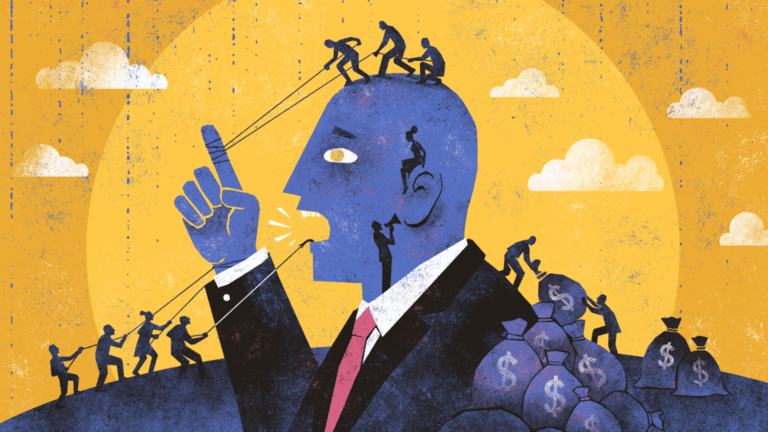
When Adolf Hitler rose to power in Germany in 1933, he hired a leading American public relations executive, Ivy Lee, to advise the Nazis on how to reduce international fears over their regime. Lee’s recommendations included arranging conciliatory meetings with diplomats and burnishing Hitler’s image by seeking favorable coverage from US journalists — actions we now call lobbying.
For journalists, there are free online tools to assist in investigating foreign lobbying around the world… Though limitations exist, stories can be uncovered via these documents no matter where you are in the world.
The United States is not alone. Countries spanning the globe, from Australia to those in Latin America, have enacted their own regulations to oversee foreign influence efforts.
These laws have evolved through the decades and resulted in a trove of records that journalists worldwide can mine for compelling stories on how countries and companies seek to exert influence abroad.
Just look at some of the stories on lobbying in 2024 and early 2025 alone:
OCCRP documented questionable actions by British politicians allegedly influenced by lobbying on behalf of northern Cyprus, a breakaway territory not recognized by most nations around the world. While some lawmakers didn’t respond to the journalist’s requests as to why they didn’t register their interest (involvement with special interest groups) before asking questions in Parliament, one later apologized for failing to register his interest, another said that she did not know it was a requirement, and a third one claimed that his “interest had been declared” but not been recorded due to a clerical error.
For journalists, there are free online tools to assist in investigating foreign lobbying around the world. While the United States has a wealth of documents and data, other countries also offer valuable records. Though limitations exist, stories can be uncovered via these documents no matter where you are in the world. This guide will walk you through the basics.
In the United States alone, more than $5 billion has been spent by foreign governments and other overseas politicians in the past decade to gain influence and push policy changes, according to the nonprofit watchdog, OpenSecrets. That includes spending by more than 180 countries, led by China, Saudi Arabia, Russia, Liberia, Canada, and Germany.
What Is Lobbying?
To follow lobbying, the first task is to understand it. Direct lobbying is when someone writes, calls, or meets with government officials at all levels to influence policy. It can include the sharing of data, research, or testimonials to sway a particular policy in their favour.
But lobbyists also use indirect lobbying methods to increase their influence. This includes grassroots lobbying and focuses on swaying public opinion to put pressure on legislators and government officials. This also includes tactics like paying a public relations firm to seek favorable media coverage, like when Vogue profiled Asma al-Assad, wife of the Syrian dictator, extolling her generosity and her looks, just a month before the Civil War in Syria started and the horrors that followed.
Not every country requires lobbyists to publicly disclose their work for foreign governments. Even when laws are in place, though, lobbyists may not publicly declare their work.
Foreign governments may also try to assert influence by making substantial donations to universities to set up programs that put their nation in a favorable light or running influence campaigns on social media like Facebook, YouTube, and Instagram. To some degree, these can be tracked online.
Foreign lobbying can come from all levels and branches of a government. It may be a top foreign government official or a less well-known branch of government, like a tourism ministry. It can be an opposition leader seeking to gain U.S. political support. The list of those who have recently hired US lobbyists for this kind of work includes the UK’s right-wing nationalist leader Nigel Farage and Duma Boko, a Harvard-trained opposition leader who sought US support in what later became his successful bid to become Botswana’s president.
It may be a broadcaster controlled by a foreign government. It can also be a private business that seeks to promote a government’s agenda.
It is also important to know who can be a lobbyist. It is not an exclusive profession that requires a license or a raft of academic degrees. Lobbyists can be lawyers, former legislators, aides, former journalists, or public relations executives like Lee, who helped Hitler.
Among many things one can discover is who is lobbying on behalf of a country. Journalists can see how much they plan to spend and the goals of the lobbying effort — maybe that is newsworthy. Perhaps the lobbyist they hired is also controversial.
A key starting point is a document called Exhibits A & B. That is where journalists can figure out which foreign government hired which lobbyist. Go to Browse Filings. Select Search By Field. Choose Document Type. Then select Exhibits A & B. Choose the country.
Image: Screenshot, US Justice Department FARA webpage
Here, one will be able to see filings with the name of the firm being hired, its contact address, the amount of the contract as well as the amount actually paid, who is hiring it, and the scope of work. Once journalists have identified the lobbyist for a country, they should pull the other filings (the registration, the short form, and others). Each document has value. Also, note that filers may put information in unexpected places.
The lobbying agenda may be benign. For example, many countries like Switzerland, Japan, the United Kingdom, and the Bahamas are promoting tourism.
Still, the filings may be revealing. For example, as Afghanistan’s government was falling in 2021, hundreds of thousands of dollars were spent on contracts for lobbyists, including by former Afghan diplomats and their families seeking protection from the US.
Some governments — from Qatar to the Marshall Islands — are lobbying on military matters.
The US repository includes lobbyists previously hired by an overseas government but whose contracts have since ended (the “terminated” category). These might be valuable for a historical investigation.
It’s also possible to find relics from the Cold War, like lobbyists for the governments of Yugoslavia and Hungary, and various branches of the Soviet Union as well as its state-run businesses.
Ron Nixon, now a top editor for the Associated Press, mined these documents for his book, “Selling Apartheid: South Africa’s Global Propaganda War,” detailing the $100 million-a-year effort by the South African government to bolster international support for its regime.
Meanwhile, new filings can make for a timely scoop.
Digging Deeper Into US Databases
In the United States, while the Exhibit A & B filings reveal contract details — and are a lynchpin for spotting which lobbyists are working for a particular country — other FARA documents provide a fuller picture of the lobbying efforts. Select these under the Document Type dropdown menu:
Registration filings detail a lobbyist’s clients, financial information, campaign contributions and whether they work in tandem with public relations firms.
Short forms list the specific individuals involved in lobbying efforts on behalf of a foreign client. With these names, it’s possible to begin to cross-check their backgrounds on the lobbyist’s website as well as the employee’s LinkedIn pages. Searching by country isn’t an option.
Exhibit C provides information about the foreign organization that hired the lobbyist, including incorporation documents and goals.
Exhibit D lists donors to the foreign organization.
Informational filings show the content sent out by the lobbyist on behalf of their client, such as invitations to cultural events or promotional emails.
Informational filings can be a treasure trove on several levels. They show the kind of information that the lobbyist is sending out for a client. It might be an invitation for a concert promoting Armenian culture. It could be emails sent out on behalf of Turkey touting closer relations with European nations.
But journalists can mine these in other ways that might prove valuable — even when a journalist isn’t doing a story about lobbying. It can be a place that documents news clippings that one might otherwise need to pay to access. It might offer detailed reports and analysis on subjects like rainforest destruction or debates surrounding Artificial Intelligence.
Not Everyone Files
A key problem with US FARA filings is how some lobbying efforts go unreported, experts say, and sometimes legal actions expose failures to properly register.
In February 2025, Trump’s attorney general, Pam Bondi, the nation’s leading law enforcement officer, issued a memorandum curtailing foreign lobbying enforcement actions.
The Justice Department also issues determination letters, which are reviews of whether an entity or individual has an obligation to register under FARA. The latest are from 2022. One such case concerned lobbyists who represented a Nigerian opposition candidate.
When President Trump returned to the White House in January 2025, one of his administration’s early actions may now mean fewer criminal cases when it comes to undisclosed foreign lobbying and improper filings.
Instead of criminal prosecutions, the Justice Department said it will look at lesser civil actions as well as issuing regulations and guidance. Bondi said the shift was to “free resources” for more urgent matters and to “end risks” of abuses by prosecutors.
Meanwhile, the Justice Department has not announced any new FARA cases since September 2024. Still, prosecutions in 2024 exposed allegedly illegal lobbying and influence campaigns by China, Russia, Azerbaijan, South Korea, Egypt, and others.
Legal observers said it is unclear exactly how Bondi’s memorandum will affect probes of improper lobbying. Read their analyses here, here, and here.
At the same time, the administration also proposed revisions to the regulations that “would give it more room to apply the … reporting requirements to the activities of global corporations, domestic subsidiaries of foreign companies, domestic nonprofits that take money from abroad, and public affairs and lobbying firms,” according to one law firm’s analysis.
Using the US Senate Lobbying Disclosure Database
To see all the lobbying activities of government-related entities, journalists should take a two-pronged approach. Search not only through the FARA filings but also through domestic lobbying filings required by the Lobbying Disclosure Act (LDA). These filings can be found on the US Senate website and at OpenSecrets.
Across the world, nonprofits, foreign governments, politicians past and present, and others lobbying abroad have also faced questions about claiming nonprofit status as a way to spread their influence and to skirt registering as foreign agents.There are several ways that journalists can try to sort out foreign government money going to nonprofits to possibly influence policy.
A decade ago, The New York Times combed through documents to track the foreign influence of nonprofits and found the Brookings Institute, a high-profile think tank, accepted millions of dollars from Qatar, raising questions about whether it was part of an effort to influence American policy. Its president, a former general, resigned. The US Justice Department decided not to file charges against him. The institute’s president denied having acted as an agent of the Qatari government.
Under US law, a charity can lose its nonprofit status “if a substantial part of its activities is attempting to influence legislation (lobbying),” according to the Internal Revenue Service (IRS), which is the US tax agency and oversees nonprofits. Sometimes that includes charities funded by overseas governments.
There are several ways that journalists can try to sort out foreign government money going to nonprofits to possibly influence policy.
First is checking tax filings. In the United States, those are called 990s. They should list major donors. Another simple step is scouring the charity’s website and public pronouncements: Are they seen with foreign government officials, or announcing support from an overseas government agency?
One footnote: The United States allows certain nonprofits to engage in lobbying if they are certified as 501(c)4 organizations. That is different from most nonprofits, which are registered as 501(c)(3) entities. While 501(c)4 organizations can engage in unlimited lobbying, 501(c)3 organizations can only engage in limited lobbying.
Consider, for example, the Coalition for Epidemic Preparedness Innovations, based in Norway. It promotes developing vaccines to eradicate diseases. Its funders include the Bill & Melinda Gates Foundation and other private sources of money. But it also is financed by governments such as India, Norway, and more than two dozen other foreign governments. It is a 501(c)4 and lobbies the United States on vaccine policy. Its U.S. branch does not file under FARA. Instead, like many businesses, its filings are in the Senate. This is just one example of why it is important to not just check FARA filings.
Experts have long noted the vagaries of why certain filings are in the Senate and others are with the US Justice Department. Officials are often just making judgment calls based sometimes on the corporate structures of an organization, the kind of lobbying performed, and the sources of funding. But because the lines are unclear, journalists should not just check in one place.
Lobbying in the European Union
There are also similar databases available in Europe, but they vary in what is reported. Also, there is far less information on lobbying by foreign governments.
Still, the European Union has numerous databases related to lobbying that journalists can dive into.
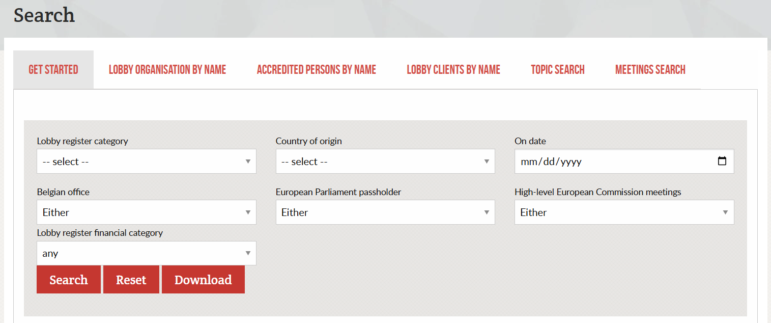
For example, the EU Transparency Register includes more than 12,000 registrations of organizations, associations, groups, and self-employed individuals who seek to influence EU policies. It includes foreign and EU-based lobbyists as well. The register remains voluntary and sanctions are weak so journalists must keep asking themselves what data is missing.
Image: Screenshot, EU
The Corporate Europe Observatory (CEO), an NGO that helps journalists and civil society keep a tap on EU lobbying, runs LobbyFacts.eu. It takes data from the official register and makes it available in an easily searchable platform, filtered by country, topic, and name. The NGO also links multiple entries from the same registrant together that aren’t linked in the initial databases. Their database dates back to 2012 and it updates once a day. Still, some months are missing due to a change in the format of the registry so make sure to also check the original database while investigating a story.
French journalist Emmanuelle Picaud recommends that reporters also check the European Commission’s Have Your Say site for EC initiatives. Governments are among those who may voice their positions on proposals, and that can help uncover lobbying by European nations.
The European Commission also publishes a database with its members’ meetings with special interest representatives. It requires all European Commission members, their closest advisors, and all directors-general to meet “only (special) interest representatives that are registered in the Transparency Register and to publish information on such meetings.” The information is downloadable in spreadsheets. Search by official’s name, date, location, subject of the meeting, and (special) interest representative.
Image: Screenshot, EU
However, the data is flawed, according to LobbyFacts.eu: “Investigations have shown that some lobby meetings take place and are not published; while some meetings are posted in duplicate, perhaps if both a commissioner and cabinet member attended. And, of course, this data is only the ‘tip of the iceberg’ covering the lobby meetings held by only 1,500 or so officials, when the total staff of the Commission is thought to be 30,000 plus.”
Image: Screenshot, LobbyFacts.eu
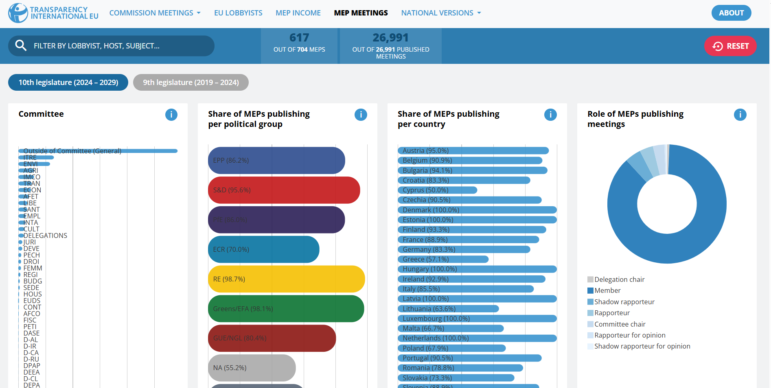
Image: Screenshot, Transparency International
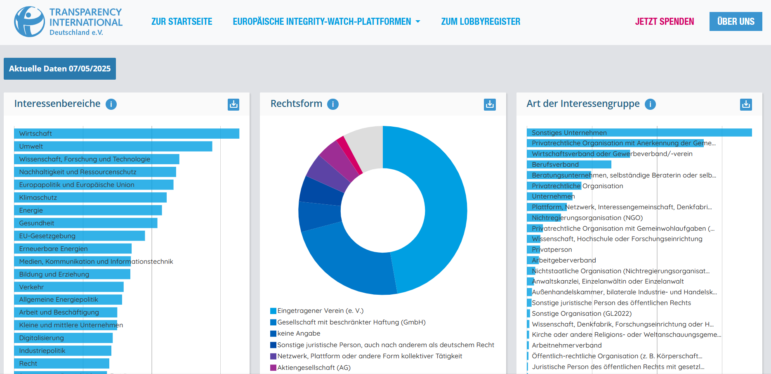
Transparency International has created a user- and data-friendly platform called Integrity Watch EU, where journalists can search for the member of parliament’s declarations of involvement with special interest groups by member, and their published meetings. Journalists can also find lobby meetings held by commissioners and the rest of the EU staff, who are obliged to file them. Also, it provides national versions of the platform for multiple countries, including Latvia, France, Greece, the United Kingdom, Germany, Lithuania, Slovenia, and Romania.
Within Europe, the landscape varies greatly.“On paper, the situation across the EU seems promising… However, in practice, the majority of frameworks assessed are not sufficient to protect public authorities from undue influence.” — Transparency International
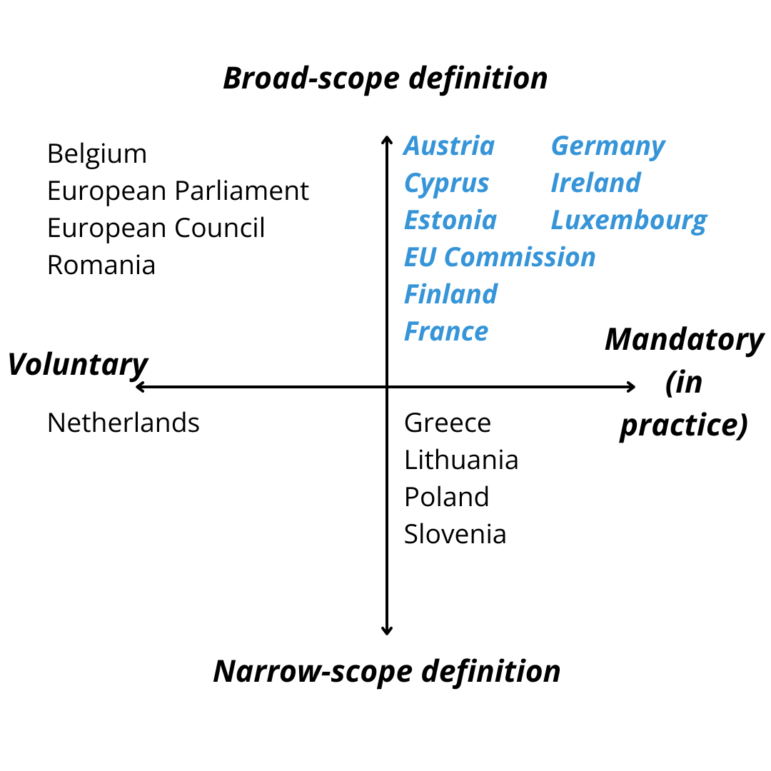
Transparency International gives high marks for lobbying databases in Ireland, Germany, and France because they provide broad definitions of lobbying and mandatory reporting rules. Each of these countries has a database of several thousand filings.
But Transparency International has also raised doubts about the implementation of lobbying rules in other parts of Europe, even though more than half of all EU countries have rules on lobbying.
“On paper, the situation across the EU seems promising,” according to Transparency International. “However, in practice, the majority of frameworks assessed are not sufficient to protect public authorities from undue influence.”
The results are in the numbers, with France taking the lead with more than 6,000 organizations filing their lobbying activities, and Germany with more than 3,000.
However, these numbers include companies and other organizations – not just foreign lobbying. For instance, Ireland has registered close to 2,700 lobbyists. It has earned praise for its expansive regulations. Fewer than 190 of its filings are for those outside the country, however. Almost all of those are companies, trade associations, and charities — not foreign governments.
Filings are voluntary in many countries, like Italy, the Netherlands, and Estonia.
Image: Screenshot, Transparency International
That means these countries have far fewer filings.
“A lot of them are voluntary. It is a big issue internationally,” Anna Massoglia, former editorial and investigations manager for OpenSecrets, a U.S. based non-profit that tracks money in politics, and currently an investigative journalist for Influence Brief, told GIJN.
Other countries in Europe have no requirements for disclosing foreign lobbying.
There is strong criticism about the U.K.’s oversight of lobbying, too.
“If you are a UK-based lobbyist who has a turnover of less than £90,000, you don’t have to register,” wrote author and investigative journalist Peter Geoghegan. “Even worse, foreign businesses don’t pay VAT – so foreign lobbying firms can operate in the U.K. with almost no scrutiny.” To show his frustration he even suggested gutting any U.K. law on oversight because of these kinds of weaknesses.
When OCCRP investigated influence efforts by northern Cyprus, its reporter found some information in lobbying filings. But the reporter also uncovered key information in the disclosure statements that members of the British Parliament filed on trips arranged by a group campaigning for northern Cyprus’s bid for international recognition as an independent state. The lawmakers involved denied they were influenced by the activities of the group.
Government’s Revolving Door
Government workers may get hired by companies and lobbyists, quit their job, and sometimes might also return to their position in government in another example of the “revolving door.” Some countries require pauses between such employment rotations.LinkedIn is a great place to spot former government officials now working in the private sector.
OpenSecrets maintains a database on US government workers getting jobs in the private sector, along with its work on tracking lobbying and campaign contributions.
LinkedIn is a great place to spot former government officials now working in the private sector.
Indirect Lobbying
Universities and Concerns of Undue Foreign Influence
Another tactic considered by many to be lobbying is when foreign entities give money to universities.
In the United States, these filings are kept by the US Department of Education as Section 117 Foreign Gift and Contract Data. Filings are updated in spreadsheets twice a year on this site for gifts over $250,000 per year. The most recent filing shows spending worth more than $50 billion in recent years, including more than 100,000 contracts and gifts from dozens of countries ranging from Ecuador to Kazakhstan.
The world has changed dramatically since the days when Lee helped the Nazis, raising concerns about foreign propaganda. Such propaganda now is harder to capture when it comes to social media. Researchers, including those at Oxford University, have been documenting the rise in foreign government influence efforts on social platforms, including those aiming to discredit rivals.
Journalists may also consider using their open source reporting skills to unearth photographs and other social media posts that might show lobbyists meeting with government officials.
Major social media companies make their recent advertisements searchable. So it is possible to filter searches for political, issue-related, and election-related paid posts. These mechanisms have limitations and may be imperfect, but they do offer a window into these efforts.
Journalists may also consider using their open source reporting skills to unearth photographs and other social media posts that might show lobbyists meeting with government officials. GIJN offers a wide range of training guides and tips on OSINT research.
Using Freedom of Information Laws
Making requests under national access to information laws may also be fruitful.
Consider where foreign governments or their lobbyists might have sent letters in order to influence officials or policies, perhaps to an agency or ministry about a proposed law or regulation.
In many countries, requests can be made by foreign citizens.
Even when public records are scarce, there are still ways to report on foreign influence efforts.
There have been notable stories that highlight the world of foreign lobbying without having relied upon documents.
Many of the most important ways to look into foreign lobbying have nothing to do with records. Reporters need to evaluate what foreign governments are trying to achieve and who they need to influence to get results. These are the basic building blocks for reporting. Shoe leather reporting means getting to know the officials involved and the issues at play. In most places, as mentioned, there are no records to guide reporters. As a result, it’s about contacts and asking questions, meeting embassy people, country experts within foreign ministries, outside experts from academia and NGOs, former government workers, and others.
There have been notable stories that highlight the world of foreign lobbying without having relied upon documents.
As of March 2025, there were no lobbying registries in any African country. Below are countries that do have some kind of registry:
Latin America
Chile
The InfoLobby portal, developed and managed by the country’s Transparency Council, contains information about meetings, trips, donations, lobbyists, special interest representatives, public officials, and public organizations.
Mexico
The Mexican Lobbyists Registry provides detailed information about lobbyists registered as required by the General Transparency Law. It includes data such as the lobbyist’s name, the issues they advocate for, their business sector, and the legislative commissions they engage with. It also provides legal frameworks, registration details, and relevant documents. Here’s the link to the Lobbying Registry Chamber of Deputies and the link to the Lobbying Registry Senate.
Europe
France
France established a public register for lobbying following legislation enacted in 2017. Registration is legally required for all lobbying organizations, with a universal exception for public entities and religious organizations. This also encompasses foreign organizations and individuals compensated for representing special interests, provided they engage in applicable activities.
Netherlands
The Dutch Parliament’s register contains just under 70 lobbyists in total, as it invites, on a voluntary basis, “umbrella” organizations to register for an access badge.”
Poland
According to Transparency International, the Polish parliament’s definition only applies to private consultants, meaning that a mere 19 individuals are said to be officially influencing public decisions in a country of 37 million.
Finland
The Finnish Transparency Register came into force at the beginning of 2024. Finland is the first Nordic country to establish a statutory transparency register for lobbying. Organizations carrying out lobbying activities must register with the register and submit a disclosure of activities to the register every six months, which are published online. They define lobbying as that which is “long-term and systematic.” Situations not disclosed to the Transparency Register include small-scale lobbying activities, ordinary dealings with government agencies, and lobbying advice provided to public-sector actors.
Cyprus
Cyprus operates a register which currently has just 77 entries.
Greece
Greece adopted a new lobbying law in 2021, creating a searchable register, but only in Greek. One can search by company or by field. As of May 2025, there’s very little information in the register, with just 39 companies listed there.
Powerbase also has data on lobbying and former government officials involved in revolving door schemes.
Elsewhere in the World
Australia
The register can be found here, and lists close to 400 foreign lobbying efforts, including by government entities from the United Arab Emirates, New Zealand, China, and Europe.
Editor’s Note: Emily O’Sullivan researched lobbying registries in Europe. Andrea Arzaba, Amel Ghani, and Toby McIntosh also contributed resources and edited the guide.
Andrew Lehren is the editorial director of The Center for Collaborative Investigative Journalism and director of investigative reporting at the CUNY Graduate School of Journalism. He is a former investigative reporter at The New York Times and NBC News who has a passion for strong storytelling, deep-dive investigations, and data-driven reporting that exposes corruption, injustice, and systemic failures. Over the past two decades, he has led and contributed to groundbreaking investigations that have shaped public policy, held corporations accountable, and earned international recognition, including Pulitzer, Peabody, Emmy, and Pulitzer honors, plus multiple IRE, Murrow, and Loeb awards.
Nikolia Apostolou is GIJN’s Resource Center director. Prior to that, she wrote stories and produced documentaries from Greece, Cyprus, and Turkey for more than 100 media outlets, like the BBC, The Associated Press, AJ+, The New York Times, The New Humanitarian, PBS, USA Today, Deutsche Welle, and Al-Jazeera. She’s also a Dart and a Fulbright Fellow. Apostolou has taught journalism at the University of Athens and Panteion University in Athens. She earned her Master’s Degree in Digital Media at the Columbia University Graduate School of Journalism and her Bachelor’s Degree at Panteion University, in Athens, Greece.
Emily O’Sullivan researched lobbying registries in Europe, Amel Ghani and Toby McIntosh also contributed resources and edited the guide.
With one more election expected in 2026 for the nine provincial councils, to complete the quarter of national elections of Sri Lanka, it is pertinent to focus once again on the often critical role of misinformation and disinformation on the democratic process. For while Sri Lankan voters have largely pushed this issue to the backs of their minds, recent examples abound globally to remind us that this remains a crucial challenge.
German accusations of Russian meddling
A few days ago, a war of words erupted between the governments of Germany and Russia – the former making the accusation of interference in its January 2025 elections; and the latter denying the charge. The Russian ambassador was officially summoned to the German Federal Foreign Office in Berlin for a dressing down. Russia’s denials notwithstanding, Germany vowed to retaliate in conjunction with its allies.
As per the Federal Foreign Office, Russian government-affiliated hackers carried out an operation known as Storm 1516, which unloaded disinformation and misinformation on two candidates – Robert Habeck of the Green Party and Friedrich Merz of the Christian Democratic Union. Merz is now chancellor.
Fancy Bear strikes again
This August, the Fancy Bear Russian hacker group, which is affiliated with Russia’s GRU intelligence agency and featured in several major foreign elections, was again in the news for purportedly carrying out a cyberattack that disrupted activities at the Bonn airport.
Germany is not of course, the first nation to make such accusations with regard to elections. Over the last year, both the UK and Romania made similar accusations. As far back as 2016, Fancy Bear and other organizations associated with the Russian Government were accused of meddling in the U.S. Presidential Election.
New frontier of regime change
Russia is not of course alone in trying to create chaos in the electoral processes of rival nations. From China to India to the United States, regime change through influencing of elections has been a long-time accusation, long before the advent of social media.
Nor is election meddling through cyberspace limited to the great powers and their global power struggles.
Meddling in Sri Lanka’s elections
Sri Lankans are no strangers to misinformation and disinformation. The 2019 Presidential Election drew widespread accusations of online meddling, including the use of influencers, foreign organizations and bots ; Subsequent elections witnessed major online campaigns swaying the electorate, while parties that didn’t operate well in the cybersphere lost ground.
A report by Hashtag Generation pointed out two critical disinformation campaigns on Facebook immediately prior to the 2024 presidential election with regard to postal voting days before the actual vote count, when claims were made that 92% of state employees had voted for Anura Kumara Dissanayake, and 55% of military had done so in favor of Ranil Wickremesinghe.
There was a time when mis and disinformation included fake surveys that showed a party or candidate in the lead during a campaign. But this would appear to be fairly pedestrian when one considers the sophistication of social media today.
The misogynic aspects of online mis and disinformation during election campaigns have been well-documented and is most troubling. Women candidates are the subject of scurrilous campaigns regarding everything from their sexual orientation to their marital fidelity. The Conversation in an April 2025 Op-Ed noted that 86% of replies to tweets of Canadian women MPs during an election campaign contained some form of harassment.
Equally troubling is the ability of mis and disinformation to target ethnic or religious minorities. Given the torrid history of many of Sri Lanka’s political parties in inciting violence against such minorities, very real threats remain in terms of safety of communities.a
Judicial processes being too slow
Sri Lanka now has a brand-new law – the highly controversial Online Safety Act No. 9 of 2024, and other legislation available to order the takedown of offending material, and if necessary to prosecute offenders. But even tracing the creator of an army of bots, who may be sitting in St. Petersburg, Cebu City or Timbuktu, far from the reach of authorities in affected small nations, or even large ones, is not easy, let alone extraditing them and prosecuting them.
In any case, by the time the long arm of the law is awakened from its slumber, much of the damage is already done.
Bots, AI and Deepfakes
Technological advances that led to programs that can write other programs led to armies of bots being unleashed across social media, which have created much mayhem much faster than human mischief.
Prior to the AI era, one required a human being to write or draw or edit the mis and disinformation, which could be a painstaking process. No longer. AI-generated images and videos are now the norm, something that most teenagers are now quite proficient in. Simply dictate to your AI program the parameters of your requirement, and you can have whatever you wish, conjuring up scandalous speeches and visuals of people, that simply never happened. It’s like rubbing the magic lamp and making a wish to an evil genie; except that in many cases those making the wishes may be the wrongdoers, and the genie doesn’t know any better.
Influencer-led disinformation
The deliberate use of high-profile influencers to spread mis and disinformation is becoming a regular practice. Star-struck audiences are apt to believe much of what their idols say, and these influencers often count their followers in the millions.
With the proliferation of social media influencers, the armies of bots have now been supplemented by armies of influencers.
Meanwhile, fact-checking organizations suffer from significant funding issues, and operate at minimal level of activity or have shut down altogether, including in Sri Lanka. They also cannot match the speed and reach of misinformation and propaganda,
Social media platforms have significantly reduced funding and staff whose responsibility is to root out disinformation and misinformation. Particularly at fault here is X (Twitter), which adopted a free-for-all attitude regarding mis and disinformation following its acquisition by Elon Musk.
Carried away by the tide
Among this sea of mis and disinformation, genuine journalists also get carried away in the pressure to rack up more views for their stories online, and become guilty of exaggeration or unprofessional editing. This of course brings with it the very real danger of lawsuits and even prison terms, depending on the country they operate in, for unlike nameless faceless bots and AI, a journalist is a very real person and his media outlet is easily located.
The most recent development in this area is the lawsuit by U.S. President Donald Trump, who is claiming the colossal sum of US$ 10 billion from the BBC for an unprofessional edit of Trump’s speech on January 6, 2020, shortly before a crowd of Trump supporters stormed the Capitol, which aired on BBC Panorama. While the BBC has admitted some culpability and apologized to Trump, and both its director general and head of BBC news have resigned, Trump’s lawsuit in the district court of Florida alleges that the action was carried out “intentionally, maliciously and deceptively”.
And it’s not just the BBC. CBS, owned by Paramount, settled Trump lawsuits a few months earlier, to the tune of US$ 16 million. Trump’s legal team had alleged that the decision by CBS to air on 60 Minutes an interview with then Vice President Kamala Harris constituted election interference.
Journalists fighting the tide
Prior to the advent of social media, journalists stood sentinel over the few bridges over which information flowed to the public; gatekeepers of truth and untruth. Not for nothing were journalists known as watchdogs – on radio, television, print media and global wire services.
Unless one was willing to stand in the middle of a town square and shout out one’s message to passersby, it wasn’t easy to reach a mass audience without going through a battery of reporters, subeditors, editors, producers, fact checkers and news directors.
But Mark Zuckerberg, Elon Musk and their ilk opened the floodgates; the lid to Pandora’s Box was lifted forever, and out of it flowed misinformation, disinformation, libel, defamation, online bullying, extortion, and all the other ills of the cyberworld.
While professional journalists do continue to publish properly researched and confirmed stories but these are simply drowned out in the cacophony of noise that flows cross social media.
In this milieu, it is easy for journalists to forget their ethics and swim with the tide. But in a world swirling with manufactured truths, where judicial processes are slow to catch up, the importance of professional journalism is felt more than ever before and be steadfast in their professional duty as arbiters of truth and ethics.
As with any profession, in this rapidly evolving era, it is vital that journalists strengthen their own capabilities, especially in the areas of keeping abreast of the newest technology and trends, and in their own journalistic skills.
Niresh Eliatamby is a long-time investigative journalist based in Colombo, who has significant experience in journalism across a wide range of social media platforms, as well as television, radio, and print media.
This Op-ed was produced under the CIR– FACTUM Media Fellowship Program.
The 2023 Slovak parliamentary election, a keenly contested election, were expected to yield a predictable electoral outcome. Multiple opinion polls have projected a victory for the Progressive Slovakia (Progresivne Slovensko) Party by a narrow margin. Yet, public expectations shifted dramatically after a deepfake audio was widely circulated by political rivals.
Any election typically spans over several weeks of campaigning and costs millions of dollars. In this case, all it took to undermine a massive election campaign was a single fake audio of 2.13 minutes.
Truth decay
The audio, created in Slovak, allegedly captured a private conversation between Michal Šimečka, Progressive Slovakia’s leader, and a journalist. The audio made claims as to how vote buying was a strong possibility and was released during the official pre-election silent period. Factcheckers verified and labelled the content as fabricated, but the speed and reach of the fake outpaced the verification. Pertinent to note that AI can also create fake fact-checking platforms, further undermining public trust. The political consequences, however, were real, and voters turned away from Progressive Slovakia, pushing the party to the Opposition benches.
An election is often the single largest logistical exercise in a year, involving thousands of officials, vehicles, polling stations, ballot papers, observers and security arrangements. Yet a mechanism of this scale can be destabilised by a deepfake, through strategically placed “fabricated truths,” speed and anonymity contributing to their success.
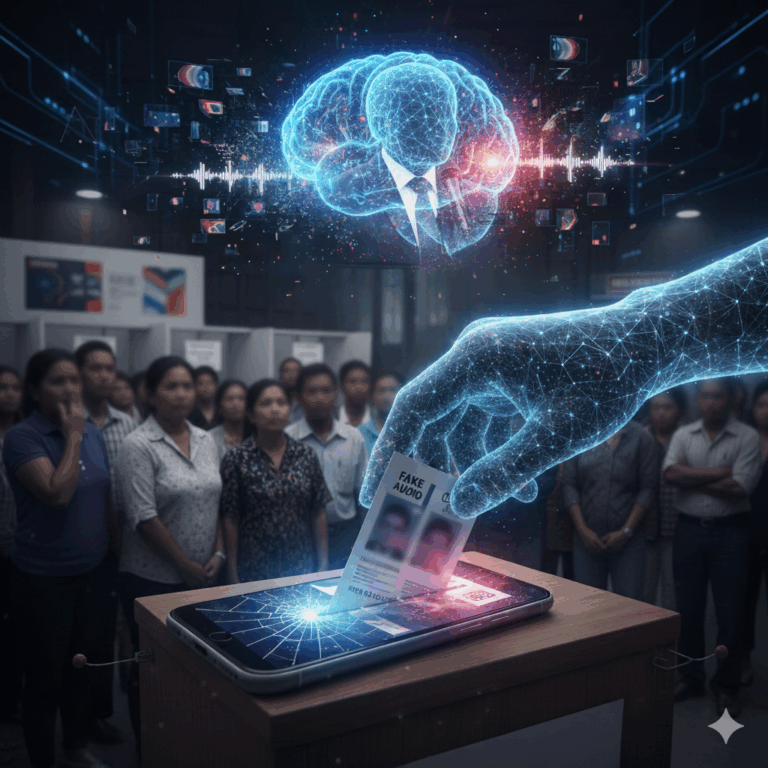
Content created by artificial intelligence (AI) can spread quickly across social media platforms, often without a verified source or identity, and at a pace far greater than that of traditional organisations. Such videos, images, or audio clips use advanced AI techniques, such as generative adversarial networks (GANs), creating highly realistic forgeries.
As an election observer, I believe every phase of the electoral process is vulnerable to disinformation and deepfakes, but the most damaging could be the silent period – and the Election Day itself. The final 24-48 hours, when formal campaigning has concluded and voters prepare to poll, offer a narrow but sensitive window to alter the outcome. This is a critical period when citizens make final decisions, and institutions are able to respond publicly without violating neutrality rules.
In many countries, including Sri Lanka, election laws lack clarity on the actual status of silent periods and what could specifically constitute a violation of election laws. This creates ambiguity about enforceability and accountability.
Vulnerable phases
Election disinformation and synthetic content can prove lethal during all the phases of an election, from pre-election to the results phase. These are times when public trust is most fragile. At such times, election disinformation does not merely undermine political competition, but triggers confusion, unrest, and long-term damage to democratic legitimacy and may contribute to distorting the electoral outcome.
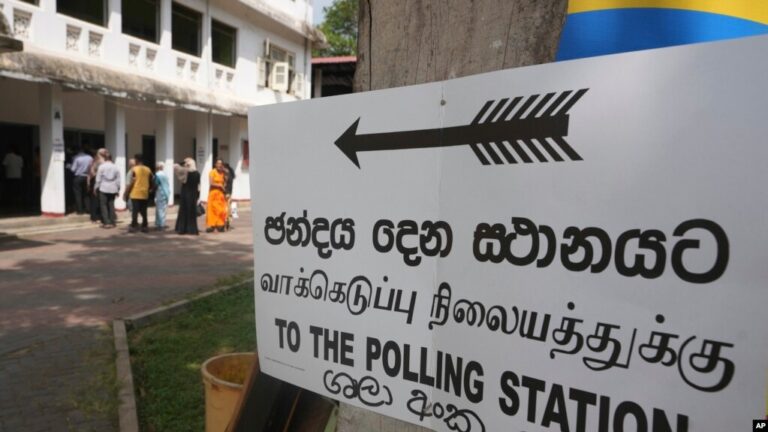
Consider this scenario on polling day. In a closely contested area, where a particular party or candidate holds a narrow advantage, if voters are instructed to travel to an alternative polling station through fabricated “hot mic” recordings created through voice cloning, the outcome itself can be altered.
In razor-sharp contests, all it takes is to shift a handful of votes. A case in point is Sri Lanka’s 2024 parliamentary election. The margin between Kalutara District’s winning candidate from the New Democratic Front (NDF) and the next most preferred candidate was merely 119 votes. In such tightly contested situations, the smallest fabrication may swing votes and the outcome.
Many global organisations are now studying and striving to reduce the impact of AI-generated election disinformation. International IDEA, the National Democratic Institute, The Carter Center, and the European Union Election Observation Missions are among those most active. There are several local organisations, such as Hashtag Generation, which are particularly active in monitoring and countering digital threats to elections.
There is a wide range of technology and research institutions dedicating time and resources to study AI-generated election disinformation, reflecting global recognition of the enormity of the problem.
Among the leading institutions examining the global rise of disinformation are the Stanford Internet Observatory, Oxford Internet Institute, Atlantic Council’s Digital Forensic Research Lab, Brookings Institution, Meedan, The Global Disinformation Index, and the International Fact-Checking Network (IFCN) at Poynter Institute. These organisations have become central to the emerging global infrastructure that studies, tracks, and exposes digital manipulation.
AI-driven disinformation
Many publications within and outside Sri Lanka examine the threat of AI-driven misinformation. One notable work is the 2023 publication ‘Foolproof: Why We Fall for Misinformation and How to Build Immunity’ by Sander van der Linden.
A widely cited idea from the book states: “At a basic cognitive level, we are all susceptible to misinformation.” It argues that misinformation behaves like a virus, “infecting our minds, altering our beliefs, and replicating at astonishing rates.” The psychological impact on voters cannot be easily neutralised or reversed. Once false narratives take root, it is difficult to dislodge them even with factual corrections.
As for Sri Lanka, we have not yet seen AI-generated misinformation shifting electoral outcomes in a decisive manner. This offers no guarantee for the future. What we have witnessed so far includes the spread of false or misleading narratives through public opinion surveys and deliberate misrepresentation of findings by international election observation missions, serving as early warning signs of a much larger risk.
At present, the Election Commission of Sri Lanka (ECSL) has only a few officers dedicated to monitoring cyber-related election threats and is currently building technical expertise. Election observation organisations face similar challenges. Many operate under constrained structures and are heavily dependent on international funding. The combination of limited capacity and increasing technological threat creates a dangerous asymmetry.
In this context, the top priority should be the development and collection of practical ‘verification tools.’ The integrity of future elections may depend on the swift strengthening of defence capabilities and their deployment.
International guidance is now available for election authorities to confront the growing threat of digital manipulation. These include UNESCO’s ‘Elections in Digital Times: A Guide for Electoral Practitioners,’ the OSCE and ODIHR ‘Handbook for Observation of ICT in Elections,’ the Council of Europe’s ‘Guidance Note on Countering the Spread of Online Mis and Disinformation,’ and International IDEA’s 2024 policy brief, ‘Protecting Democratic Elections through Safeguarding Information Integrity.’ Together, these frameworks offer a collective global playbook for defending democratic processes in the digital age.
Legal safeguards
However, the existing legal frameworks offer limited solutions. In Sri Lanka, there is an inadequacy of legal safeguards. Election campaigns are governed by legislation introduced in 1980/1981. The existing codes of conduct relating to pre-elections or extraordinary gazettes, on their own, are insufficient to stem the daily flood of coordinated disinformation.
There are examples of targeted legal interventions from elsewhere. In 2023, the US State of Texas introduced Senate Bill 75, under which political deepfakes were banned for attempting to mislead voters during the 30-day period immediately preceding an election. This represents a shift from voluntary standards to enforceable legal boundaries.
As for Sri Lanka, two fundamental tasks should be completed. First, massive public campaigns to create nationwide public awareness. Second: Investing in developing both technical and legal capacity within the Election Commission itself. It is only thereafter that meaningful collaborations could take place among political parties, tech platforms, media and civil society organisations. Voters need to be educated to treat everything seen and heard on the Internet with disciplined suspicion.
There is a deep need for the public to resist the instinct to believe and share election-related videos and audios because they are dramatic or viral content. It is necessary to exercise caution and to have content verification by credible and independent sources. This is why formal, rapid response mechanisms are required from institutions such as the Election Commission, the Election Section of the Sri Lanka Police, election observation organisations, and the Telecommunications Regulatory Commission (TRC).
Voters do not always pause to question the information they encounter. Political loyalty and emotional appeal often override critical judgement.
Features like weird facial artefacts, especially around facial boundaries, unnatural body or limb movement, and overly short, “too perfect” clips or stitched segments are signs of AI-generated content. Often, there are irregularities in hands and fingers, as well as inconsistent lighting, shadows, reflections, or background elements.
American lawyer Felicia Farber’s recent novel ‘Fake Out’ offers a powerful fictional reflection of this reality. The book deals with the inadequacy of laws to tackle sexting and cyberbullying. Particularly with respect to minors, it has a recurring theme: seeing and hearing can no longer be equated with believing.
Elections were once battles of ideas fought in public squares and through printed matter. Today, these battles take place more often in hidden realms, inside algorithms, artificial voices, and fabricated worlds.
The age of artificial intelligence does not demand blind faith or fear. It demands disciplined thinking, institutional courage, and a new social contract between citizens and information. Because when the last line of defence is no longer the ballot box, but the human mind, the future of democracy will be decided not by what we see, but by what we choose to doubt.
About the author:
Manjula Gajanayake currently serves as the Executive Director of the Institute for Democratic Reforms and Electoral Studies (IRES). An experienced election observer and an activist, he has contributed to strengthening Sri Lanka’s electoral processes through impactful civil society action.
This Op-ed was produced under the CIR– FACTUM Media Fellowship Program and was originally published in Ceylon Today on 21 December 2025.
Five media organisations from the region of 2 billion people unite to strengthen investigative reporting amid rising threats
Kuala Lumpur, November 28:
The South Asia Journalism Collective (SAJC), a collective of media organisations, was announced at the Global Investigative Journalism Conference 2025 (GIJC25) in Kuala Lumpur, Malaysia, to support cross-border investigations across the region.
The SAJC brings together media organisations from South Asia, home to 2.04 billion people. The founding members are: Centre for Investigative Reporting (Sri Lanka), Digitally Right (Bangladesh), Media Unlimited (Pakistan), Nepal Investigative Multimedia Journalism Network (NIMJN) (Nepal), and The Reporters’ Collective (India).
SAJC aims to foster collaboration among journalists and newsrooms in South Asia to investigate, capacitate, share resources, and defend media freedom in countries where journalists face mounting pressure. Journalistic collaborations have become extremely vital to foster understanding of a complex and diverse region where journalism is practiced at great risk and with limited resources, despite some of the finest and hardest reporting taking place in South Asia.
Rajneesh Bhandari– Founder and Chief Editor, Nepal Investigative Multimedia Journalism Network (Nepal), Kamal Siddiqi– Director, Media Unlimited, former Director, Centre for Excellence in Journalism (Pakistan),
Miraj Chowdhury – Founder, Digitally Right; former Bangla Editor, Global Investigative Journalism Network (Bangladesh), Mayank Aggarwal– Editor, The Reporters’ Collective (India), and Dilrukshi Handunnetti– Co-Founder and Director, Centre for Investigative Reporting-Sri Lanka (Sri Lanka) are instrumental in convening and shaping the future of the South Asia Journalism Collective (SAJC).
SAJC is a powerful and timely initiative, says the executive director of GIJN
Emilia Díaz-Struck, Executive Director, Global Investigative Journalism Network (GIJN) welcomed the formation of the collective at a time investigative journalism is facing serious challenges in South Asia.
“During these complex times, collaborations and partnerships are key to strengthening the capacity of journalists to hold powers to account and conduct investigations of public interest that are valuable for citizens around the world,” Díaz-Struck said.
“We are excited to see that journalists from South Asia have joined forces to advance their work as a community in the region and celebrate the birth of the South Asia Journalism Collective. We see this as a powerful and timely initiative and look forward to seeing it grow and develop.”
Four founding members participated in a GIJC25 panel on “Reporting on Conflict and Collaborating in a Disinformed World.”
The collective was also featured during the South Asia networking session where the need for evidence-based journalism, resource sharing, protection of media freedom, safety, and core values of accountability journalism were discussed.
“South Asia is a rapidly growing region, industrially and in democratic activities,” said Yasuomi Sawa, GIJN’s newly elected Asia/Pacific board member. “It is important for democracy and press freedom.”
Author Karen Hao argues that while the cost of Silicon Valley-led AI expansion is being borne by the Global South, there are ways to reverse this narrative and build collaborative AI systems that benefit all.
As the dependence on artifical intelligence increases and tech companies across the world invest heavily in data center facilities, award-winning reporter and author of Empire of AI, Karen Hao, argues that this scale of development is “unnecessary”. She says that this narrative about building larger data centers has been solidifed and sold to the public and policymakers. The expansion, which Hao refers to as “imperial expansion”, is happening at the cost of communities and resources which are scarce. While highlighting the widening Global North and Global South divide, she opines that the AI development should be a cross-border endeavour.
In this conversation with Sonia Bhaskar, Hao also focuses on the role of governments to regulate AI and says that AI should lead to public benefit, rather than benefitting a few “that are running these Silicon Valley companies”.
The interview has been edited for brevity.
What have been some of the more alarming developments you’ve noticed recently in the AI industry?
Sam Altman, just a few weeks ago, said that he envisions just for his company, OpenAI, building 250 Gigawatts worth of data centers by 2033, which he estimates could cost 10 trillion dollars. 250 Gigawatts, a reporter actually compared this to the entire amount of energy demand in India and so that would be an extraordinary increase in energy demand globally, and most of that would be powered by fossil fuels, because that is the energy available.
I want to emphasise that this scale is actually technically unnecessary. Even if we didn’t have that scale, we would still have AI. And yet, they’re trying to build larger and larger data center facilities, supercomputer facilities, around the world, and have sold a narrative to the public and policymakers that this is required for getting more AI capabilities.
The Global North and South divide seems to be widening with this kind of model of AI development. Are these countries geared up to even counter the threat coming their way?
There are a lot of activists, organisations, and communities themselves that have taken big leadership roles in countering this kind of expansion, which I describe in my book as a form of imperial expansion. One of the anecdotes that I highlighted in my book was of these Chilean water activists that were very concerned about a proposed Google data center landing into their community. And it was a project that was sanctioned by the Chilean government, it was one that the Chilean govt in fact celebrated, because they considered it to be a mark of economic development for the country, of participating in this technological revolution, but what the community and the water activists saw on the ground was that it was taking their already scarce fresh water resources, and without their consent, they had not been notified of this project.
They actually discovered it after someone tipped them off, that was not supposed to tip them off. They then pushed back aggressively on the proposal, so they started mobilising, talking with every single one of the neighbours within that community, explaining to them in plain terms, what exactly having a data center within this community could mean for their ability to access fresh water, and they built up so much public support that they were able to pass a referendum to block the project before there was further investigation into the environmental impacts.
And then they went even further and escalated to Google Mountain View, where Google Mountain View had to evaluate, make concessions to the community, and then they escalated to the Chilean government, which has now created this roundtable that brings together community residents and activists, as well as the tech companies, to discuss future data center projects in the country.
So that kind of spirit, even when there aren’t government protections from imperial expansion projects, and even when the government is actually in cahoots with the companies to bring even more of these facilities in, we have seen remarkable mobilising where the community steps up, and they take the leadership and are able to still gain significant concessions, and even block projects completely, when it’s not within their interest.
How do you see the role of Asia in terms of the incoming data center investments and a source of cheap labour?
Basically any time a chatbot or an AI system can do anything, it has to be taught by a human. And because chatbots are language technologies, these companies will look to contract cheap English speaking workers. And because of the history of colonialism with the UK colonising India, or the US colonising places like the Philippines, those are places where there is a large base of English speaking workers that can perform a task that these tech companies want them to do.
In my book, I highlight this example of how OpenAI contracted an Indian firm to do content moderation on their models for image generation. So, these workers were looking through all of this really horrific AI-generated images to try and figure out which ones should be allowed or not allowed with OpenAI’s technologies.
In the Philippines there’s also a huge base of data industry workers, not just chatbots, but they are doing things like labelling images or they’re trying to train self-driving cars. And all of these workers work in often extremely exploitative conditions. Because the workers are not actually told who they’re working for, they’re often unclear on who the boss even is. Like if there are problems they’re seeing, they don’t even know who to flag it too. And they’re also often paid very very little amount of money, maybe a couple dollars a day, or a couple dollars an hour, depending on where they sit geographically, and how much these companies think they can get away with.
So it has become more and more of a problem, as the industry has continued to grow and the labour demand has continued to grow.
We see three models: the US (big tech, concentrated power/profit), China (state-backed incentives and narrative control), and the EU (cautious regulation, with talk of General Data Protection Regulation [GDPR] relaxation). Where do you think the solution lies? What features of these models offer the most just and sustainable path for AI’s wide-reaching societal and economic impact?
China’s case illustrates something that we have seen for a long time, which is that in resource constrained environments there’s actually much more innovative AI work being done. So in my own interactions with researchers around the world, some of the most exciting research is by African AI researchers, or Latin American researchers, or Chinese AI researchers, because they’re just not operating under the same circumstances, of having an extraordinary amount of money or computational resources. They’re developing models that aren’t just the same as American models in terms of capabilities, with just less resources, but they’re also looking at fundamentally different types of AI technologies that are centering the problem that they ultimately want to solve with AI.
So, with African AI researchers that I’ve spoken to in the past, grid reliability is a huge issue, not just in Africa but actually around the world. And they’ve figured out how to create very small specialised AI models to improve grid reliability such as simply predicting when a piece of grid equipment is going to fail before it fails so they can swap in newer equipment, upgrade it, and not have any kind of blackout, or downtime, for that grid. And these are things that the U.S. has really underinvested in because they’re just not pursuing this kind of thinking anymore. I sort of see it as they’ve become intellectually lazy because of a glut of capital and glut of resources. So, they’re not looking at how do we actually just solve these very practical problems that can improve the quality of life and human rights around the world.
Before Silicon Valley really entered the scene with realising that there was a significant amount of money to be made in the AI industry, AI research was largely a cross-border endeavour. It was understood that if everyone around the world works together to build AI, we will just end up with better systems that improve lives for everyone. And so that is where I see the solution. We rewind the narrative of zero-sum game, like all of these competing models, and who’s gonna win and who’s gonna lose. We rewind all of that back to the narrative that once reigned, which was that we actually have cross-border collaboration, and that the best ideas can come from anywhere in the world, and everyone can take advantage of them.
Who should regulate AI, and what role should the government play? We failed to regulate social media, nowhere in the world have we successfully managed to do that. AI seems to be getting out of control and when we combine that with issues of mis and disinformation, deepfakes, privacy, security —what model of regulation can work? How can we learn from our mistakes in the past?
So first, I think we need a broader understanding of what even constitutes AI regulation. I think a lot of people think that regulating AI simply means allowing anyone to build AI, however they want, and then deciding how to constrain the deployment of that technology into the world. But actually, we also need to consider how AI is developed in the first place.
So the fact that these American companies have just been scraping whatever data they want, and hoovering up all of this intellectual property without any hindrance—that is a place where the government should be intervening.
They should be interpreting copyright law to strengthen intellectual property protections. The U.S. should please have a federal data privacy law, so that there’s actual protections from people having their children’s photos caught up in training these systems, that ultimately then can be used to harm their kids.
The data centers need to be regulated—that is also a form of AI regulation, where all governments should be thinking, within their own country’ context. What land would they actually allow these companies to build on? How much energy would they actually want these companies to be able to use for this type of technology? How much freshwater would they use? And there might be plenty of actually existing regulations that already apply, like environmental regulation, that were originally designed to check other industries and their pollution, that are actually extremely relevant for the AI industry as well. So the question when you say, who should regulate—the answer is everyone. Every government should be thinking about how to design regulations that help steer the trajectory of AI development so that ultimately leads to broad public benefit, rather than just benefits concentrated in the hands of the wealthy that are running these Silicon Valley companies. And that requires looking at the full AI development supply chain, and also the deployment scenarios, and there will need to be international coordination of course.
So we need to use all of the regulatory instruments that are available to us, that we already have, to also contain the way that the AI industry is currently creating a lot of harm. It’s never too late to do that. Because these companies require up-to-date data in order to continue developing their models, they require up to date computer chips for training the next generation of their facilities. So we might have missed the boat for the things that already exist now, but that doesn’t mean that we cannot regulate that’s gonna exist in the future.
In order for the companies to continue keeping up with the innovative feel, they need to develop new things. It’s not like, suddenly, OpenAI can continue cashing in on a ChatGPT that was generations older. So all of the things that are going to come after, the many AI technologies that come after, it’s absolutely not too late for us to actually implement regulation. In fact, we have a lot of evidence now from the last three years of this technology being around, of how to actually design this effective regulation for all the technologies moving forward.
‘There’s been talk of an AI bubble building up. What’s your estimate of where we’re headed over the next year and what are the bright spots you see in this landscape?
There’s a huge bubble.
I am very concerned that it’s going to burst in a way that is extremely harmful to the global economy and is going to leave a lot of people around the world devastated. But if there is a bubble pop, journalism is still essential. Community efforts, public education, and civil society work is still essential to figure out how do we rebuild after the bubble pops.
There’s, been plenty of work done by people like Naomi Klein, who have shown that in crisis, in disaster situations, there are two ways we can come out of it:
a) Authoritarian, fascists, corporate opportunists use that crisis to then make things worse: install more surveillance, to erode more human rights, to privatise everything,
b) It becomes a place for the phoenix to rise from the ashes. We are able to build something fundamentally better by going back to what are the real core things that we want to protect as a society, that are crucial to human flourishing, and how do we rebuild even better, more resilient institutions, communities, organisations, around those core principles.
All of the work we do now as public defenders, whether activists, advocates, or non-profit work, government work, journalism, all of that work is going to help determine which path we take.
You have drawn parallels between AI empires and colonial extraction. Where do you see this empire going, and where do we go from here as a society?
It did take a long time to unwind colonialism, but it happened. And it happened at a time when there wasn’t really a broad understanding of democracy. This global belief in fortifying human agency and human rights, and making sure that people have the freedom to choose how they self-govern and what kind of future they ultimately want to live in. So we’re in a much better place now, where we actually know those things, and people are willing to fight for them because they already have tasted that.
So one thing that I see is like, the immune system response that’s been happening to these new empires has happened much much faster than in the past, and we know for a fact that throughout history, empires have fallen, and this time it will be no different.
GIJN is excited to launch a new edition of the Sigma Awards, which recognizes the best of global data journalism. Submissions are now open for data projects published in 2025.
Submit your best data journalism work by January 11, 2026.
We are inviting journalists from all regions to identify their best data work and submit it for consideration. We are maintaining the no-category rule for the award and will have experts in data journalism from around the world to serve on the jury and prize committee. Work from individuals and small newsrooms, as well as larger newsroom teams, is welcome.
The Sigma Awards were founded in 2019, and GIJN became the official host organization earlier this year.
Criteria for the 2026 Award
Entries must be for data projects published in the 2025 calendar year (between January 1, 2025 and December 31, 2025).
Entries must be submitted via our online form.
Applicants can enter as many projects as they want.
Applicants have to specify if they are applying as part of a large or a small newsroom or as an individual, where applicable.
All entries submitted to the Sigma Awards are available on a database that allows the community to learn from the work of others, to get inspiration, and to explore the growth and evolution of data journalism from around the world over the years.
The last edition of the award received submissions of 498 data journalism submissions from dozens of countries and six regions. In this story, applicants can read more about the 2025 Sigma Award winners, including details on the tools and techniques they used in the winning projects.
Al comparar casinos en línea, teniendo en cuenta la variedad de juegos, pensando en un uso regular, una plataforma que puede revisarse de forma independiente es chicken subway juego , mientras una revisión independiente también puede abarcar la experiencia móvil y la navegación, junto con las reglas de retirada y los límites antes de registrarse.
Vor der Entscheidung, welche Seite näher geprüft werden soll, beim Vergleich von Navigation und Bedienkomfort, als Teil eines unabhängigen Vergleichs, eine Option für den direkten Vergleich ist fugu casino 5 , separat kann man auch betrachten die aktuellen Aktionsbedingungen, zusammen mit den wichtigsten Bedienungsdetails ohne die endgültige Wahl zu überstürzen.
Før man beslutter hvilken side der bør undersøges nærmere, ved vurdering af mobil brug, fra et praktisk brugerperspektiv, en platform der kan vurderes uafhængigt er https://spinlander-casino.dk/ , mens en uafhængig vurdering også kan omfatte registrerings- og verifikationsprocessen, med kundesupportens tilgængelighed i tankerne uden at forhaste den endelige beslutning.
Dla użytkowników zestawiających kilka platform jednocześnie, z uwzględnieniem metod wpłat i wypłat, na potrzeby wstępnej oceny, jednym z punktów odniesienia może być kasyno na prawdziwe pieniadze jeśli jednocześnie ocenia się najważniejsze warunki korzystania z serwisu, wraz z zasadami dotyczącymi wypłat w ramach szerszego porównania podobnych serwisów.