Maria Ressa — a 2021 Nobel Peace Prize laureate, and co-founder of the pioneering investigative outlet Rappler — opened the 14th Global Investigative Journalism Conference (GIJC25) in Malaysia with a powerful call for the under-fire investigative reporting community to embrace “radical collaboration,” and to use the crisis as an opportunity for impact and survival.
At a global moment of rampant authoritarianism, emboldened tech oligarchs, media funding freezes, and both cyber and physical attacks on journalists, Ressa used her keynote address to warn that many press freedoms may only have one year left before they could be forever lost. But she recounted her own personal experience of persecution in the Philippines to show how a relentless commitment to hold powerful actors accountable — even in the face of repression — can lead to sustainable revenue and justice.
“Everything we knew as an industry has been destroyed. So we don’t stand still. This is a time for radical collaboration.” — Rappler CEO and Nobel Prize laureate Maria Ressa
“I had 11 arrest warrants in 2019 — that was the year Rappler became profitable,” she noted, prompting cheers from the audience. She acknowledged that the repeated arrests of newsroom leaders was “not exactly a sustainable business model” for others to emulate, but noted Rappler’s turnaround was an example of how audiences can rally around a courageous press. She also cast it as an extreme example of how “crisis is opportunity” for resource-challenged and harassed newsrooms worldwide.
Referring to Rodrigo Duterte, the former president of the Philippines, Ressa prompted cheers from assembled journalists when she pointed out why she remains optimistic about the future of investigative journalism. “I want to tell you why I remain optimistic, why I think we can do this,” she said. “It’s because the man who tried to jail me and close Rappler down was arrested in March this year, and he’s now at The Hague for crimes against humanity. So you see: if you keep doing your jobs and collaborate together, impunity ends.”
However, Ressa also described several existential threats currently facing the media and civil society. “This is the deadliest year for journalists — 250 killed in Gaza alone,” she noted.
In a dramatic moment, Ressa warned that 2026 could represent a crucial, one-year window for many independent newsrooms to secure their rights, their partnerships, and their new sustainability models.
“The best advice we in the Philippines can give to those Western countries is: you fight now, when you still have your rights, because those rights will decrease, and clawing them back later on is near impossible,” she warned. “To the funders: this is the moment. If you don’t do this, if you don’t meet the moment, then in the next year, we will have fallen even further. If we do not do those things — collaborate, especially — then I think medium-size news organizations will die within a year.”
Maria Ressa explains how state-sponsored propaganda targeted her and her news organization on major tech platforms. Image: Suzanne Lee, Alt Studio for GIJN
Algorithmic Threat to Facts and Democracy
Ressa warned of the poisonous and polarizing consequences of the global war on facts perpetrated by tech algorithms, where hate is amplified and vulnerable communities are further marginalized.
“Without facts you can’t have truth; without truth you can’t have trust,” she cautioned. “Without these, you cannot solve existential problems like climate change. You cannot have democracy. As [has been said]: colonialism didn’t die; it just moved online.”
Ressa also warned of growing kleptocracy around the world, fueled by the “normalization of lies” through feedback loops amplified by decentralized networks of influencers and reinforced by platforms that reward emotionally charged content.
Before giving her speech, Ressa joined in a moment of solidarity with journalists under attack worldwide, organized in partnership with the Committee to Protect Journalists. She joined the more than 1,000 attendees gathered in the conference hall for a photo, in a symbolic recognition of the work being done by an investigative community holding the line for facts and accountability everywhere.
“Our enemies are not the governments. They rose on top of technologies that have literally splintered our societies apart. None of the tech that rules our lives today is anchored in facts.” — Maria Ressa
“Everything we knew as an industry has been destroyed,” she said. “So we don’t stand still. This is a time for radical collaboration. This is also a time for creation.” She added: “Our enemies are not the governments. They rose on top of technologies that have literally splintered our societies apart. None of the tech that rules our lives today is anchored in facts.”
Investigative journalism leaders joined together with the Committee to Protect Journalists for a moment of solidarity with the press worldwide at GIJC25. Image: Suzanne Lee, Alt Studio for GIJN
Her more specific appeals to the community included:
Journalists in the European Union should relentlessly hold their governments to their stated human rights and press freedom standards. “I look to those here from the EU: hold on, and don’t backslide with your good press laws.”
Reporters should investigate and expose the epidemic of online harassment of women journalists, and those who enable it. Ressa pointed out that 73% of women journalists experience online abuse, and 25% receive threats of physical violence — some of which transform into physical harm.
Newsrooms should do a frank assessment about the painful tradeoffs of social media. “How long do we want to keep working for the tech companies for free?” she asked. Rather, she said they should consider solutions like public interest tech stacks or audience meet-ups in which “real people can talk to real people without being manipulated by algorithms.”
Use investigations to challenge and stop the “surveillance-for-profit” industry.
Avoid — at all costs — further marginalizing groups via the press who are already marginalized in the physical world.
“My dream is a global federation of news organizations. I think we can do it — the code is there already,” she added. “All we have to do is work together while we still have strength. Otherwise, we will be depleted — and I think we only have a year.”
Resilience of the Investigative Journalism Community
Ressa’s speech followed a conference welcome from leaders of the two co-hosts of the event: Emilia Díaz-Struck, executive director of the Global Investigative Journalism Network, and Premesh Chandran, co-founder of Malaysiakini.
“Despite all these challenges we’re facing… we are alive; we are resilient; and we are doing the investigative journalism that is key for society: holding powers to account.” — GIJN Executive Director Emilia Díaz-Struck
“We are so excited — this is the first time we are hosting the global conference in Asia,” said Diaz-Struck. “We know this was a tough year for everyone. But the fact that we have more than 1,500 attendees from 135 countries and territories sends a very powerful message.”
She noted that the conference had doubled its prior complement of speakers from Africa, MENA, and Latin America — and tripled the number of speakers from Asia.
Said Chandran: “In 2018, we here in Malaysia had our first change of government in 60 years, and that was driven by journalists. Many here have been pushing the boundaries.”
Diaz-Struck added: “Despite all these challenges we’re facing — democracy going backwards, wars, more journalists in exile — we are alive; we are resilient; and we are doing the investigative journalism that is key for society: holding powers to account.”
GIJN Executive Director Emilia Díaz-Struck (right) and Malaysiakini CEO and co-founder Premesh Chandran welcomed attendees to the 14th Global Investigative Journalism Conference. Image: Suzanne Lee, Alt Studio for GIJN
This story was was originally published in GIJN Website on 21 November 2025.
When Sri Lankans scroll through Facebook, TikTok, or Instagram during an election campaign, their feeds rarely show party manifestos or policy proposals. Instead, they are flooded with memes, politicians turned into caricatures, snippets of speeches edited into jokes, and short, sarcastic videos that mock parties in seconds.
They are funny, easy to share, and incredibly powerful. For most of Sri Lanka’s younger voters who don’t watch political debates or attend rallies, memes have become the campaign message itself. But, few stop to ask who creates these posts, or whose interests they serve.
Memes have long been a part of Sri Lanka’s online humour, but their tone changed sharply around the Presidential Election of 2019. Many Facebook pages that focused on cricket or day-to-day comedy suddenly switched to political satire. Some mocked a candidate’s English, others poked fun at election promises, and a few crafted storylines featuring rival politicians as recurring characters.
Speaking to The Daily Morning, Election Commission (EC) Chairperson R.M.A.L. Rathnayake said that by the 2020 Parliamentary Election, these posts were no longer spontaneous. “By that time, the memes and most posts on social media weren’t random. We saw pages with thousands of followers posting content that mirrored campaign messaging almost word for word.”
Speaking to The Daily Morning, attorney and rights activist Swasthika Arulingam called memes “the political cartoons of the digital age”, sharp, witty, and capable of holding the powerful to account. “Memes have played an excellent role on social media when it comes to satire and holding politicians accountable. Just as political cartoons were essential in the print era, memes are equally important now. They are humorous and can deliver a message that resonates with the public.” But, she said, the difference lies in accountability. “A political cartoon carries a signature. You know the artist and the publication. A meme doesn’t. It’s an unaccountable way of trying to hold someone accountable. Unless we have the technology to trace where it came from, we can’t really know who created it.” She added that anonymity is both a shield and a weapon. “We know that cartoonists in Sri Lanka have faced threats and violence. In that context, anonymity keeps satire alive. But, it also allows abuse to thrive. Memes have been used to ridicule women, minorities, and marginalised groups. When satire turns into harassment, its purpose is lost. If you can’t verify something, don’t share it, especially if it targets a person. But, if there’s genuine wrongdoing and satire calls it out, that’s healthy. The key is responsibility, both from those in power and from us as users.”
Election monitors say that memes and anonymous accounts have become a major challenge during election seasons. Speaking to The Daily Morning, People’s Action for Free and Fair Elections (PAFFREL) Executive Director Rohana Hettiarachchi said that memes are now one of the most common tools for spreading misinformation and distorting public opinion.
“Unfortunately, social media has not yet made a positive contribution in circulating accurate information during elections. Political parties and candidates use memes to promote their campaigns, but, they are also used to tarnish reputations. We can’t always measure the damage that they cause.” He recalled a case where a prominent politician was mocked online for not having children.
“We knew it was harassment because the facts were clear. But, when memes spread falsehoods that can’t be verified, there’s no easy way to challenge them.” PAFFREL has worked with the EC to report such content. “We could get some of the clearer violations removed during Presidential and General/Parliamentary Elections,” Hettiarachchi said. “But, it was harder during the Local Government Polls. Social media companies say that they have systems for national elections but lack the capacity for smaller ones.”
Looking ahead, he warned that artificial intelligence (AI) will intensify the problem in the next round of elections. “By the next national election, we will see AI-generated voices, faces, and memes. It’s going to be harder to tell what’s real and what’s not. Many young people already believe whatever they see first. That mindset can shape votes.”
Much of this humour, insiders say, is not spontaneous. It is organised, funded, and coordinated. A person who had worked in a leading political party’s media unit for several years described the system to The Daily Morning on the condition of anonymity. “Some parties have their own pages. Others fund independent-looking ones. During election time, popular pages are paid to post memes or videos. Some charge Rs. 150,000 per post. Videos cost more.” He said that these networks extend across platforms. “We had teams creating memes, writers for captions, video editors, and people paid just to comment and boost engagement. There were salary scales for each category.”
He described one campaign that targeted an Opposition Parliamentarian through personal attacks. “Our media team interviewed his former wife, who spoke about how this particular MP treated her after their divorce. Those interviews were then edited into short clips and circulated on social media. We did that because he was very vocal against the Government at the time.” At peak times, he said that the operation had around 80 people. “There were teams to monitor engagement, respond to critics, and create counter-memes. Almost every major party has similar systems now. Without them, you can’t survive in politics.”
According to Rathnayake, the EC now has a special unit to monitor social media during elections. “We observe posts and memes with support from civil society organisations. If something threatens the electoral integrity, we notify the social media platforms to take it down.” But, with 100s of 1,000s of posts shared daily, he said, “It’s impossible to track everything. Even when we identify harmful content, we can’t remove it ourselves. We must inform the platforms, and by the time they respond, the post may have gone viral.” He added that international platforms operate under their own definitions of harm. “Sometimes, what we see as unethical doesn’t violate their community guidelines. These delays mean that the damage is already done.” Despite the limitations, the EC continues to collaborate with watchdog groups. “We can control what’s printed or aired on television (TV), but not what circulates online. We can only request action, not enforce it,” he said. Even with more funding or laws, Rathnayake doubts that any country can completely eliminate this issue. “No one can stop the negative impact of memes 100%. We can only limit it.”
Speaking to The Daily Morning, digital researcher and Groundviews founder Dr. Sanjana Hattotuwa said that memes are not merely jokes or misinformation, but that they are tools that shape emotions and identity. “Unlike fake news that can be corrected with facts, memes work emotionally. They influence how people feel about an issue or a person, not what they know. Their humour, familiarity, and algorithms make them more persuasive than propaganda articles.” He noted that memes are the “cultural equivalent of genes” (a view initially originating from British evolutionary biologist Richard Dawkins’s 1976 book ‘The Selfish Gene’), easily replicable and endlessly adaptable. This, he said, makes them perfect for “narrative corruption.”
“They don’t just spread lies. They distort the emotional landscape, guiding how people interpret politics without them realising it.” His past research, including the 2014 Liking Violence study, tracked anti-Muslim memes that contributed to online radicalisation before the 2018 Kandy riots. Later, during the #GoHomeGota protests, his team documented coordinated meme networks that smeared protest leaders and manipulated sentiment. He warned that meme-based disinformation is a bigger threat to democracy than fabricated news. “They replace policy debate with emotion-driven influence operations. They frame opponents as existential threats and normalise hate. These campaigns, funded by untraceable money and spread through non-political pages, bypass the election law entirely.” Fact-checking, he said, is rarely effective. “You can’t correct emotion with logic. A meme spreads through laughter, while a fact-check reaches a fraction of the audience. We need long-term media literacy and investment in creative, prosocial content that competes for attention.” He added that regulation alone will not solve the problem. “Banning memes only strengthens them. What we need is transparency in online political spending, accountability from tech companies, and education that builds critical thinking. The solution is civic empowerment.”
Speaking to The Daily Morning, Sri Lanka Computer Emergency Readiness Team’s Charuka Damunupola said that no authority in Sri Lanka can directly remove posts from social media platforms. “Platforms like Facebook and TikTok cooperate during elections, but, only for specific cases like advertisements that violate disclosure rules.” He added, “Even if a meme harms a politician’s reputation, we can’t take it down. Users can report it as abusive, but, most memes use satire or coded language, making it difficult to prove harm.”
According to Damunupola, only severe cases — terrorism, drugs, child abuse — prompt quick responses from tech companies. “Even if a court issues an order, social media companies rarely release data unless it’s a global priority issue.” He noted that Sri Lankan users are still developing digital maturity. “In other countries, people condemn those who post malicious content. We will get there too. It can’t be done through laws alone.” He said that while the Online Safety Act allows authorities to request user information through court orders, implementation is slow. “Even if the court issues an order, platforms may not release information. It may even become an issue between two countries. So, the introduction of this Act was not that effective.”
For ordinary voters, memes have become part of political life, something between entertainment and propaganda. Speaking to The Daily Morning, university student Nadeesha Wijesuriya said that she does not follow traditional news. “I mostly get my political updates from Facebook or TikTok. Some memes are funny and true, but sometimes, I don’t know what to believe. If a post looks real, people share it. Nobody checks.”
Speaking to The Daily Morning, a three-wheeler operator in Colombo, Sudheera Chandrasekara said that memes help him make sense of politics, even if they are exaggerated. “Politicians lie on TV, but, memes show the real thing in a funny way. Sometimes, they say what we want to say but can’t.”
Speaking to The Daily Morning, a retired schoolteacher in Homagama, D. Chandralatha said: “People laugh at memes, but, they can destroy someone’s character. My grandchildren believe everything that they see online. There’s no filter.”
Many younger voters said that they were aware of manipulation but still consumed memes daily. “We know that some pages are political,” said 27-year-old graphic designer Viraj Lakshitha while speaking to The Daily Morning. “But, memes are part of the culture now. Even if you don’t trust them, you still share them.”
As of this year, the ‘Global Digital Reports’ reveal that Sri Lanka has more than 8.5 million active social media users, most of them on Facebook, TikTok, Instagram, and YouTube. Meta platforms dominate political communication, with Facebook accounting for the largest share of online campaigning.
Although Sri Lanka’s election laws require candidates to disclose campaign spending, Rathnayake said that these rules don’t apply to digital advertising. There are no specific caps or reporting related requirements for online content, which allows political parties to fund meme campaigns and influencer networks without transparency.
Social media platforms claim to monitor content during elections, but, their local presence is limited. Meta and TikTok maintain regional hubs in Singapore and India, with no dedicated offices in Sri Lanka. The lack of direct engagement, research say, slows responses to local issues.
TikTok, for instance, has introduced election integrity guidelines in some countries but not in Sri Lanka. Facebook’s Ad Library covers paid promotions but excludes memes, influencer posts, and anonymous campaigns.
A local digital rights activist, speaking to The Daily Morning on the condition of anonymity, said: “The platforms have policies on paper, but, in practice, enforcement is minimal. They don’t understand the context of our language or politics. Sinhala and Tamil moderation is poor, and local slang can bypass filters easily.”
Sri Lanka’s election laws, written decades before social media, offer little clarity on regulating digital campaigning. The EC’s powers largely cover broadcast and print media. There are no clear definitions for digital advertisements, meme-based propaganda, or political pages without declared ownership.
Legal analysts say that reforms are overdue. A 2023 EC proposal suggested new guidelines requiring disclosure for online political content, including memes and influencer endorsements, but, it remains under review.
Speaking to The Daily Morning, attorney Thineth Korasagalla said, “Our legal framework is outdated. The election law needs to recognise digital campaigning, anonymous advertising, and cross-platform operations. But, regulation must protect free speech. Satire should not be criminalised.” He added that introducing spending transparency and digital literacy education would be more effective than bans.
Digital campaign insiders say that meme operations now rival traditional advertising in cost and reach. “A single meme campaign can reach a million people for less than what it costs to run one newspaper ad,” said a Colombo-based digital strategist who has worked with several candidates. “That’s why parties are pouring money into this space. It’s cheaper, faster, and more emotional.” Speaking to The Daily Morning on the condition of anonymity, he said that some parties spend up to 30% of their media budgets on social media operations, much of it undocumented. “The money is paid in cash. There’s no trace. Even if regulators wanted to check, they couldn’t.”
Female politicians face unique risks in this environment. Government MP Ambika Samuel described being targeted after entering the Parliament. “When I was running for elections, people supported me on social media. But, once I was elected, some of them turned against me. Memes made fun of how I dress, talk, and even my family.” Speaking to The Daily Morning, she said that while she was mentally prepared for such attacks, she knows many others who are not. “Some women leave politics because of it. That’s a loss for our future. We have to stand firm, or, no one will want to enter politics.” She said the Women MPs’ Caucus and the Ministry of Women and Child Affairs are planning awareness programmes to support females and children who become victims of social media-related issues. “If we don’t act, women’s participation will decline further.”
Globally, Courts and Governments are also grappling with how to regulate memes without stifling free expression. In August 2025, a United States federal court struck down California laws that sought to restrict online political satire, ruling them unconstitutional. In India, courts have handled defamation cases over political memes, including one involving a morphed image of West Bengal Chief Minister Mamata Banerjee. In 2019, India’s Madhya Pradesh High Court temporarily suspended livestreaming its hearings after lawyers were targeted by memes. This year, the Indian Supreme Court ordered two comedians to apologise for mocking people with disabilities, showing how the line between humour and harm is increasingly contested.
As Sri Lanka approaches another election cycle, experts say that the real battle lies not just in regulation but in building civic resilience.
Dr. Hattotuwa said: “You can’t fight emotion with fact-checks alone. We need creative counter-narratives that are just as engaging, that use humour and local culture to promote truth and tolerance.”
Some media literacy initiatives are already emerging. Non-Governmental organisations and youth collectives have started workshops, teaching young people how to spot manipulation and verify information. “It’s slow work, but, it’s important,” said a volunteer trainer from Kegalle, who spoke to The Daily Morning on the condition of anonymity. “We show them how memes are made. Once they see that process, they stop taking them at face value.”
Civil society groups have also begun experimenting with ‘positive memes’, humorous posts that promote critical thinking, community unity, and peaceful dialogue. Although small in scale, these projects hint at how creativity can counter toxicity.
As for the EC, Rathnayake said that the Commission is exploring partnerships with universities and fact-checking organisations to strengthen digital monitoring before the next election. “We can’t control everything, but, we can create awareness and work with others.”
For now, the memes keep coming, spreading faster than regulation, riding on laughter, and shaping public opinion, one joke at a time. The question is whether Sri Lankan voters can learn to tell the difference between satire and manipulation.
This story was produced under the CIR– FACTUM Media Fellowship Program and was originally published inThe Morning on 19 November 2025.
How women in politics are pushing back against AI and honour-based attacks
Online harassment of women is rising, amplified by AI-driven tools like deepfakes, doctored images, and synthetic audios
Sri Lanka Police/CCID says online sexual harassment cases rose from 182 in 2021 to 625 in 2024, and 365 in just the first five months of 2025
Support systems for women politicians exist, but gaps remain in tech knowledge, victim support, and case follow-through
CCID has received and investigated only two cases of digital harassment of women politicians to date
CCID says Meta responded swiftly to child exploitation cases, but cooperation in women’s online harassment cases was often slow or absent
Experts claim platforms amplified misogynistic content, while algorithms worsened spread
By Divya Thotawatte
When Dumali Shashikala Dayaratne (32) first entered local politics at 24, her old social media photos, some dating back to school, were enough to unleash waves of trolling. A dress worn in her private life was twisted into evidence of being ‘indecent’ and ‘unfit for leadership’.
Today, as deepfakes – synthetic media created using artificial intelligence – and doctored images flood Sri Lanka’s online spaces, these shame-based attacks have grown sharper, targeting not only women’s credibility, but their very right to participate in politics.
For women leaders, every choice of clothing, lifestyle, or expression risks being weaponised, and the rise of AI has only magnified these dangers, threatening to silence voices before they can be heard.
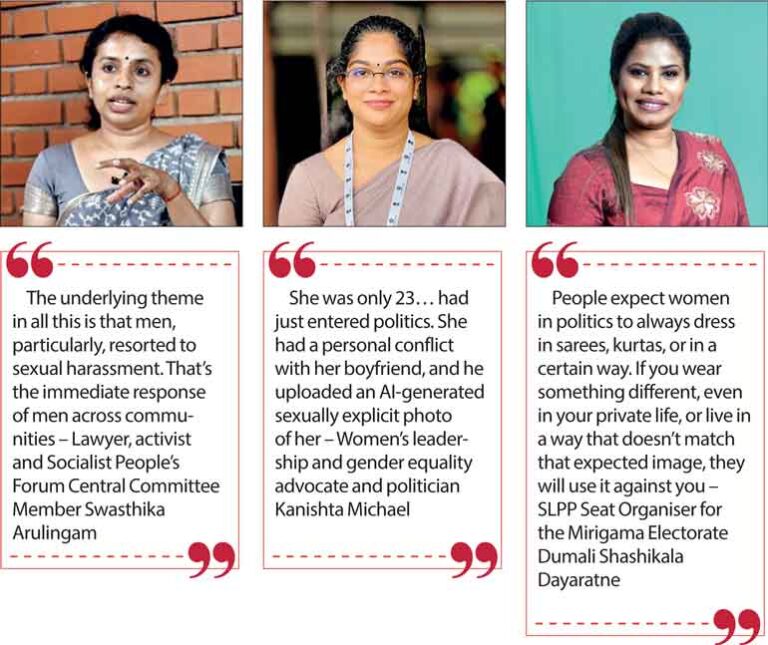
“People expect women in politics to always dress in sarees, kurtas, or in a certain way. If you wear something different, even in your private life, or live in a way that doesn’t match that expected image, they will use it against you,” said Dayaratne.
“You have to be careful because… even wearing a dress or something shorter can lead to being labelled as loose, indecent, and uneducated.”
This preoccupation with “virtue” is also a reflection of Sri Lanka’s wider honour culture, where a woman’s respectability is seen as tied to her family’s reputation and her suitability for leadership.
Targeting women
In politics, this becomes a constant surveillance of women’s attire, lifestyle, sexuality, and private choices. Where respectability is treated as political capital in Sri Lanka, women’s credibility is judged hardly by their policies or performance, but by their conformity to gendered codes of behaviour. Honour becomes political currency, and any deviation is weaponised to discredit their work, achievements, and positions.
It becomes more dangerous when the pressures and consequences of this surveillance leaks into their private lives. “I’m unmarried, and sometimes I fear how these constant attacks and false narratives will affect my life if I ever decide to get married,” said Dayaratne, explaining that sometimes even friends and family who came across the attacks would advise her to step back from public life.
Yet her close circle remains a strong support system, she said. Beyond that, she has also grown more resilient and thick-skinned with every comment and attack. Though she is still careful to keep her private and public lives separate, she admits she is stronger now than when she first entered politics.
“I’m going to keep contributing to my community, and now, I also try my best to support other women politicians, no matter the party or philosophy,” she said. Early September, she was appointed as the Sri Lanka Podujana Peramuna (SLPP) Seat Organiser for the Mirigama Electorate.
Dayaratne’s situation is the reality for most Sri Lankan women in politics. Digital Safeguarding Centre Founder and Director Shiromi Samarakoon said that during a consultation with 30 women active in politics, 29 women had reported facing online harassment, ranging from hacked WhatsApp accounts and trolling to doctored images and the non-consensual circulation of personal photos.
She explained that even within their own parties, women politicians faced competition-driven misogyny and targeted hate campaigns, making women’s political participation and advancement significantly harder.
These gendered attacks are often intensified when they intersect with other identity categories like ethnicity and religion.
Swasthika Arulingam (38), a lawyer, trade unionist, activist, and Central Committee Member of the Socialist People’s Forum, explained how her public work attracts discrimination of different forms. She has faced attacks from every side, with Sinhala nationalists calling her a “kotiya” (tiger) for commemorating Mullivaikkal – the 2009 massacre in which thousands of Tamil civilians were killed during the final stages of Sri Lanka’s civil war – while Tamil nationalists have branded her a “traitor” for critiquing the Liberation Tigers of Tamil Eelam (LTTE), and some Muslim men have subjected her to sexist commentary for supporting the rights of Muslim women.
“The underlying theme in all this is that men, particularly, resorted to sexual harassment. That’s the immediate response of men across communities,” Arulingam said, noting that while women rarely engaged in such attacks, they also sometimes remained passive observers.
In a society where women can be discredited for simply wearing a dress, a convincing AI-generated deepfake showing them drinking, dancing, or being intimate could erase their achievements and destroy their reputations overnight. This growing threat will only amplify the damage already caused by the country’s honour culture, where many women are driven out of politics and others are discouraged from entering. This reality is reflected in the numbers as well.
Women’s representation in Sri Lanka’s parliament has seen slow progress over the past decade. In 2010, women held just 5.8% of seats (13 out of 225), and by 2020, this figure remained almost unchanged at 5.3% (12 out of 225).
The Sri Lankan parliament today records its highest-ever women representation at 10% (22 out of 225), but this is still significantly low, even compared to regional and local government standards. This persistent gap underscores the systemic barriers women face, that are now added to by the growing threat of AI attacks and digital harassment.
The escalation of gendered digital harassment
Where once the reputational smear campaigns relied on whispers and print, attacks now increasingly use AI tools and digital platforms, lingering online and reaching a wider audience.
Sri Lanka Computer Emergency Readiness Team (SLCERT) has recorded a sharp rise in harassment, impersonations, and account hacks since 2022. By August 2025, there were 771 harassment cases, nearly 1,000 impersonations, and over 800 hacked accounts of women. However, a CERT representative said the data covered women in general, not specifically those in public life, and that CERT did not track AI-driven attacks, highlighting a critical data gap.
A 2025 study by the Geneva-based Inter-Parliamentary Union (IPU) covering parliaments of the Asia-Pacific region, including Sri Lanka, reports that 60% of surveyed women parliamentarians had faced hate speech, disinformation, image-based abuse, or unwanted disclosure of personal data (doxing) online. This is the highest rate for this type of abuse compared to other IPU regional studies.
According to the Computer Crime Investigation Division (CCID) of the Sri Lanka Police, reports of digital sexual harassment of women (politician-specific data unavailable) rose sharply from 182 in 2021 to 625 in 2024, and 365 in just the first five months of 2025. These included unsolicited sexual messages, non-consensual sharing of intimate images, blackmail, stalking, sexualised trolling, and deepfakes.
Despite these numbers, the CCID has only formally investigated two digital harassment cases involving women politicians to date: MP Nilanthi Kottahachchi and Deputy Media Minister Kaushalya Ariyarathne, both targeted by defamatory, false news.
In Kottahachchi’s case, police worked with Meta to identify and prosecute the perpetrator, but Ariyarathne’s case remains unresolved. The CCID representative said that Meta’s cooperation in women’s harassment was often far slower or absent compared to child exploitation cases.
Defamatory posts targeting Prime Minister Harini Amarasuriya’s sexuality and personal life were simply removed, without investigation or official record, since defamation alone is not a criminal offence under Sri Lankan law.
Samarakoon explained that perpetrators could also act anonymously, in groups, and from anywhere in the world, making them extremely difficult to trace.
Younger women politicians often faced more shame-based campaigns designed to damage their reputations and sexualise them, Samarakoon added. “The cases that are not reported are larger than what is reported at the moment. Some people don’t reveal them at all, thinking about the damage to their character and image,” she said, highlighting how the problem remains bigger than what the numbers show.
While these numbers underline a growing crisis within Sri Lanka, these attacks are not unique to the country. Globally, women leaders are undermined by gendered attacks, and they have begun to fight back.
AI attacks and global responses by women leaders
American politician and activist Alexandria Ocasio-Cortez has been repeatedly targeted with AI-generated sexually-explicit images.
As a survivor of physical sexual assault, she has said in interviews that seeing such non-consensual deepfake images of herself performing sexual acts revived trauma. However, Ocasio-Cortez turned around these misogynistic attacks, helping write the DEFIANCE Act, a proposed law that would allow victims to sue creators or distributors of synthetic pornography.
Information Minister of the Pakistani Province of Punjab Azma Bukhari has also spoken up about her experience finding a video that superimposed her face on another body in a sexualised context. Despite the public backlash, she too, chose to publicly address and challenge it, calling attention to laws and norms around digital abuse.
While AI-driven attacks targeting women leaders have been reported and battled against worldwide, Sri Lankan women politicians who face similar threats are also fighting back on their own terms.
Sri Lankan stories of resilience and solidarity
Kanishta Michael (29), a politician and advocate for women’s leadership and gender equality, recounted her experience with one of her team members. “She was only 23… had just entered politics. She had a personal conflict with her boyfriend, and he uploaded an AI-generated sexually explicit photo of her.”
The attack was “devastating”, striking at her reputation and budding political career, said Michael, who stepped in and stood by her side. Out of fear of public misperception, the young politician’s family and friends discouraged her from continuing in politics. But with Michael’s support, she was able to convince her parents to continue her political work.
Michael admitted that she was not fully familiar with formal complaint mechanisms, but she did her best to navigate the system and filed a report on Facebook. However, neither Michael’s colleague nor her family pursued formal legal complaints, highlighting the hesitation among victims of such attacks to engage with the legal system.
“This experience showed her that she was not alone, and it gave her the strength to continue her journey in politics despite such a serious attack,” Michael explained, adding that for herself, it was a lesson on the importance of preparedness, procedural literacy, and also building stronger protections and support for women in politics.
The story of the young politician is not an isolated incident. Michael’s support of her colleague exemplifies how solidarity can help more women remain in politics despite honour-based attacks. However, civil society groups also note that while support exists, it is often more symbolic than substantial.
DeleteNothing Co-Lead Mishaari Weerabangsa said, “From what we have observed, there is usually strong support from other women politicians across party lines, and some support from male politicians from the same party, but in general, it is limited to statements and denouncements.”
However, there is growing evidence that real solidarity and women’s resistance is beginning to change political culture.
Arulingam shared her own experience to illustrate this change. Earlier this year, Dr. Ramanathan Aruchchuna took offence to a Facebook post where she criticised the silence in parliament when he used parliamentary privilege to call a woman a “prostitute”. In retaliation, he launched a campaign of online sexual abuse against her.
“The first reaction of everyone was to support me,” she said, adding, “But the moment he reminded people that I have criticised the LTTE, they were okay with sexual harassment and calling me various names online.”
Yet, this time, women refused to stay silent.
A group of women activists came together, publicly defended her, mobilised online, and even pressured the government to address the issue in parliament. “They thought they couldn’t remain silent on it because it’s not only about me, it’s also about how women are approached,” she said.
The support from women and allies resulted in parliament also taking up this issue, showing a rare institutional response in Sri Lanka’s political space and culture.
Arulingam acknowledged that her own position as a lawyer and activist from a middle-class background had benefited her to an extent, but she sees such resistance beginning to slowly reshape political spaces: under the current government, when a female MP is harassed in parliament, others now speak up in her defence.
Women have begun to challenge the long-entrenched idea that sexist and sexual insults can pass without consequences. “It’s a narrow space, but it’s still creating a different kind of culture,” she said, adding that women’s voices and solidarity movements that hold institutions accountable, not only protects individuals, but also shifts public spaces for women and encourages more women to step into politics.
Yet, solidarity and personal resilience alone, while crucial, cannot make politics safer for women. Weerabangsa added that by speaking openly about their experiences and pushing for more effective remedies, women politicians could strengthen protections for themselves and ordinary citizens facing similar harassment as well.
The 2025 study by the Inter-Parliamentary Union study underscored the urgent need for institutional reform, recommending that parliaments, too, adopt clear laws against cyber harassment, establish accessible reporting and investigation mechanisms, hold platforms accountable, and provide tools to protect women in politics.
These recommendations make one thing clear: Sri Lanka’s political space requires significant systemic change, raising questions on how prepared Sri Lanka is for the future of politics in the digital age.
The role of AI in the future of politics
Senior researcher and Groundviews Founding Editor Dr. Sanjana Hattotuwa observed that AI has intensified the hostility women face on social media.
“In my research, which spans well over a decade, women have been confronted with exponentially more misogynist and dehumanising content than men, content that is essentially a rape culture,” he explained, adding that, “AI has made it easier to produce this violative content at scale, and with increased sophistication.”
Hattotuwa added that tools to create manipulated photos, deepfakes, and synthetic voice or videos targeting women are now easily accessible, noting that what once demanded advanced skills or expensive software can now be done quickly and looks highly realistic as well.
He pointed out that platforms have weakened their enforcement in recent years, with algorithms even amplifying such violative content. “Particularly in US President (Donald) Trump’s second term, what we have seen is a worsening of both the pace of production and the speed of the spread. Platforms are no longer interested in managing violative content to the extent they once did, and meaningfully enforcing community guidelines.”
Hattotuwa warned that these developments threaten electoral integrity, noting that Sri Lanka’s Elections Commission has shown no preparedness for the challenges that AI-driven disinformation would bring. His research during the 2024 presidential and general elections revealed that the Commission not only failed to detect the scale of threats to electoral integrity, but sometimes even worsened it through its own policies and ignorance.
Accountability, solutions, gaps in the system
Despite these challenges, existing laws and enforcement mechanisms remain inadequate. Deputy Commissioner, Gender Focal Point, Election Commission Samantha Jayasinghe acknowledged that while synthetic and AI-generated content poses a threat during elections, the Commission can currently only refer cases to the police.
Jayasinghe noted that media guidelines remain the only framework available, and no existing laws addressed AI or deepfakes. He said that an app to report harmful content existed, active only during elections. But, “they’re not laws, and we have to have laws,” he said, adding that the Commission is in discussions to introduce stronger laws in the future.
In a 2025 statement, the Human Rights Commission of Sri Lanka (HRCSL) also condemned the alarming number of incidents targeting women on social media, emphasising how “this trend of targeting women, including those in the public sphere, threatens their safety, dignity, and rights to privacy and equality”.
Sri Lanka is a party to the Convention on the Elimination of All Forms of Discrimination Against Women (CEDAW), which obliges the state to protect women from all forms of violence, including online harassment, and laws such as the Section 345 of the Penal Code and Women Empowerment (Act 37, 2024) aim to strengthen protection and support for women, including against digital abuse. However, gendered online attacks are evidently on the rise, while very few cases have been formally investigated.
Senior feminist activist and Women and Media Collective Joint Coordinator Kumudini Samuel said that the online harassment of women politicians reflects a “deep seated fear of competent, strong and efficient women assuming power and displacing men from entrenched privilege.”
She noted that while the state bears the ultimate responsibility of preventing and prosecuting such gendered violence, a broader shift towards a democratic political culture that accepts women’s equal right to participate is also vital. Globally, only a few countries, like Denmark, have attempted to combat AI deepfakes by giving citizens copyright over their face, voice, and physical likeness.
For Sri Lanka, with its distinct culture, this global moment is both a warning and an opportunity. Michael’s and Arulingam’s stories highlight how even in the absence of strong systems, women politicians are finding resilience and solidarity to fight these attacks. Yet, without stronger laws, digital literacy, and institutional backing, the emerging threat of AI-driven disinformation and shaming will continue to silence women before they even step into politics.
However, unless underlying “honour”-based norms and political power structures are challenged, legal reforms alone will fall short. Protecting women in public roles, therefore, demands not just stronger legal frameworks, but also cultural awareness, social change, and community support.
This story was produced under the CIR– FACTUM Media Fellowship Program and was originally published in Daily FT on 14 November 2025.
Data is a crucial part of investigative journalism: It helps journalists verify hypotheses, reveal hidden insights, follow the money, scale investigations, and add credibility to stories. The Pulitzer Center’s Data and Research team has supported major investigations, including shark meat procurements by the Brazilian government, financial instruments funding environmental violations in the Amazon, and the “black box” algorithm of a popular ride-hailing app in Southeast Asia.
Before embarking on a data-driven investigation, we usually ask three questions to gauge feasibility:
Is the data publicly available?
How good is the quality of the data?
How difficult is it to access the data?
Even if the first two answers are a clear yes, we still can’t celebrate, because the last question is often the most challenging and time-consuming step in the entire process.
When Should You Build a Web Scraper?
Accessing data published online can be as simple as a few clicks to copy-paste tables or download a data file. But we often need to extract large amounts of data from online databases or websites and move it to another platform for analysis. If the site doesn’t offer a download function, we first reach out to the people behind it to request access. In some countries, if the data belongs to the government, you may be able to request access through a Freedom of Information (FOI) or Right to Information (RTI) request. However, this process often comes with its own set of challenges, which we won’t go into here.
Note: The legality and ethics of web scraping are outside the scope of this methodology. If you are not sure whether scraping a particular website in your country is legal, be sure to seek legal advice.
If those options are unavailable, we may have to manually extract the data from the website. That could mean repeatedly clicking “next page” and copy-pasting hundreds of times, opening hundreds of URLs to download files, or running many searches with different variables and saving all results. Repetitions can reach the hundreds of thousands, depending on the dataset size and site design. In some cases this is possible if we have the time or budget, but for many journalists and newsrooms, time and money are a luxury.
This is when we consider web scraping, the technique of using a program to automate extraction of specific data from online sources and organize it into a format users choose (e.g., a spreadsheet or CSV). The tool that does this is called a scraper.
There are many off-the-shelf scrapers that require no coding. They may be Chrome extensions such as Instant Data Scraper, Table Capture, Scraper, Web Scraper, and Data Miner. Most use a subscription model, though some offer free access to nonprofits, journalists, and researchers (e.g., Oxylabs).
Most commercial scrapers are built to target popular sites: e-commerce, social media, news portals, search results, and hotel platforms. However, websites are built in many ways, and journalists often face clunky, unfriendly government databases. When commercial tools can’t handle these, we build custom scrapers. Building our own can be cheaper and faster, since we don’t need the extra features offered by commercial scrapers.
Building scrapers used to require solid coding skills. In our recent investigations, however, Large Language Models (LLMs) like ChatGPT, Google Gemini, or Claude helped us build scrapers for complex databases much faster and without advanced coding skills. With basic web knowledge, guidance, and examples, even non-coding journalists can build a scraper with LLMs. Here’s our recipe:
1. Understand How the Web Page Is Built (Static vs. Dynamic)
Before asking an LLM to write a script, you need a basic sense of how the target page is built, especially how the data you want to scrape is loaded. This brings us to the difference between a static and a dynamic web page.
A static web page is like a printed newspaper: The content doesn’t change once created unless someone edits the page. What you see is exactly what’s stored on the server. If you refresh, you’ll get the same content. An example is a Wikipedia page with a list of countries.
You can imagine a dynamic web page like a social media feed, where content changes automatically depending on who’s visiting, what they click, or what new data is available. When you load or refresh, your browser typically runs scripts and talks to a database or API (Application Programming Interface) to fetch the content. A dynamic page we scraped for the shark meat procurements investigation was São Paulo’s public procurements database, which requires you to fill in the search box to view data.
Static pages are usually easier to scrape because the data is present in the page’s HTML source, whereas dynamic pages often require extra steps because the data is hidden behind scripts or loads only when you interact with the page. That calls for a more advanced scraper, but don’t worry, we’ll show you how to build it.
However, you can’t always tell by just looking. Some pages that appear static are actually dynamic. Do a quick test: Open the page, right-click, and select “View Page Source” (in Chrome) to see the HTML. Use Find (Ctrl+F/Cmd+F) to search for the data you want to scrape. If the data is in the code, it’s likely static. If you don’t see it, the page is probably dynamic.
Alternatively, you can ask an LLM to check for you. Suggested prompt:
Here is the URL of a web page [paste below] that I would like to scrape data from. Can you tell me if the information and data on the page is directly available in the code [static] or if it loads later with scripts [dynamic]?
For LLMs without internet browsing, copy and paste the full HTML source code and replace “URL” in the prompt with “HTML source code.” If the source code exceeds the prompt limit, you need to pick the part containing your target data. Step 3 will explain how to do that.
To make this easier, here’s a real-world example from one of our investigations. We asked ChatGPT (GPT-5 model) to look at The Metals Company’s press releases page. We scraped all the press releases to analyze the company’s public messaging on deep-sea mining. ChatGPT identified it as a static web page.
2. Build Your Scraper with LLMs (for a Static Web Page)
If the web page is static, you can ask an LLM to write a Python scraping script (Python is a common language for scraping). Include the following in your prompt:
URL of the web page;
HTML source code (optional, but include it for reliability);
Which data you need to scrape (fields/columns);
Where/how to store the data (e.g., CSV file);
Pagination details (Does the page have multiple pages? How to navigate them?);
Where you’ll run the scraper (your computer or an online platform like Google Colab);
Final check: Ask if the LLM needs any other information before generating the script.
Here’s the prompt we gave to ChatGPT:
I need to build a scraper for the web page below. It is a static web page. Write me a Python script to scrape the web page from my computer. https://investors.metals.co/news-events/press-releases It has a list of press releases with title, date, and URL to the press release page. I need all three of them stored in separate columns in a CSV file. The web page has pagination. I need the full list of press releases from all pages. Here’s the HTML source code: [paste the full HTML source code]
The press releases are listed across multiple URLs, accessible via the pagination bar at the bottom of the page. Even though we only provided ChatGPT the first-page URL, it inferred the rest by appending “?page=N” to the base URL.
ChatGPT will return a script with a brief explanation. Copy and paste it into a code editor (we use Visual Studio Code), save it as a Python file (.py), and run it in Terminal (macOS) or PowerShell (Windows).
If you’ve never run a Python script on your computer, you’ll need a quick setup. LLMs can generate step-by-step instructions with the prompt below. Setup usually includes installing Python (and its package manager Pip, or Homebrew on macOS) plus common scraping libraries like Requests, Beautifulsoup4, and optionally Selenium.
I need to run a Python scraping script on macOS/Windows. Show me step-by-step setup instructions.
Pro tip: Keep prompts in the same LLM conversation so it retains context. If the script doesn’t work or setup errors appear, paste the full error messages or logs and ask it to troubleshoot. You may need a few iterations to get everything working.
3. Extra Steps for Dynamic Web Pages
Scraping a dynamic web page requires a few more steps and some extra web development know-how, but LLMs can still do the heavy lifting.
If the page requires you to interact with it to access data, you need to tell the LLM the exact actions to perform and where to find the data you need, because unlike a static page, that information isn’t in the plain HTML source. The LLM will show you how to install Python libraries like Selenium or Playwright, which can open browsers in headed or headless mode (more on that later) and interact with the web page like a human.
We’ll use São Paulo’s procurements database as an example. You need to select or fill in some of the 12 fields in the search box and click the “Buscar” (search) button to view the table.
In this case, a scraper works like a robot: It imitates your actions, waits for the data to load, and then scrapes it. To tell the scraper which fields to fill, options to select, buttons to click, and tables or lists to extract, you need the “names” of those elements on the page. This is where some basic HTML knowledge helps.
HTML is the language that structures a web page. Each piece of content is inside an HTML element. Think of them as boxes that store content. Common elements include <h1> for a header, <a> for a link, <table> for a data table, and <p> for a paragraph. Many elements also have attributes (their “labels”), such as class and id, which help you identify them.
We need to know the elements we must interact with, the ones that hold the data we want, and their attributes (class or id) so we can tell the LLM what to do.
For example, below is the HTML element for the first field, Área, in São Paulo’s search box. It’s a <select> element with the id “content_content_content_Negocio_cboArea” and class “form-control.” You can copy and paste this into your LLM prompt to help it build the scraper.
<option value=”3″>Materiais e Equipamentos</option>
<option value=”2″>Obras</option>
<option value=”7″>Projeto</option>
<option value=”4″>Recursos Humanos</option>
<option value=”1″>Serviços Comuns</option>
<option value=”5″>Serviços de Engenharia</option>
</select>
An HTML element can be nested within another element, creating layers of hierarchical structure. For example, a <table> usually contains multiple <tr>, which refers to the rows in the table and each <tr> contains multiple <td>, which is the cells in the row. You might need to tell this to LLMs to reduce errors in some cases.
To identify an element and its attributes, right-click it and choose Inspect (in Chrome). This opens DevTools, showing the page’s HTML and attributes. The selected element is highlighted; hovering in DevTools highlights the matching content on the page. To copy it, right click the element in the Elements panel and choose Copy → Copy element (gets the full HTML, including nested children). To target it in code, choose Copy → Copy selector (or Copy XPath) to grab a unique selector that helps you locate the element.
If the web page loads slow, you need to tell LLMs to include waiting time after an action.
To build the scraper for São Paulo’s procurements database, below is our prompt for ChatGPT (GPT-5 model). We want to search for closed tenders (“ENCERRADA”) under “Materiais e Equipamentos” and “Generos Alimenticios” between January 1, 2024, and December 31, 2024 (see the previous video).
I would like to write a Python script that I will run from my computer to scrape data from an online database and store it in a CSV file. It is a dynamic web page. Below are the steps required to view the data. I’ve specified the HTML elements that the scraper should interact with. Print messages at different steps to show progress and help debug any errors. Let me know if you need any more information from me.
5. Scrape the text content in the whole table. The first <tr> is the header. There are another 10 <tr> in the table after the header. In each <tr> there are 6 <td>. In the output CSV, create another column (eighth column) to store the <href> tag of the last <td> (the 7th <td>).
6. Go to the next page of the result table and repeat the scraping of the table until the last page. The number of pages appears in:
Remember to wait for the table to finish loading before scraping.
7. Data from all result pages should be appended to the same CSV file.
Several things to note in the prompt. We explicitly asked the scraper to print messages during the run; this is useful for troubleshooting if errors occur. We also instructed the scraper to click the button using JavaScript, which imitates a human click. If you don’t specify this, the button might be triggered by other methods that won’t work on some pages. Our instructions were very specific about the table content, but such detail may not be necessary as the LLM can often infer it.
Scraping a dynamic page usually requires additional Python libraries. If you see an error message: “ModuleNotFoundError,” paste the message into the LLM; it will provide the install command. Think of libraries as toolkits the scraper needs to perform certain functions.
If you want to test the scraper and inspect the downloaded data before running the full job (which may take a long time), add an instruction like: “Scrape only the first two pages for testing.”
4. Build Multiple Scrapers for a Multi-Layered Database
Most online databases organize data across multiple layers of pages. In São Paulo’s procurements database, after getting the list of tenders, you click the objeto (object) of each tender to open a new page with the tender’s contents. On each tender page, there may be one or more evento (event). You then click detalhes for each evento to view its contents. Hence, you may need two more scrapers: one to scrape each tender page and another to scrape each evento page. It’s possible to combine all three in one script, but that can get complicated. For beginners, it’s better to break the operation into smaller tasks.
In our case, we built a first scraper to extract the search results, including the URL of each tender. We then fed that URL list to a second scraper, which visited each tender page to extract the tender’s contents and the URLs of its eventos. Finally, we built a third scraper that visited each evento page, extracted the contents, and searched for keywords like “cação,” “pescado,” and “peixe” to determine whether the tender involved shark meat.
Not all websites are built the same, so the prompts shown here may not work verbatim for your targets. The advantage of using LLMs is their ability to troubleshoot errors, suggest fixes, and fold those changes into your scripts. We often go back and forth with ChatGPT to handle more complex pages.
5. Common Strategies to Overcome Blocking
By now, you know what you need to build your first scrapers and start systematically collecting information from the web. Sooner or later, though, when you try a new site or run the same scraper frequently, you’ll likely hit a wall: Your code is correct, you’ve identified the right HTML elements, everything should work … but the server returns an error.
If the error says “Forbidden,” “Unauthorized,” “Too Many Requests,” or similar, your scraper may be blocked. You can ask the LLM what the specific error means. Generally, websites aren’t designed to be scraped, and developers implement techniques to prevent it.
Below are three common types of blocking and strategies to try. This isn’t exhaustive. You’ll often need a tailored solution, but it’s a practical guide.
Blocking by geolocation
Some sites restrict access by region or country. For example, a government site may only accept connections from local IP (Internet Protocol) addresses. To work around this, use a VPN (e.g., Proton VPN or NordVPN) to obtain a local IP. You can, for instance, appear to connect from Argentina while you’re in France.
Some sites detect VPN traffic or block known VPN ranges, so the VPN may not do the trick. In that case, you can try a residential proxy provider (e.g., Oxylabs), which routes requests through real household IPs and heavily reduces detection.
Blocking due to request frequency
If your scraper makes many rapid requests, the site may flag that behavior as automated as that’s not the usual human behavior. Add random delays in your code, e.g., using the Python function time.sleep(seconds), and consider simulating mouse movement or scrolling to appear more human. An LLM can suggest the best approach for your stack.
Even with delays, a site may block your IP after a threshold of requests. You can rotate IPs with a code-driven VPN setup (e.g., ProtonVPN + Tunnelblick + tunblkctl) or, more simply, use a residential proxy that automates IP rotation across a large pool.
Blocking by bot identification
When you visit a website, your browser quietly sends a few behind-the-scenes notes like “I’m Chrome on a Mac,” “my language is English,” and small files called cookies. These notes are called HTTP headers. A bare-bones scraper often skips or fakes them, which looks suspicious. To blend in, make your scraper act like a normal browser: Set realistic HTTP headers (e.g., a believable User-Agent and Accept-Language), use a typical screen size (viewport), and include valid cookies when needed.
A starter prompt for the LLM to set this could be:
Below is the script for a Python scraper collecting information from the web page xxx. Provide a basic configuration for HTTP headers and cookies to minimize detection or blocking, and show where to add them in my code. [paste the full scraper script]
The LLM will return parameters to place near the start of your script.
You can toggle a parameter to run a scraper in headless mode (no visible window) or headed mode (with a window). It’s genuinely fun to watch Chrome click around in headed mode, and it’s easier to debug because you can see clicks, errors, and pop-ups, but it’s slower and uses more CPU/RAM. Headless is more efficient, though it can be easier for sites to detect. A good practice is to develop and test in headed mode, then switch to headless for full runs.
These strategies are just a starting point. If your scraper is still blocked, copy and paste the error into the LLM to get more clues on how to fix it.
6. Advanced Scraping: Schedule Your Scraper
Sometimes you’ll want to run a scraper on a schedule — for example, when a page frequently adds or removes information and you need to track changes. You could run it manually every day, but that’s cumbersome and error-prone.
A better approach is a tool that runs at set intervals. GitHub Actions is a very practical (and free) platform for executing workflows in the cloud. And it brings a key advantage: Your computer doesn’t need to be on as everything runs online on a virtual machine.
If you’re familiar with GitHub, a site for storing code and collaborating on software, you can upload your scraper to your repository, create a .yml file, and use YAML to configure the virtual machine and specify the run steps.
Again, you can get both the steps and the YAML script from an LLM. You might start with a prompt like:
I have a Python scraper in xxxx.py inside the xxxx repository of my GitHub account. I want to use GitHub Actions to run it once a day at 1 PM UTC. Tell me the steps and the YAML code I need to configure it. This is the source code for my scraper:
[paste the full scraper script]
With the steps, examples, and prompts above, we hope this guide helps non-coding journalists leverage the growing power of LLMs to work faster and smarter. If you have any questions or feedback, please get in touch with us at keng@pulitzercenter.org and frainis@pulitzercenter.org.
The youth in Nepal toppled its government in a span of 48 hours in what can be called one of the world’s fastest regime falls. But there are lessons in rebuilding a nation from youth-led revolutions across Asia.
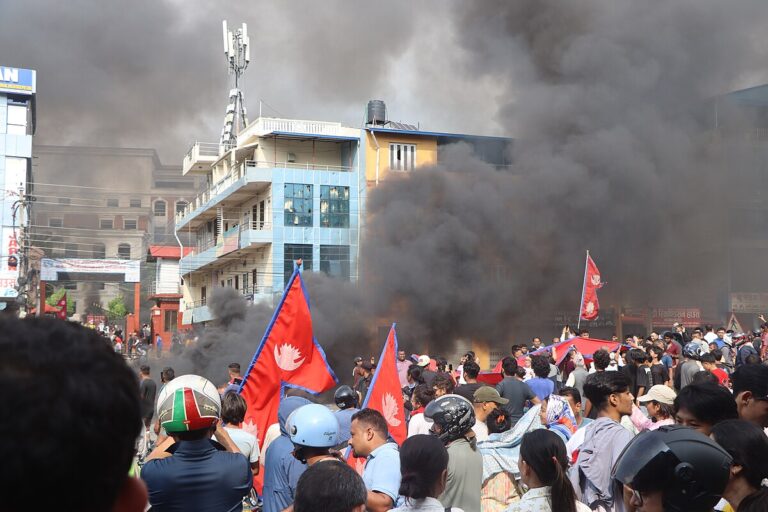
In early September, as a peaceful protest swiftly turned violent in Nepal’s capital city Kathmandu, Koan* knew things were getting out of hand. On September 4, Nepal’s government had put a ban on 26 social media platforms, prompting students to fight back peacefully on the streets.
Last week, when security forces opened fire – killing at least 72 protesters, mostly students – protests turned ugly. Unknown actors burnt down key buildings including the Parliament and the Supreme Court. Student protesters distanced themselves from the violence but within 10 hours, Prime Minister KP Sharma Oli and his cabinet resigned, effectively setting in motion what can be categorised as one of the world’s fastest regime falls.
But this was just the beginning.
25-year-old Koan, who was a part of the protests and requested anonymity to protect his privacy, says that there was a lot of chaos during the protests.
“[When the shooting of students happened] everyone was confused: why did it happen? Who ordered the shooting? Moreover, we didn’t have a fixed plan for the protest. We just knew things had to change [in the country] and it needed to be done fast,” he tells Asian Dispatch. Following the police action and announcement of resignations, Koan says the focus shifted to filling the power vacuum in the country.
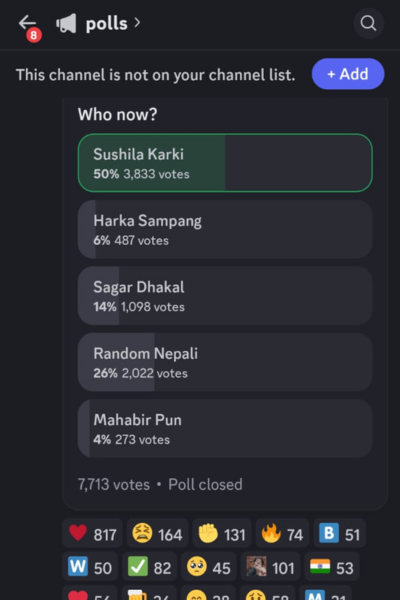
Screenshot of a poll on Discord to decide on the interim prime minister. Source: Aradhana Gurung
In the thick of this confusion, Gen Z protesters created a server on the social networking and gaming app Discord. Started with nearly 12,000 members, by the weekend, it had over 160,000 people. The group held a vote and negotiated to form an interim government with Nepal’s Army in a Discord livestream.
By Saturday, President Ramchandra Paudel dissolved the parliament and announced Sushila Karki as the interim prime minister until the elections on March 5, 2026. Karki was Nepal’s first woman Chief Justice and faced an impeachment motion in 2017 after she overruled a police appointment.
Initially, the Discord channel, Koan says, arose because of chaos but it helped them organise themselves. “People were scattered on every social media platform, and on the ground,” he says.
“The Discord server streamlined discussions so that people on the ground can get announcements based on their location.”
This group has since published a public manifesto called ‘Nepal Reforms’, which is now open for public consultation and is undergoing legal and constitutional review. This proposal focuses on decentralisation of power, wealth disclosures by all politicians, transformation in education, and banning political affiliations in student politics, among others.
Nepal’s ruling class once comprised a monarchy that lasted roughly 240 years. This was followed by shaky, successive governments that did little to reform the country. Citizens paid the price of political instability and weak governance for years as corruption scandals exacerbated the wealth gap.
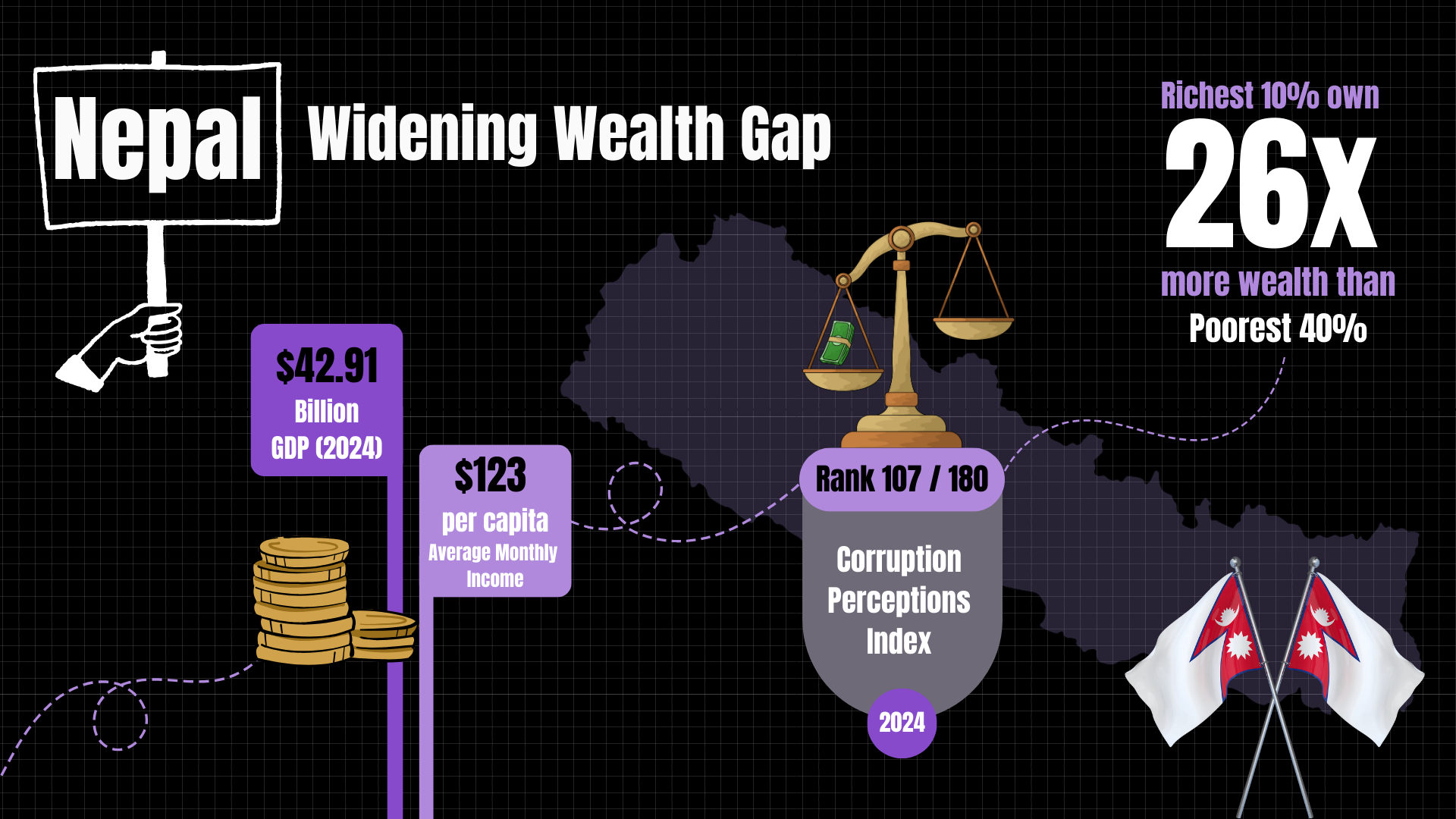
The Himalayan nation is one of the poorer nations in South Asia with a GDP of $42.91 billion (as of 2024) and the country ranks 107 out of 180 in Transparency International’s Corruption Perceptions Index. The hashtag #nepokids during the ongoing protests highlighted the vast disconnect the young generations feel with the political elites and their children. The average monthly income in Nepal is $123 per capita. The richest 10 percent of Nepalis have more than 26 times the wealth of the poorest 40 percent, according to the non-partisan think tank Nepal Economic Forum.
The widening income gap in Nepal. Graphic: Shivansh Srivastava
Nepal’s current political crisis, says Narayan Adhikari, the co-founder and South Asia director of Accountability Lab, isn’t an overnight outburst of anger. Young people have long been left out of political decisions, processes, and outcomes. In Nepal, people in the age group of 16-40 constitute 40 percent of the population, but make up only 11.6 percent of the country’s parliament.
“We’ve been ruled by kleptocrats who captured politics and state machinery, and siphoned off resources especially in the last 15 years,” Adhikari says. “Young people understand why they’re left out, why they’re poor, why they’re uneducated. They see the lives of their peers who come from wealthy families – the nepo babies – on social media. They channeled their anger into this new way of thinking that they can fight for what they deserve.”
However, Nepal’s youth are not alone in thinking this way, says Adhikari, adding, “Young people are leading the change across the world. Nepali youth see it on social media. It’s inspiring them.”
Koan reaffirms this.
“I speak for the majority of us when I say that our movement is technically inspired by movements in South and Southeast Asia,” he says. “A lot of countries have seen a lot of turmoil. Nepal started on a similar level. We knew the government was corrupt and that things weren’t going well for the last 20 years. We needed to stand up.”
A Deepening Divide
The Asia-Pacific region is home to 60 percent of the world’s adolescent and youth population but they’re increasingly getting left out of jobs, education, and seemingly optimistic economic growth in their own countries.
This region holds 35.9 percent of the global wealth, according to the Global Wealth Report 2025. However, the distribution is disproportionate due to inherent and a colonial legacy of corruption, nepotism and cronyism, thereby giving rise to a class of billionaires who “took” – not earned – wealth through these measures, according to a January 2025 report by Oxfam International titled ‘Takers, Not Makers’.
The world’s billionaire wealth has risen three times faster in 2024 than 2023, the report adds, but the number of people living in poverty – an estimated 3.6 billion people – hasn’t changed since 1990.
At this juncture, young people are finding ways to break out of the rigged system.
“The young people [in Asia] are unhappy with what the future looks like. There is deep insecurity,” Meenakshi Ganguly, the deputy director of Asia Division, Human Rights Watch, says. “In almost all these cases [of protests across Asia], the trigger was different but the underlying concerns are very similar. And in almost all these cases, it was also because of authoritarian actions by the state.”
As young people in Nepal, Bangladesh, and Sri Lanka occupied the streets, their voices were uniformly met with violent repressive tactics by the state machinery. “Protests can be peaceful,” continues Ganguly. “But it translates into anger because of security forces abuses, which happens when the forces believe they have the protection of the state.”
An image of protests against Sheikh Hasina’s government in Bangladesh. Photo: Wasiul Bahar/Wikimedia Commons
An image from the economic crisis protests against the government in Sri Lanka. Photo: Pallavi Pundir
Indonesia, Thailand, and the Arab Spring protests are other such examples. The Arab Spring protests that spread across the Arab world in the 2010s were in response to growing corruption and economic stagnation.
The protests that began in Indonesia on August 25 were a part of one of the 14 mass demonstrations that happened between October 2024 and September 2025. A 2025 Indonesia Inequality Report by Center of Economic and Law Studies states that the wealth of 50 richest Indonesians is equal to the total wealth of 50 million Indonesians.
The outrage over parliamentarians’ perks – which was nearly 10 times the minimum wage in Jakarta – snowballed after a police car killed a 21-year-old motorcycle taxi driver, Affan Kurniawan. Many protesters torched and looted politicians’ homes, revealing tangible evidence of disproportionate wealth.
Rebecca (uses only her first name), who works with a youth-focused non-profit called Pamflet Generasi (or “Pamphlet Generation”) in Jakarta, says she experienced wealth gap first-hand while growing up in north Jakarta, which is economically poorer than the south, and is also at the forefront of submergence due to a combination of climate change and groundwater extraction.
Indonesia is the world’s third-largest democracy, where political dynasties have held key political positions since independence in 1948. President Probowo Subianto, who was elected last year, himself has personal links to former President and dictator Suharto. Last year, he called the process of democracy “really very, very tiring…[and] very, very messy and costly.”
Disquiet in the Neighbourhood
Thousands of miles away in Bangladesh, the 2024 student uprising ousted Prime Minister Sheikh Hasina accusing her of nepotism, corruption, and crushing dissent and opposition. During the protests, an estimated 1,400 people died — vast majority reportedly shot by security forces — in a span of 46 days. Now on a run for over a year, Hasina faces several charges, including by her country’s International Crimes Tribunal, which she established in 2010.
Students atop former prime minister Sheikh Hasina’s official residence. Photo: Sajib Hasan
Interestingly, global consulting firms and economic surveys consistently hailed the nation of 170 million people as one of the fastest-growing consumer markets in Asia. But a recent white paper published by the interim government revealed it might all just be falsehoods.
Last year, the governor of Bangladesh’s central bank claimed that $17 billion was siphoned off in 15 years under Hasina. A 2023 government data shows that the wealthy 10 percent controlled 40 percent of the nation’s income in 2022, while the bottom 5 percent received only 0.37 percent.
“In Asian countries, whatever progress has been made, the benefits have not been shared equally because of the political and state capture of institutions,” Fahmida Khatun, the executive director of Centre for Policy Dialogue, a think tank in Bangladesh, tells Asian Dispatch.
She says that while there was economic stability, low inflation, export income and remittances helped with forex reserves, this didn’t meet the basic requirements of the citizens such as employment. “In fact, towards the end of the previous regime, the economy had essentially crumbled.”
Ganguly adds that social media, in this scenario, prised open the facade of development across these countries. “In a generation where a lot of people live their lives on social media, that disparity becomes even more glaring. Politicians cannot point to stock markets or some growth rate because that doesn’t translate to lived experiences of the people,” she adds.
While Bangladesh is still negotiating changes within an interim government, Sri Lanka provides lessons in rebuilding the country after kicking out its populist President Gotabaya Rajapaksa during the 2022 “Aragalaya” – Sinhalese for “The Struggle” – movement.
Protests in Sri Lanka in 2022 against the government. Photo: AntanO/Wikimedia Commons
Mostly led by young people, the movement blamed the Rajapaksa family, who have been entrenched in the political class for decades, for the economic crisis, and accused them of siphoning off $18 billion from the country.
Amid food, fuel, and medicine shortages, citizens braved violent repression by security forces and forced Rajapaksa to resign and flee the country overnight. A 2024 polling by the Institute for Health Policy shows that 92 percent of Sri Lankans believe the income gap in the country has widened in the last decade.
Since the uprising, though the Rajapaksas are back, the country voted for left-leaning Anura Kumara Dissanayake as its new president last year. Many see it as a refreshing outcome of the 2022 movement.
Thisara Anuruddha Bandara, who ran a Facebook group called “GoHomeGota2022” during the movement and also faced arrests in 2022 for his activism, says that the Aragalaya movement succeeded in having its popular demands met to a large extent.
“In a country where historically peoples’ uprisings have been suppressed, we could end with a victorious outcome.” However, he adds, the movement couldn’t completely overhaul the political system. “We think that within the limitations of a public force and a movement, we accomplished the maximum possible tasks. However, many tasks still remain to be accomplished in the future.”
The Hashtag Generation
If #NepoBabies were at the heart of Nepal’s recent protests, in Sri Lanka, it was #GoHomeGota. In Indonesia, it was #PolisiPembunuhRakyat, which translates to #PoliceThePeopleKiller alongside a parallel social media movement that spread across Southeast Asian countries calling for “SEAblings” – or SEA siblings i.e. Southeast Asian brotherhood.
In Bangladesh, the digital mobilisation stood against 22 days of internet blackouts, curfews, and military crackdowns, during which VPN usage shot by by 5,016 percent and young Bangladeshis increasingly released rap and memes to express their discontent against authoritarianism. Digital rights platform AccessNow called 2024 the “worst year” for internet shutdowns.
In Nepal, Koan says that while social media helped unify everyone, it also opened them up to pro-government trolls. Last week, when Koan and Sah started a Google Doc to start putting together a list of proposed reforms, “malicious actors” infiltrated the document. “There was a lot of vandalism on the document itself,” he says.
Human Rights Watch calls digital repression and violence a violation of fundamental rights, which disproportionately hurt vulnerable communities.
“We’ve been concerned about instigation of violence and targeting of minorities that happens on social media, especially in mob violence like we saw in Myanmar and Sri Lanka,” Ganguly says. “At the same time, social media is the driver to create collective moves in situations where protests build up, as it’s happened in Nepal, Sri Lanka, and Indonesia. Information is also more transparent here.”
Rebecca of Pamflet Generasi says that the internet is instrumental in the political awakening of the younger generation, where they express both rage as well as empathy and solidarity.
However, she points out that social media doesn’t represent communities from all socio-economic and cultural backgrounds. This, according to her, resulted in Indonesia not seeing any reformative changes.
We are stuck in a cycle of collective rage and frustration. The middle class and the privileged people feel good enough that they have acted upon the inequalities [online] while the vulnerable and marginalised keep living with injustice everyday. – Rebecca, Pamflet Generasi
Back in Nepal, Usha Mahato, a 28-year-old nurse, adds that for many Nepalis, especially those in the remote corners, the internet is a lifeline. She works in a government hospital in the agrarian province of Gandaki, located in central-western Nepal, and says that eight years ago when she was deployed in a remote location, she relied on the internet for upskilling, seeking information about scholarships, and connecting with medical professionals.
“It [The internet] provides young people with a platform to connect, learn, grow, and be seen. It’s a bridge to a brighter future,” she adds. Lack of domestic opportunities forced over 227,000 unskilled Nepali workers to leave the country last year for jobs, Nepal’s official estimates say.
“For over three decades, we’ve faced political instability, often led by a small group of ageing politicians, many of whom are not highly educated or capable,” adds Mahato. “The long-term development of our country depends on the active participation of its younger generation.”
Building the Future, Collectively
Koan and Sah, the two members of Nepal’s Discord group, say that the protests were just the tip of the iceberg. There, now, lies the formidable task of rebuilding a country.
While these protests were largely dubbed as ‘Gen Z’ protests, people like Aradhana Gurung, a 45-year-old development professional in Nepal, supported the negotiations as a governance expert.
“I’m 45. My mother is 78. I have a 13-year-old child. When [the Gen Z protesters] reached out to me last week, I saw the need to focus on the future for all of us,” she says.
Gurung says she was a part of student protests during the decade-long armed conflict between the monarchy and Communist Party of Nepal (Maoist), but in those days they didn’t have the tools like the ones that this generation has and even the support from their older generations was missing.
The 45-year-old says that now the group will work towards making their reform manifesto inclusive and accessible to everyone. “We’re making an effort to get these conversations to the communities at the local level and collect feedback,” she says. “This manifesto is not perfect but it’s a start, and we want people to critique and challenge it. This is big and we want to think of a big and bold future.”
Down south in Sri Lanka, Bandara says that the support of civil society organisations, intellectuals, trade unions, and farmers’ organisations, among others, was critical in making the Aragalaya movement a success. “While we can expect some short-term results – such as replacing individuals, appointing more responsible individuals who can perform their duties better, and initiating a new process – we can only achieve a long-term solution with a sustained commitment,” says Bandara.
Bandara says his political arrest in 2022 – which he labels as an abduction since the police didn’t inform his family of his whereabouts – resulted in him pursuing law and becoming an election observer in his country along with other Asian countries including Indonesia and Nepal. “This exposure has allowed me to create regional and global networks,” he adds. “Based on these experiences, we continue to strive to advance social pressure groups, organise them, and provide the necessary pressure and intervention to keep up the civic activism.”
Across Asia, student protests have been a foundational basis of the region’s politics. “In Bangladesh, it was so in the 1960s, for our language movement, or 1970s for independence, or even in the 1990s, in the context of removing the army general in power,” says Khatun, the economist. “[Young people] facilitated the fall of regimes and brought in new chapters in our history. But this time was different. While in the past, students went back to their educational institutions after the movement was complete, this is the first time when students wanted their share in power.”
Victory march by protesters in Bangladesh after Sheikh Hasina’s resignation. Photo: Wikimedia Commons
After taking positions in the interim government, young Bangladeshis have now launched a new political party. As Bangladesh hurtles towards the first general elections since the uprising, in February 2026, Khatun says that young revolutionaries should remember that interim government is just that – temporary.
“Interim arrangement should focus on institutional strengthening through reforms, which in itself is a continuous process,” she says. “Rather than opening it up on every front, just focus on crucial agendas. That is easier to follow through and implement and then quickly follow up with elections.”
Bangladesh’s fragile economy, which was once a $416-billion one, is slowly picking up as it receives millions in bailouts. The interim government is particularly focusing on reforms, particularly in banking, governance, and electoral sectors.
In Bangladesh, economic decisions have been intervened and influenced heavily by political parties. In the immediate past regime, we saw a nexus of politicians, bureaucrats, and businesses that created oligarchs who then controlled decisions in every sector. The biggest issue [right now in Bangladesh] is to separate these groups and strengthen our institutions. – Fahmida Khatun, Executive Director, Centre for Policy Dialogue
Rebecca from Indonesia says that the recent youth movements have ushered many young people into politics. Calling this a significant step, she says that the education system needs to go beyond assessing the political participation of the younger generation by the number of the voters and voter turnout. She suggests defining it through voicing of political opinions, volunteering with civic and political authorities, solidarity with all classes and so on.
“However, we have to critically ask if the participation is meaningful and inclusive (or at least, representing the diversity of youth’s identity),” she says. “The [prevalent political] system has made only certain groups of young people in the formal political arena: Those with higher degree, with connections, or with social power (i.e. influencer/celebrity). Most of the young people we met through our work in Pamflet Generasi are already fed up with formal politics, which is influenced by a feudal culture.”
At the moment, Nepal is struggling with economic blows particularly from the tourism sector, which contributes eight percent to the country’s GDP. Adhikari says that maintaining law and order is also critical to the safety of citizens right now. “The priority,” he says, “is to have a strong interim government that maintains law and order, and builds trust as the country plans its new elections, while also maintaining international relations and geopolitical order.”
Khatun adds that reforms are a continuous process. “One or two elections wouldn’t change this culture. It’s an iterative process,” she says. “If we can install a cycle of good elections, that would be our checks and balances and it would facilitate the delivery of the government’s commitments to their people.”
*The person’s name has been changed to protect their identity, upon their request.
Pallavi Pundir is an independent journalist from India who covers the intersections of politics and identity across South and Southeast Asia.
This story was produced by Asian Dispatch and was originally published on 18 September 2025. It has been republished by CIR with permission.
The 2024 parliamentary and local authority elections in Sri Lanka marked a notable shift in women’s political participation. With 22 women in parliament, nearly all newcomers, and 1,957 women (24.8 per cent) elected to local councils, the country has made commendable progress. From having 13 women in parliament, we now have 22 and many of them entered politics without any familial political lineage, breaking the South Asian norm of dynastic entry through male relatives. This shift should be celebrated, but it has also come with a disturbing cost.
Misogyny in the Digital Age
While their presence signals democratic progress, many of these women have become targets of gender-based abuse, especially online. The Mannar Women’s Development Federation (MWDF) and Women’s Action Network (WAN) have tracked a sharp rise in social media harassment, ranging from sexualised insults to viral disinformation in Tamil, especially during the last parliament and local authority elections. These are not just political critiques. They are deeply misogynistic attacks aimed at humiliating, silencing, and delegitimising women leaders. Most online discourse avoids policy or performance, instead focusing on women’s looks, clothing, personal lives, or relationships.
Sexism in Parliament: A Recent Case in Point
On September 10, 2025, MP Prasad Siriwardena of the Samagi Jana Balawegaya (SJB) mocked MP Lakmali Hemachandra (NPP) for not being “beautiful enough”. The remark, disguised as parliamentary banter, revealed the entrenched sexism even within Sri Lanka’s highest democratic spaces. Despite a public apology, the message was clear: women in politics are still judged by appearance, not ability.
Online Targeted Harassment and Character Assassination
Across the country, women politicians during the last parliamentary election have faced coordinated smear campaigns:
Mithilaichelvi Sripathmanathan (of Tamil Makkal Kootani) was publicly mocked by rival Dr Ramanathan Archchuna, who filmed himself tearing her flyer, mixing it with food, and pretending to eat it. A disturbing act of symbolic domination shared with over 90,000 followers.
Umachandraa Pragash (Samagi Jana Balawegaya) was falsely linked to a prostitution ring through TikTok and viral videos. Despite complaints to cybercrime authorities, the content remains online. This highlights platform inaction.
Dr Kaushalya Ariyarathne (National People’s Power) was dragged into a fabricated romantic scandal via a blurred image where only she was recognisable. The male MP remained unnamed, showing the gendered double standard in smear tactics, causing significant reputational damage to the first-time woman legislator.
Weaponising Religion and Identity
Hasanah Cegu Issadeen, a legal researcher and women’s rights activist, faced a brutal backlash after being appointed Private Secretary to Prime Minister Harini Amarasuriya. Her long-standing advocacy for the Muslim Marriage and Divorce Act (MMDA) reform, especially calling for child marriage bans and equal divorce rights, was distorted into accusations of undermining Islam. She was targeted via WhatsApp forwards and memes accusing her of being a Western pawn and fabricating a relationship with the Prime Minister.
Saroja Paulraj, Minister of Women and Child Affairs, advocating for MMDA reform, was labelled Islamophobic by religious leaders and online mobs. Despite factual accuracy, she was forced to apologise many times, which proves that truth is often no shield for women challenging patriarchal norms.
Transphobia in Politics
Chanu Nimesha, Sri Lanka’s first openly transgender general election candidate (Socialist Party), has faced relentless transphobic and homophobic abuse. While initially celebrated, she soon became the subject of hate due to the country’s laws still criminalising same-sex relations and lacking protections for gender identity. Her campaign highlighted the triple marginalisation of being transgender, female-presenting, and politically active.
Poetic Misogyny: The Case of Ambika Samuel
A senior Sinhalese man, Kumar Hettiarachchi, wrote a poem sexualising Ambika Samuel, a rising Up-Country Tamil politician. Beneath literary language, the poem fetishised Ambika’s body, identity, and her community’s suffering while turning her political leadership into an object of male fantasy. Her work to challenge caste, gender, and ethnic inequality was thus overshadowed by poetic predation.
Scrutiny Without Standards
Sri Lankan women in politics are held to harsher standards than their male counterparts. While men boast of power and performance, women are questioned about their attire, relationships, or simply for being outspoken. Prime Minister Harini Amarasuriya has been attacked for not dressing “like a dignified Sri Lankan woman,” with critics implying she should wear a saree, revealing the narrow mould women are still expected to fit.
Platforms and Institutions Must Do Better
Social media platforms like Meta have not been supportive in removing posts attacking public figures and women politicians, even after local moderators spend time translating and giving context to the disinformation and the harm caused by it. Social media platforms have thresholds for how their content is prioritised in content moderation, in which politicians have to meet a very high threshold, as they are public figures and are open to public criticism. Due to this high threshold, the way the community guidelines are applied and interpreted in the moderation will differ.
Despite having strong rules for hate speech and disinformation, during an election period, the rules of engagement change as the platforms prioritise moderating harmful content that has the potential to influence the outcome of the elections. This lack of expedience shown in moderating harmful content fails to respond to and affect local women who aimed to contest for the first time in the parliamentary elections, as well as established women politicians. While platforms will continue to profit off harmful content because it gets reshared and thus has increased engagement, ultimately, the cost of this is borne by a woman who loses an election campaign. This is why the presence of safe online spaces is vital to advance their movement in the political sphere.
Responsibility to counter these attacks
Many women who face sexual attacks on social media often shut down their accounts or go completely offline. This is the strategy many are advised to follow. However, some victims of online gender-based attacks have instead found ways to turn such experiences into opportunities for resistance, especially after receiving no support from social media giants and tech advisors to take the content down.
One such case is that of Swasthika Arulingam, where women’s rights activists collectively countered a sexualised social media attack on her and shut down her attacker. Dr Ramanathan Aruchchuna had been angered by a post in which Arulingam criticised the silence in parliament after he used his parliamentary privilege to refer to another woman as a “prostitute.” He then targeted Arulingam with online sexual abuse, assuming society would accept it. Interestingly, women around her rejected this and held him accountable through online solidarity posts.
Speaking about it, she said: “I believe the attacks against me had to stop because women stood up for another woman and refused to allow a member of parliament to sexually degrade someone online. If more women receive the same solidarity I did, I think more women will come forward into politics, knowing they have the support of their sisters”.
The Election Commission, social media platforms, tech companies and mainstream media must address this imbalance. Content in Sinhala and Tamil often slips through moderation filters, allowing harmful posts to go viral. Women leaders are forced to resort to legal action, a slow and insufficient remedy against viral hate and sexism.
What Needs to Change
A well-known Tamil female political candidate said:
“I have noticed that Tamil-speaking women often show solidarity, even when the issue unfolds in Sinhala. But when the roles are reversed, some Sinhala-speaking women say they didn’t understand because the attack was in Tamil and leave it at that. It’s a quiet imbalance worth reflecting on”.
This division between women in public spaces must be addressed. It stems from long-standing political divides nurtured by parties that capitalised on ethnic and linguistic fault lines. It is time women’s groups and rights activists collectively counter attacks on women politicians and political candidates regardless of party affiliation or background.
Through a series of reports by MWDF and WAN, some urgent reforms have been called for, including:
Gender-sensitive reporting desks at the Election Commission.
Local-language moderators trained in gender issues for social media platforms.
Updated cyber laws that criminalise online sexual harassment and disinformation.
The media’s responsibility is to focus on women’s policy and political contributions.
Public education on digital literacy and gender equity.
Beyond Numbers: Towards Real Inclusion:
2025 may be remembered as a breakthrough year for women’s political representation in Sri Lanka. However, without protection and meaningful participation, representation alone remains symbolic. True political inclusion is only possible when both online and offline spaces are safe for women to lead, speak, and govern without fear of abuse. If democracy is to thrive, all voices must be heard (including women’s), not merely as numbers in parliament or local bodies, but as leaders with equal power, respect, and freedom.
During election periods, women in Sri Lankan politics are especially vulnerable to targeted disinformation and sexualised online abuse designed to discredit and silence them. These attacks, often overlooked by digital platforms and political institutions, force many women out of public life, weakening democratic representation. When such disinformation is allowed to persist without consequence, it not only distorts the public narrative but also creates a chilling effect that robs women of continuity in political engagement, ultimately denying them their rightful voice and place in governance.
The writers are human rights activists and researchers at the Women’s Action Network.
This Op-ed was produced under the CIR– FACTUM Media Fellowship Program and was originally published in Daily Mirror on 20 September 2025.
A new Asian Dispatch analysis mapped nearly 400 internet shutdowns in the last five years across South Asia. As regimes resort to communication blockades, we look at how it impacts the ones who rely on it the most.
Across the world, social media has emerged as a means to collectively voice opinion and advocate for causes since the early 2000s. In South Asia, where internet penetration rates and mobile phone usage are some of the highest in the world, the platforms have been instrumental in democratising freedoms of speech and expression too.
The data speaks for itself. In India, over 70 percent of the population was using the internet as of 2024 data by International Telecommunication Union. In Bangladesh, that rate came up to 44.5 percent in 2024. The mobile broadband subscriptions stand at 899 million users for India and 98 million users in 2024. Looking at data from 2023 for Sri Lanka and Pakistan, we see the connectivity rate at 51.2 percent and 27.4 percent, respectively. The active mobile broadband subscriptions are at 73.5 per 100 people for Sri Lanka and 55.1 per 100 for Pakistan, as of 2024.
At the same time, the digisphere has created a new landscape for non-elite civic participation in everyday politics and political activism, wrote Dr Ratan Kumar Roy, a media studies professor from Bangladesh based in India, in his white paper on digitisation and civic participation. “Politics in the digital age is often subtle and takes on forms different from traditional political activism. This can include liking, sharing or commenting on political content, which can collectively have a large impact,” Roy notes in the report.
According to digital rights group Access Now, South Asia has seen some of the world’s leading internet shutdowns for over six consecutive years until 2024. In their 2024 report, they note that India witnessed 116 internet shutdowns in 2024 and over 500 in the last five years.
Mishi Chaudhary, the founder Software Freedom Law Center (SLFC.in) in India recalls two types of internet shutdowns: Preventive – that are imposed in anticipation of an event that may require the internet to be suspended by the state – and reactive, which are imposed to contain ongoing law and order situations. Internet shutdowns can take various forms, from blocking of certain websites to partial or full telecommunication and internet shutdowns.
“Internet shutdowns are the easiest tool in the toolbox for governments to control the flow and dissemination of information,” Chaudhary tells Asian Dispatch. “Although no evidence has ever been presented about the effectiveness of shutdowns, state authorities, fearful of the ease of organisation via the internet, are quick to use this blunt instrument of state power.”
In this piece, Asian Dispatch mapped 397 shutdowns between July 2019 and 2024 in India, Sri Lanka, Pakistan and Bangladesh out of which shutdowns in India, Pakistan, Bangladesh and Sri Lanka stand out. This data doesn’t include Afghanistan, Bhutan, the Maldives and Nepal, where internet shutdowns of this measure have not been documented.
Internet shutdowns have tangible real-world costs. In 2024, Pakistan’s economy was estimated to have lost between $892 million and $1.6 billion, according to the Information Technology and Innovation Foundations, a Washington-based think tank working on science and technology policy. In 2018, Sri Lanka faced an estimated $30 million loss due to similar measures, as reported by NetBlocks. The figures for India in 2024 stand at $322.9 million, as per the report by Top10VPN.
Robbie Mitchell, Senior Communication and Technology Advisor for the Internet Society, a global charitable organisation, says that information blackouts resulting from internet shutdowns can, in fact, result in increased violence. He elaborates further by adding that violent tactics of protest are less reliant on effective communication mechanisms and thus they could substitute non-violent protests that rely on the internet for planning and organization in the cases of internet shutdowns.
“In addition, internet shutdowns tend to attract international attention and create pressure on countries that undertake them. This relates to the so-called ‘Streisand effect,’ where the attempt to silence voices or hide information leads to the unintended consequence of bringing more attention to them,” Michelle says.
Left in the Dark
Mandeep Punia, a 30-year-old journalist from India, says that any internet shutdown causes a “fear of the unknown” in the society. Punia has experienced shutdowns first during the 2016 Jat community reservation protests, as well as the 2019 shutdown in Kashmir during the abrogation of article 370, among others. The most recent internet shutdown in India was in the state of Haryana in August 2025, as recorded by the internet tracker maintained by SLFC.
About 3,000 kms away, in Sri Lanka, Oshadi Senanayake, a civil society member and social worker, recalls the communication shutdown during the anti-Muslim violence in Sri Lanka in 2018. The series of violence saw the imposition of a nationwide state of emergency as Sinhalese-Buddhist crowds attacked Muslims and their establishments in the city of Kandy. “When the means of communication were restricted, it was very difficult,” she tells Asian Dispatch. “We were all in the dark, no one knew what was going on and there was no way to find out either.”
The similarity in these narratives connects the dots across South Asia on how internet shutdowns impact people.
In 2024, Pakistan invoked the region’s most recent shutdowns, which was done to curtail mass uprising in support of jailed former prime minister Imran Khan. This was one of the 17 shutdowns Pakistani people faced in the last five years, as per data collected by Asian Dispatch.
The same year, in July, Bangladesh saw mass protests by university students over government jobs, which eventually upended Sheikh Hasina’s 21-year rule. Her government resorted to internet shutdown in order to curb the organised movement. Over 1,000 people were killed during the protests, as per a report released by the interim government led by Nobel Laureate Mohammad Yunus.
At the same time, Asian Dispatch learned of students finding ways to circumvent the internet blackout, specifically by urging the residents to open their Wi-Fi networks, either by removing passwords or using “123456,” to support the movement. Shahriyaz Mohammed, a student at the University of Chittagong, and Raihana Sayeeda Kamal, another student based in Dhaka, confirmed that such appeals were made. According to Roy, who is also a former media studies professor at BRAC University in Bangladesh, this appeal drew widespread response, with many complying.
At the same time, the communication blockade disrupted the academic and professional prospects for many. Kamal said that she graduated last July and was supposed to apply for her postgraduate work permit in Canada. “I couldn’t do it. I was out of touch from Canada. It hampered my job search and communications with my professors, and delayed my application,” she tells Asian Dispatch.
Raihana Sayeeda Kamal, a student based in Dhaka talks to Asian Dispatch about her experience of living through the internet shut down of 2024 in Bangladesh/ Asian Dispatch
Mohammed, who lives in Chattogram, the second largest city of Bangladesh, says that internet cuts take place anytime, and that the Internet Service Providers (ISP) do not give any prior notice.
“The internet is the most necessary thing for my occupation and also for my study,” he says. However, due to these shutdowns, he wasn’t able to communicate with his office or get any updates from other parts of the country during the protests which hampered work for him as a budding reporter.
Controlling the Narrative
In 2019, India abrogated Article 370 of the Indian Constitution, which accorded special privileges to the region of Jammu and Kashmir. Along with the announcement came a sweeping communication blockade in order to curb disruptions due to anticipated unrest. The blockade in the region lasted 18 months prior to the services being fully restored. In all, the region experienced 213 days of no Internet and 550 days of partial or no connectivity, as noted by the Internet Society.
“Due to COVID-19, everyone knows what a lockdown looks or feels like. But it was only worse in Kashmir as there was not a restriction to physical spaces but also to virtual spaces,” Sayma Sayyed*, a student at a leading university in India, tells Asian Dispatch on condition of anonymity.
The situation, she added, resembled a pre-digital era, with no internet or mobile reception, forcing people to travel several kilometers just to check in with their loved ones.
The lack of internet creates a void of information in the society, says Sayyed*, a resident of Baramulla in Kashmir. “When I had to fill my form for competitive exams, students had to rush to government offices to do so,” Sayyed added. “So I went to the District Commissioners office to fill my form which is when I realised something has happened. Something I could do on a leisurely day became such a big task.”
Within India, the Union territory of Jammu & Kashmir holds the record of the highest number of shutdowns in the country.
Another student from the valley, who also spoke to Asian Dispatch on condition of anonymity, highlighted the psychological impact of such situations. “You don’t feel normal in places outside Kashmir,” the student said. “When I shifted to Delhi for further studies, I was confused as I was able to carry out my studies without any restrictions. I expressed this to my friends and they, too, agreed with the lack of restrictions. It felt jarring to someone who has seen so many curfews and internet blackouts.”
In this video from 2020, a student from Kashmir Valley in India’s Jammu & Kashmir voices similar concerns to Sayyed’s over the delay in her B.Tech examinations and how due to lack of internet, applying for her sister’s entrance examination became a daunting task. Source: Internetshutdowns.in, a repository of internet shutdowns in India maintained by Software Freedom Law Center, India [SFLC.in]
In Bangladesh, Shamim Hossen, a 28-year-old humanitarian worker and the reporting officer at Muslim Hands International, a charitable organisation, highlights how those solely reliant on mobile data were completely cut off. “I use mobile internet and data, and when I am in my office, I use Wi-Fi. But during the internet shutdown, our office was closed so I have no experience using Wi-Fi during that time,” she tells Asian Dispatch.
Sri Lanka has seen the use of full internet shut downs as well as partial restrictions such as curbing access to social media websites for a certain duration. Incidents such as the Easter bombings in 2019 which saw serial blasts on multiple public and religious sites in Colombo, to the economic crisis of 2022 to the Presidential elections in 2023 saw the use of such measures. The country has seen 5 shut downs from 2019 to 2022, as per data collected by Asian Dispatch.
Amarnath Amarasingam, Assistant Professor at the School of Religion, Department of Political Studies, at Queen’s University in Canada, told Asian Dispatch about the relation between misinformation and shutdowns. “In Sri Lanka, when social media was blocked, citizens turned to alternative, less reliable sources,” he says. “These shutdowns made it difficult for credible journalists and activists to fact-check information, leading to a situation where rumours and conspiracy theories filled the void. In countries with ongoing communal tensions, the spread of false rumours can lead to real-world violence against civilians as well.”
Massive protests in Delhi. All communications have been suspended in select areas where the protests were scheduled to take place. Please report any Internet shutdowns to us @NetShutdowns Reach out to us – +911143587126#LetTheNetWork#KeepItOn#delhipic.twitter.com/ziUtYdJEMe
Women’s safety and internet shutdowns. How internet shutdowns impact women’s safety and travel in the national capital of India, Delhi. Source: Internetshutdowns.in, a repository of internet shutdowns in India maintained by Software Freedom Law Center, India [SFLC.in]
Highlighting the broader implication of using internet shutdowns to control dissent, Amarasingam adds: “Internet shutdowns have significant human rights implications, especially around issues like freedom of speech and access to information. Shutting down internet services curtails individuals’ ability to express dissent, participate in protests, or even access vital services such as health and education. All of this, of course, will impact marginalised communities more than others.”
“In Sri Lanka, these shutdowns particularly affect communities with fewer alternative sources of information and who rely on mobile internet for basic services. In the former war zones in particular, these alternative sources of information are key for receiving information that is not curated by the government.”
Disrupting Normalcy
“My clients outside of Peshawar think that people from the region do not work properly due to internet restrictions coming up now and then. We had in fact replied to messages but they would reach one to two hours later, which affected our credibility.”
This is the ordeal of Sufi Ali, a 35-year-old IT officer from Mardan, located in Peshawar, Pakistan. Pakistan has recorded 35 shut downs between July 2024 to July 2019, according to the Asian Dispatch analysis. These include blocking the internet in response to protests such as the ones in support of former Prime Minister Imran Khan in 2022 to allegations of throttling with the internet speed by the government during the testing of speculated possible internal firewall.
“Along with the professional, personal life also gets affected,” adds Aftab Mohmand, a 44-year old senior journalist from Peshawar. Mohmand adds that usually, one can circumvent restrictions through VPN or Wi-Fi. But in Peshawar, there is no such facility. Four of the 35 shutdowns Asian Dispatch has documented from 2019 to 2024 for Pakistan were in Peshawar province. “VPN data is monitored and it can be dangerous too,” says Mohmand. Since 2014, he has been using the phone to make reels, create reports and record everything using the internet. .
Virtual Private Networks (VPNs) are often used to bypass shutdowns or access regionally blocked websites. But Mohmand notes that they significantly slow down internet speeds.
Journalists from India, Sri Lanka and Pakistan told Asian Dispatch that these restrictions make it nearly impossible to verify information for accurate reporting.
“I am a journalist so whenever we go out for conflict reporting, we face [internet shutdown],” says Punia, the rural journalist from India. “But the worst aspect of that is that our [media portals] are also shut down.
His concerns are mirrored by Sandun, a freelance journalist based in Sri Lanka. Talking about covering the 2018 anti-Muslim violence, she says the internet shutdown made their job even more difficult. “We treated every piece of news with suspicion and nothing could be verified. The officials were too silent or evasive and we didn’t have anyone on the ground. We felt like we would risk peddling misinformation,” she says.
On July 19 alone – the day Sheikh Hasina’s ousted regime enforced an internet blackout – at least 148 people were killed by law enforcement agencies, according to a report by the International Truth and Justice Project (ITJP) and Tech Global Institute.
CIR also identified two “peaks” in violence. The first was on July 18, where killings amounted to a massacre. It all started with the killing of a protester called Abu Sayeed, in Rangpur district, on July 16, which was captured in a now iconic image of him spreading his hands in front of the police force. The second peak in violence was on August 5, the day Hasina resigned and fled to India.
Both these peaks in violence also correspond to internet shutdowns, as Asian Dispatch has investigated.
The Policy Pitfalls
South Asian governments often cite national security and misinformation as reasons for internet shutdowns. However, these terms are frequently undefined or vaguely worded in legislation and policy, prompting global experts to raise concerns about their potential misuse.
In the absence of any explanations by government arms on the reasons behind these moves, speculation is rife. For instance in India, internet shutdowns are governed under the Temporary Suspension of Telecommunication Services Rules, 2024, which, under clause 3, explicitly states that the reason for such measures needs to be released in writing. However, these orders are seldom found in the public domain..
In Pakistan, the legal backing of shutdowns is murky as the Pakistan Telecommunications Authority (PTA) also recently highlighted this legal uncertainty. Numerous laws are speculated at play here, with most shutdowns being informed by PTA, the body responsible for establishing, maintaining and operating telecommunications infrastructure in Pakistan, via orders for enforcement by the Interior Ministry. Other than these orders it is believed that Section 54(3) of Pakistan Telecommunication (Re-organization) Act, 1996 is used for such shut downs, which has been ruled against by the Islamabad High Court in 2018. The opacity of such measures is widely recognised by activists and advocacy organisations in the country as well as globally.
Recently, Pakistani journalist Hamid Mir filed a petition in Islamabad High Court, requesting for clarity on why the internet speed in the country were significantly lagging in the past few months, leading to even voice notes or multimedia on WhatsApp not reaching receivers. The petition comes at a time when speculations are rife about the government installing a “fire wall” that would prevent free and open use of the internet in Pakistan.
Other laws in Pakistan, such as the Prevention of Electronic Crimes Act, 2016 (PECA) under its 2025 amendment-equipped section 26(A) criminalise intentional dissemination of false information in the country. ‘Fake news’ is also the basis of many internet shutdowns, thereby hinting at the indirect use of the act for enforcing such measures.
Sri Lanka, too, sees a similar trend in a mix of non-specific regulations being used to curb internet and social media access in the country. Orders to the Sri Lankan Telecommunications Regulations Commission by the Ministry of Defense have been seen as ways of enforcing such curbs. Reasons for shutdowns range from curbing the spread of misinformation, to stopping demonstrations such as during a state of emergency.
Amarasingam says that the absence of official communication during internet shutdowns often leads to an information vacuum, which can fuel misinformation.
“The problem is that in authoritarian contexts, misinformation merely means critiques of the ruling party. And ‘terrorism’ often just means agitation against the government. And so, these terms are weaponised to curtail fundamental rights. In these contexts, shutdowns may hinder the spread of accurate information, create distrust, and deepen existing societal divisions,” she says.
In India, the law is clearly laid out but often not applied consistently. For this, Chaudhary of SLFC says that the civil society has to constantly approach the courts to enforce their rights. “Time period of shutdowns are extended continuously despite limitations imposed by law. Law requires proportionality,” Chaudhary says, adding that the proportionality of these actions is far more than required for the general good.
“Can shutting down the entire system of social communications and completely crashing the payments economy for months be ‘proportional’ to the necessary problem of preventing the incitement of intercommunal riots? If this government intervention is the ‘least restrictive means,’ what are the other more restrictive means the government would not be allowed to use?” Chaudhary asks. “The mind boggles.”
Mitchell from the Internet Society adds further context to the consequences of these actions: “Internet shutdowns tend to attract international attention and create pressure on countries that undertake them. This relates to the so-called Streisand Effect, where the attempt to silence voices or hide information leads to the unintended consequence of bringing more attention to them.”
Digital Rights are Human Rights
When asked whether they were informed prior to internet shutdowns, there’s an astounding “no” from those interviewed for this piece.
Numerous international statutes reaffirm that the internet is an indispensable part of human rights. The United Nations Human Rights Council enshrines this in Article 19 of the Universal Declaration of Human Rights, which “protects everyone’s right to freedom of expression, which includes the freedom to seek, receive and impart information of all kinds, regardless of frontiers.” Restrictions to right to freedom of expression are only permissible under article 19(3) of the Universal Declaration of Human Rights, although it notes: “When States impose internet shutdowns or disrupt access to communications platforms, the legal foundation for their actions is often unstated.”
In India, on two separate instances – by the High Court of the state of Kerala and then the Supreme Court – access to the internet has been declared a fundamental right under the Indian constitution.
“In India, the law is clearly laid out but often not applied consistently. adds Choudhary of SFLC.in.
In Bangladesh, a similar trend exists. Asian Dispatch spoke to students and young professionals who didn’t receive any prior intimation of internet shutdown orders in the last one year. The trend is to slow down the internet, and then slowly revoke access fully, says Kamal, from Bangladesh.
Noting the impact of shutting down the internet, Michelle says: “Internet shutdowns have far-reaching technical, economic, and human rights impacts. They undermine users’ trust in the internet, setting in motion a whole range of consequences for the local economy, the reliability of critical online government services, and even the reputation of the country itself. Policymakers need to consider these costs alongside security imperatives.”
While law governs social media and not internet shutdowns directly, it is worth noting that the negative effects of problematic regulations become yardsticks for regimes that govern a similar cultural and social landscape.
“It also stops people from both demanding and empowering government action to protect its people,” Chaudhary adds. “Shutdowns don’t create the social and political will to safeguard our people, but rather a cloak for the government to hide its shame.”
Punia, the journalist from India, agrees and adds that freedom of speech and expression are never absolute. “They are only useful until one has to show them as democratic for indexes and rankings and gain marks there,” he says.
These are just a few examples of the broader impact experts point to. Given the concerns raised by individuals like Sayyed in India and Hossen in Bangladesh, a critical review of both the shutdowns and the frameworks enabling them is long overdue. Access restrictions need to be brought to the fore and the internet needs to be given a fair chance to make a case for its freedom.
Kaif Afridi from Tribal News Network (an Asian Dispatch Member) and Rukshana Rizwie from Asian Dispatch, Sri Lanka, contributed to the report. The data has been collected by Abdullah Al Soad from Asian Dispatch, Bangladesh.
*The person’s name has been changed to protect their identity, upon their request.
**Here, we account for all such instances as internet shutdowns, as blocking even a part of the internet is hampering communication for its users. Our methodology for data collection was to find reports by the media or advocacy organisations between Jan 2019 to Dec 2024 on internet shutdowns in India, Sri Lanka, Pakistan, and Bangladesh.
This story was produced by Asian Dispatch and was originally published on 03 September 2025. It has been republished by CIR with permission.
Methane gas spewing from landfills and waste dumps contributes significantly to global warming, but “garbage” often flies under the media’s radar.How waste is managed is not only a major climate change story, but also an important local story.
Reducing methane emissions is one of the fastest and most cost-effective ways to slow climate change. Methane from the waste sector is the third-largest human source of methane after the agriculture and fossil fuel sectors.
Investigating methane emissions from waste sites and reporting on the practical solutions can be done worldwide. Plus, improving how waste is handled benefits the health of those living near disposal sites.
How waste is managed is not only a major climate change story, but also an important local story.
Learning about methane emissions is now easier because of the availability of satellite and remote sensing data. However, ground-level reporting is essential.
Solutions exist. There are practical and economical ways to reduce methane emissions from solid waste. Investigative reporting can explore whether viable solutions are being pursued, and if not, why.
This GIJN guide will describe what resources are available and what questions to ask about methane emissions from landfills and how to reduce them.
Examples of great investigations on the issue can be found at the end of this guide.
Section One: The Big Picture
Methane emissions are a major contributor to global warming.
The decomposition of organic matter in an oxygen-free environment results in the creation of methane gas as one by-product.Human activities are… generating an estimated 60% of all methane emissions.
Methane (CH₄) is the second-largest contributor to climate warming after carbon dioxide (CO₂), which is more abundant and longer-lasting. Methane, over a 20-year time frame, is 80 times more potent than carbon dioxide as a greenhouse gas. “A molecule of methane traps more heat than a molecule of carbon dioxide, but methane has a relatively short lifespan of seven to 12 years in the atmosphere, while CO₂ can persist for hundreds of years or more,” according scientific research. (See a summary by the US National Aeronautics and Space Administration (NASA).)
Decomposition happens in nature all the time, resulting in methane emissions. Rising temperatures are accelerating methane emissions — for example, in the Arctic tundra. But human activities are the real culprits, generating an estimated 60% of all methane emissions. (See NASA and other sources listed at the end of this section.)
Organic waste, such as food and paper, accounts for about 20% of anthropogenic (human-caused) methane emissions worldwide, according to the 2021 United Nations Global Methane Assessment: 2030 Baseline Report. Agriculture accounts for 40% of methane emissions (32% from livestock, 8% from rice production), and fossil fuels contribute another 35%, the same report said.
Waste Production Increasing
The amount of waste is projected to increase.
“By 2050, in a business-as-usual scenario, the world is projected to generate 73% more MSW (municipal solid waste) than in 2020,” the World Bank said in a 2023 report.The world population generated 1.9 gigatons per year of municipal solid waste (MSW) in 2015 and is expected to generate about 3.5 gigatons per year of MSW in 2050. — 2020 study
“Every year across the globe more than two billion tons of municipal solid waste (MSW) is generated,” according to a 2024 report by the UN Environment Programme (UNEP). “If packed into standard shipping containers and placed end-to-end, this waste would wrap around the Earth’s equator 25 times, or further than traveling to the moon and back.” (And that doesn’t count construction and demolition waste, industrial waste, agricultural waste, and health care waste.)
“High-income countries produce the most waste per capita, where rising incomes and consumption have been associated with higher waste generation,” the World Bank noted. But that could be changing. The report elaborated: “Going forward, waste generation rates in most high-income countries are expected to either remain stable or slightly increase. Middle-income countries, conversely, are projected to see the largest increase in both per capita waste generation and total waste generation.”
The generation of more waste “will be driven by high levels of growth in both economic activity and population” and urbanization, according to the World Bank. “Waste volumes are projected to grow by more than 2.5 times for low-income countries (LICs) and nearly double for middle-income countries.”
Want another metaphor?
The world population generated 1.9 gigatons per year of municipal solid waste (MSW) in 2015 and is expected to generate about 3.5 gigatons per year of MSW in 2050, according to one study. That’s a lot. A gigaton is 1,000,000,000 metric tons. (A metric ton equals 2,205 pounds, about 10 percent heavier than a US ton.)
The authors of the study said that projected waste in 2050 would equal the weight of 200 million elephants; enough elephants to stretch from the Earth to the moon.
Landfills Everywhere
Where does all that waste go?
There are 48,000 landfills worldwide, according to a 2022 estimate by the UK publication Landfill Today.
There’s a distinction between “landfills,” where methods are being employed to mitigate environmental damage (such as liners to prevent water seepage), and “waste sites,” where there are no controls and garbage is simply dumped, and often burned.
The 2024 UNEP report said 38% of the MSW generated globally in 2020 was “uncontrolled.” Over 90% of waste in low-income countries is still openly dumped or burned, according to a 2018 World Bank report. One study of India identified 3,184 existing dump sites, handling about 160,038.9 tons per day of solid waste, with only half of it treated.
While “open” burning and random dumping of waste is widely seen as environmentally damaging, incineration to produce energy (waste-to-energy) is controversial. Burning causes carbon dioxide emissions, along with “black carbon” and other pollutants. This guide, however, focuses on landfills.
Managing all waste properly, in landfills, is costly. “Municipalities in low-income countries are spending about 20% of their budgets on waste management, on average,” according to a World Bank report.
Other Pollutants, Too
Nine hundred and fifty tons of obsolete pesticides being excavated from a landfill in Minsk, Belarus, to be packed into barrels and shipped for destruction. Image: Irina Oleinik, World Bank photo collection (Creative Commons)
While this guide is focused on methane emissions, there are many other types of toxic pollution from landfills that have negative health consequences.
Some of the other pollutants from landfills are airborne, while others leach into the soil and groundwater. These pollutants, and their effects, include:
Benzene, which causes cancer, found mainly in plastics;
Volatile organic compounds (VOCs) that react in the sunlight with nitrogen oxides to form ozone pollution, which can cause respiratory health problems;
Hydrogen sulfide, which smells like rotten eggs and can cause irritation to the eyes and respiratory system, and derives mainly from gypsum wallboard;
Toluene, which damages the nervous system, and is used in many applications as a solvent;
Per- and polyfluoroalkyl substances (PFAS), also known as “forever chemicals.” According to new research, landfill gas serves as a major pathway for the release of PFAS.
And methane, besides being a potent greenhouse gas, contributes to ground-level ozone that is linked to respiratory diseases and premature deaths.
Dumping garbage outside of landfills can damage the environment, often with significant human and economic consequences. For example, wetlands can be destroyed, natural fisheries can be degraded, and beaches polluted.
In addition, poor and Indigenous populations are more likely to be negatively affected by waste disposal and pollution, since these sites are often located in their vicinity. Not to mention the impact on waste-site workers, including those in the “informal sector” who scavenge sites. In the US, the modern environmental justice movement can be traced, in part, back to “Dumping in Dixie,” a 1990 book showing that landfills were disproportionately sited next to poor and Black communities.
Noxious smells and increased illness in neighboring communities may well be important subjects for stories. Gypsum drywall has been associated with the generation of hydrogen sulfide. Odors may also signal leaky gas collection systems. “If you smell something, that is oftentimes indicative of a problem,” said Tom Frankiewicz, who leads Waste Sector Methane Mitigation at the Rocky Mountain Institute (RMI), an independent, non-partisan, nonprofit organization.
In sum, many waste management problems, and solutions, are related to methane emissions.
Solutions Are Available
While the problems seem overwhelming, journalists should be aware that a wide variety of cost-effective solutions can yield significant benefits, according to policy experts.
Methane emissions from waste are largely preventable and need to be reduced by at least 30 to 35% to limit global warming to 1.5°C., according to the UN’s 2021 Global Methane Assessment.
“Transforming open dumpsites worldwide into sanitary landfills, while diverting organic waste to composters and bio-digesters, can decrease methane emissions by 80% (60–89%)… “ according to a study published July 2025, in Nature Climate Change.
The solutions are good investments. As much as 60% of waste-sector targeted measures are low cost or pay for themselves quickly by saving money (negative cost), according to the report.
The waste sector has proven to have the greatest mitigation potential for sources of pollution after the oil and gas sector, even though it only contributes 20% of overall emissions.
More on solutions to come later, but first a look at measurement.
Resources (listed in order of relevance and value):
Methane is invisible to the naked eye, but emissions can be made visible and documented using a variety of techniques, both on the ground and from above.
“We can’t really manage it if we don’t measure it,” said David Risk, a Canadian methane researcher, while telling the CBC about a simulation project run by FluxLab, an organization he heads.Governments could mandate measurement, or do it themselves, but often do not… Even when operators are mandated to report emissions, the data may not be made public.
Satellites, airplanes, and drones are increasingly a great source for images and emissions data.
The levels of emissions seen from above frequently exceed what’s officially reported. Ground measurements of methane emissions, from oil fields and landfills, are regularly underestimated. A 2024 study by Carbon Mapper in the US found “a large discrepancy and generally poor correlation” between what scientists observed from the air and what was reported to the US government. This underestimation was supported by an earlier NASA study.
Ground measurement can be gathered by landfill operators, but the results can be hard to get. Governments could mandate measurement, or do it themselves, but often do not. Instead, the focus is more on finding major leaks than identifying emission rates. Even when operators are mandated to report emissions, the data may not be made public.
“[W]hile tools to collect data exist, their application and translation into actions are lacking, meaning there is a huge untapped potential of unlocking action and finance through data collection and data use,” according to a March 2025 report by the Climate and Clean Air Coalition (CCAC), a multilateral group whose Secretariat and Trust Fund is hosted by UNEP.
More transparency is needed about potential solutions, according to the CCAC. “Key data gaps include the volume and composition of waste (particularly food loss and waste), and the quantified benefits of relevant prevention, recovery, and recycling solutions on human and ecosystem health, job creation, and economies,” according to CCAC. The report includes forms to be used for data collection.
The CCAC LOW-Methane Data Strategy has supported some national projects, “designed to unlock action on methane mitigation from organic waste by improving data collection, analysis, and application.”
Methane Tracker from the International Energy Agency provides estimates of annual national methane emissions from the waste sector.
What Are the Units of Emission Measurements?
Image: EPA/ GIJN
Methane emissions are usually expressed as the volume emitted per hour: kilograms per hour (kg/hr) or tons per hour.
To make these figures more relatable, the Guardian wrote: “An outburst near Lahore in Pakistan in February leaked at 214 tons an hour, equivalent to 34 million car exhausts.”
Orbiting satellites are providing valuable data on greenhouse gas emissions, including methane from landfills.
GIJN did some test drives and learned that the data can be very useful, but with some caveats. The main one being that supplementary ground-level reporting is essential.
Satellite data usually includes longitude and latitude coordinates for specific emissions but may not pinpoint a landfill and usually does not identify the emission source by name. This means it’s essential to use your local knowledge of landfill locations to figure out where the emissions are coming from and who’s responsible.
Here are a few other things to keep in mind about satellite images:
Satellite observation has its complications. The circling cameras take snapshots, but there are important variables, including how often the satellite flies over the site and the resolution of the images. Winds blow emissions, which is why the plumes shown are often elongated. Interview the sources of the information about the data and its limitations.
Note that the providers usually include an “uncertainty factor.”
The data provided by these sources typically is at least 30 days old, usually due to contractual obligations of providers who sell the data commercially.
For a detailed explanation of satellite detection of methane, read a April 2025 report by The Center for Law, Energy & the Environment (CLEE) at the University of California, Berkeley, and The Emmett Institute at the University of California, Los Angeles.
After looking at the data online, ask for assistance from the data providers. They may help you navigate the maps and the data. On request, some will provide more specific and more periodic observations. Many of these sources will work with reporters.
Satellite Image Sources
These sources are listed roughly in order of how much information is available.
Carbon Mapper: This US nonprofit posts global carbon dioxide and methane emissions from the fossil fuel, waste, and agriculture sectors on a searchable map. To refine the view to methane plumes from waste specifically, find the tiny print “Show Filters” just below the search bar. Locate “Sector” and pick “Solid Waste.” Also select “CH4.” This will pull up plumes of methane — indicated on the map as purple circles — that have been observed by airborne and satellite instruments. At the geographic location you want, click the circle to pull up a specific plume and get key details about the observed emissions event, such as the emissions rate and the number of observations. Previous observations, if available, are shown in a box in the right corner. There’s also a Product Guide. You can create saved searches and receive email alerts for newly published data on the Carbon Mapper portal. Press contacts are Kelly Vaughn (kelly@carbonmapper.org), Annabelle Blair (annabelle@carbonmapper.org) or media@carbonmapper.org
Methane Alert and Response System (MARS): This international methane tracking effort is run by the UN Environment Programme, relying on many public and private sources. The map view can be narrowed to “waste” and by date. Clicking on the identified spots will bring up emissions information. While in map view, click the vertical words “Access Data” to see various download formats. UNEP has an access to information policy that may be used to make requests for additional information. However, UNEP will not provide the notices it sends to governments about significant emissions. Reporters could try using national access laws to request the notices. Contact isunep-newsdesk@un.org.
The CAMS Methane Hotspot Explorer: New in 2025, this resource shows large methane plumes from strongly emitting localized sources using European Space Agency Copernicus Sentinel-5P TROPOMI methane satellite data. The data are updated daily and provide global coverage. Select source type, “Urban/landfill” and set the time period on map. The map shows only the last 14 days, but all data can be downloaded. Hover over identified spots to see more information. The exact sources usually are not identified, but the most likely source type is. See documentation. Contact the Copernicus press team.
EMIT Open Data Portal: A resource from NASA. In the upper left corner, use the Layer option to choose “Methane Metadata.” The time slider allows a focus on specific date ranges, and you can play with the range by clicking the play button at the left. On the map, click the red circles to see the time and concentration of the emissions. NASA uses parts-per-million-meter (ppm-m). (See an explainer here.) Contacts: Andrew Wang (andrew.wang@jpl.nasa.gov), Jane Lee (jane.j.lee@jpl.nasa.gov), or hq-media@mail.nasa.gov.
GHGSat Spectra: A periodically updated map posted by the Canadian-based company, GHGSAT, includes a selection of recent major emissions worldwide, usually about seven months old. (Sign-up is required for access.) Clicking on any of the locations shows a table of the featured emissions and identifies some as “waste management.” Also provided: the time the image was taken and rate of flow. The precise location is not given, but there’s a close-up image of the plume. Above the map it says: “Upgrade your account to add real-time emission, catalog data and analytics!” A spokeswoman said that, upon request the company will “share aggregate statistics about the prevalence of emissions at a regional level to give a sense of scale” and also provide specific local data to journalists. Contact Alison Boyer (aboyer@ghgsat.com) or info@ghgsat.com.
Kayrros Methane Watch: The French company Kayrros offers some of its data for free. The Kayrros map, after you click “Access Data,” allows you to narrow a search. See “Source Type” and click on “Other Human Activity” (the category in which landfill emissions would fit). You also can define the timeline. The map may show multiple readings from a location, as overlapping orange circles, but these are not easy to click on. Instead, go to “Download Data” at the lower right and use the tool with the connecting dots to define the area of interest. Then download the data. Media contact: team-kayrros@sonder-london.com
Climate Trace: The not-for-profit coalition has a map that can be narrowed to cover the waste sector (and five sub-sectors). There were 363 sites identified in a May 2025 check. Methane emissions data (in a CO₂ equivalent) is shown, but you can also switch to methane by using the drop-down menu at the top right of the screen. Updated monthly. Media contact: media@climatetrace.org
WasteMAP: This US nonprofit identifies specific landfills on a map and estimates how much methane they are emitting. These estimates are based on public data from a variety of sources, modeling, and sometimes satellite images. WasteMAP researchers also calculate total country and city emissions. The data here is mostly from 2022, but projections are made for identified locations. The project was created by the Rocky Mountain Institute and the Clean Air Task Force. Media contact: wastemap@rmi.org.
Image: Screenshot, WasteMAP/ GIJN
For a detailed explanation of satellite detection of methane, read this April 2025 report by The Center for Law, Energy & the Environment (CLEE) at the University of California, Berkeley, and The Emmett Institute at the University of California, Los Angeles.
On the Ground: Landfill Operators Collect Data
Satellite data can be a great starting point for an investigation, but it isn’t essential and needs to be supplemented with other information to fill out the picture.
Interview landfill operators and relevant government officials. They may be skeptical about the satellite data and say the problems have been fixed, but there’s lots to ask about what they know about methane emissions.
Starting questions for landfill operators:
What data exists on your methane emissions?
What methods do you use to monitor emissions?
Be prepared for complex answers and be skeptical.
“[M]any of these large persistent landfill emissions are not included — or are misrepresented — in traditional emissions accounting methods,” said Tia R. Scarpelli, staff scientist at Carbon Mapper in 2024 testimony to a US Senate committee.
Importantly: ask for documentation.
In some countries, landfill operators are required to file reports with regulators. If so, the documents may or may not be covered by freedom of information laws.
Seek out local environmental groups, scientists, and other experts.
A lack of data from a landfill operator is itself a story. No measurements? Why not?
Now let’s look at the ways emissions are measured on the ground.
Ground-Level Measurement Techniques
The quality of data gathered on site depends on which measurement techniques are used and how well, among other factors.
Ask landfill operators about their practices.Infrared cameras and other specialized equipment used from a distance can show the existence of methane emissions from point sources, such as flare stacks and vents.
Measurement techniques include walking surveys with handheld methane detectors that use laser technology to map emissions.
“There is no single monitoring technology that can ‘see’ all of the methane at the granularity that’s needed at landfills,” Scarpelli wrote in a 2024 article about research on US landfills. Getting too close to the “working face,” where trucks drop off their loads, may be dangerous, Scarpelli wrote, “… which means that large emission sources may be missed during the survey.”
Her research showed that much of the methane released, at least at US landfills, comes from the working face, where solid wastes are discharged, spread, and compacted before being eventually covered up. Operators also commonly identified construction activity on the landfill surface, malfunctioning gas wells, taking gas capture wells offline, and cracks in surface cover as sources of emissions, she found.
Robotic dogs equipped with methane sensors are now patrolling landfill sites, and drones are being used to measure emissions, too, RMI reported: “Compared to traditional monitoring, where a technician walks the site for miles, these methods are safer, more efficient, and more economical.”
See a summary of techniques on page eight of the CCAC report. Also note a Waste Wise Cities guide from UN-Habitat with seven steps for collecting data on municipal solid waste.
Methods matter. But even if some methods have faults, the data over time may identify trends.
Monitoring also applies to “flaring,” or burning off of landfill gases. Flaring does reduce methane emissions, but is not ideal compared to other solutions. Flares not operating correctly increase methane release, so monitoring is necessary. “Enclosed” flaring is an alternative that produces minimal emissions, although it does create some particulate air pollution. The World Bank’s Global Gas Flaring Tracker has data and reports on flaring, but not on specific landfill sites.
Image: Screenshot, World Bank Global Gas Flaring Tracker
Can reporters use handheld methane monitoring devices? Not really.
First, without access to the landfill, accurate measurements can’t be taken.
Second, infrared cameras and other specialized equipment used from a distance can show the existence of methane emissions from point sources, such as flare stacks and vents, but not more dispersed emissions. These devices are expensive and require training, so it’s probably best to work with environmental groups, some of which are happy to help journalists in joint projects. (For more, see the investigating leaks and emissions chapter of GIJN’s Methane Guide.)
Nevertheless, images from infrared cameras do provide excellent graphics. Satellite images can serve the same visual purpose.
Finally, what goes into a landfill will affect what comes out. Estimating emissions by measuring inputs is also feasible, although complicated.
The Solid Waste Emissions Estimation Tool (SWEET) is an Excel-based tool that quantifies emissions of methane, black carbon, and other pollutants from sources in the municipal solid waste sector. The tool was created by the Global Methane Initiative, an international public-private project. While it’s designed for experts, landfill officials can use it as well — for example, in detailed studies, such as this one from 2022 on Accra, Ghana. Journalists can ask landfill officials if they use it or similar tools to track output from their sites
Hunting Methane Using Satellites, The Center for Law, Energy & the Environment (CLEE) at the University of California, Berkeley, and The Emmett Institute at the University of California, Los Angeles, 2025
A variety of actions could significantly reduce greenhouse gas emissions from landfills. Delving into possible solutions during reporting may be the real value of a landfill investigation.
Potential solutions include:
Reducing the amount of organic material disposed of in landfills.
Capturing emissions for a renewable source of energy, sometimes called bio-gas.
Cutting emissions with improved landfill operations.
More below on each of these, but also check out a thorough survey option of solutions and implementation steps by the Clean Air Task Force (CATF), The Waste Methane Toolbox: Policy Solutions for a Low Methane Future, which notes that waste and wastewater are responsible for approximately 20% of global anthropogenic methane emissions. That’s equivalent to roughly 5.4 gigatons of carbon dioxide equivalents annually, says CATF. Country examples are provided for Colombia, Germany, India, Italy, Perú, the Republic of Korea, and the US.
CATF wrote, “When we consider examples of countries that have successfully used these approaches to improve waste management and reduce climate impacts… it becomes clear that there is no silver bullet or single solution to achieve this goal.”
But the benefits can be substantial.
Reductions of about 80% below baseline methane emissions by 2050 could be obtained if reform steps are taken, according to a 2020 study by scientists published in Environmental Research Communications.
“Fortunately, there are a number of technically feasible, readily available strategies to reduce landfill emissions today, at modest cost,” said the RMI’s waste expert Frankiewicz in his 2024 testimony before a US Senate committee.
“Modernizing landfill operations — through comprehensive leak detection and repair, expanded gas collection system coverage, and enhanced cover practices — can cut methane immediately from waste-in-place, while protecting nearby communities from co-pollutants,” according to Frankiewicz.
He also said that “scaling up efforts that keep organic waste out of landfills — through strategies like edible food donation and composting — will avoid future landfill methane generation and ensure organic materials are put to their highest and best use in the circular economy.”
“The economics of it check out,” said another expert, who works internationally but preferred not to be quoted because of his institutional connection.
There is increasing private sector interest because some of the solutions can be economically viable. “Bankability is becoming the big story,” according to the same expert. But investment is slow to come, and what there is, is mostly for extraction of bio-gas. More on that below.
Some financial assistance for landfill improvements has been provided by international development agencies, such as the World Bank. Some mitigation projects have been funded by the CCAC, a UNEP initiative, including in Panama, Senegal, Nigeria, Uganda, Argentina, Cambodia, Paraguay, Brazil, Pakistan, Costa Rica, and Liberia. (The list includes those started in 2024.)
However, the prospects for implementing solutions vary widely.
One study published in the journal Waste in 2025, began: “In sub-Saharan Africa municipal solid waste management faces significant challenges, including inadequate infrastructure, increasing waste generation, and limited resources, leading to severe environmental and public health issues.” The article said that governance structures, data availability, and informal practices prevalent in sub-Saharan Africa make it “difficult” to introduce appropriate innovations in waste management customized to local needs.
In terms of climate change ambitions, in many developing countries there’s a significant disconnect between national climate change goals for the waste sector and what is achieved, according to the 2021 World Bank report Bridging the Gap in Solid Waste Management.Approaching landfill operators and government officials might best be done initially with open-ended questions about the problem and what solutions are being employed or being considered.
“Central authorities often regard solid waste management as a local function and beyond their mandate,” the report says. “Line ministries often do not see it as being either their role or practical for them to provide the guidance, support and resources needed by local authorities to implement national policy. Yet, the primary responsibility for setting the overall institutional, policy and legislative framework for the municipal waste management sector belongs with central governments.”
A taste of how large the challenges are is provided in a 2025 study of three rural Cambodian cities. All waste was going to “unsanitary open dumpsites without soil coverage, landfill liners, leachate treatment facilities, or gas control systems.” Plus, “open burning of waste was observed across all the landfills and temporary dump sites,” according to the researchers.
For investigative reporters, this means that there will be many different situations and possible solutions.
Mitigation efforts may already be underway, so the questions to ask may be about whether they are working.
“Most” landfill operators, said Frankiewicz, who consults internationally, “are trying to do the right thing, but it’s challenging.”
What to Ask, Who to Ask
Approaching landfill operators and government officials might best be done initially with open-ended questions about the problem and what solutions are being employed or being considered.
National governments have an interest in this. In pursuit of global climate change goals, most governments make pledges to reduce greenhouse gas emissions.
Senegal, for example, aims to reduce its overall methane emissions 7% by 2030, or by 29% over the same period if external assistance is provided. “For the waste sector, Senegal’s emissions reduction intentions are set at 11% until 2030 and up to 65% if adequate external funding can be provided,” summarized a UN report.
Getting to these goals will involve various strategies.
The playbook identifies four municipal solid waste management types. The lowest category is “characterized by low to medium collection rates, poor waste management systems, low recycling rates, and limited or no waste treatment prior to final disposal.”
The playbook — which is a good primer for reporters — describes strategies to mitigate methane for each of the four archetypes, “providing a starting point for countries to further customize methane abatement solutions unique to their local context.”“A third of the global trash mountain ‘built’ every year is generated by about one-sixth of the population (high-income countries)… However, only around 13% is recycled and 5.5% composted.” — 2022 IIASA report
For countries in the lowest category, lack of access to finance for capital projects is “a major obstacle.” As a result, “these countries can start reducing methane emissions by building basic infrastructure or implementing relatively low-cost operational improvements at the dumpsites.” These strategies “can include developing small-scale decentralized organics processing facilities, limiting waste pickers’ access to dumpsites, installing landfill covers, and installing basic gas capture and control systems (GCCS).” Examples given include the Dominican Republic, Guatemala, Nepal, Nigeria, Tajikistan, and Uganda.
The playbook doesn’t list all countries by categories, although it gives a handful of examples.
Use the categories in exhibits four through nine as a basis for questions. Pathways can be read in conjunction with a 2022 RMI report on “key strategies.”
Environmental groups, especially those concerned with climate change;
Other non-governmental organizations and civil society organizations, including those looking to cut government costs and to reduce food waste;
Scientists and social scientists;
Waste management trade associations;
Businesses looking to cut their waste costs or help others do so;
Businesses hoping to profit from recycling, composting, and gas capture;
Potential customers for products such a fertilizer;
Affected citizens, such as neighbors of landfills.
Searching for news about landfills in your area may prove useful.
Here’s more about four main strategies for reducing methane emissions from landfills, followed by a collection of resources.
Reducing Organic Material Levels
Diverting organic waste from landfills can reduce methane emissions and pay other dividends.
“A third of the global trash mountain ‘built’ every year is generated by about one-sixth of the population (high-income countries),” noted one group of researchers, adding, “However, only around 13% is recycled and 5.5% composted.”
Reducing food waste is considered key. “Because food waste is the largest component of the organic waste stream, food loss and waste prevention is the best option to reduce methane emissions from municipal solid waste,” according to RMI’s Playbook. Keeping biodegradable waste from being sent to landfill is also underscored in an analysis by the International Institute of Applied Systems Analysis.
The mantra of “reduce, reuse, and recycle” will keep organics out of landfills. Among other things, food waste can be composted and paper can be recycled.
Plastics in the waste stream “is a major challenge to the diversion, recovery, and treatment of organic waste,” according to CATF’s The Waste Methane Toolbox. The amount of plastics can be reduced with a variety of prohibitions and incentives, the report says. Doing so reduces the cost of later separation.
Reducing organic waste disposal requires not only political will but also behavioral changes by the public and increased capital investment. For example, a 2022 report on Ghana underwritten by the World Health Organization noted that increased composting and recycling “would likely be preferred by society, but needs significant investments in capital, skilled labor, planning capacity and societal participation in waste separation.”
Figuring out the social, financial and political details can be complex.
Image: Screenshot, World Bank, Bridging the Gap in Solid Waste Management report
Among other things, in many places, waste pickers are a key part of the equation — totaling an estimated 15-20 million individuals worldwide, who focus primarily on plastic recycling. “In Colombia, waste pickers have transformed their social and professional status, evolving from being seen as ‘disposable people’ to being recognized as providers of public recycling services,” according to a 2024 article by the Platform Cooperativism Consortium. Women in Informal Employment: Globalizing and Organizing (WEIGO) points out: “It is well established that waste pickers contribute to reducing greenhouse gas emissions in many cities and are the backbone of recycling.”
National efforts are being tried in some countries.
The Swachh Bharat (Clean India) Mission, started in 2014, includes segregation of waste among its goals, and envisions diverting 80% of municipal solid waste from landfills by 2026.
There has been progress, but the Swachh Survekshan (National Sanitation Survey) for 2023 said India’s national waste processing average remains below 40%. Similarly, a 2023 report by the Centre for Science and Environment, a public interest research organization based in New Delhi, says about half of the total waste generated in the country remains uncollected.
Even when diversion tactics are being used, oversight is warranted. Watchful reporting by the Hindustan Times exposed weaknesses in the trash-sorting process.
South Korea has been credited with reducing food waste by the Korea Economic Institute of America, a think tank.
Taiwan, “with its stringent regulatory frameworks and advanced recycling technologies, generates significantly less FW [food waste] per capita compared to Malaysia and Bangladesh,” according to a 2024 academic study.
In the US, researchers found that, although five states passed laws pressing businesses to compost food waste instead of trashing it, only one state, Massachusetts, achieved a decrease.
There are many and varied strategies to keep organics out of landfills.“From an economic standpoint, preventing and reducing organic waste saves consumers money and avoids the costs associated with managing discards.” — Rocky Mountain Institute’s Tom Frankiewicz, 2024 US Senate testimony
One option is to send organic waste to composting facilities or anaerobic digesters instead of landfills, so that much less methane is produced, with potential byproducts such as compost, biogas, or other beneficial end products.
A 2024 RMI report said: “Diverting organic waste to compost or anaerobic digestion can achieve up to 95% methane reduction efficiency when compared with landfilling, depending on operational practices, and strategies to prevent waste generation further reduce greenhouse gas emissions throughout the supply chain.” And further: “Reducing organic waste disposal also brings significant benefits to communities and ecosystems in terms of food security, soil health, and green job creation.”
Organics recycling projects, Frankiewicz acknowledged, “typically come with incremental capital costs to invest in new infrastructure, but the revenue from valorized end products (e.g., compost, biogas, digestate) can make projects economically viable and in some instances more favorable than landfilling over time, which can be passed on to consumers through lower rates.”
In addition, other beneficial changes can occur from such initiatives. Jobs can be created, according to a study by the NGO GAIA. It concluded that “zero waste approaches create orders of magnitude more jobs than disposal-based systems that primarily burn or bury waste.” Frankiewicz in his 2024 Senate testimony said: “From an economic standpoint, preventing and reducing organic waste saves consumers money and avoids the costs associated with managing discards.”
Using Gas Capture Systems
Methane emissions from landfills can be profitably captured and used as fuel.
Methane can be extracted by embedding perforated tubes into the landfill and creating a vacuum system.
The captured methane, variously called landfill gas (LFG), renewable natural gas (RNG), biomethane, or bio-gas, can be refined and then used in any number of ways. It can be burned to generate electricity for onsite use or supplied to the grid. It can be converted to liquid natural gas that can fuel vehicles, such as garbage trucks. It can be transported elsewhere by pipeline, for industrial and other uses. Because it is fuel domestically produced, it potentially reduces the need for more expensive imports.
The choices are not all black and white, however. “In some contexts,” producing renewable natural gas, “could lead to a net increase in methane emissions when used as a vehicle fuel,” according to a report by the World Resources Institute.
The use of capture systems is growing, and there is plenty of upside potential.
The US EPA reported that 61% of methane generated by landfill food waste in the US in 2023 is not captured by gas collection systems.
A 2024 assessment in India by academic experts said power generation from landfills could result in annual financial gains of US$4.7 to $13 billion. “These findings underscore the importance of implementing integrated waste management strategies that prioritize waste reduction, efficient treatment, and energy recovery from landfill gas,” wrote the authors. Savings from methane recovery were analyzed in a 2024 article in Frontiers.
A key impediment to this solution is the expense of installing capture systems, and in many places it won’t be feasible. It may be challenging for smaller landfills.
A 2022 World Health Organization report on Ghana pointed to the complications, stating, “While the landfill gas capture scenario has lower methane emissions, it would require large infrastructure investments, building new sanitary landfill capacity, and guaranteeing robust regulatory enforcement to ensure that all collected waste is diverted to sanitary landfills.” The report also discussed alternatives.
However, investors, including oil and gas companies, are looking into deals with landfills, to underwrite the cost of developing recovery systems in exchange for a share of the revenue. Oil and gas companies are investing in landfills that turn trash into clean fuel, according to an NBC News report on a Fort Wayne, Ind., landfill that is converting waste to natural gas.
Image: Screenshot, NBC News, YouTube
Specialized companies sell the equipment. For example, Qnergy, “a leading provider of methane abatement solutions” based in the US, in 2025 announced TORCH4, “developed for small, unregulated landfills to mitigate methane emissions and gain compliance with minimal operating costs.”
A Landfill Gas Screening Tool was created by the US EPA to assist cities in assessing the potential feasibility of landfill gas energy projects.
It’s impossible to review all the options, but the increased interest in this area should provide sources. Companies looking to profit by collecting emissions could be useful sources. The comparative experiences of places using different systems could be instructive. Landfill operators could be interviewed about their options and experiences.
Operational Methods to Mitigate Emissions
Sometimes overlooked are basic landfill practices that can reduce emissions.These are complicated issues for journalists, likely to require expert help.
Waste is covered, usually daily, and the thickness and compaction of the cover affects emissions and also can increase the efficiency of capture operations. Tuning and maintenance can boost gas collection system performance. Biocovers spread across a landfill’s surface contain naturally occurring methane-eating microorganisms, which reduce emissions between 70 and 100%.
“Our modeling shows that in the short term, large methane emissions reductions will come from improvements to gas collection and cover, while organics diversion measures result in methane reductions in the long run, as it takes time for these measures to have an impact,” according to a report by the US non-profit think tank Industrious Labs.
These are complicated issues for journalists, likely to require expert help.
Government Actions
Governments have sought to reduce emissions in a variety of ways:
Requiring more monitoring and transparency;
Setting abatement goals;
Raising taxes and fees;
Incentivizing mitigation efforts;
Running awareness campaigns;
Closure of open or illegal dumpsites and conversion of open dumps to controlled dumpsites;
Imposing fines when emissions rise above set levels.
Governmental carrots and sticks may both be required.
A next step in India is a government proposal to make producers and others responsible for collecting and recycling the packaging waste they generate, as described in a Down to Earth article.
In the United States, the Biden administration issued a rule in April 2024 that required “comprehensive and accurate information on landfill emissions and the efficacy of gas collection systems and destruction devices.” However, the Trump administration has signaled opposition to the rule, announcing a reconsideration of the Greenhouse Gas Reporting Program (GHGRP).
Some US state governments are active in this area. Colorado, for example, is considering earlier installation of gas collection systems and more use of technologies such as aerial monitoring and biofilters, as reported by WasteDive and Colorado News Line.
Some Signs of Progress
There are signs that solutions are reducing methane emissions from landfills.
Landfills in the US recorded their third consecutive year of declining methane emissions, dropping to 119.8 million metric tons of carbon dioxide equivalent in 2022, according to a 2024 report by the US EPA, Inventory of US Greenhouse Gas Emissions and Sinks.
In one locale, Orange County, Calif., a variety of solutions are being implemented. Waste Today reported on a successful capture program at a landfill in Iowa. In the absence of US federal leadership, states are taking the lead, Canary Media reported.
In Europe, methane emissions decreased by 45% between 1990 and 2021, and that trend is projected to continue. “[B]ased on the Member States’ projections of greenhouse gas emissions, methane emissions from the waste sector will decrease by 52% by 2050,” according to the European Environment Agency.
Editor’s Note: Thanks to the many people who provided expert help for this guide. Special thanks for reviews by Katherine Blauvelt and Elizabeth Schroeder of Industrious Labs, Jacob Wallace of Waste Dive, and Kait Siegel of the Clean Air Task Force (CATF).
Toby McIntosh is GIJN’s Resource Center senior advisor. He was with Bloomberg BNA in Washington for 39 years. He is the former editor of FreedomInfo.org(2010-2017), where he wrote about FOI policies worldwide, and serves on the steering committee of FOIANet, an international network of FOI advocates. He is the editor of Eye on Global Transparency.
This is a Chiru, the Tibetan antelope, a Class I endangered animal poached notoriously in the 1980s-1990s for its underfur, to make the world’s most expensive fabric. Since 1979, hunting chiru has been illegal – Video Credit – Asian Dispatch This is a shahtoosh shawl, made from the underfur of the chiru, and said to be the softest fabric in the world. Weaving and buying shahtoosh is also illegal. – Credits – Asian Dispatch
In the bustling streets of Srinagar’s Old City, in India’s Union Territory of Jammu and Kashmir, the mention of “shahtoosh” elicits a violent shake of the head. There’s no shahtoosh here, we’re told consistently. It doesn’t exist anymore.
This denial is as present as the dark clouds of ongoing unrest in the region are pervasive. This is also in line with the global ban on shahtoosh trade since 1979 under the Convention on International Trade in Endangered Species (CITES). India banned it in 1979, and Jammu and Kashmir implemented it in 2000. The ban followed international scientific studies and revelations about the mass killings of a Himalayan goat species, the Tibetan Antelope or chiru.
The chiru is a Schedule-I species as per the Wild Life (Protection) Act, 1972 of India. According to the Wildlife Protection Society of India, it takes the life of three Tibetan Antelopes to make one 2m x 1m lady’s shawl, and the life of five to six of them to produce a man’s shawl. The Wild Life (Protection) Act, 1972, is essentially to afford the animal the highest degree of protection. Yet, research indicates a high degree of precarity for the chiru. In a crackdown called ‘Operation Soft Gold’, India’s Wildlife Crime Control Bureau analysed shahtoosh seizures and cases between 2009 and 2020 in the country. Their report, published in 2022, found that the trade of shahtoosh has been “actively operational undercover in India in order to cater to the worldwide demand.”
GIF Credit – Asian Dispatch
A rare fabric coveted by the world’s high-society and political elite, shahtoosh trade is counted among the world’s most alarming wildlife crimes which continues to have an exclusive market, according to the 2024 World Wildlife Crime Report by the United Nations Office on Drugs and Crime. The CITES Illegal Trade Database, documented 245 Tibetan antelope specimen seizures between 2016 and 2021 in India, Nepal, Switzerland, the Netherlands, the UK and the US.
Portrait of a Mughal courtier from 1575, with a scarf that may have been a gift from Emperor Akbar, who loved shahtoosh. Image: The Cleveland Museum of Art via Google Arts & Culture – Image Credit – Asian Dispatch
The allure of the fabric draws much from its legacy: Its name translates to “king of wool” (shah translates to king, and toosh means wool). This nomenclature can likely be traced to the 16th century documentation of Mughal emperor Akbar, who loved shahtoosh to the point of almost legislating against its use outside the royal courts. In fact, in his documentation in 1821, East India Company employee William Moorcroft recorded how Akbar allowed only two looms to be used to weave pure shahtoosh. Beyond the luxe factor, the fabric fibre happens to just be 10 microns in diameter. Microns are used to measure small objects or particles, and are equivalent to one millionth of a meter. In comparison, a pashmina is 12 microns, and merino wool is between 18 to 24 microns. This makes the fabric incredibly light. So light is the woven fabric that it’s touted to pass through a wedding ring, and so warm it is believed as capable of helping hatch an egg. By 1975, when the global ban on shahtoosh was imposed, the fabric was being sold by leading brands from Hermes to Yves Saint Laurent. Shahtoosh continues to be flaunted by the global elite: the American lifestyle expert and celebrity entrepreneur, Martha Stewart, flaunted travelling with shahtoosh as recently as in 2017 (she later retracted this claim).
Officials Asian Dispatch spoke with state that the global crackdown on shahtoosh sales has been effective. However, over the years, hundreds of shahtoosh products have been seized, and many have been arrested globally for selling the product. Now, as part of a cross-border project helmed by Asian Dispatch, journalists from India, Nepal, Pakistan, and the UAE have produced exclusive interviews, and new details have emerged to reveal a complex narrative around the shahtoosh. The broader thrust of the narrative indicates that authorities need to revisit the implementation of the ban, and ensure further collaboration to crack down on the illicit black market.
m 1575, with a scarf that may have been a gift from Emperor Akbar, who loved shahtoosh. Image: The Cleveland Museum of Art via Google Arts & Culture
A Kashmiri weaver works on a pashmina shawl in March, 2025. Video: Hashim Hakeem/Asian Dispatch
The Kashmir Story
Video Credit – Asian Dispatch
“Chori se chalta hain abhi bhi (It secretly continues even now),” Shabbir Ahmed, a second-generation weaver from Srinagar who used to weave shahtoosh before the ban, tells Asian Dispatch. “If [authorities] find out, [the culprits will] surely get raided.”
Najeeb Mushtaq, a third-generation trader of Kashmiri shawls, whose family transitioned from shahtoosh to pashmina trade after 2000, says, “Every second house in the Old City was a weaver [of shahtoosh]. They were compensated well for their craft.”
GIF Credits – Asian Dispatch
Most former shahtoosh weavers Asian Dispatch spoke to attested to the ongoing illicit trade. One trader, who spoke on condition of anonymity, said that they still get orders for shahtoosh. This trader refused to say whether they fulfilled those orders.
The story of shahtoosh seems to be rooted in the physical geography of Kashmir: Historically, Kashmir was a part of the silk route connecting Central Asia, China, and the Middle East. It is also important to note that shahtoosh has served as a strong economic pillar in the past for Kashmir’s dwindling artisanal community. India’s official surveys estimate that up until the ban, the shahtoosh production process involved up to 45,405 Kashmiris, including families, with about 14,293 who had direct involvement in its making. Around 85 percent of them lived in the Old City. By 2002, the population of active shahtoosh weavers was reduced to 15,000 workers, with a Wildlife Trust of India (WTI) report projecting that it would continue to decline. There is no recent official survey of the shahtoosh weavers.
According to an estimate by the Wildlife Protection Society of India, the price of raw shahtoosh wool in the 1990s – before Jammu and Kashmir implemented the ban – ranged between ₹34,000 to ₹60,000 per kilo (With the currency conversion being $1=₹35 at the time). Even though the ban on shahtoosh sales was imposed in Jammu and Kashmir in 2000, it took many years for the fabric to completely disappear from shelves. While it may not have the same retail prominence, it has conveniently slid into the shadows of a thriving black market.
“When the ban was enforced, the traders transitioned to legal livelihoods, but the weavers couldn’t,” says Mushtaq, “[The weavers] didn’t get appropriately rehabilitated by the state or their own community. Many of them were shifted to pashmina, but pashmina is half the price of shahtoosh, and artisans aren’t paid as well.”
A depiction of the ring test of a shahtoosh shawl. Illustration: Mia Jose/Asian Dispatch
Mushtaq refers to the unemployment rate (as of December 2024) of Jammu and Kashmir, which stands at 11.8 percent against the national average of 6.4 percent. Official data shows that despite the significant contribution of the handloom sector in the region’s economy, the industry languishes because artisans are dropping out of it.
Mushtaq says that the wave of unemployment and economic restrictions after the shahtoosh ban compelled some traders and weavers to get sucked into illicit activities. “The ban made these shahtoosh artisans not only unemployed but simultaneously took the respect they had in society. Now they’ve been reduced to smugglers,” he says.
Ahmed, the Old City weaver, told Asian Dispatch that even though he left shahtoosh-weaving when the ban came into effect, people selling illegal shahtoosh still ask him to weave it for them. “Someone contacted me just two days back in fact,” he says, during our interview, in April. However, Ahmed refused since he only weaves pashmina now.
Legality aside, there also remains the question of ethics, and when it comes to procurement of shahtoosh wool, the question of its ethicality depends on who tells the story.
Kashmiri traders and artisans say the wool has always been sourced “ethically” from their counterparts in the neighbouring union territory of Ladakh, who further source it from the Tibet Autonomous Region. The Line of Actual Control, which divides India from China-controlled Tibet, is a disputed and heavily militarised boundary. This region is marked by barren, high-altitude terrain with perpetual sub-zero temperatures – conditions befitting the chiru population. This is the region from where, Kashmiris say, Tibetans used to “gather” shahtoosh wool by collecting it from bushes that caught the chirus’ hair – not by hunting the animals. This argument, however, is contested by conservationists.
Artisans in Kashmir working on looms, weaving pashmina shawls. This is a 360° photo – use your mouse pointer to view the room fully. Photo: Hashim Hakeem/Asian Dispatch
“Our pashmina comes from the mountains, and we often don’t know what threads get mixed,” Shah says. Referring to the 2022 plea, Shah says, “Authorities claimed they’re shahtoosh which we have appealed [to rectify] many times to the textile ministry. Now, we have better testing systems in place, but these seizures have resulted in negative coverage of our people. There were times when our shipments were confiscated, and, by the time they came back from the labs, our orders were cancelled. We had to throw them away.”
At the moment, there is no official market value of shahtoosh products. Before the ban, authors Sherry Rehman and Naheed Jafri, in their book The Kashmiri Shawl: From Jamavar to Paisley (2006), estimated that 100 genuine shahtoosh shawls were exported from India every year. Today, the black-market rate of each shahtoosh shawl is estimated to be anything between $10,000 to $20,000. Rehman and Jafri write that: “Asli toos, or real shahtoos [sic] fibre is hardly used in Kashmir anymore, although international fashion and couture houses still quietly place their orders with their Kashmiri manufacturers.”
The Illicit Journey of Shahtoosh
Wildlife Crime Control Bureau officer and one of the lead researchers of the report, Operation Soft Gold, A Pragatheesh doesn’t buy the argument of “erroneous” chiru hair in confiscated material. “You can’t say the chiru hair just appeared in pashmina wool,” he tells Asian Dispatch, “It’s not a contamination.”
A depiction of the chiru or the Tibetan Antelope. Illustration: Mia Jose/Asian Dispatch
Under his supervision, ‘Operation Soft Gold’ analysed 62 confirmed cases of shahtoosh products seized over the course of 11 years, to ascertain the physical properties of the chiru hair. “We identified the guard hair [of each consignment] and we found that the chiru’s guard hair is hollow. Scientifically, it has an insulating effect, which traps the air and keeps the skin warm for those who wear it,” he said. “This is distinguishable only through a microscope.” However, he adds, “As detection [technology] increases, so does the technique of [the culprits] evading the [authorities].”
Artist’s rendition of a Pashmina shawl (left) and a Shahtoosh shawl (right), based on descriptions. Illustration: Sharanya Eshwar/Asian Dispatch
A depiction of an Instagram DM conversation between an online seller and a buyer. Illustration: Mia Jose/Asian Dispatch
Operation Soft Gold unveiled an online network that is brazen in its advertisements. Now, a cursory search on Instagram and Facebook can reveal multiple accounts claiming to sell shahtoosh. The operation corroborated these advertisements with the invoicing details of the seized products. They found that traffickers deliberately mis-declare shahtoosh as pashmina, cashmere and wool – all of which are legally and ethically derived from Indian goats. Once exported, the shahtoosh is then sold directly on retail to affluent buyers, mostly in tourist destinations across the world. The 62 consignments in question comprised 343 shawls and 101 stoles. Together, their valuation, based on the receipts, came to $1,925,464.
The Wildlife Trust of India supports agencies such as the Wildlife Crime Control Bureau in intelligence gathering, field validation and collaboration. Between 2001 and 2019, it assisted with the seizure of hundreds of consignments of shahtoosh, leading to arrests. It told Asian Dispatch by email that, over the years, it has observed a shift in the trade’s pattern—from open market sales to more covert operations, “often facilitated through digital platforms or concealed in courier shipments through a well-established network.”
Crucially, Pragatheesh charted out three main routes of how shahtoosh enters India, before leaving for foreign shores: The first is from Tibet via Nepal into Delhi, and then to Kashmir to be woven before it’s exported to other countries. The second is through Nepal’s border with the northern Indian state of Uttarakhand, and then to Kashmir. The last is the direct, albeit more challenging, route from Tibet to Ladakh – suspects likely walk this distance overnight due to the heavily guarded border. From Ladakh, he says, it reaches the traders in Kashmir. In the larger scheme of things, Nepal acts as a critical strategic hub in the raw shahtoosh delivery chain; while Kashmir is where the weaving transforms the raw material into premium ‘export ready’ products.
Neighbour’s Complicity
Video Credit – Asian Dispatch
In Nepal, two huge seizures in 2013 trained the spotlight on the country’s role as a vital transit point for smuggling shahtoosh to other countries, especially India. The country lists the Tibetan antelope as a “protected species” under Nepal’s National Parks and Wildlife Conservation Act, 1973. Anybody caught with it can face up to 10 years in prison, and/or NPR 75,000 ($550) in fine.
Despite these measures, in January 2013, the Central Investigation Bureau of Nepal Police confiscated 46 bags of shahtoosh wool weighing up to 1,181 kg, and worth about NPR 4.5 billion ($32 million). This was in Nepal’s Gorkha district, in Thumi village, which is located in the northern belt about 160 km west of Kathmandu. The Gorkha district borders the Tibetan Autonomous Region from the north.
A month later, another 400 kgs of shahtoosh wool was seized from Dhading district, which is also north of the Tibet border. Among the six arrested and charged was one Tibetan national, whom the police say came to Nepal two months prior to the heist to help identify chiru population in Tibet. “It takes around 2-3 days to reach the border that Nepal-China shares from the place where we seized the fur,” Bhola Bhatta, the deputy superintendent of Nepal Police, told Asian Dispatch. Bhatta worked on wildlife cases as an inspector in 2013. “It took me three years to arrest one of the main accused – this shows how complex the network was.” Considering the quantum of the consignments seized, experts Asian Dispatch’s Nepal correspondent spoke to claim that seven to ten thousand Tibetan antelopes may have been killed for that amount of hair.
However, more than a decade on, Sudhir Raj Shahi, the Central Investigation Bureau’s spokesperson and the information superintendent of police, says that there has been no shatoosh seizure since 2013. When asked what explains this period of lull in activities, Shahi said, “Because of our law enforcement, [the smugglers] might have changed the route.”
Whether the smuggling routes to or from Nepal have changed remains a moot point, although Pragatheesh, the researcher at India’s Wildlife Crime Control Bureau, says that the country remains a crucial transit point.
What is more evident, however, is the markets that continue to thrive next door in Pakistan, and beyond South Asian borders too.
Divided By Borders, United by Shahtoosh
Video Credit – Asian Dispatch
At a posh supermarket in Pakistan’s Islamabad city, dozens of women in the premium section of a shawl store asking for shahtoosh shawls is a common sight. The priciest shahtoosh shawl, one store seller says, can cost up to PKR 1.5 million ($5,329). But the hefty price tag is not a deterrent for these wealthy women. As the store assistants display different varieties of the shawls, the shop owner reveals the range of “shahtoosh”. “It starts at PKR 400,000 ($1,421) and can go up to PKR 1.5 million ($5,329),” a shop owner said. However, adds the owner, a person with “legitimate income” can’t afford pure shahtoosh. “Its price in Pakistani rupees is over five million, or even more.”
A representation of a shopkeeper in Pakistan. Illustration: Mia Jose/Asian Dispatch
Pakistan has in place a fine of up to PKR 1 million ($3,552) and a jail time of up to two years for trading shahtoosh. Despite that, shahtoosh is publicly adored and offers the elite bragging rights – until it draws online attention, and outrage. In December 2021, Junaid Safdar, the son of Pakistani politician Maryam Nawaz Sharif, wore shahtoosh at his wedding, and instantly came under public scrutiny after the brand behind it claimed that it sells “antique gold original shahtoosh” for $17,000. “When it’s old, the natural colour turns to gold,” their post claimed.
Dr Mumtaz Malik, the former chief conservator of wildlife in Pakistan, says that Pakistan has yet to effectively implement policies related to the chiru. “Despite being illegal, these shawls are still worn by a specific segment of the elite class in Pakistan. Legally, Pakistan is obligated to curb this trade, yet the shawls are available in upscale outlets in major cities like Lahore and Karachi,” says Malik.
Back in Islamabad’s supermarket, the store owner says, “Both shahtoosh and pashmina shawls are smuggled into Pakistan via Gulf countries, especially Dubai, from Kashmir… If immigration officials at the airport create problems, they are bribed. Nowadays, they are often brought to Pakistan in large shipping containers under the guise of import-export businesses.” In Pakistan’s cultural hub of Lahore, the main town in the province of Punjab, there’s a fabric store in a market area called Liberty, where the price of a shahtoosh shawl starts from PKR 2.8 million ($9,947).
Two traders in Lahore and Islamabad said that dozens of shahtoosh shawls worth millions of rupees were recently gifted to the wedding party – including the bride and groom – of a prominent politician’s daughter. Some of the shahtoosh shawls were worth PKR 2.5 to 5.5 million rupees ($8,881 to $19,540).
There is a general awareness of the shahtoosh ban among the traders. The sale and purchase of shahtoosh, thus, doesn’t take place in ordinary retail shops. In a shawl store in Lahore, for instance, shahtoosh shawls were kept inside locked suitcases in a hidden room behind the main counters. Further, there is no official or unofficial data on the sale of shahtoosh; neither is there any media reporting on the seizures and arrests related to its illicit trade.
The big question around the shahtoosh in Pakistan relates to its authenticity. Malik says that it’s a challenge to identify genuine shahtoosh – even for wildlife officials – in Pakistan because of poor detection technology. “Immigration staff at airports are ill-equipped to identify the material, and in many cases, wildlife personnel are not posted at the airports,” she says.
Jaleel Khan, a trader who repairs used pashmina and shahtoosh shawls in Lahore, says that the average person is prone to becoming a victim of deception due to poor knowledge of shahtoosh. “People who are unfamiliar with [shahtoosh] end up buying pashmina shawls under the label of shahtoosh,” Khan said, “Women from elite classes are often deceived in this manner.”
“Real shahtoosh is very costly,” said Khan, “The expensive ones come through Kashmir and Dubai. The price for these shawls ranges from PKR 2.5 million ($8,881) to PKR 15 million ($53,291). People openly sell these under the guise of premium products,” he said.
UAE: Core Customer Base for Shahtoosh Beyond the Sub-continent
Video Credits – Asian Dispatch
There used to be an assumption that the majority of shahtoosh clientele lay in Europe, Pragatheesh at India’s Wildlife Crime Control Bureau tells Asian Dispatch. But he realised he was wrong soon: A majority of the consignments were headed toward the Middle-East – 18 percent to Oman, and 17 percent to the United Arab Emirates. Other destinations from the region include Riyadh (12 percent), Saudi Arabia (12 percent) and 10 percent to Switzerland. Spain, Mauritius, Italy, China and Hong Kong are other destinations.
Wealth is a big factor for the UAE to be a hub of shahtoosh clients. In 2023, the average per capita net wealth of the UAE was $2.9 million. Last year, it was the world’s top destination for the wealthy, with an inflow of 6,700 millionnaires, according to the Henley Private Wealth Migration Report. This now stands in contrast to the past when the shahtoosh’s primary market was Europe.
Shahtoosh head scarves are popular in the UAE. Illustration: Mia Jose/Asian Dispatch
After Oman and the UAE, Switzerland – otherwise known for its tight borders and hundreds of seizures – was a close third, with 10 percent of Operation Soft Gold’s contraband headed there.
Over the years, Switzerland has focused on shahtoosh by cracking down on its wealthy buyers in the country. On the contrary, the Indian subcontinent primarily cracks down on smugglers.
In 2017, Swiss authorities raided the Alpine resorts of St Moritz, which unveiled 131 shahtoosh shawls worth up to $20,000 a piece. Lisa Bradbury, from the Swiss CITES Management Authority, agrees that the illicit markets are shifting, but this relies not just on the Middle-East’s wealth factor but also cultural and sentimental factors. “Shahtoosh is in demand among people with a long-standing tradition of wearing shahtoosh, or where you see a lot of family culture of owning luxury items,” she told Asian Dispatch.
Dubai recorded nearly 100 seizures right after the shahtoosh ban in the 2000s. While many of the crackdowns took place in physical spaces such as the Global Village, an analysis by Asian Dispatch found that shahtoosh sales have now moved to the online space in the region.
In one Emirati clothing brand called “Shal”, its owner is seen in several videos talking about selling shahtoosh from Kashmir among other fabrics, mentioning they sell only a limited number of these items. Another website, Alkhazam Gulf Garments, too, claims to sell shahtoosh through their videos on Instagram, although the source of the fabric or the wool isn’t detailed on the website. Their prices start from 148 Emirati dirhams (approximately $41). All transactions are conducted online, but when Asian Dispatch called on their local phone number, there was no answer.
Another page called “Shatosh Shall” promoted alleged shahtoosh products on their TikTok channel. Asian Dispatch called Shatosh Shall shop on their listed phone number and a man confirmed they have shahtoosh products from Kashmir. However, he declined to reveal how he obtained them. The shop claims to sell shahtoosh starting from 5,000 Emirati dirhams (approximately $1,500) for a single shawl meant to be worn as a luxury head covering for Emirati citizens. He confirmed that they are all “authentic, handmade,” and come with a one-year warranty.
Screenshot of the ‘Shatosh Shall’ Instagram page, taken on June 18, 2025/ Asian Dispatch
Another Instagram page, with nearly 5,000 followers, called “Tayeb Zabeel,” also claims to sell shahtoosh products. When contacted by phone, its shop owner told Asian Dispatch that shahtoosh products are “very rare” but that he still sells them, with prices starting at 10,000 dirhams (approximately $2,700) per shawl. He confirmed that shahtoosh products are “authentic, handmade,” and can be used as a head covering for men, which is the traditional Emirati garment, the ghutra. He also noted that he has some shahtoosh shawls for women, at roughly the same prices. To complete the purchase process, orders are placed via WhatsApp, and delivery is available to your home.
While the majority of shops refrained from revealing how they obtained the shahtoosh, many admitted to have “imported” it as handicraft items from Kashmir.
Economic expert Dr Abdul Nabi Abdul Muttalib, who is also the undersecretary at the Egyptian Ministry of Trade and Industry, told Asian Dispatch that the only way shahtoosh enters the UAE is through “smuggling”. “This could be through facilitation provided by some influential people inside the country,” he says, “whether from governmental or private entities.”
“Sometimes, members of diplomatic missions smuggle these products, taking advantage of the fact that their belongings and bags are not inspected,” he added. Muttalib points to Dubai’s Free Zones, which are designated areas that are granted exemptions from duty and taxes, have simplified administrative processes, and duty-free importation of items including raw materials. A 2020 report titled ‘Dubai’s Role in Facilitating Corruption and Global Illicit Financial Flows’, published by the Carnegie Endowment for International Peace, shows how these zones facilitate illicit activities including organised crime. Muttalib says that many goods enter those zones without “real oversight.”
Pragatheesh says the online space reveals a sophisticated nexus of traders and smugglers. “These sellers know multiple languages and they’re highly educated,” he says, “Some smugglers update their location on social media based on where they travel across the world. They often have associates in different countries, who run businesses that are legal and registered. Tracking these businesses helped us draw a pattern and trace their shipments for our investigations.”
Why a Rare Product is Suddenly So Easy to Find
While social media plays a significant role in diversifying shahtoosh’s customer base, the explosion of its advertising also casts aspersions on the credibility of the product.
Shah, Ahmed and Mushtaq – from Kashmir – all believe that the shahtoosh circulating in the black market is either fake, or made from leftover shahtoosh wool, or from existing private collections that haven’t been registered.
In India, registering shahtoosh items – which involves declaring shahtoosh possessions to the government through a unique identifier such a stamp or serial number – became mandatory after the ban. While traders couldn’t keep shahtoosh stocks after the ban, private individuals who acquired shahtoosh before the ban could keep it on condition of getting the item registered.
“Borders are tougher now,” Shah says. “I honestly don’t think there’s new shahtoosh being made – nobody has that kind of capacity to carry out this operation in today’s day and age.”
“The stories you hear in the news, of shahtoosh being sold, could be from the leftover stock that traders are selling illegally,” suggests Ahmed. He adds that after the ban, many traders retained the wool. “Shahtoosh doesn’t get bad but one needs to keep it carefully,” he says. “Back then, traders used to spray a specific kind of perfume to prevent it from getting spoilt. I’m sure the same method is being used now.” Asian Dispatch could not independently verify any of these claims, or the information about the aforementioned “perfume” to preserve shahtoosh wool.
A 1999 story about illegal shahtoosh shawls in the American magazine Cosmopolitan. Credit: Vanity Fair Archive/ Asian Dispatch
The Wildlife Trust of India says that while some of the smuggled products outside of India might be genuine shahtoosh, there’s merit in considering that many traders falsely label similar-looking wool products to exploit the high market value associated with it.
“Laboratory analysis or forensic examination is often required to confirm the authenticity,” it says. “Without such verification, it’s difficult to be certain. There have also been instances of counterfeit goods being passed off as shahtoosh in international markets.” The organisation added that assuming all confiscated material is legacy stock – as the Kashmiri artisans suggested – overlooks the “persistent demand and continued procurement of chiru wool.”
However, the fakes signal a major diversification of shahtoosh trade. “This is a phenomenon where an exclusive item is reserved for high level wealthy people, but the rest of the people want a piece of it too,” says Swiss CITES official Lisa Bradbury, hinting at the proliferation of mixed shahtoosh products designed for a new customer base that has aspirations but may not fall in the ultra-high-income category. “We’ve found shawls that have shifted to a mix of cashmere and shahtoosh, with a higher percentage of cashmere. This reflects in the price and the look of the shawl too.” The Wildlife Trust of India noted that in the beginning of the illicit shahtoosh trade, the ratio of wool used to be 80 percent shahtoosh and 20 percent pashmina. Recent seizures, they say, have shown 40 percent shahtoosh and 60 percent pashmina, or 50-50 percent of both wools.
Over the years, shahtoosh detection has seen advancements. From using microchip tags to discourage traders to sell shahtoosh back in the 2000s, to using DNA testing in order to get accurate results today, the technologies have evolved.
Bradbury says that CITES plays a major role in sharing information globally on the technologies needed to detect shahtoosh. While countries like India are launching advanced DNA sequencing options, Bradbury says that at present, shawls are being treated chemically, making it impossible for labs to extract the DNA, thereby rendering them unreliable tools to detect shahtoosh. However, even old-school observation of trends can help detection. “We had this notion that the design on a shahtoosh is necessarily traditional. But with time, we see shahtoosh being designed for a more modern clientele, with leopard prints or Burberry patterns. For now, we’ve shared this information with all the countries to help with more detections,” Bradbury says.
No End in Sight
In an undisclosed location, Asian Dispatch meets a private individual who requested anonymity to talk about shahtoosh. Without divulging too much detail, the individual says that the fabric is an important part of traditional ceremonies, such as weddings and other family events, and that people in their circle often access it through trusted vendors through private chain of communications. “The vendor always says that it’s a dying art, that its weavers are dwindling,” the individual says. “Nobody ever talks about where the wool came from or that the sale and purchase is banned. The exclusivity, and the way the shahtoosh feels, is where the appeal lies for many wealthy buyers.”
The individual adds that they were not aware of the ban until now. “How would I? There’s no taboo around owning a shahtoosh in my circle. I am sure many people own a shahtoosheven today,” they said. “It doesn’t shock anyone.”
When asked whether the knowledge about the ban impacts whether or how they access shahtoosh in the future, they say that they’re just a small part of the problem. “There’s an argument that there’s supply where there’s demand. But if [shahtoosh] didn’t exist, there wouldn’t be any demand. It’s the supply that creates the demand, you see.”
A chiru in the Tibetan plateau. Photo: Weichao Deng via Unsplash/ Asian Dispatch
Meanwhile, on the supply side, in Kashmir, there have been localised efforts by some traders who are advocating for the decriminalisation of shahtoosh. In 2018, the Ministry of Environment and Forests rejected a suggestion to do captive breeding in order to bring back shahtoosh weaving.
Musadiq Shah, of the Kashmir Pashmina Organisation, recommends a global and collaborative pilot project to regularise shahtoosh shearing under controlled conditions. “There should be a scientific way to bring back shahtoosh. We are against killings. But we would want to give a chance to rehabilitate the weavers,” he says.
In the wildlife community, there’s a unanimous consensus that this is not feasible. “It’s not possible to keep the Tibetan antelope in captivity and shear,” says Swiss official Lisa Bradbury, “This animal is not meant to be in contact with humans. The idea of ethical shearing of chiru wool is not possible.”
Back in Kashmir, Mushtaq says that there should be more scrutiny on those who seek illicit shahtoosh rather than the middlemen who supply it, many of whom just happen to be desperate locals in need of employment.
“I, as an honest trader, sell pure pashmina. But I get paid far less than someone who passes off their dodgy product as shahtoosh,” he says, “This deceitful trade is hurting all of us.”
CREDITS
LEAD REPORTERS
Pallavi Pundir, India
Hashim Hakeem, India
Rajneesh Bhandari, Nepal
Sajjad Tarakzai, Pakistan
Wael Elghoul, United Arab Emirates
PROJECT MANAGER
Preeksha Malhotra
STORY PRODUCTION
Anoushka Dalmia
VISUALS
Mia Jose
Shashank Raj
Sharanya Eshwar
EDITOR
Asad Ali
SPECIAL THANKS
Mike Shanahan, project director, Biodiversity Media Initiative (Earth Journalism Network)
Dr Mark Lee Hunter, veteran journalist, author and media educator
This project is produced with the support of the Earth Journalism Network. Asian Dispatch also developed biodiversity training curriculums as part of this project.
DISCLAIMER: No money or gift has been exchanged or transactions agreed upon during any part of this reporting in any country.
This story was originally published on Asian Dispatch on 26 July 2025.
Applications are now open to join the third cohort of the Ocean Reporting Network (ORN). This fellowship gives journalists the opportunity to spend up to a year working on an in-depth or investigative ocean-related story.
A great opportunity to work with this amazing team
Al comparar casinos en línea, teniendo en cuenta la variedad de juegos, pensando en un uso regular, una plataforma que puede revisarse de forma independiente es chicken subway juego , mientras una revisión independiente también puede abarcar la experiencia móvil y la navegación, junto con las reglas de retirada y los límites antes de registrarse.
Vor der Entscheidung, welche Seite näher geprüft werden soll, beim Vergleich von Navigation und Bedienkomfort, als Teil eines unabhängigen Vergleichs, eine Option für den direkten Vergleich ist fugu casino 5 , separat kann man auch betrachten die aktuellen Aktionsbedingungen, zusammen mit den wichtigsten Bedienungsdetails ohne die endgültige Wahl zu überstürzen.
Før man beslutter hvilken side der bør undersøges nærmere, ved vurdering af mobil brug, fra et praktisk brugerperspektiv, en platform der kan vurderes uafhængigt er https://spinlander-casino.dk/ , mens en uafhængig vurdering også kan omfatte registrerings- og verifikationsprocessen, med kundesupportens tilgængelighed i tankerne uden at forhaste den endelige beslutning.
Dla użytkowników zestawiających kilka platform jednocześnie, z uwzględnieniem metod wpłat i wypłat, na potrzeby wstępnej oceny, jednym z punktów odniesienia może być kasyno na prawdziwe pieniadze jeśli jednocześnie ocenia się najważniejsze warunki korzystania z serwisu, wraz z zasadami dotyczącymi wypłat w ramach szerszego porównania podobnych serwisów.