COLOMBO—A candidate can spend more than the legally permissible limit, fail to properly disclose where the money came from or leave key campaign expenses out of a financial return and the system may still struggle to do much about it.
That is the central weakness emerging from Sri Lanka’s first major attempt under the 1978 Constitution to regulate election spending.
The Regulation of Election Expenditure Act, No. 3 of 2023 was meant to level the playing field by setting limits on campaign spending and requiring candidates and political parties to disclose their election expenses. But the experience of the 2024 presidential and parliamentary elections, followed by the 2025 local government elections, has exposed a basic problem— having a law is not the same as having an effective campaign finance system.
“The Act has many shortcomings and loopholes,” R.M.A.L. Rathnayake, chair of the Election Commission of Sri Lanka (ECSL) said during the launch of three research reports developed under the Clean Money in Elections (CME) project of the Transparency International Sri Lanka (TISL).
The commission is now considering amendments to several election laws, he said, including the campaign finance legislation.
She said that almost every major political party and candidate now uses Facebook, YouTube, X and other platforms to reach voters. Yet the existing legal framework does not specifically address online aspects of campaigning and online advertising.
“There should be a provision to regulate social media platforms,” Premathilake said.
That gap matters because political campaigning has moved far beyond rallies, posters, newspaper advertisements and television commercials. A candidate can now pay for targeted advertisements, work with influencers, use digital marketing companies and direct supporters into private messaging groups — all without the same level of transparency expected from traditional campaign spending, she added.
Election monitoring bodies including IRES engaged in monitoring advertisements aired by candidates and political parties in a bid to keep a tab on how much each candidate spent on campaign. Image courtesy of Manjula Gajanayake.
Actual campaign starts way ahead
One of the most obvious loopholes is the timing of campaign spending.
Under the current law, expenses incurred from five days after nominations are filed until the final result is announced are covered.
But candidates often begin campaigning well before nominations are filed.
Chinthaka Kularatne, additional election commissioner (legal and investigation) of the Election Commission, said this creates a significant gap.
“In practice we know candidates start campaigning even before election is officially announced,” he said. “The money spent during that period is not covered.”
That means a candidate can build visibility, advertise and mobilize supporters before the statutory campaign period begins without those expenses necessarily counting toward the campaign spending limit.
The problem is particularly important in an era in which political campaigns are continuous. Social media pages, influencer relationships and political advertising do not necessarily start when an election is officially announced and stop when voting ends.
The law, however, remains largely tied to a defined election period.
Transparency International Sri Lanka’s recent report on campaign finance makes a similar point, arguing that the legislation focuses on election-period expenditure rather than political finance more broadly.
That leaves political party funding, donations and other financial activities outside election periods largely beyond the system’s reach.
Who really paid?
Another weakness is the difficulty of tracing the original source of campaign money.
Kularatne gave an example involving foreign funding.
If a foreign entity sends money to one person, who then transfers it to another person supporting a candidate, the campaign finance return may identify only the immediate source of the money.
“If a foreign entity is sponsoring a particular candidate and that foreign state or entity is sending money to the account of X and the latter transfer that money to Y, only details about X is mentioned in the report,” Kularatne said.
“Therefore, all such foreign sponsors go unrecorded.”
The problem is made worse because candidates are not currently required to maintain dedicated bank accounts exclusively for campaign finance.
Kularatne said a 2017 draft amendment had proposed a separate bank account during campaign period, similar to provisions in the 1946 State Council Ordinance. That provision did not make it into the current law.
As a result, tracing the movement of campaign money can be difficult.
“Even if we get a blank sheet as the report, we can’t do anything about it until and unless public (even one individual) make a complaint about certain candidate’s expense returns report,” Kularatne said.
However, Gayani Premathilake claimed the Election Commission could address part of this problem even without waiting for parliament to amend the law.
The Commission could issue guidelines, circulars or published orders requiring candidates to use dedicated bank accounts for campaign transactions, she said.
Such accounts would create a clearer financial trail and make it easier to audit campaign spending.
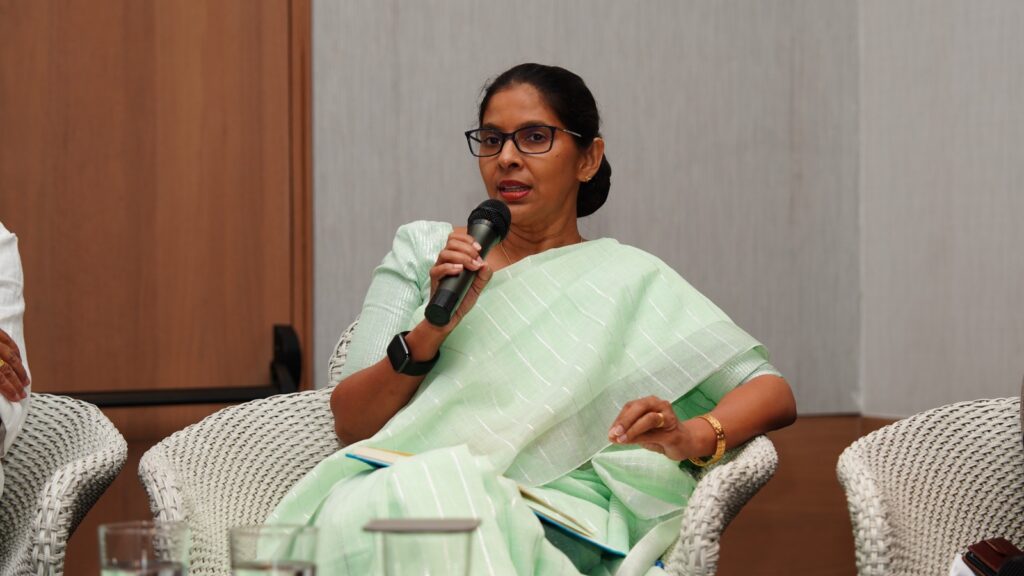
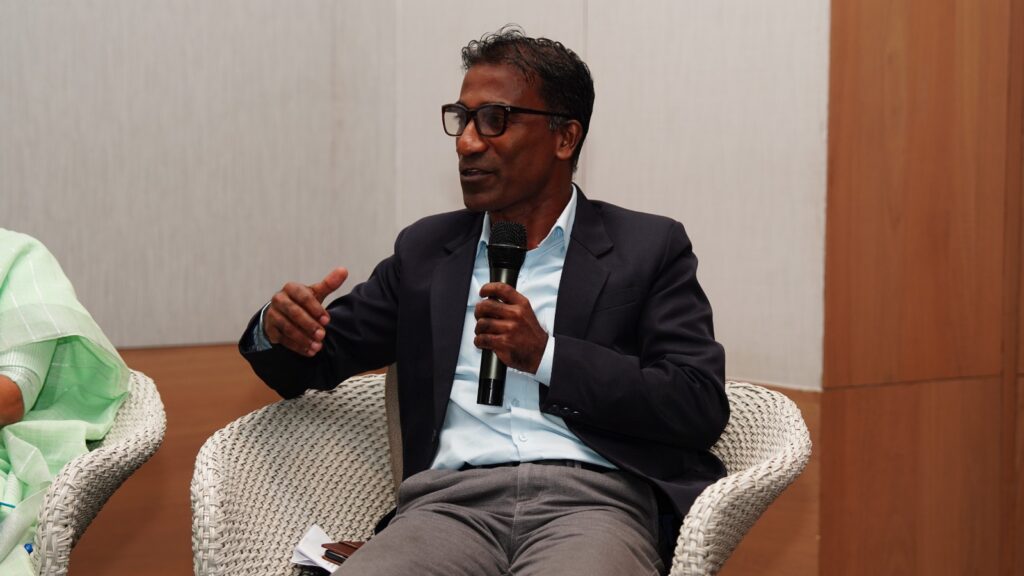
For Gayani Premathilake, chief legal officer of the Pubic Administration, Provincial Councils and Local Government Ministry, legal reform should start with bringing the law into the digital age. Image courtesy of TISL.
A law that counts too late
Timing is also a problem when it comes to disclosure.
Candidates and political parties are required to report their campaign finances, but the information is generally available only after the election.
By then, voters have already made their decisions.
The TISL, election observers and Premathilake said Sri Lanka should move toward real-time disclosure, allowing candidates and parties to report funding as it is received.
She endorsed proposed online dashboard where voters could see who funds candidates and political parties while an election campaign is underway.
That would turn campaign finance disclosure from a post-election accountability exercise into information voters could actually use, the TISL report observed.
The current system does not provide that.
The TISL report found that candidate financial returns are not available through a permanent centralized online platform. The Election Commission is required to make returns publicly available for only 10 days, after which people may have to physically inspect documents at election offices or use Right to Information requests.
For voters, journalists and researchers, that makes meaningful scrutiny far more difficult.
Manjula Gajanayake, executive director, Institute for Democratic Reforms and Electoral Studies (IRES) said greater transparency could even influence election results.
Gajanayake noted that greater public awareness of candidates’ financial transparency could influence voter choices and potentially affect election outcomes. The argument is simple. “Financial disclosure is not merely about catching wrongdoing. It can give voters information about who stands behind a candidate.”
The new blind spot
The biggest challenge may be the rapid growth of online political campaigning.
The current law does not clearly spell out how spending on Facebook, YouTube, X, Google advertisements, boosted posts, influencers or digital marketing agencies should be reported.
That leaves a significant part of modern campaigning in a gray area.
Gajanayake told CIR third-party campaigning also needs to be brought under clearer regulation.
Businesses, individuals, advocacy groups, influencers and other organizations can campaign on behalf of a candidate or party without necessarily being captured in the same way as the candidate’s own expenditure.
“If a third party is campaigning on behalf of some other candidate or a political party, there should be a way to track those kinds of campaigns,” he said.
The TISL report recommends extending disclosure requirements to third parties that spend above a defined threshold on election-related campaigning.
It also recommends requiring digital marketing agencies to register and disclose which candidates or parties they represent.
The Election Commission could establish a dedicated digital audit function to monitor online political advertising using tools such as Meta’s Ad Library and Google’s advertising transparency systems, Premathilake noted.
Without such measures, a campaign’s official financial return may show only part of what voters actually saw during an election.
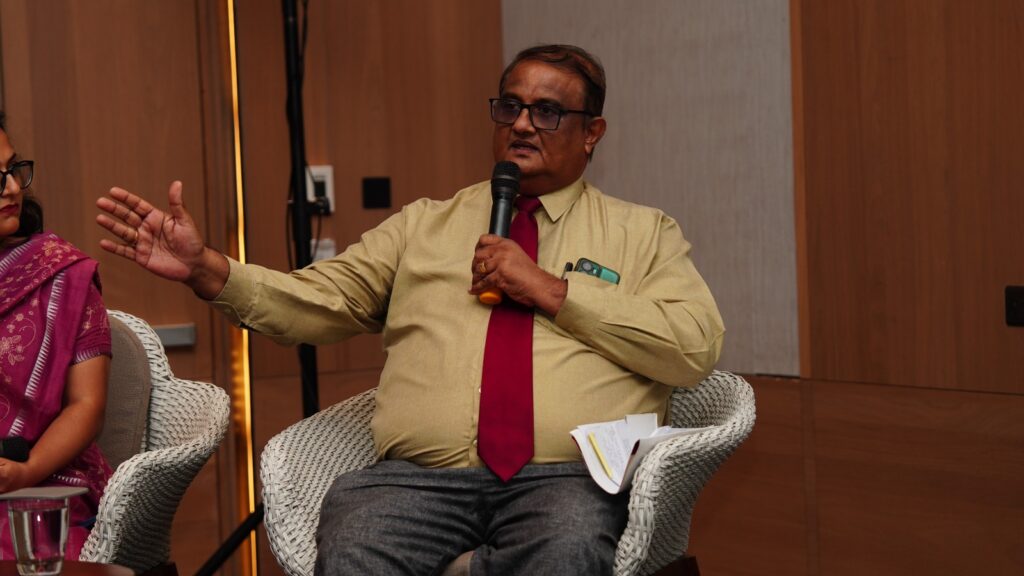
Chinthaka Kularatne, additional election commissioner (legal and investigation) of the Election Commission said campaign begins even before election was declared and expenses during that time goes unrecorded. Image courtesy of TISL.
Donation limits remain a gap
The law limits what candidates can spend but does not cap how much individuals, companies or other entities can donate. This could allow wealthy donors to exert disproportionate influence while candidates remain bound by spending ceilings.
The TISL report recommends aggregate limits on individual and corporate donations, adjusted periodically for inflation, campaign costs and median income.
Corporate donations raise another concern. Companies can contribute to political campaigns without necessarily having to disclose those payments in their financial statements, making it harder to identify links between donations, business interests and government contracts or other benefits, it was stated in the report.
A key weakness is the Election Commission’s limited power to independently investigate and punish campaign finance violations.
EC chair said the commission can act against candidates who fail to submit expense reports but must inform the police.
“We cannot study, analyze the content of the documents submitted and take action on those reports,” he said.
The process can therefore be slow and cumbersome. Rathnayake said Commission officials worked extensively to ensure candidates submitted their expense reports after the local government elections. But cases still require returning officers to prepare detailed statements and refer them to the police.
“If majority did not submit,” Rathnayake said, “imagine what would be the scenario.”
Where returns raise questions about missing documents or spending above the legal ceiling, the commission’s ability to act independently remains limited. The system consequently relies on complaints, police investigations and referrals to the Attorney General’s Department.
A law that requires several agencies to act before violations have consequences is unlikely to provide a strong deterrent when enforcement is slow.
Campaign finance and gender
The weaknesses in Sri Lanka’s campaign finance system have implications beyond money and transparency.
Gajanayake argued that campaign finance rules must also account for the barriers women face when entering politics. Sri Lanka has held nearly 78 elections since 1947 and elected about 3,200 MPs, of whom only 159 have been women, he said.
There are currently 22 women in Sri Lanka’s 10th Parliament, but Gajanayake noted that they come from only two political parties, limiting political diversity among women lawmakers.
Campaign financing can be one of the barriers. He cited the case of parliamentarian Ambika Samuel, who he said received Rs. 480,827 in campaign funding.
Political parties therefore play a major role in determining who has the resources to compete.
“The deciding factor is the political party,” Gajanayake said.
Campaign finance reform, therefore, cannot focus only on individual candidates. It must also examine how political parties raise, allocate and spend money and whether their financing systems give women and other underrepresented groups a fair chance to compete.
Election observer Manjula Gajanayake said third-party campaigning also needs to be brought under clearer regulation. Image courtesy of TISL.
The enforcement gaps
Sri Lanka’s campaign finance law was an important first step. Before 2023, the country had no dedicated campaign finance legislation of this kind since 1977.
But its first test has exposed a familiar problem — rules that appear strong on paper can be ineffective when they are difficult to monitor and enforce.
A campaign finance system cannot rely on voters discovering financial irregularities months after an election. Nor can it depend entirely on complaints, police investigations and lengthy legal proceedings, Gajanayake noted.
Money moves faster.
Campaigns now operate through social media, influencers, messaging apps, digital agencies, businesses and informal networks. Spending can begin before an election is officially called and be routed through people and organizations far removed from candidates, TISL report observed.
If the law does not follow the money, spending limits become easier to circumvent, Gajanayake said.
The next phase of reform, therefore, needs to go beyond adding clauses to existing legislation. Sri Lanka needs a system that can track where campaign money comes from, where it goes and who benefits — while voters still have time to use that information.
Otherwise, the country risks having a campaign finance law without the enforcement needed to make it meaningful.
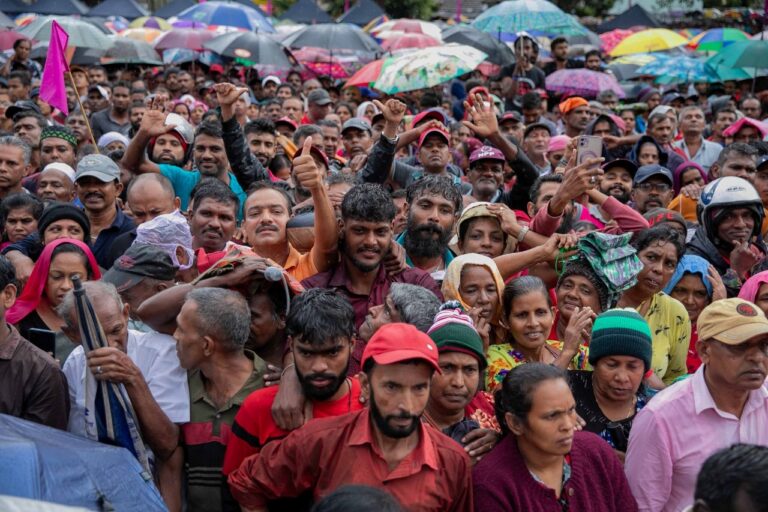
Banner Image: Greater public awareness of candidates’ financial transparency could influence voter choices and potentially affect election outcomes. The image shows an election rally during parliamentary election campaign. Image courtesy of National People’s Power media Unit.
This story was written and edited by Gagani Weerakoon. She leads the editorial at the Center for Investigative Reporting (CIR).
This story was produced with support from Report for the World, a global media service strengthening local independent journalism.
JAFFNA, Sri Lanka — It was around 4:15 in the afternoon of Aug. 4, 2006. The men who came through the gate asked in Sinhala what the aid workers were doing there when everyone else in the town had fled, according to an account assembled by the University Teachers for Human Rights (Jaffna) from police sources in Muttur. The staff answered that their office in Trincomalee had told them to stay and wait to be collected. A home guard interrupted and said they were Tamil Tigers.
Seventeen employees of the French humanitarian organization Action contre la Faim, 16 of them Tamil and one Muslim, were made to kneel. They were shot at close range as they begged. Two who ran were killed away from the others. Their bodies were found separately, behind a vehicle. It was over within five minutes of the party’s arrival, the group’s reconstruction found.
All 17 were wearing white T-shirts and vests bearing their organization’s logo. They were inside a compound whose GPS coordinates had been provided to the Sri Lankan Army, Navy, and Police so that it would not be shelled.
Twenty years later, no one has been arrested or indicted. A magisterial inquest, a criminal investigation, a human rights commission inquiry, and a presidential commission of inquiry all examined the killings. None identified a perpetrator. None produced a charge.
This month, as the anniversary passed, United Nations human rights experts, Amnesty International, Human Rights Watch, the French Embassy in Colombo, and the aid organization itself all called on Sri Lanka to reopen the investigation. The government has not responded.
Independent investigators concluded that at least four types of ammunition were fired inside the compound. One type entered the official record. It was the 7.62 round carried by both sides in the war.
A Jaffna Monitor review of reports by the International Commission of Jurists, the University Teachers for Human Rights, the Office of the United Nations High Commissioner for Human Rights, and the aid organization’s own investigations, together with interviews with former combatants, sets out what happened to the other three.
The town
Muttur sits on the southern shore of Trincomalee harbor. Fabrice Carbonne, who ran the organization’s Trincomalee base from March 2005 to June 2006 and had left before the killings, described it as the entry gate to its operations across the south of the district.
The organization arrived in Sri Lanka as a tsunami response after December 2004 and remained as the cease-fire broke down. In the year before the killings, it delivered water and sanitation services to more than 116,000 people across Sri Lanka. By August 2006, the U.N. experts said this month, it was the only international aid group still working in and around Muttur.
Fighting for the town began Aug. 1, and the Liberation Tigers of Tamil Eelam captured Muttur on Aug. 2. The organization’s new anniversary report says more than 150 people were killed in the surrounding area as civilians fled. The University Teachers for Human Rights, a group founded by academics at the University of Jaffna and critical of both the government and the LTTE, put the figure at about 50, most of them Muslim civilians killed by government shelling.
The 17 staff members did not leave.
“We believed that displaying our humanitarian identity would provide a form of protection,” said François Danel, the organization’s deputy director general in 2006. “Realizing that we were wrong, and that the military paid no attention to it whatsoever, was devastating.”
Between Aug. 1 and Aug. 4, the organization and the International Committee of the Red Cross attempted evacuation by road and by boat. Neither side in the fighting would guarantee safe passage.
An army major, a colonel, and a senior superintendent of police were each personally asked by staff in Trincomalee to secure the safety of the trapped team. The Presidential Commission of Inquiry that later examined the case scrutinized the aid organization’s internal decisions in detail. It never examined the conduct of those three officers.
The clock
Radio contact with the team was lost at about 7:45 on the morning of Aug. 4, according to Andrew Mitchell, the organization’s desk officer at the time. A convoy sent to reach the compound after the team went silent was stopped at an army checkpoint six miles away.
The LTTE withdrew from Muttur around midday. Government forces then moved in.
If the killings occurred in the early morning, the rebels were plausibly in control of the ground. If they occurred in the afternoon, the security forces were.
The commission of inquiry, chaired by Justice Nissanka Udalagama, placed the deaths in the early hours of the morning, relying on the judicial medical officer of Anuradhapura, who recorded the time of death as most likely early on Aug. 4. The commission also concluded that no evidence placed army commandos anywhere near the compound at any point that day. A police witness told the same commission that commandos had been seen at a school nearby on Aug. 3 and 4.
The University Teachers for Human Rights rejected the commission’s finding and assembled a competing chronology, set out in its Special Report No. 30, published on April 1, 2008.
A religious leader in Muttur told the group that he had gone to the compound between 8 and 8:30 a.m. and urged the staff to leave on foot with the departing residents. They refused, he said, telling him their superiors had instructed them to remain in the office and wait to be collected. In a later report, Special Report No. 33 of August 2009, the group recorded testimony from the Rev. Albert Sornarajah, who saw the aid workers alive after 8:30 that morning.
A staff member who was not lodging at the office and who left Muttur on foot with most of the town’s residents around 10 a.m. told the group that he believed his colleagues were still alive when he went. He had not seen them himself. His account rested on a woman who cooked for the team and who had met them after 9 a.m.
The group cited, as corroboration, a report in the Tamil-language Sunday Virakesari of Aug. 13, 2006, quoting a neighbor who had fed the aid workers and warned them that everyone else was packing to leave.
Later that day, sources the group reached in 2007 said, some of the staff walked to a grocery on the main road near the hospital to buy tea and biscuits. That would place them alive after the rebel withdrawal, which residents generally put at around noon. The group was not able to trace those sources again.
The same report states that the Anuradhapura medical officer gave a different account privately. The group wrote that it had later learned he told Peter Apps, then a Reuters correspondent, that the probable time of death was the afternoon of Aug. 4. The medical officer said this after examining some of the bodies at Trincomalee Hospital on Aug. 8, 2006, four days after the killings and well before he prepared his post-mortem reports.
What he entered in the inquest reports was that death had occurred most likely in the early morning of Aug. 4.
Apps was separately told by Sri Lankan commanders in Muttur on Aug. 5 that most rebel fighters had already withdrawn early on the 4th.
The police obtained the cellphone numbers of all 17 victims and their call records from the operators within days. Those records have never been made public.
The Sri Lanka Monitoring Mission, the Nordic body overseeing the 2002 cease-fire, issued its assessment in late August 2006. Given that government forces controlled the town, it said, no armed group other than the security forces could have been responsible. Ulf Henricsson, its head, called the killings a clear war crime and said an independent international commission was needed because the mission trusted neither side to investigate.
What the rebels say
Former Tamil Tiger fighters interviewed by Jaffna Monitor said the movement had never intended to capture Muttur. The offensive, they said, was commanded by its Trincomalee commander, Sornam, and was aimed at overrunning the Kaddaparichchan army camp. When the assault failed, the cadres moved into the adjoining town.
They rejected any role in the killings, arguing from opportunity. Most of the aid workers were Tamils from areas the movement controlled. Had the Tigers wanted to kill civilians and blame the military, the former fighters said, the withdrawal offered far better opportunities, and the cadres passed large numbers of Muslim and Sinhalese civilians without harming them.
“Sornam was no saint,” a senior former rebel leader said. “He was a ruthless commander who was responsible for the deaths of many innocent civilians.”
The same man said Sornam had killed members of a Rupavahini television crew shortly after fighting broke out between the Tigers and the Indian Peacekeeping Force in October 1987. Sornam was killed in the final phase of the war in 2009 and cannot answer the allegation.
The compound
Aid agencies did not reach the compound until Aug. 7, when the Consortium of Humanitarian Agencies gained access and found the bodies. Some accounts, including one published by the organization’s British office, date the first entry to Aug. 6.
Local police did not secure the scene, preserve evidence, or collect the dead. The bodies had lain where they fell for days. Action contre la Faim staff loaded their colleagues onto trucks themselves.
The guns
Two calibers of ammunition were in circulation in Muttur that week, and they were not equally revealing.
The police at the Muttur station were generally issued the T-56, a Chinese-made copy of the Kalashnikov that fires a 7.62-by-39-millimeter round. So did the Tamil Tigers. It was the standard rifle on both sides. A recovered 7.62 projectile is consistent with the police, with the Muslim home guards attached to them, and with the rebels.
The Naval Special Forces commandos deployed to Muttur on Aug. 3 were seen carrying M16 rifles and FN Minimi light machine guns, the University Teachers for Human Rights found. Both fire a 5.56-by-45-millimeter round. In 2006, that caliber was neither standard police issue nor standard rebel armament. It was a special forces caliber. Witnesses stated separately that government Special Forces carrying M16S were in Muttur at the height of the battle, a point acknowledged even in The Muttur Massacre: A Quest for the Whole Truth, an account written from within the government and published in July 2008.
The same report identifies two further weapons carried by police constables in the party that went to the compound: an Uzi submachine gun, firing a 9-millimeter round, belonging to the station commander’s bodyguard, and a belt-fed light machine gun carried by a second constable. The group concluded that a minimum of four types of ammunition were fired inside the compound.
A missing photograph
Eleven of the 17 bodies were exhumed after burial. Second post-mortem examinations were conducted on Oct. 24 and 25, 2006, with an Australian forensic pathologist, Dr. Malcolm J. Dodd, observing. Seven bullets and three bullet fragments were recovered.
The government analyst identified every one of them as 7.62.
There was one exception, briefly. At the second autopsy, Dr. Dodd identified a projectile taken from the head of one of the women, Romila Sivapragasam, as 5.56. The International Commission of Jurists reported the identification in April 2007 and set out what it implied about who had fired.
In June 2007 the Attorney General’s Department moved to establish that the object was not a bullet at all, but the core of a 7.62 round. Dr. Dodd withdrew his identification. He did so, the University Teachers for Human Rights found, after being sent a photograph of the projectile that was not the original. The original certified photograph taken at the autopsy is missing.
A fired 5.56 projectile carries rifling marks visible to the naked eye. The core of a 7.62 round is smooth. It is also the wrong color: cores are gray-black, jacketed bullets are copper. A police sub-inspector had earlier submitted actual cores to the court among productions from the scene, so both he and Dr. Dodd had handled the difference.
Michael Birnbaum, the senior British barrister sent by the International Commission of Jurists to observe the inquest, examined the documentation of the ballistic exhibits and found numerous inconsistencies in how items were recorded, described, and transmitted. The commission’s published summary of his conclusions states that there was serious concern that a bullet of the type used by Sri Lankan military and special forces units was removed from the evidence and replaced with a bullet of a different caliber.
The second magistrate to hear the inquest had ordered that the ballistic exhibits be opened only in the presence of the Australian expert. Birnbaum found that the police disobeyed that order.
One of the earliest accounts obtained by the University Teachers for Human Rights came from an elderly Muttur resident who lived near the compound. He said he saw an army patrol enter the office at about 4:15 p.m. and leave shortly afterward. About 45 minutes later, he said, masked men in commando uniforms arrived on a convoy of motorcycles, followed by a senior officer in a vehicle accompanied by guards. They entered the compound and remained there for about half an hour.
The group described that second visit as an attempt to remove ammunition that would not fit the official account. The witness later became untraceable.
Removing the magistrate
The Muttur magistrate, M. Ganesharajah, a Tamil, had conducted three hearings and was about to deliver his verdict on the post-mortems. That undelivered verdict described the killings as a crime against humanity and ordered a rigorous investigation, the University Teachers for Human Rights found.
On Sept. 4, 2006, the Judicial Service Commission, acting through the Secretary to the Ministry of Justice, ordered the inquest transferred to the magistrate of Anuradhapura. Ganesharajah was replaced by a Sinhalese magistrate.
Birnbaum found that no provision in Sri Lankan law justified replacing one magistrate with another at such an advanced stage of the proceedings. He described the move as unwarranted interference contrary to international standards, while concluding that both magistrates had nevertheless conducted the inquest with sensitivity and fairness.
One of the three members of the Judicial Service Commission that removed Ganesharajah was Justice Udalagama. Three months later he was appointed chairman of the presidential commission that would examine the same case.
The inquiry
Birnbaum’s report, published in April 2007, identified two failures in the police investigation.
Official police reports showed that from the outset, before any investigation had been conducted, the police had settled on the Tamil Tigers as the perpetrators.
And the Criminal Investigation Department had not interviewed a single member of the Sri Lankan security forces. Nor had it interviewed any Tamil, apart from the families of the dead.
President Mahinda Rajapaksa announced the commission of inquiry in September 2006, with a mandate covering about 15 alleged violations, including the Muttur killings. Foreign donors, skeptical of earlier Sri Lankan commissions, negotiated the creation of an International Independent Group of Eminent Persons to observe its work, chaired by P.N. Bhagwati, a former chief justice of India. The group could not investigate independently and had no access to witnesses of its own. Its reports went to the president, who could veto publication.
In March 2008 it quit. Its final report concluded that the proceedings had fallen far short of transparency and of basic international standards, and identified conflicts of interest compromising the commission’s independence, the absence of witness protection, and the conduct of the Attorney General’s Department. The government, it concluded, was unwilling to investigate cases with vigor where the conduct of its own forces was in question.
One commissioner had already been forced out by the president over a perceived conflict of interest, at the urging of counsel for the army.
The commission exonerated the army and navy in 2009, attributing the killings instead to the LTTE or a Muslim militia group. Its full report was never published.
The witnesses
The University Teachers for Human Rights documented threats delivered by telephone and in person, forced reporting to police stations, abduction and assault, bribery and threats from the commission’s own police investigation unit, surveillance, illegal detention, house searches and threatening letters. Witnesses were intimidated inside the commission’s own witness protection room.
Witnesses who had fled abroad were to testify by video link. A presidential directive stopped it.
A key witness whom the police had themselves identified, Haji Abdul Rahuman, has been missing since late September 2006.
Two people connected to the victims’ families died. The guardian of one of the dead drivers died after being beaten by a naval officer in an unrelated incident. The wife of another victim died of a brain hemorrhage a day after receiving a summons to appear before the commission, following months of harassment.
Several families left the country. The 2015 U.N. investigation separately documented allegations that witnesses and officials connected with the case faced intimidation and harassment.
The letters
The commission wound up in mid-2009 without identifying anyone. Udalagama told the BBC that the culprits had not been identified because the commission had run out of funds. He said that video conferencing had been essential for hearing witnesses abroad and had been stopped by a presidential directive. Journalists who approached individual commissioners for copies of the report were referred to the president’s office.
On July 14, 2009, news organizations reported that the commission had cleared the army.
Four days later, plainclothes police officers went to the homes of the victims’ families in Trincomalee and summoned them to Fort Frederick, then the army’s headquarters and the government’s administrative center in the town. A man who introduced himself as a private attorney from Colombo presented them with two letters in English and told them to sign, the University Teachers for Human Rights found. Others present filmed them.
The letter addressed to the president thanked him for appointing the commission, said the families agreed with its finding that the deaths were caused by the Tamil Tigers, and said compensation should be paid by the aid organization for gross negligence. The second thanked the Attorney General’s counsel for their impartiality.
“I do not know English, but I gathered from others that the truth had been turned on its head and we were to give our assent,” one parent said. “Some of us gave excuses, trying to wriggle out of it. The attorney was firm that we must sign.”
The letters were collected on July 25. After the BBC reported that the families had signed under duress, they came back by post on Aug. 1, 2009, stamped at Thampalakamam.
Still no justice
In 2011, the government’s own Lessons Learnt and Reconciliation Commission recommended further investigation and prosecution. Nothing followed.
In 2015, the U.N. human rights office concluded that there were reasonable grounds to believe members of the Sri Lankan security forces committed the extrajudicial executions. It recorded the government’s rejection of the allegation and its position that rebel involvement could not be ruled out. Its recommendation for a hybrid court was never acted on. In 2021, the U.N. human rights office said Sri Lanka remained in a state of denial about the past.
Action contre la Faim left Sri Lanka in 2008.
On May 15 this year, Dr. Robert Sebbag, the president of Action contre la Faim, wrote to President Anura Kumara Dissanayake requesting an account of what Sri Lanka’s governmental and judicial authorities had done to investigate the massacre and bring those responsible to justice, in accordance with what the letter called Sri Lanka’s international obligations. He asked to meet the president to discuss progress toward an impartial, transparent, and effective investigation.
The letter said the organization was deeply concerned that twenty years on, there had been no justice for its colleagues, and that the families continued to endure the trauma of a decades-long wait. An open case file, it warned, sent a dangerous signal that attacks on humanitarian workers could be carried out without consequence. It noted that Sri Lanka has signed the Declaration for the Protection of Humanitarian Personnel, which affirms its determination to end impunity for such attacks.
In an accompanying statement on June 15, the organization called on the international community to support the request. It says it has received no reply from the president.
Amuthan Sivajnanam, whose sister Kovarthani, 27, was among the dead, told The Guardian that years of fear had silenced many relatives.
“I refuse to remain anonymous because fear has already taken too much from us,” he said. “I want the world to know my name, my sister’s name, and the names of the 16 others who died with her.”
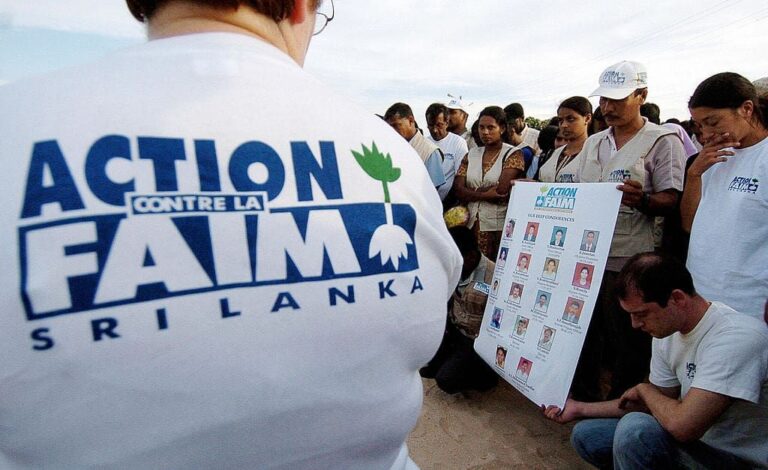
Banner Image: Family members and supporters gather with banners demanding justice and accountability for the 17 Action contre la Faim aid workers killed in Muttur in August 2006. Image courtesy of Jaffna Monitor.
TRCSL blocked 24 unlicensed gambling websites on 4 August, but 17 remained accessible through a major telecom provider the following day.
Two days after the ban, Sri Lanka Cricket’s 5.75 million-subscriber YouTube channel carried 341 seconds of 1XBAT, Dafanews, BatSS and MelBat branding in a 22-minute highlights video.
One arm of the Ministry of Digital Economy blocked betting websites while another continued broadcasting betting-linked branding, with no evidence of coordination between state institutions.
An analysis of about 1,000 Facebook comments found support for the ban tempered by scepticism over mirror sites, mobile apps and surrogate advertising.
COLOMBO—On 4 August, the Telecommunications Regulatory Commission of Sri Lanka (TRCSL) blocked access to 24 unlicensed gambling and betting websites. When I checked the following day, however, 17 of those websites were still accessible through Dialog, one of the telecommunications providers regulated by the commission itself.
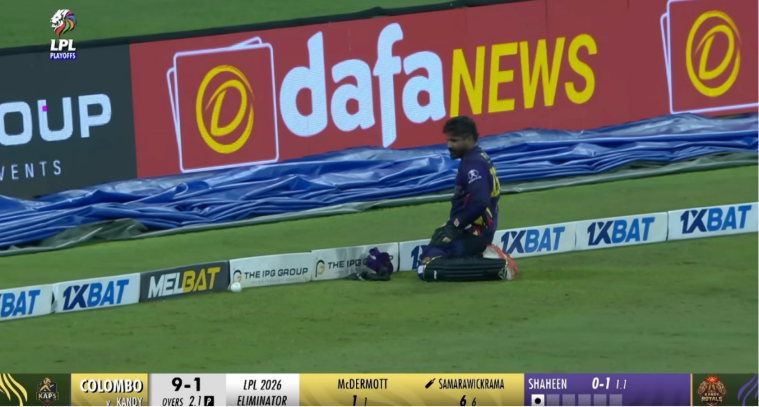
Two days after the block, Sri Lanka Cricket (SLC) uploaded match highlights to its official YouTube channel, which has 5.75 million subscribers. Across a video lasting 22 minutes and 36 seconds, the logos of 1XBAT, Dafanews, BatSS and MelBat remained visible for 341 seconds across 75 separate appearances—almost a quarter of the video’s running time. The contrast is the finding. What the regulator blocked at the level of the domain, the State’s own sporting body continued to broadcast to millions of viewers. The website block therefore functioned less as governance than as gesture.
To understand how the public interpreted the ban, I examined around 1,000 Sinhala-language comments posted beneath five Facebook posts announcing the enforcement action. What emerges is neither uncomplicated approval nor outright opposition, but a blend of relief, ridicule and settled cynicism. In many respects, the public appears to be several steps ahead of officialdom in understanding how the offshore gambling ecosystem actually operates.
Most commenters welcomed the move, but their approval was frequently qualified by a recurring tax-based logic captured in dozens of near-identical formulations: “රජයටබදුගෙවනවානම්නීතිවිරෝධිනොවෙයි“ (if an operator pays taxes to the government, it is no longer considered illegal). Others immediately posted working .lk mirror domains as practical alternatives rather than political statements. Several argued that the vast majority of users gamble through mobile applications that remained untouched, while one commenter listed roughly two dozen offshore operators, from Bet365 and Stake to Parimatch, that did not appear on the government’s blocked list, inadvertently producing a crowd-sourced map of a market the state itself has neither comprehensively mapped nor measured.
One observation in particular anticipated the argument developed in my earlier research on surrogate gambling advertising. A commenter wrote: “උන්ස්පොන්සර්කරන්නෙBET කියලනෙමේBAT කියල“ which says they sponsor as “BAT”, not “BET”. In other words, banning one brand leaves its surrogate entirely untouched.
That interpretation is not speculation. In September 2023, Sri Lanka Cricket Secretary Mohan de Silva told The Morning, on the record, that 1XBAT was a subsidiary of a betting company operating under a surrogate structure. Surrogacy, therefore, was not a conclusion reached by researchers or journalists; it was a description volunteered by the cricket board itself.
The international response moved in a different direction. Within months, Pakistan’s Ministry of Information and Broadcasting described the same branding as unambiguous surrogate gambling advertising. Pakistan Television suspended broadcasts until clean feeds were supplied, the Pakistan Electronic Media Regulatory Authority prohibited such advertising outright, and Cricket Australia removed the branding after reputational concerns emerged. Those jurisdictions revisited their positions within days or weeks. Sri Lanka, by contrast, has had nearly three years to confront the same issue.
Yet the contradiction persists.
Peo TV, which carries the same betting-linked branding visible in Sri Lanka Cricket’s Lanka Premier League broadcasts, is owned by Sri Lanka Telecom. Sri Lanka Telecom falls under the Ministry of Digital Economy, as does the TRCSL. One arm of the same ministry blocked access to 24 gambling websites while another continued distributing the promotion of betting-linked brands to millions of viewers through state-linked broadcasting platforms.
I can find no evidence that these institutions coordinated their actions. Until enforcement extends beyond blocking domains to addressing surrogate advertising, broadcast promotion and institutional coherence, Sri Lanka’s response to offshore gambling will remain fragmented. The websites may disappear from search results, but the branding that drives people towards them continues to reach millions through the country’s most popular sporting broadcasts.
Banner Image: Across a video lasting 22 minutes and 36 seconds, the logos of 1XBAT, Dafanews, BatSS and MelBat remained visible for 341 seconds across 75 separate appearances—almost a quarter of the video’s running time. Image via https://sanjanah.wordpress.com/
This report was produced by Dr. Sanjana Hattotuwa and was originally published on sanjanah.wordpress.com. Headline and content changed appropriately to give better context. He studies information disorders, influence operations, and information integrity in order to evaluate the impact on public opinion, political discourse and democratic institutions.
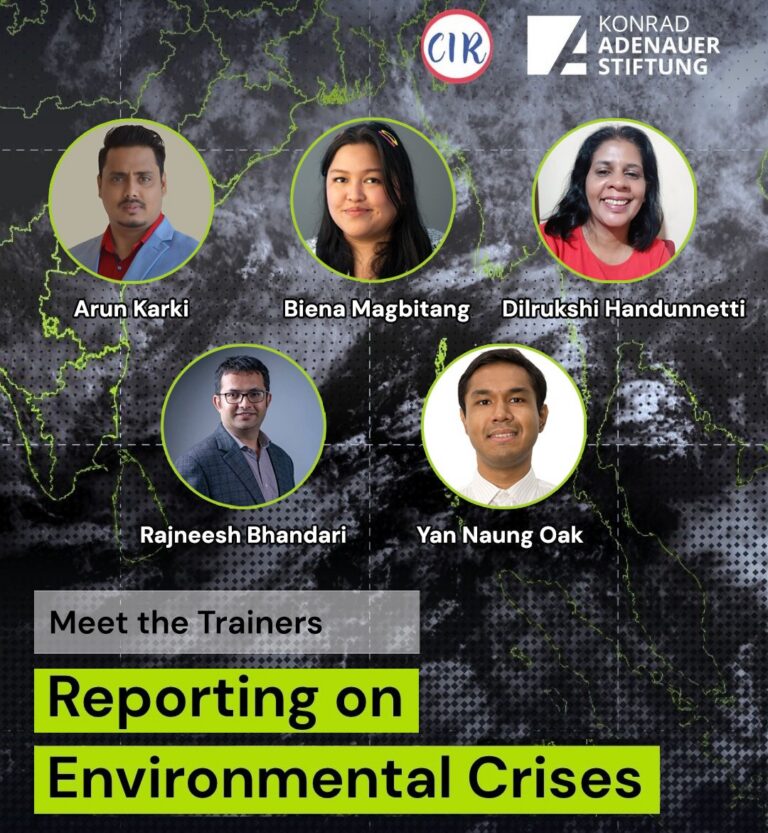
We are happy to introduce our expert panel of trainers who will be delivering an intensive three day residential workshop, “Reporting on Environmental Crises,” for 28 Asian environmental journalists from 17 -19 August 2026 in Kalutara, Sri Lanka.
Arun Karki is the founder of the Center for Data Journalism Nepal (CDJN) and South Asia Coordinator at the Centre for Investigative Journalism, London. He is a leading expert in data journalism and open-source investigations with a strong focus on satellite imagery, geospatial analysis, verification techniques, and digital mapping.
The Executive Director of Climate Tracker Asia, Biena Magbitang has worked extensively to strengthen climate journalism across Asia. She brings expertise in climate communication, ethical reporting, collaborative journalism, and solutions-oriented storytelling.
Dilrukshi Handunnetti is an international award-winning investigative journalist and journalism trainer with a strong focus on climate science, environmental governance, and public-interest journalism. She is the Co-Founder of the Center for Investigative Reporting (CIR) and Sri Lanka Editor for Mongabay.
Founder and Chief Editor of the Nepal Investigative Multimedia Journalism Network (NIMJN), Rajneesh Bhandari has extensive experience reporting on disasters and humanitarian crises. His sessions will explore disaster risk reduction, ethical crisis reporting, solutions and accountability journalism.
Founder of Thibi, Yan Naung Oak specializes in data, artificial intelligence, digital research, and investigative technologies. He focuses on practical AI tools and innovative digital workflows that support faster, more accurate crisis reporting.
We look forward to welcoming our participants from across South Asia and Southeast Asia.
Sri Lanka blocked access to 24 unlicensed offshore gambling websites under the Gambling Regulatory Authority Act.
The blocked websites include several brands identified in a recent investigation that documented Facebook-based promotion of offshore betting operators targeting Sri Lankan users.
Authorities urged the public not to use or invest money in unauthorized online gambling platforms operating outside Sri Lanka’s legal framework.
Experts say regulators must also target payment networks, affiliates, social media promotions and encrypted messaging channels to effectively curb illegal online gambling.
COLOMB—Sri Lanka, on August 5, blocked access to 24 online gambling and betting websites operating without valid licenses, marking the country’s first major enforcement action against offshore betting operators since the Gambling Regulatory Authority Act took effect in December 2025.
The move comes just days after an unprecedented investigation into Facebook’s gambling ecosystem found that offshore betting operators continued to openly target Sri Lankan users months after the law came into force by using lifestyle content, cricket promotions, WhatsApp networks and local payment agents to bypass enforcement.
The report, Betting on Facebook: Online Gambling Promotion, Offshore Operators, and the Limits of Regulation in Sri Lanka, by digital rights researcher and disinformation analyst Sanjana Hattotuwa, analyzed 10,813 public records from Meta’s Content Library and documented an extensive network linking Facebook pages, influencers, WhatsApp groups, cash agents and offshore betting platforms, including 1xBet and Melbet.
According to the ministry, operating or promoting online gambling services without valid licenses issued under Sections 15, 16 and 18 of the Gambling Regulatory Authority Act No. 17 of 2025 is an offense under Section 44 of the law.
The blocked websites are 1xBet, Betway, 22Bet, Melbet, Unibet, Betfair, Dafabet, Bet365, 1Win, SpinBetter, 10Cric, BC.Game, Megapari, Pin-Up Bet, Stake, Mostbet, Parimatch, BetWinner, Linebet, 4rabet, Rajabets, DBBet, Coldbet and WinWin.
The Ministry of Digital Economy and the TRCSL also urged the public not to use or invest money in unauthorized online gambling platforms operating outside Sri Lanka’s legal framework.
The move is seen as the State finally recognizing that offshore betting operators have been openly targeting Sri Lankan users. Image courtesy of Aidan Howe via Pexels.
Much larger market
While welcoming the government’s decision, Hattotuwa cautioned that blocking websites should not be viewed as a comprehensive solution to Sri Lanka’s rapidly evolving online betting ecosystem.
“The blocking order is significant because it marks the first clear enforcement action under the Gambling Regulatory Authority Act,” he said. “It shows that the State has finally recognized that offshore betting operators have been openly targeting Sri Lankan users. But it also risks creating the impression that blocking a list of websites is enough to disrupt this market. My research suggests it is not.”
Hattotuwa said his analysis of 10,813 public records from Facebook and four offshore betting websites found substantial overlap with the operators identified by the government. The research documented extensive promotion of brands including 1xBet, Melbet, Linebet, Coldbet, Megapari, Mostbet and WinWin, all of which appear on the government’s blocking list.
“That overlap validates one of the central findings of the research — that many of the major offshore brands were operating openly in Sri Lanka through Facebook and associated promotional networks,” he said.
However, the study also identified repeated promotion of other betting services, including BetSS, LS.Bet and 888starz, which do not appear on the current blocking list.
“The list should therefore not be interpreted as representing the full extent of the market,” Hattotuwa said. “It captures part of the ecosystem, but certainly not all of it.”
He said one of the greatest weaknesses of website blocking is that offshore betting operators rarely rely on a single domain.
“My research documented how these operators constantly rotate domains, create mirror websites, use referral gateways and affiliate links, and redirect users through localized websites,” he said.
The study found that the Facebook account “1X BET SRI LANKA” promoted 1xlanka.live in 194 posts before switching to 1x-gift-lankafb.com in another 277 posts. Researchers also identified referral links redirecting users to 1xbet.lk, Bitly links leading to melbet-srilanka.com, and affiliate gateways routing users to Linebet registration pages.
“Interestingly, the domain 1xbet.com — the hostname included in the government’s announcement — appeared only five times in the entire dataset,” Hattotuwa noted. “If enforcement targets only specific hostnames, operators can simply migrate users to alternative domains or launch new mirror sites.”
He argued that websites represent only the final destination in a much broader customer acquisition network.
“The website sits near the end of the recruitment chain, not the beginning,” he said.
The study identified 1,483 Facebook group posts inviting users to WhatsApp groups, 1,893 posts containing contact information or external links, and 1,138 posts advertising deposit and withdrawal services.
“People are not discovering betting sites by typing domain names into browsers,” Hattotuwa said. “They are being recruited through lifestyle videos, cricket content, influencers, affiliate marketing, WhatsApp groups and local cash agents. Those pathways remain untouched by website blocking.”
He also claimed technical restrictions would prove durable, noting that users can bypass ISP-level blocking through widely available virtual private networks, while promoters can quickly shift activity to encrypted messaging platforms.
“If anything, enforcement that focuses only on websites may push these networks further underground, making them harder, not easier, for regulators, journalists and researchers to observe,” he stated.
Technical restrictions would prove durable, noting that users can bypass ISP-level blocking through widely available virtual private networks, while promoters can quickly shift activity to encrypted messaging platforms. Image courtesy of Chris F via Pexels.
Call for broader enforcement
Hattotuwa said meaningful enforcement must instead target the commercial infrastructure supporting offshore betting.
“The Gambling Regulatory Authority should maintain a public register linking every licensed operator to its brands, domains, mirror sites, apps, affiliates, social media accounts, promotional codes and approved payment intermediaries,” he said.
He added that the Central Bank and the Financial Intelligence Unit should investigate recurring payment agents and settlement patterns, while Meta should be required to investigate betting promotions and preserve evidence showing how users are funneled from Facebook into private WhatsApp groups.
“If enforcement stops at a static list of 24 names, the market will almost certainly change its links faster than the State updates its list,” he said.
Banner Image: Expert cautioned blocking websites should not be viewed as a comprehensive solution to Sri Lanka’s rapidly evolving online betting ecosystem. Image courtesy of top10-casinosites via Pixabay.
This story was written and edited by Gagani Weerakoon. She leads the editorial at the Center for Investigative Reporting (CIR).
Marginalized communities who were repeatedly displaced by floods and landslides and settled in Madi, Chitwan, remain unsafe even in their current location. Living in extreme poverty, they are also at high risk of gender-based violence, labor exploitation and human trafficking.
Krishna Bahadur Chepang (72), living on the banks of the Parbi Stream in Madi Municipality-9, Chitwan, arrived here after being displaced for the sixth time. On the night of September 7, 1985, a flood and landslide in his ancestral home in Dhading left him without food or shelter. His series of displacements began that very night.
In search of shelter, Krishna Bahadur moved with his family to Sagbari in Madi-9, Chitwan. But just two years later, a landslide uprooted them from there as well. From Sagbari, he moved to Kusumkhola, also in Madi-9.
He stayed in Kusumkhola for three years. He dragged timber from the forest to build a wooden house, cleared unregistered land and made a field capable of yielding approximately 1.4 metric tons (20 muri) of paddy. His four sons and three daughters grew up there. But around 1990, Chitwan National Park drove him away, citing that he was living in the buffer zone. “I had built that house with so much hard work, but in a single night, they used elephants to destroy it completely,” he recalled.
After being driven away by the national park, he moved to Chharchhare Chisapani in Madi-5. In 1996, the park authorities set fire to his home there. According to the Department of National Parks and Wildlife Conservation, the arson occurred while attempting to remove structures built by encroaching on the buffer zone.
Krishna Bahadur then moved with his family to Govinda Basti in Thulochhange, Madi-9. In 2017, a flood swept away his house there. Yet, Krishna’s story of displacement did not end there.https://flo.uri.sh/visualisation/29865557/embed
After the flood washed away his home, he went to a place called Kharkatta in Madi-8. Local residents drove him away from there within a few months, calling him a squatter. After that, he arrived at the banks of the Parbi Stream in Madi-7.
The land where Krishna Bahadur is currently living on the banks of the Parbi Stream is unregistered public land. The annual floods keep eroding the land. He has no idea when he might have to pack up his belongings and leave again. Having been displaced from six different places over four decades, Krishna Bahadur says, “Now, these old bones cannot go anywhere.”
Krishna Raj Adhikari, the former ward chairperson of Madi-8, is well aware of Krishna Bahadur’s pain of displacement. “The old man was troubled sometimes by floods and sometimes by the national park. The place he lives in now is also on the riverbank. Embankments have been built to protect against floods but you never know,” Adhikari said.
Due to repeated displacements, Krishna Bahadur was unable to educate his children. Once they grew up, all four sons left for India. Among them, two are completely out of contact.
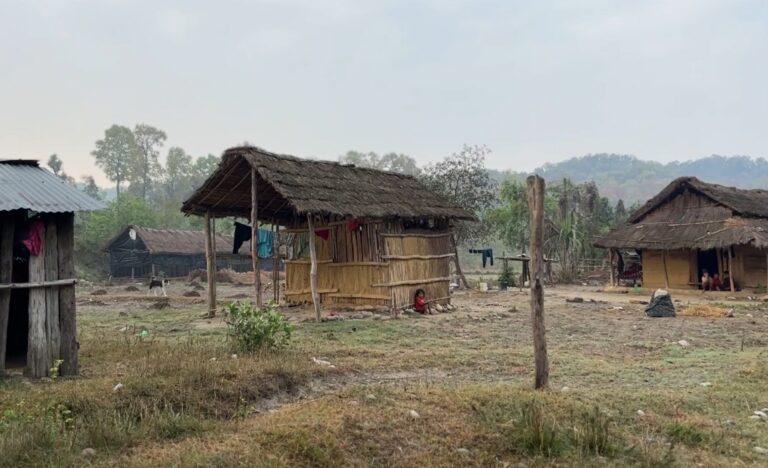
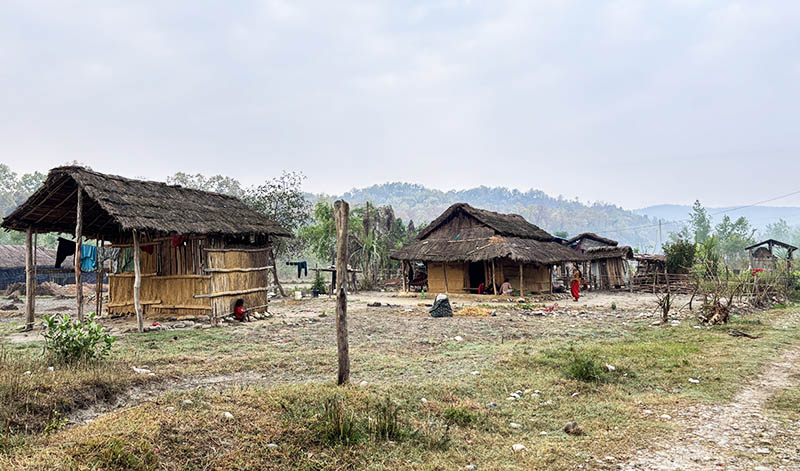
The house of a person displaced by the Kusumkhola flood. Image courtesy of Samari Utthan Sewa.
Another person who went through a series of displacements is Hai Kancha Praja (56) from Pyauli, Madi-9. In 2012, a flood swept away his ancestral house and registered land in Silinge, Makawanpur. In search of shelter, he then reached Kusumkhola in Madi. But in 2017, a flood drove him away from there as well.
Hai Kancha moved to Pyauli with his family. However, the very year they relocated, floodwaters from the Riu River entered the settlement. Currently, they are still living on the banks of the Riu River.
“Right now, we are living here, but our hearts are filled with constant fear. This is a place that was completely devastated by floods before as well,” says Hai Kancha.
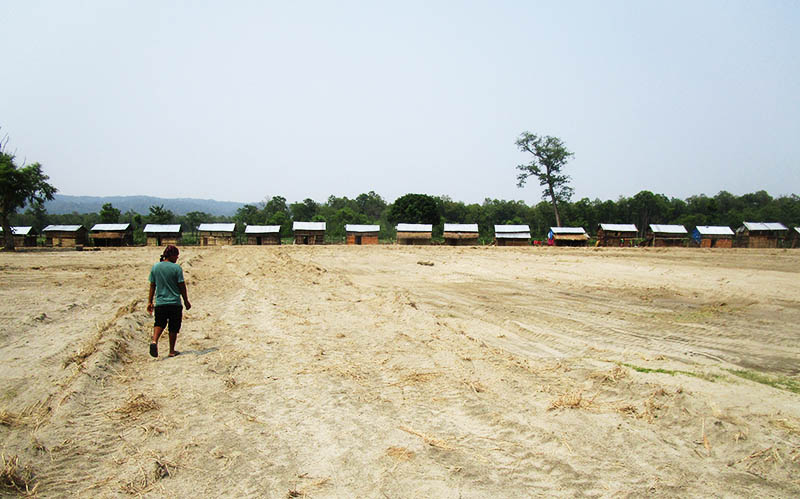
Repeated floods and landslides in the Kusumkhola area of Madi-9 have left many families homeless. The vast majority of those displaced belong to the Chepang community. The 2017 flood alone rendered 225 families in Kusumkhola homeless. Madi Municipality did relocate those families but the new locations also happen to be on the banks of another river.
According to Ghanshyam Dawadi, the ward chairperson of Madi Municipality-9, those displaced by the Kusumkhola flood have been relocated to Pyauli, Shivadwar, Parbi, Bandarjhula and Krishnanagar areas. According to municipal data, 82 households were relocated to the Chepang Model Settlement in Krishnanagar, 55 to Parbi, 45 to Pyauli, 28 to Bandarjhula and 15 to Shivadwar. He says that some families settled in Bandarjhula on their own initiative and have not come into contact with the municipality.
A settlement on the banks of the Parabikhola. Image courtesy of Anita Bhetwal/NIMJN.
Most of the houses of the families displaced back then remain in a dilapidated condition today. However, some houses in Krishnanagar were built with support from the government and social organizations. All other settlements are located along streams and riverbanks. Regarding the reason for relocating settlements to high-risk areas, Ward Chairperson Ghanshyam says, “Even though there are streams and rivers, we have constructed embankments. Repairs are also ongoing on them right now. If a small flood comes, nothing will happen, but if a big one strikes, we cannot say.”
Section 52(B), Sub-section 4 of the Lands Act 1964 (Eighth Amendment) states that land on river, stream or canal banks, in high-risk areas, or within national parks and protected areas shall not be provided to landless squatters. Madi Municipality has not issued land ownership certificates to them but because victims displaced by disasters were relocated directly to riverbanks, the risk of another catastrophe looms.
However, the municipality states that efforts are underway to make the areas where they have been settled safe. Dandapani Paudel, spokesperson for Madi Municipality, says, “After those displaced by the Kusumkhola flood were settled along various riverbanks and stream banks, embankments were constructed. Work is also ongoing to make the places where they are living even safer.”
Risk of violence and trafficking
After a landslide swept away their house in Silinge, Makwanpur, in 1993, a Praja family moved to Madi-9, Kusumkhola. They took shelter under a thatched roof on unregistered public land.
While the family was still coping with frequent floods in Kusumkhola, a landslide in 2015 displaced them once again. The family of eight, including husband, wife and six children, began struggling just to feed and clothe themselves. The Praja couple then turned to daily-wage labor. A short while later, the husband fell ill with diarrhea and pneumonia and passed away.
Following her husband’s death, the children were scattered among distant relatives and the wife remarried. One day, their 15-year-old third daughter, Rupa (name changed), was trafficked for 12,000 rupees at the hands of her own relatives.
Promising to fund her education, a family brought her to Dhankuta in 2023. Once in Dhankuta, Rupa was not allowed to study. Instead, she was forced to work in a hotel. Not only that, she also had to massage the landlord’s daughter’s feet every evening.
Rupa made a friend in Dhankuta whose maternal home was in Bandarjhula. That friend’s mother informed Rupa’s family about her plight. Following this, through the joint efforts of Samari Utthan Sewa, the police, and the local government, she was rescued that same year in 2023.
“After finding out that she had been taken to Dhankuta under the pretext of supporting her education and put to child labor, we rescued her,” said Shivahari Gyawali, Program Director at Samari. According to him, Rupa is currently pursuing her education under Samari’s care.
This is a representative incident illustrating the extreme hardship families face after being caught in the grip of floods and landslides. Others like Rupa, who have suffered labor exploitation and human trafficking, can also be found across displaced settlements in Madi. Some have even fallen victim to sexual violence.
Samari Utthan Sewa conducted a study on the ‘Entertainment and Hospitality Sector and the Risk of Internal Human Trafficking.’ The study covered 420 households across flood- and landslide-affected areas in Madi Municipality-8 and 9, Rapti Municipality-1, 2 and 5, and Bharatpur Metropolitan City-2.
According to the study, 9.5% of the people in those areas work in the entertainment sector. Among the women working there, 85.5% suffer sexual violence and exploitation. Furthermore, 13.6% of those engaged in labor are children aged between 10 and 14.
According to Parusun Paswan, in-charge of the Basic Health Service Center in Bandarjhula, Madi-9, a local organization is currently funding the education of 30 orphaned children in Bandarjhula, a settlement heavily populated by flood and landslide victims. “There are many other children here living under single guardianship as well,” he said. “Parents here go to places like Delhi, Ladakh and Kashmir in search of work. The trend of getting remarried there and abandoning children in the village is evident, which has also left many children stranded.”
According to Parusun, more women than men have gone abroad for employment from Bandarjhula. “Women here also work in the entertainment sector. There are also reports of them falling victim to human trafficking,” he noted, based on discussions with locals during health surveys. “This settlement has existed since 1993. Some people came here after being repeatedly displaced. Those whose lives were hit by floods right in this place are becoming poorer and poorer.”
Bina Thapa, an executive member of Madi Municipality and a resident of Bandarjhula, Madi-9, states that cases of polygamy are high in Chepang settlements displaced by floods and landslides. “Many marry at a young age, have children, and later leave their sons and daughters behind to marry someone else. That is why many children are living under the care of relatives,” she said. “Children who do not have their parents by their side face a much higher risk of falling into wrongdoing. The root cause of all these problems is poverty.”
Two years ago, a 17-year-old girl from a family living in Bandarjhula after being displaced by floods committed suicide. “Being poor, I couldn’t fulfill my children’s needs. My fourth daughter had gone to Bharatpur to earn on her own. Who knows what happened there? We suddenly received news that she had committed suicide,” said the girl’s father, Rupak (name changed).
Rupak, a father of seven children, had also left his ancestral home in Lamjung with his family after the 1990 flood and arrived in Bandarjhula, Madi. They were making a living by farming unregistered public land. While the Bhimire Stream was continuously causing them trouble, a massive flood struck in 2005, destroying fields that used to yield 1.9 metric tons (27 muri) of paddy.
There was no other source of income. Rupak struggled to support his family of nine. He was unable to educate any of his seven children, including six daughters and one son. Three of his daughters moved to the city to earn money. His fourth daughter was working in the entertainment sector in Bharatpur, something the family was completely unaware of. While living there, she committed suicide inside her own room. “If I had been able to educate her properly and guide her path, I wouldn’t have lost my daughter. But what could I do? I was helpless,” Rupak said.
Rupak’s financial condition remains unchanged today. He lives by the riverbank. Crops are destroyed by wild animals at times and lost to river cutting at others. Living inside the buffer zone, there is also constant worry about being evicted by the state at any moment.
The story of a village called Pyauli, which also falls under Madi-9, is similar. It is known as a settlement of flood-displaced families. The risk of flooding persists here as well. Women here have taken the path of foreign employment in hopes of escaping the vicious cycle of poverty. However, their suffering did not end after going abroad. Instead, it grew worse. Binda (name changed) is one such example.
Displaced by floods, Binda had moved from Lothar in Makawanpur to Kusumkhola in Madi, and eventually to Pyauli. Facing riverbank erosion and trouble from wild animals, it became difficult to manage the responsibility of educating four children on her husband’s monthly income of 10,000 rupees. Taking a loan of 300,000 rupees, Binda flew to Kuwait. Violence against her began the very day she arrived in Kuwait.
“The workload was heavy. If things didn’t go as expected, they would pinch me, pull my hair and make me stand for 24 hours straight. They would lock me in a room and beat me. They even broke my hand,” Binda recalled her hellish experience in Kuwait. “The employer used to say, ‘I bought you, pay back the money and then leave.’ I even tried to commit suicide. But because the windows were high up, I couldn’t hang my shawl.”
When the violence crossed all limits, Binda secretly contacted her husband and explained her condition. After her husband in Nepal threatened the agent with police action, she was rescued.
Binda says, “I returned from abroad saving my life but there is no source of income here. The land I farm on is unregistered public land. When we plant crops with hard work, wild animals eat them. When floods come during the monsoon, we have to abandon our home and take refuge in someone else’s place, we can’t sleep all night.”
According to Binda, at least 12 women in Pyauli are currently enduring similar exploitation abroad.
Monitoring Center at Madi bus park. Image courtesy of Anita Bhetwal/NIMJN.
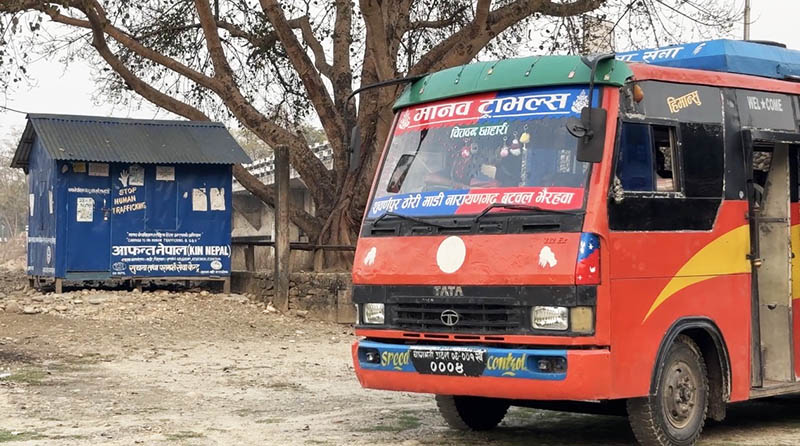
Areas such as Pyauli and Bandarjhula, where flood victims reside, border India. Because vehicles depart from the Madi bus park heading directly to Indian border villages, the risk of human trafficking is exceptionally high. Considering this risk, the organization ‘Aafanta Nepal’ has been operating a Border Monitoring Center (Help Booth) at the Madi bus park with the aim of ending human trafficking and gender-based violence.
Through this center, 8,976 individuals have received counseling and awareness services over the past five years. During the same period, the organization rescued 180 people from this location. Those rescued include women and children who suffered violence and rape, those affected by family breakdown, and those heading to India unknowingly. They belong to Dalit, Janajati and minority communities.
Bandana Sharma, a border monitoring facilitator for Aafanta Nepal, notes that girls under the age of 18 rescued from the border point are illiterate, affected by family breakdown and living in poverty. “In most cases, they do not appear to be under parental protection,” she said.
According to data from the Human Trafficking Bureau, 53 people, including 33 women, 17 girls and three men, were trafficked from Chitwan district over the past seven years. Bureau Spokesperson Rajan Limbu stated that this statistic includes victims of both internal and international trafficking. “Human trafficking incidents in Chitwan remain at a consistent level every year,” he said.
Greater concentration of problems in Ward No. 9
According to a study by the organization Samari, which focuses its work in Madi Municipality, 37% of households fall under the poor category in Madi, which has a population of around 38,000. Among those migrating from Madi, 28.6% stated that they moved to new places in search of employment. According to the 2021 National Census, 4.4% of those who migrated from the municipality cited natural disasters as the reason.
Areas such as Pyauli and Bandarjhula, which endure severe human trafficking, forced involvement of young girls in the entertainment sector, extreme poverty and the brunt of repeated displacement, fall under Ward No. 9 of Madi. This is the least literate ward in the entire municipality.
According to the latest census, 41.8% of houses in Madi Municipality are made of mud, with the highest concentration of mud houses located in this ward. Such homes are at higher risk from climate-induced disasters.
Data from the census also shows that Ward No. 9 is the most backward region among Madi’s nine wards. This ward has low toilet coverage and a higher prevalence of temporary homes made of bamboo and wood. It is the ward with the highest poverty rate. The number of persons with disabilities is also higher here compared to other wards. The census further indicates that internet access is exceptionally low.
According to Samari Utthan Sewa’s study, 41 disaster events, including floods, were recorded in Madi between 2011 and 2022, resulting in 29 deaths. Researcher Shivahari Gyawali notes that Ward No. 9 remains the most severely affected by disasters.
He also shared that social problems are particularly acute among the Chepang community in Wards 7, 8 and 9 of Madi, who reside on unregistered public land and rely entirely on agriculture. “Because floods and landslides have repeatedly displaced them, they are trapped in the flames of deprivation.”
According to environmental researcher Menuka Maharjan, climate change has recently rendered the timing of disasters unpredictable in Chitwan. She stresses that residents of Madi should not consider June-August as the only risky months. “The people of Madi need to prepare under the assumption that floods can occur in other months as well,” she said, “Otherwise, the heaviest toll will continue to be borne by the poor, marginalized and agriculture-dependent families.”
Two years ago, a study titled ‘Flooding Induced Migration and Adaptation Strategy’ was conducted focusing on Chitwan. Menuka, who carried out research in Madi Municipality under this study, shared that access to home, land and livestock insurance in the region was found to be exceptionally low. “The lower class here suffers on all fronts,” she said. “Even the traditional methods indigenous communities used to store grain appear to be disappearing due to changing rainfall patterns.”
The most severe impact of climate change also falls on the same community
A study titled ‘Diverging from Agriculture-based Livelihoods: Environmental Migration in Nepal’ points out that water-related risks have heightened due to drought or irregular rainfall, warning that this trend will escalate further. The study report mentions that this harms crops and livestock rearing, leads to a decline in income and employment, and ultimately increases human migration and overseas displacement.
According to another study focused on Chitwan, annual temperatures have increased by 0.043°C and rainfall by 0.93 mm over a 30-year period. A study published in the journal Climate Sciences also shows that climate-induced hazards such as drought, floods, irregular rainfall and hailstorms have brought widespread changes to the farming practices of Chitwan’s farmers. Among the farmers surveyed, 63.51% stated that climate change has significantly impacted agricultural production.
According to a 2017 study on participatory assessment of climate sensitivity and impacts in Chitwan’s Madi Valley, the effects of climate change have become clearly and catastrophically visible at the local level. It was found that poor and marginalized ethnic communities are more severely affected by climate risks, particularly due to their residence in environmentally sensitive and high-risk areas alongside their limited capacity to adapt.
“It is essential to formulate effective adaptation strategies targeting vulnerable communities but reliable climate data and information are unavailable at the local level due to a lack of weather monitoring stations,” the study report states. Although studies highlight that the marginalized and poor are worst affected by climate change, their total lack of access to state resources is evident right from the situation in Madi.
The connection between the climate crisis and internal migration was also confirmed by a study published in 2024 titled ‘Policy Brief: Enhanced Social Protection for Internal Migrant Workers in Nepal’. According to the study, 94% of internal migrant workers in Nepal suffer the negative impacts of climate crises in both their origin and destination places. Twelve percent of workers had to abandon their ancestral homes due to disasters and long-term climate change. This indicates that nearly one million of the country’s workforce has been displaced due to climate-related factors. The study estimates that if environmental imbalance and changes in rainfall and temperature continue at this rate, nearly 7.9 million Nepalis will soon be directly affected by climate-related issues.
According to the study, the migration pattern between Madi Municipality and Bharatpur Metropolitan City in Chitwan is completely opposite. Over the past three years, a total of 569 people left Madi, while 391 entered. That means 178 more people moved out than moved in. In Bharatpur Metropolitan City, only 9,331 people left, while 26,146 moved in.
Among those who migrated to Madi, many have taken shelter in high-risk areas along riverbanks. Most of them do not have land registered in their own names. They also lack the financial capacity to migrate to well-serviced cities like Bharatpur. For that reason, they remain stuck, facing climate-induced disasters and extreme poverty.
After floodwaters wash away their home on one side of a river, they move to the opposite bank of the same river and set up a new hut. “Because of this, the marginalized, poor, low-income, backward and unable-to-migrate communities of Madi are set to bear an even heavier brunt of future climate change,” expressed climate expert Ngamindra Dahal with concern.
What is the Solution?
Dinanath Bhandari, a disaster risk reduction and management expert and author who has long worked in the geographical and social environment of Chitwan, notes that indigenous livelihood strategies sometimes tie people to specific locations.
“The lifestyle of the Chepang community, in particular, revolves around forest areas and riverbanks,” he said. “The cause of their harrowing condition is not just natural crises but the cumulative result of continuous state neglect, an exploitative social structure, and a flawed administrative system that has persisted for centuries.”
As Dinanath points out, the consequences of structural apathy and governance neglect are visible in every corner of Madi. Seventy-two-year-old Krishna Bahadur Chepang, who has been facing a cycle of displacement since 1993, is living precariously on unregistered public land along the banks of the Parawi River in the latter stage of his life. In Pyauli, Madi, Rupa Praja (name changed), who was driven away by floods, fell into the trap of human traffickers while trying to escape the insecurity of unregistered land and low income. She suffered labor exploitation abroad and got trapped in a deep quagmire of debt.
On the other hand, residents of Bandarjhula, which falls within the buffer zone of Chitwan National Park, have neither access to electricity nor guaranteed employment. Even when wild animals destroy crops grown through their hard labor on unregistered land, they receive no compensation from the state because they do not possess land ownership certificates.
This village in Bandarjhula still does not have electricity. Image courtesy of Anita Bhetwal/NIMJN.
According to the Relief Distribution Guidelines for Damage Caused by Wildlife, 2023, farmers must mandatorily present documents proving land ownership to receive relief funds for crop damage caused by wildlife.
When members of families facing multidimensional hardship step out to seek employment, they end up suffering exploitation instead. Many young girls are forced to work in the entertainment sector, where escaping the vicious cycle of labor exploitation and sexual violence is extremely difficult.
Disaster risk reduction and management expert Dinanath says, “Ravaged by both natural and human-made crises, these communities continue to live with their lives hanging in the balance. This is the result of the state’s corrupt administrative system.”
Ishwari Bhattarai, a researcher on climate change and migration, also views the plight of the displaced in Madi as extreme neglect by the state. “The government’s responsibility is not fulfilled merely by rescuing flood victims and moving them to another location,” he said. “To resolve the social crisis there, the economic status of the displaced must be uplifted. Until they become economically resilient, they cannot escape falling into the vicious trap of crimes like violence and human trafficking.”
According to Ishwari’s analysis, the main reason post-disaster rehabilitation plans in Nepal are ineffective is the oversight of livelihoods. “The displaced are simply left with a house and land. No attention is paid to the fact that unemployment can worsen social problems and drive people back to their old, unsafe ancestral grounds,” he noted.
He emphasizes that for the indigenous and displaced communities of Madi who bear the brunt of climate change, the state must mobilize funds from climate funds or other resources to invest in their welfare. “The need and obligation of the state exist precisely for those citizens who cannot afford their own upliftment,” he said.
Climate expert Ngamindra Dahal states that given Chitwan’s, and specifically Madi’s, unique geographical layout and potential crises from an environmental perspective, vulnerable communities must be provided with early warnings and protection. According to him, Madi experiences not only heavy rainfall but also occasional cloudbursts, which trigger flash floods.
“There are high hills on both sides of Madi. Clouds carried by winds blowing from the south get trapped in Madi’s sky,” he explained. “While high-altitude clouds cross over the hills, lower-altitude clouds stay trapped in the valley. Ultimately, a cloudburst occurs, bringing torrential downpours and triggering flash floods.”
Because Madi also includes hilly terrain, monsoon streams become exceptionally aggressive during the rainy season, according to Ngamindra’s analysis. Warning that a devastating disaster similar to the one at Roshi River in Kavre two years ago could repeat in Madi, he notes that during floods, debris flows ten times more than the volume of water.
“The local government must immediately conduct a serious study on this and classify high-risk zones (red areas),” he suggested.
He sharply criticizes the practice where the state fails to recognize squatters living on unregistered public land as citizens. Climate expert Ngamindra says, “They are the ones who need the state’s support the most. But ironically, the very government laws prevent those in need of help from receiving services and facilities. The Chepang community farming on unregistered land being deprived of compensation even for damage caused by wildlife is a cruel example of this.”
Madi Mayor Tara Kumari Kaji Mahato is also aware of this severe social condition of the displaced Chepang community in Madi and the potential risks looming over them.
She admits that the municipality has not been able to do expected work to uplift the living standards of displaced families and increase their access to education. “They are economically very weak. We still haven’t been able to bring all children to school,” she said. “Despite our efforts, we haven’t been able to give expected attention to all areas. There has been some improvement compared to before but much work remains to be done.”
Mayor Tara Kumari also stated that there is no safe land elsewhere to relocate the displaced population. She feels that installing at least an early warning system (siren) to protect vulnerable settlements could reduce loss of life and property. However, she noted that this is not immediately possible due to the municipality’s limited resources. “For this, the central government itself needs to create a special project and allocate a budget,” she said.
According to Mayor Tara Kumari, multidimensional social crises stemming from displacement and poverty cannot be resolved all at once. “Poverty is the root of violence, trafficking and social problems. Realizing that economic empowerment is needed for this, we also provided various skill-based training programs for women. However, the results have not turned out as expected,” she said.
Banner Image: Marginalized communities who were repeatedly displaced by floods and landslides and settled in Madi, Chitwan, remain unsafe even in their current location. Image courtesy of NIMJN.
The Center for Investigative Reporting (CIR) Sri Lanka has joined the SafeBox Network, a global initiative led by Forbidden Stories, strengthening international efforts to protect investigative journalists to prevent critical public-interest reporting from being silenced.
Forbidden Stories is a Paris-based nonprofit organization that continues and publishes the work of journalists who are threatened, imprisoned, or killed because of their reporting. By coordinating cross-border investigations with leading media organizations worldwide, it ensures that attempts to silence journalists only amplify the stories they sought to suppress.
CIR’s collaboration with the SafeBox Network is an attempt to expand the network’s reach to investigative journalists in Sri Lanka and across South Asia.
The SafeBox Network provides journalists working on high-risk investigations with a secure platform to store reporting materials, documents, and evidence. If a journalist is attacked, detained, or otherwise prevented from publishing, Forbidden Stories and its international network of media partners are able to access the materials and continue the investigation, ensuring that the public-interest story reaches audiences despite attempts to suppress it.
By joining the network, CIR reinforces its commitment to investigative journalism, press freedom, and the safety of journalists. The partnership also creates new opportunities for collaboration with international investigative reporters and organizations working to defend independent journalism around the world.
As attacks on journalists continue to threaten press freedom globally, the SafeBox Network serves as a powerful safeguard, sending a clear message that silencing a journalist cannot silence the story.
At 8:27 on the morning of April 21, 2019, a foreign intelligence service sent one last message to the head of Sri Lanka’s State Intelligence Service. The bombers would probably move between six and ten that morning, it said, and one of their targets was a Methodist church in Colombo. Surveillance teams were being deployed. The police, it added, had already been warned.
The first explosions came shortly before nine, less than twenty minutes later.
Over the course of that day, seven suicide bombers struck three churches, three Colombo hotels, and a guesthouse in Dehiwala. The dead were counted at St. Anthony’s Shrine in Kochchikade, at St. Sebastian’s in Katuwapitiya, at Zion Church in Batticaloa, and in the breakfast rooms of the Shangri-La, the Cinnamon Grand, and the Kingsbury. In all, 268 people were killed, and 586 were injured. At least 42 of the dead were foreigners. Nothing on that scale had happened in the country since the war ended in 2009.
The verdict, seven years on
On July 31, 2026, the Colombo Permanent High Court Trial-at-Bar sentenced two of the men who had been responsible that day to death: Pujith Jayasundara, the inspector general of police at the time of the attacks, and Hemasiri Fernando, then secretary to the Ministry of Defence.
Jayasundara was convicted on 854 of the 855 counts against him. Two of the three judges, Priyantha Liyanage and Thilakaratne Bandara, voted to convict. The third, Viraj Weerasuriya, would have acquitted both men. On top of the death sentence, the court imposed twelve years’ rigorous imprisonment on each of 586 counts of abetting attempted murder, the terms to run concurrently.
In practice, the death sentences are unlikely to be carried out. Sri Lanka has not executed a prisoner since 1976, and President Anura Kumara Dissanayake has made clear that he intends to maintain the moratorium. As a result, death sentences are typically commuted to life imprisonment. Both men have the right to appeal.
Eight warnings in twelve days
The charges are built on eight pieces of intelligence that reached Jayasundara between April 9 and the morning of the attacks.
The first came on April 9, in a letter from the director of the State Intelligence Service. Mohamed Zahran Hashim, the leader of a group called National Thowheeth Jama’ath, was planning suicide attacks with a circle of associates. The likely targets included prominent churches and the Indian High Commission. The letter named the men expected to take part, Rilwan, Shahid, Milhan, and others, and gave their addresses. The same day, a second warning, passed on by the Chief of National Intelligence on behalf of the Defence Secretary, repeated the substance, listed the methods the group might use, from suicide vests to a truck, and asked that the police be put on alert.
A week later, the intelligence turned specific. On April 16, someone connected to the group set off a motorcycle packed with explosives at Palamunai, near Kattankudy, apparently as a test. The reports that followed traced the motorcycle’s chassis number back to Zahran’s people, tracked the suspects’ movements, logged their calls to numbers abroad, and described how relatives had been selling land to raise money. One report mentioned that some of the men were carrying automatic weapons. Another noted that officers at the Kattankudy police station had been in contact with a wanted suspect and had not arrested him.
Then, on April 20, a foreign service reported that the group intended to carry out a martyrdom attack in Sri Lanka “at any time on or before 21.04.2019.” Eight places had been chosen, it said, among them a church and a hotel where large numbers of Indians stayed. The last message, the one that arrived at 8:27 the following morning, said only that the attackers would probably move within hours.
What the police chief did
When the case reached the Supreme Court, the judges pressed the defence on one question: What had Jayasundara actually done with these reports? His counsel could point to only four things.
In one of the letters, the April 9 note from the Chief of National Intelligence, he wrote three letters, “F.N.A.,” and sent them on to four senior officers. One witness thought the initials stood for “For Necessary Action.” Another told the court that this was the kind of marking an officer uses to get a file off his own desk, not to demand that anything be done about it. Jayasundara himself never said what he had meant by it.
When Nilantha Jayawardena, the intelligence director, asked him to hand the reports to the Criminal Investigation Department, Jayasundara’s reply, by Jayawardena’s account, was “tell Ravi” — meaning a senior deputy. After the April 20 warning, Jayawardena telephoned him again, and this time he was told, “tell Nandana,” another deputy. The fourth action was a note Jayasundara wrote on the dry-run reports, asking his intelligence branch to report back on progress by May 5. He dated it April 21, the day the bombs went off.
Both sides agreed, in a formal admission on the record, that Jayasundara had received each of those reports on the day it was written, April 18, 19, and 20, and not on the 21st, as his lawyers later suggested. He had therefore been sitting on the most detailed warnings for the better part of a week, and his response, written on the morning of the attacks, was to ask for an update in a fortnight.
Jayasundara had accepted in court that Section 56 of the Police Ordinance applied to him. It requires every police officer to use their best endeavors to prevent crime and to gather and pass on intelligence affecting public order. The judges wanted to know how three initials on a letter and two telephone calls telling subordinates to handle it could count as best endeavors in the face of a plan to bomb churches.
In 2024, a three-judge Trial-at-Bar had acquitted Jayasundara and Fernando on all charges. The Supreme Court found the reasoning behind that acquittal grossly erroneous. The trial court, it held, had demanded proof that Jayasundara was as culpable as the bombers when he was charged only with aiding the attack by failing to act. That error, the court said, let both Jayasundara and the force he commanded avoid answering for their inaction. The Supreme Court ordered a retrial, which ended in July 2026 with convictions and death sentences.
A government at war with itself
The failure, though, was never Jayasundara’s alone. The same warnings passed through the State Intelligence Service, the Chief of National Intelligence, and the Defence Secretary’s office. Some were produced inside the country. Others came from foreign services.
The problem, in April 2019, was a government that could barely function. President Maithripala Sirisena and Prime Minister Ranil Wickremesinghe were in open conflict, months after Sirisena had tried to remove him and set off a constitutional crisis. Wickremesinghe had stopped being invited to National Security Council meetings. Sirisena himself was out of the country from April 16 to 21, on a visit to India and Singapore, and had gone without appointing anyone to act as defence minister. The office at the centre of national security sat empty in the days when the warnings were mounting.
A parliamentary committee that examined the attacks concluded that Jayawardena, the intelligence chief, had treated his job as finished the moment he forwarded the warnings. He did not tell the President, nor did he pass the reports to the army, navy, or air force. In the end, the intelligence never travelled beyond a small circle of senior men talking to one another on the telephone. The public was never warned. Churches and hotels went into the Easter weekend, when they were at their fullest, with no extra protection.
Not the first inquiry
The July verdict was not the first attempt to assign responsibility for the Easter Sunday attacks. A Presidential Commission of Inquiry, in its final report in January 2021, recommended criminal proceedings against a number of senior officials, including former President Maithripala Sirisena, former Defence Secretary Hemasiri Fernando, former Police Chief Pujith Jayasundara, intelligence chiefs Sisira Mendis and Nilantha Jayawardena, Jayasundara’s deputy Nandana Munasinghe, and a former cabinet minister. Two years later, the Supreme Court, ruling on petitions filed by victims and their families, found several of those officials had violated the victims’ fundamental rights and ordered them to pay compensation.
For many families, however, the convictions of Jayasundara and Fernando marked only a partial reckoning.
Several relatives who spoke to Jaffna Monitor welcomed the verdict before turning to the one person they believe has yet to be held fully accountable: former President Maithripala Sirisena.
“They have punished the officials, and that matters,” said a relative of a victim killed in the Easter Sunday attack on Zion Church in Batticaloa. “But Sirisena was the president. He was also the defence minister. He received the warnings, nothing was done, and he has never faced a criminal trial. That is not justice for our people.”
At the time of the attacks, Sirisena held the defence portfolio in addition to the presidency, placing him at the head of the country’s national security apparatus. The only legal penalty he has faced was the 100 million rupee compensation payment ordered by the Supreme Court in 2023 after it found that he had failed to prevent the attacks, violating the fundamental rights of the victims.
He has never been criminally prosecuted.
Although the Presidential Commission recommended criminal charges against him, no government has acted on that recommendation.
Victims’ families and the Catholic Church have long argued that compensation cannot substitute for criminal accountability in an attack that killed 268 people. They continue to call for Sirisena and the other officials named by the commission to face trial.
The unanswered part
There is an unresolved awkwardness in who is now doing the reinvestigating. The two officers driving it, Ravi Seneviratne and Shani Abeysekara, were the men running the Criminal Investigation Department when the warnings arrived in 2019. Seneviratne, a retired senior DIG who had overseen the CID for years, is now secretary to the Ministry of Public Security. Abeysekara, who was the CID’s director at the time of the attacks, was reinstated by the current government and returned as its director in July 2025.
Before he was sentenced, Fernando told the court that he believed former President Maithripala Sirisena had wanted only him and Jayasundara prosecuted, while others who shared responsibility had been spared.
What the verdict settles
The verdict settles one thing, even if only in part. What went wrong before Easter Sunday was not a lack of information. The authorities knew the group and its leader. They knew the likely targets and, by the morning of April 21, knew the attacks were imminent. They had the legal powers to intervene and the institutions to act. What failed was the final link: turning intelligence into orders and orders into police officers protecting the identified churches and hotels.
Two men will now spend the rest of their lives in prison for what the court found they failed to do. Others, including former President Maithripala Sirisena, remain under a cloud of unresolved accountability as victims continue to press for criminal prosecutions.
Whose Lives Demand Justice?
For the families, however, no verdict can undo what happened that morning.
“My child is never coming back,” said Swarna, a Tamil mother who lost her son in the bombing at Zion Church in Batticaloa. “The lives of 268 people are gone forever. We can only hope that one day everyone who failed them will be held to account.”
Another relative, who also lost a family member at Zion Church, said the search for justice had endured because the Easter Sunday attacks cut across Sri Lanka’s ethnic divide.
“Sinhalese, Tamils and foreigners—we all died together that day,” she said. “That is why the country could not look away. People from every community demanded justice, and Cardinal Malcolm Ranjith became its most powerful public voice.”
Then her voice faltered.
“Sometimes I ask myself a painful question,” she said. “If the bomb had exploded only at Zion Church in Batticaloa, killing only Tamil worshippers, would the same fight for justice have continued for seven years? Would Cardinal Malcolm Ranjith have become its torchbearer? I don’t think so.”
She paused before continuing.
“For decades, Tamil civilians in the North and East have lived through massacres, disappearances, the killing of priests, humanitarian workers, and countless other atrocities. Yet I never saw the same moral outrage from the national establishment or the same sustained campaign from the leadership of the Catholic Church in Sri Lanka. Those wounds were treated as Tamil tragedies, not national ones.”
She fell silent for a moment before offering one final thought.
“Easter became the nation’s wound because it claimed everyone. Had it been only another massacre of Tamils in the North or East, I believe it would have joined the long list of unresolved crimes this country has learned to live with. That is the hardest truth for me to accept.”
Banner image: A survivor injured in the 2019 Easter Sunday bombings is comforted amid scenes of grief and anguish. Image courtesy of Jaffna Monitor.
10,813 Facebook records analyzed. Identified four betting-branded Facebook accounts (29,400 followers), 16 groups (116,700 members) and 13 additional betting pages.
The investigation found 1,000+ WhatsApp group invitations and direct-chat links, with promoters using lifestyle content, cricket, influencers and affiliate marketing to funnel users into private betting networks.
Study identified 2,755 duplicate posts, 5,227 template-based posts, 229 recurring author identities indicating a highly organized promotional ecosystem.
Despite the Gambling Regulatory Authority Act taking effect on Dec. 1, 2025, the report found no public register linking licensed operators to affiliates.
COLOMBO — An unprecedented investigation into Facebook’s gambling ecosystem has found that offshore betting operators continue to openly target Sri Lankan users months after the Gambling Regulatory Authority Act took effect, using lifestyle content, cricket promotions, WhatsApp networks, and local payment agents to bypass enforcement.
The report, Betting on Facebook: Online Gambling Promotion, Offshore Operators, and the Limits of Regulation in Sri Lanka, by digital rights researcher and disinformation analyst Sanjana Hattotuwa, analyzed 10,813 public records from Meta’s content library and documented an extensive network linking Facebook pages, influencers, WhatsApp groups, cash agents and offshore betting platforms such as 1xBet and Melbet. Rather than hiding in the shadows, the study found the ecosystem operates largely in plain sight, exposing significant weaknesses in both platform moderation and Sri Lanka’s regulatory enforcement.
Although Sri Lanka introduced the Act on Dec. 1, 2025, the research argues that legislation alone has not translated into effective enforcement.
The study found an openly accessible promotional ecosystem consisting of more than 10,800 public Facebook records, four betting-branded Facebook accounts with roughly 29,400 followers, 16 Facebook groups with approximately 116,700 members, and another 13 betting-related Facebook pages identified through separate searches.
While these figures cannot be used to estimate the total number of gamblers in Sri Lanka because audiences overlap, they demonstrate sustained promotional activity over six months rather than isolated campaigns.
Following is the excerpts from an interview:
Q: How widespread is this gambling network in Sri Lanka? Is it growing?
A: I would hesitate to call it underground because much of it operates in plain sight. We documented more than 10,800 public Facebook records, four betting-branded accounts with around 29,400 followers, and 16 groups with about 116,700 members. While we cannot estimate the total size of the market, the data shows sustained activity and rapid replication across pages, domains and identities.
Q: Which social media platforms drive the most gambling engagement?
A: Our research focused on Facebook, so we can’t compare it directly with TikTok or Telegram. On Facebook, lifestyle posts and public pages generated far greater engagement than official betting accounts. WhatsApp was the main pathway from public content into private conversations, with more than 1,000 links directing users to groups or direct chats.
Researcher Hattotuwa says lifestyle posts and public pages on Facebook generated far greater engagement than official betting accounts. Image courtesy of Sujeewa Kumar.
Q: Are young people being targeted?
A: We cannot prove who viewed the content because we don’t have audience data. However, the marketing clearly uses youth-oriented themes such as cricket, humor, sports, Sinhala and Singlish, WhatsApp, and low-cost betting options. Only 10 of more than 2,000 posts carried age restrictions, suggesting young people are particularly exposed.
Q: How do betting advertisements avoid detection?
A: They rarely look like traditional betting ads. Instead, promoters hide betting codes beneath lifestyle videos, cricket clips or entertainment content, use altered spellings such as “1XBAT,” rotate domains, and embed betting terms inside images. This makes the content appear organic while making automated detection much harder.
Q: What role do Facebook groups, WhatsApp channels, Telegram groups and influencers play in recruiting gamblers?
A: Each platform plays a different role. Influencers and sports pages attract users through lifestyle content and cricket coverage, often embedding betting codes and search instructions. Facebook groups facilitate deposits, withdrawals, and account registration, while WhatsApp moves users into private conversations to handle payments and support. Telegram is used mainly for betting signals, and YouTube for tutorials and affiliate promotions. Together, they create a coordinated recruitment and payment network, although activity within private messages could not be examined.
Q: How sophisticated are the affiliate networks operating behind these promotions?
A: The affiliate networks appear highly sophisticated. Promo codes and tagged links track new registrations and deposits, while the 1xPartners program advertizes commissions starting at 25% of net profit from referred users. We identified thousands of duplicate and template-based promotional posts, hundreds of recurring authors across Facebook groups, and repeated phone numbers and WhatsApp contacts. Many promoters also provide end-to-end services, from account registration and deposits to withdrawals and betting tips, primarily through WhatsApp. Together, these patterns point to a well-organized referral network, though they do not prove a single company controls every promoter or agent.
Q: How does the payment system work?
A: Offshore betting platforms advertise Sri Lankan bank transfers, mobile wallets and cryptocurrencies. Local cash agents collect deposits, confirm payments via WhatsApp and credit offshore betting accounts. This makes gambling easier while complicating oversight, taxation and anti-money laundering enforcement.
A screenshot of a 1xBet-branded Facebook page identified through Meta’s Content Library as part of a broader network connecting Facebook pages, influencers, WhatsApp groups, cash agents, and offshore betting operations.
Q: Does this point to regulatory failures within Sri Lanka’s financial sector?
A: Yes. It points to significant regulatory gaps, though it does not prove that any bank knowingly processed illegal gambling payments. Offshore betting platforms openly advertise local payment options, including iPay, Sampath Vishwa, eZCash, mCash, and major commercial banks, while cash agents publicly describe using Sri Lankan bank accounts to facilitate deposits and withdrawals. The Central Bank was also unable to provide satisfactory answers to 18 questions raised by Parliament’s Committee on Public Finance. At the same time, Sri Lanka had not introduced licensing rules for virtual asset providers, even as platforms such as Melbet and 1xBet offered cryptocurrencies, including Monero, alongside local payment methods. Financial institutions can see account holders, transfer patterns and settlement flows that researchers cannot. If regulators examine only the bookmaker’s domain and not agent accounts, payment references, wallets, crypto gateways and repeated counterparties, a domestic transfer can hide one step in an offshore gambling settlement.
Q: Why hasn’t the Gambling Regulatory Authority Act produced effective online enforcement?
A: The law is in place, but the enforcement system is not. Although the Act requires digital licenses and bans deceptive gambling advertising, key regulations remain incomplete and there is no public register linking licensed operators to their brands, affiliates, domains, or payment channels. Meanwhile, promoters continue to exploit social media, WhatsApp, rotating websites, and local payment networks faster than regulators can respond, leaving significant gaps in enforcement.
Q: Which institutions should lead the response?
A: The Gambling Regulatory Authority should lead the response, but no single agency can tackle this alone. The Authority should maintain a public register linking licensed operators to their brands, domains, affiliates, and payment channels. The Central Bank and Financial Intelligence Unit should monitor suspicious payment flows, while the police investigate illegal operations and financial crimes. The Telecommunications Regulatory Commission can restrict access to verified unlicensed services, although domain blocking alone will not stop operators from shifting to mirror sites. Meta also has a responsibility to detect and remove coordinated gambling promotions across Facebook and WhatsApp. Most importantly, these agencies need a permanent mechanism to share intelligence, coordinate enforcement, and report publicly on their actions.
Q: Are offshore operators exploiting legal loopholes?
A: Before the 2025 Act, online gambling operated in a regulatory gray area. While the law now requires licenses and bans deceptive advertising, enforcement has not kept pace. There is still no public register linking licensed operators to their brands, affiliates, social media accounts, or payment agents, allowing mirror sites, surrogate brands, WhatsApp channels, and cryptocurrencies to exploit regulatory gaps. However, the evidence does not prove that any operator deliberately designed these tactics to evade Sri Lankan law.
Q: How much responsibility do Facebook and WhatsApp bear?
A: Meta bears significant responsibility because Facebook drives public reach while WhatsApp enables private transactions. We found betting promotions embedded in lifestyle content, cricket posts, affiliate links, and gambling groups, with more than 1,000 WhatsApp group invitations and direct-chat links. Meta also labeled all 2,614 betting-related Content Library records as “unbranded,” limiting effective detection. While platforms did not create Sri Lanka’s regulatory failures, their systems make these networks easier to scale and harder to detect.
Online gambling could become even more deeply embedded in everyday life, spreading through social media, private messaging, influencers, and local payment systems. Image by besteonlinecasinos via Pixabay.
Q: Did your research find evidence of people losing life savings, borrowing money or falling into debt?
A: There’s no verified evidence that people lost their life savings or fell into debt because of these networks. However, users reported financial losses, blocked or delayed withdrawals, missing deposits, unresponsive agents, and repeated attempts to recover losses. These accounts document real harm and payment disputes, but the study does not include the financial records needed to verify claims of life-changing debt.
Q: Are there links between online gambling and fraud, money laundering, cybercrime or organized crime?
A: The Sri Lankan evidence identifies risk junctions, not a proven criminal enterprise. The combination of cash agents, local bank transfers, cryptocurrency and offshore operators warrants further financial investigation.
Q: Why is it so difficult to act against overseas operators like 1xBet and Melbet?
A: It is extremely difficult if authorities focus only on the foreign operator or its website. Offshore companies rely on rotating domains, mirror sites, affiliates, WhatsApp, local cash agents, and cryptocurrencies to evade enforcement. Blocking a single website does little if the wider network remains intact. Sri Lanka needs stronger disclosure requirements, better coordination with financial institutions and platforms, and greater cross-border cooperation. The real challenge is linking the offshore operator to local promoters, payment networks, and consumer harm.
Q: What can Sri Lanka learn from other countries?
A: Singapore demonstrates the value of strict licensing, age controls and spending limits. India shows the importance of following financial flows rather than focusing only on advertising. Sri Lanka needs both approaches.
Q: Is this unique to Sri Lanka or part of a wider South Asian trend?
A: The evidence suggests this is part of a broader regional trend, not a uniquely Sri Lankan problem. We found similar tactics in Sri Lanka and India, including surrogate branding, sports sponsorships, affiliate marketing, and local payment networks used to promote offshore betting platforms. While the study cannot measure the scale across South Asia, it shows a common cross-border business model rather than an isolated case.
Q: Did you find evidence that political, corporate or criminal interests protect these networks?
A: No. The study found no evidence that political actors, corporations, or criminal groups are protecting these networks. However, it does raise important accountability questions, including the use of the 1XBAT surrogate brand in Sri Lanka Cricket sponsorships, the public promotion of local payment methods by offshore operators, and concerns about the independence of the Gambling Regulatory Authority. These findings point to regulatory weaknesses and possible due diligence failures, but they do not establish corruption, collusion, or criminal protection.
Q: What might Sri Lanka face in five years if this environment continues unchecked?
A: Online gambling could become even more deeply embedded in everyday life, spreading through social media, private messaging, influencers, and local payment systems. More households, especially young people, could face financial losses, debt, and payment disputes, while regulators struggle to keep pace. The deeper cost will reach beyond gambling. Public trust will erode when visible, harmful commerce operates in plain sight under a law that appears unable to touch it.
Q: What single message should policymakers take from the report?
A: Regulate the entire ecosystem—not just gambling websites. Online betting operates through social media, affiliates, messaging apps, local payment networks, and offshore platforms. Sri Lanka has the legal framework, but it now needs effective regulations, stronger enforcement, better platform cooperation, financial oversight, and a public register that makes the entire network transparent and accountable.
Banner Image: The four Facebook accounts studied held roughly 29,400 followers at collection, and the 16 groups a combined membership of roughly 116,700. Image by besteonlinecasinos via Pixabay.
This interview was conducted and edited by Gagani Weerakoon. She leads the editorial at the Center for Investigative Reporting (CIR).
This interview was produced with support from Report for the World, a global media service strengthening local independent journalism.
Al comparar casinos en línea, teniendo en cuenta la variedad de juegos, pensando en un uso regular, una plataforma que puede revisarse de forma independiente es chicken subway juego , mientras una revisión independiente también puede abarcar la experiencia móvil y la navegación, junto con las reglas de retirada y los límites antes de registrarse.
Vor der Entscheidung, welche Seite näher geprüft werden soll, beim Vergleich von Navigation und Bedienkomfort, als Teil eines unabhängigen Vergleichs, eine Option für den direkten Vergleich ist fugu casino 5 , separat kann man auch betrachten die aktuellen Aktionsbedingungen, zusammen mit den wichtigsten Bedienungsdetails ohne die endgültige Wahl zu überstürzen.
Før man beslutter hvilken side der bør undersøges nærmere, ved vurdering af mobil brug, fra et praktisk brugerperspektiv, en platform der kan vurderes uafhængigt er https://spinlander-casino.dk/ , mens en uafhængig vurdering også kan omfatte registrerings- og verifikationsprocessen, med kundesupportens tilgængelighed i tankerne uden at forhaste den endelige beslutning.
Dla użytkowników zestawiających kilka platform jednocześnie, z uwzględnieniem metod wpłat i wypłat, na potrzeby wstępnej oceny, jednym z punktów odniesienia może być kasyno na prawdziwe pieniadze jeśli jednocześnie ocenia się najważniejsze warunki korzystania z serwisu, wraz z zasadami dotyczącymi wypłat w ramach szerszego porównania podobnych serwisów.