COLOMBO – Applications are now open for Digital Equity SL: AI training workshops for women journalists, civil society actors and policy makers, being organised by South Asian Women in Media – Sri Lanka (SAWM-SL) in partnership with the Sri Lanka Working Journalists Association (SLWJA), Sri Lanka Muslim Media Forum (SLMMF) and the Jaffna Press Club (JPC),
Scheduled to be held in October-November in Colombo, Jaffna, Kandy and Puttalam, the in-person full-day workshops in Sinhala, Tamil and English, with online follow-ups, seek to equip participants with critical dual capabilities: leverage AI to enhance reporting and related work whilst developing robust defences against its weaponisation.
The trainings will combine theory with hands-on practice, covering foundational concepts of AI, practical AI tools, recognising and countering technology-facilitated gender-based violence (TFGBV), digital safety, data protection, the ethical use of AI, and the use of AI for advocacy, providing participants with the practical skills to use AI tools ethically, recognise AI-driven threats, and implement digital safety protocols.
The workshops will be conducted by Dr Sanjana Hattotuwa, an international authority on influence operations, disinformation and digital safety.
“This initiative ensures women journalists, rights advocates and policy people have both the technical fluency to lead in modern newsrooms, advocacy programs and the tools to protect themselves in an evolving digital space,” said Sharmini Boyle, Program Lead and Trustee, SAWM Sri Lanka.
Interested applicants from media houses including freelancers, civil society organizations and local government bodies are invited to apply viahttps://www.sawmsrilanka.org/ai-training-2026before 15 September 2026.
As each workshop will be limited to 25 participants, early applications are encouraged.
Workshop Schedule:
-13 October 2026 — Colombo (Sinhala)
-20 October 2026 — Jaffna (Tamil)
-27 October 2026 — Kandy (Sinhala)
-3 November 2026 — Puttalam (Sinhala/Tamil)
-10 November 2026 — Colombo (English)
The workshops are part of the ‘Digital Equity SL: Responsible AI Empowering Women, Media and Civil Society – AI Literacy Workshops for Women Journalists, Civil Society Actors and Policy Makers’ program supported by the Canada Fund for Local Initiatives (CFLI).
இலங்கை தெற்காசிய பெண்கள் ஊடக அமைப்பினால் ஏற்பாடு செய்யப்பட்டுள்ள இந்த பயிற்சிப் பட்டறையில் கலந்துக்கொள்ள
பெண் ஊடகவியலாளர்கள், சிவில் சமூக செயற்பாட்டாளர்கள் மற்றும் கொள்கை வகுப்பாளர்களுடமிருந்து
விண்ணப்பங்கள்
கோரப்பட்டுள்ளன.
இந்தப் பயிற்சிப் பட்டறைகள் இலங்கை தெற்காசிய பெண்கள் ஊடக அமைப்பினால், இலங்கை உழைக்கும் ஊடகவியலாளர்கள் சங்கம், இலங்கை முஸ்லிம் ஊடக போரம் மற்றும் யாழ் பத்திரிகைக் கழகம் ஆகியவற்றுடன் இணைந்து ஏற்பாடு செய்யப்படுகின்றன
கொழும்பு, யாழ்ப்பாணம், கண்டி மற்றும் புத்தளம் ஆகிய நகரங்களில் ஒக்டோபர்–நவம்பர் மாதங்களில் நேரடியாக நடைபெறவுள்ள இந்த ஒரு நாள் முழுநேரப் பயிற்சிப் பட்டறைகள் சிங்களம், தமிழ் மற்றும் ஆங்கிலம் ஆகிய மொழிகளில் நடத்தப்படும். இதனுடன் இணையவழி தொடர்ச்சியான அமர்வுகளும் நடைபெறும்.
செயற்கை நுண்ணறிவு உதவியுடன் செய்தி அறிக்கையிடல் மற்றும் அது தொடர்பான பணிகளை மேம்படுத்துவதற்குப் பயன்படுத்தும் திறனையும், அதேவேளை செயற்கை நுண்ணறிவு தவறாகவும் தீங்கிழைக்கும் வகையிலும் பயன்படுத்தப்படுவதற்கு எதிரான வலுவான பாதுகாப்பு முறைகளை உருவாக்கும் திறனையும் பங்கேற்பாளர்களுக்கு வழங்குவதே இப்பயிற்சியின் நோக்கமாகும்.
பயிற்சிகளில் கோட்பாட்டு அறிவுடன் நடைமுறைப் பயிற்சிகளும் இடம்பெறும். செயற்கை நுண்ணறிவின் அடிப்படைக் கருத்துக்கள், நடைமுறை செயற்கை நுண்ணறிவு கருவிகள், தொழில்நுட்பத்தின் மூலம் மேற்கொள்ளப்படும் பாலின அடிப்படையிலான வன்முறையை (TFGBV) அடையாளம் கண்டு எதிர்கொள்வது, டிஜிட்டல் பாதுகாப்பு, தரவுப் பாதுகாப்பு, செயற்கை நுண்ணறிவை நெறிமுறையுடன் பயன்படுத்துதல் மற்றும் வலியுறுத்தல் (advocacy) நடவடிக்கைகளுக்கு செயற்கை நுண்ணறிவை பயன்படுத்துதல் உள்ளிட்ட விடயங்கள் இதில் உள்ளடக்கப்படும்.
செயற்கை நுண்ணறிவு
கருவிகளை நெறிமுறையுடன் பயன்படுத்துதல், செயற்கை நுண்ணறிவு மூலம் உருவாகும் அச்சுறுத்தல்களை அடையாளம் காணுதல் மற்றும் டிஜிட்டல் பாதுகாப்பு நடைமுறைகளைச் செயல்படுத்துதல் போன்ற நடைமுறைத் திறன்களையும் பங்கேற்பாளர்கள் பெற்றுக்கொள்வார்கள்.
இந்தப் பயிற்சிப் பட்டறைகளை
கலாநிதி சஞ்சன ஹத்தொட்டுவ
நடத்தவுள்ளார்.
இவர் செல்வாக்கு நடவடிக்கைகள் (influence operations), தவறான தகவல் பரவல் (disinformation) மற்றும் டிஜிட்டல் பாதுகாப்பு ஆகிய துறைகளில் சர்வதேச அளவில் அங்கீகரிக்கப்பட்ட நிபுணராவார்.
“இந்த முயற்சியின் மூலம் பெண் ஊடகவியலாளர்கள்,சிவில் அமைப்பினர், உரிமைகளுக்காகக் குரல் கொடுப்பவர்கள் மற்றும் கொள்கை வகுப்பாளர்கள், நவீன செய்தி அறைகள் மற்றும் வலியுறுத்தல் திட்டங்களில் தலைமைத்துவம் வகிப்பதற்குத் தேவையான தொழில்நுட்ப அறிவைப் பெறுவதுடன், வேகமாக மாற்றமடைந்து வரும் டிஜிட்டல் சூழலில் தங்களைப் பாதுகாத்துக்கொள்வதற்கான கருவிகளையும் பெற்றுக்கொள்வார்கள்,” என இலங்கை தெற்காசிய பெண்கள் ஊடக அமைப்பின் திட்ட பொறுப்பாளரும் அறங்காவலருமான ஷார்மினி போயில் தெரிவித்தார்.
ஊடக நிறுவனங்களில் பணியாற்றும் ஊடகவியலாளர்கள், சுயாதீன ஊடகவியலாளர்கள், சிவில் சமூக அமைப்புகள் மற்றும் கொள்கை வகுப்பாளர்கள் மத்தியில் ஆர்வமுள்ளவர்கள் விண்ணப்பிக்கலாம்
விண்ணப்பங்கள் 2026 செப்டெம்பர் 15ஆம் திகதிக்கு முன்னர் பின்வரும் இணையத்தளத்தின் ஊடாக சமர்ப்பிக்க வேண்டும்:
ஒவ்வொரு பயிற்சிப் பட்டறையிலும் 25 பங்கேற்பாளர்கள் மட்டுமே அனுமதிக்கப்படுவதால், ஆர்வமுள்ளவர்கள் முன்கூட்டியே விண்ணப்பிக்குமாறு கேட்டுக்கொள்ளப்படுகின்றனர்.
பயிற்சிப் பட்டறை அட்டவணை
13 ஒக்டோபர் 2026 — கொழும்பு (சிங்களம்)
20 ஒக்டோபர் 2026 — யாழ்ப்பாணம் (தமிழ்)
27 ஒக்டோபர் 2026 — கண்டி (சிங்களம்)
3 நவம்பர் 2026 — புத்தளம் (சிங்களம்/தமிழ்)
10 நவம்பர் 2026 — கொழும்பு (ஆங்கிலம்)
“பெண்கள், ஊடகம் மற்றும் சிவில் சமூகத்தை வலுப்படுத்தும் பொறுப்பான செயற்கை நுண்ணறிவுக்கான டிஜிட்டல் சமத்துவம் “என்ற திட்டத்தின் ஒரு பகுதியாக இந்த அறிவூட்டல் பயிற்சி பட்டறைகள் நடத்தப்படுகின்றன.
இத்திட்டத்திற்கு Canada Fund for Local Initiatives (CFLI) ஆதரவு வழங்குகிறது.
මෙම වැඩමුළු “Digital Equity SL: Responsible AI Empowering Women, Media and Civil Society – AI Literacy Workshops for Women Journalists, Civil Society Actors and Policy Makers” වැඩසටහනේ කොටසක් වන අතර, Canada Fund for Local Initiatives (CFLI) හි සහාය මත ක්රියාත්මක වේ.
As of the morning of Sept. 3, the ninth day of the Bhotekoshi flood, government figures show more than 1,200 bodies recovered and 4,216 people still unaccounted for.
A full account of how many died in the flood has yet to emerge.
Nearly 600 of the missing are from hydropower projects alone.
Scientists say a second flood is still lodged in the mountains above.
On the morning of August 26, Gita Maya Dangol was managing the canteen at Uttargaya Public School near Betrawati on the Nuwakot-Rasuwa border when students rushed in to warn her that the river was surging nearby.
“I had no idea the river was coming,” she said. “It was the children who told me. At first, I said, ‘It must just be a small one like before. You kids are trying to trick me.’”
They told her it was far bigger than before, adding that a teacher had confirmed it. By then, she was standing right next to the water.
“If I had run that way toward the river bank instead of this way up the slope, I wouldn’t have survived,” she said.
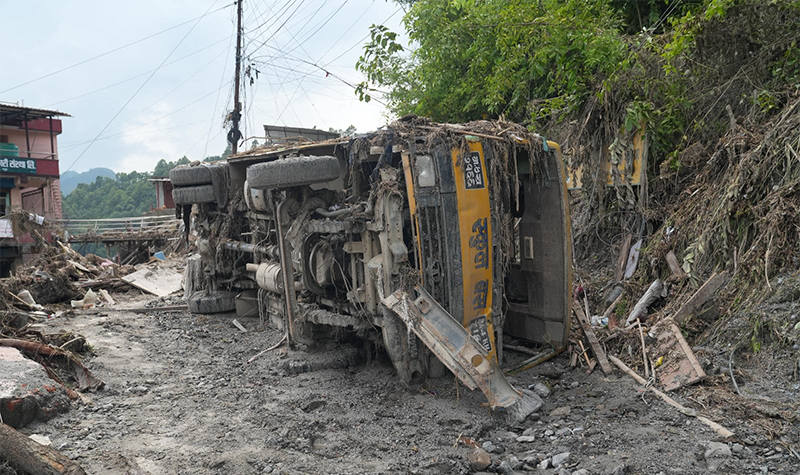
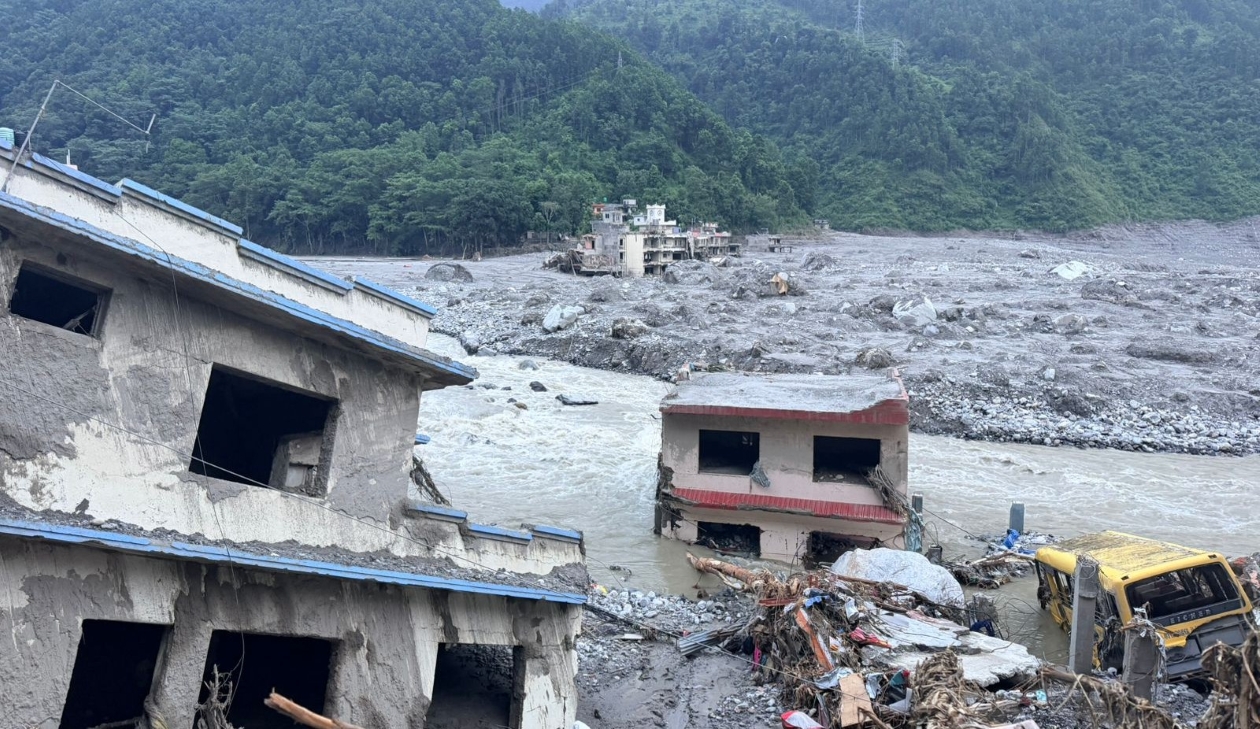
A school bus swept away by the flood at Betrawati, Rasuwa. Image courtesy of Rajneesh Bhandari/NIMJN.
She scrambled up the hillside behind the school building, walked for three or four hours to get out of the water’s reach, and stayed on the slopes for two days before moving on to Nuwakot. Five days later, she returned to look at the place where she had lived. She came back not to salvage anything, she said, but simply to look.
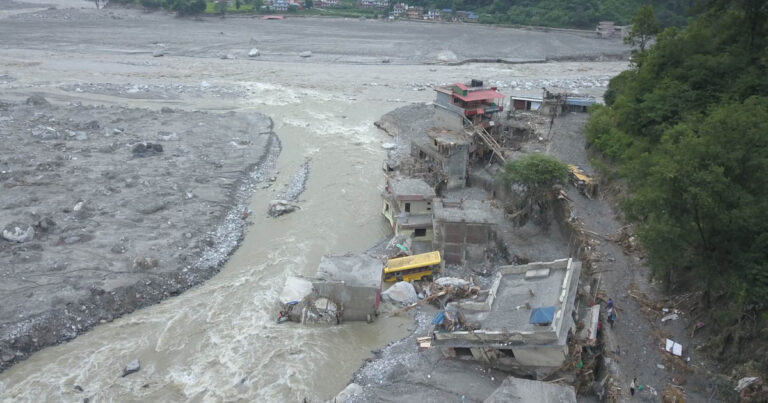
Her house is still standing, in the way a structure can remain standing while being entirely ruined. The bedding has been swept away. The animal pens are gone. The contents of the microfinance office that occupied the ground floor lie scattered outside in the mud. Five members of her family remain missing eight days after the deadly flash flood struck the region.
“This whole place is like a graveyard,” she said. “I am trembling with fear even as I walk here now.”
Nabaraj Sapkota, a school inspector in the education section of Bidur municipality, said more than 250 students from the municipality’s schools are missing – 150 from Uttargaya Public School and 100 from Ramchandra Basic School – along with 10 teachers and staff.
The Origins of the Mountain Collapse
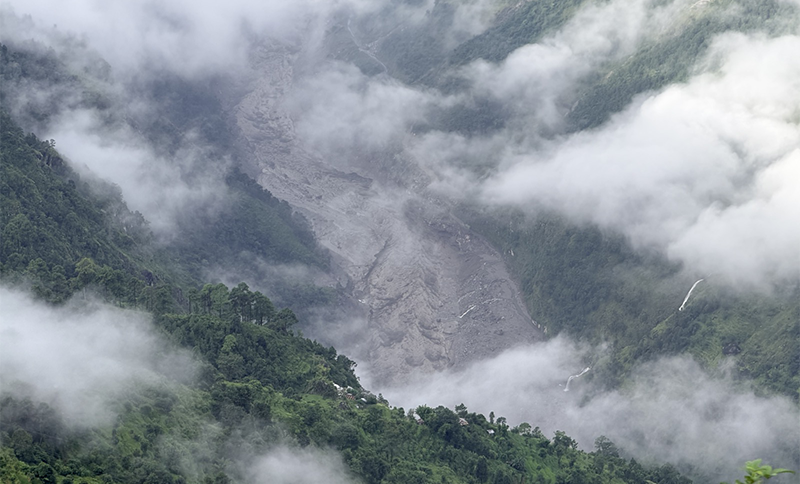
Around 8:37 in the morning on August 26, about 20 kilometers upstream of the Rasuwagadhi border crossing and a vertical kilometer above any human settlement, a massive block of rock and ice broke off the northern flank of the Langtang Lirung massif.
It fell from an elevation of roughly 5,200 meters, slammed into a debris-covered glacier at 3,800 meters, swept up everything in its path, and plunged into the Lhende Khola at 2,900 meters. A rapid assessment by the Youth Alliance for Environment and Kathmandu University estimates that over 142 million cubic meters of ice, rock, sediment and debris surged downward at 15 meters per second, faster than a car driving through a village.
For a brief moment, the avalanche halted in the Lhende Khola, temporarily dammed by its own debris, before bursting through.
A seismometer near Langtang recorded a magnitude-5-plus signal, which was initially mistaken for an earthquake that triggered the avalanche. Similar anomalous seismic activity was also captured by Chinese seismic monitoring stations at Jilong and Zhangmu. It was not an earthquake. The government later confirmed that the signal was generated by the moving mass itself. The falling mountain was heavy enough to register as an earthquake as it came down.
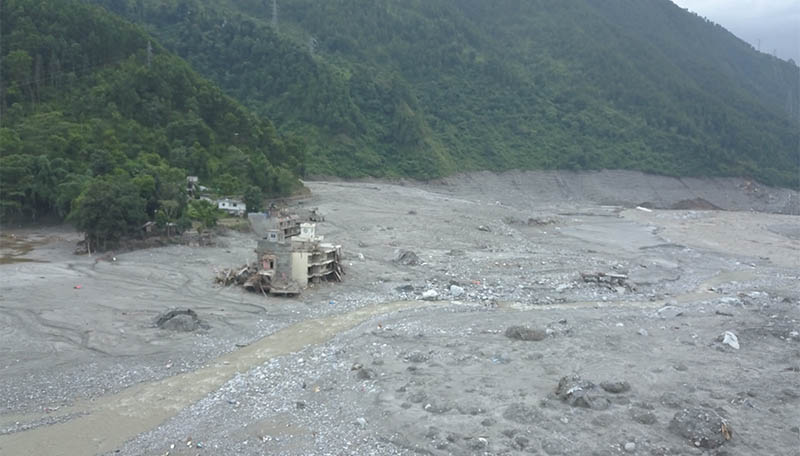
Trishuli river after flood. Image courtesy of Rajneesh Bhandari/NIMJN.
Scientists at the International Centre for Integrated Mountain Development (ICIMOD), who are investigating the event alongside partners in Nepal and China, remain cautious regarding the cause. “An ice avalanche in the Lhende Khola is the suspected trigger but the cause remains unconfirmed,” said Qianggong Zhang, head of climate and environmental risks at ICIMOD. The center noted that it is still too early to determine the exact role climate change played.
However, they are clear on one point. “The Lhende Khola has flooded twice in 14 months,” said Saswata Sanyal, a disaster risk specialist at ICIMOD.
Timeline of the Surge and Warning System Failures
8:37 a.m. The avalanche occurs. Within three minutes, the flood begins to move.
8:50 a.m. The hydrological station at Syabrubesi stops transmitting data. Its last recorded water level is 1.62 meters. The instrument built to detect this exact event is destroyed by it just 10 minutes in.
9:15 a.m. The Department of Hydrology and Meteorology confirms a major flood wave and issues warnings along the Trishuli corridor.
9:15 to 9:25 a.m. The flood surges into Nepal through Timure, Syabrubesi and Betrawati, destroying the Rasuwagadhi checkpoint. The torrent sweeps through the Bhotekoshi and Trishuli river valleys with catastrophic force.
10:28 a.m. It reaches Galchhi in Dhading.
11:50 a.m. Malekhu.
1:00 p.m. Mugling.
3:20 p.m. Devghat.
Downstream, the system worked. Galchhi had 73 minutes between the warning and the water, and it used them. Devghat had six hours.
Rasuwa had nothing. Between the mountain giving way and the water reaching Timure, there were about 35 minutes, and for most of that time, nobody in Kathmandu knew anything had happened. By the time the alert went out, the water was already surging through the villages it was meant to warn, and would have warned. Then the power failed and the phones went dead with it.
Addressing the Federal Parliament on September 2, Prime Minister Balendra Shah stated that the government was notified of the flood at 8:45 a.m., with a mobile alert reaching citizens at 9:35 a.m. Fifty minutes elapsed between the two. Within that timeframe, the surging waters destroyed the Rasuwagadhi checkpoint and swept through Timure toward Syabrubesi.
When asked why no timely warning was issued, he stated that the disaster was ‘beyond forecasting’. He added, “As soon as we received information that the flood was coming, our security personnel were deployed to alert local residents. They too have gone missing.”
His address made no reference to the July 2025 flash flood within the same river system, nor to the subsequent agreement signed between Nepal and China to share information regarding glacial flood risks. Furthermore, he made no mention of the Syabrubesi hydrological station.
There is one fact that cuts the deepest and it is the reason this story exists. After a smaller flood struck this same river system in July 2025, Nepal and China agreed to share cross-border information on glacial flood risks.
Fourteen months later, in the very same valley, the people at the top only learned a flood was coming by watching it arrive with their own eyes.
Surviving the Deluge in Syabrubesi
Mendo Gyalmo lives above Syabrubesi. She was getting ready to walk down to the market.
“It came at nine o’clock,” she said. “After it came at nine o’clock, we couldn’t see a thing.”
Had anyone warned her? Had there been any information?
“We didn’t know. It came all of a sudden. It was like, ‘What is this coming?’ We had no idea a flood was coming.”
She ran uphill, over the ridge. “And then I even cried. I cried wondering if I should go this way or that way, where I should go.”
Her grandson was at school. When a helicopter landed, she registered his name, folded her hands and begged them to take him to Dhunche. They did. She walked back down.
On August 31, she was still on the hillside above her own house, watching a landslide work its way toward it, and had not eaten a proper meal.
“There’s no rice, no salt, no gas,” she said. “We can’t go to the forest to collect firewood in this rain.”
Had relief reached her?
“No, no, no. We have received nothing so far. Nothing at all.”
Had the government told her to move higher?
“No. Not to us. No.”
Asked how many people from her area were gone, she stopped counting.
“Many are missing from here. It’s beyond words. In some houses, only one person is left. It swept away everyone.”
The government’s own report records 14,461 people, including 3,650 children, cut off from roads, electricity and telephones in the two worst-hit rural municipalities of Rasuwa for as long as six days.
The prime minister informed parliament that over 7 billion rupees has been collected in the relief fund, with 1 billion disbursed to the disaster management authority and 67.5 million rupees distributed among the 15 affected local governments, averaging 4.5 million rupees each. He added that contributions continue to arrive.
Meanwhile, the government reports that 11,993 individuals have been rescued over eight days, and of the 309 hospitalized, 195 have been discharged.
Destruction Across the Valley Floor
Sixty-eight bridges are gone. Between 40 and 45 kilometers of the Betrawati-Rasuwagadhi road no longer exist, and every main highway in Rasuwa is listed as completely obstructed until further notice.
Thirteen hydropower projects were damaged, taking 431 megawatts offline, roughly a tenth of the national grid. Sixteen schools were damaged or destroyed. The Rasuwagadhi-Gyirong crossing, Nepal’s main overland trade route into China, is blocked, and the customs post at Timure is gone.
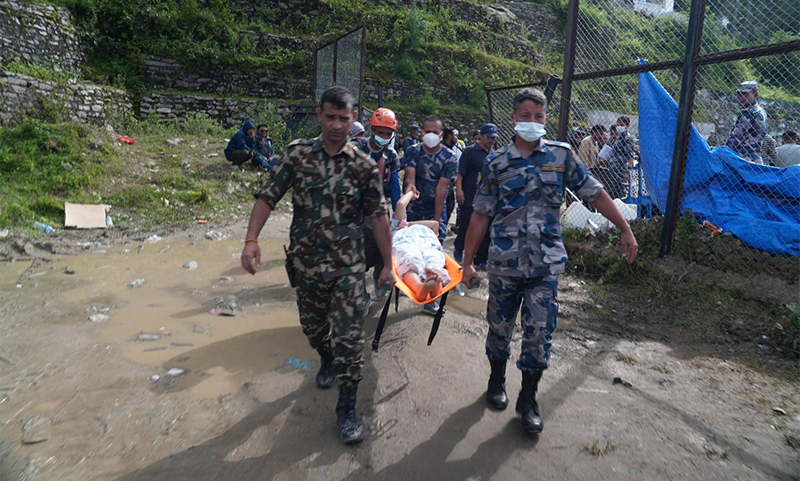
Security personnel rescuing the injured following the flood. Image courtesy of Rajneesh Bhandari/NIMJN.
Four health facilities were destroyed outright, the health posts at Syabrubesi and Timure, the desk at Rasuwagadhi and the community health unit at Mailung. That is, in effect, the entire primary health system of the valley floor.
Surendra Gautam, a regional director with ADW International, reached the edge of Syabrubesi on August 30.
“We found that only a single building remained there in Syabrubesi,” he told NIMJN. “Other than that, there is nothing left.”
Above it, in Thulo Syabru, about a hundred households remain. Kancha Tamang, who ran a shop on the valley floor and cannot get back to it, described a district reduced to a helicopter map: the bridges gone, the crossing to the villages of Syo and Gre gone, and the route above blocked by the Runga River.
“Since there is no bridge here, they can only be transported if a helicopter is provided,” he said. “Those people have no other option, sir. No option at all.”
Asked what he wanted, he did not say food, money or an inquiry.
“If they install a bridge as soon as possible, all the people in this region can be rescued, and food and water will be sorted out.”
Trapped in the Hydropower Tunnels
Indra Prasad Gotame, a member of the Bagmati provincial parliament representing Rasuwa, was in Rasuwa on August 30.
“It is reported that there are over 300 people inside those tunnels,” he said. “There is hope that they might be alive. But we don’t have the technicians to go inside and there is intense pressure from relatives who believe those people might still be alive.”
Four men, he said, were brought out alive from the Rasuwagadhi tunnel. That is what the hope is built on.
“It is being said that technicians have come from outside,” he said, “But no technicians have arrived here yet.”
Two days later, the government published a figure twice the size of his. Of 4,216 people listed as missing, 639 fall under a single heading, ‘Hydropower Projects’.
The same report says Indian, Chinese, Korean and Nepali rescue teams ‘continue to be mobilized for joint search and rescue operations’ at four named sites, including Chilime.
Between an elected representative saying on August 30 that no technicians had reached him, and the state reporting on September 1 that four countries were working at four tunnels, there is a gap the families of 639 people are entitled to have explained.
Indra Prasad Gotame. Image courtesy of Rajneesh Bhandari/NIMJN.
At Chilime, Kancha Tamang counted on his fingers the men from his own settlements who are inside, five from Kalathan, one from Sano Bharkhu. He had heard that 100 meters of the tunnel had filled with water and mud. A helicopter had gone in and brought out one body because the family had asked for it.
“You can see the mouth of that tunnel there,” he said. “Yes, it’s just a small opening.”
Uncounted Casualties Along the River
Here is the government’s death toll by district, as published on September 3.
Rasuwa is where the flood happened. Rasuwa is where the market town was reduced to a single building, where the border crossing was destroyed, and where 14,461 people spent six days cut off from the world. Yet, it has the lowest death toll of any affected district and the reason is not that Rasuwa was spared.
Trishuli Bazar. Image courtesy of Rajneesh Bhandari/NIMJN.
The reason is that the river carried its dead 200 kilometers south into the Narayani river system and deposited them in the plains, where the water slowed and where they are being recovered by people who did not know them. Unidentified bodies are currently being held at 21 hospitals across the country. The Nepal Police maintain a public database of them, while government logistics records show 1,146 body bags dispatched from the emergency warehouse at Kathmandu airport.
As of Sept. 3 morning, 1,204 bodies had been recovered, of which 95 have been identified and returned to their families. However, he did not specify where the DNA matching will take place, the timeline for the process or who will bear the cost.
A death toll organized by where a body was found, when the river is what moved it, is not a measure of where people died. Anyone reporting these figures, including this publication, has to make that distinction every time.
The missing column presents the same problem in another form. Reports have come in from 62 of Nepal’s 77 districts, because the men and women who worked along this river, in the tunnels, on the trucks, in the hotels and at the customs sheds, came from everywhere. The overall national missing list also includes dozens of security personnel, government workers and hundreds of visiting foreign nationals.
Shakeb Nabi, country director of the German aid organization Welthungerhilfe, was in the field and did not pretend otherwise.
“The biggest challenge I see in this humanitarian crisis is that we don’t know the number of people,” he said. “That’s tragic, that’s unfortunate.”
His point is not that the state is concealing anything. It is that the categories themselves have collapsed. People who survived did not stay behind to be counted. They walked to relatives in Nuwakot, to friends over the ridge or to Kathmandu if they could reach it. The phones died along with the power, leaving families to report people missing a week later, some of whom were actually alive three valleys away with dead handsets.
Devastation Downstream at Betrawati
Forty kilometers downstream, Madan Lal Lawat was on the road to Kathmandu when the news reached him. He turned around and returned on foot through the forest, stopping at Beltari, across the river, to look.
Three houses. His own, with the microfinance office on the ground floor. His elder brother Somlal’s, which housed the agriculture office. His elder sister Santamaya’s.
“This settlement has been set back hundreds of years,” he said. “There is no suitable land left to live on here.”
Five of his relatives are out of contact, two sisters-in-law, an elder brother and two aunts.
Betrawoti Bazar. Image courtesy of Rajneesh Bhandari/NIMJN.
Betrawati was not only a market town. It was the sacred site of Uttargaya, featuring a Ram temple across the water and hosting an annual fair on the new moon of Paush. It drew pilgrims, trekkers and trucks bound for the Chinese border.
Sneha Shrestha, who arrived with an animal welfare group and has worked through many of Nepal’s disasters, noted that this one was distinct in a way she could smell.
“The river is filled with dead animals and they have already begun to rot completely,” she said. Her fear is disease, that if the human and animal remains are not cleared quickly, cholera and other water-borne pathogens will sweep through populations with nowhere else to seek refuge. “We are finding it hard to breathe here,” she said. “The survivors have to stay right here. They have nowhere else to go.”
That fear has now become a direct line in an official government document. Under the list of needs and priorities for Bidur, in Nuwakot, the state specifies the requirement: “Disinfectant/chemicals to control odor from dead animals and human remains.”
Asked whom she held responsible, Shrestha did not point to the weather.
“A natural disaster is a natural disaster but I believe the blame for this ultimately rests on humans,” she said. “There is no ground left to absorb the water. We are building houses everywhere. And with the way we extract stone and sand from the rivers, both legally and illegally, the government needs to pay serious attention.”
The Threat of a Secondary Flood
The flood is not finished. The collapse blocked the river in more than one place. Some of those temporary lakes have drained. Others have not. Satellite images show a new lake forming in the hollow gouged out at 5,200 meters.
“With a blockage still lodged upstream on the Nepal-China border, authorities warn a second flood is imminent,” ICIMOD’s Qianggong Zhang said, “And evacuation orders are now in place for Jilong port, the Chinese side of the crossing.”
The government’s own assessment warns of ‘sudden river damming, lake breach floods, additional debris flows and secondary flooding events’, and that further rainfall could restart the entire sequence on slopes that have already given way once.
The people this would reach are those now living on the hillsides because the valley floor is gone. Mendo Gyalmo was awakened at four in the morning on August 31, and ran once more.
“We were very scared today too,” she said.
In Betrawati, on the morning of August 26, the warning arrived from three schoolchildren. It was correct, yet an adult initially doubted them.
Gita Maya Dangol survived anyway. She has lost her house, her livelihood and five members of her family. What she seeks from the state is not compensation.
“Our only hope for living is from the government,” she said. “We have nothing left ourselves. The children are just studying. I just want them to provide facilities for the children, make their education free and let them study well. That’s my only wish.”
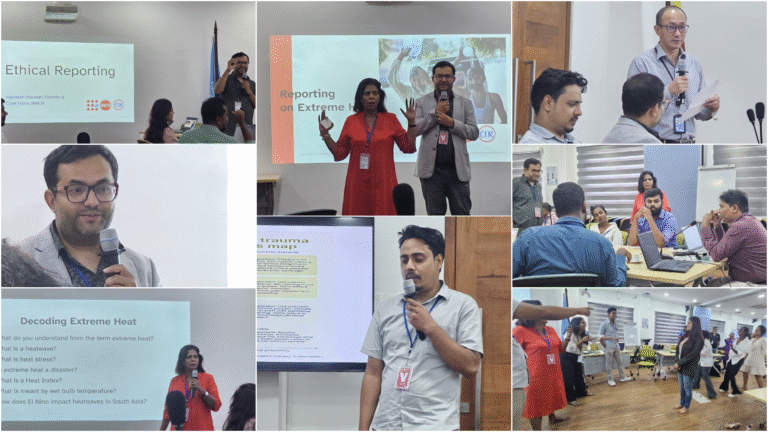
CIR, in partnership with UNFPA, concluded what we believe is the first specialized training for Sri Lankan journalists focused specifically on reporting extreme heat.
The training aimed to help journalists better understand the science, data and human impact of extreme heat as Sri Lanka faces shifting climate patterns and growing heat-related risks.
The training brought together experts including Arun Karki, a leading data journalism and open-source investigation specialist; Dilrukshi Handunnetti, an award-winning investigative journalist with expertise in climate and environmental reporting; and Rajneesh Bhandari, an experienced disaster and humanitarian crisis journalist from Nepal who is heading he Nepal Investigative Multimedia Journalism Network (NIMJN).
Extreme heat is not simply a weather story. It is also a story about health, livelihoods, inequality, vulnerable communities and the wider social and economic consequences of a changing climate. Helping journalists make those connections is increasingly important.
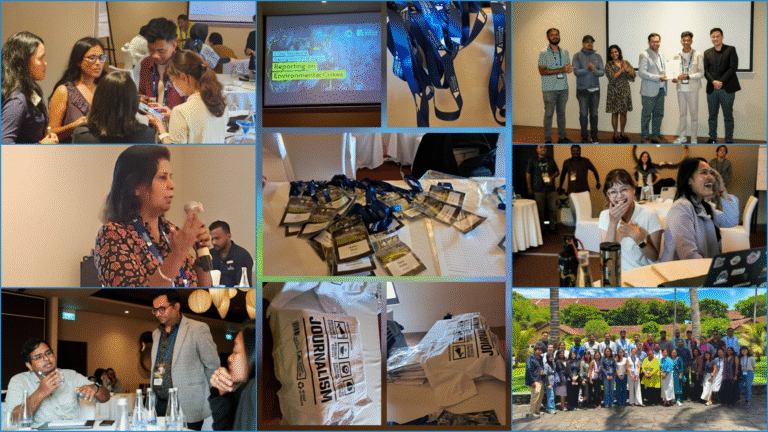
From August 17–19 in Kalutara, CIR, in partnership with the Konrad-Adenauer-Stiftung’s Media Programme Asia, conducted a three-day Environmental Crises Reporting Training for 26 journalists from 12 countries across South and Southeast Asia. The participants were selected from an overwhelming 700+ applications received.
The training explored the full disaster cycle from preparedness and early warning to crisis response, recovery and accountability. Participants also worked with tools including AI, data and satellite imagery, while examining ethical, solutions-focused and investigative approaches to environmental reporting.
Beyond the sessions themselves, one of the most valuable aspects was the opportunity for journalists from different countries to exchange experiences and recognize how many of the challenges facing our communities are shared.
As Bidhya Rai from Nepal reflected:
“Had great sessions from all trainers, wonderful networking, and opportunities to exchange experiences among damn good colleagues from across region.”
Yash Sadhak Shrivastava from India said the training made him realize how common many of the challenges are, particularly as communities across the region face the impacts of climate change. He also highlighted the sessions on data journalism and visual storytelling, which helped him identify gaps in his own work.
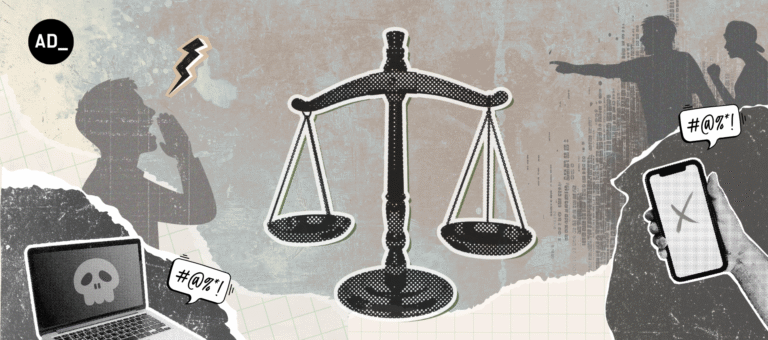
Experts say the rising attacks against judges is a result of hypernationalism and the failure of independent institutions, including the judiciary.
Earlier in June, Tabassum Khan, a trial court judge in Madhya Pradesh was subjected to online abuse for convicting a group of cow vigilantes to life imprisonment for lynching truck driver Sheikh Lala Nazir Ahmed in August 2022. Khan’s religious identity took centerstage as an online mob issued rape and death threats.
In another incident, Justice Gautam Patel, who retired from the Bombay High Court in April 2024, and his family faced online threats after he delivered a verdict securing the succession line of the Dawoodi Bohra community. Justice Patel’s daughter, who lives in London, was physically assaulted and reportedly faced a house invasion attempt.
In early 2024, then-Chief Justice of Pakistan Qazi Faez Isa faced online threats and protests after he delivered a verdict acquitting a man accused of blasphemy. The man was from the Ahmedi sect – considered to be a heretical by hardline Muslim scholars.
In an unprecedented move, earlier this year Sri Lankan Supreme Court judge AHMD Nawaz moved the Karnataka High Court in India seeking the takedown of defamatory content against him. Justice Nawaz said the articles, published between 2015-2020, essentially accused him of being corrupt even after he was acquitted of all charges.
The Sri Lankan judge said he decided to seek relief from Indian courts since it would be improper for a sitting judge to file the matter in Sri Lankan courts as “no man can be a judge in his own cause” and because there was no Google office in Sri Lanka.
These are just a handful of examples which demonstrate how the judiciary across South Asia is facing online mobs when their decision seems to go against the majoritarian sentiment.
Experts say there is a direct link between majoritarian politics, hypernationalism, and a general decline in institutional trust — especially the judiciary — leading to increased instances of attacks against the judges.
“We are in a populist era where the judiciary is no longer considered sacrosanct, so people feel increasingly empowered to comment on legal issues online,” Professor Joyojeet Pal, who teaches user experience (UX) and client-based design at the School of Information, University of Michigan Ann Arbor, said.
In 2023, Pal, along with his colleague Sheyril Agarwal and Indian news portal Newslaundry, published a study focusing on the nature of trolling of former Chief Justice of India DY Chandrachud.
They analysed data from X (formerly Twitter) between January 1 – April 20, 2023.
According to his study, the trolling was an organised campaign by digital influencers. They also found that the content shared by BJP-leaning influencers was a lot more dominant. The study highlighted that Chandrachud was presented as “anti-Hindu”, attacked for his father’s legacy, and his liberal views.
Pal added that when judges pass a judgement on a contentious matter, they are seen as “unelected elites superseding elected representatives’ position”.
Hypernationalism, Social Media, and Declining Trust in Judiciary
Studies and experts have underscored the correlation between the rise in hypernationalism and a declining trust in the judiciary. This lack of trust could be attributed to the judiciary’s alleged hesitation to confront executive excesses and judicial corruption.
Noted Bangladeshi scholar Dr. Kalam Shahed, who passed away in 2024, wrote in an article in 2021, “Systemic judicial corruption stifles the broader accountability function that the judiciary is constitutionally entrusted with. It remains, at best hesitant, or at worst, incapable of safeguarding the state’s essential democratic functions – upholding citizens’ rights, securing the integrity of the political rules of the game, and sanctioning of other branches when they act in contravention of law.”
Experts also point out that loyalty to the government is often conflated with loyalty to the nation and that creates a warped idea of nationalism. “Any disagreement with the executive is seen as disloyalty,” scholar and author Insiyah Vahnavaty said.
Niranjan Sahoo, senior fellow, Observer Research Foundation (ORF), a Delhi-based think tank, pointed out that social media has made such attacks even more common.
“While judges in many countries particularly in South Asia earlier faced verbal or physical intimidation/abuse/attacks on some occasions, with the arrival of digital/social media, this has gone up dramatically in recent years,” Sahoo said.
In 2024, hashtags such as #SupremeKotha, #MiyaLord (a derogatory communal form of My Lord), #Dogali_Nyay_Vyavastha among others were trending after the Indian Supreme Court granted bail to then Delhi Chief Minister and leader of the Aam Aadmi Party (AAP) Arvind Kejriwal in a corruption case.
Sahoo said that “Pakistan is notorious in this regard” and added, “lately judges, particularly in lower courts in India, have been subject to vicious online attacks where threats have been issued for rape and murder. This poses gravest threats to the independence of judiciary/judges.”
Earlier this year, Lahore High Court directed state authorities to probe those behind the social media campaign vilifying women high court judges. The court directive followed petitions seeking accountability after Lahore High Court Chief Justice Aalia Neelum — Lahore’s first female chief justice — faced online harassment after suspending certain provisions of the Punjab Protection of Ownership of Immovable Property Ordinance, 2025 in December 2025.
Similarly, Moyeedul Islam, a former senior trial court judge in Bangladesh told us that he saw the prevalence of a mob culture in August 2024 following the July uprising and the resignation of former Bangladeshi Prime Minister Sheikh Hasina.
“During that period, even the courts were not spared from this. Although it has largely subsided now, its lingering impact remains in the minds of the judges.,” Islam said.
He spoke about how online attacks quickly turn violent and cause real-world harm.
Islam shared another instance from March 2020 where a district judge of Pirojpur rejected bail pleas of a former MP from the Awami League and his wife in a corruption case and remanded them to jail. Pro-party lawyers and activists vandalised the court premises, and even blockaded roads and set fires. “The authorities transferred the district judge elsewhere within three hours, yet no action was taken against the rioters,” the former judge said.
Speaking about the impact of such instances, Vahanvaty said, “These mobs may be encouraged by the political actors, or by powerful hypernationalist groups that know they are unlikely to face any consequences.” She added that if judges have to balance those risks with their safety and job then one can’t blame them for choosing caution.
State Inaction Leads to a Weak Judiciary
Courts across South Asia have also used contempt of court laws to protect the judiciary. However, critics say that the South Asian judiciary is “better known for its impulsive acts of invoking contempt actions”.
Drawing attention to State’s inaction to such instances due to political alignment, Vahanavaty said, “We have seen situations where the courts themselves have had to step in and provide protection when the State machinery has been slow to respond or has remained silent. That is welcome when it happens, but it should not be the norm. Protecting judges is not the Court’s responsibility; it is the State’s.”
In 2024, when Islamabad High Court derecognised the cricket bat as Pakistan Tehreek-e-Insaf’s (PTI) election symbol, political workers in a coordinated campaign targeted Chief Justice Qazi Faez Isa and the other top judges. The judges were exposed to public ire as the State failed to proactively prevent and stop the online trolling and harassment. However, later a Joint Investigation Team (JIT) was formed to investigate the matter.
Recognising these threats, in November 2025, leaders across South and South East Asian judicial systems endorsed and adopted the Manila Statement on judicial integrity, which explicitly recognised digital threats.
Pointing out the similarities across South Asia, psychologist Niral Bhatia said, “Social media can turn a judicial order into a community/religious/political/identity battle – ‘an us v/s them’.
Bhatia also spoke about the impact of such harassment and said this fear of trolling, doxxing and being “viral” online can also subconsciously prompt judges into ‘defensive adjudication’ and take an overtly cautious approach to law. “That’s why this is now becoming a systemic issue. No judge will change a judgement because of social media. But constant harassment can definitely create a kind of anxiety and fear,” she said.
The Blurring Lines Between Criticism and Harassment
Former Chief Justice of India DY Chandrachud, who has been massively trolled for his judgements on social media, said that certain actors on the internet can’t seem to tolerate other peoples’ right to free speech. The digital space has shrunk that space, he said.
Experts say that similar to other public institutions, the judiciary should be open to criticism but that criticism shouldn’t become harassment and at the same time no sweeping laws should be used to suppress legitimate dissent.
“We don’t want a system where criticism of judges is treated as a threat, because the judiciary, like any public institution, must be open to criticism. The safeguards have to be narrow, transparent and subject to judicial oversight. I would resist giving the government sweeping powers to decide what constitutes harmful speech. That can very easily become a tool for suppressing legitimate criticism or dissent. The line has to be drawn at threats, doxxing, incitement to violence and coordinated harassment designed to intimidate a judge from doing their job,” Vahanavaty said.
She added that it’s crucial to recognise that criticism is not the same as harassment.
“We need to be much better at making that distinction. Protect the judge from intimidation, but allow for criticism. That, I think, is the balance we need,” she added.
Banner Image: An illustration by Shivansh Srivastava/Asian Dispatch.
This story was written by Ritika Jain and edited by Kritika Goel.
This story was originally published by Asian Dispatchon September 02, 2026. It has been republished by Center for Investigative Reporting with permission.
Transparency International Sri Lanka (TISL) has challenged the Bill in the Supreme Court, arguing that several provisions violate constitutional protections.
People’s Action for Free and Fair Elections (PAFFREL) says restrictions on the use of asset declarations could undermine public scrutiny of politicians and other public officials.
The bill raises the state-ownership threshold from 25% to 50%, potentially excluding companies with significant minority government ownership from certain anti-corruption obligations.
The requirement to declare the assets of cohabitants would be removed, which critics say could create a loophole for concealing assets.
Use of redacted asset declarations could become a criminal offense, carrying a fine of up to $305 (Rs. 100,000) or up to one year in prison.
COLOMBO—Sri Lanka’s proposed amendments to its anti-corruption law are facing growing criticism from election monitors, civil society and governance advocates, who claimed provisions intended to strengthen the framework could instead restrict public scrutiny, weaken accountability and concentrate powers within the anti-graft commission.
Civil Society groups, accountability and good governance experts have raised concerns over provisions affecting asset declarations, state-linked companies, bail and the powers of CIABOC officials.
TISL takes Bill to Supreme Court
Transparency International Sri Lanka (TISL) filed a petition in the Supreme Court on Aug. 31, challenging several provisions of the proposed amendments.
TISL claimed that the contested provisions are inconsistent with Articles 1, 3, 4, 12, 13, 14(1)(a), 14A, 126, 140 and 156A(1)(c) of the Constitution. It says the amendments could affect the sovereignty of the people, the right to information and judicial power.
Among its central concerns is a provision allowing the director general of CIABOC to decide whether to refrain from prosecuting accomplices without authorization from a magistrate. TISL states that this removes an important layer of judicial oversight.
The organization has also challenged the proposed increase in the state-ownership threshold from 25% to 50%. Under the amendment, companies in which the state or a public corporation holds between 25% and 49.9% would fall outside the relevant definition.
TISL stated that the change could exclude entities handling or controlling public assets from important asset declaration and anti-corruption requirements.
The petition also challenged the removal of the requirement to declare the assets of cohabitants, as well as new restrictions and criminal penalties relating to the use of redacted asset declarations.
TISL has urged the Supreme Court to determine that the disputed provisions cannot become law unless approved by a two-thirds majority in Parliament and at a referendum.
Transparency rollback
Meanwhile, PAFFREL has separately called on President Anura Kumara Dissanayake to reconsider provisions that it says could restrict public access to and use of asset and liability declarations.
PAFFREL executive director Rohana Hettiarachchi said the 2023 Anti-Corruption Act represented an important step toward transparency and accountability because it allowed members of the public to scrutinize declarations made by public officials.
Concerns expressed over the removal of the requirement to declare the assets and liabilities of a person who has lived with the declarant and shared the same household for at least six months. AI generated image.
The proposed amendment would restrict how redacted declarations obtained by the public can be used. They could be used only for submission to specified officers or institutions under the Act. Breaching that restriction could result in a fine of up to $305 (about Rs. 100,000), imprisonment for up to one year, or both.
“Journalists, civil society groups and citizens should be able to examine declarations, identify discrepancies and question whether the wealth of public officials is consistent with their legitimate income,” Hettiarachchi told CIR.
The organization also objected to raising the state-ownership threshold from 25% to 50%, warning that companies in which the government holds a minority stake could fall outside the relevant anti-corruption framework.
Another concern is the removal of the requirement to declare the assets and liabilities of a person who has lived with the declarant and shared the same household for at least six months.
PAFFREL cautioned that this could potentially allow assets to be held in another person’s name while remaining under the control or for the benefit of the public official.
At the same time, PAFFREL acknowledged that the Bill contains positive provisions aimed at addressing gaps and ambiguities in the existing anti-corruption framework. It has called for wider public discussion before the amendments proceed.
‘Best way to deal with rumors’
For Manjula Gajanayake, executive director of the executive director, Institute for Democratic Reforms and Electoral Studies (IRES), the controversy goes beyond technical amendments to an existing law.
Gajanayake said the proposed Bill should be viewed alongside the government’s proposed 22nd Constitutional Amendment and NGO Bill as documents that could reveal the broader direction of the National People’s Power government.
He described the anti-corruption legislation as a “mirror” through which the government’s approach to transparency, public scrutiny and dissent could be examined.
His strongest concern is the proposed restrictions on public access to asset and liability declarations.
Gajanayake asked why public access should be restricted if the government believes journalists or others are misusing the information.
“If you hide information, rumours will only grow,” he told CIR, adding that transparency is a more effective response.
He also queried the rationale for removing the requirement to disclose the assets and liabilities of people who have lived with a declarant for at least six months.
Gajanayake suggested recent criticism of politicians’ asset declarations on social media could be one factor behind the proposed restrictions, pointing particularly to Facebook and YouTube administrators and opposition politicians. He said the government’s greater concern may increasingly be online criticism rather than traditional political opposition.
What changes under the Bill?
The government said the amendments are intended to strengthen corruption prevention, investigations and prosecutions and resolve legal, administrative and technical problems that have emerged since the 2023 Act came into force.
While presenting the Bill, prime minister Amarasuriya said it would also introduce tougher financial penalties for corruption. Where a convicted person acquired or converted property as proceeds of corruption, the court would be required to impose an additional penalty of at least three times the value of that property.
If corruption caused a financial loss to the government, the court would also be required to impose an additional penalty equivalent to the full amount of the loss.
The amendments would further restrict bail for certain major corruption offenses. Where a suspect is accused of soliciting, accepting or offering a bribe of at least
The disagreement, however, is increasingly centered not on whether Sri Lanka needs stronger anti-corruption enforcement, but on who gets to scrutinize those exercising public power.
Banner Image: Civil Society groups, accountability and good governance experts have raised concerns over provisions affecting asset declarations, state-linked companies, bail and the powers of CIABOC officials. Screenshot via https://ciaboc.gov.lk/
This story was written and edited by Gagani Weerakoon. She leads the editorial at the Center for Investigative Reporting (CIR).
This story was produced with support from Report for the World, a global media service strengthening local independent journalism
84,545 persons from 26,457 families across seven districts have been affected by the ongoing dry spell, according to Sri Lanka’s Disaster Management Centre.
Authorities have distributed drinking water to 24,144 families as water shortages intensify.
Water levels in some dry-zone reservoirs have fallen below 30%, while the combined capacity of the country’s 74 major reservoirs has declined to 36%.
The government has allocated $9 million (Sri Lankan rupees 3 billion) for agricultural insurance compensation as drought damages about 32.4 square kilometers (8,000 acres) of crops.
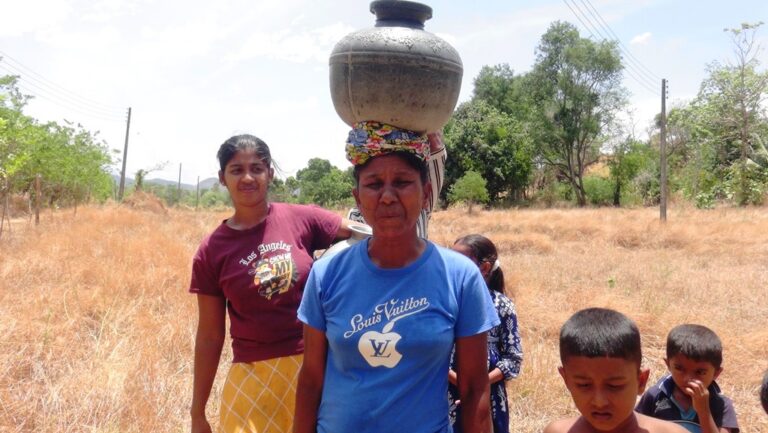
COLOMBO— Chandrakanthi’s daily routine now includes a seven-kilometer walk to secure something her family cannot live without — safe drinking water. Living in a remote village bordering Sri Lanka’s North Central Province, she makes the journey to a neighboring village to fetch water for her seven-month-old granddaughter, as the prolonged dry spell has left most wells in her area nearly dry.
Her experience reflects a growing water crisis across parts of Sri Lanka. More than 84,000 people in seven districts are now affected by drought, while declining reservoir levels and crop losses are putting additional pressure on communities and farmers. The situation is worsening as a strengthening El Niño threatens to bring more heat and water stress, forcing authorities to prioritize drinking water as available supplies shrink.
As of Aug. 26, the Disaster Management Centre (DMC) said 84,545 persons from 26,457 families had been affected by drought conditions in Ratnapura, Batticaloa, Ampara, Monaragala, Badulla, Hambantota and Polonnaruwa. The dry spell is affecting 23 Divisional Secretariat divisions across those districts.
Samanmali Matharaarachchi, assistant director of the DMC, said authorities had distributed potable water to 24,144 families affected by the shortages.
The crisis comes as the U.S. National Oceanic and Atmospheric Administration (NOAA) cautioned that El Niño is strengthening, with a greater than 90% chance of a very strong event during the Northern Hemisphere fall and winter of 2026-27. NOAA said the current event has strengthened significantly over the past month.
Dwindling water supplies
The Department of Meteorology issued a warm-weather advisory for Aug. 27 covering Polonnaruwa, Jaffna, Kilinochchi, Mullaitivu, Ampara, Batticaloa and Monaragala.
The advisory warned that the heat index — the temperature human body feels when the effects of heat and humidity are combined — could reach the “caution” level in some areas during the daytime.
Residents were advised to remain hydrated, avoid prolonged exposure to direct sunlight where possible and limit strenuous outdoor activity during the hottest part of the day.
The combination of high temperatures and dry conditions is putting additional pressure on already declining water resources.
According to irrigation director engineer L.S. Sooriyabandara, water levels in the main reservoirs in the country’s wet zone remain relatively stable, but reservoirs in the dry zone are declining rapidly.
“Water capacity in some reservoirs in Hambantota, Batticaloa, Monaragala, Mannar and Trincomalee districts has fallen below 30%,” Sooriyabandara told CIR.
Overall, the water capacity of Sri Lanka’s 74 major reservoirs has fallen to 36%, according to the director.
“While dry conditions are normal in August, the situation has been aggravated this year by the prevailing El Niño conditions,” he said. Higher temperatures are also increasing evaporation, causing water levels in lakes and reservoirs to fall more rapidly.
The worsening water situation is creating a growing conflict between domestic consumption and agricultural needs. Image courtesy of Rahul Samantha Hettiarachchi.
Drinking water takes priority
The worsening water situation is creating a growing conflict between domestic consumption and agricultural needs.
As demand for water increases while supplies decline, authorities have had to prioritize drinking water and environmental requirements in areas experiencing severe dry conditions. That has limited the amount of water that can be released for cultivation.
Sooriyabandara said drinking water supplies had not been restricted so far, but measures had been taken in some areas to reduce the amount of reservoir water released for agriculture.
He urged the public to use water sparingly and adopt greater environmental responsibility as the dry conditions continue.
The director also warned that the combination of high temperatures and dry vegetation was increasing the risk of wildfires, which could spread rapidly under the prevailing conditions.
He urged the public to remain vigilant and monitor El Niño forecasts so that authorities and communities can prepare for further changes in weather conditions.
Mounting crop losses
The drought is also taking a toll on agriculture, with paddy and other crops including maize reported to have suffered damage in Monaragala, Polonnaruwa, Hambantota, Anuradhapura and Ampara.
The Agriculture and Agrarian Insurance Board has recorded paddy crop damage across five districts, with losses estimated at 5.7 square kilometers (1,401 acres) in Monaragala, 5.1 square kilometers (1,259 acres) in Polonnaruwa, 3.2 square kilometers (783 acres) in Hambantota, 4.3 square kilometers (1,055 acres) in Ampara, and 7.8 square kilometers (1,923 acres) in Anuradhapura.
The five reported district-level figures amount to about 26 square kilometers (6,421 acres) of paddy land.
The Agriculture and Agrarian Insurance Board estimates that approximately 32.4 square kilometers (8,000 acres) of farmland belonging to nearly 7,000 farmers have been affected overall, including crops beyond the paddy acreage listed above.
Field officers from the Agriculture and Agrarian Insurance Board, together with officials from the Department of Agrarian Development, are visiting affected farmland to assess the losses.
Planned compensation
The government has allocated about $9 mn (Rs. 3 bn) to accelerate agricultural insurance compensation for farmers whose crops have been damaged by the dry conditions.
The government aims to release the compensation before the next cultivation season, providing financial relief to farmers and helping them prepare for the next cycle of cultivation.
The agriculture minister has instructed officials to expedite assessments and payments for damaged paddy fields.
“For six crops, maize, big onion, potato, soybean, chili and paddy, compensation will be paid at Rs. 100,000 per hectare, with a maximum coverage of five acres per farmer under the stated scheme,” the Board in a statement noted.
Farmers who have not yet reported crop damage have been urged to notify agrarian officers or record their losses at agrarian development centers.
Disaster Management Center (DMC) has distributed potable water to 24,144 families affected by the shortages. Image courtesy of Rahul Samantha Hettiarachchi.
A wider climate warning
The immediate concern is the availability of water, but the strengthening El Niño adds another layer of uncertainty to Sri Lanka’s weather outlook.
NOAA’s latest assessment says there is a greater than 90% chance that the current El Niño will become very strong during the Northern Hemisphere fall and winter. NOAA also says there is a 69% chance that the October-December period will meet its definition of a historic El Niño event, exceeding the strength of previous events dating to 1950.
For Sri Lanka, the combination of prolonged dry conditions, high temperatures, declining reservoir storage and rising agricultural water demand creates mounting pressure on already limited resources.
With authorities prioritizing drinking water in some drought-hit areas and restricting agricultural releases from certain reservoirs, the coming weeks will be critical for both communities dependent on water supplies and farmers preparing for the next cultivation season.
Banner Image: With water levels in some dry-zone reservoirs have fallen below 30%, women and children are seen walking miles to fetch clean potable water. Image courtesy of Rahul Samantha Hettiarachchi.
This story was written and edited by Gagani Weerakoon. She leads the editorial at the Center for Investigative Reporting (CIR).
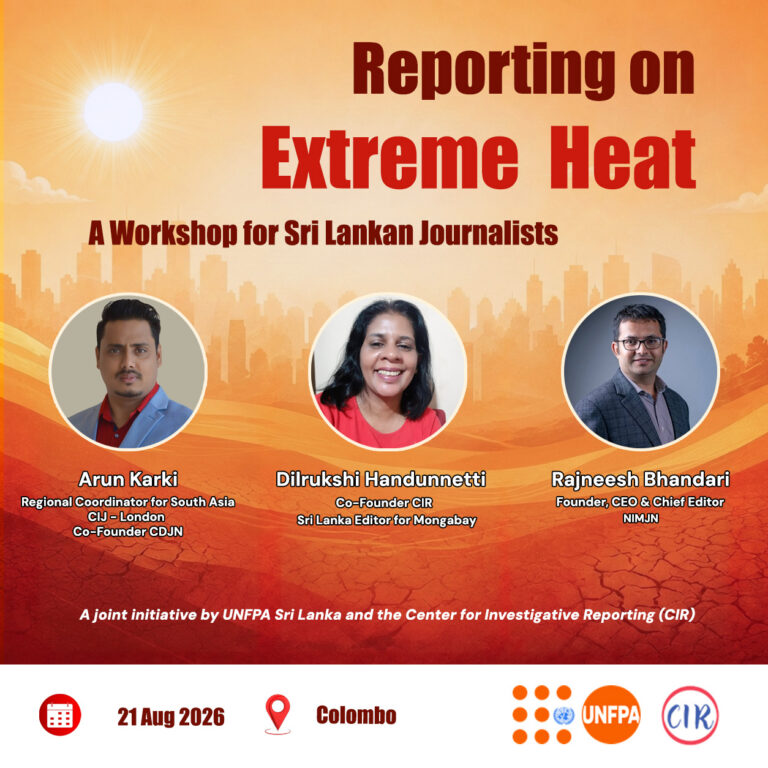
To support Sri Lankan journalists to better understand extreme heat, the Center for Investigative Journalism (CIR) in partnership with the UNFPA will host a specialized training workshop “Reporting on Extreme Heat” in Colombo.
As SriLanka faces shifting climate patterns and the threat of super El Niño, this training will equip local journalists with climate data & insights on how extreme heat impacts, especially vulnerable groups.
The training will be delivered by, Arun Karki is the founder of the Center for Data Journalism Nepal (CDJN) and South Asia Coordinator at the Centre for Investigative Journalism, London. He is a leading expert in data journalism and open-source investigations with a strong focus on satellite imagery, geospatial analysis, verification techniques, and digital mapping.
Dilrukshi Handunnetti is an international award-winning investigative journalist and journalism trainer with a strong focus on climate science, environmental governance, and public-interest journalism. She is the Co-Founder of the Center for Investigative Reporting (CIR) and Sri Lanka Editor for Mongabay.
Founder and Chief Editor of the Nepal Investigative Multimedia Journalism Network (NIMJN), Rajneesh Bhandari has extensive experience reporting on disasters and humanitarian crises. His sessions will explore disaster risk reduction, ethical crisis reporting, solutions and accountability journalism.
Al comparar casinos en línea, teniendo en cuenta la variedad de juegos, pensando en un uso regular, una plataforma que puede revisarse de forma independiente es chicken subway juego , mientras una revisión independiente también puede abarcar la experiencia móvil y la navegación, junto con las reglas de retirada y los límites antes de registrarse.
Vor der Entscheidung, welche Seite näher geprüft werden soll, beim Vergleich von Navigation und Bedienkomfort, als Teil eines unabhängigen Vergleichs, eine Option für den direkten Vergleich ist fugu casino 5 , separat kann man auch betrachten die aktuellen Aktionsbedingungen, zusammen mit den wichtigsten Bedienungsdetails ohne die endgültige Wahl zu überstürzen.
Før man beslutter hvilken side der bør undersøges nærmere, ved vurdering af mobil brug, fra et praktisk brugerperspektiv, en platform der kan vurderes uafhængigt er https://spinlander-casino.dk/ , mens en uafhængig vurdering også kan omfatte registrerings- og verifikationsprocessen, med kundesupportens tilgængelighed i tankerne uden at forhaste den endelige beslutning.
Dla użytkowników zestawiających kilka platform jednocześnie, z uwzględnieniem metod wpłat i wypłat, na potrzeby wstępnej oceny, jednym z punktów odniesienia może być kasyno na prawdziwe pieniadze jeśli jednocześnie ocenia się najważniejsze warunki korzystania z serwisu, wraz z zasadami dotyczącymi wypłat w ramach szerszego porównania podobnych serwisów.