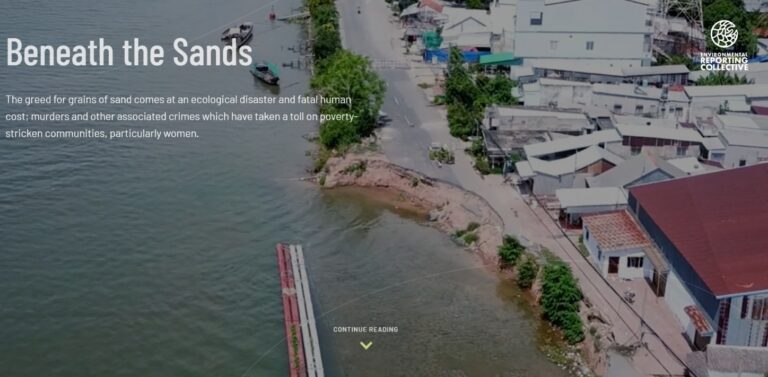
Beneath the Sands, published in 2023, is a collaborative global investigation by the Environmental Reporting Collective (ERC), bringing together journalists and newsrooms from 12 countries to examine the global sand-mining industry and its environmental and human costs.
This investigation looked at the growing demand for sand, the communities and ecosystems affected by extraction, illegal trade and organized crime, and the challenges of regulating a rapidly expanding global industry. Reporting spanned across Cambodia, China, India, Indonesia, Kenya, Nepal, the Philippines, Sri Lanka, Taiwan, Thailand, Vietnam and the United States.
In Sri Lanka, CIR reporter Tharushi Pitigala reported from Mannar, where Australian mining company Titanium Sands Ltd and its local subsidiaries were busy conducting exploratory drilling for ilmenite-bearing mineral sands. The investigation examined concerns raised by residents over access to private land, potential impacts on groundwater and the prospect of mining in the area.
The Sri Lankan reporting was part of the wider Beneath the Sands investigation, which documents how the global demand for sand is reshaping landscapes, livelihoods and communities.
Ending a five-year trial, a Colombo High Court trial-at-bar has convicted 15 of 24 men accused of being involved in the 2019 Easter Sunday bombings.
The multiple bombings killed 270 people, including 45 foreigners, and injured more than 500 people.
A total of 23,270-charges were filed against those indicted and 15 convicted 15 received prison terms ranging from 200 to 260 years.
The court heard evidence from 2,309 prosecution witnesses and the three-bench judge held 14 of them guilty on all charges, which included murder, conspiracy to commit acts of terrorism and possessing firearms and explosives under the Prevention of Terrorism Act.
In separate legal proceedings last month, two former senior security officials were sentenced to death for criminal negligence that resulted in the bombings.
COLOMBO — Nearly seven years after Sri Lanka’s Easter Sunday attacks shattered churches, hotels and families across the country, a high court verdict has convicted 15 people accused of helping plan, facilitate and support the coordinated bombings in 2019.
For survivors and families of those killed, the judgment marked an important moment in a judicial probe that had stretched across years of investigations and court proceedings.
“Today, I can finally go to sleep with some solace after seven years,” said Sheron Fernando, whose parents were killed in the bombing at St. Sebastian’s Church in Katuwapitiya on April 21, 2019.
“I am not overjoyed but, I find myself at ease. In my mind, I have imposed the death sentence on all involved, but I completely understand that the judiciary does not run on emotions.”
Fernando said she was among those who continued to place faith in the justice system and expressed respect for the trial-at-bar process, which heard the case through years of proceedings.
The permanent bench on Sept. 22 delivered a guilty verdict on 15 of the 24 accused persons in a case that involved 23,270 charges, including allegations of conspiracy to commit terrorism, murder and aiding and abetting the synchronized attacks. Nine were acquitted while, one died during pre-trial detention. The court also imposed prison terms ranging from 200 to 260 years on the 15 convicted. Five received 220-year terms, four were sentenced to 240 years, five to 200 years and one to 260 years. The court also ordered the confiscation of their movable and immovable property.
The judgment was delivered by High Court Judges Navaratne Marasinghe, Ramanathan Kannan and Sujeewa Nissanka.
Unprecedented trial
The case, filed by the Attorney General, was one of the largest and most closely watched criminal proceedings arising from the 2019 Easter Sunday serial bombings.
Prosecutors called 2,309 witnesses during nearly five years of court hearings. The recording of evidence by both sides concluded Aug. 24, after which the trial-at-bar fixed Sept. 22 for the delivery of judgment.
Among those convicted was Mohamed Naufar, also known as Naufar Maulavi, whom prosecutors identified as a key figure who supported the eight-member suicide bombing team.
The case concerned people accused of supporting or facilitating the attacks rather than the suicide bombers themselves, all of whom died during the attacks.
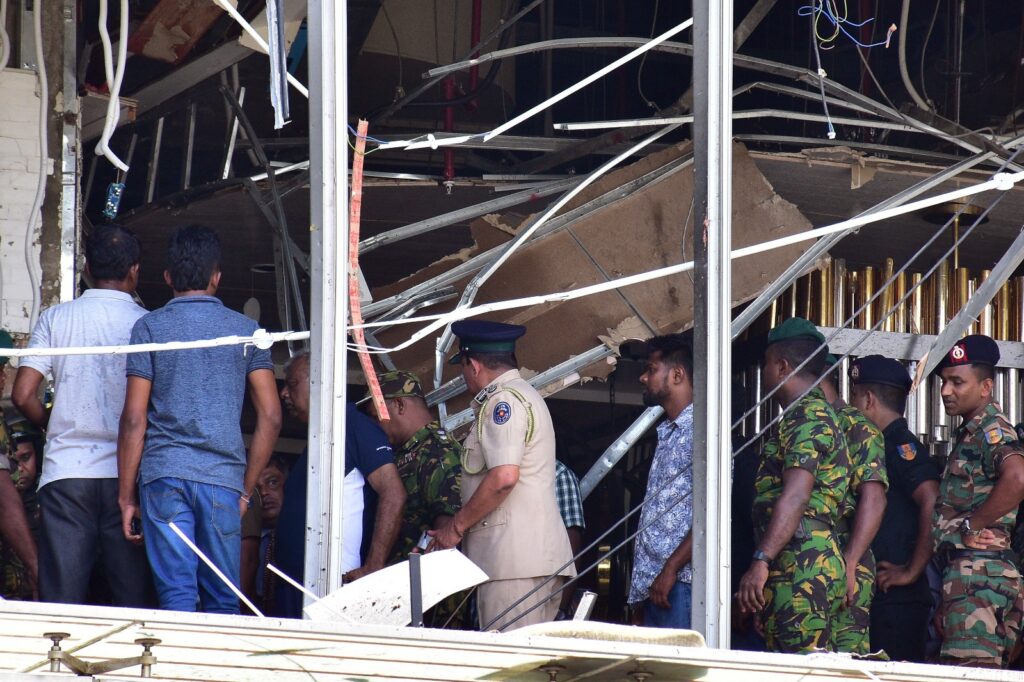
Several senior officials were found guilty of violating the fundamental rights of citizens by failing to take appropriate action on intelligence available before the attacks took place. Image courtesy of Sajeewa Chinthaka.
Attacks that changed Sri Lanka
On Easter Sunday, April 21, 2019, coordinated suicide bombings struck three churches and three luxury hotels in Colombo, Negombo and Batticaloa.
The attacks killed 279 people, including 45 foreign nationals, and injured hundreds more. They were the deadliest terrorist attacks in Sri Lanka since the end of the civil war in 2009.
The bombings were attributed to local Islamist extremists inspired by the Islamic State (IS). The attackers had pledged allegiance to the group before the attacks.
The scale of the killings was compounded by the fact that Sri Lankan authorities had received intelligence warnings before April 21 but failed to prevent the attacks.
That failure has generated a separate line of criminal and constitutional proceedings involving senior state officials.
Separate case on state culpability
In July 2026, former inspector general of police Pujith Jayasundara and former secretary of the ministry of defence Hemasiri Fernando were sentenced to death after a separate trial-at-bar found them guilty of criminal dereliction of duty, criminal negligence and related offenses over their failure to act on intelligence warnings about the impending attacks. Court convicted both Jayasundara and Fernando in a majority decision with one judge recording dissent and both have the right to appeal.
Sri Lanka has not carried out an execution since 1976 and has maintained a moratorium on executions.
FR violation
In January 2023, the Supreme Court found that several senior officials had violated the fundamental rights of citizens by failing to take appropriate action on intelligence available before the attacks. The defendants included then-president Maithripala Sirisena, former police chief Jayasundara, former defence ministry secretary Fernando, former chief of national intelligence Sisira Mendis and former director of the state intelligence service Nilantha Jayawardena.
The court ordered personal compensation from the officials, with the amounts totaling Rupees 311 million (approximately $324847.94). The money was directed to a victim fund administered through Sri Lanka’s Office for Reparations.
According to the Office for Reparations, the Supreme Court proceedings concerning the compensation orders concluded on May 21, 2025. It reported that the Rupees 311 mn ($324847.94)) received had been fully disbursed to victims and beneficiaries under the established scheme.
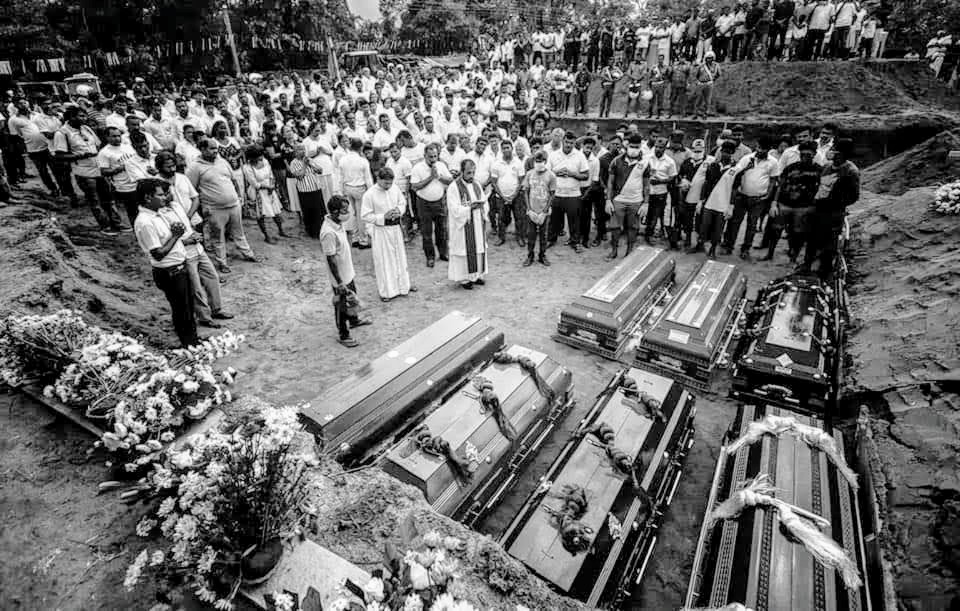
Mass funeral for victims of the Easter Sunday’s explosion at St. Sebastian’s Church in Katuwapitiya, Negombo, was held on April 23, 2019, as the country observed a day of mourning. The remains of the victims were brought to the church before being handed over to grieving relatives for burial. Image courtesy of Tharaka Basnayaka.
Questions that remain
For many families, Tuesday’s verdict closes one chapter but does not necessarily answer every question surrounding the 2019 Easter attacks.
The Catholic Church and others have continued to raise questions about whether the bombings involved a wider network or whether all those responsible have been identified. Those claims remain contested and should be distinguished from matters already adjudicated upon by the judiciary. For survivors such as Sharon Fernando, however, the significance of the verdict is less about the political questions that have surrounded the attacks and more about finally seeing a long-running criminal matter reach judgment.
After seven years of waiting, a court has now imposed criminal liability on 15 accused in one of Sri Lanka’s most consequential terrorism cases.
For the families still living with the consequences of April 21, 2019, that judgment represents a measure of accountability — while leaving other questions about the attacks and the state’s failures on separate legal tracks.
Banner Image: The verdict delivered on Sept. 22, 2026, closes one chapter but does not necessarily answer every question surrounding the 2019 Easter bombings. Image courtesy of Tharaka Basnayake.
This story was written and edited by Gagani Weerakoon. She leads the editorial at the Center for Investigative Reporting (CIR).
Sri Lanka’s campaign finance law has produced high rates of report submission, but the Election Commission says the quality of disclosures remains weak.Spending limits are declared five days after nominations close, potentially leaving substantial pre-nomination spending outside the monitoring framework.
The Election Commission says it lacks direct power to prosecute spending-limit violations and must rely on public or police complaints.
Officials are considering stronger financial tracking, including dedicated campaign bank accounts and greater support from institutions such as the Auditor General’s Department.
COLOMBO—Sri Lanka’s campaign finance law has now been tested at four elections since it came into effect three years ago. While the Election Commission has received expenditure returns from most candidates, questions remain about the quality of disclosures, enforcement, monitoring and the ability of citizens to challenge violations.
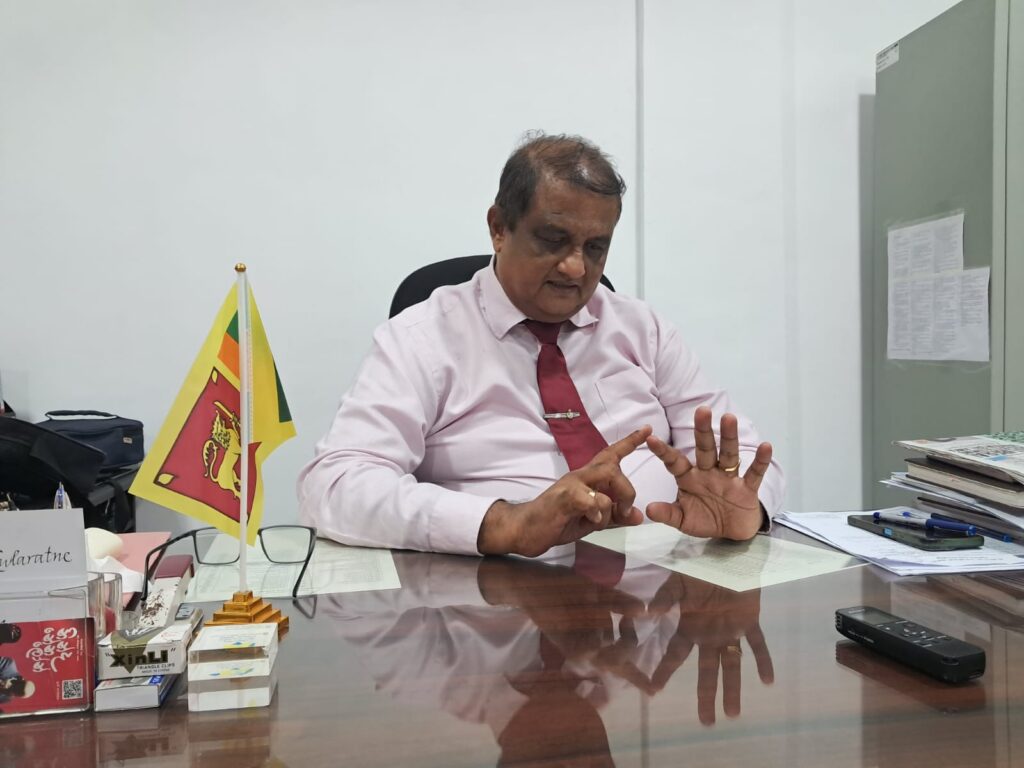
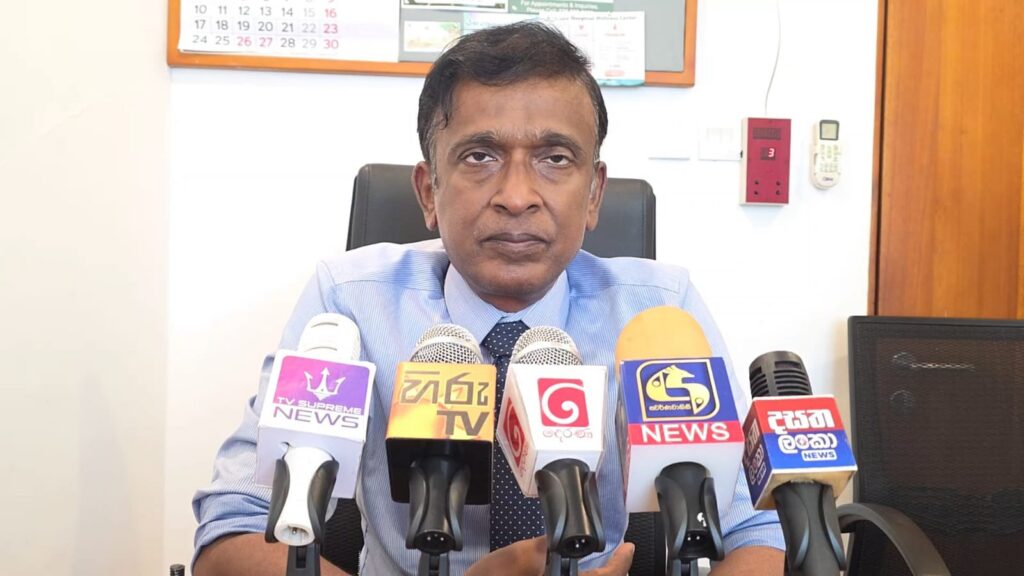
Chinthaka Kularatne, additional election commissioner (legal and investigation) of the Election Commission, discusses the practical challenges of implementing the Regulation of Election Expenditure Act, the Commission’s enforcement powers and the need for stronger auditing and verification.
He also explains why simply digitizing campaign finance returns will not be enough, and outlines proposals including dedicated campaign bank accounts and greater involvement by other state institutions.
Excerpts:
Q: The campaign expenditure law has now been applied at four elections. How would you assess its implementation?
Over the past three years, the law has been applied at four elections — the presidential, parliamentary, Elpitiya Pradeshiya Sabha and local government elections.
The submission rate has been relatively high, but there are significant qualitative, structural and procedural shortcomings.
So, while there has been compliance in terms of the number of reports submitted, the quality and effectiveness of the system remain concerns.
The maximum campaign spending limit is declared five days after nominations close. By then, financially powerful parties and candidates may already have spent substantial amounts before the limit is formally announced. Image courtesy of media unit of the National People’s Power.
Q: What are the main problems with the expenditure reports?
The quality of the reports is a major concern. Some are very superficial, consisting of only one or two pages. In some cases, candidates use the prescribed formats, cross out sections and simply sign the documents.
Such reports provide very little insight into the actual finances of a campaign. The issue is therefore not simply whether a candidate has submitted a return, but whether that return provides meaningful and verifiable information.
Q: Is the timing of the spending limits another problem?
Yes. The maximum campaign spending limit is declared five days after nominations close. By then, roughly half of the campaign period has already passed.
Financially powerful parties and candidates may already have spent substantial amounts before the limit is formally announced.
We also do not currently have an active monitoring mechanism during the campaign period to track expenditure as it happens. The Commission is largely left waiting for post-election declarations without an independent system to verify actual spending against the legal limits.
Q: What can the Election Commission do when candidates violate campaign finance rules?
The Election Commission has direct statutory authority to prosecute candidates who fail to submit their expenditure reports within the prescribed 21-day period.
But when it comes to spending-limit violations or prohibited donations, the situation is different. The law requires us to publish the reports so that the public or the police can inspect them and lodge formal complaints.
Q: Has that public oversight system worked as intended?
Not sufficiently. Citizens rarely file formal complaints.
This may be due to limited awareness of the law, concerns about the difficulties of going to court or reluctance to challenge powerful political figures who may hold state power in the future.
Enforcement can also require Election Commission officials to lodge individual complaints with the police. We had around 450 complaints relating to the presidential election and 1,941 cases reported to court in relation to the parliamentary elections.
These complaints can involve lengthy consultations with the Attorney General’s Department, which can contribute to delays in concluding cases.
Q: Has the Election Commission taken steps to address these problems beyond what the law requires?
Yes. We conduct monthly follow-ups on complaints submitted to the police. When investigations or the flow of information stalls, our officials speak directly with the police officers handling those files. In most districts, once these direct follow-ups take place, officers act diligently to process the cases.
We have also tried to build a broader institutional framework. The Commission convened a roundtable involving around 15 state institutions and civil society groups, including the Police, Auditor General’s Department, Commission to Investigate Allegations of Bribery or Corruption, Inland Revenue Department, Attorney General’s Department, Bar Association of Sri Lanka and election monitoring organizations.
We consulted these institutions on developing campaign expenditure reporting formats.
We also introduced training programs for candidates and political party secretaries. District officers were trained and then conducted awareness sessions on how to properly complete the reports. This helped reduce the number of non-submissions.
Q: Some election observers have suggested establishing a strong independent body to oversee campaign expenditure returns. Could the anti-corruption commission play that role with the support of the Election Commission?
I think we will need external state support in the future to strengthen the auditing and monitoring of campaign expenditure returns.
The Auditor General’s Department could potentially play that role, subject to its formal consent.
We have already taken steps toward establishing a multi-agency framework. The Election Commission has brought together the anti-corruption commission, Auditor General’s Department, Inland Revenue Department, Police, Attorney General’s Department, Bar Association of Sri Lanka and election monitoring organizations to discuss the process and develop appropriate reporting formats.
Q: Is there already a similar arrangement for candidates’ asset declarations?
Yes. Under the previous legal framework, which had been in place since 1970, the Election Commission collected and physically maintained candidates’ asset declarations.
After the Anti-Corruption Act came into effect, authority over asset declarations was transferred entirely to the anti-corruption commission, and the existing records were handed over to it.
Today, candidates complete their asset declarations through the commission’s online filing platform. They are required to submit either a physical copy of the declaration or the filing receipt from the online system to the Election Commission along with their nomination papers.
Modern campaign expenditure does not always come directly from candidates or political parties. It can involve third-party promotions, nonprofit sponsorships, media appearances and digital and social media advertising. Image by Gagani Weerakoon.
Q: Could a similar model be considered for campaign expenditure returns?
A similar arrangement could be considered, but campaign expenditure has different requirements.
We would need the support of other state institutions, particularly for auditing and monitoring. The Auditor General’s Department could potentially play an important role, subject to its agreement.
Q: Some observers argue that campaign finance monitoring places too much of a burden on the Election Commission. Is a separate oversight body necessary?
I do not agree that a separate oversight body is necessary. We have the capacity to manage this process within the Election Commission.
During an election, we have the authority to mobilize the wider public sector. We can draw approximately 200,000 officials from a state workforce of around 1.5 million. We also have constitutional powers to issue binding directives to state institutions.
So, from our perspective, the institutional capacity is there.
Q: Observers have also raised concerns that the Commission may be reluctant to take strong action against political parties or candidates because it has to maintain working relationships with them. Is that a concern?
The issue is not that we are reluctant to act because of political relationships. The limitations we face are primarily statutory and procedural.
At present, the Election Commission has direct statutory authority to prosecute a candidate who fails to submit a campaign expenditure report within the prescribed 21-day period.
Q: What happens when a candidate is suspected of exceeding the spending limit?
That is different. The law does not give the Election Commission the same direct prosecutorial authority for spending-limit violations.
Instead, we are required to publish the expenditure reports for public and police inspection.
There is also a practical challenge in proving a spending-limit violation in court. You need a detailed financial audit, dedicated personnel and sufficient evidence. You may also need witnesses who are willing to participate in lengthy judicial proceedings.
That creates a significant evidentiary and staffing burden.
Q: Where the Election Commission has clear legal authority, has it taken action?
Yes. Where we have clear legal authority, we have demonstrated that we are prepared to take action.
For example, in cases involving the misuse of state resources, we have taken enforcement action and initiated court proceedings against officials who violated the relevant rules.
Q: The biggest concern is disclosure and how to empower citizens. Has the Election Commission considered introducing a digital system to receive campaign expenditure returns and publishing them on a dedicated website?
At present, there is no dedicated real-time digital portal for campaign expenditure returns.
Online submission has already been established for asset declarations through the anti-corruption commission’s online portal, but campaign expenditure returns are handled differently.
The Election Commission currently meets its disclosure requirements through media releases and by making physical candidate expenditure reports available for public inspection.
Q: Could candidates’ income and expenditure be updated regularly through an online system so voters can monitor campaign finances during an election?
For such a system to work effectively, we first need a reliable mechanism to track campaign income and expenditure as it happens.
One proposal we have discussed is a mandatory campaign bank account system. This was originally drafted in 2017–2018.
Under such a system, candidates and political parties would have to open a dedicated campaign bank account within seven days of nomination and route all campaign receipts and expenses through that account.
This would create a centralized financial trail that could be monitored and verified.
Q: Would digitizing the existing system be enough to improve transparency?
No. Simply digitizing the existing forms does not necessarily result in meaningful transparency.
Some candidate expenditure returns are very superficial, sometimes consisting of only one or two pages or standard templates with sections crossed out.
If the information entered online is not properly verified, candidates could still submit incomplete figures.
The system would therefore need verification mechanisms that allow declared expenditure to be compared with bank transactions and other financial records.
Leader of Samagi Jana Balawegaya during early stage of election campaigning in 2024. Image courtesy of SJB media unit.
Q: Is the timing of the current campaign finance rules another problem?
Yes. One of the structural problems is that campaign spending limits are officially declared five days after nominations close. By that point, roughly half of the campaign period has already passed.
At the same time, financially powerful parties and candidates may begin spending well before nominations open.
If an online monitoring system only covers the official campaign period, it could miss significant expenditure incurred before nominations.
The law would therefore have to be amended if the system is intended to capture pre-nomination campaign spending as well.
Q: How difficult is it to monitor spending through third parties and social media?
That is a major challenge.
Modern campaign expenditure does not always come directly from candidates or political parties. It can involve third-party promotions, nonprofit sponsorships, media appearances and digital and social media advertising.
Tracking these decentralized forms of expenditure is difficult, particularly when it comes to establishing a legal connection between a third-party expenditure and a particular candidate or political party.
Q: Would greater public access to campaign finance information automatically lead to greater citizen oversight?
Not necessarily.
Citizens need to be able and willing to use the information that is disclosed. So far, the existing public disclosure mechanisms have generated very few formal complaints from citizens.
People may not be sufficiently aware of their legal rights, may be reluctant to become involved in lengthy court proceedings or may hesitate to challenge political figures who could hold state power in the future.
Empowering citizens therefore requires more than simply putting information online. It also requires accessible information, public awareness and mechanisms that allow citizens to raise concerns without unnecessary barriers.
Q: What would be required to verify the information submitted by candidates?
The Election Commission would need significant investigative and technical capacity to compare candidates’ declared expenditure with actual spending on the ground.
Detailed audits require specialized personnel, financial expertise and access to relevant records.
This is why we have said that formal support and partnerships with other state institutions, such as the Auditor General’s Department, will be important if we are to strengthen the auditing and verification process.
Banner Image: Chinthaka Kularatne, additional election commissioner (legal and investigation) of the Election Commission, discusses the practical challenges of implementing the Regulation of Election Expenditure Act, the Commission’s enforcement powers and the need for stronger auditing and verification. Image by Gagani Weerakoon.
This interview was conducted and edited by Gagani Weerakoon. She leads the editorial at the Center for Investigative Reporting (CIR).
The GCJT Ochberg Fellowship is a unique seminar program for senior and mid-career journalists who wish to deepen their knowledge of emotional trauma and psychological injury, and improve reporting on violence, conflict and tragedy.
Reporting responsibly and credibly on traumatic events — on street crime and family violence, natural disasters and accidents, war and genocide, pandemic and social upheaval — is a major challenge. Since 1999 we have brought together outstanding journalists from around the world to explore critical issues around news coverage of violence, trauma and tragedy.
Theapplication deadline is October 20, 2026 at 5:00pm ET. Late applications will not be accepted.
Fellows attend an intensive weeklong program of seminars held at Reid Hall in Paris, France. Program activities include briefings by prominent interdisciplinary experts in the trauma and mental health fields; conversations with journalist colleagues on issues of ethics, craft and practice, and a variety of other opportunities for intellectual engagement and peer learning.
The Fellowship program will be held March 22-27, 2027 in Paris, France.
ELIGIBILITY
The Ochberg Fellowships are open to outstanding journalists from any part of the world (with at least five years of professional journalism experience) working across all media. Past Fellows have ranged from small-town and regional general-assignment and crime reporters to war photographers and foreign correspondents for international news organizations. Both staff journalists and freelancers are welcome to apply. Applicants’ work must demonstrate journalistic excellence and a strong track record of covering trauma and its impact on individuals, families or communities.
The Fellowship is open to print, broadcast and digital reporters, photographers, editors and producers with at least five years of professional journalism experience. Approximately half of the Fellows will be based in North America, with the balance drawn from Latin America, Europe, the Asia Pacific region, Africa and the Middle East.
All fellowship seminars are conducted in English. Fellows must be fluent in spoken English to participate in the program.
APPLICATION REQUIREMENTS
In order to submit a completed application, you will need:
Resume/CV
Letter of interest (Your letter should discuss your work as a journalist, your experiences covering violence and trauma, challenges you’ve encountered or particular events or experiences that have informed your outlook and/or professional trajectory, and what you hope to take away from the fellowship.) [No more than 2 pages]
Two relevant work samples (Work samples must have been published or broadcast within the last 24 months by a professional news outlet [no personal websites]. If your work samples are in a language other than English, please submit two sets – one in the original language and another in English translation. For non-English audio, video or multimedia, you may submit a translated transcript.)
Two letters of recommendation (You will be asked to provide an email address for each of your recommenders and they will be contacted directly by Submittable to submit their recommendation in support of your application. Recommendation letters can be submitted by October 27th at 5pm ET at the latest.)
APPLICATION DEADLINE AND DETAILS
The application deadline is October 20, 2026 at 5:00pm ET.
The Fellowship program will be held March 22-27, 2027 at Reid Hall in Paris, France.
SELECTION CRITERIA
Applications are reviewed by a judging committee comprised of GCJT staff, Fellowship faculty and past Fellows. Selection is not based on any single factor. Judges consider a variety of factors, with an emphasis on whether applicants:
Demonstrate consistent and thoughtful journalistic engagement with issues of violence, conflict, tragedy and their aftermath;
Have demonstrated journalistic excellence and leadership in their journalism careers;
Will likely benefit personally and professionally from the Fellowship experience and contribute meaningfully to the program and fellows cohort.
Other considerations may include geographic and other diversity, and overall group composition.
The judging committee comprised of journalists, trauma clinicians and issue experts will review applications and select 12-14 fellows for 2027. Selected fellows will be notified by Submittable.
Banner Image: John Holcombe, with his children, Evelyn Hill, 8, and Philip Hill, 16, waters flowers and an olive tree planted for nine family members buried in Sutherland Springs, Texas on June 16, 2018. John and Evelyn survived the fifth largest mass shooting in the United States, at the First Baptist Church of Sutherland Springs on November 5, 2017. Image courtesy of Lisa Krantz.
Colombo— What began as a disturbing experiment in manufacturing attractive, apparently ordinary Sri Lankan women on Facebook has evolved into something with far more serious implications: the use of synthetic identities and AI-generated media to influence political discourse.
A June report examining AI-generated female personas on Facebook found that accounts were creating fictional Sri Lankan women, giving them recognizable names and constructing seemingly ordinary lives around them. Their sexualized images and fabricated intimacy were then used to attract attention, move users into private conversations and direct traffic toward adult-chat services, gambling, cryptocurrency and other questionable financial destinations.
The report, based on a detailed examination of 10 principal personas and a wider network of engagements, found evidence suggesting that the accounts were not simply isolated examples of AI-generated content. Their patterns of interaction, audience-building and off-platform links pointed to a potentially broader influence and monetization model.
Comparisons with AI-generated accounts targeting Spanish, Italian and Malayalam-speaking audiences also demonstrated how easily the production and engagement model could be reproduced across languages and communities.
At the time, however, there was limited evidence that the 10 accounts examined were part of a political influence operation.
That distinction would become increasingly significant within months.
By late August, sophisticated, high-resolution AI-generated deepfakes of Sri Lankan Prime Minister Harini Amarasuriya were circulating on Facebook. In one video, the prime minister appeared to promise that the government would solve dengue by making mosquitoes homosexual.
That video alone attracted about 324,000 views. Nine additional impersonation videos, portraying Amarasuriya as admitting government incompetence, ridiculing supporters or acknowledging that political promises had failed, pushed the combined view count beyond 1.2 million.
The videos carried a visible watermark from the AI platform used to generate them. Yet, during an inspection of the 10 individual Facebook video pages, no platform-native AI-content label was displayed.
The reaction in the comments demonstrated the difficulty of relying on audiences to identify synthetic media on their own. While some users recognized that the videos were AI-generated, many others appeared to treat them as genuine, congratulating the deepfake version of the prime minister for supposedly “telling the truth.” The comment sections were also dominated by misogynistic and abusive remarks directed at Amarasuriya.
The development raises a broader question for Sri Lanka: what happens when the infrastructure already used to manufacture synthetic women, build audiences and move users across opaque digital channels is repurposed for political influence?
A June report examining AI-generated female personas on Facebook found that accounts were creating fictional Sri Lankan women, giving them recognizable names and constructing seemingly ordinary lives around them. Image via sanjanah.wordpress.com.
Synthetic intimacy, political manipulation
The June report had already identified an ecosystem in which AI-generated identities could attract large audiences through familiar visual and social cues, establish an appearance of authenticity and direct users toward destinations beyond Facebook.
That infrastructure can also be adapted for political messaging.
For policymakers and journalists, the emergence of AI-generated political impersonation points to a new challenge for electoral and democratic integrity. Sri Lanka’s existing oversight and regulatory systems were developed for a media environment in which political actors, voters and campaign material could generally be tied to identifiable people and organizations.
Generative AI complicates that assumption.
Synthetic personas can be created at scale, altered rapidly and deployed across multiple languages and communities. They can also combine highly familiar prejudices, including misogyny, political polarization and distrust of institutions, with increasingly convincing synthetic audio and video.
The implications extend beyond elections. AI-generated political content could influence public debate before campaigns formally begin, distort perceptions of political figures and shape how citizens understand events between elections.
Sri Lanka’s next general and presidential elections will take place in an environment in which the ability to create and circulate convincing synthetic media is likely to be substantially greater than it is today.
The risk is not limited to fabricated statements by politicians. Synthetic media can exploit major events, economic uncertainty, geopolitical tensions and public anxiety to create narratives designed to provoke anger, fear or distrust among large online audiences.
A global template
The Sri Lankan experience also reflects a much wider development in the use of AI-generated human personas.
Journalist and writer Marina Adami’s reporting for the Reuters Institute documents the growing use of AI-generated news presenters and avatars by news organizations from Seoul to Mexico City. Many of these synthetic presenters are young, conventionally attractive women.
The aesthetic template is strikingly consistent: thin bodies, conventional notions of beauty and highly polished, often unrealistic appearances.
Adami’s reporting also documents the explanations offered by some organizations for using female AI presenters, including claims that audiences are more comfortable receiving information from feminine voices. Other accounts are more blunt, acknowledging that gendered design is influenced by audience and consumer-testing data.
The Sri Lankan AI personas therefore did not invent the association between femininity, attractiveness and availability. They draw on an aesthetic and commercial model that has already been normalized elsewhere.
What makes the Sri Lankan case particularly significant is how that model intersects with Facebook’s attention economy.
The same visual conventions that can be used to attract engagement and monetize synthetic identities can also be repurposed to build political audiences, amplify partisan narratives and distribute fabricated statements attributed to real politicians.
By late August, sophisticated, high-resolution AI-generated deepfakes of Sri Lankan Prime Minister Harini Amarasuriya were circulating on Facebook. Image via sanjanah.wordpress.com.
The platform problem
The issue is therefore not simply whether people can identify AI-generated content.
It is also about whether platforms can identify, label and limit synthetic media that is designed to deceive, particularly when that content targets public figures during politically sensitive periods.
The absence of a platform-native AI-content notice on the deepfake videos examined in the report raises questions about how effectively users are being informed about the provenance of content they encounter.
The scale of engagement adds another dimension. A fabricated video does not need to convince everyone who sees it to have an impact. Its reach, repetition and ability to generate thousands of comments and shares can contribute to a broader information environment in which authentic and fabricated material become increasingly difficult to distinguish.
The evolution documented across the two reports therefore points to a continuum rather than two unrelated phenomena. AI-generated identities can first be used to attract attention and build audiences, and the same underlying techniques can subsequently be adapted to political messaging.
The question for Sri Lanka is no longer whether synthetic media will become part of its information environment. It already has.
The more urgent questions concern who is producing it, who benefits from its circulation, how platforms respond, and whether regulators, journalists and the public have the tools needed to distinguish manufactured reality from the real thing.
Banner Image: Comparisons with AI-generated accounts targeting Spanish, Italian and Malayalam-speaking audiences also demonstrated how easily the production and engagement model could be reproduced across languages and communities. Image via sanjanah.wordpress.com.
This report was produced by Dr. Sanjana Hattotuwa and was originally published on sanjanah.wordpress.com. He studies information disorders, influence operations, and information integrity in order to evaluate the impact on public opinion, political discourse and democratic institutions.
David Buell Sabapathy Jeyaraj (DBS) left behind more than decades of journalism. He left behind a record of a country at war with itself — its conflicts, its politics, its people and the truths that were often difficult, dangerous or inconvenient to tell.
When DBS died on May 17, 2026, Sri Lankan journalism lost one of its most distinctive voices. For generations of readers, particularly during the years of the civil war, his reporting and political analysis offered a rare window into events unfolding in the North and East, connecting experiences that might otherwise have remained separated by geography, language and politics.
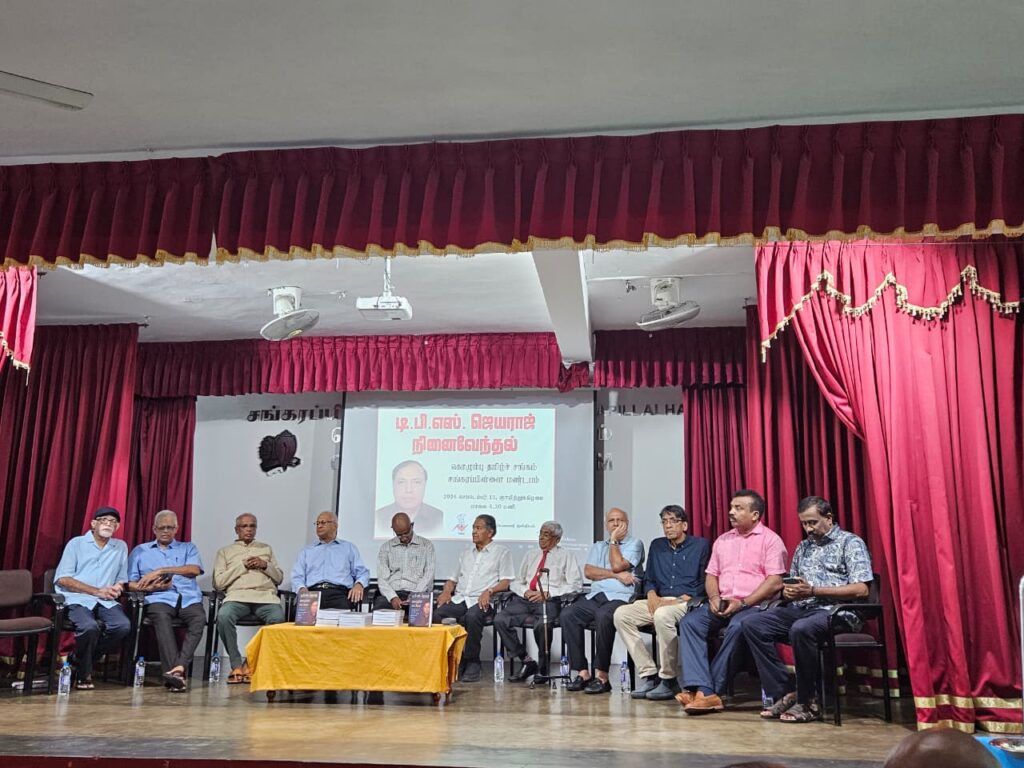
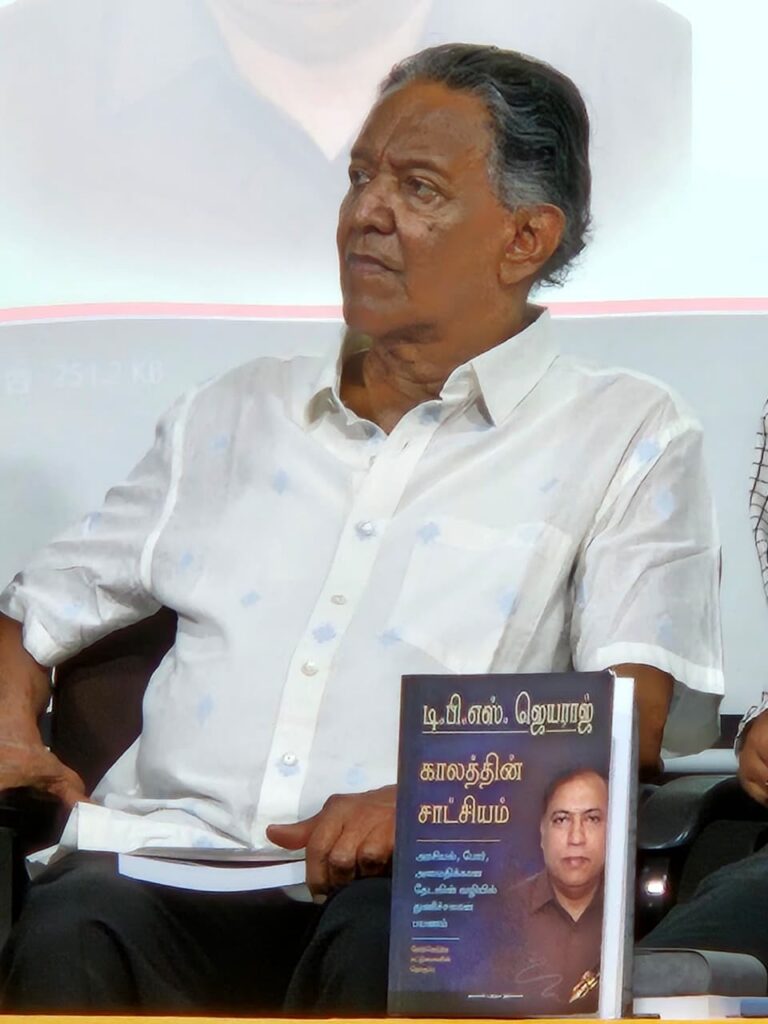
A commemorative book launch was organized by the Sri Lanka Tamil Media Alliance which was chaired by senior journalist Ananth Palakidnar and graced by dignitaries including Kumar Nadesan, K. Kanag-Isvaran, M.A. Sumanthiran, Rauff Hakeem, Mano Ganesan, Jehan Perera and Vijitha Yapa. Image by Dilrukshi Handunnetti.
On Sept. 12, his family, friends and fellow journalists gathered at the Tamil Sangam to remember the man behind the byline and to launch a collection of his work in Tamil. The gathering became not simply a commemoration, but a reflection on what made DBS difficult to replace — his pursuit of truth, his extraordinary memory for detail, his independence and his determination to make Sri Lanka’s different communities see one another.
‘He tried to keep truth alive’
For parliamentarian Mathiaparanan Abraham Sumanthiran, DBS was more than a respected journalist. He was “Rajan anna,” a second cousin whose family connection stretched back generations. Sumanthiran’s paternal grandmother and Jeyaraj’s maternal grandmother were sisters.
He first met DBS as a child, sometime in the late 1970s, when his father took him to visit Jeyaraj at a room on W.A. Silva Mawatha after a haircut.
DBS was exactly 10 years older than Sumanthiran. In the years that followed, Sumanthiran began reading his work in Virakesari and later followed his journalism in the English-language press.
Among DBS’s most significant contributions, Sumanthiran recalled, was his reporting during Sri Lanka’s long civil war, including his Behind the Cadjan Curtains column in The Island.
He was a journalist working through years in which truth was often one of the first casualties of conflict.
“He tried to keep truth alive, valiantly fought to keep truth alive,” Sumanthiran said.
What set DBS apart, he said, was his almost obsessive attention to detail. His accounts could contain the movements of military units, precise timings of events and extensive background on the people involved.
“He had multiple sources that he checked. Always checked, and had to be accurate,” Sumanthiran said.
That same care extended to names and family histories. Even when someone appeared only incidentally in a story, DBS would often establish who that person was, where they came from and how they were connected to others.
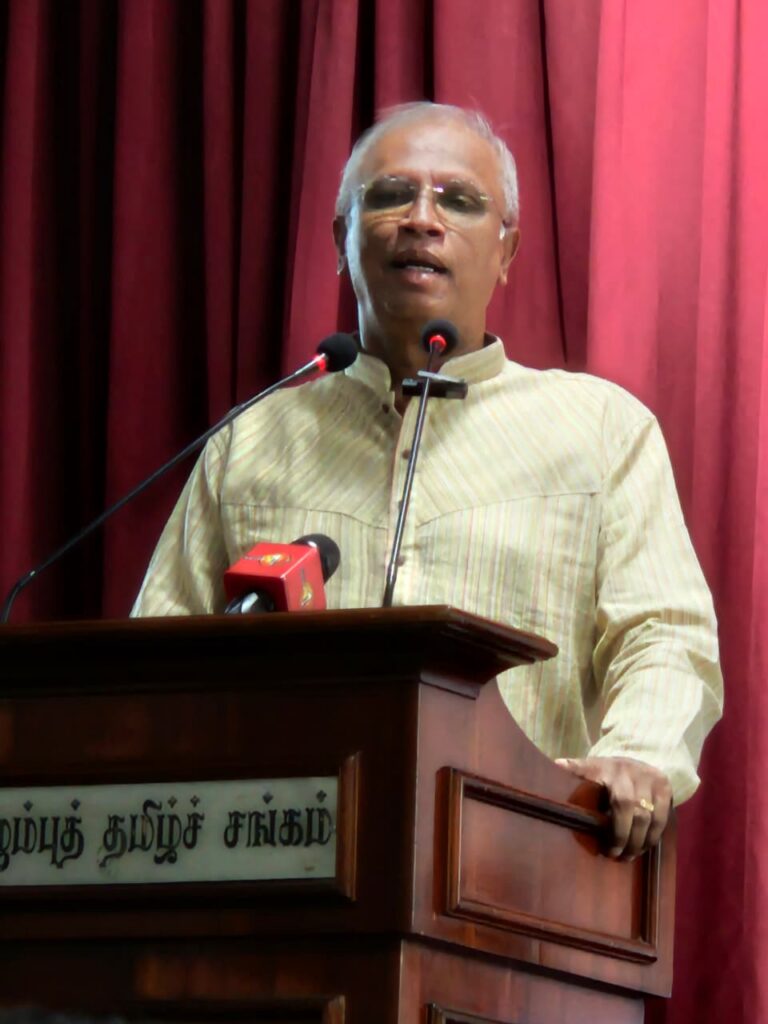
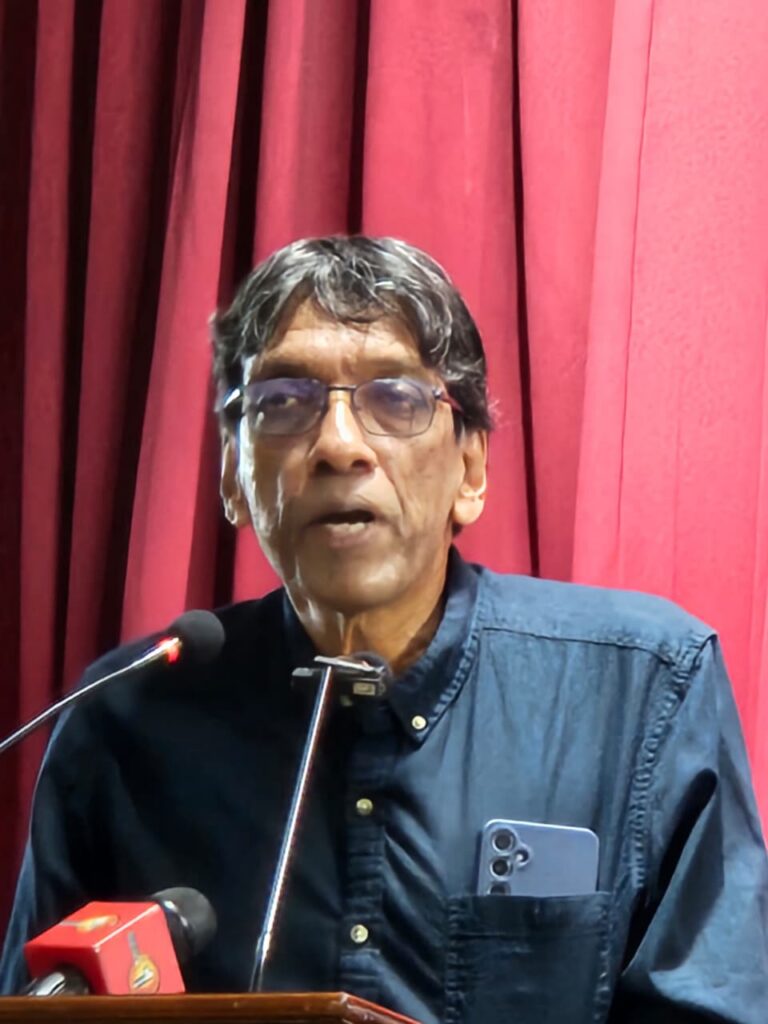
Mathiaparanana Sumanthiran said DBS was a journalist working through years in which truth was often one of the first casualties of conflict. Image by Dilrukshi Handunnetti.
Those details, Sumanthiran said, gave his larger stories credibility.
“Those who knew all the other details, the unrelated details, would immediately know, well, he’s got all that right. So, the story also must be right,” he said.
His commitment to truth was not confined to professional life.
When Sumanthiran entered politics, DBS initially tried to persuade him not to do so. He spent hours warning him about the consequences.
“We have a family tradition of telling the truth,” DBS told him. “I suspect you may also suffer from that, and you’ll be hunted down for that.”
Sumanthiran said DBS was not entirely wrong.
He also remembered a more painful conversation, when DBS spoke about being branded a “traitor” to the Tamil cause.
“He said, ‘I was nothing of that sort. But that’s how I have been painted.’ And that hurt him the most,” Sumanthiran recalled.
Yet the hostility did not persuade DBS to abandon the principles that guided his journalism.
There was a personal price for those principles. Sumanthiran recalled DBS’s arrest in October 1987 after he published a detailed interview with Gopalaswamy Mahendraraja, known as Mahattaya, then a deputy leader of the LTTE. DBS refused to reveal information about his source.
Sumanthiran also recalled DBS’s gratitude to N. Ram, the former editor of The Hindu, who flew from Chennai to Colombo and intervened with the highest echelons of the government on his behalf.
The episode illustrated the professional respect DBS commanded beyond Sri Lanka.
Even people who disliked him, or who had been angered by what he exposed, would return to his writing when they wanted to know what had actually happened.
Kumar Nadesan, managing director of Express Newspapers Ceylon Limited. Image by Dilrukshi Handunnetti.
“I came across a number of people who hated him — hated him for the things that he exposed. But when they really wanted to know what actually had happened and what the truth was, they went to his column,” Sumanthiran said.
“That’s a true mark of an honest journalist.”
His interests extended well beyond politics and the civil war. DBS wrote about prominent personalities and developed a deep interest in Tamil cinema, its actors, singers, films and music.
For Sumanthiran, that body of work deserves to be preserved alongside his political journalism.
“There will be no other DBS,” he said.
“He reached those heights of what a journalist should be.”
Sumanthiran also paid tribute to those who had worked to preserve DBS Jeyaraj’s journalism, including those behind the commemorative event and the publication of the Tamil collection.
‘DBS was a mentor to me’
For National Peace Council chair Jehan Perera, DBS was not simply a columnist or political analyst. He was a journalist whose work helped readers understand Sri Lanka’s conflicts from multiple perspectives — and, for Perera personally, a mentor whose example shaped his understanding of journalism.
“It is indeed fitting that we remember him, DBS, if I can call him, and most of us call him, through his writings,” Perera said at the commemoration.
DBS was primarily a columnist, Perera recalled, and his articles were often among the first he read when they appeared in newspapers.
But the columns were distinctive because the commentary was grounded in reporting.
DBS was a mentor to me and mentors are not necessarily people who formally teach us or with whom we have close personal relationships, Jehan Perera of the National Peace Council said. Image by Dilrukshi Handunnetti.
DBS drew on first-hand accounts from people he spoke to, as well as information he uncovered himself. His work was therefore not simply opinion or analysis. It was rooted in events on the ground, particularly in the Northeast and among people directly affected by Sri Lanka’s ethnic conflict.
That grounding allowed him to continue writing about Sri Lanka from Canada without losing touch with developments at home.
“I trusted his writing,” Perera said. “I felt that he tried to give a balanced account, bringing in different points of view, including views that were opposed to his own.”
That balance mattered in a country where political writing, particularly on the ethnic and national conflict, was often shaped by deep divisions.
DBS occupied a distinctive position: a Tamil journalist writing about the North and the Tamil national question for the mainstream English-language press. His readership extended well beyond the Tamil community, bringing perspectives that might otherwise have remained confined to particular communities into the wider national conversation.
For Perera, this was among DBS’s most important contributions.
Sri Lanka’s communities can exist in separate “silos,” he said, with limited understanding of one another’s histories, fears and political aspirations. Jeyaraj’s journalism created a space in which readers from different communities could encounter those perspectives, even when they disagreed with them.
But Perera cautioned against reducing DBS’s contribution simply to his identity as a Tamil journalist.
“His writings mattered because they addressed the country as a whole,” he said. “The experiences of one community are not less important than those of another. But neither are they more important simply because they belong to that community.”
President counsel K. Kanag-Isvaran. Image by Dilrukshi Handunnetti.
Drawing on his extensive knowledge of history, he recognized that each side had its own experiences, fears and perceptions of threats. The conflict, Perera said, could not be understood through a single narrative, nor could a lasting solution be imposed unilaterally by one community on another.
“A journalist who understands this complexity needs to do more than simply take sides,” Perera said. “He or she must help readers understand why the conflict has endured, why trust has been so difficult to establish, and why lasting peace requires more than one dominant story.”
Seeing Sri Lanka beyond its politicians
Perera also recalled an interview DBS gave after returning to Sri Lanka on April 23, 2013, following 25 years away.
“During that visit, DBS said he had deliberately stayed away from politics so he could experience the country as an ordinary person rather than through politicians and political associates.
What struck him was the resilience and tenacity of people who had lived through decades of conflict and were trying to rebuild their lives.”
He also saw a disconnect between the needs of ordinary people and those of the political class — a disconnect that Perera said became particularly visible during Sri Lanka’s 2022 crisis.
For Perera, that observation pointed to another responsibility of journalism: remembering that a country is more than its governments, political parties and conflicts. It is also made up of people, their struggles, their pragmatism and their efforts to build better lives.
DBS also offered journalists working in Sri Lanka a simple but powerful piece of advice. External pressures, he acknowledged, could prevent journalists from writing everything they wanted to write. But those pressures should never force them to write something they did not want to write.
SLMC Leader Rauff Hakeem and parliamentarian Mano Ganesan also shared their memories and thoughts on DBS. Images by Dilrukshi Handunnetti.
Perera described that as a powerful statement of journalistic independence — an acknowledgment of the pressures journalists face without allowing those pressures to become an excuse for surrendering integrity.
“For all these reasons, I consider DBS to have been a mentor of mine,” Perera said. “I never said so to him.”
Mentors, Perera noted, are not necessarily people who formally teach us or with whom we have close personal relationships. Sometimes they are people whose work we follow, whose judgment we respect and whose example shapes what we aspire to become.
“DBS was such a person to me,” he said.
As DBS Jeyaraj’s writings are collected and published, his legacy is becoming more than an archive of Sri Lanka’s turbulent past.
It is also a record of a way of doing journalism — rigorous, deeply reported, independent and willing to look beyond the dominant narrative.
The event was organized by the Sri Lanka Tamil Media Alliance. Kumar Nadesan, managing director of Express Newspapers Ceylon Limited, and K. Kanag-Isvaran, president’s counsel, attended the event. Vijitha Yapa, founding editor of The Island and The Sunday Times, Rauff Hakeem, leader of the Sri Lanka Muslim Congress, and Parliamentarian Mano Ganesan also shared their memories of DBS.
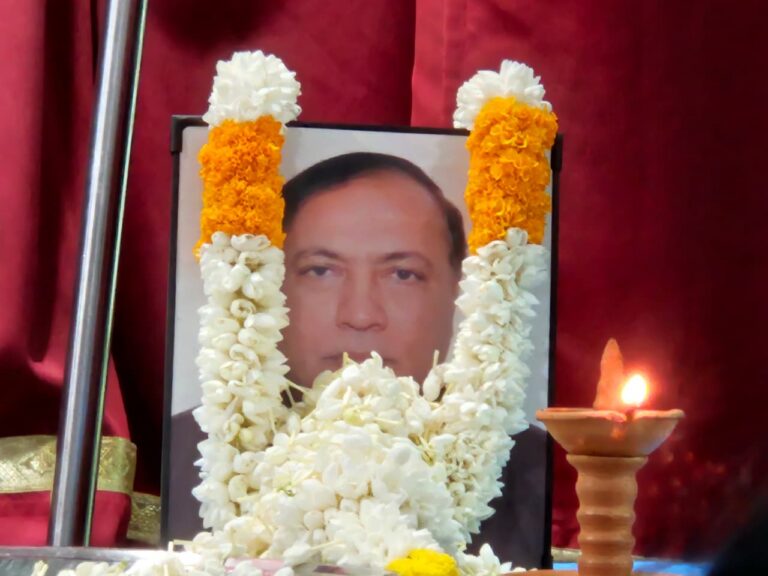
Banner Image: A floral tribute was paid to the portrait of DBS Jeyaraj by Kumar Nadesan, managing director of Express Newspapers Ltd and other dignitaries at the Tamil Sangam during the commemorative book launch. Image by Dilrukshi Handunnetti.
This was written and edited by Gagani Weerakoon. She leads the editorial at the Center for Investigative Reporting (CIR).
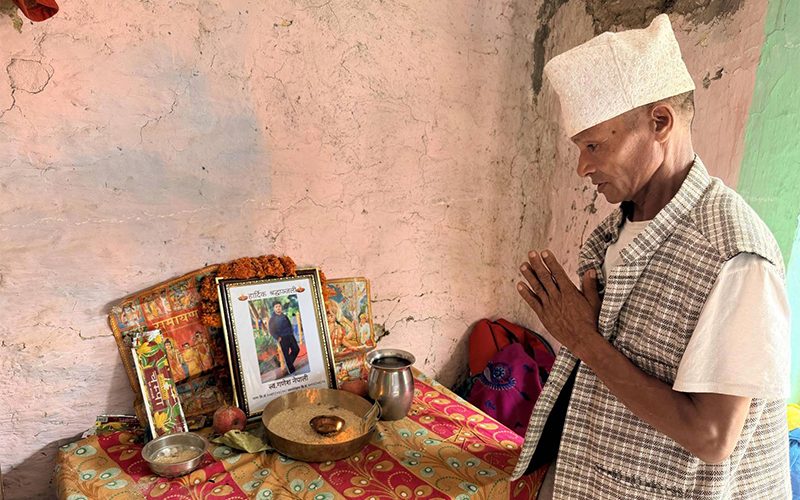
On Sept.7, Nepali families performed the13th day funeral ituals without knowing what became of their loved ones, missing since flash floods.
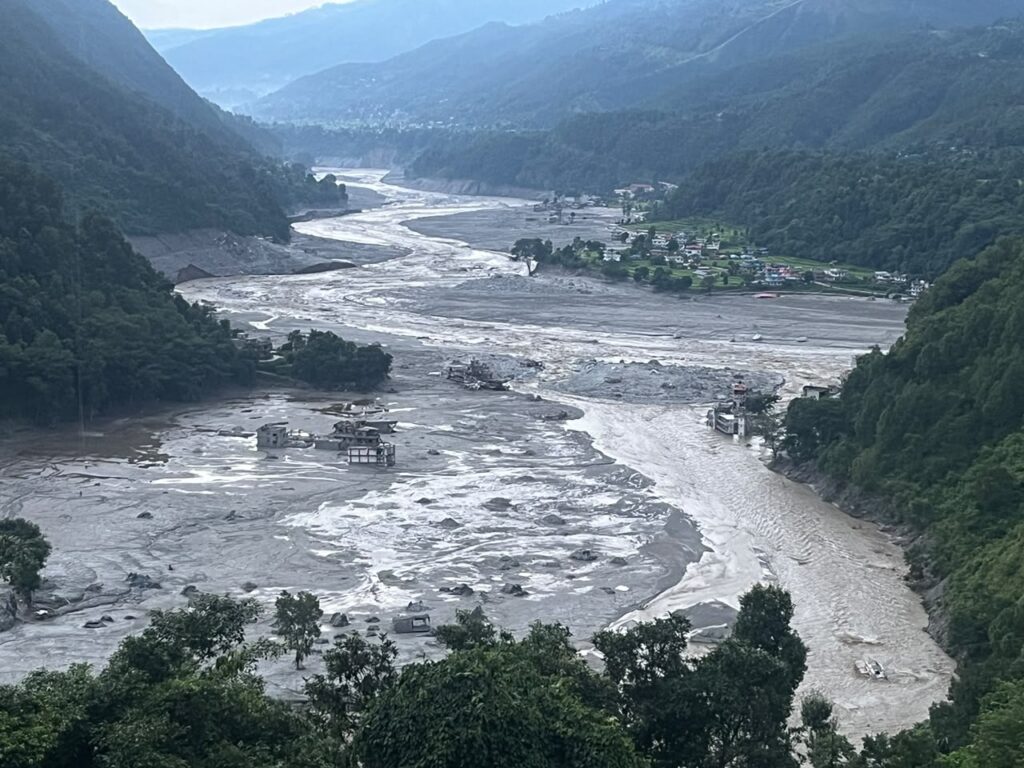
On Aug. 26, a sudden section collapse of a mountain glacier named Langtang Lirung triggered a 5.2 magnitude seismic tremor and sent a catastrophic wall of water, mud, and rocks downstream, resulting in at least1,300 reported deaths with thousands missing.
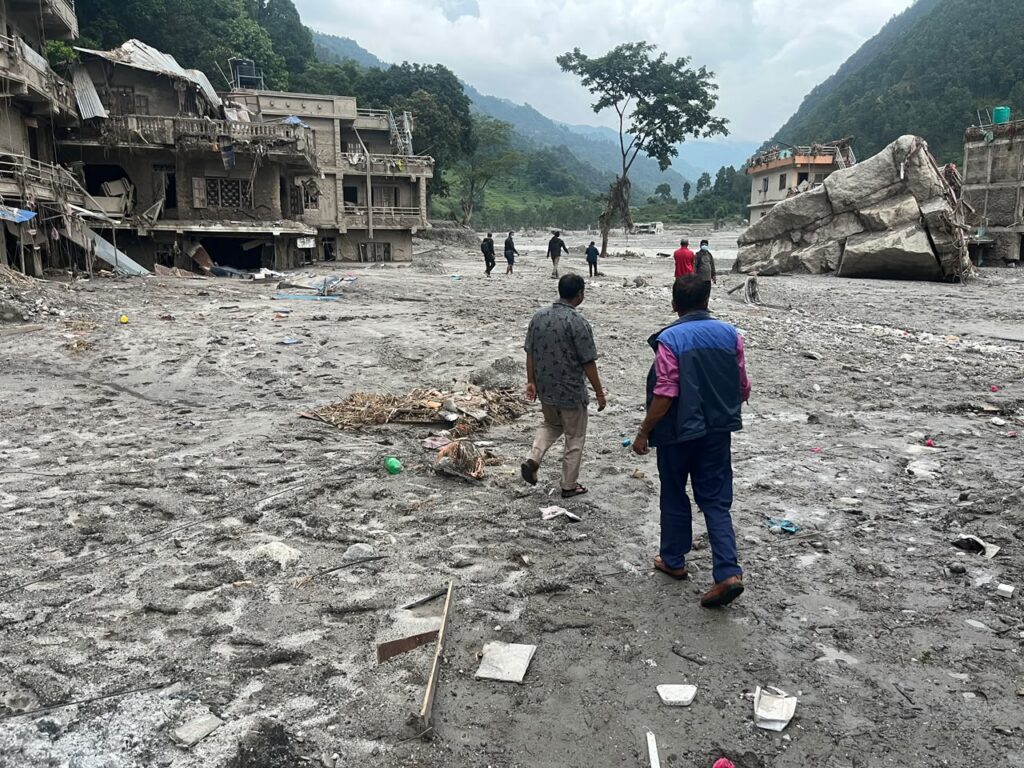
Considered one of the biggest natural disasters to have occurred in Nepal, the flooding caused widespread destruction of bridges, roadways, and hydropower projects, making relief efforts highly challenging.
With Nepal’s Rasuwa, Nuwakot, Dhading, Gorkha, and Chitwan districts alongside the Tibetan border devastated, the resettlement and rebuilding may take years, according to relief workers.
COLOMBO — For Bishwash Nepali, the Aug. 26 flash floods in Nepal’s Rasuwa district were not a disaster he could watch from afar. His home village is about 10 minutes from the river. The people he was helping were his neighbors, friends, relatives and members of his own community. Six of his relatives were among those lost.
Nepali, a civil rights activist, was in Kathmandu when the floods struck, staying with his hospitalized brother. With roads into Rasuwa destroyed, he could not return immediately. Two days later, he found an alternative route and made his way home.
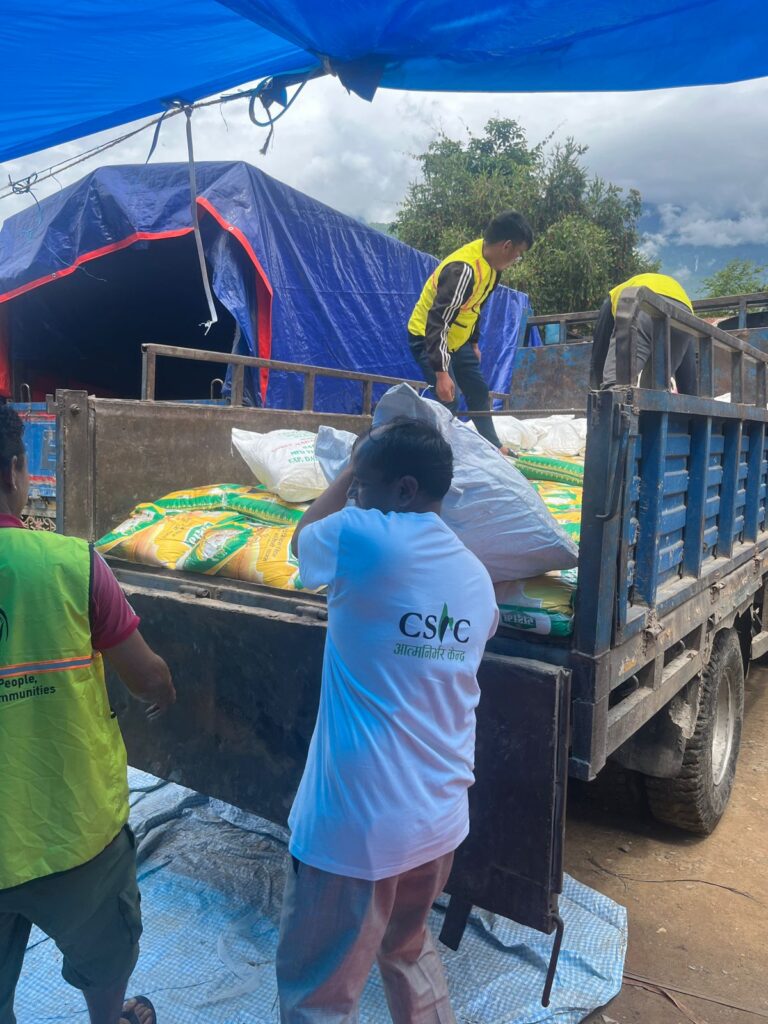
Since then, he has helped collect and distribute relief, coordinate with local authorities and volunteers, and support displaced families in holding centers.
Two weeks on, the relief worker says the emergency is far from over. People are still missing, bodies remain unidentified and survivors are beginning to face another crisis: finding somewhere safe to rebuild their lives.
In a telephone conversation with CIR’s Gagani Weerakoon, Nepali shared his firsthand account of the disaster and its aftermath.
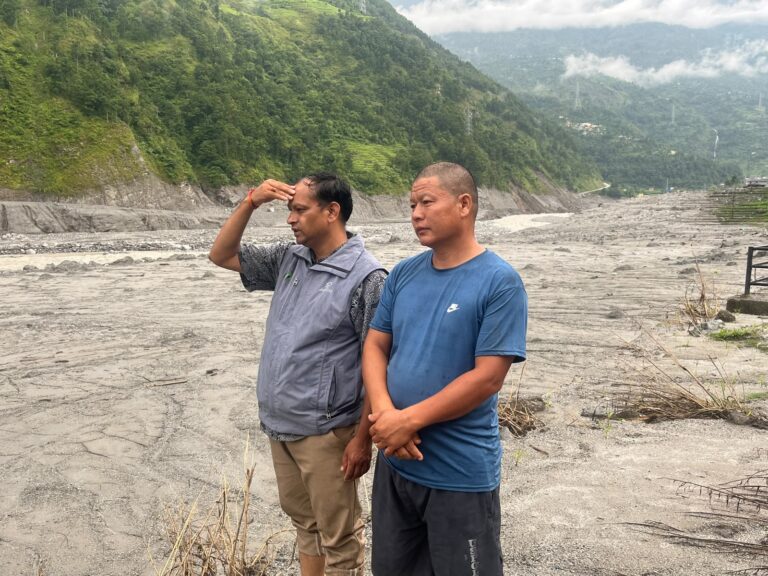
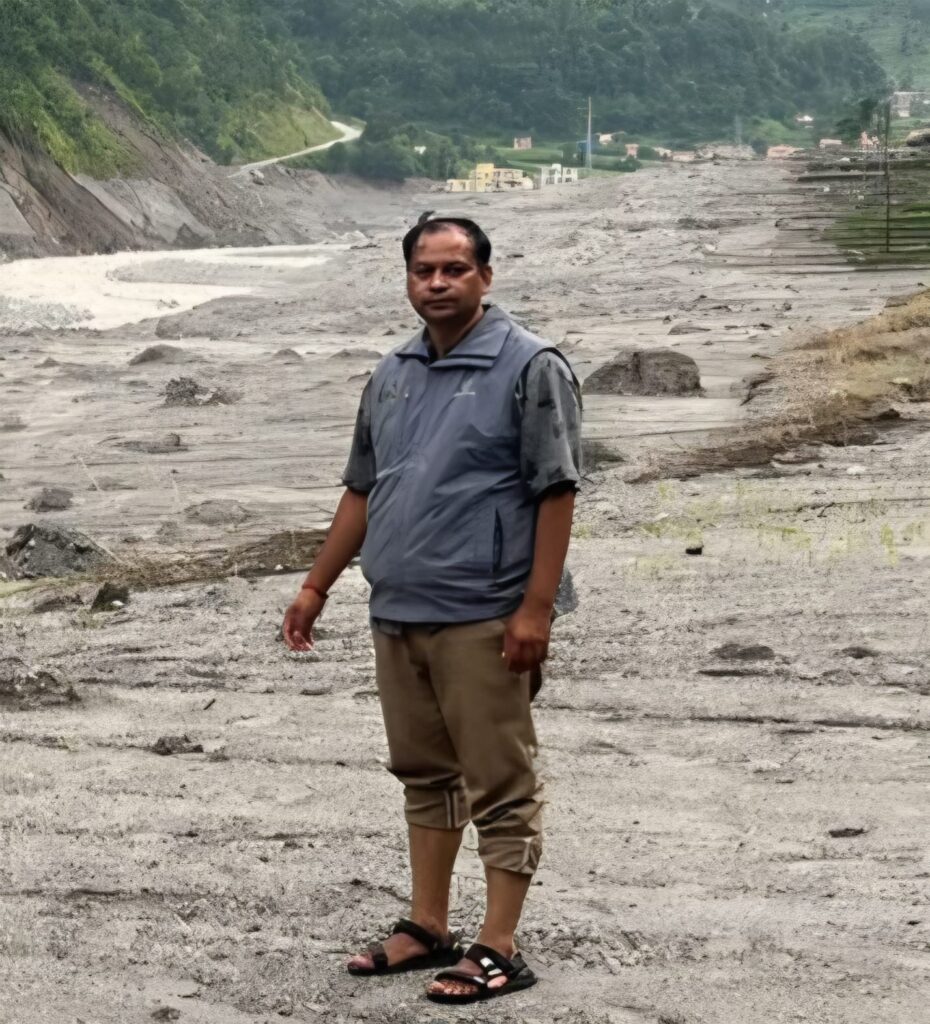
Bishwash Nepali who engages in relief and rescue operation stares at the completely devastated neighborhood while working tirelessly for more than 12 hours in the past 14 days. Image courtesy of Bishwash Nepali.
‘The situation still critical’
I am trying to do what I can to support people affected by the recent floods in Nepal. The situation is still critical. Search and rescue operations are continuing, and many people are still missing.
Local government authorities are managing holding centers for displaced people. Some families are staying with relatives, while others remain in temporary shelters. The government and other organizations are providing relief, but collection and distribution are still continuing, 14 days after the disaster.
On Sept. 7, many families carried out funeral rituals according to Nepali tradition. Families traditionally observe the 13th day after a death. But in this case, many people are still missing, so families performed these rituals without knowing what had actually happened to some of their loved ones.
The government also declared Sept. 7 a day of condolence for those who died or went missing.
Many places remain disconnected. Roads and bridges have been destroyed, and some rural areas still have no electricity, mobile networks or internet access.
Some areas have received limited relief by helicopter, but there are still places where government and organizational support have not reached. Many injured people remain in hospitals.
‘My own are gone’
I was in Kathmandu when the flood happened. My brother was in the hospital, and I was with him.
I wanted to come to Rasuwa on the first day, but there was no road access. The roads had been blocked or destroyed by the flood. After two days, I reached the area through an alternative route using a gravel road.
From then on, I got involved in collecting and distributing relief and supporting the local government and affected communities.
The river is only about 10 minutes from my home. My village is on the opposite side of the bazaar and slightly elevated from the riverbank.
When I returned to Rasuwa, I coordinated with the local government, my organization, our team and other volunteers. We mobilized support from organizations and individuals to collect relief materials.
We centralized the relief and distributed it to victims and affected communities based on decisions made by local authorities and political parties.
We also supported holding centers with management and counseling. Almost everyone there has been affected in some way. Many are missing family members or have been displaced.
I know many of these people personally. They are my neighbors, villagers and people from my district.
This disaster also affected me personally. I lost six members of my family — my uncle’s son, other relatives, a classmate, friends and villagers. We lost many people we knew.
I am still helping families with relief distribution. We started two days after the disaster, and the work is continuing.
Trishuli river flows calmly after a week of devastating floods that killed at least over 1300 people with scores still missing. Image courtesy of Bishwas Nepali.
‘Younger generation badly hit’
I work with the Community Self-Reliance Centre, a national NGO that works on land rights and supports landless people in securing land and housing. We also work with small-scale and older farmers to protect their land and livelihoods.
Through the organization, we are supporting displaced families and communities affected by the flood.
I have contacted other NGOs, INGOs and foundations and asked them to bring relief to rural districts and coordinate distributions.
This flood has affected everyone, but many of the victims are from Indigenous communities living along the river and near the China border.
Women, children, men and older people have died or gone missing. Families have lost parents, children, relatives and household breadwinners.
In areas such as Timure and Rasuwagadhi, many business owners, entrepreneurs and young people are missing. Tech workers, including engineers and technicians at hydropower projects, are also among those missing.
The younger generation has been particularly affected. Many young people owned trucks, containers, cars and jeeps and transported goods between China and Nepal. Many are now missing.
‘Khalte lost so many people’
In Uttargaya rural municipality, about 250 households displaced by the 2015 earthquake are still living in temporary shelters in Khalte.
Khalte is close to the Trishuli River. According to community members, more than 1,500 people lived there.
The data is still being collected because families are scattered. But community members say more than 500 people are missing from that one community.
Khalte is home to indigenous Tamang communities, including older people, women and children. Everyone has been affected. Betrawati is another area that was devastated. It is a historic market and important commercial center, with banks, microfinance offices, shops and wholesale businesses.
The entire area was swept away. Businesses were destroyed, property was lost, and people were killed or went missing.
Betrawati also has religious and historical importance, including a pilgrimage site associated with the Hindu tradition. That area was destroyed as well.
We have lost people from every age group. We have lost young technicians, engineers and business owners. Their families have also lost their sources of income.
People have lost their businesses, vehicles, homes and family members.
Local governments have also suffered enormous losses. In Uttargaya and Gosaikunda rural municipalities, government offices were completely destroyed, and some staff and elected representatives are missing.
The torrent surged down the Lhende Khola, spilling powerfully into the Bhote Koshi and Trishuli rivers. Image courtesy of Bishwas Nepali.
‘The toll remains uncertain’
The situation with the dead bodies has not been fully resolved. Search and rescue operations are still continuing.
Thousands of people have reportedly been missing, and hundreds of bodies have been recovered. But identifying them is a major challenge.
People are missing from the China-Nepal border areas, while bodies have been found far downstream, including near the Indian border.
In Chitwan and Nawalpur, police and health officials are struggling to manage and identify the bodies.
For families, identifying the dead and establishing their identities is extremely important. But people have been swept so far from where they disappeared that identification has become very difficult.
Relief workers have to overcome multiple challenges to bring essentials to flood-affected areas. Image courtesy of Bishwas Nepali.
‘Where can people live?’
The people who survived have lost their homes, land, relatives and family members. Now they face another enormous problem: rebuilding their lives.
In Rasuwa, there is very little land available to resettle displaced families. It is a mountainous district with steep terrain, so finding safe land is difficult.
The government also does not have enough land or funds to relocate everyone.
This disaster is different from an earthquake. People have not simply lost their houses. Many have lost the land itself. They have lost their property and almost everything they owned.
The biggest question is how to resettle them.
Our government policy on resettlement is weak. Land prices are rising because so little land is available, while government subsidies are limited.
I saw this problem after the 2015 earthquake. I was involved in reconstruction and recovery work for earthquake victims in Rasuwa, Nuwakot and other districts. It took five to six years for many people to be resettled because of difficulties finding land and the long process of receiving government subsidies and support.
That is why I am very worried now.
This time, some of the land itself has been destroyed by the flood.
People will have to move to safer areas, but there is very little land available. Much of it is privately owned, and owners are asking for compensation. The government will have to negotiate land acquisition, and that will take time.
At the same time, affected families have no money because they have lost everything.
They are in a very critical situation and need support from the government and other organizations.
They need safe land. They need money to rent land and build temporary shelters. They need livelihood support. They need almost everything.
Walking among the ruins after the devastating flashfloods. Image courtesy of Bishwas Nepali.
‘This will not be solved quickly’
It will take time.
Our government and political situation is not very stable. There are communities that have been waiting for relocation support for more than 10 years after the earthquake.
The government still has not properly supported some of those communities.
That is why I am worried about the flood-affected families. I do not think it will be possible to relocate and resettle them quickly.
They will need support not only from the government but also from NGOs and other organizations.
The immediate relief effort is still necessary, but we also have to think about what happens afterward.
People have lost their homes. They have lost their land. They have lost family members. They have lost their businesses and livelihoods.
The question now is not only how we rescue those who are still missing. It is how we help the people who survived build a life again.
And that will take much longer.
Banner Image: Bishwash Nepali who engages in relief and rescue operation stares at the completely devastated neighborhood while working tirelessly for more than 12 hours in the past 14 days. Image courtesy of Bishwash Nepali.
This story was produced with support from Report for the World, a global media service strengthening local independent journalism.
When historians look back on the wars of the 2020s, they may be struck by two things.
The first is that vast wells of content that traditionally helped such historians report on wars are completely missing. The modern equivalent of the diaries of the Great War? WhatsApp messages long deleted. The comparable typed-up Situation Reports — if they survived being destroyed — once found in the Vietnam War? Vanished on corroded servers. Immense tracts of digital data might be lost to time.
The second insight might be a struggle to locate the frontline of the fighting. Was it where civilians were most harmed? Was it the headquarters of a drone squadron? Was it on the servers of some tech giant? The physical geography of modern armed conflict, once defined by that thin red line of battle, has extended and extended, so that the operational frontline is harder and harder to place. A complex map of the digital battlefield would emerge, that would include satellite constellations, cloud contracts, server archives, and arms and tech supply chains.
The true nature of modern war is not found in the images that we see on our smartphone screens: the shattered apartment block, the mass grave, the cries of mothers at a black-bowed funeral procession. As the author CS Lewis once noted, these are its final results. The violence begins elsewhere. It is conceived, authorized, financed, coded, and contracted in conference rooms, data centers, and technology offices. It advances through procurement frameworks, cloud-service agreements, venture-capital investments and software updates. Decisions to purchase such technology are moved, seconded, approved and minuted long before a missile strikes its target.
The reporter’s task, therefore, is not simply to document the result of violence, but to reconstruct the process that produced it. The battlefield today extends far beyond the shell-holes of impact. It runs through bureaucracies, corporations, tech-hubs and financial institutions. The explosion might be the final expression of a line of decisions, relationships and incentives that began long before any weapon was launched. To understand modern conflict — more than ever — has to be to trace that chain backwards, from harm to system, from incident to infrastructure, from death to the details of a technological machinery that made it possible.
It is this labor that forms the main focus of this guide: how to investigate a contemporary conflict that increasingly operates through a blurred space between military and civilian systems, where cloud platforms, surveillance networks, AI models and commercial infrastructure have become embedded within warfare itself. It means tracing the chain from battlefield harm back through the systems that enabled it.
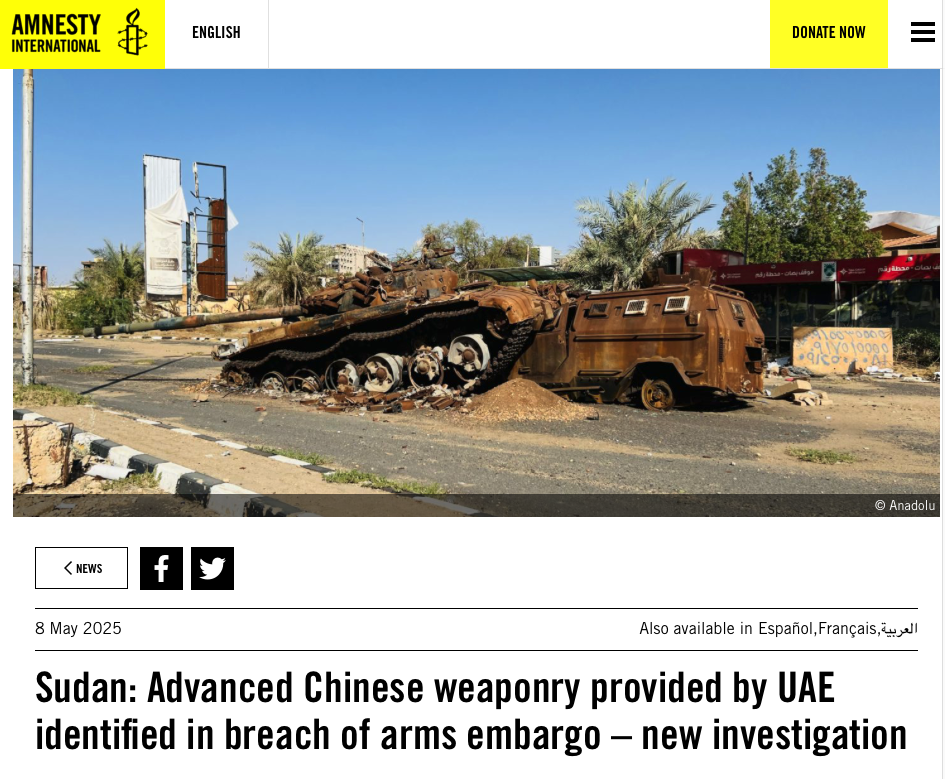
An Amnesty International investigation into Sudan, for example, used analysis of bomb fragments to identify Chinese-made guided munitions that it concluded had almost certainly been re-exported by the United Arab Emirates to the Rapid Support Forces in breach of the UN arms embargo. Equally, investigations into the war in Gaza have examined how commercial AI platforms and data services supplied by companies such as Palantir have become embedded within military targeting systems, raising profound questions about corporate responsibility for civilian harm.
The challenge, of course, is for journalists to be able to track lines of responsibility that are fragmented across states, companies, supply chains, and technical architectures in ways that make accountability far harder to establish.
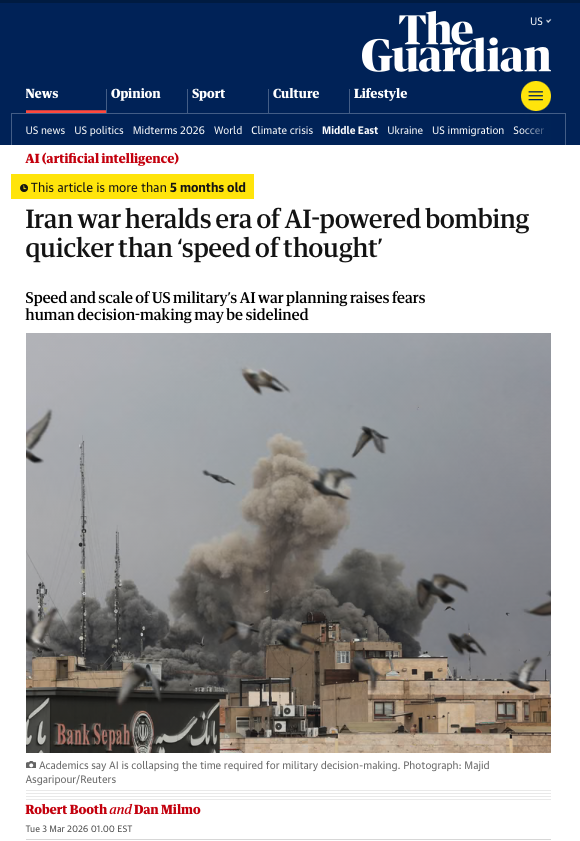
The question for reporters is no longer whether militaries are using AI systems. It is, rather, in what ways have these systems become part of a killing machine?
Needless to say, the urgency of doing this is acute, because the pace of digital development has been startling. By early 2025, the Royal United Services Institute, a London military think tank, estimated that drones accounted for 60-70% of damaged or destroyed Russian military equipment in Ukraine. It was a figure that would have seemed fantastical a decade ago. By 2026, the military-tech nexus had become so distinct that, in the US-Iran war, Iran deliberately targeted the global delivery service Amazon’s data centers in the UAE and Bahrain.
Digital is no longer seen as assistance to fighting; it is deemed integral to its waging.
As we see a shift towards the digital battlefield, so too have human rights concerns risen. The International Committee of the Red Cross (ICRC) has urged states to keep AI in conflict firmly subordinate to human judgment. It’s a battle towards moderation that, to be frank, is not really working. Goodwill United Nations talks toward a binding instrument on lethal autonomous weapons have so far stalled. And it’s not controversial to say that international regulation is lagging behind the realities of modern conflict.
It is into this gap that journalism must now step.
So, the question for reporters is no longer whether militaries are using AI systems. It is, rather, in what ways have these systems become part of a killing machine? Who sells them? What profits are made from them? Where does the targeting data come from? How much control do humans have in practice? What happens when systems of civilian protection fail (or don’t exist in the first place)?
An Amnesty International investigation into Sudan used analysis of bomb fragments to identify Chinese-made guided munitions that it concluded had almost certainly been re-exported by the United Arab Emirates to the Rapid Support Forces in breach of the UN arms embargo. Image: Screenshot, Amnesty International/ GIJN
From Military-Industrial to Military-Tech Complex
To arrive at a deeper understanding of what the new digital battlefield looks like, perhaps we first have to accept that the phrase “the military-industrial complex” is some 60 years old and a bit threadbare. Contemporary warfare is organized not just around a clutch of arms manufacturers; instead, a wider “military-tech” complex has grown where cloud infrastructure, AI models, analytics, sensors and communication systems enable war to be planned, fought and — even — narrated.
So, in the West, this system includes the likes of Microsoft, Amazon, Google, Palantir Technologies, Anduril Industries, OpenAI, and Anthropic (despite controversies involving the last). China has developed its own “military-civil fusion,” with firms like Huawei, Tencent, and SenseTime being deeply embedded in their military might. While Russia relies on a more state-directed nexus centered on Rostec, Yandex, and a host of cyber, drone, and dual-use suppliers that operate within and beyond the sanctions regimes facing the Kremlin.
Combined, these firms have evolved into a highly profitable tech-arms race, where artificial intelligence, autonomous systems, social media platforms and quantum science are reshaping remote warfare from the inside, as well as changing how it is viewed from the outside.
The money involved is eye-watering. In its 2027 budget, the Pentagon requested more than US$54 billion to fund the Defense Autonomous Warfare Group, including “autonomous and remotely operated systems across air, land, and above and below the sea.” This was a 24,000% increase on 2025. In May 2026, it was reported that Helsing, the German defense technology group was on track to raise funding of about US$18 billion, making it one of Europe’s most valuable start-ups.
The rise of these digital behemoths is causing a power shift. Yes, states still command, but capability (surveillance, communication, automated decisions) are increasingly exercised by firms whose customers and staff are still largely civilian, and such civilian platforms are being weaponized. An Associated Press investigation into commercial AI use in Gaza and Lebanon documented a wartime surge in the use of off-the-shelf models for transcription, translation, and search across intelligence stores. The research claims that AI models (in this case, from Microsoft) primarily made for civilian use were allegedly extensively used for military purposes. Microsoft didn’t respond to the AP journalists for this story.
An Associated Press investigation into commercial AI use by Israel in Gaza and Lebanon documented a wartime surge in the use of off-the-shelf models for transcription, translation, and search across intelligence stores. The research claims that AI models (in this case, from Microsoft) primarily made for civilian use were allegedly extensively used for military purposes. Image: Screenshot, Associated Press/ GIJN
A different joint investigation by the Guardian, +972 Magazine, and Local Call also reported that audio files of millions of Palestinian phone calls had been stored on a Microsoft/Azure platform and from there had been used to plan airstrikes and arrests. Microsoft has since said it has blocked certain Israeli uses of its technology, but the harm has been done, and the precedent struck.
It’s not some murky, unethical, unheard-of company crossing a moral line in assisting the killings of civilians. Rather, global commercial systems are part of the operational IT infrastructure that enables warfare. The boundary between civilian tech product and military application is thinner than it has ever been.
The idea of dual-use technology makes the picture even murkier. A dual-use item is defined by the US Bureau of Industry and Security as one that has civil application alongside military or weapons-related use. So, for instance, high-performance integrated circuits are dual-use items because they power civilian data centers while also enabling advanced military computing systems. The European Commission’s guidance on cybersurveillance exports warns that items with legitimate civilian functions (for instance, law-enforcement analytics or network monitoring) can be repurposed and, as such, “pose a risk for internal repression or serious violations of human rights and international humanitarian law in the importing country.”
So where to begin investigating? The most useful starting point is to look into two separate things.
Together, these two chains reveal not only how an attack was authorized but also how it became technically possible. Modern investigations increasingly need to examine both.
First, we have the chain of command: who decided that an operation should go ahead? It is a command structure that runs vertically through military officers, lawyers, brigade commanders, and political ministers. At its heart lies, or should lie, rules of engagement, civilian protection mechanisms, and the issue of proportionality in war (for more on legal proportionality and command structures, read GIJN’s War Crimes Reporting Guide). This chain of command, in the end, authorizes the bombs and bullets that lie at the heart of most investigative war reporting. And this chain of command, in theory, should be relatively impervious to the new technology forming around it. But it would be naïve to think that enhanced technologies do not shape kill orders and battlefield tactics. Proving this, however, is a challenge.
Second, there is the chain of systems: journalists should investigate what linkages and digital connections made these targeting decisions possible. This system runs through cloud vendors, telecoms carriers, platform operators, subcontractors, university and corporate research laboratories, data brokers, exporters, logistics firms, and, perhaps most critically, the investors, venture funds, sovereign wealth vehicles, and insurers whose capital made the capability viable in the first place. This chain is far more opaque.
The distinction becomes clearer in practice. Investigations into Israeli military operations in Gaza, for example, have examined both chains simultaneously. The chain of command concerns who authorized particular strikes, how proportionality assessments were conducted and which officers approved targeting decisions. The chain of systems asks a different set of questions: which cloud platforms stored the intelligence, which AI systems helped process it, which companies supplied the software, where the infrastructure was hosted, and who financed or maintained it. Together, these two chains reveal not only how an attack was authorized but also how it became technically possible. Modern investigations increasingly need to examine both.
Pillars of Technological Warfare
To penetrate this opacity, modern conflict can usefully be broken into five pillars of the chain of systems. These are not in chronological order, but they are all interconnected.
Weapons and components
Infrastructure
Information
Surveillance
Automated decision support
As it stands: weapons depend on infrastructure; infrastructure enables information flows; information systems feed surveillance; surveillance shapes targeting; and automated decision systems accelerate how weapons are deployed.
Any deep-dive report into the chain of systems will have to look at several if not all of them.
Weapons and Components
Hardware still matters, and in some ways it is easier to investigate than software. The closer to the more physical hardware, the more obvious the evidence.
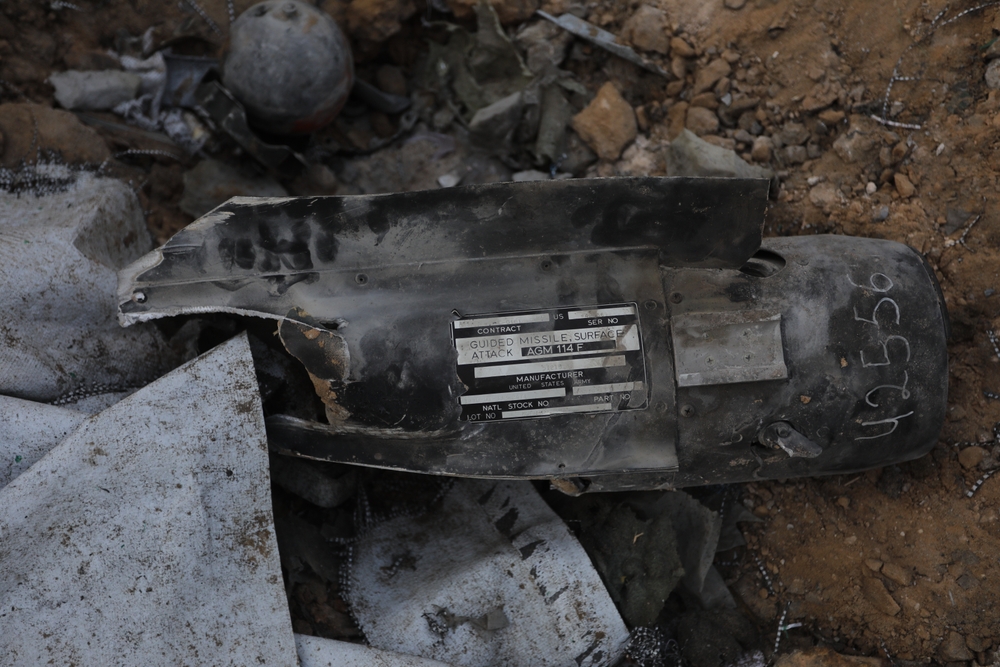
Wreckage, serial numbers, customs codes, tenders, component markings, training artefacts, and manufacturer literature all leave trails that can lead you into a deeper insight into the digital hand of warfare at play. As such, collect or photograph and catalog every serial number, batch code, customs identifier, manufacturer logo, and technical marking that you can find of battlefield remnants at any point of concern (i.e. a bombed school or hospital). These can sometimes be matched to procurement records, customs declarations, shipping manifests, patents, and export licenses.
A US-manufactured AGM-114 Hellfire missile fragment showing the marking plate and serial number at a crater site in Gaza. Image: Shutterstock / Anas Mohammed/ GIJN
Ask five questions of every component: who made it, who sold it, who shipped it, who paid for it, and who authorized its export?
Shipping and supply chain databases such as ImportYeti, Panjiva, ImportGenius, and commercial maritime tracking platforms might throw you a lead in terms of naming digital suppliers, intermediaries, and software support systems.
Meanwhile, manufacturers themselves are often among the best sources. Defence companies routinely publish product brochures, investor presentations, annual reports, exhibition catalogues, technical specifications, and press releases that identify where systems have been tested, demonstrated, or sold.
If you can, go to a weapons fair, such as the Paris Air Show, DSEI, and Farnborough International Airshow, and take a big bag. There you can get access to catalogs, promotional materials, and even contract announcements that might be difficult, if not impossible, to find elsewhere or online. Also, if you can’t locate what you are looking for, remember that archive services such as the Internet Archive’s Wayback Machine can recover deleted marketing claims and product information.
An example of a story that took a photograph from a missile strike and led it back to its origin is this 2026 Action on Armed Violence investigation, by this author, where the Tomahawk missile that attacked the girls’ school in Minab, Iran, consisted of digital components that could be traced back to UK-based manufacturers. For more on arms trade, read this chapter in GIJN’s War Crimes guide.
Data centers are new targets in warfare, sometimes with strange but meaningful consequences.
They are also — increasingly — the targets of war. Attacks on systems of communication are increasing, for instance. Indeed Access Now’s #KeepItOn coalition sees internet shutdowns as causing specific human-rights harm that enable “covering up atrocities during conflict, quelling protests or gagging citizens during important national events like elections.” Its Shutdown Tracker Optimization Project has documented hundreds of shutdowns globally, many coinciding with grave abuses.
Increasingly, complicity in digital infrastructure shutdowns can be found in current wars. This 2025 Reuters investigation found that Elon Musk personally ordered SpaceX engineers to shut down Starlink coverage during Ukraine’s 2022 Kherson counteroffensive, causing battlefield communications failures that disrupted Ukrainian operations and triggered panic. Musk didn’t respond to requests from Reuters for comments, though he wrote on X that “we would never do such a thing.” In Gaza and beyond, as reported by Al Jazeera in 2023, civilian digital infrastructure was also deliberately targeted by Israeli forces, attacking telecommunication towers of Palestinian companies like Jawwal and Paltel. Additional examples include the cable cut in the Red Sea and the Russian cyberattack on Ukraine’s largest telecom operator and its Ministry of Justice.
Another critical element of digital infrastructure is data. As the Center for Strategic and International Studies has it: Data Is Now the Front Line of Warfare. This report shows how data centers are new targets in warfare, sometimes with strange but meaningful consequences. As the Jerusalem Post reported in 2026, the strike hitting the data center of the Iranian bank disrupted the payment of salaries to the Iranian military.
Again ask questions. Which state agency requested it? Was the law broken? What was the real price paid by civilians (from disrupted medical services, to interrupted emergency communications, to blocked humanitarian coordination, to families unable to locate displaced relatives)? Who owns the data pipes, satellites, or infrastructure elements? And which pieces of private infrastructure have become militarily indispensable?
Perhaps take time to read Reuters’ investigation US and China Wage War Beneath the Waves, which traced how governments and technology companies compete for control of undersea internet cables. What you are really reading is how ostensibly private infrastructure has become a strategic asset at the heart of modern geopolitical conflict. And, if you are interested in the intersection of conflict and space, then in his book “The Future of Geography,” Tim Marshall explores the emerging field of “astropolitics,” arguing that humanity has entered a second space race in which control of orbital space, lunar territory, and extraterrestrial resources will become increasingly important determinants of geopolitical power. It’s a good read.
And if it sounds like science fiction, secret Russian and Chinese military documents exposed by The Insider revealed that Moscow and Beijing have developed a far deeper defense partnership than previously known, including plans to disrupt or destroy Starlink, jointly develop advanced air and missile defence systems, and exchange Russian battlefield experience in Ukraine for Chinese technology and manufacturing capacity. Star Wars may be closer than we think.
This Reuters’ investigation traced how the US and Chinese governments and technology companies compete for control of undersea internet cables. Image: Screenshot, Reuters/ GIJN
Information: the Participatory Battlespace
As Francis Bacon first conceived more than four centuries ago, “knowledge is power,” a maxim that has become ever relevant in an age where information itself is a strategic asset. War is being witnessed, captured, relayed, and consumed in real time in ways that mankind has never seen before.
The growth of social media is at the center of this. Scholars writing on the military-social media complex describe a new ecology where “the distinctions of combatant, civilian, and informational warrior implode.” Where opposing groups upload material minute by minute, platforms shape what is amplified, demoted, or removed, and which accounts are amplified or suspended.
AI services used by platforms like Youtube or Facebook to protect users from violent content can also lead to the destruction of evidence of war crimes.
The UK-based charity Business and Human Rights Centre’s 2023 report revealed how Israel pushed dozens of ads on YouTube and X with brutal imagery to win support for their military response to the Hamas attacks in October 2023. The platforms’ “set standard” of what can be posted on their streams, in this case, helped Israel’s social media campaign. Therefore, platforms are no longer passive carriers of wartime information. They shape what audiences see, what militaries can deny, and which narratives gain ground and — by not being suspended — legitimacy.
In addition, and more obliquely, it’s worth noting that AI services used by platforms like Youtube or Facebook to protect users from violent content can also lead to the destruction of evidence of war crimes. This has been the case in Ukraine, as the BBC reported in June 2023, where videos of human rights violations were taken down without being archived, when they could have been useful in war crimes prosecutions.
To investigate this information battlespace, follow the data (which is another word for money, really). Start with platform transparency databases such as Meta Ad Library, Google Ads Transparency Center and TikTok Creative Center. These would help you, if you get a break, to identify who is paying to promote wartime narratives and which audiences are being targeted.
Then you can use OsoMeNet and Gephi that offer ways to help you map how stories spread through networks of influencers, state media, or anonymous accounts. For removed content, the archives of Mnemonic, Bellingcat, and the Internet Archive Wayback Machine, might help you find or preserve material that may later disappear. Scrutinize platform transparency reports from Meta Transparency Center, Google Transparency Report, and X Transparency Center to determine whether governments are requesting content removals or account restrictions during conflicts (though perhaps it is telling that X is so committed to the open exchange of information that their last Transparency Center report was in 2024).
For issues such as AI manipulation, comparing deleted videos with copies and other ways to look at AI’s impact, head to organizations such as Witness, the Human Rights Center Investigations Lab at the University of California, Berkeley, and Syrian Archive, which all have various digital archives. If you have 90 seconds, this is how the BBC tells if a video is AI or not (it’s looking for visual inconsistencies, searching for physical and digital watermarks, finding the source, or speaking to experts if you don’t have 90 seconds).
Surveillance
This pillar is where, you could argue, the waging of war and where ordinary state monitoring and intelligence gathering become hardest to separate and to investigate. So things like intercepted calls, biometrics, facial recognition, and even population registries might be presented as legitimate and reasonably security systems. In practice, they can also be integral to targeting, detention, or other forms of coercive control (they can also be used to identify the dead). The ICRC has warned that armed forces are increasingly leveraging biometrics and that facial recognition is moving closer to battlefield targeting.
Intelligence can be easily transformed from legitimacy to harm. A biometric system that was explicitly built for border control could easily be redeployed for a military occupation or towards discriminatory surveillance.
You might also find that systems used in one country and implicated in harm are also used and justified in another country — such as this Al Jazeera investigation into how the UK government is expanding police use of AI facial recognition technology supplied via a subcontractor, Israeli firm Corsight AI, whose software has been used by Israeli forces in Gaza, prompting criticism from human rights groups over privacy concerns, civil liberties, and the UK’s partnership with a company linked to alleged abuses in the occupied Palestinian territories. Al Jazeera journalists didn’t get any response from the Israeli firm.
Facial recognition systems work by detecting faces in images or video, extracting biometric data to create a unique mathematical “faceprint,” and comparing it against databases, including through data-sharing systems that allow agencies to check and request matches across different databases. Imagine a hovering killer drone equipped with such a system — preloaded with a host of kill lists — monitoring the ground beneath, searching for a match.
Such intelligence can be easily transformed from legitimacy to harm. A biometric system that was explicitly built for border control could easily be redeployed for a military occupation or towards discriminatory surveillance; a predictive-policing platform refined in domestic law enforcement can be exported to another state where it is used to suppress freedoms of speech.
One example, reported by The Times (UK) in 2021, was how the Chinese border surveillance data firm Nuctech secured more than £12 million (US$16.3 million) in UK contracts for prison and border-scanning equipment. This same product was used for stringent border controls in Nicaragua, flagging names on flight manifests and banning investigative journalists (namely, reader, this author).
The same infrastructures, then, used by policing, migration control, occupation and war, often have the same vendors, the same engineers and the same data prejudices embedded within them. The LA Times reports on a targeting system that fuses all kinds of data, including Wi-Fi, traffic cameras, government databases, and social media, to track Hezbollah members. This system contains computing powers developed by Amazon and Microsoft, and retrieved data from commercial platforms.
Tracing the money, again, is often a way into discovering who is using what. The investigation into Pegasus, the sophisticated surveillance platform developed by Israel’s NSO Group, illustrates how different investigative techniques can reinforce one another. The wider Pegasus Project, led by Forbidden Stories with Amnesty International’s Security Lab and media partners, first established through forensic analysis that Pegasus had been used to infect the phones of journalists, activists and politicians across multiple countries. Building on that work, an OCCRP investigation matched import records and bills of lading to hardware specifications consistent with Pegasus deployments. Reporters may not always be able to prove the operation of proprietary software directly, but procurement records, customs paperwork, contracts, and hardware shipments can collectively provide compelling evidence that surveillance capability has been acquired.
This OCCRP investigation matched import records and bills of lading to hardware specifications consistent with Pegasus deployments. Image: Screenshot, OCCRP/ GIJN
So, to investigate surveillance systems in conflict, as with the issues above, it is best to start with the procurement trail. Search procurement portals such as TED (Tenders Electronic Daily), UK Contracts Finder, USASpending, and customs databases such as ImportGenius or Panjiva to identify who bought surveillance technology, when it was delivered and which companies supplied it. Perhaps for facial-recognition and biometric systems, examine technical patents through Google Patents or look at evidence gathered by groups such as Amnesty International’s Security Lab.
Ask who built the database? Where is the data stored? Which agencies can access it? Has the system ever crossed from identification into targeting? Look for any technical manuals, patent applications, export licences, and investor engagement that might set down a digital breadcrumb trail that leads to harm. In short, look for the gaps that let the light in.
Additionally, it’s worth being acquainted with the Wassenaar Arrangement, the European Commission’s cybersurveillance guidance, and the US Export Administration Regulations. These explain what is formally treated as dual-use, and where exporters are meant to consider repression and humanitarian-law violations.
Automated Decisions
As noted, automated decision systems have been increasingly used in warfare in the past decade. These are often legitimized by the argument that they improve target precision and make war less lethal for civilians. So investigate: is this the case? Also ask: what does the software actually do to the pace of war? Does it extend the palatable thresholds of violence? What does it do to our own sense of the human, and to the moral responsibility of those making life-and-death decisions?
The task for journalists is therefore not simply to describe new military technologies, but to investigate the gap between their promised effects and their real-world consequences.
Recent reporting offers useful starting points. Investigations by +972 Magazine and Local Call into the Israeli military’s reported use of the AI systems Lavender and The Gospel suggested that machine-assisted targeting dramatically accelerated strike decisions, while raising questions about the extent of meaningful human oversight. Israel has rejected claims that AI autonomously selected targets, stating that such systems merely assist human analysts. Likewise, the US military’s Project Maven has become a focal point in debates over automation in warfare, using machine learning to analyse drone and satellite imagery and compress the time between detection and targeting, prompting wider questions about accountability as the kill chain becomes ever faster.
Researchers at Utrecht University have also argued that such systems risk compressing the time available for proportionality assessments and legal scrutiny within military command structures. It’s worth noting that technological warfare disperses responsibility while preserving lethality. As Lauren Gould of Utrecht University has argued, responsibility blurs: “The commercial companies developing these systems argue they have no control over how their technology is used, and governments often deny using them altogether.” Military officers point to procedures, companies deny operational control, governments deny their use (under the guise of secrecy), and you are reassured that a human being remains formally somewhere in the loop, but you are never given a name or a rank of the person in the kill chain. Tellingly, perhaps, some Western militaries lack formal civilian casualty units.
The task for journalists is therefore not simply to describe new military technologies, but to investigate the gap between their promised effects and their real-world consequences. As GIJN’s War Crimes Reporting Guide makes clear, scrutiny of civilian harm, command responsibility, and targeting practices remains essential regardless of how advanced the technology appears.
The Guardian has reported that Anthropic’s AI tool Claude was used by the US military in a barrage of strikes against Iran that “shortens the kill chain.” Image: Screenshot, the Guardian/ GIJN
The consequences of this shift are already becoming visible. The Guardian has also reported that Anthropic’s Claude was used by the US military in a barrage of strikes that “shortens the kill chain” (the process from target identification through legal approval to launch). As Craig Jones and Helen M. Kinsella of Newcastle University have put it: “Two decades ago, it was easy to dismiss as hyperbole the idea that the coming age of cyberwarfare might bring about ‘bombing at the speed of thought,’ a phrase coined by US historian Nick Cullather in 2003. Yet with the advent of AI warfare, the unthinkable has become almost antiquated.”
And this acceleration will keep going. New developments like Cerebionics brain-computer interfaces mean even brain activity is being decoded and directly translated into machine commands. A thought can even lead to an order to kill, in this not-so-Brave New World.
Again, journalists can scrutinize this pillar through procurement and PR announcements. Defense deals like the US Defense Department’s Project Maven, can provide a starting point for research. Palantir won the US$480 million Pentagon Maven prototype contract and later confirmed its software was being used for targeting in Ukraine. Also, note that the AI company Anthropic has publicly flagged the risks of autonomous weapons and mass surveillance even while pursuing defense work, whereas OpenAI subsequently struck a deal with the US government meant to ensure its systems would not be used for either purpose. This might create the opportunity to find whistleblowers and ethical leaks in these ecosystems. But don’t hold your breath too much. As Tech Policy Press argues, “all lawful use” is too imprecise a phrase to do the ethical work companies want it to do. The term rarely explains who decides what is lawful, how compliance with international humanitarian law is assessed, or what accountability exists when those standards are disputed.
From Incident to System: What Reporting Works
In the end, reporting the practical workflow of technology-enabled warfare is far less dramatic than the science-fiction image of autonomous “killer robots,” but it goes much more directly to the heart of the matter. The reporter’s task is to move from a bombshell to the tech system that caused such harm. Ask what violations may have occurred and whether the incident crossed a threshold under international humanitarian law. Then work backwards.
What tech system was behind the event? Was a targeting database used? What facial recognition is deployed? Were there exports and imports and customs shipments? Much of this infrastructure becomes visible only through procurement. Reporters investigating military technology should, accordingly, become familiar with framework agreements, delivery orders and subcontracting structures, because the most important operational relationships are often buried there.
A framework contract may only establish a relationship between a ministry and a technology firm; the operational detail often appears later in cloud-service addenda, maintenance agreements, or consultancy contracts. Freedom of Information requests might detail the architecture of procurement.
The investigation by Article 19, which takes the January 2026 internet shutdowns in Iran as a starting point, showed how procurement made visible the underlying power structures, in which both state and corporate responsibility came to light. It investigates China’s role in the unprecedented Iranian controlled shutdowns following the December 2025 protests. By following the chain from state trade deals, to the Digital Silk Road to Chinese companies like Huawei and ZTE, it revealed how China has been instrumental in Iran’s internet control.
Another example is the Associated Press reporting on internal staff protests at Microsoft and Google. The investigation began with employee protests, which provided reporters with leads from current and former staff, eventually uncovering evidence that fuelled questions about breaches of corporate human rights commitments. Admittedly, activist employees are not neutral witnesses, but they may have access to valuable material, including screenshots, internal documents, emails and procurement records that can be independently verified. More broadly, journalists investigating military technology should think beyond conventional sources. Whistleblowers, former contractors, procurement officials, open-source researchers and technical specialists can all provide valuable leads.
Leaked datasets published by organizations such as DDoSecrets, as well as secure whistleblower platforms such as PSST, can also reveal procurement relationships, internal communications and technical documentation that would otherwise remain hidden. Such material should always be corroborated with other evidence before publication. At the same time, these investigations can expose sources to significant legal and personal risks. Journalists should therefore adopt robust source-protection practices from the outset, using encrypted communications, minimising identifying information and understanding the legal protections and limitations that apply in their own jurisdiction.
Journalism must respond… by becoming more forensic, more technical, and more interdisciplinary. Follow the chain from harm back to the decisions, contracts, code, and institutions that made it possible.
Another great example is Follow The Money’s investigation into “ethical” pension funds, which started from leaked documents on database reporting. The investigation sheds light on the chain of linkages from an investor’s money to human rights abuses in occupied territories in Palestine.
What these investigations have in common is their rigor. They tested witness testimony against procurement records. Tested procurement records against trade data. Tested trade data against evidence of deployment and use. Tested corporate statements against internal documents, technical specifications, and timelines.
In so doing, each source compensated for the weaknesses of the others. And, in this way, they allowed the reporters to move beyond a single, harmful horror to reveal the systems, institutions, and commercial relationships that make technologically-facilitated violence possible.
The Way Forward
The challenge for investigative and war reporters is no longer simply to document violence. It is to understand the systems that produce it. As warfare becomes increasingly dependent on commercial technology, cloud infrastructure, data systems, and artificial intelligence, responsibility is increasingly distributed across states, militaries, technology firms, subcontractors, and financiers. The result is that accountability becomes both harder to trace and easier for individual actors to deflect.
Journalism must respond to this by becoming more forensic, more technical, and more interdisciplinary. Follow the chain from harm back to the decisions, contracts, code, and institutions that made it possible. For this to be made possible will almost certainly mean it will be repeated. And, in an age of technological warfare, the most important story may not be the strike itself, but the system that enabled it and seems destined to do it again and again.
Banner Image: An illustration by Louiza Karageorgiou for GIJN.
Iain Overton is a British investigative journalist, author, and human rights activist. He is the executive director of Action on Armed Violence (AOAV) and an Associate Professor at SOAS University of London, where he leads the MA Investigative and Human Rights Journalism pathway. A Peabody Award winner and former managing editor of the Bureau of Investigative Journalism, he is the author of “Gun Baby Gun,” an exploration of global gun culture, and “The Price of Paradise,” a history of suicide bombing and its impact on contemporary conflict. He holds a PhD from the University of Portsmouth based on his conflict reporting.
This guideline was originally published on the GIJN website on 7 September 2026.
Five people set themselves on fire in Nepal in July. Some are now reading the deaths as political in a country whose citizens are asking whether, one year after its Gen Z revolution, anything has changed.
Ganesh Nepali, a 25-year-old ride-hailing driver from a marginalized Dalit community in Nepal’s Mugu district, left home early on the morning of July 9 and told his brother to cook beans and goat trotters for when he returned.
But he never made it home for the meal. Hours later, he set himself on fire outside the Department of Passports in Kathmandu after municipal police wheel-locked his motorcycle over a parking violation, which carries a Nrs 1000 ($6.5) fine. He died the next day at Bir Hospital.
Nepali had been worried about money lately and was looking for job opportunities, his brother Madan Nepali told NIMJN.
The following day, an educated but unemployed 35-year-old named Bibek Mandal from southern Sarlahi district set himself on fire and was airlifted to Kathmandu with burns covering 85% of his body. He died several days later.
“He applied (for jobs) everywhere, but because he didn’t have money, he was rejected,” his father Upendra Mandal told NIMJN, adding that his son had also been under stress from a large loan.
Before the end of the month, three more were dead.
Police have determined all five of these cases to be self-immolations and are still investigating the circumstances of the deaths.
In the meantime, some activists in Nepal are reading the spate of tragedies as a sign that the country’s new government is failing those on society’s lowest rung.
What has grabbed attention is not just the high number of self-immolations, but the speed and the timing: five deaths in under three weeks, and nearly one year after a Gen Z-led revolution ushered in new leaders who have promised to rid the country of corruption and reverse its long history of underdevelopment.
At least three of the five who died in July had been struggling economically, according to their families and police who are investigating these cases.
Chine Nepali pays respects before a candlelit photograph of his son Ganesh in Kirtipur, in August. Image courtesy of Rajneesh Bhandari/NIMJN.
This has prompted activists to ask whether the country’s new leaders have done enough to tackle the pernicious inequality that fueled last year’s protests, which Nepali — the first to die in July — had taken in part in himself, his brother told NIMJN.
The demonstrations were led by young Nepalis fed up with watching a series of high-level corruption cases unfold at the top echelons of their government while those at the bottom struggled to survive.
Tanuja Pandey, a Gen Z movement leader, noted that recent self-immolations involved “mostly working-class people, individuals running their own small businesses, or people placed at the very bottom of society’s historical hierarchy.”
“I think this points to a failure of the government, not just this current government, but a historical failure. There is massive frustration among the people, and they see no way out.”
Sociologists warn against collapsing the recent suicides into one cause, with the precise psychological and social drivers behind each case still the subject of investigation.
But they also note that in Nepal, a public burning is never read as only a death.
“The act of immolation is also an act of protest,” said Pranab Kharel, a sociologist associated with the Kathmandu research institute Martin Chautari.
“The person committing that act is also making a strong political statement by using their own body to express the feeling that the person has, a feeling of unhappiness or anxiety or whatever that may be. So it is both a protest and, therefore, it is also political.”
Spokespersons for the Government and Prime Minister’s Office did not answer questions about whether the self-immolations were a sign of a broader failing on the government’s part.
A spokesperson for Kathmandu’s police stressed there are always “multiple factors” that drive a person to commit such an act.
“There are things the state must do, and things society must do” to address these underlying causes, Superintendent of Police Dan Bahadur Thapa told NIMJN.
“There can be a gap between the state’s capacity — in terms of education, health, employment, and the economy — and the citizens’ expectations. Bridging that gap is important.”
‘An act of protest’
Within hours of Nepali’s death, a video of his final minutes circulated widely on social media, and the incident became a topic of heated discussion in parliament.
“Is the government for those who earn a living through hard work, or for the affluent?” opposition lawmaker Khadga Shahi said in a July session, accusing the government of driving a working man to his death.
Home Minister Sudhan Gurung, a former DJ who has overseen the arrests of nearly a dozen high-profile politicians since taking office, rejected the charge and pointed the finger at the opposition.
The officers who locked Nepali’s motorcycle belonged to the municipal police in a city and provincial government led by the opposition, he told parliament.
“You hold two levels of government — did we make these rules and laws? You made them,” he said.
The total number of self-immolations that took place in July account for more than a third of all such incidents recorded in the year prior.
Dr. Rishav Koirala, a psychiatrist and researcher at the Brain and Neuroscience Center Nepal, stressed the need to examine each case individually.
“If you look at the trigger, say a 1,000-rupee fine, yes, that trigger happened. But we can’t just say they committed suicide only because of that. We need to know their background, what hardships they were facing, what their mental state was.”
Kharel also cautioned against expecting any government to fix in months an issue that has been decades in the making.
“To expect that in three or four months a government will use a magic wand to change the situation is, optimistically, fanciful, and pessimistically, a foolish idea,” he said.
Nepal is one of South Asia’s poorest countries, with about a fifth of its population living below the national poverty line, and an economy mostly supported by remittances from workers abroad.
It was in this context that a steady drumbeat of corruption scandals over the years — plus the sight of politicians and their children flaunting lavish lifestyles — sent young Nepalis facing joblessness to the streets, culminating in last year’s revolution.
Kharel noted that for many in the country, a sense of “collective anxiety” has been accumulating over decades, starting with Nepal’s long postwar transition, through to the pandemic and the uprising itself.
“Gen Z gave a lot of hope, but Gen Z also dashed a lot of hopes,” he added.
“A lot of businesses were burned down, individual homes were targeted, people were killed,” he said in reference to last year’s demonstrations, which turned violent after security forces used lethal force on the protesters, ultimately leading to the deaths of 76 people.
Promises unfulfilled
After Nepali’s death, the national government and Kathmandu Metropolitan City signed a nine-point agreement with his family that was negotiated in the chief district officer’s presence.
The document, reviewed by NIMJN, promised an independent investigation that would file a report within seven days; the suspension, pending its findings, of the municipal police officers deployed at the scene; a job for Nepali’s wife; cover of his daughter’s education through higher studies; financial relief; funeral and mourning costs; and health insurance for the family.
A month later, much of it has yet to transpire.
The investigation report has not been released by the Ministry of Home Affairs, who told NIMJN it had forwarded the investigation committee’s recommendations to the health ministry, provincial, and local governments for implementation.
“You should ask the Metropolitan City about that,” ministry spokesperson Ananda Kafle said on August 24. “The Metropolitan City was supposed to handle it by holding a board meeting… I haven’t taken any updates on that since.”
Contacted on the same day, Kathmandu Metropolitan City spokesperson Nabin Manandhar said he was unaware of any written instruction from the Home Ministry.
He told NIMJN in an earlier interview that the city said it had not received any suspension directive to the municipal police.
Asked whether the incident had changed anything about how the municipal police operate, Manandhar pushed back: “Has this happened because of the City Police? Do you think this happened because of the City Police?” As spokesperson, he added, “I have to defend them.”
Madan Nepali shows the nine-point agreement signed with government officials following the death of his brother, Ganesh. Image courtesy of Rajneesh Bhandari/NIMJN.
Meanwhile, Nepali’s relatives said they had not received the promised compensation and job, and that they will refuse such help until the report into Nepali’s death is made public and acted on.
“We desire that the agreements are implemented,” Madan said. “Only after that happens do we feel it’s appropriate to pursue other matters.”
If the investigation is buried, Madan says the family is ready to take extreme measures.
His parents, he told NIMJN, have made their own grim vow: “‘The two of us will go right in front of the government, where they can see us, and we will hang ourselves and die.'”
Of the nine points the government signed, the only other promises that have been delivered so far were the government’s handling of Nepali’s cremation, and their coverage of his family’s journey to Kathmandu to mourn him, according to the family.
Meanwhile, on August 12, two more people — one in Kathmandu and the other in Janakpur — reportedly attempted self-immolation. Both had been protesting against predatory lending practices known to trap those on society’s lowest rung in endless cycles of debt.
Since then, several hundred microfinance borrowers have been sleeping and protesting on the street for days, said Lily Thapa, a member of Nepal’s National Human Rights Commission.
“There is a lot of frustration among citizens right now,” she told NIMJN. “A question mark has definitely been raised regarding the government’s working style.”
This story discusses suicide. In line with World Health Organization guidance on responsible reporting, method details have been minimized. In Nepal, free confidential support is available through the Mental Health Helpline at 1166, the Tribhuvan University Teaching Hospital Suicide Prevention Hotline at 9840021600, and the Patan Hospital Crisis Support Hotline at 9813476123.
Banner Image:A photograph of Ganesh Nepali beside a lit oil lamp at his family’s rented room Kirtipur. Nepali, 25, a ride-hailing driver, died on July 10 after setting himself on fire outside the passport office in the capital. Image courtesy of Rajneesh Bhandari/ NIMJN.
Rising temperatures can disrupt sleep, increase fatigue and affect emotional regulation.
Psychiatrists warn heat could contribute to road rage among motorists and increase tensions within households.
Children, older adults and people with existing psychiatric conditions face greater risks.
Heat can also limit everyday activities people rely on to protect their mental health, such as exercise, socializing and spending time outdoors.
COLOMBO—Do you find yourself tossing and turning at night because your bedroom feels unbearably hot? Do you wake up exhausted, struggle to get out of bed and find yourself more irritable than usual?
For many people, these may seem like temporary consequences of a hot spell. But psychiatrists and emerging research suggest that extreme heat can affect far more than physical comfort. It can disrupt sleep, drain energy, impair concentration and emotional regulation, and intensify anxiety, irritability and depressive symptoms.
As Sri Lanka experiences prolonged periods of unusually high temperatures, mental health professionals are warning that the psychological consequences of extreme heat deserve greater attention.
Dr. Rumi Ruben, consultant psychiatrist at the Teaching Hospital, Karapitiya said the continuing hot weather associated with the El Niño phenomenon was contributing to an increase in reported mental health problems.
“Prolonged exposure to the sun increases body heat, which can affect mental wellbeing,” Ruben said.
He said research has associated prolonged periods of high temperatures with increased anger, lower tolerance and more confrontational behavior. Ruben told CIR these effects could, in some cases, develop into more serious psychological problems.
“The consequences may extend beyond individual distress.” He said extreme heat could contribute to road rage among motorists and increase tensions within households, potentially raising the risk of domestic violence.
“People already living with psychiatric conditions may be particularly vulnerable, as extreme heat can aggravate existing symptoms,” he added.
Ruben said children and older adults also require special attention during periods of intense heat. He advised people to limit unnecessary exposure to direct sunlight and drink sufficient water to reduce the effects of heat stress.
Heat beats sleep
One of the clearest links between extreme heat and mental health is sleep.
A 2025 study by Lea Baecke and researchers from the Department of Psychosis Studies at King’s College London’s Institute of Psychiatry, Psychology & Neuroscience found that people experiencing extreme heat frequently reported poorer sleep in both quality and duration.
Participants described hot indoor environments as making it difficult to fall asleep and stay asleep. The resulting exhaustion could then affect mood and motivation the following day, it was stated.
One person with lived experience described their bedroom becoming so hot that it felt like a greenhouse. Poor sleep left them feeling significantly worse the next morning, with little energy or motivation to get out of bed.
“The relationship can become a cycle. Hot conditions make sleep more difficult; inadequate sleep contributes to fatigue, irritability and low mood; and those effects can make it harder for people to cope with the next day of heat.”
Consultant psychiatrist Rumy Ruban. Image courtesy of Farhan Nizamdeen.
Heat, stress and the brain
Consultant psychiatrist Malsha de Silva of the National Institute of Mental Health (NIMH) said the relationship between heat and mental health was rooted in a combination of physiological and psychological responses.
When the body is exposed to high temperatures, it works harder to regulate its internal temperature. Increased sweating can result in dehydration, while the physical strain of heat can contribute to exhaustion and discomfort. These effects can influence how people think and respond emotionally, de Silva said.
Studies have found associations between prolonged heat exposure and increased stress and irritability. “Physical discomfort, dehydration and disrupted sleep can also contribute to fatigue and difficulties with concentration and cognitive functioning” she told CIR.
In other words, the psychological effects of extreme heat do not necessarily begin in the mind. They can emerge from a chain of physical responses that eventually affect mood, behavior and cognitive performance, she said.
Usual coping mechanisms disappear
Extreme heat can also take away some of the everyday activities people use to maintain their mental wellbeing.
Going for a walk, exercising outdoors, meeting friends or simply spending time outside can become difficult or unsafe during periods of intense heat.
For people who depend on these activities to manage stress, their sudden absence can remove important coping mechanisms.
The 2025 research noted that extreme heat could restrict access to activities that people normally use to keep their mental health stable.
This matters because mental wellbeing is not maintained solely through clinical treatment. Everyday routines, physical activity, social contact and time outdoors can all play a role.
When extreme heat forces people indoors and disrupts those routines, another layer of psychological strain can emerge.
The psychological effects of extreme heat do not necessarily begin in the mind. They can emerge from a chain of physical responses that eventually affect mood, behavior and cognitive performance. Image courtesy of David Garrison via Pixels.
Facing greater risks
The effects are unlikely to be distributed equally.
People with existing psychiatric conditions may be more vulnerable to worsening symptoms during periods of extreme heat. Older adults and children may also face heightened risks because of their greater physiological vulnerability to high temperatures.
“Those taking regular medication for mental health issues may encounter side effects due to dehydration. Some regular medications include pills with lithium. Due to excessive sweating, and lack of water intake could lead to dehydration and as a result, lithium composition of patient’s body may increase,” she noted.
People who work outdoors, live in poorly ventilated homes or have limited access to cooling may have fewer options for escaping prolonged heat.
For low-income households, extreme heat can therefore become both a physical and psychological burden. Staying cool may depend on access to electricity, fans, air conditioning, adequate housing and clean drinking water — resources that are not equally available to everyone.
A growing climate-health concern
The health effects of extreme heat have traditionally focused on dehydration, heat exhaustion, heatstroke and cardiovascular stress. But the growing body of evidence suggests that mental health needs to be part of the same conversation.
For psychiatrists, the warning signs can be deceptively ordinary.
“Individually, these symptoms may not immediately appear to be heat-related. But when they occur alongside prolonged exposure to high temperatures, they can form part of a broader picture of heat-related psychological stress,” Ruban said.
As Sri Lanka prepares for a future in which extreme heat may become increasingly common, experts say protecting public health will require more than keeping people physically cool. Mental health must also be considered when governments issue heat warnings, plan public health responses and identify vulnerable communities.
For someone lying awake in an overheated room or waking exhausted after another hot night, the problem may not simply be discomfort.
The heat could be affecting how they sleep, think, feel and cope.
Banner Image: People already living with psychiatric conditions may be particularly vulnerable, as extreme heat can aggravate existing symptoms. Image courtesy of Towfiqu barbhuiya via pixels.
This story was written and edited by Gagani Weerakoon. She leads the editorial at the Center for Investigative Reporting (CIR).
Al comparar casinos en línea, teniendo en cuenta la variedad de juegos, pensando en un uso regular, una plataforma que puede revisarse de forma independiente es chicken subway juego , mientras una revisión independiente también puede abarcar la experiencia móvil y la navegación, junto con las reglas de retirada y los límites antes de registrarse.
Vor der Entscheidung, welche Seite näher geprüft werden soll, beim Vergleich von Navigation und Bedienkomfort, als Teil eines unabhängigen Vergleichs, eine Option für den direkten Vergleich ist fugu casino 5 , separat kann man auch betrachten die aktuellen Aktionsbedingungen, zusammen mit den wichtigsten Bedienungsdetails ohne die endgültige Wahl zu überstürzen.
Før man beslutter hvilken side der bør undersøges nærmere, ved vurdering af mobil brug, fra et praktisk brugerperspektiv, en platform der kan vurderes uafhængigt er https://spinlander-casino.dk/ , mens en uafhængig vurdering også kan omfatte registrerings- og verifikationsprocessen, med kundesupportens tilgængelighed i tankerne uden at forhaste den endelige beslutning.
Dla użytkowników zestawiających kilka platform jednocześnie, z uwzględnieniem metod wpłat i wypłat, na potrzeby wstępnej oceny, jednym z punktów odniesienia może być kasyno na prawdziwe pieniadze jeśli jednocześnie ocenia się najważniejsze warunki korzystania z serwisu, wraz z zasadami dotyczącymi wypłat w ramach szerszego porównania podobnych serwisów.