


Speed read
- Sri Lanka’s campaign finance law has produced high rates of report submission, but the Election Commission says the quality of disclosures remains weak.Spending limits are declared five days after nominations close, potentially leaving substantial pre-nomination spending outside the monitoring framework.
- The Election Commission says it lacks direct power to prosecute spending-limit violations and must rely on public or police complaints.
- Officials are considering stronger financial tracking, including dedicated campaign bank accounts and greater support from institutions such as the Auditor General’s Department.
COLOMBO—Sri Lanka’s campaign finance law has now been tested at four elections since it came into effect three years ago. While the Election Commission has received expenditure returns from most candidates, questions remain about the quality of disclosures, enforcement, monitoring and the ability of citizens to challenge violations.
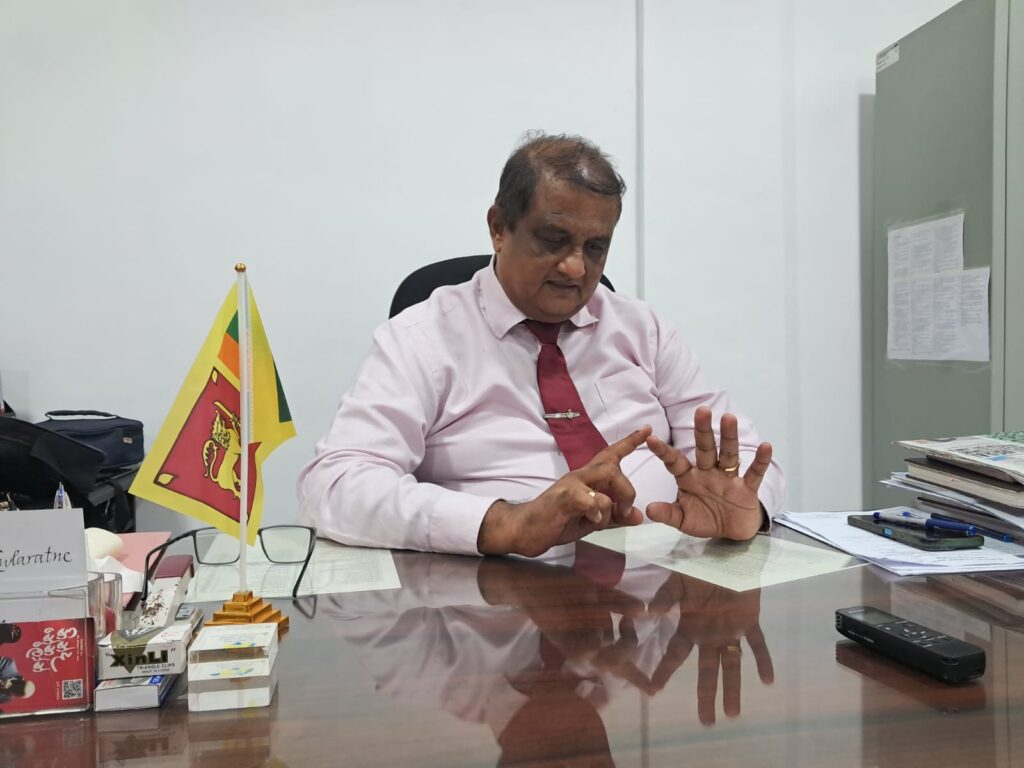
Chinthaka Kularatne, additional election commissioner (legal and investigation) of the Election Commission, discusses the practical challenges of implementing the Regulation of Election Expenditure Act, the Commission’s enforcement powers and the need for stronger auditing and verification.
He also explains why simply digitizing campaign finance returns will not be enough, and outlines proposals including dedicated campaign bank accounts and greater involvement by other state institutions.
Excerpts:
Q: The campaign expenditure law has now been applied at four elections. How would you assess its implementation?
Over the past three years, the law has been applied at four elections — the presidential, parliamentary, Elpitiya Pradeshiya Sabha and local government elections.
The submission rate has been relatively high, but there are significant qualitative, structural and procedural shortcomings.
So, while there has been compliance in terms of the number of reports submitted, the quality and effectiveness of the system remain concerns.

Q: What are the main problems with the expenditure reports?
The quality of the reports is a major concern. Some are very superficial, consisting of only one or two pages. In some cases, candidates use the prescribed formats, cross out sections and simply sign the documents.
Such reports provide very little insight into the actual finances of a campaign. The issue is therefore not simply whether a candidate has submitted a return, but whether that return provides meaningful and verifiable information.
Q: Is the timing of the spending limits another problem?
Yes. The maximum campaign spending limit is declared five days after nominations close. By then, roughly half of the campaign period has already passed.
Financially powerful parties and candidates may already have spent substantial amounts before the limit is formally announced.
We also do not currently have an active monitoring mechanism during the campaign period to track expenditure as it happens. The Commission is largely left waiting for post-election declarations without an independent system to verify actual spending against the legal limits.
Q: What can the Election Commission do when candidates violate campaign finance rules?
The Election Commission has direct statutory authority to prosecute candidates who fail to submit their expenditure reports within the prescribed 21-day period.
But when it comes to spending-limit violations or prohibited donations, the situation is different. The law requires us to publish the reports so that the public or the police can inspect them and lodge formal complaints.
Q: Has that public oversight system worked as intended?
Not sufficiently. Citizens rarely file formal complaints.
This may be due to limited awareness of the law, concerns about the difficulties of going to court or reluctance to challenge powerful political figures who may hold state power in the future.
Enforcement can also require Election Commission officials to lodge individual complaints with the police. We had around 450 complaints relating to the presidential election and 1,941 cases reported to court in relation to the parliamentary elections.
These complaints can involve lengthy consultations with the Attorney General’s Department, which can contribute to delays in concluding cases.
Q: Has the Election Commission taken steps to address these problems beyond what the law requires?
Yes. We conduct monthly follow-ups on complaints submitted to the police. When investigations or the flow of information stalls, our officials speak directly with the police officers handling those files. In most districts, once these direct follow-ups take place, officers act diligently to process the cases.
We have also tried to build a broader institutional framework. The Commission convened a roundtable involving around 15 state institutions and civil society groups, including the Police, Auditor General’s Department, Commission to Investigate Allegations of Bribery or Corruption, Inland Revenue Department, Attorney General’s Department, Bar Association of Sri Lanka and election monitoring organizations.
We consulted these institutions on developing campaign expenditure reporting formats.
We also introduced training programs for candidates and political party secretaries. District officers were trained and then conducted awareness sessions on how to properly complete the reports. This helped reduce the number of non-submissions.
Q: Some election observers have suggested establishing a strong independent body to oversee campaign expenditure returns. Could the anti-corruption commission play that role with the support of the Election Commission?
I think we will need external state support in the future to strengthen the auditing and monitoring of campaign expenditure returns.
The Auditor General’s Department could potentially play that role, subject to its formal consent.
We have already taken steps toward establishing a multi-agency framework. The Election Commission has brought together the anti-corruption commission, Auditor General’s Department, Inland Revenue Department, Police, Attorney General’s Department, Bar Association of Sri Lanka and election monitoring organizations to discuss the process and develop appropriate reporting formats.
Q: Is there already a similar arrangement for candidates’ asset declarations?
Yes. Under the previous legal framework, which had been in place since 1970, the Election Commission collected and physically maintained candidates’ asset declarations.
After the Anti-Corruption Act came into effect, authority over asset declarations was transferred entirely to the anti-corruption commission, and the existing records were handed over to it.
Today, candidates complete their asset declarations through the commission’s online filing platform. They are required to submit either a physical copy of the declaration or the filing receipt from the online system to the Election Commission along with their nomination papers.
Q: Could a similar model be considered for campaign expenditure returns?
A similar arrangement could be considered, but campaign expenditure has different requirements.
We would need the support of other state institutions, particularly for auditing and monitoring. The Auditor General’s Department could potentially play an important role, subject to its agreement.
Q: Some observers argue that campaign finance monitoring places too much of a burden on the Election Commission. Is a separate oversight body necessary?
I do not agree that a separate oversight body is necessary. We have the capacity to manage this process within the Election Commission.
During an election, we have the authority to mobilize the wider public sector. We can draw approximately 200,000 officials from a state workforce of around 1.5 million. We also have constitutional powers to issue binding directives to state institutions.
So, from our perspective, the institutional capacity is there.
Q: Observers have also raised concerns that the Commission may be reluctant to take strong action against political parties or candidates because it has to maintain working relationships with them. Is that a concern?
The issue is not that we are reluctant to act because of political relationships. The limitations we face are primarily statutory and procedural.
At present, the Election Commission has direct statutory authority to prosecute a candidate who fails to submit a campaign expenditure report within the prescribed 21-day period.
Q: What happens when a candidate is suspected of exceeding the spending limit?
That is different. The law does not give the Election Commission the same direct prosecutorial authority for spending-limit violations.
Instead, we are required to publish the expenditure reports for public and police inspection.
There is also a practical challenge in proving a spending-limit violation in court. You need a detailed financial audit, dedicated personnel and sufficient evidence. You may also need witnesses who are willing to participate in lengthy judicial proceedings.
That creates a significant evidentiary and staffing burden.
Q: Where the Election Commission has clear legal authority, has it taken action?
Yes. Where we have clear legal authority, we have demonstrated that we are prepared to take action.
For example, in cases involving the misuse of state resources, we have taken enforcement action and initiated court proceedings against officials who violated the relevant rules.
Q: The biggest concern is disclosure and how to empower citizens. Has the Election Commission considered introducing a digital system to receive campaign expenditure returns and publishing them on a dedicated website?
At present, there is no dedicated real-time digital portal for campaign expenditure returns.
Online submission has already been established for asset declarations through the anti-corruption commission’s online portal, but campaign expenditure returns are handled differently.
The Election Commission currently meets its disclosure requirements through media releases and by making physical candidate expenditure reports available for public inspection.
Q: Could candidates’ income and expenditure be updated regularly through an online system so voters can monitor campaign finances during an election?
For such a system to work effectively, we first need a reliable mechanism to track campaign income and expenditure as it happens.
One proposal we have discussed is a mandatory campaign bank account system. This was originally drafted in 2017–2018.
Under such a system, candidates and political parties would have to open a dedicated campaign bank account within seven days of nomination and route all campaign receipts and expenses through that account.
This would create a centralized financial trail that could be monitored and verified.
Q: Would digitizing the existing system be enough to improve transparency?
No. Simply digitizing the existing forms does not necessarily result in meaningful transparency.
Some candidate expenditure returns are very superficial, sometimes consisting of only one or two pages or standard templates with sections crossed out.
If the information entered online is not properly verified, candidates could still submit incomplete figures.
The system would therefore need verification mechanisms that allow declared expenditure to be compared with bank transactions and other financial records.
Q: Is the timing of the current campaign finance rules another problem?
Yes. One of the structural problems is that campaign spending limits are officially declared five days after nominations close. By that point, roughly half of the campaign period has already passed.
At the same time, financially powerful parties and candidates may begin spending well before nominations open.
If an online monitoring system only covers the official campaign period, it could miss significant expenditure incurred before nominations.
The law would therefore have to be amended if the system is intended to capture pre-nomination campaign spending as well.
Q: How difficult is it to monitor spending through third parties and social media?
That is a major challenge.
Modern campaign expenditure does not always come directly from candidates or political parties. It can involve third-party promotions, nonprofit sponsorships, media appearances and digital and social media advertising.
Tracking these decentralized forms of expenditure is difficult, particularly when it comes to establishing a legal connection between a third-party expenditure and a particular candidate or political party.
Q: Would greater public access to campaign finance information automatically lead to greater citizen oversight?
Not necessarily.
Citizens need to be able and willing to use the information that is disclosed. So far, the existing public disclosure mechanisms have generated very few formal complaints from citizens.
People may not be sufficiently aware of their legal rights, may be reluctant to become involved in lengthy court proceedings or may hesitate to challenge political figures who could hold state power in the future.
Empowering citizens therefore requires more than simply putting information online. It also requires accessible information, public awareness and mechanisms that allow citizens to raise concerns without unnecessary barriers.
Q: What would be required to verify the information submitted by candidates?
The Election Commission would need significant investigative and technical capacity to compare candidates’ declared expenditure with actual spending on the ground.
Detailed audits require specialized personnel, financial expertise and access to relevant records.
This is why we have said that formal support and partnerships with other state institutions, such as the Auditor General’s Department, will be important if we are to strengthen the auditing and verification process.
Banner Image: Chinthaka Kularatne, additional election commissioner (legal and investigation) of the Election Commission, discusses the practical challenges of implementing the Regulation of Election Expenditure Act, the Commission’s enforcement powers and the need for stronger auditing and verification. Image by Gagani Weerakoon.
This interview was conducted and edited by Gagani Weerakoon. She leads the editorial at the Center for Investigative Reporting (CIR).