Thousands of students in French-speaking Belgium have been protesting against education reforms and rising costs.
The protests started in Liège, and spread to other cities in Belgium.
Protests turned violent in the center of Brussels and more than a 100 people were detained on October 9th.
The Flemish- speaking part of Belgium is not protesting as their education system is not affected, however it’s expected they will take to the street too in the coming days.
A stranger helped Hilde Bastiaens put her keffiyeh over her mouth as tear gas spread through a street in Brussels. The 59-year-old was struggling to breathe, and her eyes were watering as people surrounding her tried to help those affected by the gas.
On Oct. 9, Bastiaens had travelled to Brussels to join student protesters against government austerity measures. She encountered tear gas, water cannons and police force. But at the center of the unfolding unrest are students as young as 14 or 15, worried about what these reforms might mean for their future.
In French-speaking Belgium, thousands of students have been protesting over education reforms and rising costs. But clashes with the police and increasing unrest threaten to overshadow their concerns.
For Maxime, a 18-year old student, that future has become more difficult to afford. He worries that the rising cost of higher education will put more pressure on parents. “I might have to help my parents pay for it,” he said.
The demonstrations began on Oct. 1 in Liège, a city in the East of Belgium, with high school students at the forefront. The following days, it spread to other cities like the capital, Brussels, as university students, teachers and trade unions joined the protests.
On October 9th, demonstrations drew between 30,000 and 50,000 people, according to police and trade unions reports. For many young protesters, anger over government austerity measures and education reforms led them to take to the street.
“They were genuinely concerned about their education and their future,” says Jeremie Nzita Mambu, a 22-year-old journalist and founder of Yurbise, an independent Belgian news outlet. He attended the demonstration to cover the events. “There was a real sense of collective frustration, but also excitement at being politically active.”
Belgium’s education system
Understanding the protests starts with understanding the education system. Belgium does not have a single national education system. Responsibility for education lies with its language communities. The ongoing protests focus on the French-speaking Community, governed by the Wallonia-Brussels Federation, which oversees French-language education.
“A large number of students are looking for financial aid to pay this tuition because they can’t afford it and therefore can’t access higher education,” Maxime said.
The reforms include a major increase in the standard annual tuition fee for university students, going from $937 (€835) to $1340 (€ 1,194). Protesters are also concerned about an increase in annual passes for the bus and tram in Wallonia with the price going from €12 a year to €384 a year. Changes in teachers’ conditions such as adding two teaching hours a week without an increase in pay are among the reforms as well.
Placards shown at the protest about the increase in public transport passes. Image courtesy of Hilde Bastiaens.
From chants to violence
The demonstrations have not all remained peaceful. In Liège,media reports described projectiles thrown at police, property damage and fires. On 8 October, the city’s mayor, Willy Demeyer, introduced a ban on gatherings of more than three people, reported to remain in force until 16 October.
Maxime has participated in protests for two years but believes that previous protests have been unsuccessful. “We want to make our voices heard, and the protests are much more violent”, he said.
The demonstrations in Brussels the following day, remained largely peaceful. However, clashes broke out in central areas to which the police responded with tear gas and water cannons.
Mambu described the atmosphere as energetic, with students chanting and marching together. But he said it changed as tensions with police escalated.
Over 100 students have been detained since the start of October according to police reports.
Bastiaens says she was shocked by the destruction she witnessed, including rocks being thrown and a bus shelter being levelled. But she believes those incidents should not erase the reasons people came to protest.
“That’s not really helping — but it’s also not a reason to dismiss the message and requests the students and everyone at the syndical protest wanted to have heard,” she says.
While covering the protests, Mambu said he received footage and testimonies describing alleged violent arrests and excessive force against minors. These claims require independent verification and it’s not established if the force used by police was unlawful.
Who is behind the protests?
Belgium’s Interior Minister, Bernard Quintin, claimed Antifa, a radical-left and anti-fascist movement, from involvement in the protests and encouraging students to use violence.
But Mambu disagrees with the suggestion that the protests should be understood primarily through the actions of radical groups or individuals involved in violence.
“My biggest concern is how quickly the public debate shifted away from the students’ actual demands and towards accusations that they were being manipulated by radical or extremist groups,” he says.
He argues that the students’ concerns are rooted in the education policies affecting their lives. While acknowledging that violence and vandalism should not be ignored, he says it is important not to treat all protesters as responsible for the actions of some.
“I strongly disagree with treating an entire generation of young protesters as dangerous or manipulated because some individuals committed violent acts,” he says.
Poster planned for protests across Belgium for Oct. 17. Image courtesy of Hilde Bastiaens.
Beyond Belgium
The protests have unfolded alongside the student protests going on in France over education funding, school conditions and staffing.
For now, the demonstrations remain concentrated in French-speaking Belgium. Flanders has its own education policies. However, Bastiaens, who travelled from the Flemish part of Belgium, said the situation in Flanders was different, but added: “I expect students here won’t stay silent for long.”
Protests across all major cities in Belgium held on Oct. 17 as France also heated with ongoing rigorous protests by students.
Banner Image: In French-speaking Belgium, thousands of students have been protesting over education reforms and rising costs. Image courtesy of Hilde Bastiaens.
Thousands of protestors, student leaders, journalists, lawyers, leaders of political parties, and even those who were not protesting were detained by the Delhi Police on October 10-11 as security forces locked down parts of the national capital in an attempt to thwart a demonstration demanding Chief Election Commissioner (CEC) Gyanesh Kumar’s resignation over alleged irregularities in the Special Intensive Revision (SIR) of the electoral rolls.
The detentions were, however, not restricted to those who were present near the protest site. Several, including YouTuber Dhruv Rathee, independent journalist Harsh Yadav, were picked up from their homes and hotels even before the protests began. Cockroach Janta Party (CJP), a satirical youth-led outfit, leaders were detained from inside their flight upon landing in Delhi.
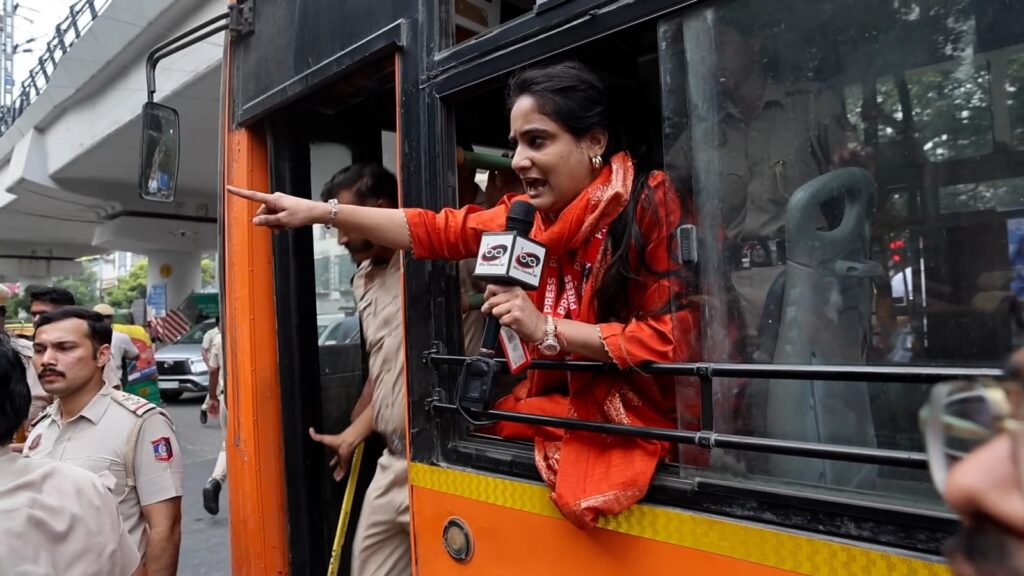
Since then, the United Nations, lawyers, and journalist associations have criticised Delhi Police’s indiscriminate action. Rights groups such as Committee for the Protection of Journalists (CPJ) and Reporters Without Borders (RSF) have recorded close to 40 instances of journalists being detained, harassed, and stopped from reporting during the protests.
28-year-old journalist Pragya Mishra was detained while covering the protests on October 11. Image courtesy of Ulta Chashma uc.
On October 11, the Supreme Court of India also held a special hearing as lawyer bodies sought contempt action against Delhi Police for flouting earlier court orders that directed the authorities against closure of metro stations, internet shutdown, and preventive mass detentions.
A bench comprising Justices Joymalya Bagchi and V Mohana reiterated in its interim order that the internet facilities should function unhindered, there shall be no illegal detention, and that lawyers and journalists should be allowed to work without hindrance.
Since the Sunday hearing, a bunch of petitions have been filed before the apex court in connection with the October 10 protests. The matter will be heard on October 15, when the court has also summoned senior Delhi police officials to appear personally.
The police may take preventive action when there is a genuine and reasonable basis to believe that a particular offence or disturbance may occur. But preventive powers do not give the police unlimited authority to detain people merely because they are activists, political opponents or suspected participants in a peaceful protest. Vikas Pahwa, Senior Advocate
Legal experts have called these detentions “illegal” and have questioned Delhi Police’s refusal to allow anti-CEC protests. They also said “reasonable apprehension” to avoid violence can’t be used as a reason to stop demonstrations.
Prohibiting Protests: A Wrong Call
Former IPS officer Amodh Kanth said prohibitary orders can be issued only in limited circumstances and in limited high-security areas. Even then, this does not mean that a total prohibition on gathering of people can be imposed.
The Constitution and several Supreme Court judgments state that protests and dissent are fundamental rights subject to reasonable restrictions. “The government, any state, or the police cannot take away these fundamental rights,” Kanth told Asian Dispatch.
Commenting on the close proximity of Jantar Mantar (which has now been de-notified as a designated protest site) to the parliament, Kanth added, “Protests happen [close to the place of power] so the parliament knows what a citizen’s grievances are.”
As the CJP leaders announced a protest on October 2, the Delhi Police had imposed Section 163 (prohibitory orders) of the Bharatiya Nagarik Suraksha Sanhita (BNSS). This empowers them to issue orders to prevent potential disturbances where “there is sufficient ground for proceeding under this section and immediate prevention or speedy remedy is desirable.”
However, the police went to the extent of detaining individuals from their homes, hotels, even trains and flights.
Pahwa, who specialises in criminal defence, stressed that a person cannot be taken into custody simply because the authorities find the protest inconvenient or disagree with its message. He also referred to Section 172 (persons bound to conform to lawful directions of police) of the BNSS, and explained that the section allows the police to detain a person who resists, refuses, or disregards a lawful police direction issued to maintain public order.
The concern is that the provision does not clearly define what constitutes a “petty case” and it gives the police considerable initial discretion to decide when a person should be detained or removed. In the context of protests, this creates a real risk that people may be detained merely for refusing to comply with police directions, even where their conduct does not independently justify arrest under the ordinary criminal law. Vikas Pahwa, Senior Advocate
While a petition has been filed in the Supreme Court challenging the constitutional validity of the section, Pahwa added that whether the police relied specifically on this section must be verified.
Regulation Different From Suppression
Governments have always regulated protests but experts emphasise that there is a difference between regulation and suppression.
Kanth recalled the 1988 Mahendra Tikait protest where the dissenters were prevented from gathering at the Boat Club near India Gate and instead diverted to Jantar Mantar, which was a more convenient space for all stakeholders.
Senior Supreme Court advocate Huzefa Ahmadi said that there should be an element of proportionality in any kind of action and added, “In a republic, every citizen has the right to protest. Authorities cannot stop them unless there is [an] incitement for violence. As far as public nuisance is concerned, even to stop that, there is an element of proportionality. One can’t say that a group of people gathered to protest are creating a nuisance and stop it. This is what distinguishes us from a banana republic. What Delhi Police has done is something that only happens in a banana republic.”
Pahwa, too, said that the State may impose restrictions to protect public safety and order but those restrictions must be “lawful, necessary and proportionate”. “They cannot be used as a blanket excuse to silence dissent or prevent people from exercising their constitutional rights,” he added.
Despite following guidelines shared by the Delhi Police, videos shared by journalists across social media platforms show that they were heckled and detained.
On Sunday afternoon, journalists from several media organisations were detained by Delhi Police while they were covering protests near Lady Hardinge Hospital.
On Sunday afternoon, journalists from several media organisations were detained by Delhi Police while they were covering protests near Lady Hardinge Hospital.
News magazine Caravan’s Editor-in-Chief Hartosh Singh Bal said, “The police were arbitrarily picking up people, including individuals, and bundling them in buses. Under what law were the journalists detained? The detentions were just to clamp down in a high-handed fashion in order to create fear to express one’s self.”
According to the news outlet, a journalist from their newsroom was also detained and brutally beaten up.
Ahmadi said we must redeem ourselves and the democratic republic. “In a democracy, it is healthy and necessary to let off steam. This is why most evolved democracies have designated sites for protest subject to the laws of defamation.”
Pahwa also focused on the need to maintain public order but also allow peaceful dissent. “Maintain public order, but do so lawfully. Prevent violence, but do not criminalise peaceful dissent; take preventive action where genuinely necessary, but do not use it as a tool of arbitrary detention; and obey the directions of the Supreme Court in both letter and spirit.”
“A democratic government must protect public safety while also protecting the liberty, dignity and constitutional rights of the people,” he added.
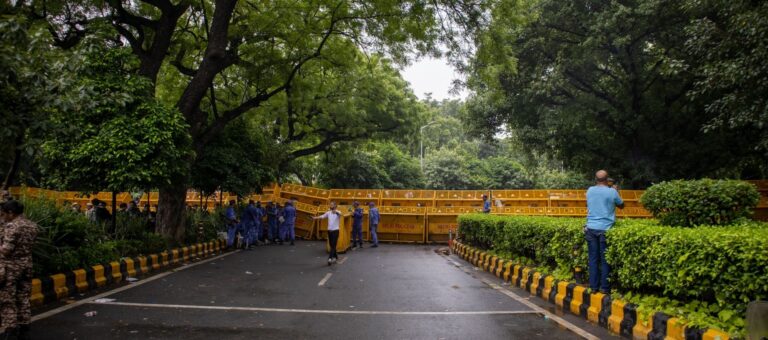
Banner Image: File photo of a road blocked by Delhi police barricades in July. Image courtesy of Shivansh Srivastava/Asian Dispatch.
This story was produced by Asian Dispatch and originally published on 15 October 2026. It is republished by CIR with permission.
Médecins Sans Frontières (MSF) South Asia, in partnership with Drugs for Neglected Diseases initiative (DNDi) is inviting journalists, photographers, filmmakers, digital media influencers, and newsroom editors from across South Asia to submit proposals for the 2026 cohort of the Without Borders Media Fellowship.
The fellowship is designed to support humanitarian and health-related journalistic reporting and to use scientific storytelling to draw attention to emerging local and cross-border issues across the South Asia region.
MSF General Grant
Open to applicants across South Asia, with reporting proposals on themes including:
Tuberculosis, HIV, Health Impact of Climate Change, Women’s Health, Impact of Caste on Health, Health Misinformation, Antimicrobial Resistance (AMR), Digital/Mobile Health, Access to Healthcare in Conflict Settings, Migration and Displacement/Refugees, and Mental Health.
MSF-DNDi Grant on Neglected Tropical Diseases (NTDs)
Focused on diseases such as lymphatic filariasis (hathipaon), visceral leishmaniasis (kala azar), mycetoma, dengue, and snakebite.
This category is only open to applicants from India, Nepal, Bangladesh, and Sri Lanka.
Apply to join a fellowship that supports rigorous, compassionate, field-based reporting on some of the most urgent health and humanitarian issues in South Asia.
Saudi Arabia’s Supreme Court set aside the death sentence imposed on Sri Lankan migrant worker Sivarasa Anojan after an appeal filed on Oct. 11.
Sri Lankan officials, lawyers, politicians and civil society members worked to challenge the sentence and seek a clemency.
The ruling does not confirm whether Anojan will be released, whether his original prison sentence remains in force or when he could return to Sri Lanka.
The case highlights the need for stronger consular support, timely access to legal representation and better communication with families of migrant workers detained overseas.
COLOMBO— When the news arrived on the morning of Oct. 14, Hamsithan watched his mother, Rasamanickam Yogalakshmi, finally release a breath she seemed to have been holding for months. She cried with relief as his father sank into a chair with a sigh.
Their son, Anojan Sivarasa, a 27-year-old Sri Lankan migrant worker facing execution in Saudi Arabia, had been given a reprieve.
Saudi Arabia’s Supreme Court overturned the death sentence imposed on Anojan, following an appeal filed on Oct. 11. The ruling, delivered on Oct. 13, came after weeks of diplomatic engagement, legal intervention and public appeals to save his life.
Announced by deputy foreign minister Arun Hemachandra on Oct. 14, the decision brought relief to Anojan’s family and the many people who had campaigned on his behalf. But, it did not settle the questions whether he will remain in prison, when he might return home and what Sri Lanka can do to protect other migrant workers facing serious criminal charges overseas.
The government has credited sustained diplomatic engagement and cooperation between Sri Lankan and Saudi Arabian legal teams for the outcome. Hemachandra thanked the Saudi government, Sri Lankan diplomatic officials, the Sri Lanka Bureau of Foreign Employment (SLBFE) and the lawyers involved.
The immediate threat of execution has receded, but the legal process is not necessarily over. The case is expected to return to a lower court, and the status of Anojan’s earlier conviction and prison sentence remains unclear.
“The Supreme Court has overturned the death sentence, and the case will now be referred to a lower court. We expect it to be taken up within two weeks. That court will decide whether to reinstate the original five-year prison sentence or issue a different ruling. Our mission was to secure clemency and ensure Anojan would not face the death penalty,” Faiszer Musthapha told CIR.
Mustapha was part of special legal delegation that went to Saudi Arabia to exhaust all possible legal avenues in seeking mercy for Anojan.
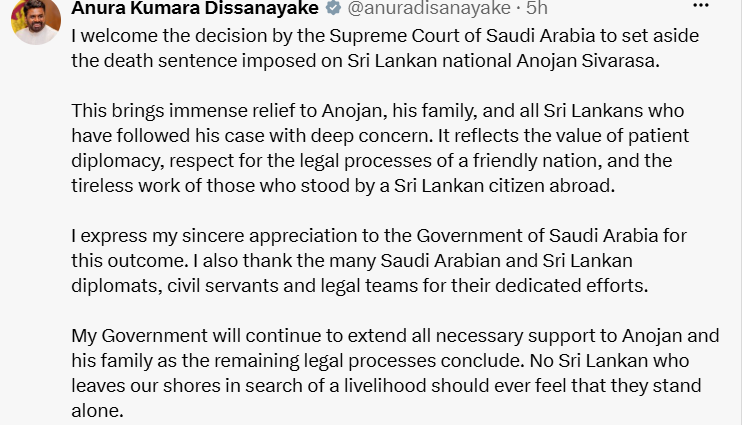
Meanwhile, President Anura Kumara Dissanayake welcomed the supreme court’s decision, describing it as a source of immense relief for Anojan, his family and Sri Lankans who had followed the case. He thanked Saudi authorities, diplomats, civil servants and legal teams for their efforts and pledged continued government assistance until the remaining proceedings are concluded.
“No Sri Lankan who leaves our shores in search of a livelihood should ever feel that they stand alone,” Dissanayake said.
Opposition lawmaker Shanakiyan Rasamanickam also welcomed the ruling but stressed that the campaign would continue until Anojan was safely reunited with his family in Sri Lanka.
“Our mission will only be complete when Sivarasa Anojan is safely brought back to Sri Lanka, following the completion of all necessary legal procedures and due process, and reunited with his family,” he said in a statement posted on X.
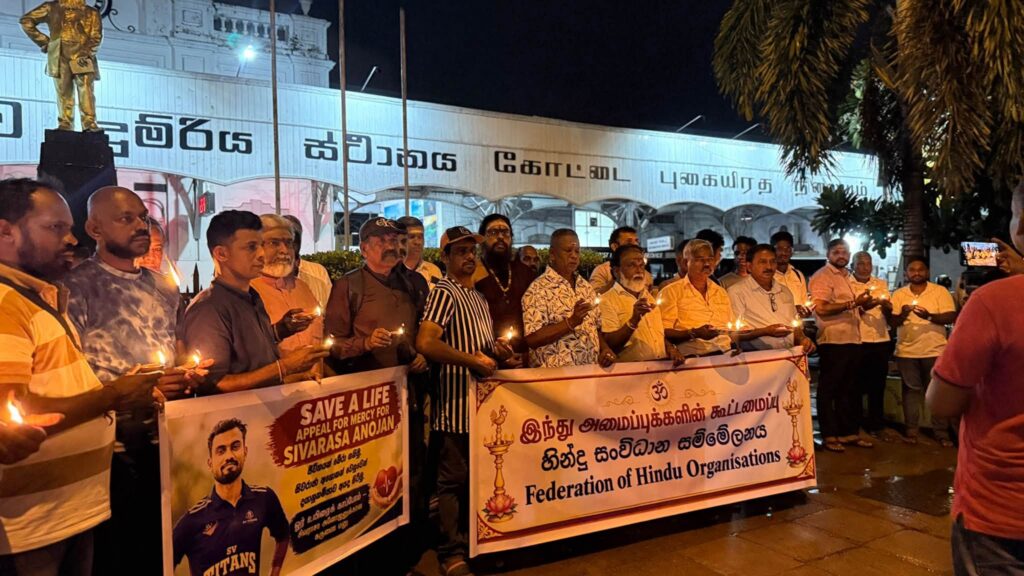
A candlelit vigil held in front of Fort Railway Station calling for the revisal of death sentence to Anojan. Image courtesy of Thusanthan Rasenthiram.
Deadly social media comment
Anojan’s case began with an online argument in late June 2026
A video showing a young Muslim man kicking a dog fondly called Subramani who accompanied Hindu foot pilgrims circulated on social media, prompting heated exchanges about religion. During the argument, a user has made derogatory remarks about a Hindu deity. Anojan responded in Tamil with remarks insulting the Prophet Muhammad.
He later deleted the comment and published an apology video. But a screenshot of the exchange allegedly reached his employer and Saudi authorities. He was arrested on July 1.
On July 27, the Al-Ahsa Criminal Court sentenced him to five years in prison and imposed a fine of three million Saudi riyals, equivalent to about $800,000.
An appellate court subsequently imposed the death penalty in September, finding him guilty of blasphemy against Islam and the Prophet Muhammad.
For Anojan’s family, the case became a fight to bring their son home alive. For Sri Lanka, it became an urgent diplomatic challenge involving another country’s criminal justice system and a punishment with irreversible consequences.
The case also underscored the potential consequences of online speech across borders. A comment made during an argument on social media could carry consequences far beyond the immediate exchange when the person involved was living and working under a different legal system.
Screenshot of President Anura Kumara Dissanayake’s gratitude to the Kingdom of Saudi Arabia.
A campaign reached beyond Sri Lanka
As news of the death sentence spread, politicians, civil society groups and members of the public called for intervention. Petitions and appeals urged the government to act, while Anojan’s family pleaded for mercy.
The government pursued diplomatic channels and assembled a legal team to challenge the sentence.
Former Maldivian president Mohamed Nasheed became one of the people approached for assistance. On Sept. 23, president’s counsel Faiszer Musthapha and president’s counsel Upul Kumarapperuma met Nasheed in the Maldives to discuss the case. Nasheed acknowledged that Anojan’s comments were offensive but said he would support efforts to save his life on humanitarian grounds.
His involvement was not to determine the outcome of the appeal. The legal process remained in Saudi Arabia, where the sentence had been imposed. But the effort illustrated how regional relationships can complement formal diplomacy when a citizen faces an urgent threat abroad.
Sri Lanka also sent a delegation to Saudi Arabia to work with local lawyers and establish the procedure for appealing to the Supreme Court.
The delegation included Musthapha, Kumarapperuma, president’s counsel Hafeez Azard Navavi, consul general in Jeddah M.T. Mohamed Laffar, attorney-at-law Hafeel Farisz and Mohamed Riyasdeen Silmy, a coordinating secretary to Musthapha.
Sri Lanka’s ambassador to Saudi Arabia, Ameer Ajwad, also took part in the effort. He visited Anojan at Dammam central prison on Oct. 8 to inquire about his welfare.
The Supreme Court’s decision followed the filing of the appeal on Oct. 11. The court’s reasoning, however, should be established from its written decision rather than inferred from the announcement.
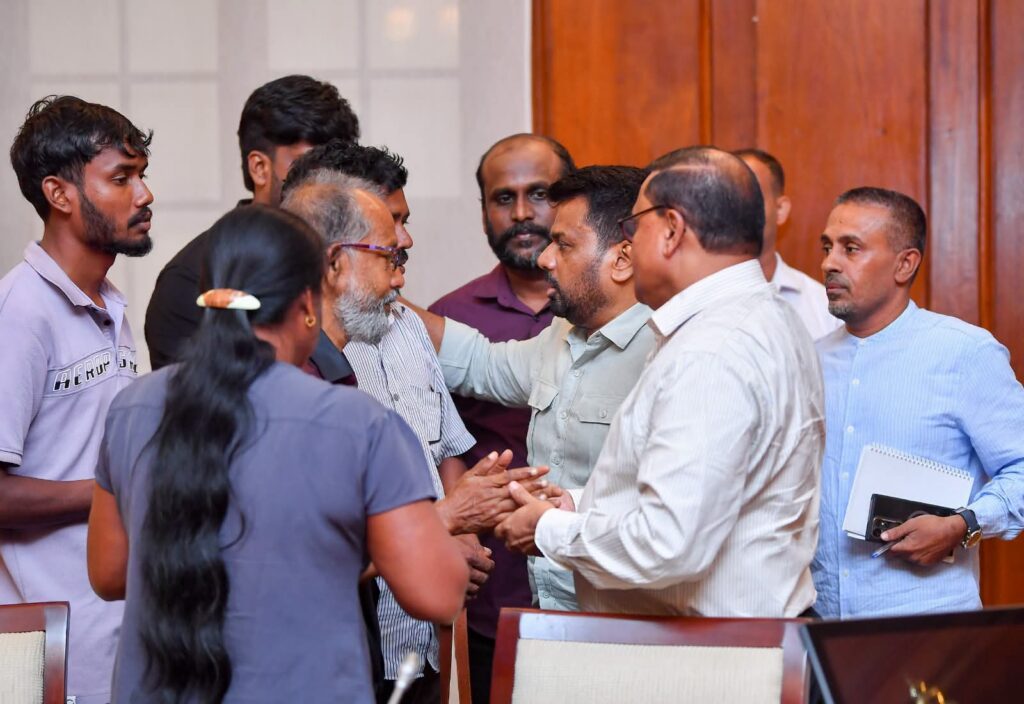
Anojan’s family met President Anura Kumara Dissanayake in September 2026 seeking his intervention in seeking clemency from Saudi Arabia. Image courtesy of President Media Division.
Concerns remain
The reversal of Anojan Sivarasa’s death sentence is a significant reprieve, but his legal ordeal is not over. Sri Lanka must continue to pursue his release and return while keeping his family informed of every development.
The case also demands a broader response. Sri Lanka must strengthen consular support for citizens facing serious criminal charges abroad, ensuring timely legal assistance, clear communication and effective protection.
The death sentence has been overturned. The next test is whether Sri Lanka can bring Anojan home and ensure that other migrant workers are not left without support when they need it most.
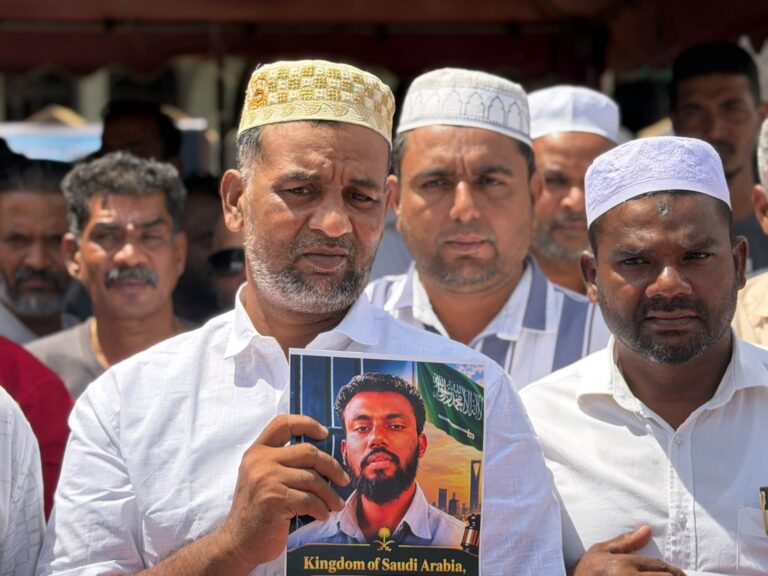
Banner Image: Sri Lanka united in calling authorities to intervene and seek clemency for Anojan and bring him home alive. Muslims in northern Sri Lankan city Vavunia are seen engaged in vigil in front of the grand jummah mosque after prayers. Image via Vavunia.net Facebook page.
This story was written and edited by Gagani Weerakoon. She leads the editorial at the Center for Investigative Reporting (CIR).
This story was produced with support from Report for the World, a global media service strengthening local independent journalism.
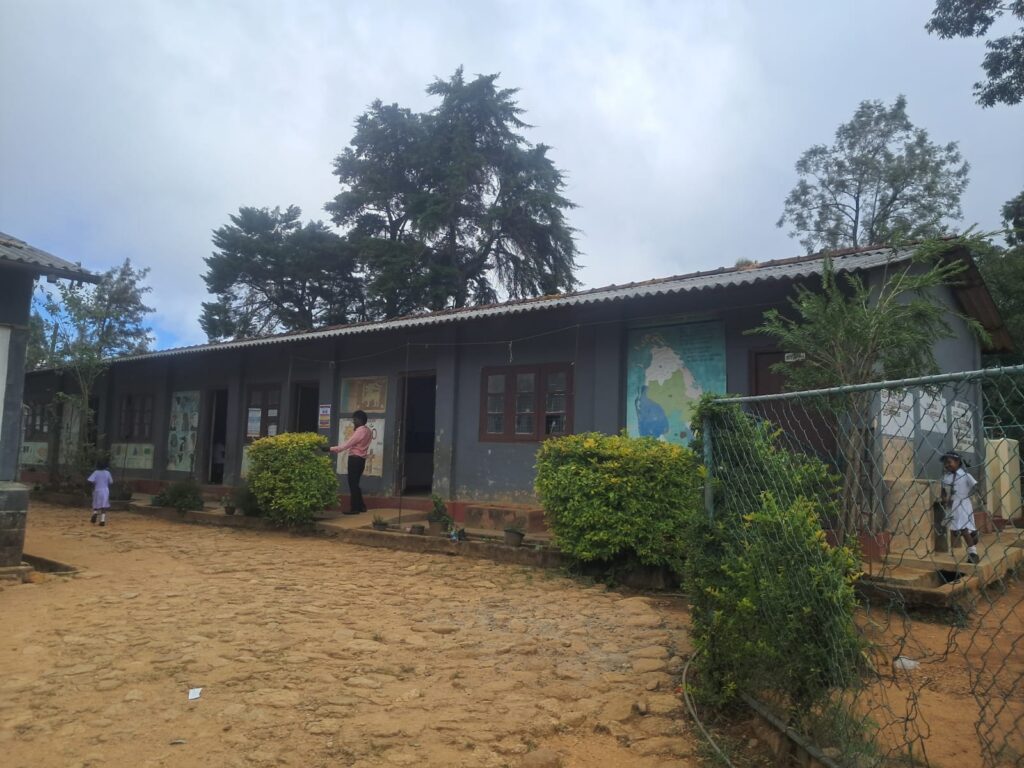
A grade 4 student’s mastery of the periodic table contrasts with the unsafe, poorly equipped conditions at Rilamulla Arunodaya Hindu Primary School.
Despite a government commitment to allocate land to plantation schools, it still operates in disused tea factory buildings, with inadequate water, sanitation and classroom facilities.
A $ 12,700 renovation project raises questions about implementation, while children face dangerous journeys to school and frequent disruptions to learning.
Advocates say plantation companies’ continued control over school land and infrastructure perpetuates inequality, leaving Malaiyaha Tamil children without educational opportunities promised by free education.
In just two minutes, Kanshika recited the periodic table. She is only in grade 4.
There was reason to marvel at her ability. But the gathering did not break up in celebration. Instead, an unsettling question lingered. What future awaits a child with such promise when the school meant to nurture her potential, struggles to provide even the most basic conditions for learning?
We were at Arunodaya Hindu Primary School in Rilamulla, Mathurata, in Sri Lanka’s Nuwara Eliya district, more than 5,000 feet above sea level. While thousands of schools across the country prepare to navigate the government’s new education reforms, children here are fighting for something more fundamental – a safe classroom, reliable water, adequate sanitation and a fair chance at an education.
For these children, even the promise of free education comes with formidable obstacles. They remain far removed from the administrative decisions made in Colombo that will shape their futures.
“The government promised to allocate two acres of land to every plantation school, but we have received nothing. We don’t have a reliable water supply. Water flows from the springs for only a few months of the year. During the yahapalana government, we raised the school’s problems with then deputy minister V. Radhakrishnan. He said he had made a request to the Mathurata Plantation Company, but nothing came of it,” principal V. Wijendran said.
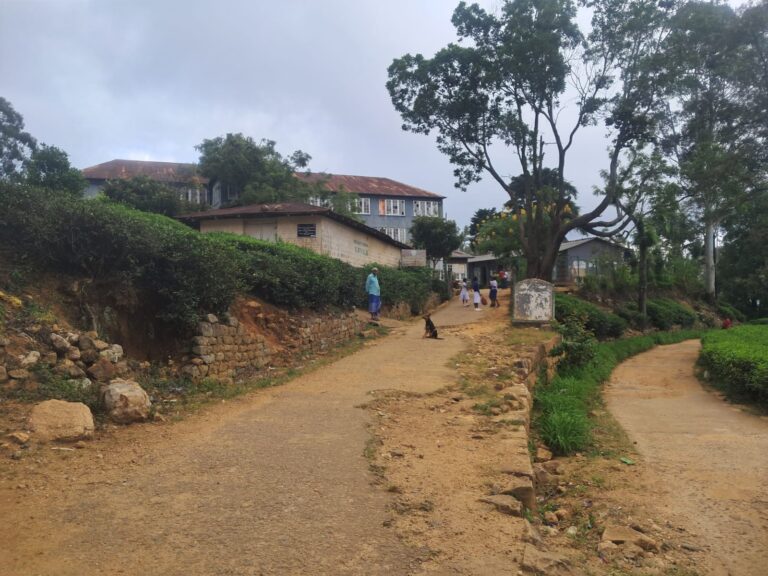
Rilamulla Primary School offers a stark illustration of that inequality, beginning with the unusual category to which it belongs: a plantation school. Image courtesy of Selvaraja Rajasegar.
Students in grades 6–8 at this school also attend classes in the primary school’s buildings. There is dust everywhere. “Even when the public health inspector visits, nothing is done. We have no playground, so the children play on the road,” principal noted.
“Despite all this, two children passed the Grade Five Scholarship Examination. We also received approval for LKR 150,000 from UNICEF to build toilets. That is all.”
The principal’s account captures the daily struggle at Rilamulla Primary School, where the children’s aspirations far exceed the facilities available to support them.
A dangerous journey
Deputy Principal J. Navaratnam describes a similar disconnect between the government’s education reform agenda and the realities facing students.
Teachers were given training under the education reforms, but we don’t have equipment such as digital boards, he said.
“The first bus reaches here at 9 a.m., so the school day starts late. That means classes also finish late in the afternoon. A bus from Ragala arrives at 7:45 a.m., but the children who take it still have to walk two kilometers to reach school. The route is dangerous, too, with wasps attacking people along the way. Even today, about six children missed school because they were stung. Even if these children pass the grade five scholarship examination, they cannot transfer to another school because it is too far away.”
President Anura Kumara Dissanayake’s description of education as “wings” has become a recurring reference point in Sri Lanka’s education reforms debate. The sentiment is difficult to dispute. Free education can lift children beyond the circumstances into which they are born, opening doors to opportunities far beyond their immediate surroundings.
But the educational disadvantage experienced by Sri Lanka’s Malaiyaha Tamil community is not simply a story of poverty or inadequate resources. It is also a story of unequal power and entrenched social hierarchies. Rilamulla Primary School offers a stark illustration of that inequality, beginning with the unusual category to which it belongs: a plantation school.
Children in Arunodaya primary school lacks even basic facilities and this dilapidated wall is testament to it. Image courtesy of Prasanna Kumar.
Sri Lanka generally classifies schools as national or provincial, as well as boys’, girls’ or mixed schools. Plantation schools, however, occupy a distinct category, shaped by their location on land controlled by plantation companies and the complicated administrative arrangements surrounding them. This has contributed to their marginalization within the public education system.
A 2018 Cabinet memorandum submitted by then education minister Akila Viraj Kariyawasam identified 843 plantation schools. The document recorded a policy agreement to allocate two acres of land to each plantation school, although many lacked clearly demarcated land of their own.
Because state-owned plantations had been leased to private companies, land required for school development had to be secured from those companies. Cabinet subsequently approved a joint proposal by Kariyawasam, then minister of public enterprises and Kandy city development Lakshman Kiriella, and then plantation Industries minister Navin Dissanayake to acquire up to two acres for 354 plantation schools operating on restricted land across seven districts.
Yet those policy commitments have apparently done little to transform conditions at Rilamulla Arunodaya Primary School. Its classrooms still occupy disused buildings from an old tea factory, a reminder of how little has changed for children growing up in the plantation sector.
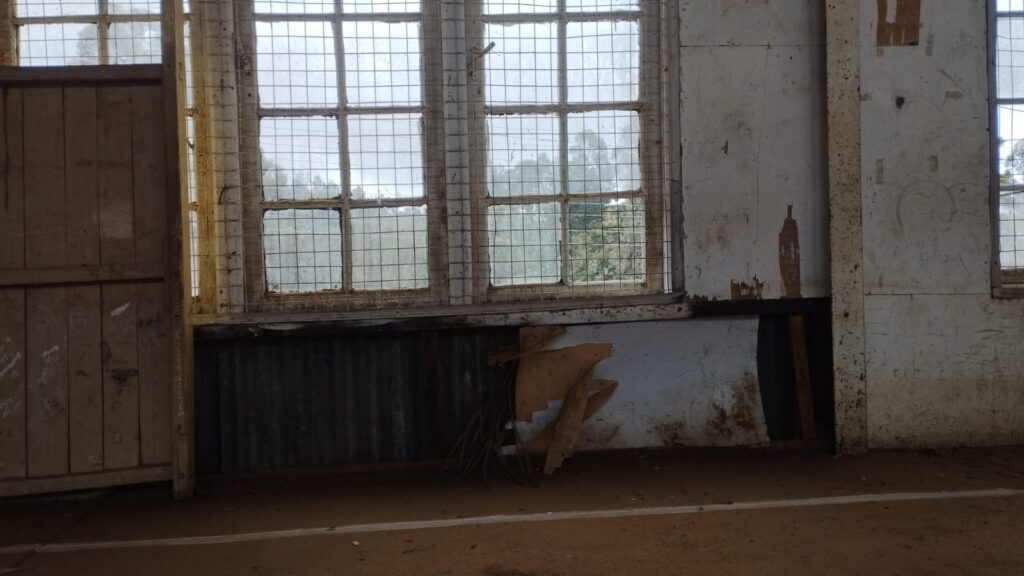
The school’s main hall offers an especially disturbing glimpse of their circumstances. With inadequate lighting in the classrooms, the principal and teachers have also been forced to use the loft of an old building resembling a tea factory storeroom as their main gathering space.
A thick layer of dust covers the wooden floor. Large holes have opened in several places, allowing anyone looking down through them to see the young children in the classrooms below. The same hazardous space is also used for volleyball practice.
The stench from pigeon droppings scattered across the floor is so overpowering that some members of the visiting team felt nauseated. If adults struggle to tolerate the conditions, how are the children expected to endure them every day?
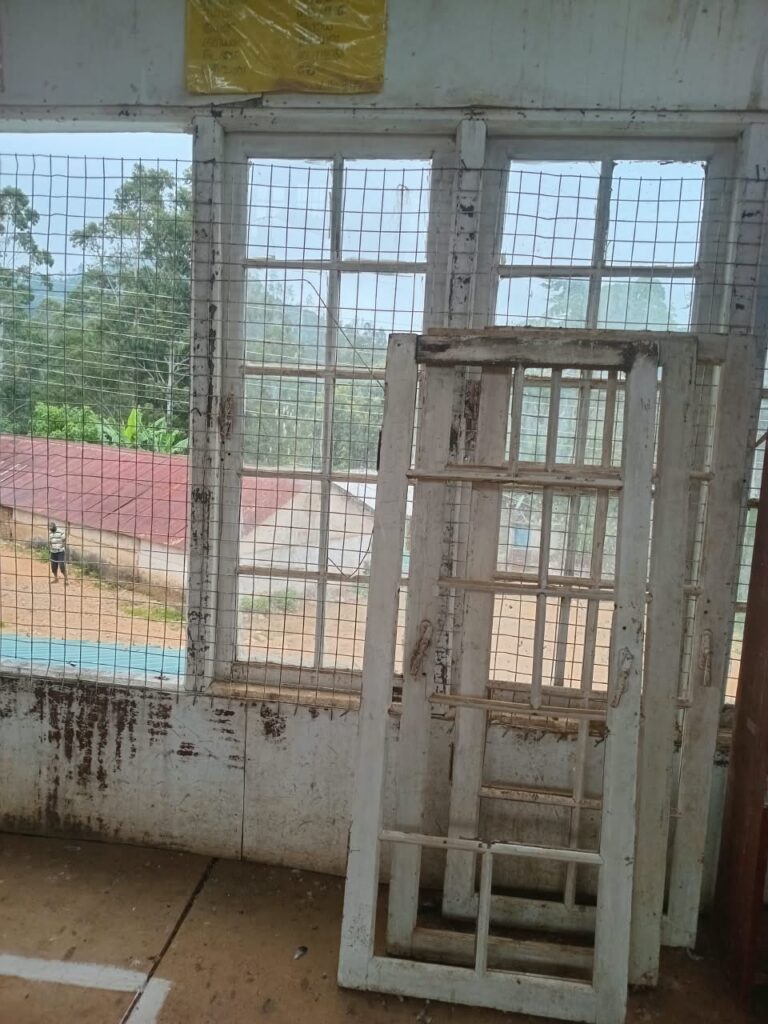
The windows offer little protection from the elements. Years of heavy rain and strong winds have left the shutters damaged, and even a light shower sends water seeping into the building. During the torrential rains common to the hill country, the situation is worse.
The loft, which doubles as the school’s main hall and meeting space, is plainly a death trap.
Anyone familiar with the facilities at one of Sri Lanka’s more privileged, well-known schools would likely be appalled by what passes for an assembly hall at Rilamulla.
Lack of maintenance has left broken windows and doors idling in classrooms. Image by Bingun Menaka Gamage.
For P. Krishnasamy, 70, the danger is deeply personal.
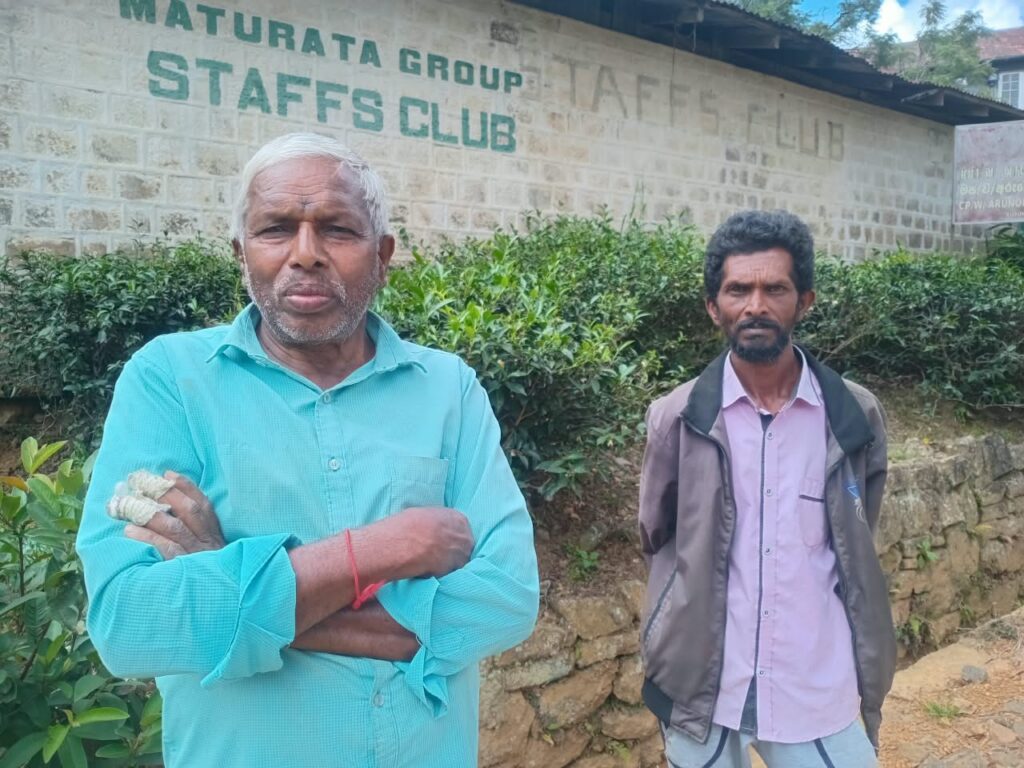
“My grandchild also attends this school. The children don’t even have a proper place to hold assemblies. The government says it will do things, but nothing gets done. It would mean so much if someone could build a proper building for them,” he said.
Nawananthan Loganathan, 45, pointed to another consequence of the school’s precarious existence: its role as an emergency shelter.
“If there is a landslide in the houses downhill, everyone comes to this school. Then classes have to stop, and the children cannot study. Look at the condition inside. The windows are broken, and even a little heavy rain brings water into the classrooms. There isn’t even a bus to get to school. If people have money, they pay about 20 rupees to someone who can drop them part of the way,” he said.
Brocken promise
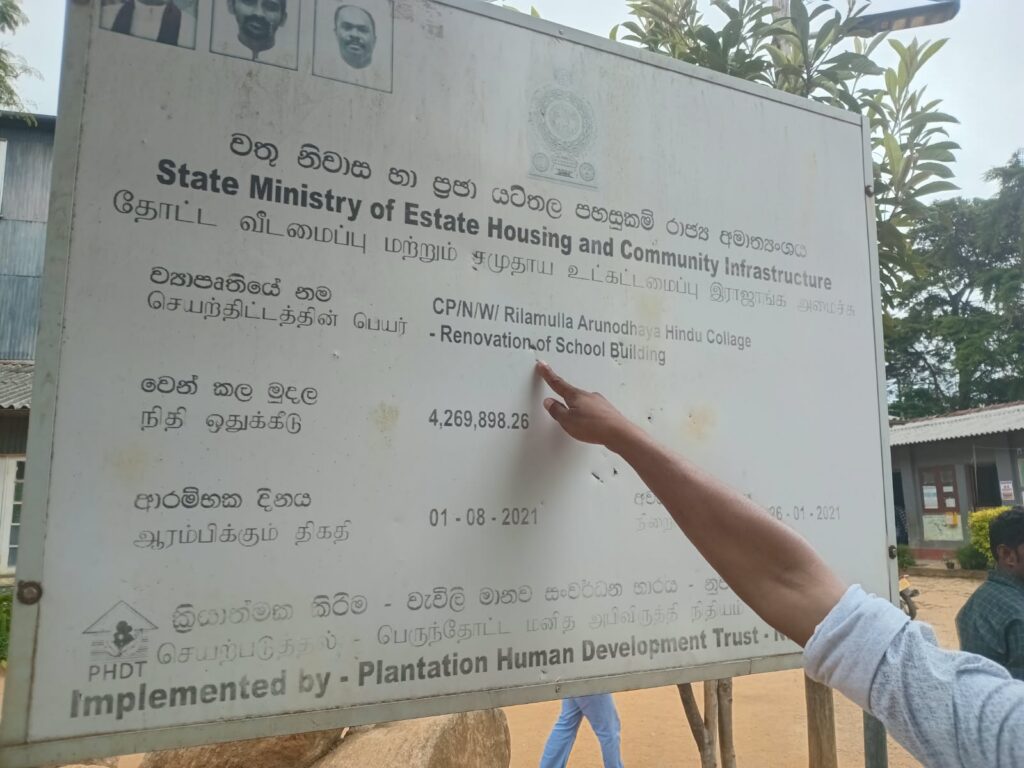
At the school entrance stands a signboard bearing smiling portraits of former president Mahinda Rajapaksa and former minister Jeevan Thondaman. It identifies a project under the State Ministry of Estate Housing and Community Infrastructure to renovate the school building.
The board lists an allocation of $ 12,709 (LKR 4.2 Mn). Yet anyone visiting the school would struggle to identify improvements commensurate with that sum.
The dates recorded on the signboard offer an additional, bitter irony. The project’s start date is listed as Aug. 1, 2021, while its completion date is given as Jan. 26, 2021 — more than six months before work supposedly began. The Plantation Human Development Trust is identified as the implementing agency.
The discrepancy raises questions about the project’s implementation and the extent to which the allocated funds translated into improvements at the school. The signboard alone, however, does not establish what happened to the money.
For Jeevaratnam Suresh, executive director of the iPEN organization, the school represents a broader failure to break the cycle of deprivation endured by the Malaiyaha Tamil community.
Krishnasami and Loganathan lament their children having to study in extremely inconducive conditions. Image by Bingun Menaka Gamage.
“Our lives are still where they began, and this school is a good example of that. Plantation workers have lived for five generations alongside tea and the factories. Now their children are being sent back into the same conditions. Education cannot take place in a shed. Is there equal treatment for these children?”
He also said Rilamulla is just one example.
“There is so much talk about digitalization. The prime minister recently spoke about system change, too. But there are still plenty of schools without even the most basic facilities. The entire system needs to change, and we stand by the principle that every child must have equal opportunities. The school system must be brought onto a common footing,” Suresh said.
Children at Rilamulla walk at least five kilometers to school. Is education reform about pursuing digitalization while ignoring realities like this? The authorities have not even managed to provide these children with a bus service or transport vouchers, he asked.
“The president has spoken about closing schools with fewer than 100 students. If a school in a remote place like this is shut down, will the children be able to travel to a school farther downhill? Development must begin by identifying the resources and needs of each community. A child attending Royal College and a child attending Rilamulla do not have the same learning conditions. Sri Lanka is not just Colombo, and Malaiyaham is not just Nuwara Eliya town. There are many more places like Rilamulla across the country,” Suresh noted
He has spent years campaigning for the rights of the Malaiyaha Tamil community, including taking the fight to the Supreme Court to secure access to registered postal addresses. He now sees the right to education as another front in the struggle for equality.
A system that keeps children behind
An ambitious school building renovation plan started in 2021 remains limited only to a nameboard in 2026. Image by Bingun Menaka Gamage.
The problems extend well beyond Rilamulla.
In Meedumpitiya, in Badulla, children have to travel six kilometers to reach town. These are not paved roads. There are wasps, and the journey is dangerous. Families cannot afford to pay for three-wheelers, Suresh said.
“If the authorities cannot dismantle the system that keeps plantation schools under company control, they must at least provide transport for Malaiyaha children until meaningful change takes place. It has been 203 years, and the plantation companies are still in the middle of everything. We have yet to see a clear policy decision that changes this.
“Governments have repeatedly tried to make two acres of land available to every plantation school, but these schools have still not been freed from company control. The school may have moved farther back from the plantation housing, but the line rooms and the school remain intertwined. They are still called plantation schools. A school is a school. There should be no such category as a plantation school,” he added.
As parents of children in better-resourced schools across the country wait to see when the government’s education reforms will deliver results, Malaiyaha Tamil children in Nuwara Eliya, Badulla, Ratnapura and other districts continue to study within a system shaped by plantation companies and their managers.
In practice, these schools remain on the margins of the Education Ministry’s reach, with government policies and circulars often failing to translate into meaningful improvements on the ground. The result is a double deprivation: children are denied not only the full benefits of free education but also the freedom, dignity and opportunities that education is supposed to provide.
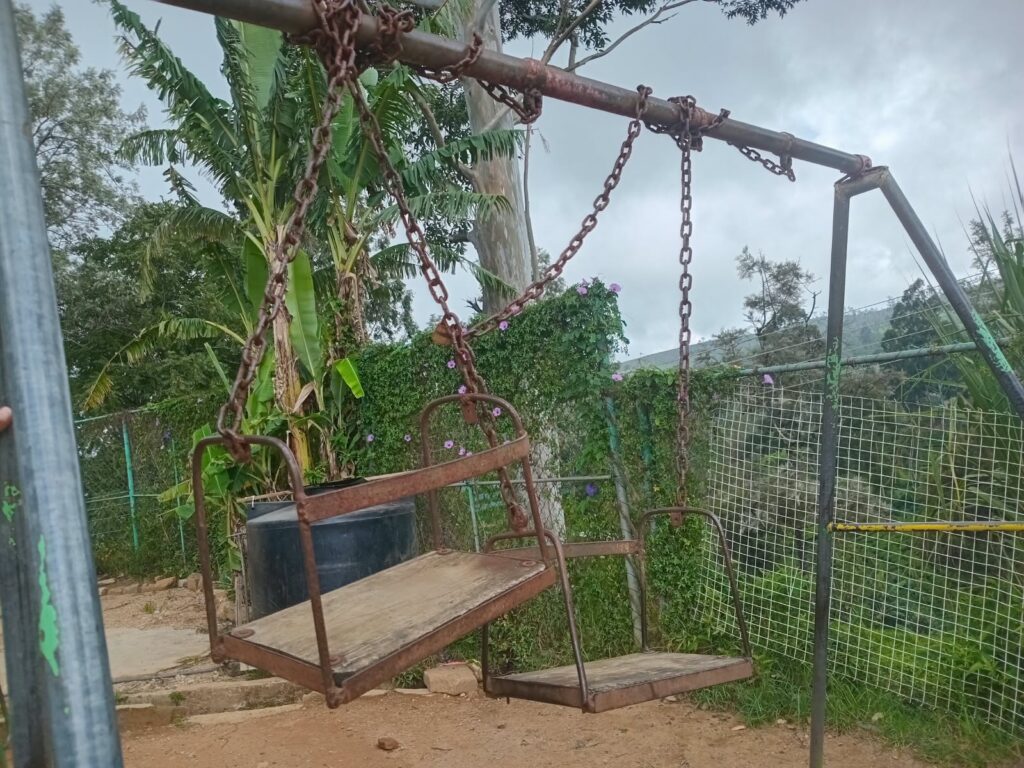
Swings remain tied and broken just like their dreams of reaching the heights of education. Image by Bingun Mekana Gamage.
Kanshika can recite the periodic table. Her ability offers a glimpse of what a child can achieve despite the odds. But talent alone cannot compensate for unsafe classrooms, unreliable transport, inadequate sanitation or years of unfulfilled promises.
Sri Lanka’s education reforms promise to give children wings. At Rilamulla, the more immediate challenge is to give them a school in which they can learn safely, and a fair chance to fly.
If the law is equal for all, how can such a system of exclusion persist?
Banner Image: Unsafe classrooms, dangerous journeys and unresolved land issues expose the education inequalities facing children in Sri Lanka’s plantation communities. Image courtesy of Selvaraja Rajasegar.
This story was Written by Bingun Menaka Gamage and edited by Gagani Weerakoon.
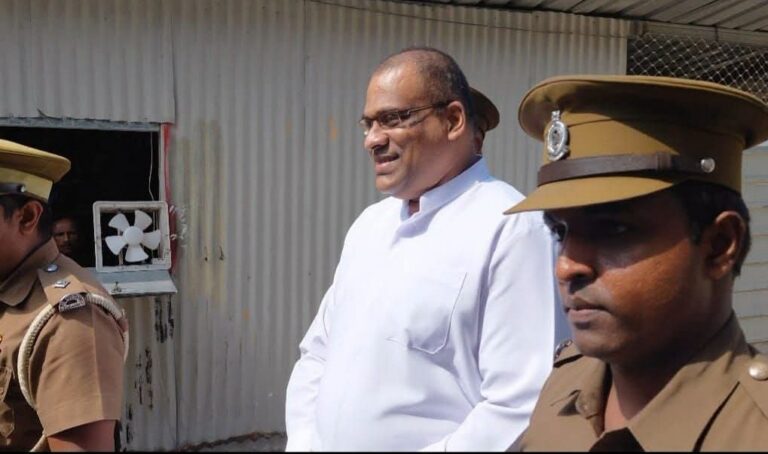
COLOMBO— Controversial Sri Lankan Buddhist monk and Bodu Bala Sena general secretary Galagodaaththe Gnanasara Thera’s appearance in court on Oct. 6 wearing prison-issued civilian clothing instead of his saffron robes has sparked a new controversy over whether prison authorities can require a priest to remove his robes.
Gnanasara Thera is currently serving a six-year prison sentence for contempt of court after the Supreme Court invalidated a presidential pardon granted to him by former President Maithripala Sirisena in 2019. He was originally sentenced in 2018 over his conduct during proceedings at the Homagama Magistrate’s Court concerning the case of missing journalist Prageeth Eknaligoda, but was released from prison after receiving the presidential pardon. The Supreme Court ruled in September 2026 that the pardon was arbitrary and invalid in law, paving the way for the sentence to be enforced.
Prison law
Cabinet spokesperson minister Nalinda Jayatissa fielding questions at the weekly cabinet briefing on October 6 said the removal of Gnanasara Thera’s robes and his being dressed in civilian clothing were carried out under the provisions of the Prisons Ordinance.
Prisons media spokesman and commissioner Senaka Palletenna said prison regulations require prisoners sentenced to more than three years to be produced before court in clothing issued by the Department of Prisons.
According to Pallathtenna, the rules distinguish between monks and priests serving simple imprisonment and those sentenced to rigorous imprisonment.
“A Buddhist monk serving a sentence of simple imprisonment may remain in saffron robes while in prison. However, where the sentence is rigorous imprisonment, the monk is required to wear prison-issued clothing,” he added.
The rules also provide discretion in cases involving shorter sentences. Where a prisoner has been sentenced to less than three years, the superintendent may permit the person to wear the civilian clothing worn before sentencing. “A Buddhist monk may similarly be allowed to appear in court in robes in such circumstances.”
For prisoners sentenced to more than three years, however, Palletenna said prison-issued clothing must be worn when they are produced before court.
Does this mean a monk has been disrobed?
Not necessarily.
This is one of the key distinctions in the controversy.
Being required to wear prison-issued or civilian clothing does not, by itself, determine whether a person remains a Buddhist monk under the Vinaya, the disciplinary code governing the Buddhist monastic community.
The question of whether a monk should be formally disrobed is a separate religious and disciplinary matter.
The Kotte Sangha Sabha has raised precisely this issue in its letter to the Commissioner General of Prisons. It said there were no records before the Sangha Sabha indicating that Gnanasara Thera had committed an offense under the Vinaya Pitaka that would warrant his disrobing.
The Sangha Sabha said responsibility for determining, from a Sasana perspective, whether the Thera should be disrobed or permitted to retain his robes rests with the Sangha.
It therefore asked the commissioner general of prisons not to remove his robes and to permit him to appear in court wearing them.
That is a question concerning Buddhist monastic discipline and the authority of the Sangha.
The current dispute arises because the two issues have become intertwined.
The Department of Prisons maintains that it is applying the same prison rules to convicted monks as it does to other prisoners. The Kotte Sangha Sabha, meanwhile, has objected to the removal of Gnanasara Thera’s robes on the grounds that disrobing is a matter that should be determined within the Buddhist monastic system.
Is Gnanasara Thera being treated differently?
The government says he is not.
Minister Jayatissa said more than 60 Buddhist monks are currently serving prison sentences for various offenses and that the same procedure has been applied to them.
He said no special exception was made for Gnanasara Thera and that the Department of Prisons acted according to prison law.
Palletenna, however, gave a broader figure, saying more than 63 members of the clergy from different religions are currently serving prison sentences in prisons across the country. He said religious figures serving prison sentences are also required to wear prison-issued clothing under the applicable regulations.
The government’s position, therefore, is that the clothing requirement is based on the prisoner’s sentence and prison regulations, rather than the person’s religious identity.
Why the controversy?
The controversy stems from the symbolic and religious significance of the robes.
For a Buddhist monk, the saffron robe is not simply ordinary clothing. It is an outward marker of monastic status. Seeing a prominent monk appear in court without his robes has therefore raised questions about whether the act amounted to, or implied, disrobing.
The prison authorities’ position is different: the clothing worn by a convicted prisoner being produced before court is governed by prison regulations.
The dispute is therefore not simply about clothing. It concerns the boundary between state authority over prisoners and the religious authority of the Sangha over monks.
Banner Image: Gnanasara Thera in lay clothing being escorted by prisons officials. Image via Facebook (Shantha Rathnayake).
This story was written and edited by Gagani Weerakoon. She leads the editorial at the Center for Investigative Reporting (CIR).
Jeyaraj reported on Sri Lankan politics and the ethnic conflict from the late 1970s, working in both Tamil- and English-language journalism.
He wrote extensively on Tamil politics and the North and East, while questioning government, militant and other political accounts.
Former colleagues remember him not only for his journalism, but for advising and protecting younger reporters and maintaining close friendships across the profession.
His columns and articles documented political developments as they unfolded, leaving behind a substantial archive of writing on Sri Lanka’s conflict and political history.
COLOMBO—In the Sri Lanka of David Buell Sabapathy Jeyaraj’s journalism, the distance between Colombo and Jaffna was more than geography. It was also a divide in experience, information and political understanding. As the country’s ethnic conflict deepened, Jeyaraj who is widely known as DBS, spent much of his career trying to explain one side to the other.
He wrote about the North and East for readers in the South. He wrote about Tamil politics for audiences that often knew little about its history or internal divisions. He questioned government accounts, challenged militant groups and followed stories beyond the statements of those in power.
The work carried risks. Jeyaraj was threatened, seriously injured and eventually left Sri Lanka. From Canada, he continued to write about the country he left and its politics.
When he died in May 2026, he left behind nearly five decades of journalism and a generation of journalists who had worked with him, edited his copy, sought his advice and remained his friends.
Founding editor of The Island and The Sunday TimesVijitha Yapa, who introduced DBS to English readers remembers the young reporter who joined The Island in the early 1980s and quickly demonstrated an ability to explain developments in the North to Southern readers.
Hana Ibrahim, editor if Daily and Weekend Express remembers a colleague who once angrily confronted her for taking an unnecessary risk on an assignment and told her that her safety mattered as much as the story.
Marianne David, who edited the works of DBS for 20 years remembers editing Jeyaraj’s long political pieces at The Sunday Leader and later becoming his friend. She also remembers his repeated messages asking whether she had received something he had sent.
Former chief editor of Thinakkural, a daily Tamil newspaper Veeragathy Thanabalasingham remembers a journalist who documented and analyzed Sri Lankan politics, particularly Tamil politics, as events unfolded.
Their recollections describe a man who was demanding about facts, protective of younger journalists, deeply interested in Sri Lanka and unwilling to align his journalism permanently with any political side.
At the center of his work was a basic question. How could one part of Sri Lanka understand what was happening in another?
Much of Jeyaraj’s career was an attempt to answer it.
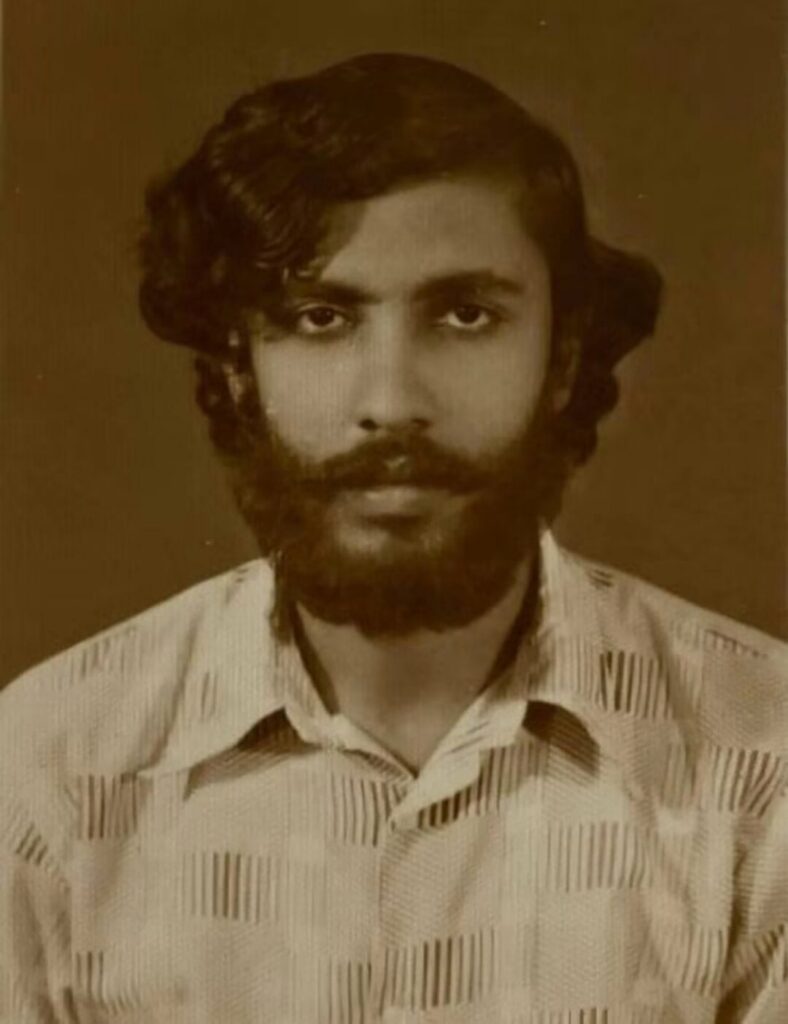
DBS at his early stages of journalism. Image courtesy of Sam Jeyaselvan.
Outstanding young reporter
Yapa first encountered Jeyaraj in the early 1980s at The Island.
Ajit Samaranayake, then the newspaper’s deputy features editor, recommended a young Tamil journalist who could help readers in the South understand developments in Jaffna and the Tamil areas.
Yapa had expected someone with a bushy moustache.
Instead, a clean-shaven young man walked into the office.
The surprise did not last long.
Jeyaraj spoke fluent English and expressed himself with unusual clarity. Yapa sent him to cover a Cabinet press conference as a test.
Within an hour, Jeyaraj returned with a report Yapa considered better than the work normally produced by the newspaper’s regular correspondent.
Yapa offered him three times the salary he had requested.
When Jeyaraj said he could start in a month, Yapa told him to come the next morning.
He did.
What soon became apparent was that Jeyaraj could do something more important than cover politicians.
He could provide context.
As the crisis in the North deepened, Yapa saw the need for journalism that went beyond official statements and explained what was happening on the ground.
That became Behind the Cadjan Curtain, a column on the political and social realities of the North and East.
For readers in the South, it offered a view into a part of the country that was becoming increasingly remote — geographically, politically and emotionally.
“He was trying to explain what was happening in the North and East and in the Tamil areas,” Yapa recalled. “How can that be explained to the people in the South?”
That question would define much of Jeyaraj’s career.
Journalism at the fault line
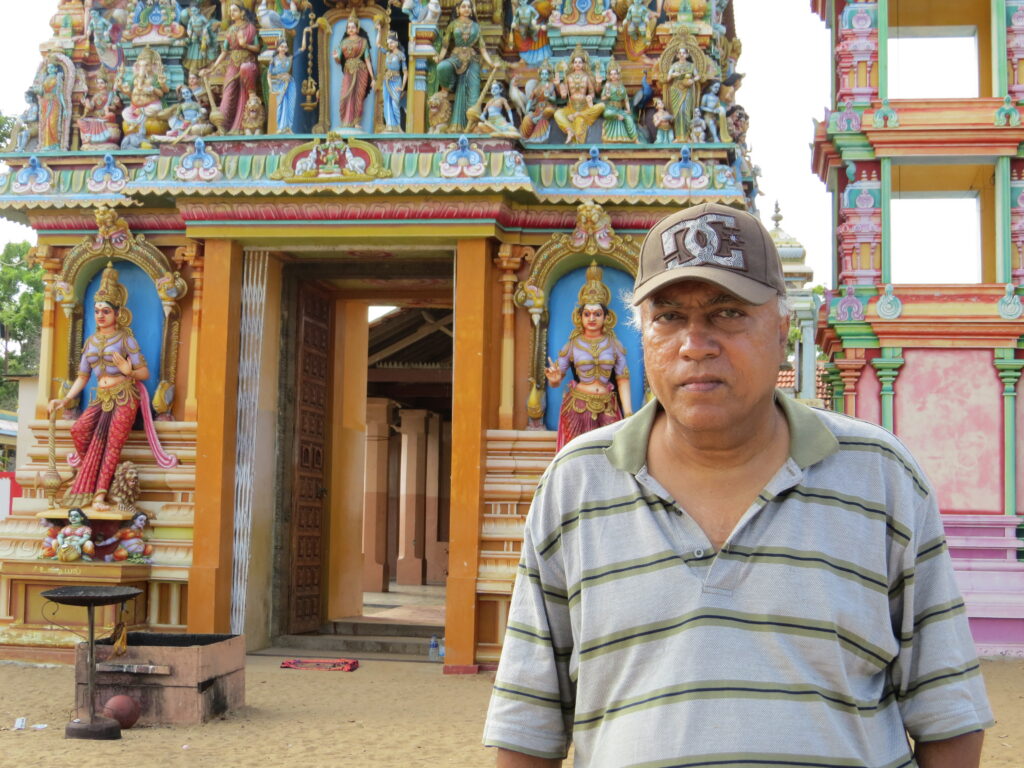
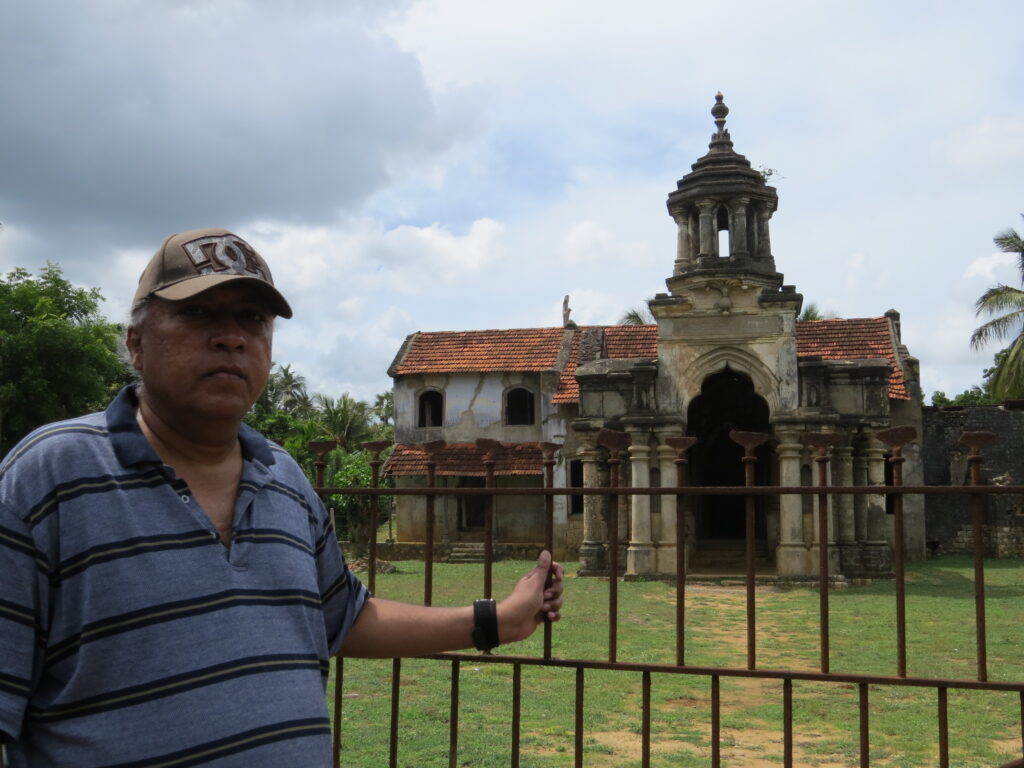
DBS at the legendary Vattraappalai Kannaki Amman temple in Mullaitheevu district. Image courtesy of Dushiyanthini Kanagasabapathipillai.
As anti-Tamil violence spread through Colombo, Jeyaraj had nowhere safe to stay and slept in the newspaper office.
Yapa took him home.
Mobs were moving through the streets and Tamils were being targeted, but Yapa refused to abandon his journalist.
“The newspaper has stood for the unity of the Sri Lankans,” he recalled. “I have no fear.”
Jeyaraj stayed with Yapa’s family during the violence.
Years later, when Yapa launched The Sunday Times, he sought him out again.
One of Jeyaraj’s early front-page stories involved the Indian High Commission. Living near the residence of Indian High Commissioner J.N. Dixit, Jeyaraj noticed black smoke rising from the area and went to investigate.
The resulting story angered Indian diplomatic officials.
But it demonstrated the instinct that had impressed Yapa years earlier: Jeyaraj saw something, questioned it and pursued it.
That instinct came at a cost.
He was seriously injured while reporting in the North. After moving abroad, he continued writing critically about the conflict and militant groups. He was later attacked while shopping and suffered broken legs.
Threats were also made against distributors of his newspaper.
He continued publishing.
For Yapa, the pattern was unmistakable: Jeyaraj did not easily submit to political or militant pressure.
He belonged to the truth
Thanabalasingham, sees Jeyaraj’s career in broader historical terms.
He describes him as a political chronicler who documented and analyzed Sri Lankan politics, particularly Tamil politics, as events unfolded.
“Jeyaraj dedicated his life to analyzing and writing fearlessly, and to documenting the complex dimensions of Sri Lankan politics, especially Tamil politics, as they unfolded in real time,” Thanabalasingham said
His columns connected immediate events to the history, personalities and geopolitical forces behind them.
They became required reading for politicians, diplomats and others trying to understand the conflict.
“His pen did not merely record the trends of history; it also helped us understand the depths from which those trends flowed,” Thanabalasingham says.
Jeyaraj’s position was often uncomfortable.
Different sides accused him of disloyalty and betrayal. At times, he was even accused of being a terrorist.
David (Marianne) believes that was partly because he refused to become an instrument of any side.
“His cause, I think, was always this country and its people,” she says.
Ibrahim (Hana) remembers the same quality.
“You have to admire his journalism because he did not compromise on truth,” she says. “For him, facts were sacred.”
“He favored the truth.”
The mentor behind the byline
Jeyaraj’s influence was not limited to what he published.
Ibrahim remembers him as a quiet, protective presence — a “very protective big bear.”
She recalls an incident around 1987, when she was asked to carry a parcel into several major buildings to assess their security.
She was young and did not question the assignment. She entered prominent buildings, including the Central Bank, and found that security checks were minimal.
When she returned, Jeyaraj was furious.
Not because she had found a good story.
Because she had put herself in danger.
“As soon as I walked in, he grabbed me by the arm and said, ‘You stupid, you’re so careless,’” Ibrahim recalled.
He warned her that her life mattered as much as the story.
“Your story is important, but your life is also important.”
That lesson stayed with her.
“Every time I think of him, that’s what I try to draw out.”
He was also the journalist she turned to when she needed help with a difficult story.
“If I want advice on how to do a story, what I need to do, all the details, he was the guy,” she says.
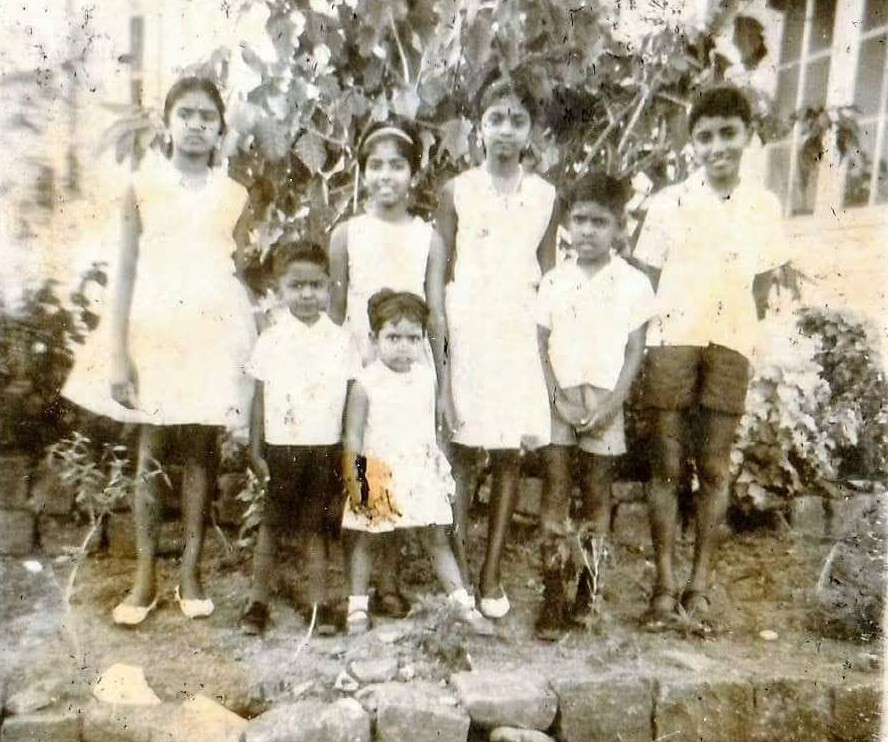
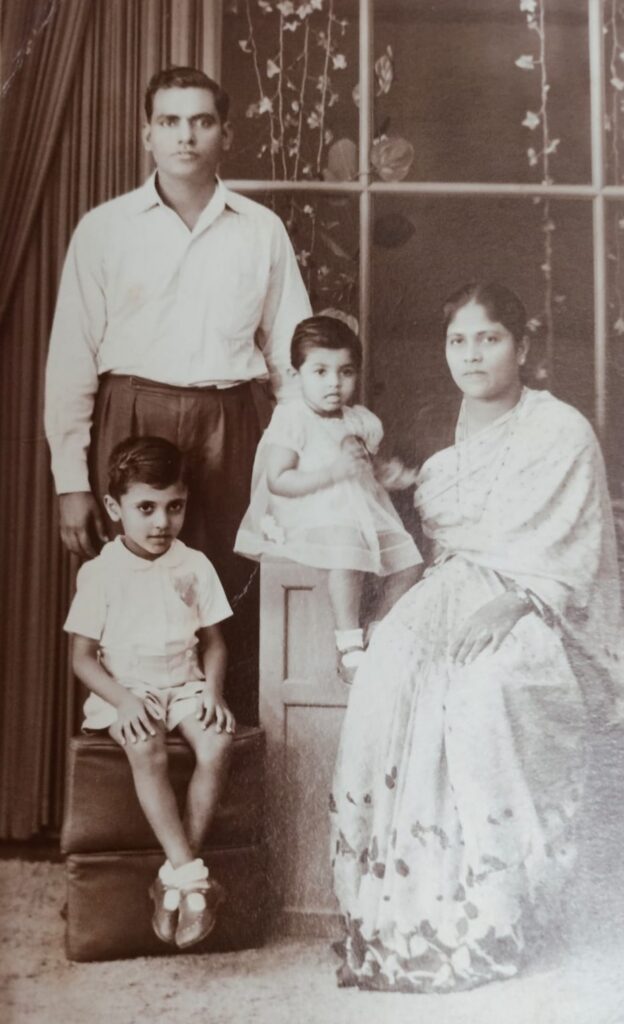
DBS (extreme right) with his siblings and cousins. Image courtesy of Sam Jeyaselvan.
The columnist young editors feared
David first knew Jeyaraj through his copy.
When she joined The Sunday Leader in 2001 as a sub-editor, she and her colleagues took turns editing his columns.
They could run 3,000 or 3,500 words and were packed with unfamiliar terminology, political analysis and intricate details about the North and East.
“It was really being thrown into the deep end,” David said.
Most of the sub editors were barely out of their teens.
“You don’t necessarily want to edit a 3,500-word copy about the war and politics.”
But the work taught them.
She edited his work for about six years at The Sunday Leader. Later, at The Nation, their professional relationship became a friendship.
Jeyaraj joked that his “co-author” was following him everywhere.
Behind the formidable columnist, David discovered a remarkably affectionate man.
He encouraged young journalists whose work impressed him, often tracking down their contact details simply to tell them so.
He remembered birthdays.
He sent David messages in both English and Tamil.
And he could be wonderfully exasperating.
If I did not respond to an email, he might send the same through another email account and Facebook Messenger.
He knew he was doing it.
“I panic about these things. I get anxious,” he would tell her.
David found it endearing.
It was another glimpse of the person behind the political commentator. Someone who valued reassurance, connection and friendship.
He left Sri Lanka. He never left it behind.
Jeyaraj left Sri Lanka in the late 1980s as threats surrounding his journalism intensified.
In 1988, he became a Nieman Fellow at Harvard University. He later settled in Canada and continued writing about Sri Lanka.
But those who knew him say he never stopped thinking about home.
David saw that most clearly when he returned to Sri Lanka in 2013 after about 25 years away.
“He was anxious about the visit and concerned about the possibility of arrest. He kept the trip quiet and avoided political meetings.”
Instead, he saw friends, family and places that mattered to him.
He visited Colombo and Jaffna, travelled in the South and returned to newsrooms that had been part of his life.
He also visited his ancestral property. The house was no longer familiar. Some of the trees were.
The old well remained. He drank its water.
“He was very sentimental about it,” David said while adding “he was very tender, very sensitive, very emotional.”
She said that Jeyaraj chose the same date he left the country 25 years ago to return to Sri Lanka 25 years later.
He also wanted to eat the food he remembered.
He planned to return.
He wanted to see Polonnaruwa, Kandy and Galle, and visit Wilpattu and Sinharaja.
He never did.
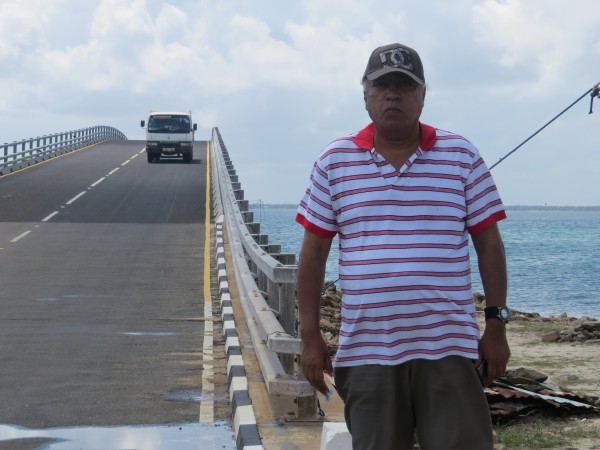
Near the newly Constructed Poonagari Bridge linking Jaffna Peninsula to Northern mainland. Image courtesy of Dushiyanthini Kanagasabapathipillai.
Journalist with a cultural memory
Politics and war dominated much of Jeyaraj’s professional life, but they did not define the full range of his interests.
Thanabalasingham remembers his deep affection for Tamil and South Indian culture.
Jeyaraj could write about geopolitics and militant movements with the same enthusiasm with which he wrote about cinema.
He wrote profiles of M.G. Ramachandran (MGR), Sivaji Ganesan and Jayalalithaa, as well as Sri Lankan artists.
“He could write a full-page article in English even about the movie songs he loved to listen to,” Thanabalasingham said.
That breadth was part of his understanding of Sri Lanka.
The country he wrote about was not simply a political map. It was made up of language, memory, food, music, cinema, personalities and places.
A friendship that survived distance
Thanabalasingham’s friendship with Jeyaraj lasted nearly half a century.
They both began at Virakesari, although their careers soon took them in different directions.
Jeyaraj joined the newspaper in April 1977 as a staff reporter. He later worked as its Jaffna and Batticaloa correspondent before moving into English-language journalism.
By 1981, he was at The Island.
The friendship remained.
“We never called him by his full name; to us, he was always just ‘D.B.S.,’” Thanabalasingham says.
Even from Canada, Jeyaraj called regularly. Conversations could last two hours, sometimes extending into the early morning.
In later years, he sometimes asked a haunting question:
“We wrote so much for so many years — was it all in vain?”
Thanabalasingham does not think so.
For four years before Jeyaraj’s death, he translated his political articles into Tamil and arranged for their publication in Virakesari.
The work continued.
DBS as a child with parents and sister. Image courtesy of Sam Jeyaselvan.
The archive he never finished
David had urged Jeyaraj for years to turn his journalism into a book.
They had discussed it for about 15 years.
His website, had been created largely as a platform for his own writing. But as illness affected his ability to write, preserving the archive became increasingly important.
The book remained unfinished.
So did the larger task of ensuring that decades of his journalism survived in accessible form.
The disappearance of old newspaper websites made the problem more urgent.
For a journalist who had spent his career documenting Sri Lanka’s conflict and political history, losing those articles would mean losing part of the country’s memory.
A final piece of writing
Jeyaraj did, however, leave one last piece.
Thanabalasingham had recently published Pathirigaithuraiyil En Kathai (My Story in Journalism), a book about his life in journalism.
Jeyaraj wrote its foreword in English and sent it on March 9, 2026.
Thanabalasingham published it in English, exactly as Jeyaraj had written it.
He believes it may have been Jeyaraj’s last piece before illness overtook him.
The book was launched May 17 at the Colombo Tamil Sangam.
As preparations were underway, Thanabalasingham received a WhatsApp message from Jeyaraj’s wife.
His friend had died.
At vintage “Manthiri Manai” mansion at Sangilithoppu in Nallur. Image courtesy of Dushiyanthini Kanagasabapathipillai.
What he left behind
Jeyaraj’s career began at Virakesari in 1977 and took him through some of Sri Lanka’s most important newsrooms. He wrote for The Island, The Sunday Times, The Sunday Leader, The Nation, The Hindu and Frontline, among others.
He founded Tamil-language publications after moving to Canada, became a Nieman Fellow and received major recognition for his journalism.
But his former colleagues remember more than the résumé.
They remember the journalist who walked into Yapa’s office and produced an exceptional Cabinet report.
The colleague who slept in a newsroom during Black July because he had nowhere safe to go.
The reporter who saw smoke and went looking for the story.
The demanding columnist whose 3,500-word articles forced young editors to learn.
The mentor who called young journalists simply because he admired their work.
The protective colleague who believed a reporter’s life mattered as much as a scoop.
The friend who remembered birthdays and worried when messages went unanswered.
The Sri Lankan who returned after 25 years and drank water from an old well on his family’s former land.
And the chronicler who, after decades of writing about war, politics and nationalism, still wondered whether it had all been in vain.
Perhaps his colleagues have already answered that question.
Jeyaraj did not simply record Sri Lanka’s divisions.
He tried to make one part of the country understand another.
He questioned every side.
He challenged power.
He protected people.
And he kept writing.
For a journalist who spent his life explaining Sri Lanka, that may be the most enduring explanation of all.
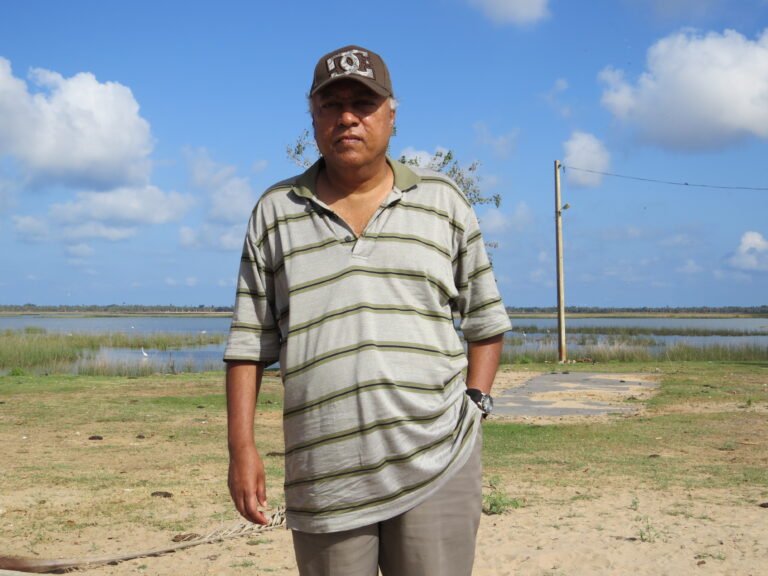
BannerImage: DBS at Nanthikkadal Mullaitheevu lagoon during his visit to Sri Lanka in 2013. Image courtesy of Dushiyanthini Kanagasabapathipillai.
This story was written and edited by Gagani Weerakoon. She leads the editorial at the Center for Investigative Reporting (CIR).
Hunger and violence push children from home. Drugs, criminal exploitation and barriers to care make leaving the streets harder.
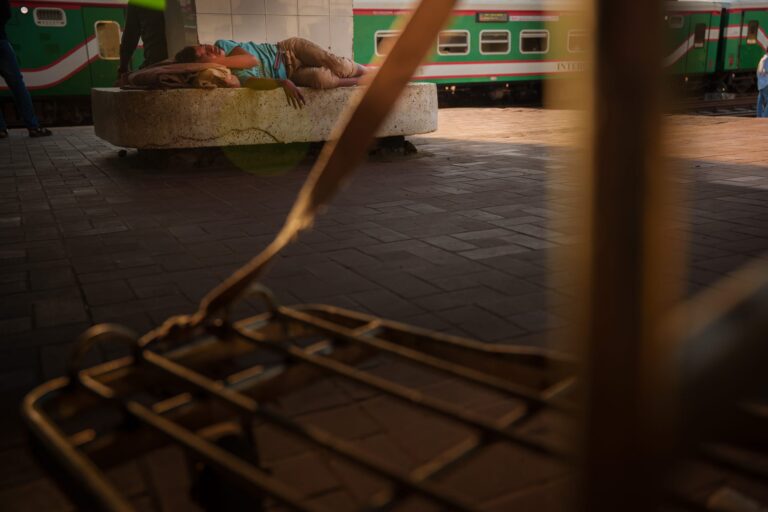
At midday in Palton, a child sleeps beneath Dhaka’s metro-rail pillars. Beside him lies a crumpled plastic bag containing industrial glue, inhaled as an intoxicant known locally as “dandi”.
The scene captures one part of a larger trap. Children escape hunger or violence, only to encounter drugs and adults who exploit them. Meanwhile, the institutions meant to offer an alternative can be difficult to enter — or frightening to stay in.
Netra News visited eight locations across Dhaka, interviewing 15 children and five adults who grew up on the streets. Their accounts suggest that the crisis persists because the routes out are often as uncertain as the routes in.
Research has identified hunger and domestic violence as reasons children leave home. Even an institution can fail to provide refuge. Sathi, who grew up in an orphanage, said:
“In the orphanage, you have to pay to eat. If I had to pay 5 taka, I had to come down to the streets.”
Once outside, she said, people lured her away and exploited her.
Children playing at the landfill near the Buriganga River in Kamrangichar. Image courtesy of Al-Amin Tusher/ Netra News.
Drugs, gangs and survival
Some children use substances to cope with hunger, trauma and distress, according to theConsortium for Street Children. But drugs can introduce further harm into already precarious lives.
Children can also be drawn into the drug trade. A Department of Narcotics Control study of 1,600 street children reported that 58% of those surveyed were addicted to drugs and 21% were used as drug carriers.
A2021 study of 53 street children described links between poverty, gang recruitment and criminal involvement, including theft and drug dealing. Its small sample cannot establish how common those patterns are among all street children. But the accounts collected by Netra News show how coercion can work.
One child described being ordered to deliver packets, and what happened when a friend refused.
“A friend of mine said, ‘I won’t do bad work’, so they pulled him.”
The child also described being beaten: “You know the rod? I got hit on the leg with a rod. Look, the whole leg burst open.”
Those issuing orders claimed to be police. The account does not establish their identities or the packets’ contents. It describes a child carrying out deliveries amid intimidation and violence.
LEEDO’s founding director said criminal groups could readily exploit children whose disappearance might attract little attention.
“If they die in a train accident, if they die in a road accident, or if someone kills them, actually there is no one to search for them.”
For girls, even the search for protection can create dependence. Umme Salma Akter Urmi, director of Pother School, said some students entered relationships they described as marriages at ten or eleven.
“When she says that she is someone’s wife, other men harass her less.”
Urmi also described girls pressured into sexual exploitation by relatives or the people sheltering them. Having a protector is not necessarily the same as being protected.
The obstacles to leaving
Legitimate opportunities can be harder to access. A 2025 Caritas Bangladesh survey of 667 street children in three cities found that more than half lacked birth registration.
LEEDO encounters demands for parents’ national identity documents when seeking birth certificates to enrol children in school. Its director asked:
“So, we don’t even find the addresses of these parents, where will we find the National ID of that child’s father… of the parents.”
The procedure assumes access to the very adults whose absence may explain why help is needed.
A shelter does not necessarily resolve the problem either. One child who stayed at a Sheikh Russel rehabilitation centre alleged being restrained and beaten with sticks, iron rods and bats. Lawyer Faysal Ahmed recalled children moved into a safe home to prevent trafficking, asking whether they would ever be free.
Government figures list 17 integrated rehabilitation centres nationwide, serving 19,668 children between August 2012 and March 2026. That cumulative total does not show how many found a lasting alternative to street life.
Russel Ahmed, a deputy secretary in the Ministry of Social Welfare, said four centres opened in January 2025 without additional recruitment. Existing staff were reassigned.
“It is not possible to give any new appointments because they don’t have any service rules.”
Night falls over Dhaka’s Central Shaheed Minar as a homeless family seeks rest together on the open pavement. Image courtesy of Jibon Ahmed/ Netra News.
When the law steps in
The criminal-justice system can become another obstacle. Faysal Ahmed recalled meeting a child in 2016 who had been arrested in an Explosives Act case over a bomb attack during a strike. According to the investigating officer’s testimony, more than 100 police officers took part in the operation, but only the child was arrested.
“100 people got together and arrested one child!”
Ahmed said the child spent three and a half years without trial before being freed.
Towhidul Haque, a Dhaka University expert on society and crime, argues that the state mobilises against children associated with criminality after failing to protect them from exploitation. Rehabilitation projects, he says, cannot substitute for addressing why children become homeless.
Kulsum, left at Kamalapur at ten or eleven, now wants that chance for her own child.
“Now, after working and saving some money, when we have some money, we will leave.”
She has a reason to leave. What she lacks is a dependable way out.
Banner Image: A homeless street child sleeps on a concrete bench at Komlapur railway station, where abandoned and runaway children often seek temporary refuge. Image courtesy of Al-Amin Tusher/ Netra News.
Investigative journalists are a bit peculiar. Many of us carry a strange mix of hero complexes and impostor syndrome. One moment we think we are about to change the world, next, we suffer in agony feeling unable to write a decent story.
“Not another fucking leak!” a colleague cried after I teased them with a new project similar to an investigation we worked on a year earlier. “Why are we doing this to ourselves?” asked another, but not before already coming up with deadlines to start work. One small team: many different personality types.
How do you run a newsroom full of people whose job is to question authority? How do you convince them to stick to a workflow when they love to challenge accepted norms?
Despite sharing certain instincts, investigative journalists have different strengths and weaknesses. Some prefer to be left alone, others do their most powerful work when part of a team. Some thrive on data analysis, others on building up impactful personal relationships. But there can be challenges, too, with a genre of journalist known for asking difficult questions: How do you run a newsroom full of people whose job is to question authority? How do you convince them to stick to a workflow when they love to challenge accepted norms?
After talking to reporters and editors, I identified six newsroom archetypes. To be sure, I am not a psychologist, and these are not professional conclusions, and they are certainly not mutually exclusive. But perhaps by thinking about our differences, our strengths and weaknesses, the categories can help editors understand what different reporters bring to an investigation, what may derail them, and what kind of support they need.
So which ones do you recognize in your own newsroom, or in yourself? Are there more we have missed?
Image: GIJN/ Illustration: Shutterstock
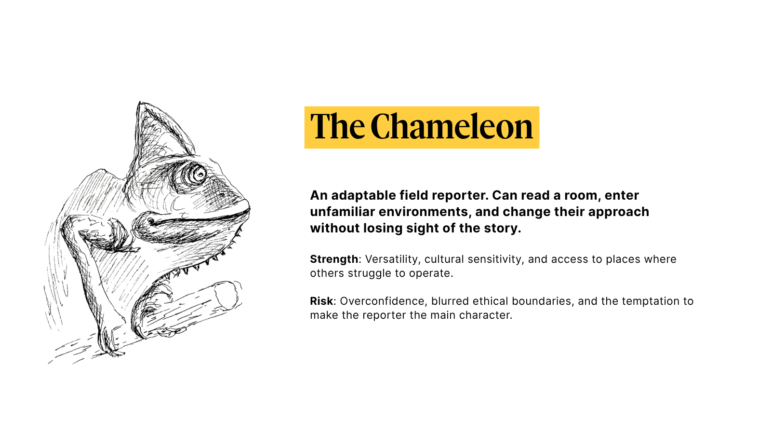
“I thought every journalist needed to be like a chameleon,” says John-Allan Namu, co-founder of Africa Uncensored. “You are covering different kinds of assignments, and where the story takes you, you kind of have to go.”
Marina Walker Guevara, the Pulitzer Center’s executive editor and previously the deputy director of the International Consortium of Investigative Journalists (ICIJ), has seen journalists move comfortably between radically different worlds. “You can see them today addressing a group of high-powered editors and tomorrow having tea in the rainforest, making people feel comfortable,” she says.
The important quality here is not one of performance. It is humility. A genuine chameleon does not enter every environment believing they can control it. They adapt because the story and the people require it, not because they want to demonstrate how fearless they are.
Undercover reporting is the most extreme version of this tendency. It can reveal wrongdoing that would otherwise remain hidden, but it also introduces deception, privacy concerns, security threats and the risk of entrapment – and not every chameleon is able to handle that.
Image: GIJN/ Illustration: Shutterstock
“That is the classic hyper focused person,” says Tina Lee, the editor-in-chief of Unbias The News, a feminist cross-border newsroom.
“They are very valuable members of any team. Somebody must have that natural impulse to do the paperwork, to send the FOI requests. The paper trail is also an addictive part of journalism. It’s like you are pulling the thread and getting more and more. But at one point, there needs to be someone else to pull them out of the weeds and say: ‘We have enough information, let’s go talk to people.’”
Eli Moskowitz, who coordinates environmental investigations for the Organized Crime and Corruption Reporting Project (OCCRP), says: “I like to work with people who are obsessive paper-trail-hunters, as long as they share everything.”
But there is a risk that some paper-trailers keep their findings to themselves. ““When someone says that they’re a lone wolf before joining a collaboration, I get a little bit uneasy,” he adds.
Image: GIJN/ Illustration: Shutterstock
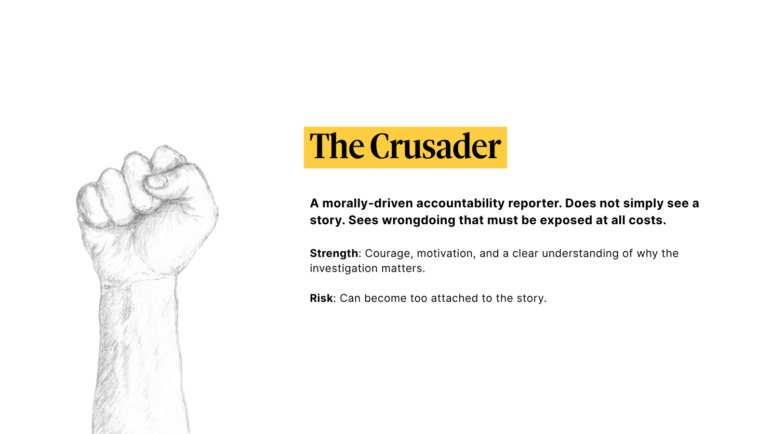
This is a journalist who often works for years exclusively on one topic. They have a sharp vision of the relevance of the story they are working on.
“Their strength is their motivation,” says Lee. “Someone who is very motivated will also be motivated to go through paper after paper, dig in the archives, knock on doors, or build more sources.”
Craig Shaw, editor and director of The Black Sea, says this type of journalist is often very passionate: “Everything is dramatic and everything has to happen now, or this is the end of the world if this doesn’t happen.”
That urgency can keep an investigation alive. It can also make contradictory evidence feel like an obstacle.
Generally, there is a perception that this newsroom personality type is more prone to be categorized as an activist journalist – but that too brings pros and cons. “That impression will cut off certain sorts of people that will speak to you, [but] that will also shine through in your writing,” Lee says.
Image: GIJN/ Illustration: Shutterstock
This is the journalist who somehow knows everyone: judges, activists, prosecutors, retired police officers, drug dealers…
“What all of them have in common is at least giving off the vibe that they’re nonjudgmental,” says Lee. “To keep trust after you write stories about people is hard.”
Namu considers that ability fundamental. “We need to be able to get along because journalism is about people,” he points out. “If not, then how are you ever going to be able to get the right kinds of sources?”
OCCRP’s Moskowitz remembers one incident dealing with a “human magnet” colleague who was taking calls from his laptop in smoky bars.
“You’re saying, ‘This person is not taking this seriously,’” he says. “Then, next thing you know, they’ve found the key subject of our investigation and made major breakthroughs.”
Human magnets might be very good at befriending people, but “If you want to be friends with everybody, that’s always a weakness in journalism,” Lee says. “If you have three sources inside and you talk to those sources all the time, but the sources on another side aren’t willing to talk to you, this can produce bias.”
Image: GIJN/ Illustration: Shutterstock
The data-obsessed journalist finds stories in datasets, code, satellite images, and other digital traces.
“One of their strengths is that they are usually sense-checkers in any newsroom,” Namu says. When other reporters reach for an analogy, the data nerd can say: “No, actually, this is what happened.”
“They also help us see beyond the things that are obvious and visible,” he adds. “They have a nose for news, but in a different way.”
Technical knowledge can create a power problem inside a collaboration, however. If only one person understands the analysis, the rest of the team cannot properly challenge what was counted, excluded, or assumed.
“The best kind of data nerd is also the one that can understand how this applies to individuals and how this impacts real lives,” says Lee of Unbias The News.
Walker Guevara has also experienced data specialists who become too attached to their formulas and tools. “They are like: Why is nobody using my amazing tool called Aphrodite? Well, because you built Aphrodite for your own needs. You need to know who your public is before you build your Aphrodite.”
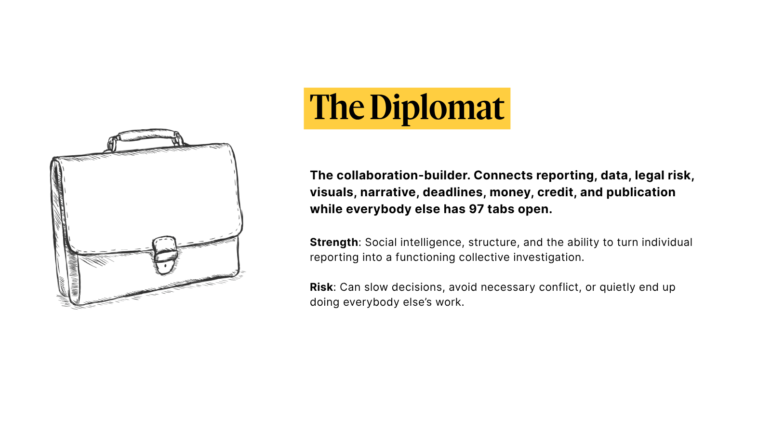
“They’re really good at personal relationships. I know a few of these diplomats, and they’re really amazing under pressure and with other people,” says The Black Sea’s Zeynep Şentek.
“They are such an important person in investigative work, especially in collaborations,” Namu adds. “There are times when journalists get lost in the weeds, or you are in the middle of a story and wondering how this is going to pan out. Yet there is someone constantly egging you on, trying to put facts in front of you, and help you collaborate better.”
Namu partly identifies with the type and recognizes its costs. “One thing that you do lose with a person like that who is constantly consensus-building is speed,” he says.
But coordination becomes a power issue when it is expected rather than formally assigned. Lee says women are frequently pushed toward the role because of an assumption that they will be more accommodating.
“There is a feeling that women are nicer. I mean, that’s already shit, right?” she says. “But it’s kind of emotional care work: getting people on the phone but also mediating conflict.”
“What pisses me off a little bit is that it is still largely played by women,” Walker Guevara concurs.
The other danger appears when the team begins to struggle. This person will take over unfinished tasks, resolve every disagreement, and carry the project across the finish line. The story gets published, but the team does not improve because one person has been doing the heavy lifting for everybody else.
But this character must not be confused with a people-pleaser type. “The real diplomat is the one that wants to bring everyone together but has a very clear idea of what the red lines are,” says Walker Guevara.
Their work is often invisible. Lowering the temperature, resolving conflicts, and protecting relationships take time, time that may then be missing from the diplomat’s own reporting.
Who Gets Called ‘Difficult’?
The same behavior can be interpreted differently depending on who displays it. One reporter may be characterized as independent; another as uncooperative. One is uncompromising; another is labeled as aggressive. One is a natural leader, another controlling. Gender, nationality, and economic status often decide which label sticks.
“I have seen a lot of women struggle when they assert themselves as journalists on the basis of the reporting they have done,” Namu says. “They are looked at as being arrogant or standoffish, when really what they are doing is standing by their work and standing for the work.”
Editors or team leaders should consider not only which working style a journalist leans towards, but how newsroom power dynamics shape the way that style is perceived, rewarded, or punished.
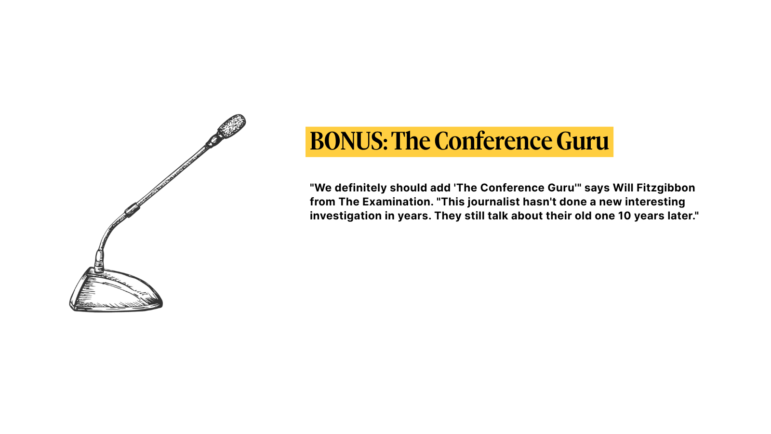
“We definitely should add ‘The Conference Guru’” says Will Fitzgibbon from The Examination. “This journalist hasn’t done a new, interesting investigation in years. They still talk about their old one 10 years later.”
Image: GIJN/ Illustration: Shutterstock
The Type No Team Needs: The Brilliant Jerk
Walker Guevara uses a term she credits to her mentor Dawn Garcia, the director of the John S. Knight Journalism Fellowships at Stanford University: “The brilliant jerk.”
“This person is accomplished, confident, and sometimes charming. They may bring a rare skill or an impressive reporting record. But they work for themselves rather than the team. They hoard information, put colleagues down, and challenge decisions without helping resolve them,” says Guevara. The difficult question for an editor is whether the person’s brilliance justifies the damage.
Walker Guevara’s answer is unequivocal: no. “There are enough brilliant, supportive, collaborative people out there in the world and in the journalism industry,” she says. “The brilliant jerks can work among themselves. Good luck to them.”
In reality, most investigative journalists are probably messy hybrids: part bloodhound, part crusader, part exhausted data nerd running on coffee and suspicion, hopefully not the guru.
And most teams that thrive will probably have a mix of people on them bringing their different strengths. As Walker Guevara explains it, team composition is an editorial decision. “The management starts in the selection process,” she says. “And that is what is going to determine how nightmarish or how blissful the rest of the experience is going to be.”
“It is your responsibility to be a judge of character and to know that there are certain characteristics you’re going to need for this team to function well and for everyone to be able to do their best work,” she explains.
Or as Lee puts it: “The best kind of investigation has a bit of all of them.”
Serdar Vardar is a freelance investigative journalist based in Berlin mainly reporting for Deutsche Welle. His work follows the money, covering power and the political incentives behind environmental harm. He has investigated greenwashing, asbestos risks, toxic mining, political influence networks, and deep-sea mining finance. He has worked on major global investigations including Pandora Papers, Shadow Diplomats, and Deforestation Inc. with his work appearing in Al Jazeera, ICIJ, and OCCRP. He considers himself 20% human magnet, 30% chameleon, 50% bloodhound.
CIR Co-founder Dilrukshi Handunnetti delivered the Presidential Address at Madurai International Communication Conference (MICC) on 24 September. Organised by the School of Linguistics and Communication at Madurai Kamaraj University, Madurai, under the theme “Environmental Communication, Climate Action, Emergent Media & AI,” her address explored the transformative potential of AI and emerging media in climate communication, the importance of ethical and impactful digital storytelling, the environmental costs of technology, and the challenges of ‘digital extractivism’ and protecting indigenous ecological knowledge.
The second edition of the conference took place from September 24–25, 2026, in a hybrid format, focusing on environmental communication, climate action, emergent media, and artificial intelligence.
Al comparar casinos en línea, teniendo en cuenta la variedad de juegos, pensando en un uso regular, una plataforma que puede revisarse de forma independiente es chicken subway juego , mientras una revisión independiente también puede abarcar la experiencia móvil y la navegación, junto con las reglas de retirada y los límites antes de registrarse.
Vor der Entscheidung, welche Seite näher geprüft werden soll, beim Vergleich von Navigation und Bedienkomfort, als Teil eines unabhängigen Vergleichs, eine Option für den direkten Vergleich ist fugu casino 5 , separat kann man auch betrachten die aktuellen Aktionsbedingungen, zusammen mit den wichtigsten Bedienungsdetails ohne die endgültige Wahl zu überstürzen.
Før man beslutter hvilken side der bør undersøges nærmere, ved vurdering af mobil brug, fra et praktisk brugerperspektiv, en platform der kan vurderes uafhængigt er https://spinlander-casino.dk/ , mens en uafhængig vurdering også kan omfatte registrerings- og verifikationsprocessen, med kundesupportens tilgængelighed i tankerne uden at forhaste den endelige beslutning.
Dla użytkowników zestawiających kilka platform jednocześnie, z uwzględnieniem metod wpłat i wypłat, na potrzeby wstępnej oceny, jednym z punktów odniesienia może być kasyno na prawdziwe pieniadze jeśli jednocześnie ocenia się najważniejsze warunki korzystania z serwisu, wraz z zasadami dotyczącymi wypłat w ramach szerszego porównania podobnych serwisów.