
Colombo— What began as a disturbing experiment in manufacturing attractive, apparently ordinary Sri Lankan women on Facebook has evolved into something with far more serious implications: the use of synthetic identities and AI-generated media to influence political discourse.
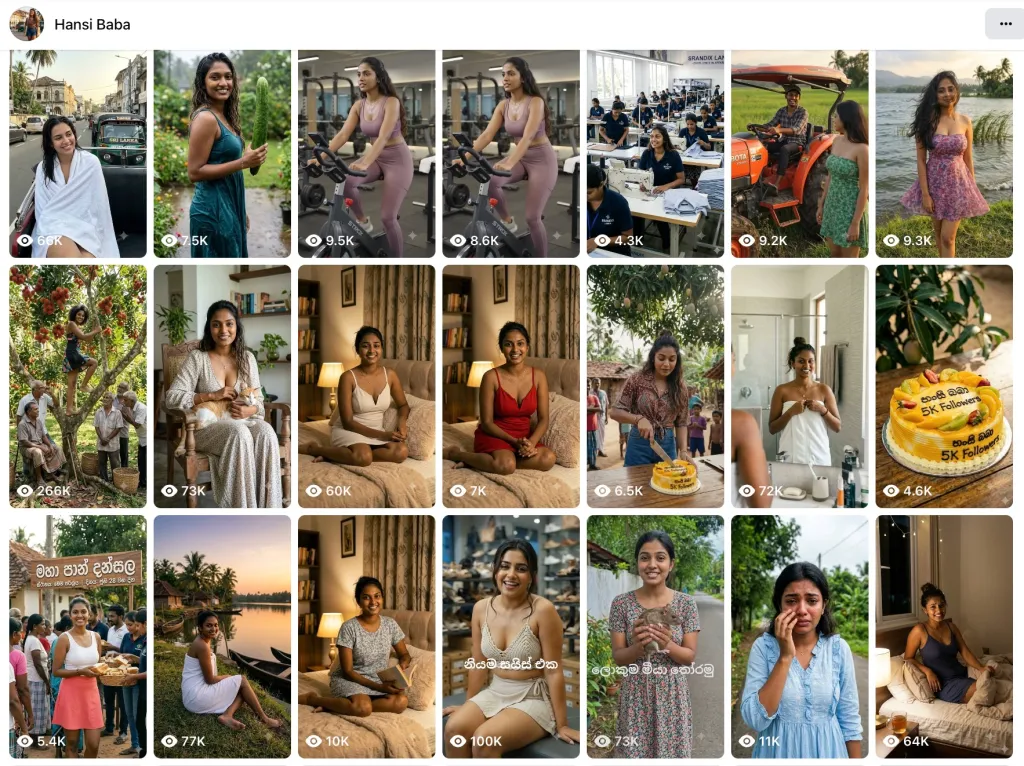
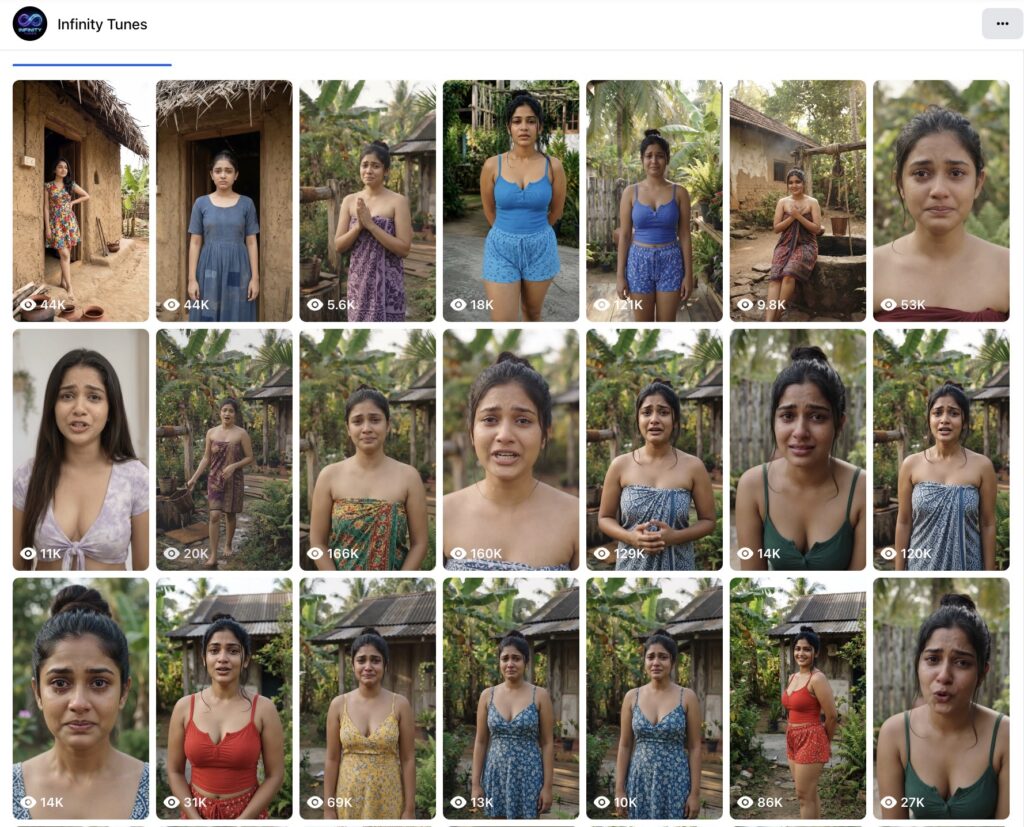
A June report examining AI-generated female personas on Facebook found that accounts were creating fictional Sri Lankan women, giving them recognizable names and constructing seemingly ordinary lives around them. Their sexualized images and fabricated intimacy were then used to attract attention, move users into private conversations and direct traffic toward adult-chat services, gambling, cryptocurrency and other questionable financial destinations.
The report, based on a detailed examination of 10 principal personas and a wider network of engagements, found evidence suggesting that the accounts were not simply isolated examples of AI-generated content. Their patterns of interaction, audience-building and off-platform links pointed to a potentially broader influence and monetization model.
Comparisons with AI-generated accounts targeting Spanish, Italian and Malayalam-speaking audiences also demonstrated how easily the production and engagement model could be reproduced across languages and communities.
At the time, however, there was limited evidence that the 10 accounts examined were part of a political influence operation.
That distinction would become increasingly significant within months.
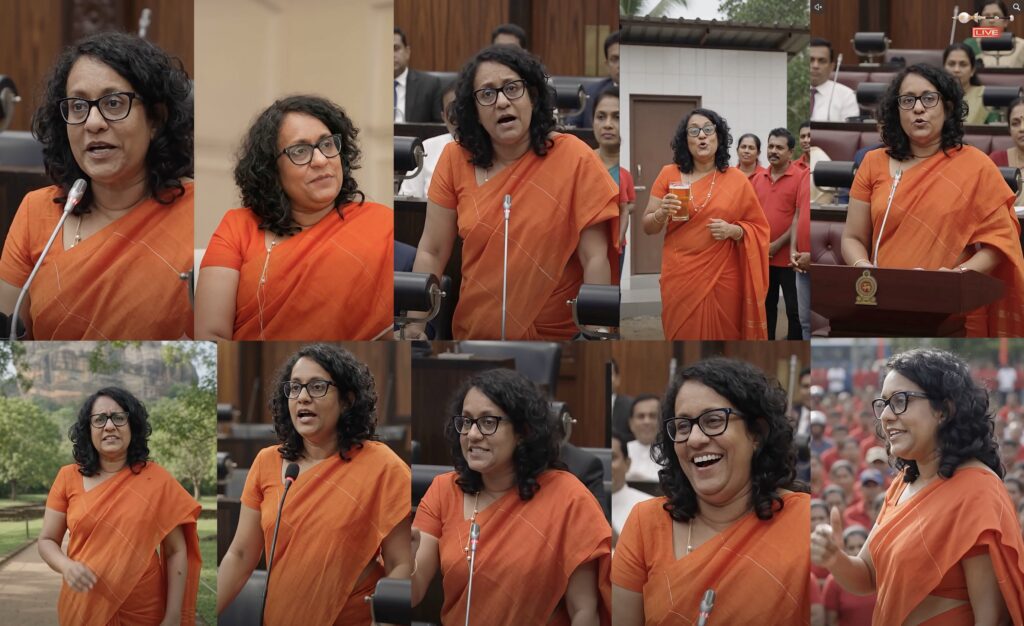
By late August, sophisticated, high-resolution AI-generated deepfakes of Sri Lankan Prime Minister Harini Amarasuriya were circulating on Facebook. In one video, the prime minister appeared to promise that the government would solve dengue by making mosquitoes homosexual.
That video alone attracted about 324,000 views. Nine additional impersonation videos, portraying Amarasuriya as admitting government incompetence, ridiculing supporters or acknowledging that political promises had failed, pushed the combined view count beyond 1.2 million.
The videos carried a visible watermark from the AI platform used to generate them. Yet, during an inspection of the 10 individual Facebook video pages, no platform-native AI-content label was displayed.
The reaction in the comments demonstrated the difficulty of relying on audiences to identify synthetic media on their own. While some users recognized that the videos were AI-generated, many others appeared to treat them as genuine, congratulating the deepfake version of the prime minister for supposedly “telling the truth.” The comment sections were also dominated by misogynistic and abusive remarks directed at Amarasuriya.
The development raises a broader question for Sri Lanka: what happens when the infrastructure already used to manufacture synthetic women, build audiences and move users across opaque digital channels is repurposed for political influence?
Synthetic intimacy, political manipulation
The June report had already identified an ecosystem in which AI-generated identities could attract large audiences through familiar visual and social cues, establish an appearance of authenticity and direct users toward destinations beyond Facebook.
That infrastructure can also be adapted for political messaging.
For policymakers and journalists, the emergence of AI-generated political impersonation points to a new challenge for electoral and democratic integrity. Sri Lanka’s existing oversight and regulatory systems were developed for a media environment in which political actors, voters and campaign material could generally be tied to identifiable people and organizations.
Generative AI complicates that assumption.
Synthetic personas can be created at scale, altered rapidly and deployed across multiple languages and communities. They can also combine highly familiar prejudices, including misogyny, political polarization and distrust of institutions, with increasingly convincing synthetic audio and video.
The implications extend beyond elections. AI-generated political content could influence public debate before campaigns formally begin, distort perceptions of political figures and shape how citizens understand events between elections.
Sri Lanka’s next general and presidential elections will take place in an environment in which the ability to create and circulate convincing synthetic media is likely to be substantially greater than it is today.
The risk is not limited to fabricated statements by politicians. Synthetic media can exploit major events, economic uncertainty, geopolitical tensions and public anxiety to create narratives designed to provoke anger, fear or distrust among large online audiences.
A global template
The Sri Lankan experience also reflects a much wider development in the use of AI-generated human personas.
Journalist and writer Marina Adami’s reporting for the Reuters Institute documents the growing use of AI-generated news presenters and avatars by news organizations from Seoul to Mexico City. Many of these synthetic presenters are young, conventionally attractive women.
The aesthetic template is strikingly consistent: thin bodies, conventional notions of beauty and highly polished, often unrealistic appearances.
Adami’s reporting also documents the explanations offered by some organizations for using female AI presenters, including claims that audiences are more comfortable receiving information from feminine voices. Other accounts are more blunt, acknowledging that gendered design is influenced by audience and consumer-testing data.
The Sri Lankan AI personas therefore did not invent the association between femininity, attractiveness and availability. They draw on an aesthetic and commercial model that has already been normalized elsewhere.
What makes the Sri Lankan case particularly significant is how that model intersects with Facebook’s attention economy.
The same visual conventions that can be used to attract engagement and monetize synthetic identities can also be repurposed to build political audiences, amplify partisan narratives and distribute fabricated statements attributed to real politicians.
The platform problem
The issue is therefore not simply whether people can identify AI-generated content.
It is also about whether platforms can identify, label and limit synthetic media that is designed to deceive, particularly when that content targets public figures during politically sensitive periods.
The absence of a platform-native AI-content notice on the deepfake videos examined in the report raises questions about how effectively users are being informed about the provenance of content they encounter.
The scale of engagement adds another dimension. A fabricated video does not need to convince everyone who sees it to have an impact. Its reach, repetition and ability to generate thousands of comments and shares can contribute to a broader information environment in which authentic and fabricated material become increasingly difficult to distinguish.
The evolution documented across the two reports therefore points to a continuum rather than two unrelated phenomena. AI-generated identities can first be used to attract attention and build audiences, and the same underlying techniques can subsequently be adapted to political messaging.
The question for Sri Lanka is no longer whether synthetic media will become part of its information environment. It already has.
The more urgent questions concern who is producing it, who benefits from its circulation, how platforms respond, and whether regulators, journalists and the public have the tools needed to distinguish manufactured reality from the real thing.
Download the report in full here.
Banner Image: Comparisons with AI-generated accounts targeting Spanish, Italian and Malayalam-speaking audiences also demonstrated how easily the production and engagement model could be reproduced across languages and communities. Image via sanjanah.wordpress.com.
This report was produced by Dr. Sanjana Hattotuwa and was originally published on sanjanah.wordpress.com. He studies information disorders, influence operations, and information integrity in order to evaluate the impact on public opinion, political discourse and democratic institutions.