

Speed Read
- Transparency International Sri Lanka (TISL) has challenged the Bill in the Supreme Court, arguing that several provisions violate constitutional protections.
- People’s Action for Free and Fair Elections (PAFFREL) says restrictions on the use of asset declarations could undermine public scrutiny of politicians and other public officials.
- The bill raises the state-ownership threshold from 25% to 50%, potentially excluding companies with significant minority government ownership from certain anti-corruption obligations.
- The requirement to declare the assets of cohabitants would be removed, which critics say could create a loophole for concealing assets.
- Use of redacted asset declarations could become a criminal offense, carrying a fine of up to $305 (Rs. 100,000) or up to one year in prison.
COLOMBO—Sri Lanka’s proposed amendments to its anti-corruption law are facing growing criticism from election monitors, civil society and governance advocates, who claimed provisions intended to strengthen the framework could instead restrict public scrutiny, weaken accountability and concentrate powers within the anti-graft commission.
The Anti-Corruption (Amendment) Bill, presented to Parliament by prime minister Harini Amarasuriya on Aug. 19, is intended by the government to address legal and interpretation problems in the Anti-Corruption Act No. 9 of 2023, as well as administrative and technical issues affecting the Commission to Investigate Allegations of Bribery or Corruption (CIABOC).
Civil Society groups, accountability and good governance experts have raised concerns over provisions affecting asset declarations, state-linked companies, bail and the powers of CIABOC officials.
TISL takes Bill to Supreme Court
Transparency International Sri Lanka (TISL) filed a petition in the Supreme Court on Aug. 31, challenging several provisions of the proposed amendments.
TISL claimed that the contested provisions are inconsistent with Articles 1, 3, 4, 12, 13, 14(1)(a), 14A, 126, 140 and 156A(1)(c) of the Constitution. It says the amendments could affect the sovereignty of the people, the right to information and judicial power.
Among its central concerns is a provision allowing the director general of CIABOC to decide whether to refrain from prosecuting accomplices without authorization from a magistrate. TISL states that this removes an important layer of judicial oversight.
The organization has also challenged the proposed increase in the state-ownership threshold from 25% to 50%. Under the amendment, companies in which the state or a public corporation holds between 25% and 49.9% would fall outside the relevant definition.
TISL stated that the change could exclude entities handling or controlling public assets from important asset declaration and anti-corruption requirements.
The petition also challenged the removal of the requirement to declare the assets of cohabitants, as well as new restrictions and criminal penalties relating to the use of redacted asset declarations.
TISL has urged the Supreme Court to determine that the disputed provisions cannot become law unless approved by a two-thirds majority in Parliament and at a referendum.
Transparency rollback
Meanwhile, PAFFREL has separately called on President Anura Kumara Dissanayake to reconsider provisions that it says could restrict public access to and use of asset and liability declarations.
PAFFREL executive director Rohana Hettiarachchi said the 2023 Anti-Corruption Act represented an important step toward transparency and accountability because it allowed members of the public to scrutinize declarations made by public officials.
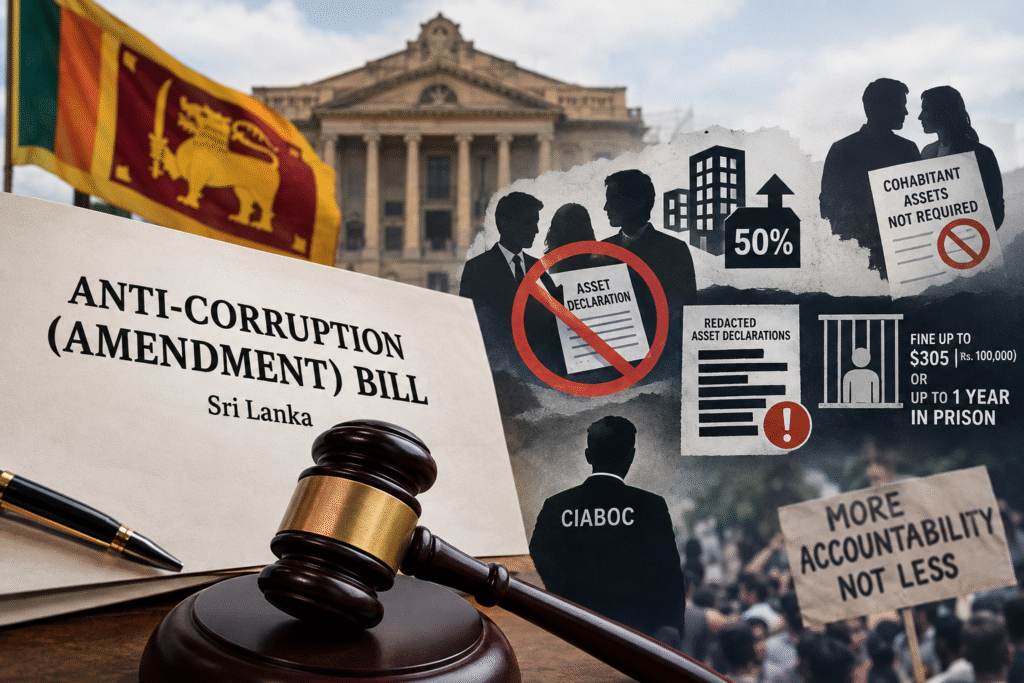
The proposed amendment would restrict how redacted declarations obtained by the public can be used. They could be used only for submission to specified officers or institutions under the Act. Breaching that restriction could result in a fine of up to $305 (about Rs. 100,000), imprisonment for up to one year, or both.“Journalists, civil society groups and citizens should be able to examine declarations, identify discrepancies and question whether the wealth of public officials is consistent with their legitimate income,” Hettiarachchi told CIR.
The organization also objected to raising the state-ownership threshold from 25% to 50%, warning that companies in which the government holds a minority stake could fall outside the relevant anti-corruption framework.
Another concern is the removal of the requirement to declare the assets and liabilities of a person who has lived with the declarant and shared the same household for at least six months.
PAFFREL cautioned that this could potentially allow assets to be held in another person’s name while remaining under the control or for the benefit of the public official.
At the same time, PAFFREL acknowledged that the Bill contains positive provisions aimed at addressing gaps and ambiguities in the existing anti-corruption framework. It has called for wider public discussion before the amendments proceed.
‘Best way to deal with rumors’
For Manjula Gajanayake, executive director of the executive director, Institute for Democratic Reforms and Electoral Studies (IRES), the controversy goes beyond technical amendments to an existing law.
Gajanayake said the proposed Bill should be viewed alongside the government’s proposed 22nd Constitutional Amendment and NGO Bill as documents that could reveal the broader direction of the National People’s Power government.
He described the anti-corruption legislation as a “mirror” through which the government’s approach to transparency, public scrutiny and dissent could be examined.
His strongest concern is the proposed restrictions on public access to asset and liability declarations.
Gajanayake asked why public access should be restricted if the government believes journalists or others are misusing the information.
“If you hide information, rumours will only grow,” he told CIR, adding that transparency is a more effective response.
He also queried the rationale for removing the requirement to disclose the assets and liabilities of people who have lived with a declarant for at least six months.
Gajanayake suggested recent criticism of politicians’ asset declarations on social media could be one factor behind the proposed restrictions, pointing particularly to Facebook and YouTube administrators and opposition politicians. He said the government’s greater concern may increasingly be online criticism rather than traditional political opposition.
What changes under the Bill?
The government said the amendments are intended to strengthen corruption prevention, investigations and prosecutions and resolve legal, administrative and technical problems that have emerged since the 2023 Act came into force.
While presenting the Bill, prime minister Amarasuriya said it would also introduce tougher financial penalties for corruption. Where a convicted person acquired or converted property as proceeds of corruption, the court would be required to impose an additional penalty of at least three times the value of that property.
If corruption caused a financial loss to the government, the court would also be required to impose an additional penalty equivalent to the full amount of the loss.
The amendments would further restrict bail for certain major corruption offenses. Where a suspect is accused of soliciting, accepting or offering a bribe of at least
The disagreement, however, is increasingly centered not on whether Sri Lanka needs stronger anti-corruption enforcement, but on who gets to scrutinize those exercising public power.
Banner Image: Civil Society groups, accountability and good governance experts have raised concerns over provisions affecting asset declarations, state-linked companies, bail and the powers of CIABOC officials. Screenshot via https://ciaboc.gov.lk/
This story was written and edited by Gagani Weerakoon. She leads the editorial at the Center for Investigative Reporting (CIR).
This story was produced with support from Report for the World, a global media service strengthening local independent journalism