Home Blog Page 6

Sri Lanka judicial crisis deepens over plan to extend judges’ retirement age

Speed Read:

  • 1.13 million cases remain pending across Sri Lanka’s 293 courts, with more than 818,000 stuck in Magistrates’ Courts alone.
  • Eight vacancies remain unfilled in the Supreme Court and Court of Appeal even as the government seeks to extend judges’ retirement age by two years.
  • A recent recruitment drive filled only 33 of 50 magistrate positions, underscoring the judiciary’s growing shortage of judges.
  • Sri Lanka has only 20 judges per one million people, a ratio the government says has contributed to years of mounting court delays

COLOMBO—Sri Lanka’s courts are buckling under the weight of more than one million unresolved cases. Courtrooms remain overcrowded, judicial vacancies persist, and litigants often wait years for justice.

Meanwhile, the government’s latest effort to improve the justice system has triggered a constitutional debate over judicial independence.

The National People’s Power (NPP) government’s proposal to extend the retirement age of Supreme Court and Court of Appeal judges has become one of its most contentious legal initiatives. Supporters argue the measure would retain experienced judges and improve court efficiency. Critics counter that changing the tenure of sitting judges without broad consultation risks undermining public confidence in the judiciary while doing little to address the systemic causes of Sri Lanka’s court backlog.

At the center of the dispute is a broader constitutional question: Can a reform intended to improve judicial efficiency be justified if it is perceived to weaken judicial independence?

The answer has sharply divided the government from nearly every major institution representing Sri Lanka’s legal profession.

The Bar Association of Sri Lanka (BASL), the Judicial Service Association of Sri Lanka (JSASL), retired judges, senior attorneys and legal academics maintained that the government should first fill long-standing judicial vacancies, modernize court administration, strengthen institutional capacity and implement reforms that have remained dormant for years.

Justice minister Harshana Nanayakkara rejected claims that the proposal threatens judicial independence, saying it forms only one part of a broader strategy to reduce delays and strengthen the justice system.

“The judiciary must become more efficient, just like other systems. Increasing the retirement age of judges is only one aspect of improving efficiency. We are intervening in several other areas as well,” Nanayakkara said.

System under pressure

The scale of Sri Lanka’s court backlog underscores the urgency of reform.

According to Justice Ministry figures, courts were handling 1,134,474 pending cases across 293 courts as of June 30, 2025. More than 818,000 were before Magistrates’ Courts, while District Courts accounted for nearly 260,000. The Supreme Court and Court of Appeal together had more than 5,000 pending cases.

The backlog reflects years of institutional strain rather than a sudden breakdown.

Sri Lanka has roughly 20 judges for every one million persons, significantly fewer than many developed judicial systems, according to the Justice Ministry. Recruitment has also failed to keep pace with demand. A recent drive to recruit 50 magistrates attracted only 33 applicants, leaving vacancies unfilled at the entry level of the judiciary, Nanayakkara said.

The shortage extends to the country’s highest courts, where four vacancies remain in the Supreme Court and another four in the Court of Appeal. Many lawyers claimed those positions should be filled before the government considers constitutional amendments extending the tenure of sitting judges.

Nanayakkara acknowledged that years of inadequate planning contributed to the current crisis.

“To be frank, the root cause of this crisis is that, over the past 10 to 15 years, there should have been proper forecasting and a corresponding increase in the number of judges. That did not happen, and as a result, we are now facing a massive accumulation of cases.”

The minister said retaining experienced judges for an additional two years would help courts dispose of cases more quickly while broader reforms are implemented.

Those reforms include increasing court staff, addressing delays at the Government Analyst’s Department, reforming the Attorney General’s Department and strengthening institutional capacity across the justice sector.

Legal organizations, however, argue that the government’s solution does not match the underlying problem.

The BASL says extending judicial tenure neither resolves the shortage of judges nor addresses the institutional weaknesses responsible for chronic delays. Instead, it argues that constitutional amendments affecting superior court judges should be considered only as part of a comprehensive judicial reform program supported by broad public consultation and independent expert review.

The association has urged the government to prioritize filling judicial vacancies through the existing constitutional process and implement recommendations contained in the Justice Sector Assessment and Strategic Action Plan 2023.
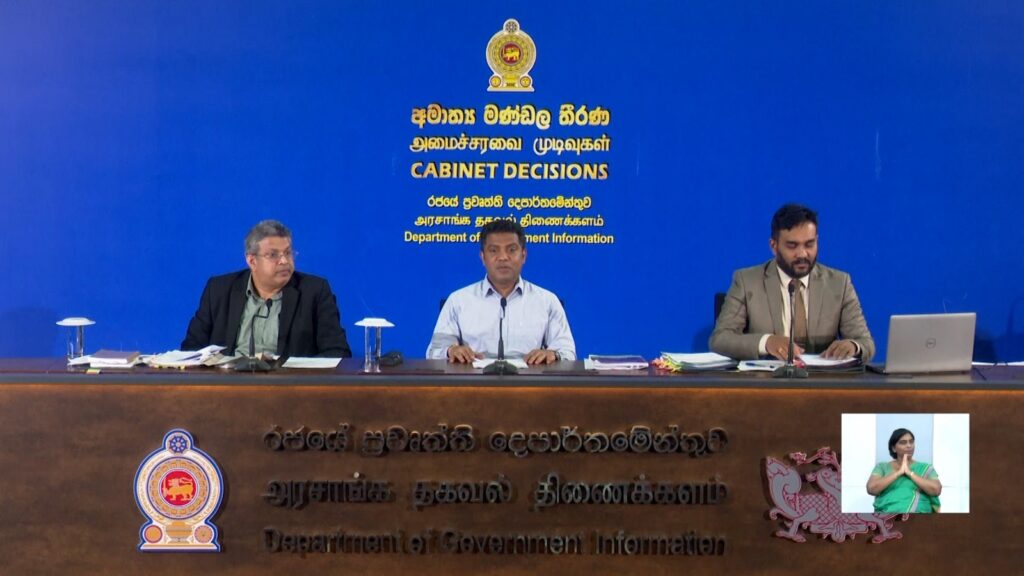
Justice minister Harshana Nanayakkara during post Cabinet media briefing acknowledged that years of inadequate planning contributed to the current crisis. Image courtesy of Department of Government Information.

Ripple effect

The government’s proposal has drawn its strongest resistance not from political opponents but from within the judiciary itself.

The JSASL, which represents district judges and magistrates, warned that extending the retirement age of Supreme Court and Court of Appeal judges would create a ripple effect throughout the judicial hierarchy, delaying promotions and disrupting career progression.

According to the association, keeping sitting judges in office for an additional two years would postpone appointments to the Supreme Court and Court of Appeal, delay promotions to the High Court and create bottlenecks throughout the judicial service.

The association argued that slower promotions would weaken morale, reduce professional motivation and make judicial service less attractive to experienced lawyers considering appointments to the bench.

The BASL has framed the issue more broadly as one of constitutional governance.

At a special general meeting on July 29, the association unanimously adopted a seven-point resolution opposing the amendment unless the government could demonstrate a clear institutional need supported by transparent evidence, meaningful consultation and a comprehensive assessment of its constitutional implications. It also urged the government to fill existing judicial vacancies before altering the tenure of serving judges.

Calls for consultation

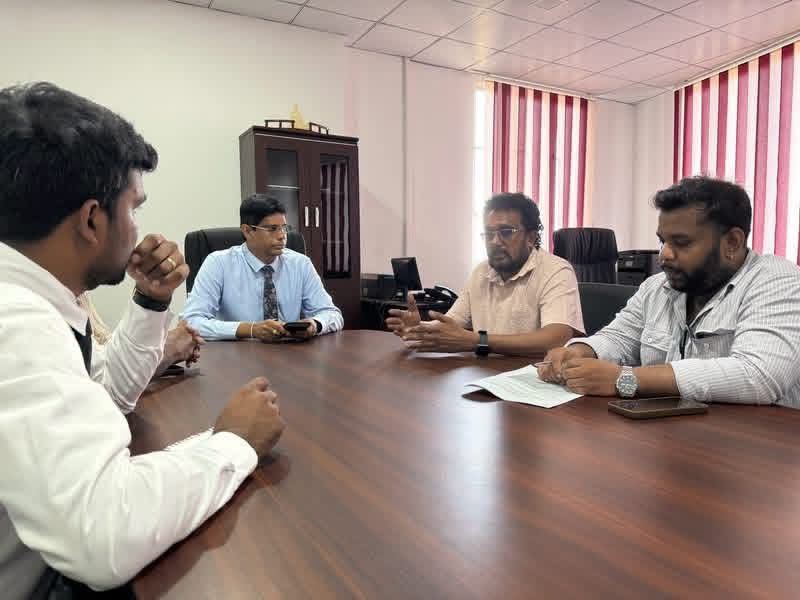
Facing mounting criticism, Nanayakkara met a BASL delegation led by President Rajeev Amarasuriya on July 29.

Following the meeting, Amarasuriya said the BASL reiterated that the amendment should not proceed in its current form and urged the minister to present the association’s concerns to President Anura Kumara Dissanayake before the government makes a final decision.

Nanayakkara assured the delegation he would brief the president before determining the government’s next steps.

Despite the meeting, neither side appeared to shift its position.

The BASL maintained that the proposal had been developed without meaningful consultation and questioned why constitutional amendments affecting the superior judiciary were being pursued before addressing more immediate institutional shortcomings.

The government continued to insist that extending judicial tenure is only one component of a broader reform package intended to improve efficiency.
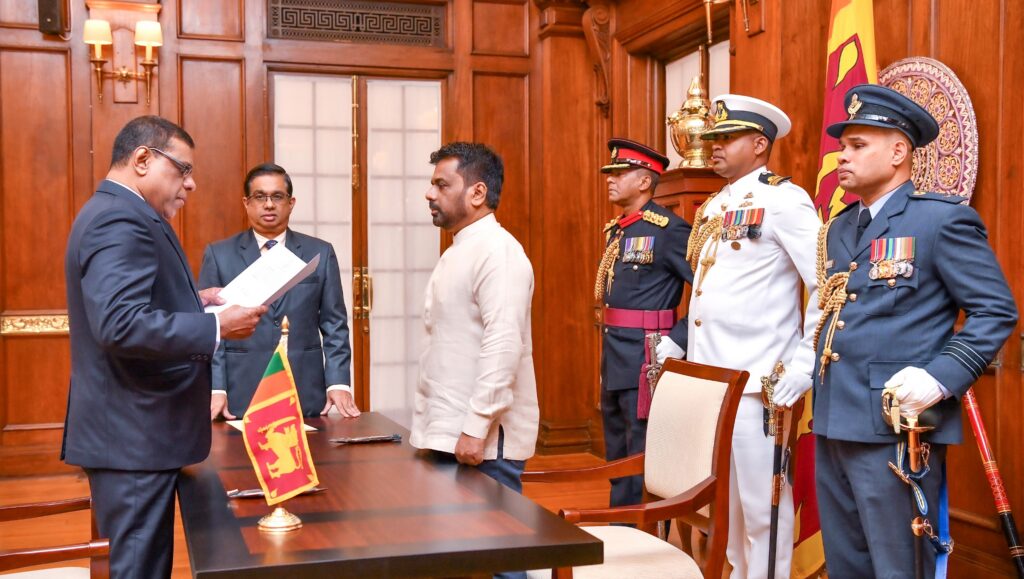
Incumbent chief justice Preethi Padman Surasena who assumed office on July 27, 2025 is scheduled to retire by December 2026. Image courtesy of President’s Media Division.

Constitutional question

The debate has become more complicated because of public confusion over the Supreme Court’s role if the amendment is challenged.

Ruling party legislator and attorney Lakmali Hemachandra said many people misunderstand the court’s constitutional function during the review process.

She explained that the Supreme Court is not asked to determine whether extending judges’ retirement age is good policy or whether judges themselves support it. Instead, its role is limited to deciding what level of constitutional approval the amendment requires.

“In practical terms, the court will determine whether Parliament alone has the authority to enact the amendment or whether it must also receive approval through a national referendum.”

Either outcome, she said, should not be interpreted as judicial support for—or opposition to—the proposal.

Hemachandra cautioned that portraying the court’s determination as an endorsement or rejection of the amendment misrepresents the constitutional process and risks drawing the judiciary into a political debate it is not required to resolve.

Her explanation underscores a distinction often lost in public discussion. The controversy is no longer simply about when judges should retire. It has evolved into a debate over how constitutional reforms affecting the judiciary should be made and who ultimately determines their legitimacy.

Treating the symptoms

The government’s case is rooted in practicality.

Officials argue that courts overwhelmed by more than one million pending cases need experienced judges to remain in office while wider reforms take effect.

Few within the legal profession dispute the scale of the crisis.

Instead, they question whether extending the tenure of sitting judges addresses its underlying causes.

Critics point to vacancies in the superior courts, recruitment failures at lower levels, outdated court infrastructure and years of unimplemented reform recommendations. Those structural deficiencies, they argue, cannot be resolved simply by postponing retirements.

The BASL has also argued that the recent expansion in the approved number of superior court judges has already increased judicial capacity, making it difficult to justify altering constitutional tenure provisions solely on efficiency grounds.
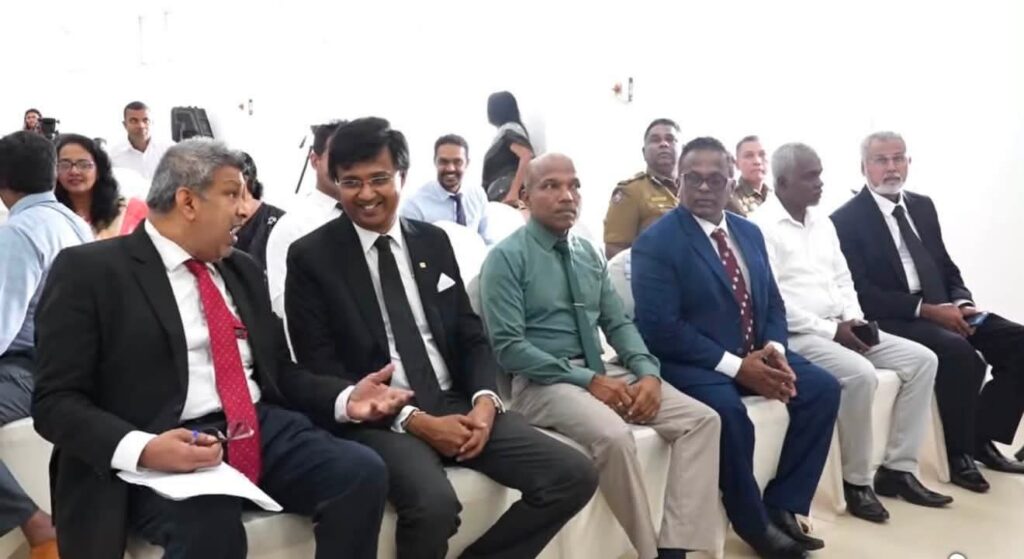
ustice minister Nanayakkara and BASL president Rajeev Amarasuriya are seen in conversation during the opening ceremony of newly constructed Pugoda court complex on July 24. Image courtesy of Ministry of Justice.

More than a retirement debate

The dispute has grown far beyond the retirement age of a handful of judges.

It has become a test of how Sri Lanka intends to modernize one of its most strained public institutions while preserving the constitutional safeguards that protect judicial independence.

There is broad agreement that the justice system needs more judges, faster appointments, stronger court administration, better forensic capacity and modernized institutions. The disagreement lies in whether extending the tenure of sitting superior court judges should be part of that reform.

The government views the amendment as a practical step to improve efficiency. Much of the legal profession sees it as a constitutional change that demands far greater scrutiny.

Whatever Parliament ultimately decides, the controversy has exposed a deeper truth. Sri Lanka’s judicial crisis is rooted not in the retirement age of a few judges but in years of underinvestment, delayed appointments and neglected institutional reform. Extending judicial tenure may buy time, but it cannot substitute for rebuilding the foundations of a justice system burdened by more than one million pending cases. Lasting reform will depend not only on clearing court dockets, but also on preserving public confidence that judicial independence remains beyond political expediency.

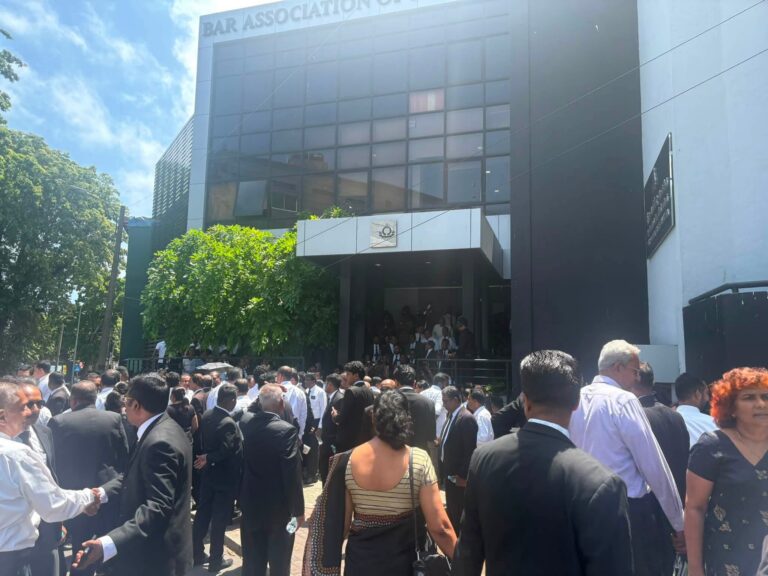
Banner Image: BASL call for a special general meeting on July 29 where they passed a resolution unanimously agreeing to oppose government’s proposal to extend the retirement age of Supreme Court judges by two years. Image courtesy of Lakmal Sooriyagoda.

This story was written and edited by Gagani Weerakoon. She leads the editorial at the Center for Investigative Reporting (CIR).
Add your comment

1987: The Year Sri Lanka’s War Could Have Ended

This article by renowned Indian journalist and author M.R. Narayan Swamy, known for his wide-ranging reporting on subjects from politics to insurgencies and best known for his definitive works on the LTTE, was originally published in Jaffna Monitor.


It was close to midnight on July 28, 1987, when I got a tip I had been waiting for: Velupillai Prabhakaran and Anton Balasingham were in a meeting with Prime Minister Rajiv Gandhi, ahead of his trip to Colombo to sign the India-Sri Lanka Agreement. My source was the indefatigable Shankar Rajee of EROS.

This was breaking news. The Tamil Tigers, we knew, were unhappy with the proposed accord and were avoiding Gandhi. The TULF and other militants had given their approval, even if with reservations. The last person holding out was Prabhakaran. Now he, too, was talking to Gandhi.

I immediately called Ashoka Hotel, where Prabhakaran was put up, to know if the LTTE leaders had returned to their room. They hadn’t. The meeting was still on. I kept telephoning every 12-15 minutes. On the fifth or sixth try, I struck gold.

Balasingham came on the line. He did not want to talk at length. Will it be correct to say that the LTTE has accepted the India-Sri Lanka Agreement, I asked him. “You may say that,” he said. AFP became the first to report that the Liberation Tigers of Tamil Eelam (LTTE) had given their approval to the pact.

It would emerge much later that not only had Prabhakaran given the thumbs up to the agreement after pointing out his reservations, but he sought – and got – money from India to “rehabilitate” his fighters (this was kept under wraps). Just before he left, a grateful Gandhi gifted a bulletproof jacket to the Tiger boss.

Little did Gandhi – and the rest of the world – realise that Prabhakaran had played a trick. Indian External Affairs Minister P.V. Narasimha Rao (who would later become the prime minister) had told Gandhi that the accord should be signed by Colombo and the LTTE, not India. Rao’s junior, Minister of State K. Natwar Singh, insisted that Prabhakaran should be kept in Delhi till his men began to surrender their weapons in line with the accord.

It is clear in retrospect that Prabhakaran realised that the only way to return safely and quickly to Jaffna, his lair, was to say “yes” – for now. He did that. The rest, as they say, is history.

When we journalists flew into Jaffna soon after the first of Indian troops, ordinary Tamils were brimming with unconcealed joy. As far as they were concerned, this was the best thing to happen. It gave them respite from fighting – and the overlordship of armed actors. Ordinary men and women ran after slow-moving Indian military trucks, offering tender coconut water and bananas to startled Indian soldiers, most of whom knew no Tamil. Namaste! Namaste! Many on the streets shouted, using the only Hindi word they probably knew.

Prabhakaran was furious when the wildest clapping for his August 4 speech at Suthumalai in Jaffna was triggered by his announcement that the Tigers had agreed to lay down their weapons. The disappointment showed on his face. Nanrikatta sanam (Ungrateful people), one of his lieutenants snapped.

The LTTE’s arms surrender the next day was a farce, although the Indian media, goaded by the establishment, made a song and drama over it. It must be granted to Prabhakaran that he did not hide what he was scheming. He told Indian journalist P.S. Suryanarayana, whom he knew from his Chennai days, that he would play “games” with India that would shatter the peace process. He did that.

Prabhakaran had once fasted in Chennai after the authorities seized his communication equipment. But in Jaffna, he told a junior cadre to undertake a fast because he was expected to die. Tamil supporters were encouraged to stage noisy protests outside and stone Indian military camps. As former LTTE guerrilla Niromi de Soyza revealed, after ordering LTTE leaders trapped at sea to take cyanide and die, Prabhakaran reacted with explosive anger—as if whatever had happened had come as a surprise to him. The LTTE-India war erupted. Four years later, Prabhakaran ordered the assassination of the very man who had once presented him with a bulletproof jacket.

India was unprepared for what turned out to be a painful and bloody showdown. Among other things, it is evident that the Indian government had not conducted an exhaustive study of the man known as Prabhakaran. Could he be trusted? Should he be trusted? Would he agree to explore peace? Would he allow India to guide him after having spent long years underground with the singular aim of breaking up Sri Lanka? This was a colossal blunder, all the more so because Prabhakaran had spent more than three years in Tamil Nadu.

The 1987 agreement sparked unprecedented protests across much of southern Sri Lanka, areas populated by the majority Sinhalese community. The nihilist JVP decided this was the best chance to take another violent jab at power. The opposition to the accord was on two fronts: one, India had deployed its military in the northeast (while Sri Lankan soldiers were confined to barracks); two, the bilateral pact was a “sell-out” to New Delhi and “Tamil terrorists”.

As the war expanded, the LTTE changed its tune. Its “yes” of July 29, 1987, turned into an outright rejection of the India-Sri Lanka Agreement. As the Tigers made peace with Colombo, lulling President Ranasinghe Premadasa, and Gandhi lost elections in India, the Indian Army, badly bruised, returned home. The Tigers and their supporters celebrated, in Sri Lanka and everywhere.

Today, in circa 2026, I hear many Tamils say that Prabhakaran should have built on the 1987 pact for a better future for the Tamil-speaking population, brick by brick, with New Delhi’s additional backing. The LTTE, one of its former leaders recalls telling Prabhakaran, was not formed to make an enemy of India. As for Sri Lanka, the war for Tamil Eelam would have ended in 1987. Tens of thousands of lives on all sides that were lost subsequently could have been saved.

I agree. My rider: Prabhakaran’s thinking was such that he would have never agreed to any peace that did not include a separate homeland. (I conveyed this to Erik Solheim, too, in late 2003.) The insurgents’ political immaturity would have ensured that. It did, until he was killed with select loyalists while some 12,000 of his guerrillas and sympathisers of all ages surrendered to a regime they had vowed to destroy. The larger Tamil society lay in bloody ruins in 2009 – and it still limps.

July 1987 was the first solid opportunity Tamils in Sri Lanka got to achieve a semblance of autonomy. Was it the ideal solution? Perhaps not, but it was the best under the circumstances. Yes, it did not give them Tamil Eelam, but there was no Tamil Eelam in 2009, either.

Tamil society was largely intact in 1987, even though the preceding four years had brought considerable turmoil, civilian suffering, strained Tamil-Sinhalese relations, and divisions within the Tamil community. Most Tamil leaders who could have contributed to the betterment of their people were still alive. Tamil-Muslim bonds had not yet been destroyed.

Unfortunately, some on the Tamil side spat on the 1987 agreement, probably in fear of the LTTE, not realising the amount of work which went into making it a reality. Many of them are now hungry for the 13th Amendment and the Provincial Councils which flowed from that very accord.

In 1987, rightly or wrongly, India gave the northeast administration in Sri Lanka on a platter to Prabhakaran. It was a last-ditch attempt to appease him – amid his “games”. He rejected it with contempt. Those under his sway lauded him for his “revolutionary” credentials.

What Sri Lanka gave in 2009 was death, destruction, defeat, and despair – and a verdict that the Tamil Tigers were not invincible. 1987, in my view, was far better. But those who make history often think differently. In Prabhakaran’s case, he himself became history.


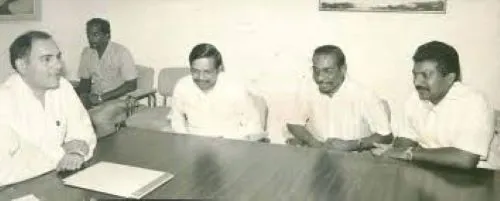
Banner Image: Velupillai Prabhakaran (right) with Indian Prime Minister Rajiv Gandhi (left). Also pictured are LTTE political adviser Anton Balasingham (second from right) and Indian Tamil politician Pandrutti Ramachandran. Image courtesy of Jaffna Monitor.

How years of ignored cybersecurity warnings caused Sri Lanka to misplace millions of dollars

Speed Read

  • Two major payment diversion incidents, the Treasury and Postal Department, point to systemic failures rather than isolated cyberattacks.
  • Sri Lanka’s Committee on Public Finance found that recommendations from Sri Lanka’s Computer Emergency Readiness (CERT) team, security audits, and Cabinet-approved cybersecurity policies went largely unimplemented.
  • SLCERT’s government cybersecurity policy, approved by the Cabinet, had already warned of the very weaknesses exposed by the Treasury fraud, including weak information security, obsolete technologies, and a shortage of skilled cybersecurity personnel.
  • The COPF found that SLCERT lacked the legal authority to enforce its cybersecurity recommendations, leaving a critical gap between technical advice and implementation across government institutions.

COLOMBO—On July 22, when the Criminal Investigation Department (CID) informed the Colombo Magistrate’s Court that more than $626,000 (Sri Lankan rupees 210,773,699) belonging to the Department of Posts had allegedly been diverted into nine bank accounts, it appeared to be another cyber-enabled financial crime targeting a government institution.

According to investigators, the payment, intended for the United States Postal Service, was allegedly redirected after fraudsters exploited the department’s email system, using an email address outside the official communication channel established by the Universal Postal Union.

The investigation is ongoing.

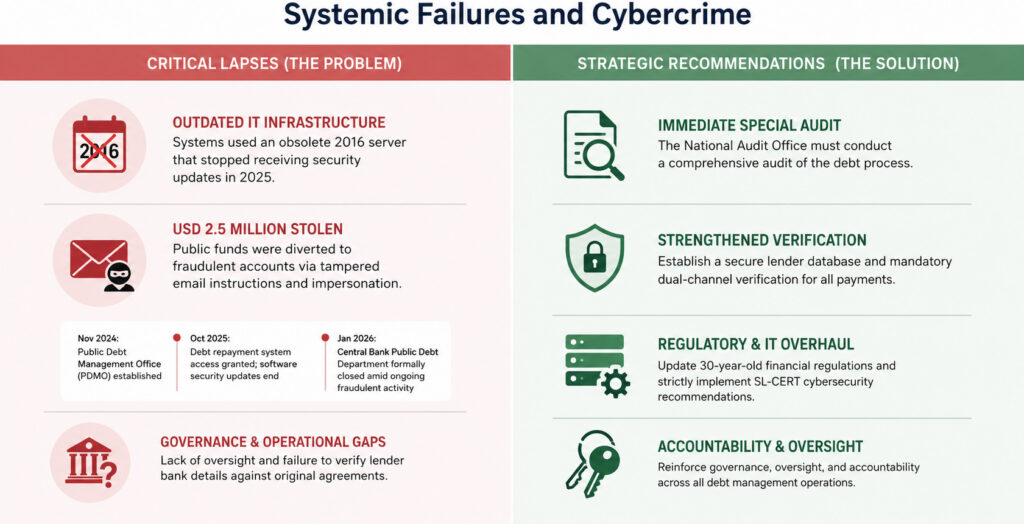
Yet the allegations bear striking similarities to another case that has already exposed deep weaknesses in Sri Lanka’s public sector. The Treasury cyber fraud, in which $2.5 mn (rupees 8,375,000,000) earmarked for sovereign debt repayments to Export Finance Australia was diverted after government officials unknowingly relied on fraudulent email instructions between November 2025 and January 2026

Different institutions.

Different victims.

The same weaknesses.

Viewed together, the two cases suggest something far more troubling than isolated cyber incidents. They point to a pattern of weak digital governance across Sri Lanka’s public sector where ignored cybersecurity warnings, outdated technology, poor internal controls, and weak digital hygiene continue to leave critical institutions vulnerable.

The Parliamentary Committee on Public Finance (COPF), which investigated the Treasury fraud from April 30, concluded in its report submitted on July 7that the theft was not simply the work of sophisticated cybercriminals. It was enabled by years of institutional failures, including outdated IT infrastructure, inadequate cybersecurity awareness, weak internal controls, and the government’s failure to implement recommendations repeatedly made by the Sri Lanka Computer Emergency Readiness Team (SLCERT).

While investigators are yet to determine how the alleged fraud involving the Department of Posts occurred, the case raises an uncomfortable question of  lessons from the Treasury fraud not being  acted upon.

A chain of institutional breakdowns collectively created the conditions for frauds. AI generated image.

Misplaced digital hygiene

Cybersecurity discussions often focus on hackers, ransomware, or sophisticated malware. Experts say that the greater threat usually lies much closer to home.

Digital hygiene refers to the routine practices organizations follow to protect their information systems—from using strong passwords and multifactor authentication to updating software, independently verifying financial transactions, and training employees to recognize phishing attempts.

Most of these measures are neither expensive nor technically complex.

Yet, COPF’s investigation suggests that some of the government’s most sensitive institutions consistently failed to perform these basic tasks.

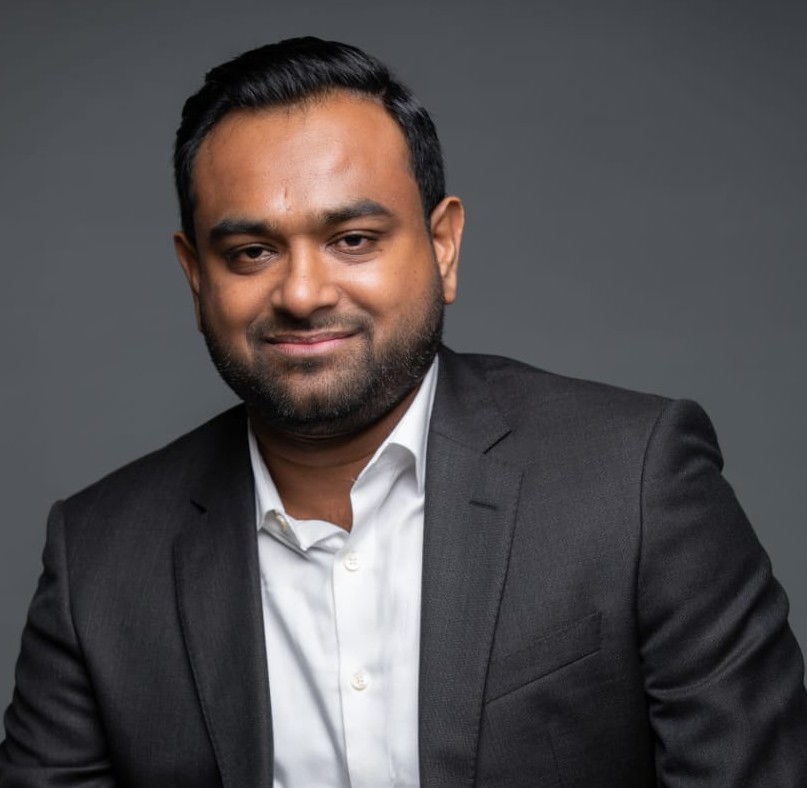
Cybersecurity expert and digital policy leader Asela Waidyalankara told CIR the Treasury fraud exposed three interconnected weaknesses that continue to affect much of Sri Lanka’s public sector –people, processes, and technology.

“The incident was not about one mistake,” he noted. “It demonstrated failures in people, failures in processes and failures in technology governance.”

His assessment mirrors COPF’s findings, which concluded that the fraud succeeded not because cybercriminals possessed extraordinary technical capabilities but because multiple layers of institutional safeguards failed simultaneously.

Asela Waidyalankara claims one of Sri Lanka’s greatest weaknesses is treating cybersecurity as an IT procurement issue rather than a governance responsibility. Image courtesy of Asela Waidyalankara.

Warnings already existed

Perhaps the most disturbing aspect of the Treasury fraud is that few of the vulnerabilities were new.

A joint audit conducted by KPMG and SLCERT in December 2024 had already identified serious weaknesses within the Ministry of Finance’s IT environment. The assessment found the absence of multifactor authentication, weak password practices, and poorly defined cybersecurity roles and responsibilities that created significant accountability gaps.

Instead of being promptly addressed, many of those shortcomings remained unresolved well into 2026.

In written submissions to COPF on June 9, SLCERT highlighted that follow-up reviews conducted jointly with the National Cyber Security Operations Centre (NCSOC) in January and April 2026 found many of the same vulnerabilities still existed.

One of the most serious concerns involved the External Resources Department’s (ERD) Microsoft Exchange Server 2016.

Microsoft’s extended security support for the platform ended in October 2025, only weeks before the fraudulent transactions occurred. Yet the ministry continued relying on the unsupported email infrastructure without replacing it, according to COPF report.

SLCERT also cautioned that operating unsupported systems significantly increased the government’s exposure to cyberattacks, while COPF concluded that procurement delays and poor technology planning left critical government systems vulnerable long after the risks had been identified.

The timeline is striking.

Auditors identified weaknesses.

Cybersecurity specialists recommended corrective action.

Follow-up reviews found little progress.

Then millions of dollars disappeared.

The Treasury fraud illustrated what can happen when cybersecurity recommendations become reports sitting on shelves instead of driving institutional reform.

Government agencies often invest heavily in digital platforms before gradually neglecting software updates, infrastructure maintenance, staff training, and long-term oversight. Image via SLCERT Facebook page.

Human error opened the door

According to COPF, cybercriminals manipulated government officials using carefully crafted emails sent from domains that closely resembled legitimate government and lender addresses.

Simple verification procedures that should accompany multimillion-dollar international financial transactions have been overlooked.

Officials continued communicating with fraudulent email addresses even after receiving warnings from the Central Bank about suspicious payment instructions.

Instead of independently verifying revised bank account details through trusted communication channels, they sought clarification from the same fraudulent email accounts that initiated the deception.

For Waidyalankara, those failures reflect a broader cultural problem across government.

Unlike many private-sector organizations, cybersecurity awareness rarely forms part of employee performance or institutional accountability.

“Cybersecurity must become part of everyday work, not remain solely the responsibility of IT departments. Training should be continuous, supported by simulated phishing exercises, regular awareness campaigns, and ongoing assessments, because human error remains the most common entry point for attackers.”

Government, he said, has yet to fully embrace that reality.

“The solutions already exist,” Waidyalankara noted. “The challenge isn’t buying technology. It’s governing it properly.”

Governance failed before technology did

The Treasury investigation exposed a striking paradox.

Sri Lanka did not lack cybersecurity policies.

The SLCERT had already developed an Information and Cyber Security Policy for Government Organizations, aligned with the national cyber security strategy and international information security standards. The Cabinet had approved its implementation across all public authorities covered under the Right to Information Act.

The policy itself acknowledged many of the weaknesses that later contributed to the Treasury fraud.

It warned that government institutions increasingly relied on digital systems while paying insufficient attention to information security, continued using obsolete technologies, and struggled with shortages of skilled cybersecurity personnel.

In other words, government had already diagnosed its own vulnerabilities.

SLCERT’s submissions to COPF reveal a familiar pattern: outdated infrastructure remained in service, multifactor authentication was still absent, weak password practices persisted, and vulnerabilities identified more than a year earlier had yet to be addressed.

Perhaps most significantly, COPF observed that SLCERT lacked the legal authority to compel government institutions to implement its recommendations.

That gap between technical advice and institutional action became one of the parliamentary investigation’s most important findings.

CERT recently conducted a cybersecurity training to Sri Lanka Administrative Service officers at SLIDA. Image via SLCERT Facebook page.

A governance problem

For cybersecurity professionals, the Treasury fraud reinforced one of the industry’s oldest lessons: technology alone cannot protect an organization if its people remain vulnerable.

Nirosh Ananda, chief security information officer of SLCERT told CIR the incident underscored the need for stronger cybersecurity awareness across the public sector.

Following the Treasury fraud, SLCERT urged government institutions to strengthen cybersecurity awareness, improve basic cyber hygiene, and foster a stronger culture of incident reporting.

“Building awareness is one of the most important measures because these incidents often begin with human error,” Ananda said. “Officials need to know how to identify suspicious communications, particularly emails, and follow good cyber hygiene practices.”

He said SLCERT has continued conducting awareness programs across the public sector while encouraging institutions to report suspicious cyber incidents as early as possible rather than waiting until significant damage has occurred.

His observations echoed COPF’s finding that the Treasury fraud resulted more from human and procedural failures than sophisticated hacking techniques.

The Treasury fraud has understandably renewed calls for stronger cybersecurity technologies across government. But experts say that purchasing new software alone will accomplish little unless institutions fundamentally change how they govern technology.

Waidyalankara claimed one of Sri Lanka’s greatest weaknesses is treating cybersecurity as an IT procurement issue rather than a governance responsibility.

Government agencies often invest heavily in digital platforms before gradually neglecting software updates, infrastructure maintenance, staff training, and long-term oversight.

“In a bank, if a critical server is approaching the end of its supported life, replacement planning begins well in advance,” Waidyalankara said. “That level of governance was clearly missing.”

He said responsibility cannot rest solely with institutions like GovTech or the Ministry of Digital Economy.

> “Every ministry that procures technology must also build the capacity to maintain it, manage cybersecurity risks, and seek technical support where expertise is lacking.”

Waidyalankara noted that Sri Lanka has experienced significant cyber incidents before, including the ransomware attack that disrupted government email systems two years ago. Those incidents attracted far less public attention because they did not involve direct financial losses.

“If you are building a road, you do not just lay the asphalt,” he said. “You install the streetlights, the lane markings and the safety features that make it usable. Cybersecurity and data protection are those fundamentals for a digital state.”

Nirosh Ananda, chief security officer at Sri Lanka CERT. Image via SLCERT Facebook page.

 Costly governance failures

The Treasury fraud demonstrated that governance failures can be just as costly as technological ones.

As investigators continued examining the alleged diversion of funds from the Postal Department, the government moved to reinforce existing cybersecurity requirements.

On June 22, 2026, Waruna Sri Danapala, secretary to the Ministry of Digital Infrastructure, issued a circular, reminding government institutions that implementing the Information and Cyber Security Policy for Government Organizations is mandatory.

“Cyber-attacks and online financial scams threaten sensitive data, disrupt public services, and cause economic losses, making strong cyber security measures essential for protecting national digital infrastructure,” it stated.

It further reminded heads of government institutions that implementing the policy is their responsibility.

“Heads of organizations are hereby reminded that the implementation of the Policy in their respective organizations is mandatory. As directed by the Cabinet of ministers, it is a responsibility of the heads of the organizations to allocate necessary budgets for cyber security activities through the annual budget.”

The circular reinforces many of the same recommendations that SLCERT and cybersecurity professionals have been making for years.

Whether it translates into meaningful institutional change remains to be seen.

Banner Image: Recent cybersecurity incidents and rising online financial fraud have highlighted the urgent need to strengthen the security of government digital systems. Image courtesy of Amar Preciado via pexels.

This story was written and edited by Gagani Weerakoon. She leads the editorial at the Center for Investigative Reporting (CIR).

This story was produced with support from Report for the World, a global media service strengthening local independent journalism

Add your comment

India’s student protests grow as calls for education reform intensify

India is witnessing an unprecedented wave of student protests over exam leaks, accountability and education reforms. This report, published by our collaborative newsroom Asian Dispatch, explores the grievances fueling the nationwide movement.

Despite heavy security deployment, rain, and closed metro stations, tens of thousands joined the march.

Delhi woke up to a slight drizzle on Monday, July 20, but that couldn’t deter tens of thousands of students, parents, political leaders, activists, and even actors from joining the Cockroach Janta Party (CJP) led protest at Jantar Mantar. As crowds gathered near the protest site in the national capital to march towards the Parliament, they had only one demand — Education Minister Dharmendra Pradhan’s resignation.

Huge crowd at the Jantar Mantar protest site. Image courtesy of Shivansh Srivastava/Asian Dispatch.

There was a sense of anger and disappointment among those present, questioning the government’s silence over the month-long protests, which gained fresh momentum after activist Sonam Wangchuk was whisked away from the protest site by the police on Saturday. Most said that they just want the government to take accountability for the alleged irregularities in the competitive examinations. Some even demanded Prime Minister Narendra Modi’s resignation.

Protesters demanding Dharmendra Pradhan’s resignation. Image courtesy of Shivansh Srivastava/Asian Dispatch.
Protesters near the Jantar Mantar protest site. Image courtesy of Shivansh Srivastava/Asian Dispatch.
While the CJP continues to demand Pradhan’s resignation, posters demanding Modi’s resignation were also seen at the protest. Image courtesy of Shivansh Srivastava/Asian Dispatch.
Protesters seen requesting the police personnel to remove the barricades. Image courtesy of Shivansh Srivastava/Asian Dispatch.

As the ‘Chalo Sansad’ march coincided with the first day of the Monsoon Session of the Parliament, the government finally swung into action. CJP representatives were called in to meet senior Bharatiya Janata Party (BJP) leader and Union Minister JP Nadda. However, so far, there has been no commitment or assurance that their demands will be met.

CJP Founder Abhijit Dipke and Gitanjali Angmo. Image courtesy of Shivansh Srivastava/Asian Dispatch.

Undettered and Unfazed

People travelled from across the country to join the protests and as per media reports, nearly 50,000 had joined the march by midday.

Zaina, a student from Jaipur, Rajasthan, had appeared for NEET examination along with her cousin in May 2026. But as the paper was cancelled over allegation of questions being leaked, her cousin died by suicide. His family had borrowed Rs 15 lakhs to support his dream of becoming a doctor.

We are the future of the country. If our prime minister had even the slightest love for this young nation, he would not have made us wait this long.Zaina, Student

She continued, “We are young student leaders. We represent youth organisations. We are the power of the youth. If we have the strength to elevate you to the position of [the] prime minister, we also have the power to bring you down.”

Zaina fell to the ground after she was lathi-charged by the police. Image courtesy of Shivansh Srivastava/Asian Dispatch.

Underscoring the need to strengthen the education system, Deena Bharti, 47-year-old biology professor from the same state, said, “I am worried about the future of [my] students. The demands are absolutely right. My point is how is it that a question paper leaks from the very place where it is being printed?”

Several parents present at the site demanded accountability from the government and said that this fight is for the future of their children. “Just imagine parents collect every penny to support their child’s education, only to see them sitting at home unemployed. How must that feel?,” questioned Malti Yadav, a mother of four.

As protesters braved tear gas shells and lathi-charge by Delhi police, they remained unfazed even in the face of violence. Some were even detained.

21-year-old Mohammad Lukman, who hail from Nuh, Haryana, said, “The police just lathi-charged us. Yet, I have not backed down. I am standing at the very front and I will remain here until my last breath. Dharmendra Pradhan must resign. We will not leave this spot until he does.”

Image courtesy of Shivansh Srivastava/Asian Dispatch.

Priyanshi Singh, a student of physical education at Delhi University, said, “The girls who were there got beaten with lathis (baton); one girl is bleeding from her leg, someone else suffered a head injury, and others had to be taken away in ambulances. There is even a boy whose fate is unknown, we don’t even know if he is alive or dead.”

‘The Fight Continues’

Wangchuk, who has been on a hunger strike for the past 23 days, had earlier said during the day that he will end his fast if the government gives him assurance that the matter will be raised in the Parliament or they take accountability for the lapses.

However, as the day progressed none of these two demands were met and Wangchuk said that he will continue his hunger strike until the CJP leaders are allowed to meet the parliamentarians. Meanwhile, CJP leader Abhijeet Dipke, Saurav Das, Ashutosh Ranka, and Wangchuk’s wife Gitanjali Angmo continue the sit-in protest at Jantar Mantar.

Abhijit Dipke, Gitanjali Angmo, Prakash Raj atop a truck at the protest site. Image courtesy of Shivansh Srivastava/Asian Dispatch.

Jantar Mantar: A Symbol of Resistance

Jantar Mantar has been the designated protest site since 1993. In the past 33 years, the site has seen some major protests seeking resignations, introduction of Bills, and accountability from those in power.

The protests in 2011, led by Anna Hazare, sought the enactment of the Jan Lokpal Bill. Hazare had sat on multiple hunger strikes and eventually ended them after the then Congress government passed a resolution accepting his core demands.

Anna Hazare on his hunger strike at Jantar Mantar, Delhi, India. Image via Wikimedia Commons/Asian Dispatch.

In 2012, a protest was led by people around Jantar Mantar and across the country to demand justice for the 23-year-old physiotherapy intern who was gangraped in a moving bus in Delhi’s Munirka. The case was known as ‘Nirbhaya case’ and the protests led to the government enacting major legal reforms.

The National Green Tribunal, in October 2017, banned all protests and sit-ins at Jantar Mantar citing violations of environmental laws. However, the Supreme Court of India passed a ruling in July 2018 striking this down and said that there could not be a “complete ban” on protests at the site.

The site also saw Indian wrestlers protesting in 2023 to demand an enquiry into allegations of harassment against former Lok Sabha BJP MP and Wrestling’ Federation of India’s President Brij Bhushan Sharan Singh.

An image from the wrestlers’ protest. Image via Wikimedia Commons/Asian Dispatch.

The hunger strike started by Wangchuk was the latest protest that took place at the site.Palpable Anger Among Protesters Demanding Education Reforms in India

Banner Image: Students demanded accountability from the government as they marched towards the parliament on Monday, July 20. Image courtesy of Shivansh Srivastava/Asian Dispatch.

By Shivansh Srivastava | Editor: Kritika Goel 

This story was originally published by  Asian Dispatch on July 21, 2026. It has been republished by Center for Investigative Reporting with permission.

Too many people, too little justice lead to prison crisis in Sri Lanka

Speed Read

  • Sri Lanka’s prisons hold nearly three times their intended capacity, with some facilities operating at up to 400% occupancy.
  • Almost two-thirds of inmates are awaiting trial, making prolonged pretrial detention a key driver of overcrowding.
  • Nearly 8,500 inmates are in prisons due to the delays of reports from the Government Analyst Department.
  • Nearly three out of every four admissions involved unconvicted individuals.
  • Police have arrested more than 230,000 suspects since October 2025 on narcotics-related charges.
  • Country has only one magistrate’s court for roughly every 315,000 people.

COLOMBO—When retired military officer and attorney-at-law Ajith Prasanna walked through the gates of Welikada prison in February 2023, he expected to lose his freedom.

He did not expect to lose his dignity.

For more than three years, Prasanna said he endured conditions that exposed a prison system crippled by severe overcrowding, inadequate health care, weak rehabilitation programs and chronic shortages of even the basic necessities.

“We were unable to use the toilets during the night and had to relieve ourselves into tins kept inside the cells,” he recalled after his release, describing how inmates were locked in cramped cells from about 5:30 p.m. until 6:00 a.m.

Prasanna described prisoners sleeping shoulder-to-shoulder on concrete floors, queuing for bland meals, working long hours, waiting months for soap and toothpaste, and watching seriously ill inmates struggle to receive medical care.

“Some prisoners do not receive even a bar of soap for six months,” he said.

His account comes just weeks after the deadly Negombo prison riot reignited debate over the state of Sri Lanka’s correctional system. While investigations into the violence continue, prison experts, lawyers and human rights advocates argue the deeper crisis extends far beyond a single prison or incident.

Instead, they say, Sri Lanka’s prisons have become the clearest symptom of a justice system neglected for decades.

Retired military officer and attorney-at-law Ajith Prasanna in front of Welikada prison. He recalled appalling circumstances within packed cells in Sri Lankan prisons. Image courtesy of Ajith Prasanna.

A system bursting at the seams

Official statistics paint a stark picture.

Sri Lanka’s prisons were built to house just over 10,000 inmates. Today, they hold nearly three times that number.

According to the Department of Prisons statistics, the average daily prison population reached nearly 30,000 in 2024 despite an authorized capacity of 10,395—an occupancy rate of almost 287%.

Some facilities reportedly operate at between 300% and 400% of their intended capacity.

The crisis is not new.

Department data show that prison capacity has continued to increase  every year for more than a decade. In 2019 alone, prisons designed for fewer than 12,000 inmates held more than 24,000 people.

Prasanna believes conditions have worsened further.

“The prison population has increased from around 27,000 when I entered prison to more than 44,000 today,” he told CIR.

“Prisoners now sleep packed together like canned fish. They even fight over space to bathe or wash their clothes.”

An unconvicted majority

Perhaps the most striking feature of Sri Lanka’s prison population is that most inmates have not been convicted.

Official 2023 statistics show nearly 65% of the average daily prison population consisted of remand prisoners awaiting trial or the completion of legal proceedings. Nearly three out of every four admissions that year involved unconvicted individuals.

The figures suggest overcrowding is driven less by convicted offenders than by prolonged pretrial detention.

Prasanna argues lengthy delays in granting bail, slow government analyst reports in narcotics cases and the routine incarceration of drug users have all fueled the prison population.

The most striking feature of Sri Lanka’s prison population is that most inmates have never been convicted. Image courtesy of Prison Department of Sri Lanka.

Recent policing trends reinforce that concern.

Since the nationwide “Ratama Ekata” anti-drug operation began in October 2025, police have arrested more than 230,000 suspects on narcotics-related charges.

Ashoka Dharmasena, a deputy inspector general and director of the Police Narcotics Bureau, said 230,248 suspects had been arrested nationwide and that authorities continue to arrest an average of 750 to 800 people each day.

Without reforms to bail procedures, forensic capacity and drug rehabilitation, many of those arrested risk adding further pressure to an already overwhelmed prison system.

According to a research by the Committee for Protecting the Rights of Prisoners (CPRP), an average of 8,423 unconvicted men and 1,056 unconvicted women are imprisoned each day.

“For every eight unconvicted men in prison, there is roughly one unconvicted woman,” said Sudesh Nandimal, the committee’s convener.

DIG Ashoka Dharmasena said since the nationwide “Ratama Ekata” anti-drug operation began in October 2025, police have arrested more than 230,000 suspects on narcotics-related charges. Image courtesy of Government Information Department.

Health care under pressure

Overcrowding affects far more than sleeping arrangements.

Nandimal said it undermines rehabilitation, increases the spread of disease, worsens mental health and strains correctional services. Drug offenses, he noted, remain the primary driver, underscoring the need for alternatives to incarceration and expanded treatment programs.

Prasanna also alleged many prisoners fail to receive timely medical care.

Official figures show prison hospitals designed to accommodate just 185 patients are treating around 350 inmates at any given time.

In an 863-page report based on 2,881 questionnaires administered to prisoners, 352 interviews with incarcerated individuals and 102 interviews with prison staff, the Sri Lanka Human Rights Commission (HRCSL) in 2020 found that severe overcrowding forces many newly admitted remand prisoners to stand throughout the night because there is no space to sleep. Others are compelled to sleep next to, or even inside, toilet areas.

The commission also documented widespread complaints about infestations of mosquitoes, bedbugs, rats and pigeons inside prison wards, conditions it (commission) directly observed during  visits. The report found that ward conditions and other prison facilities are not regularly inspected by medical officers or public health inspectors, despite legal requirements. It concluded that the lack of independent oversight and follow-up by the Ministry of Justice and Prison Reforms demonstrates a serious disregard for prisoners’ health and living conditions. Such conditions create an environment conducive to the spread of infectious diseases, placing even greater strain on prison health care and inmate transport systems.

Former human rights commissioner Ambika Satkunanathan said access to specialized care remains a serious concern. Some prisoners, she noted, have reportedly lost their eyesight after waiting years for cataract surgery.

She also questioned proposals to relocate prisons away from urban centers, arguing they would make access to courts, hospitals and family visits even more difficult.

“Prisons were established close to courts and other institutions for a reason,” she said.

Longer journeys mean higher transport costs, more security personnel and greater difficulty accessing medical care. Family visits also become less frequent, weakening one of the strongest predictors of successful rehabilitation after release.

Justice starved of investment

Rajeev Amarasuriya, attorney-at-law and he president of the Bar Association of Sri Lanka stated overcrowded prisons are only one symptom of a broader failure within Sri Lanka’s justice system.

Public debate, he said, often focuses on judges, lawyers or prison officials while overlooking decades of chronic underinvestment.

Sri Lanka allocates just 0.57% of total government spending to the administration of justice, far below many comparable countries.

According to Amarasuriya, the country has only one magistrate’s court for roughly every 315,000 people.

Court backlogs exceeding one million cases, judicial vacancies, outdated infrastructure, limited digitization and staffing shortages have all contributed to prolonged remand detention and prison overcrowding.

“The events at Negombo were not an isolated disturbance,” he wrote.

“They were the foreseeable consequence of years of chronic underinvestment by the state in the administration of justice.”

Remote prisons, increase transport costs, reduce access to hospitals and discourage family visits, ultimately undermining rehabilitation. Image courtesy of T. Pratheepan.

Beyond building more prisons

Following recent unrest, the government has announced plans to expand prison infrastructure.

Cabinet spokesman and minister Nalinda Jayatissa said temporary prison facilities at Welikada and Magazine prisons are nearing completion. A high-security prison has also been established at the Welisara navy camp.

Longer-term projects extending through 2029 include expansion at Wataraka, redevelopment of Kalutaraprison, expansion at Wariyapola, relocation of Matara prison to Kotawila and plans to move Colombo Prison to Milwala in Horana.

But Satkunanathan cautioned that simply building more prisons risks treating the symptom rather than the cause.

Remote prisons, she said, increase transport costs, reduce access to hospitals and discourage family visits, ultimately undermining rehabilitation.

“Most families cannot afford to travel long distances,” she said. “Maintaining family connections is essential to rehabilitation and reintegration.”

Speeding up government analyst reports, expanding bail for suitable offenders, diverting people with drug dependency into treatment programs, increasing community-based sentences for minor offenses, strengthening prison health care and rehabilitation, and accelerating the digital transformation of Sri Lanka’s courts are among many recommendations set out in part studies and committee reports appointed to look into ways of reducing prison population.

Nearly 8,500 inmates are in prisons due to the delays of reports from the Government Analyst Department. It is about 40% from the total remand population, a report titled ‘Prison overcrowding: short – mid – lang term plan to overcome the challenge’ stated.

For Prasanna, prison reform is no longer an abstract policy debate.

After spending more than three years inside Sri Lanka’s prison system, he says improving conditions has become one of the causes he intends to champion.

His account offers a rare glimpse into a system largely hidden from public view. Combined with official statistics and the warnings of human rights advocates and justice experts, it points to a broader conclusion.

Sri Lanka’s prison crisis is not simply the result of too few prison cells. It reflects a justice system strained by prolonged court delays, punitive responses to drug offenses, chronic underinvestment and the absence of meaningful rehabilitation.

Unless those structural failures are addressed, experts warn, overcrowding, deteriorating conditions and periodic prison violence will remain recurring features of Sri Lanka’s criminal justice system rather than isolated incidents.

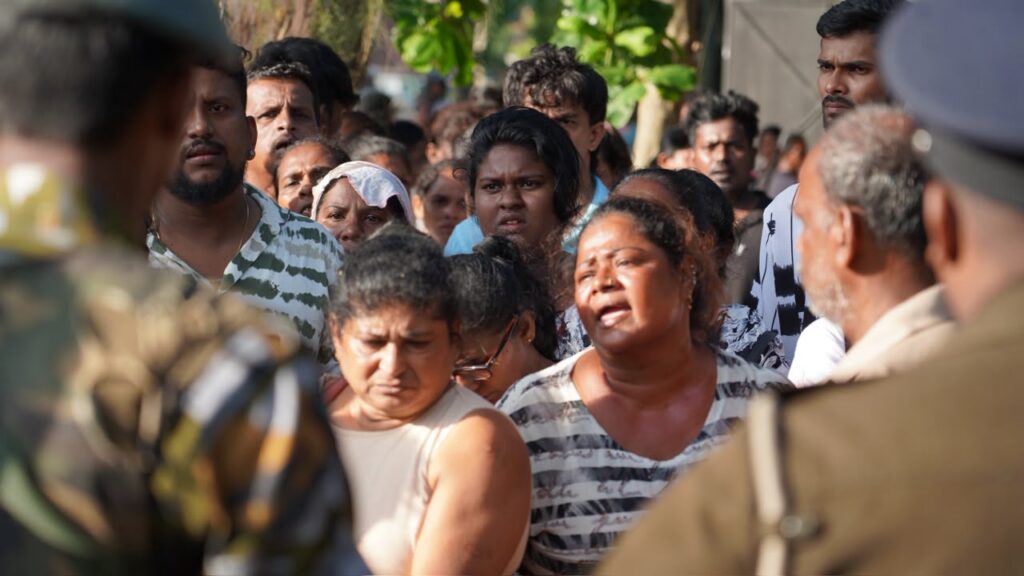
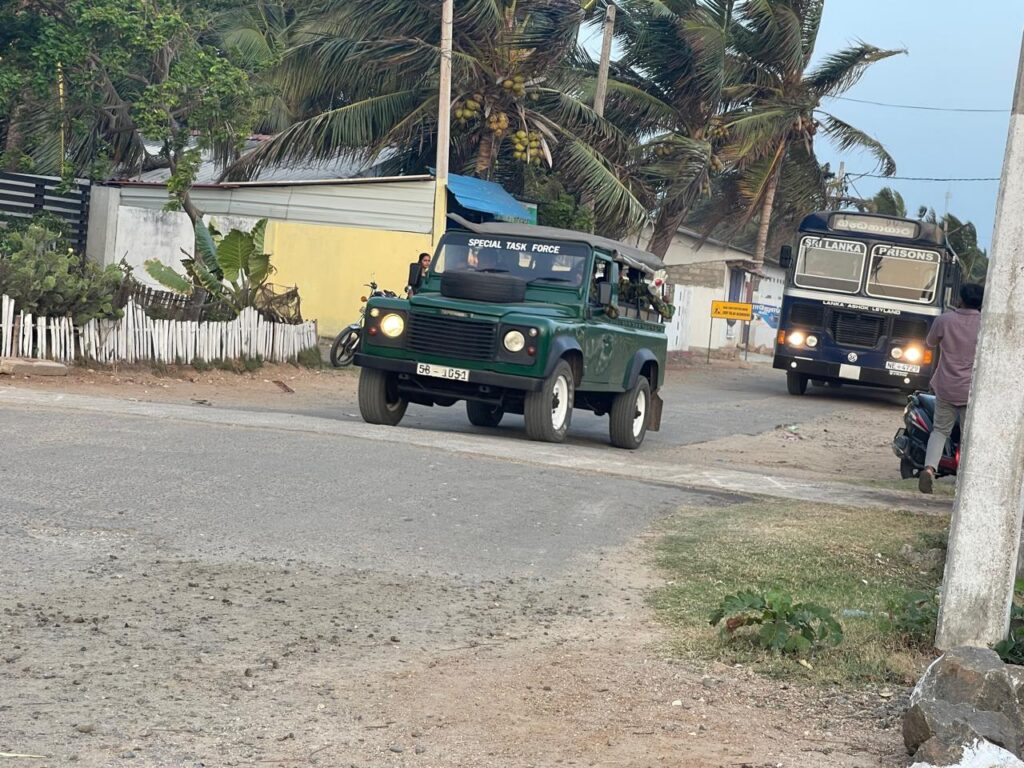
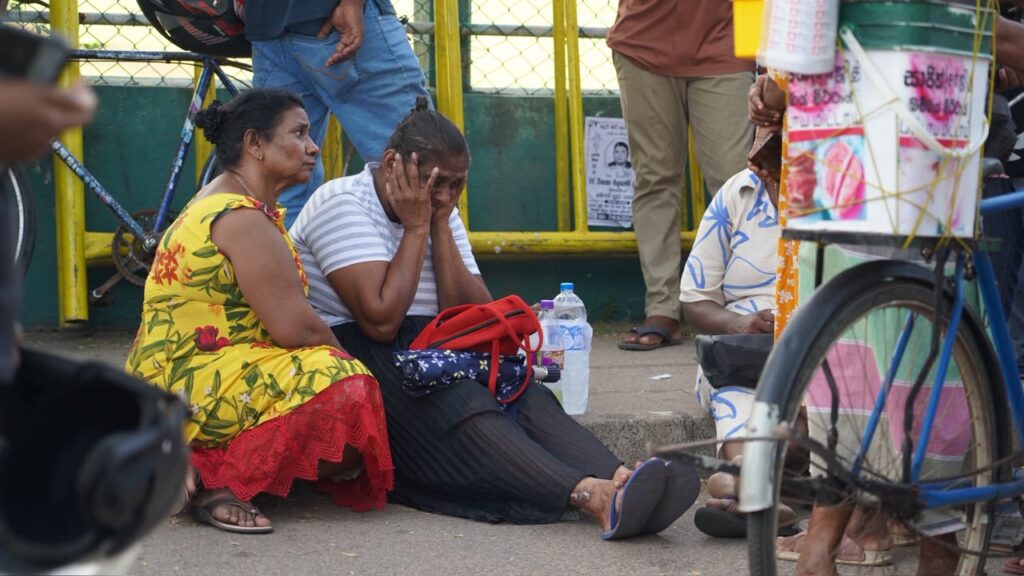
Banner Image: Outside Negombo prison, anguished families searched for answers as police, the Special Task Force, and the military sealed off the area amid the inmates engaged in a riot. Image courtesy of Shabeer Mohamed.

This story was written and edited by Gagani Weerakoon. She leads the editorial at the Center for Investigative Reporting (CIR).
This story was produced with support from Report for the World, a global media service strengthening local independent journalism

Add your comment

$2.5m gone and Treasury cyberattack reveals a state machinery in disarray

Speed Read

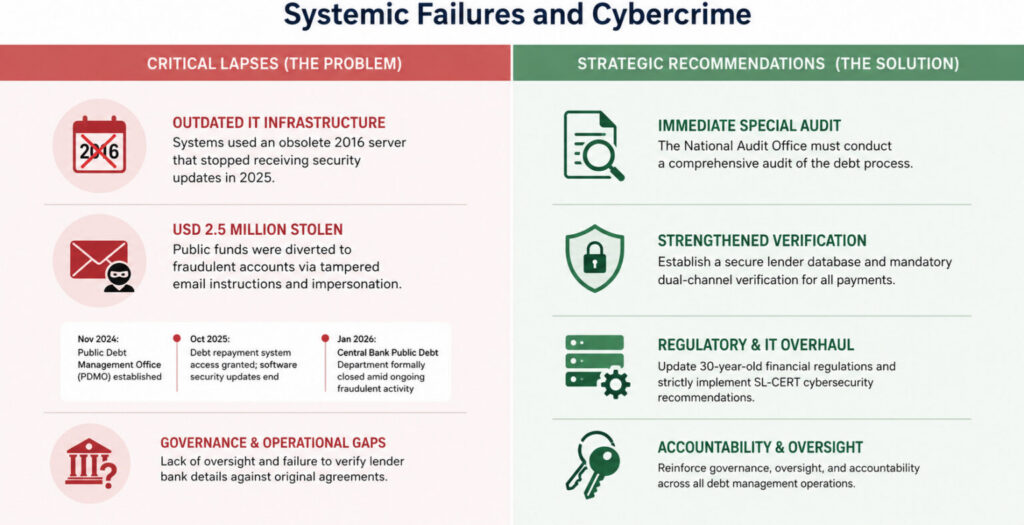
  • The Committee on Public Finance (COPF) has found Sri Lanka’s $2.5 million Treasury fraud stemmed from systemic governance failures, weak cybersecurity and poor internal controls—not a single human error.
  • COPF chairperson Harsha de Silva said the committee was unanimous in confirming a cybercrime-linked fraud and reiterated that only criminal investigations could  determine individual liability.
  • Cybercriminals have hijacked official email threads, used look-alike domains and exploited outdated IT systems during Sri Lanka’s debt management transition.
  • The committee urged sweeping reforms to debt repayments, cybersecurity and financial oversight, warning that institutional failures enabled fraud.

COLOMBO—Sri Lanka’s $2.5 million Treasury fraud was never just a cyberattack.

A parliamentary investigation has found that years of weak governance, outdated technology and institutional failures allowed cybercriminals to infiltrate one of the government’s most sensitive financial operations and divert sovereign debt repayments meant for a foreign lender.

The money was stolen between November 2025 and January 2026 while Sri Lanka was repaying sovereign debt to Export Finance Australia, one of several creditors involved in the country’s debt restructuring following its historic sovereign default. Instead of reaching the Australian export credit agency, several repayments were redirected to fraudulent overseas bank accounts after attackers infiltrated official email correspondence and manipulated payment instructions.

Because the money never reached the lender, Sri Lanka was forced to make the repayments again using public funds while investigators worked to determine how one of the country’s most significant cybercrime-linked financial losses had occurred.

The findings are contained in a 169-page report tabled in Parliament by the Committee on Public Finance (COPF), which concludes that the fraud was enabled not by a single administrative error but by longstanding governance lapses across multiple state institutions, including the Ministry of Finance and the Central Bank of Sri Lanka (CBSL).

The report identifies a chain of institutional breakdowns—from outdated email infrastructure and weak cybersecurity to fragmented oversight and poor verification procedures—that collectively created the conditions for the recent fraud.

For a country still rebuilding international confidence after its 2022 sovereign default, the findings extend well beyond the loss of $2.5 mn (Sri Lankan rupees 8,375,000,000). They raise fundamental questions about the government’s ability to safeguard billions of dollars flowing through the sovereign debt repayment system and whether reforms introduced after the economic crisis have been implemented effectively.

Unanimous parliamentary finding

COPF chairman Harsha de Silva, after presenting the report in Parliament later told media that all members had unanimously endorsed the findings after delaying publication to incorporate a supplementary submission accepted across party lines.

He described the consensus as unusual for a parliamentary oversight committee and said it reflected the strength of the evidence gathered during the investigation.

“The committee clearly finds that a fraud linked to cybercrime did take place, resulting in the theft of approximately $2.5 mn in public funds,” de Silva, an economist turned politician told CIR

While COPF examined how the fraud became possible, he noted that; parliament’s constitutional oversight role does not extend to deciding criminal liability or identifying whether officials knowingly assisted those behind the theft.

“It is beyond the scope of our committee to determine whether the fraud involved internal collaboration or conspiracy,” he said. “Criminal investigations must establish whether officials acted through negligence, incompetence, ignorance or deliberate involvement.”

That distinction is central to the report. Rather than focusing on individual culpability, COPF sought to determine whether government systems themselves had failed.

Its conclusion was unequivocal.

The cybercriminals succeeded because multiple institutional safeguards failed simultaneously.

The report identifies a chain of institutional breakdowns collectively created the conditions for the fraud. AI generated image.

Fraud hidden in plain sight

The theft occurred during routine sovereign debt repayments, a process that normally attracts little public attention but involves the transfer of hundreds of millions of dollars to foreign lenders.

Between November 2025 and January 2026, Sri Lanka was making scheduled repayments under debt restructuring arrangements, including payments to Export Finance Australia.

Rather than attacking banking systems directly, investigators found that cybercriminals infiltrated official email communications between the Ministry of Finance’s External Resources Department (ERD) and the Australian lender.

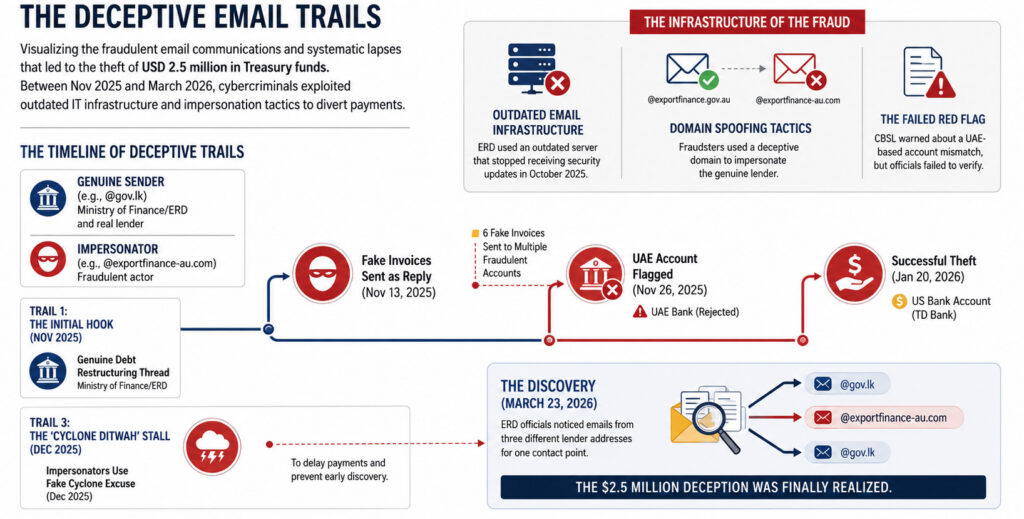
Using fraudulent internet domains that closely resembled legitimate addresses, the attackers inserted fake invoices and altered payment instructions into authentic email conversations.

Treasury officials, believing they were communicating with the genuine lender, approved payments to bank accounts controlled by the fraudsters.

In total, 10 transactions were processed using manipulated payment instructions.

The deception remained undetected for months.

Authorities only discovered the theft after Export Finance Australia informed the Ministry of Finance that scheduled repayments had never been received.

More than a cyberattack

Although the fraud relied on sophisticated cyber techniques, COPF rejected any suggestion that technology alone was responsible.

Instead, the report paints a picture of institutional weaknesses that had accumulated over years.

“The risks of cybercrime-related fraud were heightened by weaknesses in internal controls governing debt repayments and vulnerabilities in the government’s email infrastructure,” the report stated.

Those weaknesses extended well beyond outdated computer systems.

The committee identified poor oversight of debt repayment operations, inadequate procedures for escalating concerns to senior officials, fragmented IT governance, weak verification procedures and long-standing deficiencies in sovereign debt management.

Collectively, these failures created what investigators describe as an environment in which cybercriminals encountered little resistance.

A transition, a governance vacuum

One of the committee’s most significant findings concerns the government’s transition of sovereign debt management responsibilities from the Central Bank to the newly established Public Debt Management Office (PDMO).

The transition, intended to modernize Sri Lanka’s debt management framework, instead became one of the central vulnerabilities exploited by the attackers.

COPF found that authorities embarked on the institutional shift without establishing a comprehensive governance framework defining responsibilities between agencies.

No detailed terms of reference governed the transfer.

No key performance indicators existed to measure whether the transition had been completed successfully.

Operational guidelines for the new office were issued nearly 10 months after its establishment, while the memorandum of understanding between the CBSL and the PDMO was signed only in March 2026—months after the fraud and just before the transition ended.

The delayed arrangements left responsibilities unclear, fragmented oversight, and blurred accountability. COPF found that these governance gaps significantly increased operational risk as Sri Lanka managed complex debt restructuring payments to multiple international creditors.

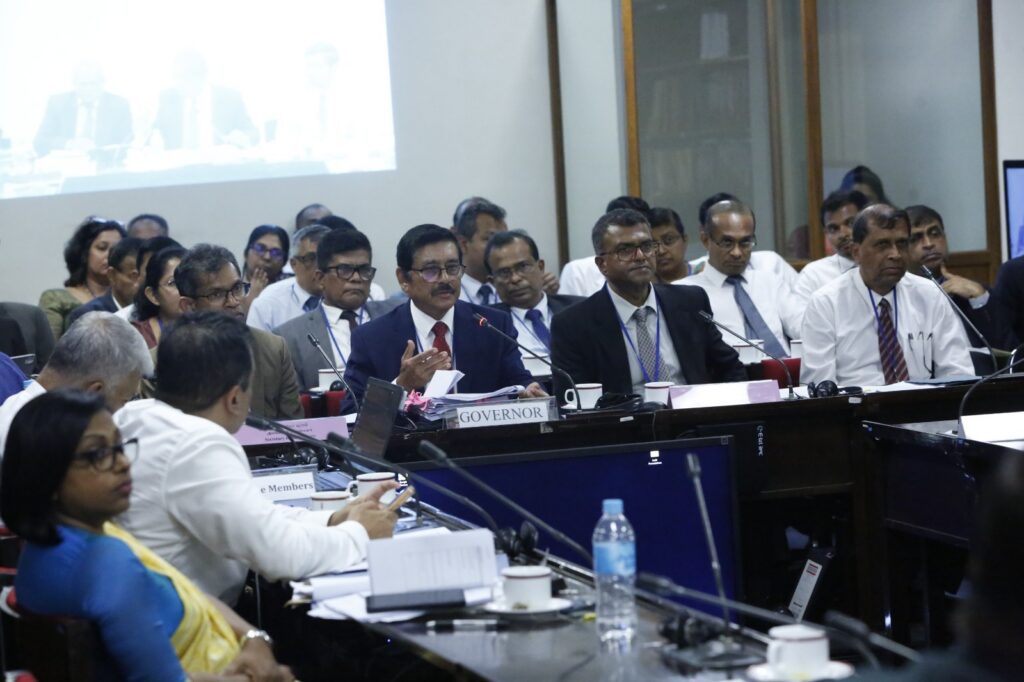
CBSL Governor Nandalal Weerasingle and Treasury Secretary Harshana Suriyapperuma were summoned before the COPF and interrogated on institutional collaborations and transferring responsibilities. Image courtesy of Parliament Communication Department.

Weakest link

While governance failures laid the foundation, outdated technology opened the door.

The committee was sharply critical of the Ministry of Finance’s cybersecurity posture, particularly within the External Resources Department.

Despite repeated warnings, officials continued operating Microsoft Exchange Server 2016 long after Microsoft’s extended security support ended in Oct. 2025.

The timing proved consequential.

Investigators found that the cyber fraud began roughly one month after security updates ceased.

COPF described the sequence as “far more than a coincidence.”

Independent assessments conducted by both the Sri Lanka Computer Emergency Readiness Team (SLCERT) and KPMG had repeatedly warned the ministry about serious cybersecurity deficiencies.

Those assessments identified weak password policies, the absence of multi-factor authentication, poorly defined IT responsibilities and failures to implement recommended security upgrades.

Yet many of those recommendations remained unimplemented when the fraud occurred.

The committee also discovered that the ERD operated its own independent email infrastructure outside the Treasury’s centralized IT management system.

“There appears to have been no coordination between the two IT teams,” the report stated.

For investigators, this represented not merely a technical oversight but a governance failure that prevented consistent cybersecurity standards across the Ministry of Finance.

Meanwhile, Nirosh Ananda, chief security information office of SL-CERT, said the agency had provided recommendations to the government following the incident, focusing on strengthening cybersecurity awareness, improving basic cyber hygiene and fostering a stronger incident reporting culture. He said CERT has intensified awareness programs across government institutions, emphasizing that many cyberattacks begin with human error. Ananda declined to discuss specific recommendations made to the Treasury but confirmed that Sri Lanka CERT had made submissions to the COPF.

Thread hijacking

Rather than hacking banking systems or deploying ransomware, the attackers relied on deception. Investigators found they hijacked an existing email thread between Treasury officials and Export Finance Australia shortly after Sri Lanka signed a debt restructuring agreement on October 27, 2025.

On Nov. 13, the attackers inserted six fake invoices into the legitimate email chain and used lookalike domains that closely mimicked Export Finance Australia’s official address. The fraudulent invoices redirected sovereign debt repayments to bank accounts in the United Arab Emirates (UAE) and the U.S.

COPF found that officials failed to detect the fake domains or independently verify the revised payment instructions, concluding that a relatively simple social engineering attack succeeded because of weak institutional controls, outdated IT systems and inadequate verification procedures.

Ignored warnings

Perhaps the most troubling finding in the report is that warning signs emerged before the full loss occurred.

One fraudulent payment initially failed when an intermediary bank rejected it over incorrect beneficiary details, prompting CBSL officials to question the sudden change in Export Finance Australia’s bank account and instruct that the new details be independently verified.

That verification never happened. Instead — the report pointed out— that the Treasury officials continued communicating through the compromised email thread. The attackers provided revised invoices and explanations, leading officials to resend nearly $1 mn that had briefly been recovered—this time to another fraudulent account in the United States.

COPF concluded that a critical opportunity to prevent much of the loss was missed because officials ignored basic verification procedures and relied on compromised email correspondence instead of independently confirming the payment instructions.

Fraud bigger than Australia

As investigators began reviewing other debt repayments following the failed transaction involving India’s Export-Import Bank, they discovered that the cybercriminals had cast a much wider net.

Using similar impersonation techniques, attackers attempted to redirect sovereign debt repayments involving creditors in the United Kingdom, Germany and Belgium.

In one case, JPMorgan’s Global Fraud Prevention Operations detected suspicious payment instructions intended for India’s Export-Import Bank and blocked the transaction before any funds left Sri Lanka.

That intervention prompted Treasury officials to review recent foreign debt repayments.

The subsequent investigation uncovered fraudulent payment instructions affecting multiple creditors.

Authorities managed to halt a payment destined for the United Kingdom before it was processed.

Belgian authorities were contacted in time to verify legitimate banking details, allowing that payment to proceed safely.

Australia, however, was different.

By the time officials contacted Export Finance Australia directly, several repayments had already been diverted to fraudulent overseas accounts.

The committee concluded that the pattern demonstrated a coordinated campaign targeting Sri Lanka’s sovereign debt repayment system rather than an isolated attack against a single creditor.

Attackers inserted six fake invoices into the legitimate email chain and used lookalike domains that closely mimicked Export Finance Australia’s official address. AI generated image.

Governance, not just cybersecurity

Throughout the report, COPF repeatedly returns to one central conclusion: technology alone did not fail.

Institutional governance did.

COPF found that poor inter-agency coordination, fragmented responsibilities, weak oversight and outdated financial procedures created an environment that cybercriminals easily exploited. It said operational officials failed to exercise proper judgment, while senior management failed to establish governance systems capable of identifying and addressing vulnerabilities.

The committee was particularly critical of fragmented IT governance, noting that the ERD operated its own email and server infrastructure outside the Treasury’s central IT system. This led to inconsistent cybersecurity standards, unclear responsibilities and delayed security upgrades— failures COPF described as governance, not merely technical, shortcomings.

Cybersecurity expert and digital policy leader Asela Waidyalankara said the $2.5 million Treasury fraud exposed systemic weaknesses in people, processes and technology.

He said cybersecurity awareness is not embedded in the public service, with limited staff training and little accountability for following basic security practices. He also maintained that operational controls weakened after sovereign debt payment responsibilities shifted from the Central Bank to the Treasury, recommending internationally recognized standards such as ISO/IEC 27001 for critical payment functions.

Waidyalankara added that the continued use of unsupported technology highlighted broader failures in IT governance and planning. Rather than a lack of cybersecurity tools, he said, the incident reflected poor governance, cautioning that similar breaches are likely unless these structural weaknesses are addressed.

Who is responsible?

While identifying serious institutional failures, COPF Chair Harsha de Silva explained that parliament’s role was to examine how public funds were lost—not to determine criminal liability.

“The committee clearly finds that a fraud linked to cybercrime did take place,” he told parliament, adding that only criminal investigations can determine whether officials colluded with the perpetrators or whether cybercriminals exploited negligence or incompetence.

The report neither exonerates nor implicates individual officials, concluding instead that systemic failures enabled the fraud regardless of whether criminal collusion existed. Four officials remain suspended pending investigations by the Criminal Investigation Department (CID) and the Financial Intelligence Unit (FIU), while one suspended official died during the inquiry.

COPF said the response must go beyond upgrading software. It recommended a comprehensive overhaul of sovereign debt management and public financial governance, including a special audit of the foreign debt repayment process, updated Financial Regulations aligned with the Public Financial Management Act and Public Debt Management Act, stronger payment verification procedures, mandatory multi-channel confirmation of changes to lender bank accounts, and centralized oversight of Treasury IT systems.

The committee also urged the Ministry of Digital Economy (hyperlink)to implement long-standing cybersecurity recommendations, including modern email infrastructure, multi-factor authentication and stronger governance, while completing the transition to the PDMO under a clear accountability framework.

Lessons beyond the loss

COPF said the fraud’s significance extends well beyond the $2.5 mn loss. Occurring during Sri Lanka’s debt restructuring, it exposed governance and cybersecurity weaknesses that risked undermining confidence among international creditors.

The report concludes that the theft was not simply the result of a sophisticated cyberattack but of years of neglected reforms, weak oversight, outdated technology and fragmented governance. Whether criminal investigations ultimately establish negligence, incompetence or collusion, COPF’s central finding is that systemic failures within the state enabled the fraud.

Banner Image: COPF chair  Harsha de Silva claimed parliament’s oversight role is to examine how public funds were lost—not to determine criminal liability or whether officials knowingly assisted those behind the theft. Image courtesy of Parliament Communication Department. 

This story was written and edited by Gagani Weerakoon. She leads the editorial at the Center for Investigative Reporting (CIR).
This story was produced with support from Report for the World, a global media service strengthening local independent journalism

Add your comment

Overcrowding, drugs and system failures fueled Sri Lanka’s deadliest prison riot

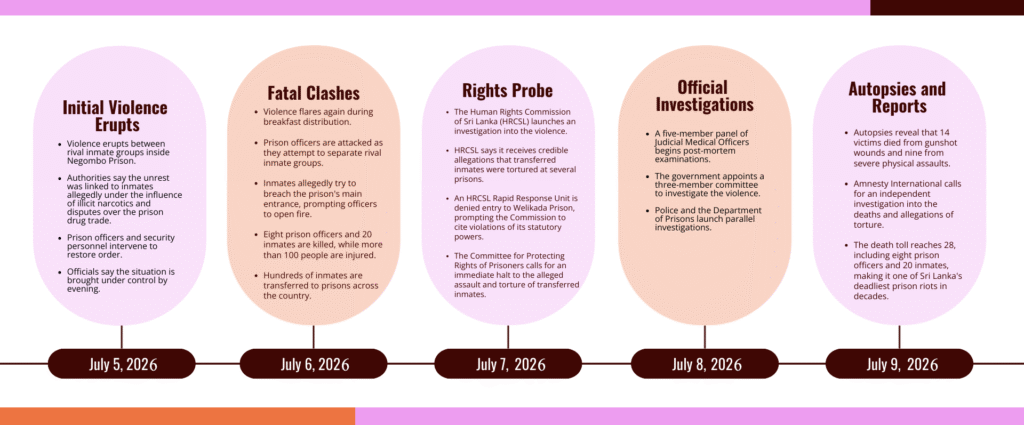
Negombo Prison Riots 2026. Chronology by Ayodhya Kiriella.

Speed Read:

  • The Negombo Prison riot became one of Sri Lanka’s deadliest prison disturbances in decades with 28 fatalities.
  • Authorities are probing the violence, the use of lethal force and allegations of  transferred inmates being tortured.
  • Following the incident, overcrowding, drugs, poor intelligence and weak prison management are under renewed scrutiny.
  • With more than 40,000 inmates held in prisons built for about 12,000, rights groups and the United Nations are calling for meaningful reform—not just new investigations or more prisons— to prevent another tragedy.

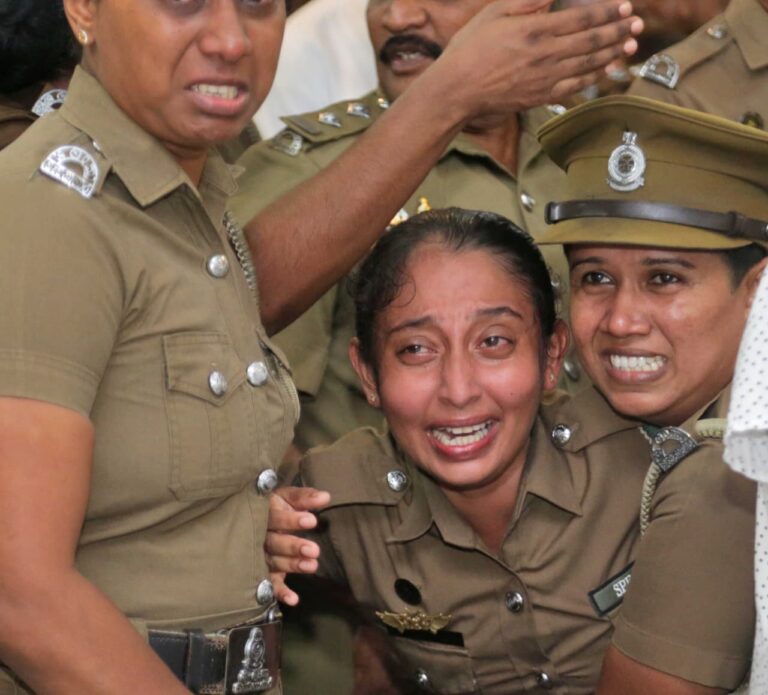
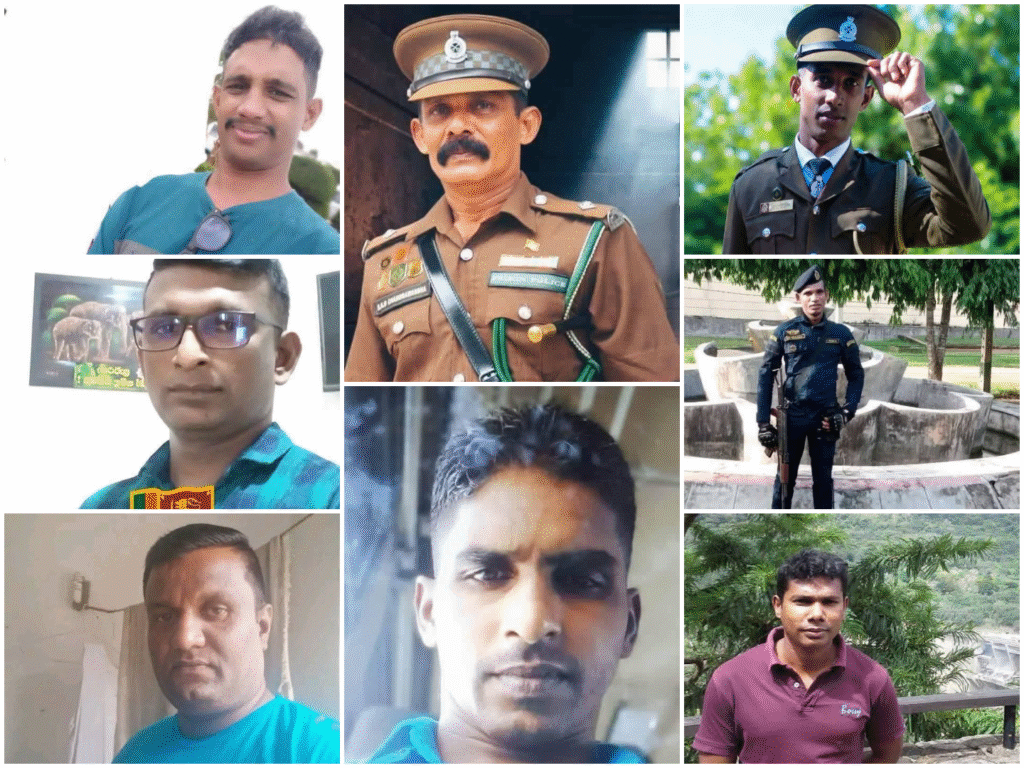
COLOMBO—When 27-year-old prison officer Darshana Tharanga reported for duty at Negombo prison on the morning of July 6, he expected another day in uniform. Instead, it became his last.

The member of the of Sri Lanka Prisons Emergency Action and Tactical Force (SPEAT Force) had been deployed from Welikada prison to help contain a clash between rival groups of inmates. It was his first assignment at the Negombo Prison. Unfamiliar with the sprawling facility, he had no idea where to run when violence erupted around him.

Back home, his seven-month-old daughter was waiting for a father who would never return.

For the family of 73-year-old Indian national Unnikrishanan Subramaniam, who was awaiting trial on drug trafficking charges, the outcome was equally devastating. They would never see him alive again.

Between them lies the story of a prison system that had long been under pressure and one that finally exploded into violence.

By July 9, 28 people were dead and more than 100 others had been injured in one of Sri Lanka’s deadliest prison riots in decades. Allegations of torture, excessive force and systemic failures have intensified as multiple investigations seek to determine what triggered the violence and how authorities responded.

What began as a clash between rival inmate groups at Negombo Prison on July 5 has quickly escalated into one of the bloodiest episodes in the country’s correctional history. The violence left at least eight prison officers and 20 inmates dead, according to government figures, while hundreds of prisoners were transferred to other facilities amid fears of further unrest.

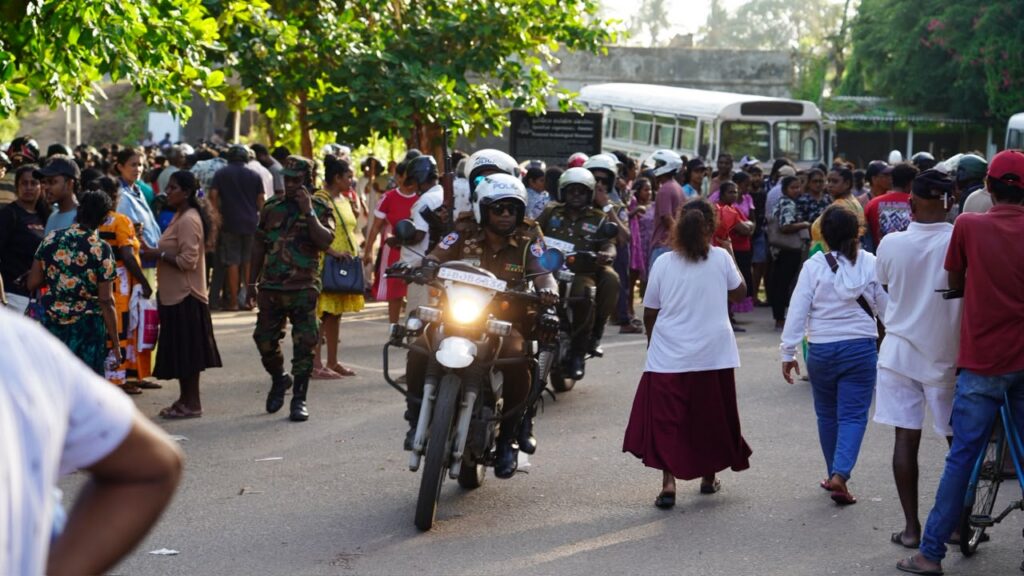
Police, the Special Task Force, and the military surrounded Negombo prison as the violence intensified. Image courtesy of Shabeer Mohamed.

The focus of the investigations has since expanded beyond the riot itself to broader questions about prison management, chronic overcrowding, intelligence failures, the use of lethal force and allegations that transferred inmates were subjected to torture. For many observers, the Negombo bloodshed was not an isolated tragedy but the latest manifestation of a prison system strained by years of neglect and structural failures.

Violence escalated, extraordinary brutality

Acting Commissioner General of Prisons Prasad Hemantha Kumara described the attacks on prison officers as unprecedented, saying the first officers who responded to the initial disturbance were overwhelmed by coordinated assaults from inmates before reinforcements managed to regain control.

According to prison authorities, preliminary investigations indicated the unrest began on July 5 after several inmates allegedly consumed illicit narcotic pills, triggering aggressive and erratic behavior. Officials also said some female inmates who allegedly consumed the substances made a series of allegations during the chaos.

Authorities maintained they had received no prior intelligence warning of an imminent riot, although officers had been deployed across the prison as a precautionary measure.

By the evening of July 5, officials believed the situation had been brought under control. Inmates had returned to their cells and were served dinner ahead of scheduled court appearances the following day.

The calm, however, was short-lived.

Violence erupted again on the morning of July 6 during breakfast distribution. Prison officials said officers attempting to separate rival inmate groups were attacked before being chased toward the prison’s main entrance, where inmates allegedly tried to breach the gates. Authorities said prison officers ultimately used what they described as the minimum force necessary to restore order.

A prison already under pressure

Investigators believe the initial confrontation may have been rooted in the prison’s illicit drug trade.

Police suspect rival inmate factions clashed after intelligence about drug trafficking inside the prison was leaked to authorities. Investigators allege that an inmate identified as “Katuwellegama Suresh,” believed to have links to the organized crime figure known as “Booru Moona,” orchestrated the attack against inmates suspected of providing information to prison officials.

Outside Negombo prison, anguished families searched for answers as police, the Special Task Force, and the military sealed off the area amid the escalating riots. Image courtesy of Shabeer Mohamed.

As the violence spread, female inmates climbed onto the prison roof in protest, followed by a group of male prisoners. Part of the roof later collapsed, injuring several inmates.

Outside the prison, anxious relatives gathered demanding information about the fate of family members inside, while security forces worked to contain the unrest.

Adding to the chaos, prison sources said inmates broke into the prison hospital and removed medication used to treat psychiatric patients.

Autopsies raise new concerns

Post-mortem examinations have revealed the brutality of the violence. A five-member panel of Judicial Medical Officers found that 14 victims died from gunshot wounds and nine from severe physical assaults, while one death remains under investigation with an open verdict.

The eight prison officials who lost their lives during the Negombo prison riots: Chief Jailer S.H.G. Chandrawansa; Sergeants R.P.R. Sanjeewa, B.N.N. Tharanga, T.N.R. Thilakasiri, D.W. Pushpakumara, S.D.S. Abeywardena, and A.D. Tharanga; and Prison Guard M.G. Upali. The officers were fatally assaulted while responding to one of the deadliest prison uprisings in Sri Lanka’s recent history. Images via Facebook page ‘Bandhanagara Niladhari Ekamuthuwa’.

The examinations also showed that the prison officers who died suffered catastrophic head injuries, underscoring the ferocity of the attacks.

Negombo chief magistrate Shilani Perera has ordered comprehensive forensic investigations and directed police to submit a detailed report to the court.

Allegations shift focus to prison authorities

As investigators examine how the violence unfolded, allegations of abuse against inmates transferred from Negombo Prison have shifted scrutiny to prison authorities.

Prison spokesperson Chamika Gajanayake said 1,200 prisoners including foreign nationals from the Negombo prison were transferred to other prisons across the island.

The Committee for Protecting Rights of Prisoners (CPRP) said it had received credible reports that some inmates were subjected to severe beatings and torture, including at Welikada Prison.

Members of the Committee to Protect the Rights of Prisoners (CPRP) met with Justice Ministry officials to discuss measures to ensure the safety and welfare of inmates transferred from Negombo prison to other correctional facilities following the riots.Image courtesy of CPRP.

The Human Rights Commission of Sri Lanka (HRCSL) launched its own investigation, expressing concern over allegations that inmates transferred to Angunakolapelessa, Boosa, Dumbara, Batticaloa, Jaffna and Welikada prisons had been tortured or otherwise ill-treated. It also raised concerns over the reported death of an inmate in Welikada prison custody.

The commission criticized prison authorities for denying  HRCSL’s Rapid Response Unit access to the Welikada prison on the night of July 7, saying the refusal violated its statutory powers to inspect places of detention. It ordered prison authorities to preserve evidence, protect inmates from reprisals, investigate allegations of abuse and take disciplinary action against any officials found responsible.

Meanwhile, Amnesty International has called for an urgent, independent investigation into the reported deaths of inmates transferred after the violence.

Deputy Regional Director for South Asia Babu Ram Pant described reports of torture and custodial deaths as “deeply alarming,” urging authorities to ensure the safety of all prisoners, grant the HRCSL unrestricted access, allow lawyers and family members to visit detainees, and provide timely medical care.

Following the Negombo prison riots, nearly 1,200 inmates were transferred to prisons across the country, including about 60 who were relocated to the Jaffna Prison as authorities sought to restore order and ease overcrowding. Image courtesy of T. Pratheepan.

The organization also called for an independent and transparent inquiry, saying the violence highlights longstanding problems in Sri Lanka’s prison system, including chronic overcrowding, prolonged pretrial detention and poor prison conditions.

Government defends Its response

Cabinet spokesperson Nalinda Jayatissa rejected comparisons between the Negombo violence and the deadly prison riots at Welikada in 2012 and Mahara in 2020, arguing that the latest unrest was fundamentally different because prison officers were the direct targets of coordinated inmate attacks.

He said, in addition to the government’s three-member independent committee, police and the Department of Prisons are conducting parallel investigations.

Justice minister Harshana Nanayakkara has accepted ministerial responsibility for the tragedy and pledged a thorough investigation, while prison officers have defended colleagues who opened fire during the unrest, saying their actions prevented a mass prison escape that could have posed a serious threat to public safety.

Justice minister Harshana Nanayakkara paid his respects at the funeral of the prison officers killed in the Negombo prison riots, where he accepted ministerial responsibility for the tragedy. Prison officers, meanwhile, defended colleagues who opened fire during the unrest, saying their actions prevented a mass prison escape that could have posed a grave threat to public safety. Image courtesy of Saswin Kumar.

“Sir, this could have nipped at the bud had we received proper orders on time,” an extremely emotional prison officer claimed as minister Nanayakkara visted the Welikada prison to pay his last respects to prison officers who died in the incident.

They also urged the minister to protect the prison officer who opened fire during the recent unrest at Negombo prison, claiming that ‘misleading information’ is being circulated about his response, endangering his life.

Opposition demands accountability

Opposition leader Sajith Premadasa accused the government of failing to prevent the tragedy, arguing that the deaths reflected deeper failures in governance and prison administration. He called for an independent investigation free from political influence and asked whether the government’s promised systemic reforms had materialized.

Former foreign minister G.L. Peiris also asked the deployment of prison intelligence officers and the use of live ammunition, demanding that authorities disclose who authorized the use of lethal force.

The remains of the seven prison officials killed in the July 6 Negombo prison riots were brought to the Welikada prison Headquarters, where colleagues, prison authorities, and other officials paid their final respects. Image courtesy of Saswin Kumar.

A system stretched beyond capacity

Beyond the immediate investigations, the violence has once again exposed the deep-rooted crisis within Sri Lanka’s prison system.

The country’s prisons currently house an estimated 40,000 to 42,000 inmates despite having an official capacity of just 11,000 to 12,000 as per official data. Rights groups estimate occupancy exceeds 286%, with some facilities operating at more than three times their intended capacity.

The CPRP recently informed a visiting United Nations delegation that severe overcrowding has forced inmates to sleep in shifts and, in some cases, beside toilets because of a lack of space. Government officials acknowledge the problem has worsened following large-scale anti-narcotics operations that significantly increased arrests.

Outside Negombo prison, anguished families searched for answers as police, the Special Task Force, and the military sealed off the area amid the escalating riots. Image courtesy of Shabeer Mohamed.

The Ministry of Justice and National Integration said the prison sustained extensive damage and could no longer safely accommodate detainees while investigations continued.

Although the government has designated the former Bogambara prison and approved a new prison in Mahamodara to expand capacity, critics argue that building more prisons alone will not address systemic problems such as corruption, drug trafficking, inadequate staffing, weak intelligence and poor accountability.

Echoing those concerns, the United Nations Resident Coordinator Marc-André Franche said the tragedy underscored the state’s responsibility to protect both prison officers and inmates, emphasizing that everyone deprived of liberty remains under the care and protection of the state.

Multiple investigations will eventually determine who fired the shots, who failed to act and whether crimes were committed during the violence at Negombo Prison.

The more difficult question, however, is whether Sri Lanka will finally confront the structural failures that have plagued its prison system for decades.

Successive commissions, court rulings, human rights bodies and international organizations have repeatedly warned about chronic overcrowding, drug trafficking, corruption, inadequate staffing and poor prison management. Many of their recommendations remain only partially implemented.

Whether the Negombo prison riot becomes another tragedy added to that long list—or the catalyst for meaningful prison reform—will depend not only on the outcome of the investigations, but on whether successive governments are willing to implement the reforms they have postponed for decades.

Banner: Hours after sharing breakfast with their colleagues, prison officers who were deployed to control Negombo prison riot returned in coffins. Left reeling by shock and grief, fellow officers struggled to comprehend how an ordinary morning ended in a brutal assault that claimed their comrades’ lives. Image courtesy of Saswin Kumar.

This story was written and edited by Gagani Weerakoon. She leads the editorial at the Center for Investigative Reporting (CIR).
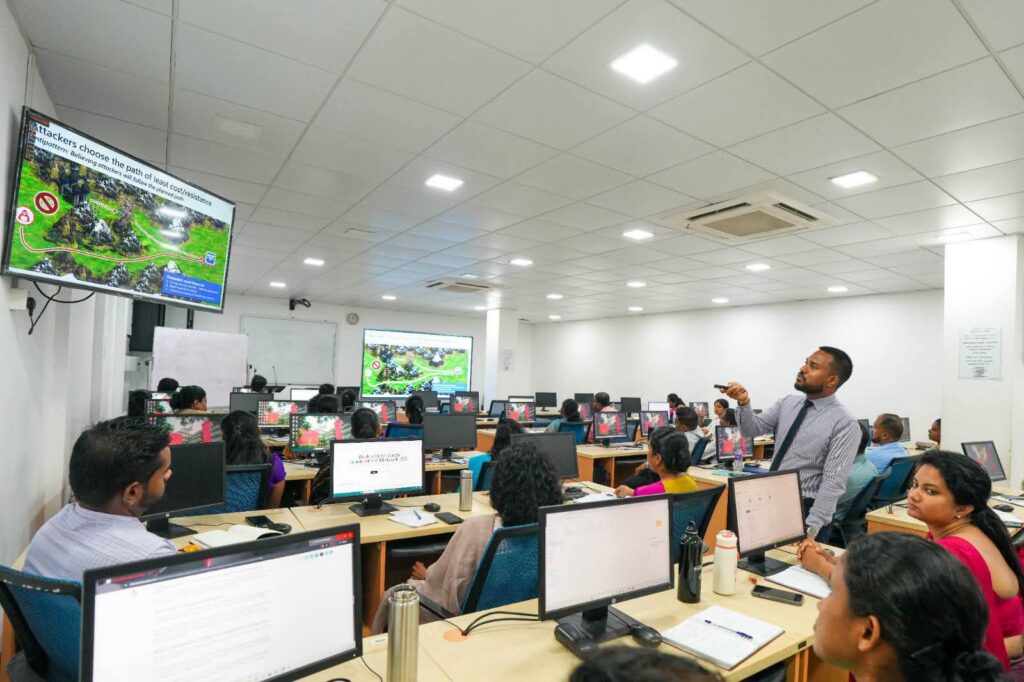
This story was produced with support from Report for the World, a global media service strengthening local independent journalism

Add your comment

AI profiles of women on Facebook: Identity deception, sexualised engagement, and platform accountability

Speed Read

  • 10 Facebook profiles posing as Sri Lankan women were found to be entirely AI-generated, using fabricated identities to attract users and drive them to gambling, adult-chat, crypto and other dubious platforms.
  • The investigation identified clear signs of coordinated activity, including identical captions, cross-posting within minutes, and nearly 900,000 engagements across 1,706 posts, indicating an organised network rather than isolated fake accounts.
  • The study found that Facebook’s existing features enable these deceptive operations to function largely undetected, while key details such as ownership, automation and revenue remain hidden from public scrutiny.

This report is the first of its kind in Sri Lanka: a systematic account of how AI-generated women are manufactured, coordinated and monetised on Facebook. Not one of the women fronting the 10 accounts studied is real, but the system behind them is, present and operational in Sri Lanka, built for speed, scope and scale, and converting fabricated intimacy across 1,706 posts and 890,632 engagements into attention, private contact and off-platform traffic towards gambling, adult-chat, adult dating, crypto and other dubious financial destinations.

The coordination is measurable rather than inferred, because five of the accounts effectively write with one hand, leaving 113 clusters of identical captions, 676 near-duplicate pairs and high-performing posts relayed from account to account within minutes, inside compressed 10-day posting windows with sub-minute median gaps. Engagement runs hub-and-spoke, with three pages capturing more than half of all attention while the remaining personas are held in reserve as disposable inventory. The bait is heartbreak in Sinhala, staged through personas presenting as lonely, widowed, divorced or financially exposed women seeking private contact, while the imagery is calibrated to a fetish niche (exaggerated busts, simulated sweat, deliberately exposed armpits) engineered to stay on the platform-safe side of moderation.

The money trail hides in plain sight, in profile bios, shortlinks and first comments where operators can change destinations without editing a post and where bulk auditing rarely reaches; the traced routes end in adult-chat surfaces, gambling registration, crypto downloads and advertising-arbitrage pages. The women even change names between the feed and the landing page, resurfacing under new identities at the point of conversion, and nothing inside the feed discloses the switch.

Nor is this a peculiarly Sri Lankan pathology, since accounts working in Spanish, Italian and Malayalam reproduce the same architecture at more than three times the per-post efficiency, framing the local network as the franchise of a transnational operating model in which the synthetic woman is the interchangeable part. The evidence for a political influence operation is low in this data, but the infrastructure is dual-use, since audiences already assembled, personas already trusted and provenance already invisible are precisely what such a campaign would need, and the same features act as a force multiplier for the crypto and financial scams already resident on Meta’s platforms in Sri Lanka. 

Because every mechanism documented runs on Facebook’s own affordances, on public surfaces that give a user no way to distinguish a person from a funnel, the deception required no rule-breaking at all, and the transparency tools that should make the difference visible appear only by exception. What remains unproven (common ownership, operator identity, ad spend and revenue flow) sits beyond anything a public surface allows an observer or a regulator to establish, and that limit is itself a finding about how little accountability the platform’s visible layer affords.

Key highlights

  1. In the first systematic study of its kind in Sri Lanka, none of the 10 Facebook accounts examined belongs to a real woman: each trades on the name, face and life of a Sri Lankan woman assembled by AI, a finding the photographic evidence places beyond reasonable doubt.
  2. Five of the accounts write with one hand, leaving 113 clusters of identical captions, 676 near-duplicate pairs and posts relayed from account to account within minutes, a pattern of coordination that coincidence of style cannot explain.
  3. At 1,706 posts and 890,632 engagements, the scale is industrial rather than artisanal, with three pages capturing 51.9% of all attention, and the remaining personas held in reserve as disposable inventory.
  4. The bait is heartbreak in Sinhala: scripted loneliness, widowhood, divorce and financial distress, each engineered to move a sympathetic stranger from a public comment to a private WhatsApp chat.
  5. The imagery is calibrated to a niche rather than to glamour, with exaggerated busts, simulated sweat and deliberately exposed armpits recurring across the highest-reach Sri Lankan pages and the foreign set, an erotic vocabulary designed to slip beneath the threshold at which moderation acts.
  6. The money trail hides in plain sight: the links that matter sit in bios, shortlinks and first comments, where bulk auditing rarely reaches, and resolve to adult-chat, gambling, crypto and advertising-arbitrage destinations.
  7. The women change names between the feed and the landing page (Kavya becomes Kumari, Nethmi becomes Wasana and then Hiruni), and a user inside Facebook has no way of seeing the switch.
  8. The evidence for a political influence operation is low in this data, but the infrastructure is dual-use, since audiences already assembled, personas already trusted and provenance already invisible are precisely what such a campaign would need.
  9. Accounts working in Spanish, Italian and Malayalam reproduce the same architecture at more than three times the per-post efficiency (median engagement of 459 against 130), which frames the Sri Lankan network as the local franchise of a transnational operating model.
  10. None of this required breaking Facebook’s rules so much as using Facebook well, since every mechanism documented runs on the platform’s own affordances, and the platform’s public surfaces give a user no way to detect the deception.
  11. The report’s limits are themselves telling, because common ownership, operator identity, backend automation and revenue flows sit beyond anything a public surface allows an observer, or a regulator, to establish.
Screenshot/ sanjanah.wordpress.com

Download the report in full here.

Banner Image: Composite image of Facebook profile photos analysed as part of an investigation into AI-generated identities and coordinated online engagement. Image created by Dr. Sanjana Hattotuwa.

This report was produced by Dr. Sanjana Hattotuwa and was originally published on sanjanah.wordpress.com. He studies information disorders, influence operations, and information integrity in order to evaluate the impact on public opinion, political discourse and democratic institutions.

Corruption complaint casts shadow over Sri Lanka’s Guinness record dance event over fees, foreign links

Speed Read

  • A complaint has been filed with Sri Lanka’s national anti-corruption watchdog seeking an investigation into the organization and financing of the “Sangamam 2026,” a Guinness world record Bharatanatyam event held in Colombo.
  • Thousands of families collectively spent millions of rupees on registration fees and absorbed other expenses and are now  questioning how participants’ funds were managed.
  • Concerns have been raised over the involvement of Sundaralingam Pradeep, deputy minister of plantation and community infrastructure. The national agency is urged to scrutinize  whether government influence or official resources were utilized in support of what is described as a privately organized commercial venture.

COLOMBO — What was promoted as a landmark cultural celebration that brought together nearly 5,000 Bharatanatyam dancers at Colombo’s Galle Face Green has now become the subject of a sweeping complaint alleging possible financial irregularities, abuse of public office, and misuse of government influence.

A complaint filed with the Commission to Investigate Allegations of Bribery or Corruption (CIABOC) calls for a comprehensive investigation into the organization, financing, and administration of the “Sangamam 2026” Guinness World Record event held on June 14.

The event organized by a private entity, Sangamizh Liya Holidays, in collaboration with Sangamam Global Academy saw 4,988 dancers successfully set a new Guinness World Record for the largest Bharatanatyam dance lesson.

The complaint asked the investigators to determine whether the event involved violations of Sri Lanka’s Anti-Corruption Act, including the alleged misuse of public office, financial irregularities, conflicts of interest, or other  unlawful conduct.The allegations remain unproven, and there is no indication that CIABOC has commenced a formal investigation. Deputy Minister of Plantations and Community Infrastrcuture Sundaralingam Pradeep and the event organizers had not publicly responded to the allegations at the time of publication.

The official certificate recognizes Sangamizh Liya Holidays (Pvt) Ltd of Sri Lanka, Sangamam Global Academy of India, and D. Vennmani Selvi of India as the record holders. Image via Sangamizh Liya Holidays Facebook page.

Complaints from parents, teachers

The complaint was filed by Rajkumar Rajeevkanth, an activist affiliated to the People’s Struggle Alliance, who told CIR that he was prompted to act after receiving numerous complaints from parents and Bharatanatyam teachers across the country.

According to Rajeevkanth, many teachers declined to speak publicly because they feared repercussions.

“I received numerous complaints from parents and teachers. Most of them were from the Eastern province and Malaiyaha community and were unwilling to disclose their identities because they feared the consequences,” he said.

After reviewing payment records, participant communications, and other documents, Rajeevkanth said he began questioning both the financial arrangements behind the event and the role played by government officials.

Participants were later asked to make additional payments to obtain medals, participation certificates, framed certificates, and other Guinness-related memorabilia. Image courtesy of Rajkumar Rajeevkanth.

Minister’s role questioned

Central to the complaint are public statements made by deputy minister Sundaralingam Pradeep, on his official Facebook page.

According to the complaint, the minister Praadeep has stated that he initiated the program after discussions during an official visit to India, that the event was organized under his guidance and advice, and that he received the official Guinness World Record certificate following the event.

Rajeevkanth argues these statements warrant scrutiny into whether government influence or official resources were used in support of what he describes as a privately organized commercial venture.

He also questions why organizers with Indian links were selected to spearhead the initiative when, he says, Sri Lanka possesses the expertise, teachers, and infrastructure to organize a similar event independently.

“We have the teachers, the students, and all the necessary resources in Sri Lanka. My question is why a private company from India was brought in to organize an event that could have been conducted locally,” he said.

Millions collected from participants

The complaint alleges that organizers recruited more than 100 Bharatanatyam teachers, encouraging each to bring 10- 15 students, eventually assembling approximately 5,000 performers.

According to the complaint, participants paid registration fees ranging from Sri Lankan rupees   4,500 -to . 6,000 ($ 13.40 to $18).

Families were also responsible for purchasing costumes and jewelry, paying for transport, accommodation, and rehearsals, meaning the overall cost per participant was significantly higher than the registration fee alone.

Rajeevkanth estimates organizers collected between $ 60,000 -$ 74,000 (rupees . 20 million to  25 million) through registration fees alone.

“The students, teachers and parents bore almost every expense themselves. They paid the registration fee, purchased costumes, arranged transport and accommodation, and participated in the performance, yet the official Guinness World Record recognition was issued to private organizations rather than to the participants,” he said.

The new Guinness World Record states, “The largest Bharatanatyam dance lesson consists of 4,988 participants and was achieved by Sangamizh Liya Holidays (Pvt) Ltd (Sri Lanka), Sangamam Global Academy (India), D. Venmani Selvi (India), and Bharatanatyam teachers and students in Colombo, Sri Lanka on 14 June 2026.”

The complaint asks investigators to determine how much money was collected, who controlled the funds, whether proper accounting records exist, and whether any public officials directly or indirectly benefited from the exercise.

Registration fees were deposited into a private bank account instead of an official government account. Image courtesy of Rajkumar Rajeevkant.

Private bank account, additional charges

Another allegation centers on how participant payments were handled.

The complaint claims registration fees were deposited into a private bank account instead of an official government account. It asks investigators to determine who controlled the account, whether the collections complied with taxation and financial reporting requirements, and whether any public officials facilitated the arrangement.

Rajeevkanth also claims participants were later asked to make additional payments to obtain medals, participation certificates, framed certificates, and other Guinness-related memorabilia.

The complaint asks whether these additional costs were disclosed before registration and whether the collections were lawful.

Guinness recognition questioned

The complaint also questions how the Guinness World Record recognition was ultimately awarded.

According to the complaint, the official certificate recognizes Sangamizh Liya Holidays (Pvt) Ltd of Sri Lanka, Sangamam Global Academy of India, and D. Vennmani Selvi of India as the record holders.

Rajeevkanth argues that despite thousands of Sri Lankan students and teachers participating in the performance—and bearing much of the financial burden—they were not recognized on the official certificate.

The complaint seeks an investigation into any agreements between the organizers and these entities, ownership of any commercial rights arising from the record, and whether participants were informed beforehand that the recognition would be issued in those names.

Rajeevkanth said he has submitted payment slips, participant communications, official announcements, photographs, and copies of the Guinness World Record certificate to support his allegations. Image courtesy of Rajkumar Rajeevkanth.

Call for a financial investigation

Among other requests, the complaint asks CIABOC to obtain bank records relating to participant payments, examine agreements involving organizers, government institutions and foreign organizations, determine whether public resources were used, and investigate whether any offenses under the Anti-Corruption Act or other applicable laws may have been committed.

Rajeevkanth said he has submitted payment slips, participant communications, official announcements, photographs, and copies of the Guinness World Record certificate to support his allegations.

“I believe this amount to a serious deception. This is not how an event involving thousands of children should have been organized,” he said.

The previous Guniess Record for the largest Bharatnatyam dance consisted of 10,544 participants and was achieved by Mridanga Vision Premium Art Magazine in Kochi, Kerala, India on 29 December 2024.

Banner Image: A total of 4,988 dancers successfully set a new Guinness World Record for the largest Bharatanatyam dance lesson. Image via Sangamizh Liya Holidays Facebook page.

This story was written and edited by Gagani Weerakoon. She leads the editorial at the Center for Investigative Reporting (CIR).
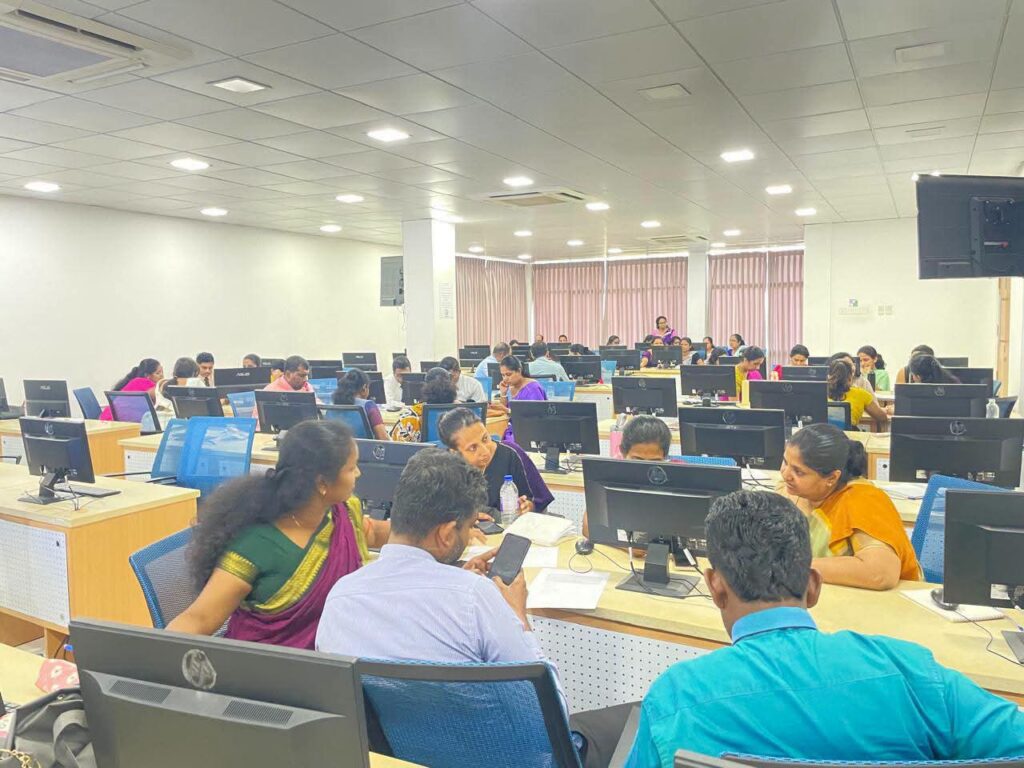
This story was produced with support from Report for the World, a global media service strengthening local independent journalism

Add your comment

Serving long-term interests through military training and hardware

Speed Read

  • In March, declassified archives showed how Israel secretly supplied Sri Lanka with weapons, campaign funding and military training disguised as agricultural advice.
  •  The cables show not only Israel’s contribution to Sri Lankan Government’s war effort but also how Israel set out to normalize relations between the countries after Colombo severed diplomatic ties with Israel in 1970.
  • Tel Aviv has retained cordial relations with Colombo despite fluctuations and supported successive governments’ military offensives against the Liberation Tigers of Tamil Eelam (LTTE), with Colombo relying heavily on Israel for security advise and training.
  • However, with the influx of Israeli tourists in the East and South, there is growing tension between the ‘settler tourists’ with local communities strongly opposing Israeli presence. 

COLOMBO –The ethnic tensions in Sri Lanka were palpable long before the war broke out in 1983. The simmering discontent had historical contributory factors. Political marginalisation and disenfranchisement of Tamils of Indian origin, now known as the Malaiyaha Tamils, driving statelessness and language-based discrimination through legal instruments have fanned the flames of Tamil separatism over decades. War erupted in July 1983, consuming nearly three decades and nearly 70,000 lives.

Meanwhile, Sri Lanka came to rely on a few friendly nations in its fight against the Liberation Tigers of Tamil Eelam (LTTE), and Israel was one of them.

Military historians have recognized that Israel has secured a special place in the country’s fight against the LTTE. Those with insights into military strategy-making and surveillance architecture confirm that some approaches, including the combat model, were not dissimilar. From the ‘settlements approach’ where lands were taken under military control or how the military offensives were conducted, there were strong similarities between Colombo’s approach to the North and Tel Aviv’s to the West Bank.

This relationship had seen fluctuations, and this was often based on Colombo’s political leadership at the time. Colombo needed Israel’s support to strengthen VIP security and to fight the LTTE, while the West Asian nation wanted greater acceptance by the Sri Lankan public. Recently declassified leaks have shown how important it was for Tel Aviv to shift the public opinion in its favor.

An image of a declassified communication from 1984 records Sri Lanka’s agreement to set up an Interests Section in Colombo. Image via Wikipedia.

Strengthen bilateral ties

The declassified Israeli archives show that in the 1980s, Israel secretly supplied Sri Lanka with millions in weapons, military training disguised as agricultural advice, and possible support for election campaigns, despite serious allegations of human rights abuses against Sri Lanka.

In March 2026, declassified Israeli archives offered a glimpse of how Israel gradually laid the foundation for military policy influence in Sri Lanka.

Under pressure from the Arab states, Colombo had severed diplomatic ties with Tel Aviv in 1970. This changed when Junius Richard Jayewardene, known for his pro-West politics, decided to forge ties with Israel. In 1984, a year after the war broke out, an Israeli Interests Section (IIS) was opened at the U.S. Embassy in Colombo. According to a review prepared on Dec. 11, 1987, by Israel’s Foreign Ministry, Sri Lanka had initially agreed to the establishment of the IIS due to its need to obtain assistance to solve “the Tamil terrorism problem”. Israel had sold military equipment worth $30 million to Sri Lanka in the next four years.

The files confirm that Israel viewed the relationship as a key strategic opportunity to strengthen ties with Sri Lanka during the civil war, with Israeli personnel providing crucial military and intelligence training. It would be among the earliest times when Israel embedded itself in the local system for intelligence gathering. Israel had remained a key supplier of weapons during the nearly three decades of Sri Lanka’s war.

One of the leaks from 1987 showed how President Jayewardene requested $1 million from Mossad, Israel’s intelligence agency, to fund his election campaign. Israel approved the request, though the cables do not bear evidence of it.

According to insiders, since the UNP’s election in 1977, Mossad had increased its sphere of influence, particularly in military policy. The files reveal long-term ties between Sri Lanka and Israel and, in the late 1980s, how Israeli personnel provided military training to Sri Lankan forces and the president’s security division.

Leaks also showed that Israeli instructors involved in training operations in the North were, at times, presented as “agricultural advisers”. This method was considered the best way to support the war effort without their real identities being discovered.

These developments occurred at a time when India-Sri Lanka relations were strained, with reports indicating India’s concern over Sri Lanka’s engagement with Western and Israeli actors. The neighbor’s discontent did little to dampen Jayewardene, who was convinced of the need for Western allies.

In this archived image from September 1979, President Junius Richard Jayewardene is seen pinning a medal on an army officer at a presidential awards ceremony held at the Panagoda Army Cantonment. Image courtesy of the Sri Lanka Army Service Corps.

What the cables say

Cables from 1985 and 1986 showed Israel having sold Colombo six Dvora-class fast patrol boats worth $10 million and Mini-Uzi submachine guns “for considerable sums”. A June 1987 cable referred to the sale of electronic fences, communications equipment, machine guns, and ammunition to Colombo. Other cables referred to training the personal bodyguards of President Jayewardene and Sri Lanka’s military. A 1987 cable reported that Israeli military instructors had been publicly presented as “agricultural advisers”.

On Feb. 15, 1987, Israel had responded positively to “Sri Lanka’s urgent request for assistance in security preparations against Tamil underground activity” and indicated weapons and ammunition worth $3 million. One cable revealed how the U.S. ambassador in Colombo approved Israel maintaining ties with the Sri Lankan military but recorded his dim view of the Special Task Force (STF).
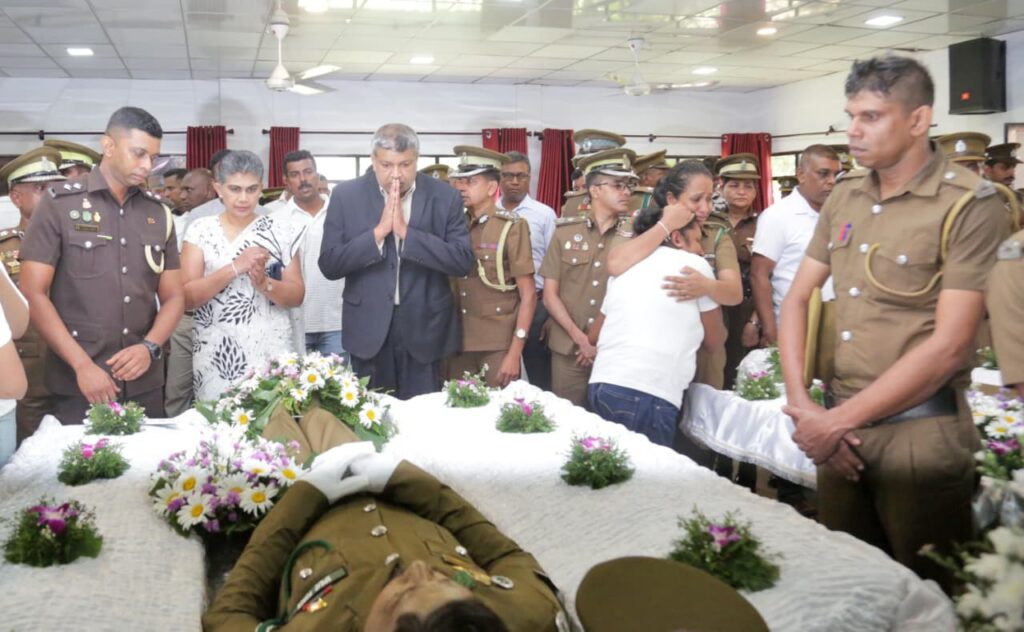
Cables also showed how important it was for Israel to be positively viewed by Sri Lanka, especially the IIS.
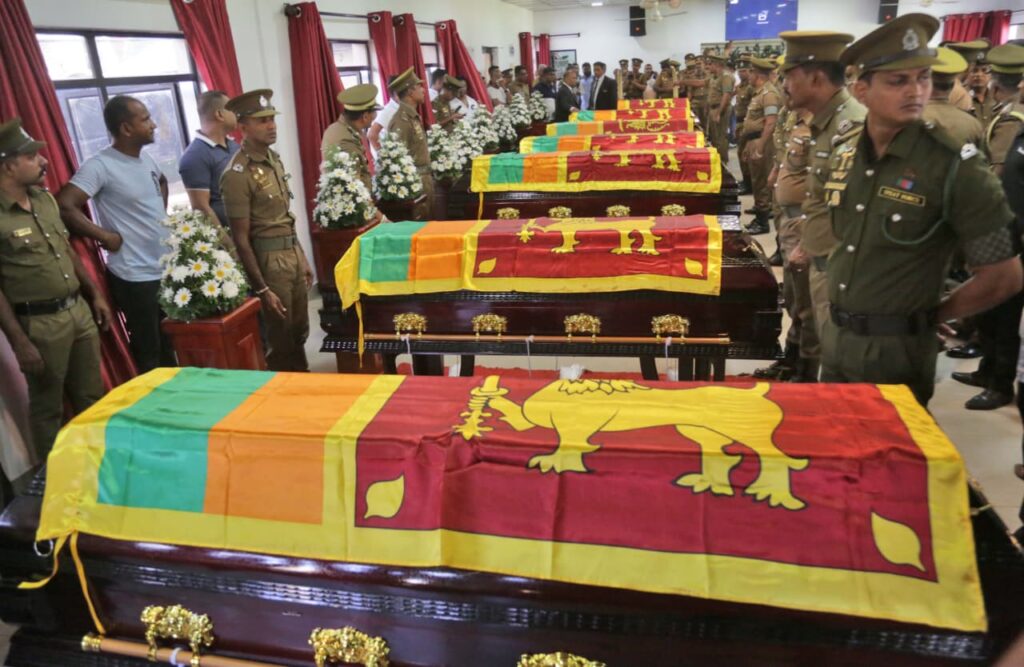
A 1987 cable mentioned how important it was for Israel to see the complete normalization of relations with Sri Lanka and the need for public diplomacy to create the right atmosphere among the local people. There were concerns about being viewed solely as an organization established to assist the government in its war against Tamil terrorism, which was also the official explanation provided for setting up a mission in Colombo.

Israel had also acknowledged Colombo’s main reason for renewing diplomatic ties was the need for military assistance, and though there was little faith in the ability to win the war, it suited Tel Aviv to bolster ties with Colombo by extending military support. A cable recorded Jayewardene being unhappy with the Western nations for not favoring the requests for military aid and being appreciative of Israel as the only country to help with security and intelligence.

Meanwhile, the Colombo administration was under severe pressure from the Arab states and the political opposition to close the IIS in Colombo, and cables from August 1987 recorded that President Jayewardene had asked a Mossad representative for $1 million to fund his election campaign. A cable read: “We have an interest in his victory, and therefore we should assist it.” It was the IIS belief that the unit will have to shut down if power shifts to the opposition, which had severed ties with Israel in 1970 and had pledged to expel the Israelis after electoral success.

The IIS’ military assistance was viewed by some as something that should not have happened considering the human rights abuses linked to the war and a history of a violent military crackdown in 1971 to control a southern uprising. Human rights bodies and local Tamil groups have opposed IIS’s open support through advice, training and equipment to conduct surveillance to unleash violence on the Northern Tamil populations, a charge dismissed by Tel Aviv as anti-Israel propaganda.

The cover of “By Way Deception – A Devastating Insider’s Portrait of the Mossad” by Claire Hoy and Victor Ostrovsky. The latter was a former Mossad agent. Image via Wikipedia.

Dismantling IIS

However, the bilateral romance ended when Ranasinghe Premadasa was elected president in 1988. He shut down the IIS in 1990 and, in 1991, set up a Presidential Commission of Inquiry into the allegations contained in the book “By Way of Deception” by former Mossad agent Victor Ostrovsky that probed the activities of Mossad in Sri Lanka.

The commission was established during a period of complex security and political challenges, after reports emerged that Mossad agents participated in training Sri Lankan security forces in the early days of the war. The Commission was mandated to probe the extensive influence of the foreign security entity in Sri Lanka. Meanwhile, the book bore evidence as to how deeply embedded Israel was in Sri Lankan counter-terrorism operations and how Mossad trained both the government security forces and the LTTE. The commission chaired by S.W.P. Wadugodapitiya had been labelled by critics as an eyewash which failed to document the extent of Israel’s actual engagement and influence in Sri Lanka’s military operations.

In 1992, President Premadasa ordered the closure of the Israeli Interests Section (IIS) in Colombo. 

Defense cooperation

Eight years later, Sri Lanka re-established diplomatic ties with Israel in 2000.

However, Israel has never been out of Sri Lanka’s military scene. By the time Mahinda Rajapaksa became the president in 2005, Sri Lanka had become one of Israel’s important Asian clients, with Colombo heavily relying on Tel Aviv for military procurements and technology. By 2009, Israel was a well-established supplier of weapons to the island. In the post-war period, new procurements have slowed, but technical support and upgrading of existing hardware continue.

A sizeable portion of Sri Lanka Navy still relies on Israeli-built Dvora, Super Dvora, and Shaldag fast attack craft and they require regular maintenance and parts replacement. Similarly, Sri Lanka Air Force operates Israeli-made Kfirs, with technical-personnel collaborations ongoing. A $50 million contract was signed with Israel Aerospace Industries to upgrade the Sri Lanka Air Force’s fleet of Kfir fighter jets and test flights of these modernized aircraft took place as recently as June 2026.

“There have been some rough patches, but overall, it has remained a steady relationship. Both countries continue to deepen economic and labor ties,” notes a retired diplomat.

A beautiful Chabad house of a local Jewish community located in Hikkaduwa. Image courtesy of Chabad of Sri Lanka Facebook Page.

Settler tourism

The recent leaks may have given Sri Lankans a glimpse of what was known and unknown as Israel’s strong links with Sri Lanka. During the years of war and thereafter, and long before television news brought the West Bank’s atrocities into people’s living rooms, a section of Sri Lankans may have viewed Israel positively. But Israel’s recent role in the West Asia crisis has globally caused its reputation to plummet.

As Israelis form small communities in the South and East, operating unauthorized businesses and sometimes clashing with local customs, many residents are becoming uneasy about their presence and suspicious.

Tensions have emerged in recent years regarding an influx of Israeli tourists setting up unregulated businesses – such as yoga studios, surf camps, guesthouses, and Chabad houses – primarily in coastal regions like Hikkaduwa, Ahangama, Weligama and Arugam Bay. Local communities have protested that these settler tourists operate on tourist visas, evade local taxation and bypass regulatory oversight. There had also been clashes between the Israelis and local communities, sometimes triggering travel warnings.

From yoga instructors to business operators to digital nomads to long-term visitors, the line between tourism and settlement has become increasingly blurred. “I don’t know whether they are tourists anymore. Tourists are short-term visitors, not settlers. Local people lived in fear during the recent West Asia crisis and now there is greater tension. There have already been clashes between them and residents, and now we are on permanent edge,” says Mevan, a local tourist guide from Hikkaduwa.

Banner Image: Ongoing tactical training and field exercises conducted by contemporary Sri Lankan military forces. Images via Sri Lanka Army and Sri Lanka Military Academy.

This report was filed by a Special Correspondent.

Add your comment