
By Aanya Wipulasena
With overcrowding, more than double the capacity, and dire states, Sri Lanka’s prisons have become a ‘living hell’ for inmates, while some don’t make it out alive.
The death certificate states that Rajitha Suranga Dissanayake died from heart failure due to pneumonia in the lungs on 26 June 2024, at the Ragama Hospital. He was 35.
“They killed my son. He would still be alive if they listened to him and took him to the hospital on time,” Carmen Liyanage, 62, said. She still can’t believe she won’t hear her son’s voice again.
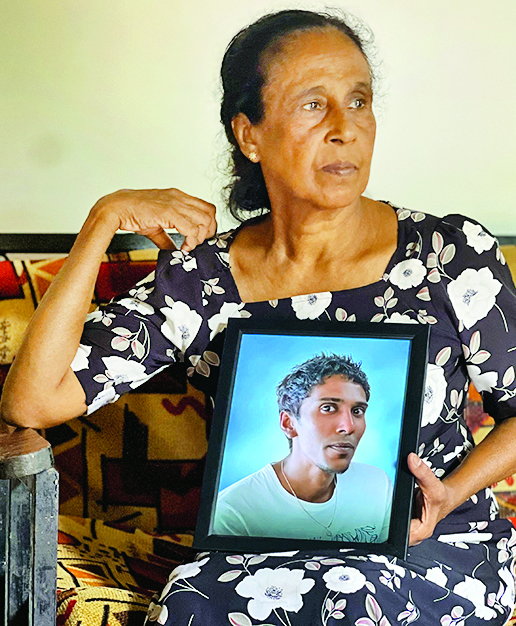
“I can’t accept this. He can’t be gone,” she said, sobbing uncontrollably, as Rajitha’s eight-year-old daughter watched on.
Rajitha was detained by the Special Task Force (STF) on 17 December 2023, in an anti-drug operation. Days after, he was sent to the Dumbara prison complex in Pallekele.
While awaiting his case to be heard, Rajitha was transferred to the Mahara Prison in Ragama for an earlier case of possessing a phone within the prison complex, which resulted in him travelling nearly 130 km every other week between Mahara and Pallekele. During this period, his health deteriorated.
According to Carmen, he was caught with the phone while he was in Pallekele Prison, in 2023, after he was arrested for possession of drugs. He was released from prison in August and was rearrested in December.
“I went to see him every month after his arrest. He was healthy till June last year,” Carmen said.
During one of her visits on 21 June 2024, Carmen found that her son was having chest pains. Days later, on 25 June, they returned to see him when they heard that he was gravely ill.
“My son was crying when he spoke with us that day. He was weak and could barely speak. He said a prison guard told him, ‘ubala merenna inna aya thamai. Malla aran enna’ (you are all going to die. Bring your bag.).
Later, Rajitha was rushed to the Ragama Hospital around midnight on the prison bus where he died.
Carmen blames prison officials for negligence leading to the untimely death of her son.
Chathura Deshapriya, 43, who was with Rajitha during his last days in prison echoed Carmen’s sentiments. Now released and recalling the ordeal, Chathura said he urged prison officials to take Rajitha to the hospital. His pleas fell on deaf ears. Later, Chathura heard the news that Rajitha had died.
“Rajitha said he would die on the bus. He asked prison officials not to take him, but they (prison officials) put handcuffs on him and took him to Mahara Prison. That night, someone came from Mahara to our ward. He asked, “When Rajitha Ayya left, was he swollen?” We said that he was not. This inmate told us when Rajitha entered from the gate, he was swollen. His fingers were swollen, and he looked very fat.”
Chathura and other inmates were concerned about Rajitha, but that same night they received the news that he had died.
According to a Court report, on 26 June 2024, Mahara Prison warden Sanjaya Prabath Ekanayake gave the following statement, “On 25.06.2024, I reported for duty at Mahara Prison. At around 2:00 in the morning, I was told that I had a duty at Ragama Hospital. Accordingly, I came to the hospital. The suspect had already been admitted to the hospital. He was being treated in the emergency ward. Artificial respiration was given. Later, at around 3:30 in the morning, the doctor informed me that he had died. I informed Mahara Prison by phone. After staying in the ward for about two hours, the deceased’s body was brought to the mortuary.”
The Court report also lists acute myocardial infarction, severe coronary artery, and bronchopneumonia disease as causes of death. The conditions reflect the symptoms Rajitha had days before his death.
Rajitha’s wife, Monica Erandhi, 31, tries to be strong for her daughter. “No one has loved me as much as he (Rajitha) did. If you ask me how I feel now that he is gone, I don’t have words to explain what I feel,” she said.
The Court report, quoting the post-mortem report, stated that Rajitha had two tattoos depicting the name MONICA on both his hands.
Like Rajitha, at least 377 inmates died between January 2023 and December 2024 while detained in prisons, a Right to Information (RTI) request to the Department of Prisons disclosed.
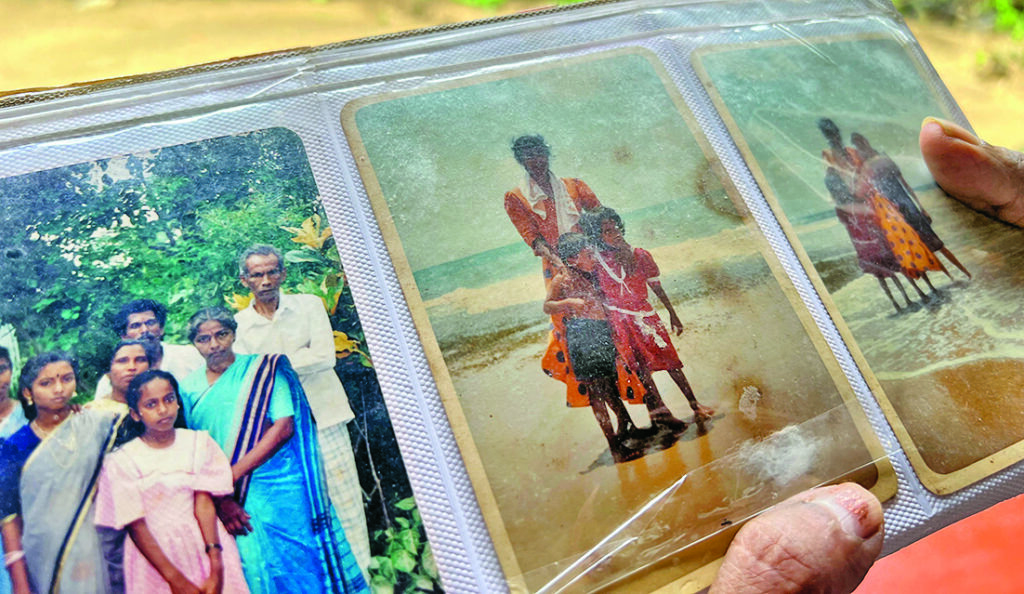
In 2024 (from 1 January to 28 November), 168 inmates died within Sri Lankan prisons. While most of the deaths (155) were reported as due to illnesses, nine inmates are reported to have committed suicide, two died by assault and 2 in fall accidents.
Prisons Department Spokesman and Prisons Commissioner Gamini B. Dissanayake said most of the prisoners who died of illnesses had contracted them before incarceration.
“Another reason is old age. We have over 600 prisoners over the age of 60,” adding that prisoner deaths have decreased in 2024 due to the reduction in the number of incarcerations.
Commissioner of Prison Administration, Ajith Basnayake, said that the basic rights a person has apply to incarcerated persons. Sri Lanka also follows the Nelson Mandela Rules that outline the minimum standards within prisons.
“In the headquarters, there is a separate Deputy Director who is in charge of health. In addition to that, there are prison hospitals. In some prisons, even if there is no hospital, there is a ward and doctors visit them. A doctor must attend to a prisoner when needed,” Basnayake said, adding that this happens as soon as possible.
However, overcrowding within prisons has severely disrupted the system. As of 21 November 2024, the Department of Prisons reported there were over 28,000 inmates, despite the prisons’ capacity being around 10,000. Alarmingly, nearly 19,000 are unconvicted inmates.
Senaka Perera, lawyer and President of the Committee for Protecting Rights of Prisoners (CPRP) said one of the main issues he has observed is that prisoners don’t receive timely medical attention, while inmates have also died due to assault by prison officers. About five of his cases are due to negligence within prisons.
Perera said that the health of prisoners should be a top priority for prison officials. “Outside the Welikada Prison, you see the statement ‘prisoners are human beings’ written on the wall. They must act on it,” he said.
He said that even though Rajitha had a criminal history, prison officials should have ensured that his basic rights were maintained.
A prisoner who wished to remain anonymous said despite the pledge by the Prisons Department to treat inmates humanely they are treated ‘worse than animals’ and prisons are like ‘living hells’.
“Inmates are packed in overcrowded wards. Sometimes we don’t even have a place to sleep. Some people keep standing, in the night, because there is no space to even lie down. We stay like dogs,” he said.
He said an inmate who was in a ward in Dumbara Prison (Bogambara) died by suicide last year.
“He did not have a place to sleep. He stood in the bathroom for days before he hung himself,” the inmate said.
The death of an inmate was verified through information obtained through an RTI regarding prisoner deaths. The report stated that an inmate died by suicide on 4 May 2024, in Bogambara A3.
“Prison officers beat inmates for sport too,” the inmate said, adding that many have signs of depression, but they don’t get treatment.
“We get access to water for 2-3 hours. Seventy inmates have to use water and save up for drinking within that short period. Sometimes, we don’t even have water to drink,” he said, adding that many fear speaking out fearing retaliation from prison officials and the Police.
A 2020 report by the Human Rights Council of Sri Lanka states ward conditions fall short of accepted standards for space per prisoner, ventilation, lighting, and temperature, often resulting in inhumane living conditions and the primary reasons for this include not only the overcrowding prevalent in nearly every facility but also the dilapidated state of the prisons, many of which were built decades ago.
“There is a severe shortage of medical infrastructure and supply of specialised medicine inside prison hospitals, thereby limiting the options for treatment available inside the prisons and requiring prisoners to be transferred to the General Hospital for diagnosis and treatment,” it further stated.
A report by the Department of Prisons titled ‘Prison Overcrowding’ states if courts expedite the hearing of these cases, the process of releasing or convicting inmates could be accelerated. It adds that currently, many suspects are held in prisons for prolonged periods without any form of rehabilitation, and this not only creates numerous issues within the prison system but also results in a significant waste of the country’s labour and financial resources.
In Digana, each day is a battle for Carmen. She cries every time she wakes up and remembers that her son is gone.
“He was the man of the house since his father died. He loved me so much. My life is not the same without him,” she said.
Attempts were made to contact Mahara Prison officials for comment.
The Story was Originally Published in Ceylon Today on 01 March 2025.