From 2015 to 2020, authorities in Sri Lanka and India seized nearly 65 metric tons of sea cucumbers worth more than $2.8 million and arrested 502 people in connection with the attempted trafficking.
The sea cucumber fishery is banned in India and restricted under a licensing system in Sri Lanka, but growing demand for the animals in East Asia has turned the waters between these South Asian countries into a hotspot for the illegal trade.
The presence of the legal trade in Sri Lanka means Indian fishers can smuggle their catches into the country and launder them into the legal market for export.
The overharvesting of sea cucumbers has severely depleted their populations; from 21 species of sea cucumber deemed commercially viable for fishing in 2008, there were only nine by 2015, according to surveys.
COLOMBO/MANDAPAM — It was a calm October night over Sri Lanka’s northern seas, the silence broken only by the sound of a rapidly approaching motorboat from India. In Kalpitiya, a town further down the island’s western coast, it rendezvoused with a truck waiting on the beach.
Also waiting there was a Navy patrol team, which seized the illegal consignment of 1,196 kilograms (2,637 pounds) of dried sea cucumbers worth more than 16 million Sri Lankan rupees (nearly $80,000); authorities also arrested two trafficking suspects.
The previous month, on Sept. 19, the Indian Coast Guard made a similar arrest in the waters off Mandapam in Tamil Nadu state. The individuals arrested in that incident were carrying 2 metric tons of sea cucumbers meant to be smuggled by sea into Sri Lanka.
Seizures of illegally harvested sea cucumbers have become increasingly common in the waters between India and Sri Lanka. Between 2015 and 2020, the Sri Lankan Navy and the Indian Coast Guard made 502 arrests and seized nearly 65 metric tons of sea cucumbers worth a combined $2.84 million.
A group of men sorting sea cucumbers for processing. Image courtesy of Ganeshan Nishanthan/Mongabay.
Increase in smuggling
According to data analysis of sea cucumber-related seizures and arrests reported in the media, 2019 and 2020 saw a sharp increase in cases, making the Gulf of Mannar/Palk Bay region between the two countries a global hotspot for sea cucumber smuggling.
Despite their name, sea cucumbers aren’t vegetables; they’re echinoderms, from the same phylum of marine animals that includes starfish and sea urchins, and live on the sandy bottoms of oceans, where they perform the important ecological function of nutrient cycling.
Sea cucumbers aren’t typically eaten in South Asia. Instead, their harvest here is for demand from East Asia, where they go by many names, most often bêche-de-mer, and are considered a delicacy, eaten both fresh or dried, and used in traditional Chinese medicine.
Exports of bêche-de-mer from this region have historically been low, but the trade has grown significantly in recent years as the demand for sea cucumbers has increased. Some species, like the sandfish (Holothuria scabra), sell for around $1,800/kg ($816/lb) while the white teatfish (H. fuscogilva) fetches about $401/kg ($182/lb) due to the high demand, making sea cucumber harvesting a lucrative business.
For the harvesters, the slow-moving sea cucumbers are easy pickings. But this has led to sea cucumber populations becoming overexploited across much of their historical ranges.
In light of this, India banned the sea cucumber fishery in 2001, while Sri Lanka tried to restrict the trade through a system of permits issued for collection, processing, transporting and exporting.
Sea cucumbers are slow-moving echinoderms, similar to starfish and sea urchins, and make for easy pickings for divers. Image courtesy of OceansAsia/Mongabay.
Risking legal loopholes
Given the current market trends, this disparity has allowed Indian fishers to exploit Sri Lanka’s legalized sea cucumber trade. They do this by smuggling their harvest to Sri Lanka to “launder” the Indian sea cucumbers with the legally permitted supplies for export. Sri Lankan fishers also often violate permit conditions by gathering more sea cucumbers than allowed, as a bigger catch means more profit.
There’s also the problem of bottom trawling, which is banned in bothcountries. While 20% of the sea cucumber catch in India is deliberately targeted by fishers, the rest is incidental catch, mainly from bottom trawling. Even then, the incidental catch is hardly ever released back into the sea, said Deepak Bilgi, conservator of forests in Madurai, India.
This stock of sea cucumbers was confiscated by the Indian Coast Guard in September 2020, in which authorities foiled an attempt to smuggle the animals to Sri Lanka. Image courtesy of the Indian Coast Guard/Mongabay.
Indian link
Satish Sundaram, a forest range officer from India’s Mandapam and Ramnathapuram wildlife ranges in the Gulf of Mannar Marine National Park, said that during his five-year tenure until November 2020, he had arrested more than 100 persons in connection with 70 cases of sea cucumber trafficking.
In Sri Lanka, records show that the Navy seized 16,576 kg (36,544 lb) of dried sea cucumbers and 11,840 kg (26,103 lb) of wet sea cucumbers from 2015 to 2021. “While the dried consignments are mostly the smuggled lot, there are also instances that consignments are confiscated because they had sea cucumbers in their possession without a valid permit or in violation of permit conditions,” said Indika de Silva, a spokesman for the Navy.
The biodiversity-rich Gulf of Mannar and Palk Bay areas, the main stretches of water between India and Sri Lanka, are the current hotspot for sea cucumber poaching. But over on the southwestern side of the Indian subcontinent, the Lakshadweep archipelago saw a significant spike in the number of reported smuggling and poaching incidents last year, showing that sea cucumber-related offenses are expanding and spreading to this remote island chain, said Teale Phelps Bondaroff, director of research at OceansAsia, an organization that investigates and marine environmental crimes.
Bondaroff, who analyzed data compiled by the authorities and the media, said there was a sharp increase in cases in 2019 and 2020. “The increase could mean two things: an increase of illegal activity and also the increase of patrolling,” he told Mongabay.
In Sri Lanka, the Navy continues its regular sea patrols and has also strengthened its surveillance along coastal areas where seizures generally occur, according to a Navy spokesman.
Most fishers and the fishing community along the northwestern coastal belt live below the poverty line, and the COVID-19 pandemic only worsened the problem, driving people to look for alternative sources of income.
“But fishers in and around the Gulf of Mannar and the Indian side of Palk Bay are used to collecting and trading sea cucumbers. This requires more study to understand whether the pandemic was a driver of illegal trade of sea cucumber,” said Sajan John, head of the marine unit at the Wildlife Trust of India.
Sea cucumbers were common in shallow coastal waters decades ago, but divers say they now have to go deeper in search of high-value species. Image courtesy of Chamari Dissanayake/Mongabay.
Fishermen’s woes
S. Chinnathambi, coordinator of Sri Lanka’s National Traditional Fishermen Federation, said fishers are constantly being exploited by unscrupulous traders into harvesting high-value threatened species.
“Because sea cucumbers can be sold at a good price, fisherfolk try to harvest more. They will exploit any opportunity,” said Anthony Rajah, a diver from Mannar in the island’s north.
Rajah, who has been harvesting sea cucumbers for decades, told Mongabay that fishers used to be able to collect the animals closer to shore, but now they have to dive deeper and wade into unexplored areas to find them.
“It is not that easy, and we need to put more effort now to collect them compared to then, but still this gives us a better income and I continue to engage in sea cucumber fishery,” Rajah said.
The license system in Sri Lanka has failed to effectively control the ongoing overexploitation of the country’s sea cucumber stocks, with reduced catch sizes reflecting the levels of depletion.
Sea cucumbers being dried in preparation for export. Image courtesy of Ganeshan Nishanthan/Mongabay.
A 2008 study listed 21 commercially viable species for fishing, but by 2015, this had dwindled to just nine. The latter survey also warned of the possible loss of more species, potentially leaving just five as feasible for fishing, according to Ganeshan Nishanthan of the University of Sri Jayewardenepura.
A scientific base for issuing licenses should be adopted based on species and available stocks, said Chamari Dissanayake, also from the University of Sri Jayewardenepura. During her tenure at the National Aquatic Resources Research and Development Agency (NARA), Dissanayake conducted a sea cucumber stock assessment in 2008. That didn’t include the northern seas, given that this part of the country was under rebel control during Sri Lanka’s civil war, which only ended only in 2009.
“So, it is time to have a countrywide stock assessment, before it becomes too late for the species,” Dissanayake told Mongabay.
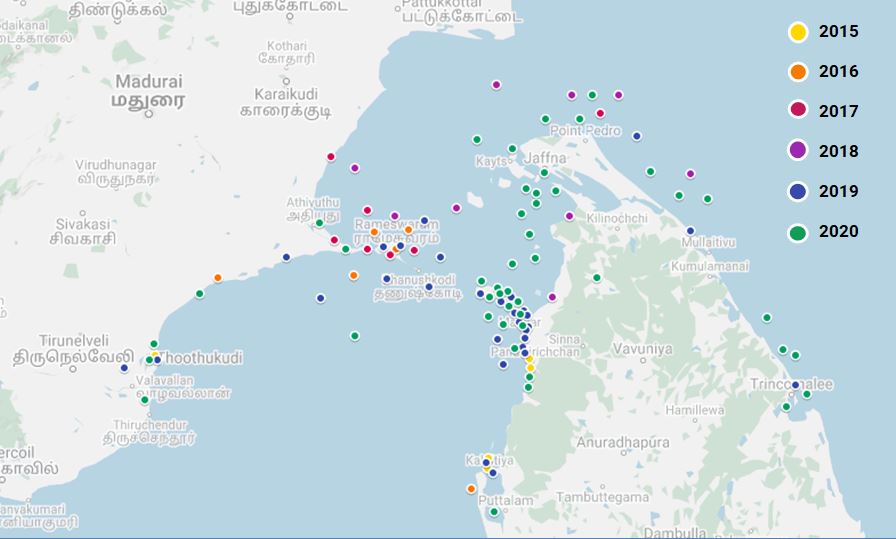
This map shows the locations where arrests and seizures relating to the sea cucumber trade were carried out from 2015-2020. Image courtesy of OceansAsia/Mongabay.
The government is now promoting sea cucumber farming, which is expected to ease the pressure on wild stocks. While experts have welcomed the move, they caution it must be accompanied by measures to prevent it from becoming yet another way to conceal the illegal trade and export of wild-caught sea cucumbers.
While regulations pertaining to sea cucumber fishery should be reinforced, addressing the smuggling of stocks should be addressed as a bilateral issue with serious repercussions on the conservation of the species in both India and Sri Lanka, Bondaroff said.
This is a high-value trade, so penalties should not be normalized, and immediate action should be taken to protect the region’s sea cucumber populations from overexploitation, he added.
Banner image of processed sea cucumbers, known as bêche de mer, are a popular delicacy in East Asia and an ingredient used in traditional Chinese medicine, making them an expensive commodity. Image courtesy of OceansAsia.
Journalists residing in coastal countries can apply for grants up to US$1,000 to produce in-depth stories on coastal resilience.
Earth Journalism Network (EJN) is accepting applications for the Coastal Resilience Story Grants 2022. With support from the Kingfisher Foundation, EJN is offering 15 story grants to journalists to cover stories that will also call attention to solutions for coastal issues in their communities.
These journalists will receive support from journalist mentors and a coastal resilience expert to increase media coverage of this critical issue in their region.
To apply, applicants must submit a story proposal. Stories can be produced in any language. However, applicants who intend to write or produce stories in their local language need to also include an English translation.
Bloomsbury is pleased to announce the development of a very exciting new project: The Handbook of Online Research Ethics.
It is nearly 20 years since the launch of the first specialist ethics guidelines for Internet research and subsequent publication of specialist monographs and edited collections focused on the ethics of Internet and online research. During this time, the nature of our online lives and uses of digital media, as well as the technologies, infrastructures and business models that underpin them, has changed dramatically, presenting new and emerging questions, tensions, and challenges for researchers to confront.
This new collection aims to contribute to the online research ethics space in a few different ways. The editors want to examine and interrogate the current theories, practices, politics, and philosophies surrounding online research ethics. They want to question – and perhaps challenge – conventions in thinking that have perhaps become sedimented in writing on online research ethics. They seek to explore new research directions, considering innovative methods and researchers’ ethical responses to these. They are particularly keen to broaden the discourse with globalization as a systemic theme throughout the handbook, such that we push readers to think through the implications of localised ethics vis-à-vis global perspectives. Contributions from IE scholars across Latin America and the Caribbean, the African continent, Indian sub-continent, South-East Asia and the Pacific are particularly welcomed.
The editors are soliciting chapters (8-10,000 words) that explore new areas of online research ethics from a range of disciplinary perspectives and theoretical bases.
Possible topics include, but are not limited to:
Historical development of ideas in study of online research ethics
Ethical controversies and provocations
Global and transnational perspectives on online research ethics (challenges, issues, regulation, institutional responses, comparative case-studies)
Negotiating/surviving/responding to the commercialisation and platformisation of the web
Intimacy and managing research relationships (friending, unfriending, ending projects)
Big data research, AI, algorithmic culture
Ethical regulation and the law
Social Media – research ethics beyond Facebook and Twitter
Ethics of participatory, activist online research
Ecological considerations of AI methods
Social and communal perspectives on online ethics
Ethical considerations of data trusts
Ethics of augmented/mixed reality research (towards a research ethics for the study of the metaverse?).
Editors:
Elizabeth Buchanan, Marshfield Clinic Research Institute.
Natasha Whiteman, University of Westminster.
Submission information:
Abstracts (approx. 300 words) + brief author(s) bio(s) should be sent to n.whiteman@westminster.ac.uk.
Abstract submission date: 28th February 2022.
Final deadline for accepted chapters: December 2022.
Whilst the cost of handbooks can sometimes be prohibitive for a wide readership, Bloomsbury are committed to making their handbooks accessible through pricing. A paperback version of the handbook will be published 12-18 months after the hardback.
Countries in South Asia have been experiencing displacement movement for the last few years particularly in Bangladesh and in Afghanistan. The displaced people are narrated in the media with both positive and negative perspective that impacts on the establishment of both social cohesion and peaceful coexistence as well as hatred and conflict.
Capacity Development ARTICLE 19 (A19) in collaboration with Deutsche Welle (DW) Akademie is implementing a project on ‘Interdisciplinary network of experts in information in refugee and migratory contexts in South Asia’ in the region. The project is funded by the German Federal Ministry for Economic Cooperation and Development. Capacity development of journalists in South Asia in reporting on displacement and migration is a part of the Project. A19 and DW Akademie will offer an online training to 12 journalists for 3 days in February 2022 along with a session of lecture by a Resource Person from the region. The training will be followed by a competition with an award of 275 Euro upon publication of stories which are expected to be published by professional media outlet by 5 March 2022.
Training content: – Beyond stereotypes and clichéd narratives in displacement and migration (criminalization, victimization etc.), nuanced storytelling instead of polarization (“them” and “us”) – Collaborative reporting with refugees and migrants focused on individuals rather than numbers – Conflict-sensitive wording and conflict-sensitive photos/illustration – how to avoid stereotyping in images – How shortcomings impact on host societies and minorities alike
– Gender issues
– Legal aspects of reporting on displacement and migration
Training Schedule: The training will be held in 3 half-day sessions with the following schedule: Dates: 1st Day : Monday, 14 February 2022 2nd Day : Tuesday, 15 February 2022 3rd Day : Tuesday, 22 February 2022
Time (from – to) From 12 PM to 3:30 PM Central European Time| 3:30 PM to 7 PM Afghanistan | 4 PM to 7.30 PM Pakistan | 4:30 PM to 8 PM in India and Sri Lanka | 4:45 PM to 8.15 PM in Nepal | 5 PM to 8.30 PM in Bangladesh.
Competition – A new article with 3 photos – Word limit of the article is 1000-1500 – The article could be either in English or in other language than English but shall be sent with a translated copy in English in PDF form – The journalists shall send the pdf version of the write up along with the link in case of online publication and the scan copy in case of hard copy publication within the deadline to rumkyfarhana@article19.org – Deadline of the competition is 5 March 2022
Who can apply Journalists of South Asian countries (Afghanistan, Pakistan, India, Nepal, Sri Lanka, Bhutan, Maldives and Bangladesh) with the following criteria can apply for the training: – Print and online journalists (textual) – Mid-career with at least 5 years of experience – High level of English skill – Women journalists are especially encouraged to apply
How to Apply
Please apply with the following information and documents via email to rumkyfarhana@article19.org within Monday 7 February 2022: – CV/Resume – 3 samples of your recent work relating to displacement or migration – Letter of motivation
About ARTICLE 19 ARTICLE 19 is an international human rights organization based in the UK, working in 9 Regional Offices around the world operating in 35 countries. ARTICLE 19 works to promote and defend the universal human rights of freedom of expression and right to information around the world delivering change through local and international influence.
About Deutsche Welle Akademie (DWA): DW Akademie (DWA) is German’s leading organization for international media development, with projects in more than 60 countries worldwide which is an integral part of Germany’s International public broadcaster Deutsche Welle (DW). DW Akaemie empowers people to make independent decisions based on reliable facts and constructive dialogue.
“A crime feeds on crime, and as vile views move from the fringes to the mainstream, I am profoundly concerned that we are nearing a pivotal moment in battling hatred and extremism.”
These were the concerns of the Secretary-General as violence was escalating in the country. The Easter Sunday attacks in April 2019 ravaged the island with terror. The Sri Lankan government and the media focused on the transnational terrorist support for the attacks; the issue of local unrest between the Sinhalese and the Muslim communities was largely ignored.
The lack of reliable, structured, and accessible data to academic and public institutions, media organisations, and the general public compounded the issue. Such failures enabled the spread of negative, discriminatory campaigns by Buddhist extremists that deepened the fear and heightened the mistrust within the Muslim community.
In mid-2020, UNDP reached out to several civil society organisations in Sri Lanka to develop effective and innovative tools and methods that aim to reduce the vulnerability of Sri Lankan communities towards violent extremism. The Center for Investigative Reporting (CIR) stepped in to address and curtail the spread of conflict-inducing reporting in the media.
Sri Lanka’s media technology was up-to-date, but its media literacy among media practitioners and content creators is one of the lowest in the South Asian region. In addition, journalistic accountability and integrity have fallen by the wayside. These were the challenges faced by the CIR.
Focusing on the Truth and Positive Narratives
Today, technology and media diversification have made ‘breaking news’ the need of today, and social media plays a vital role in conveying information in a matter of moments to millions.
Therefore, CIR engages journalists and social media influencers to take a deeper look at issues, produce inquiry-based reports, and avoid amplifying rhetoric and systematic propaganda. The CIR initiative to empower journalists, visual storytellers, bloggers, citizen journalists, media educators, and interested citizens used investigative journalism as its tool; the initiative created awareness on the best practices of journalism, and its higher purpose, thereby aiding to halt the spread of hate messaging and propaganda.
The CIR projects, the first of their kind to be implemented in Sri Lanka, began on the 30th of November 2020 and used a three-pronged approach. The first was the Media Literacy Foundations Program, under which 18 training sessions were conducted for 300 journalists, media academics, civic groups, citizen journalists, and non-journalists who were made aware of the aspects and importance of media literacy and its need as a professional requirement.
One of the participants was Keshayini Edmond, a 30-year-old qualified architect, engineer, and freelance journalist from Batticaloa. Being involved with the program for a lengthy period, Keshayini shared her thoughts on the project stating, “as a Tamil citizen, we lived in our community with little to no interaction with other communities. Thanks to this project, I have learned that these stereotypes are man-made, and they should not be a reason for division among our communities. Every community should be respected and loved.”
As a freelance journalist, Keshayini’s focus within the project is to capture stories which most would avoid and she reflects on this with pride.
“People have constantly discouraged me from talking about subjects that are uncomfortable to hear. But I want to change that. As a freelance journalist, my duty is to bring out the truth, and I will continue to do so with my videos and stories.”
Investigative Reporting-The Way Forward
CIR’s second stage was the Investigative Journalism Foundations Initiative. This initiative was a collaboration with local and international experts on the subject. Here, a selected group of senior journalists learned the fundamentals of investigative journalism and they in turn are now serving as resource persons for young journalists.
The Associate Editor of the Ceylon Today newspaper, and a former Print Media lecturer at the Sri Lanka College of Journalists, Gagani Weerakoon, was a participant in this initiative and is currently a trainer. She said, “as an investigative journalist, this project enabled me to think critically while putting the theories into practice. It also emphasised the importance and raised my consciousness of investigating a news item, even if it is a simple WhatsApp message, before sharing it.”
As a trainer, Gagani plans to continue her teaching, sharing these new learnings with young journalists, as she guides them towards the correct path of investigative journalism, where the truth will be reported professionally, without any misinformation.
23-year-old freelance web-journalist Koshala Gunawardena from Sooriyawewa was another participant in this program. Working for three years as a mobile journalist, Koshala’s area of interest was investigative reporting. Speaking on the subject matter, he said, “Simply reporting news is not difficult. The questions are an interesting part of investigative reporting. Why is it happening? What are the reasons behind a news event? Does the reason have validity or have a social significance? Even though finding answers to such questions is difficult under the current system, I will rise to that challenge.”
“This project changed my outlook on reporting as a whole. It taught me how to obtain the truth, and how that information needs to be presented to my audience, plus the power the truth holds.”
Currently, Koshala is continuing his journalistic aspirations by utilising the learnings from the project on his own platform to provide news items truthfully to his audience. Speaking further on the matter, Koshala stated,
“I have a voice, and I know it is powerful. I am also aware that the truth behind every story is important. It is not for me to stereotype or marginalise any person or community as others do in mass media or spread fake news. My audience has the right to know the truth. I aim to offer that truth and by doing so change the current state of journalism.”
Evidence Based Story Telling
The third stage consisted of Accountability Journalism, and Alternate Narratives that took a novel approach by focusing on evidence-based creative storytelling. Using visual storytelling and creating compelling narratives through citizen journalism, the program attracted 200 plus young people who were not traditional journalists. Through this, they curated stories from far-flung places that record tales of inclusion and diversity. Selected video stories can be viewed through the CIR website.
The outcome of these initiatives by the Center for Investigative Reporting is building the capacity of media personnel and others to produce unbiased and balanced narratives to counter the current hate messaging and propaganda. These initiatives continue to have positive effects as it creates a new group of journalists like Keshayni, Gagani and Koshala. They, in turn, will encourage more to uphold journalistic accountability while writing truthful narratives that do not cause or encourage racial or religious divides in the future.
“If I can change the mind of one person with my narrative, I have made a difference.”
Koshala Gunawardena
Team from the Center for Investigative Reporting Sri Lanka
Footnotes
These interventions were a part of the United Nations Development Programme (UNDP)’s Regional Project on ‘Preventing Violent Extremism through promoting tolerance and respect for diversity’ funded by the European Union.
By Yu Yu Din (Strategic Partner Manager, News Partnership)
In 2020, the Meta Journalism Project partnered with the Centre for Investigative Reporting to provide free training to Sri Lankan journalist-trainers. These trainers learned foundational Facebook skills and were equipped to train other journalists across Sri Lanka in Sinhala and Tamil.
By mid 2021, the CIR Facebook Foundations training had been completed by over 300 regional journalists in Sri Lanka, ranging from long-established reporters to fresh journalism graduates.
Participants received training on the basic tools available to journalists on Facebook, including how to use Facebook Live to file video stories. The course also offers modules on online safety, Page administration, and other best practices for showcasing their reporting on the platform.
Since graduating, this cohort of talented Sri Lankan journalists have published video stories watched by tens of thousands of readers; investigative reports that have alerted communities to negative environmental impacts; and some journalists are now inspired to establish their own media businesses.
L-R Prasad Purnimal, Ibunu Anas Abbas and Nadeeshan Meedin / Meta
Prasad Purnimal is starting his own media business
Prasad was one of the Program’s most experienced journalists, with nearly two decades as a provincial journalist based in North Western Sri Lanka.
Not long after graduating from the CIR Facebook Foundations program, Prasad launched his own Page, වැලි ජාවාරම් වලට එරෙහි අපි, and published investigative environmental stories. His story about the environmental damage caused by illegal sand mining has driven change in his community.
“After graduating from the training, I broadcast live on Facebook from a protest against illicit sand mining in the area. I also created a Facebook page dedicated to a group campaigning against illegal sand mining,” said Prasad.
This dedicated Page and Group is where community activists come together to fight this issue. He said, “Facebook is the best medium for us to communicate. I understand this since completing the training.”
“People say about 60% of sand mining has stopped after my reporting,” said Prasad. “Activists filed a fundamental rights violation case before the Supreme Court. The case is underway and the government stopped illicit sand mining temporarily.”
“I wanted to cover the true story as a journalist. I used Facebook to promote these stories,” said Prasad.
Prasad is now dreaming of taking the next step and launching his own media business.
Ibunu Anas Abbas now delivers news to 165,000+ Tamils around the world
This talented young journalist is bringing the global Tamil community together and sharing relevant News stories via Facebook. He established a Page for Tamils around the world and it has grown to a community of over 165,000+ followers.
“I am proud as a Sri Lankan to deliver a message which promotes unity and peace to more than 160,000 followers,” said Anas, “This video message of inclusion gained 3,700+ Positive Reactions, 2,700+ Engagement, 90+ Positive Comments and 800+ Shares.
”After graduating from the CIR Facebook Foundations program, Anas worked to make his Page more secure, “I placed more attention on protecting my privacy by setting up two factor authentication (2FA) and I added an alternate email to secure the Facebook Page.”
“I have worked on media related activities on Facebook for the past eight to 10 years. From this training, I had the opportunity to learn more about Pages, user engagement, and privacy issues,” said Anas. “These are important.”
Nadeeshan Meedin captures Sri Lanka’s sports heros
Colombo based sports journalist TM Nadeeshan has been sharing his passion for Sri Lankan Athletics since he started his Ceylon Athletics Page in 2017. Today, he runs this Page with a group of other young sports journalists. At the beginning of 2021, with the Olympics around the corner, Nadeeshan was preparing for a big year of reporting.
The CIR Facebook Foundations program taught his team to better engage athletics fans through different story formats using Facebook tools. “We have limited resources, so we increased our use of Facebook Live streams in competition environments,” said TM Nadeeshan, Co-Founder of Ceylon Athletics.
Sri Lankan athletics fans are loving the Page’s Facebook Live video stories, these video stories span competition footage through to the personal stories of Sri Lankan athletes and industry personalities. This competition video, Sri Lanka Creates History in 4X400m, attracted over 1.5M views.
The team also began sharing video stories in Facebook Groups, “We used community groups very efficiently to drive awareness. We have chosen subjective community groups and created conversations to enhance performance,” noted TM Nadeeshan.
Ceylon Athletics’ videos have become so well known, they are being reported in traditional media outlets. “Some Ceylon Athletics videos have created national headlines because we are the only professional journalism team promoting the sport of Athletics in Sri Lanka,” said TM Nadeeshan.
“As a young group of journalists we thank the Facebook Asia-Pacific team for involving us in this project. It tuned-up our knowledge plus it enhanced our productivity and confidence.” TM Nadeeshan.
Daminda Harsha (L) and Waruna Liyanage (R) / Meta
Waruna Liyanage is enabling junior journalists with tools for news gathering and sharing
Waruna Liyanage, a senior journalist at Sinhala Adaderana and the Manager of News at Derana FM Radio, completed the CIR Facebook Foundations training. He then functioned as a trainer, instructing and teaching junior staff members on the tools and best practices for news gathering and sharing.
In his role as trainer, he has engaged with Adaderana’s social media team and shares his learning from the training sessions with them. He uses his skills from the program to teach his staff Facebook best practices, community standards, and how to avoid violating these important regulations.
“I have guided staff and colleagues to promote their Facebook stories without using clickbait and other inappropriate methods,” shares Waruna. “I have also made them aware about hate speech, misinformation, disinformation, and more.”
Daminda Harsha is live streaming major news events
Daminda Harsha is the Pictures Editor of Daily FT – Sri Lanka’s only business daily – published by Wijeya Newspapers Ltd. A former President of Photojournalists Association of Sri Lanka, he is an industry leader committed to building the capacity and skills of fellow photojournalists.
Harsha is using the knowledge gained from the CIR Facebook Foundations training program to train his fellow photojournalists, “We learnt how to use Facebook as a platform to share our professional work; we also learnt how to secure our Facebook accounts and use our Facebook accounts safely,” he shares.
His focus has been on filing video stories, “I am encouraging my colleagues to specialize in video content on Facebook. We have been doing a lot of livestreaming on Facebook through our Daily FT Page, and we’ve seen a growth in our audience,” says Harsha.
“Recently we livestreamed Sri Lanka’s post-budget forum and the Cyber Security Summit through our page. We have found that reach through Facebook is much higher than other platforms for our channels.”
Lasantha de Silva (L) and Sandun Arosha (R) / Meta
Trainer Spotlight: Sandun Arosha
Sandun Arosha is the Editor in Chief of Citizen News Network, and served as a trainer for the CIR Facebook Foundations program, training graduates in early 2021.According to Sandun, teaching journalists to enhance their security on Facebook was the most valuable contribution of the CIR Facebook Foundations program.
Not only has Sandun trained journalists on basic Facebook tools, including how to use Facebook Live to file video stories, he’s been applying those best practices on his own Page.
Referring to a video story posted in May 2021, he said “This video got 586,300 views. It happened because we used a new Post testing tool in Creator Studio.
”This story is also a great example of a lesson from the program, which also covers Facebook’s Community Standards. He noted the importance of meeting the platform’s Community Standards and said he taught participants to, “Post only original content or secure permission before publishing someone’s footage, and give credit to the owner.
”The other lesson Sandun’s team is implementing is to avoid hate speech and sensitive visuals. The team has utilised these skills, and others learnt during CIR Facebook Foundations program, to increase their followers and viewers.
Trainer Spotlight: Lasantha de Silva
Secretary of the Free Media Movement of Sri Lanka, Lasantha de Silva, is a prominent regional journalist based in the Uva Province and a national-level free media activist. He is responsible for the official Facebook Page of Sri Lanka’s Free Media Movement.
Lasantha served as a trainer for the CIR Facebook Foundations program, training graduates in early 2021.Not only a trainer, Lasantha manages his own Facebook Page, with the purpose of creating a voice for alternative opinions. Forever learning, he used his updated skills to convert the eJournalistsLKA Page to a news page. Since then, a community has been built around this News page.
“I realized Facebook plays a great role as a news source. In my institutional work, I use Facebook as a platform to address various audiences beyond traditional media,” he said
“We investigate corruption and misappropriation of public property. This story is based on Right to Information (RTI). I managed to prove information the authorities provided on a water supply project in a rural area was false. The RTI story was different from the real story. We published an article, radio, TV and also cross-posted on the eJournalistsLKA Page.” Lasantha said, ”I am happy that there is an impact from the Facebook story. It seems that water officials saw the story through Facebook. They are reviewing the status of the site.
”He continued, “Facebook search has been a very useful tool for me as a journalist. The training also helped me learn how to use verifications and the importance of complying with community standards. I now try my best to protect community standards and prevent whatsoever hate speech.
“As a young group of journalists we thank the Facebook Asia-Pacific team for involving us in this project. It tuned-up our knowledge plus it enhanced our productivity and confidence.”
TM Nadeeshan (Co-Founder of Ceylon Athletics)
*All results self reported by the partners. These results are self-reported and not identically repeatable. Generally expected individual results will differ.
Al comparar casinos en línea, teniendo en cuenta la variedad de juegos, pensando en un uso regular, una plataforma que puede revisarse de forma independiente es chicken subway juego , mientras una revisión independiente también puede abarcar la experiencia móvil y la navegación, junto con las reglas de retirada y los límites antes de registrarse.
Vor der Entscheidung, welche Seite näher geprüft werden soll, beim Vergleich von Navigation und Bedienkomfort, als Teil eines unabhängigen Vergleichs, eine Option für den direkten Vergleich ist fugu casino 5 , separat kann man auch betrachten die aktuellen Aktionsbedingungen, zusammen mit den wichtigsten Bedienungsdetails ohne die endgültige Wahl zu überstürzen.
Før man beslutter hvilken side der bør undersøges nærmere, ved vurdering af mobil brug, fra et praktisk brugerperspektiv, en platform der kan vurderes uafhængigt er https://spinlander-casino.dk/ , mens en uafhængig vurdering også kan omfatte registrerings- og verifikationsprocessen, med kundesupportens tilgængelighed i tankerne uden at forhaste den endelige beslutning.
Dla użytkowników zestawiających kilka platform jednocześnie, z uwzględnieniem metod wpłat i wypłat, na potrzeby wstępnej oceny, jednym z punktów odniesienia może być kasyno na prawdziwe pieniadze jeśli jednocześnie ocenia się najważniejsze warunki korzystania z serwisu, wraz z zasadami dotyczącymi wypłat w ramach szerszego porównania podobnych serwisów.