Home Blog Page 52

Claiming undue credit: Do we owe politicians for just doing their jobs?

Imagine watching this scene unfold: a heavily pregnant woman sips a glass of milk alone at night, during a raging thunderstorm. Suddenly, she feels the pangs of labour, and grabs a phone to dial a hotline number, prompting an ambulance to rush to her residence. Immediately afterwards, you see a candidate’s name and number appear, reminding you of the politician that claimed to have founded and implemented the service.

In another election commercial, voters are requested to vote for a candidate who added and developed 6,000km of road during his tenure as Minister in charge, while another has created several commercials under a theme ‘Do you remember?” in which he highlighted Budget proposals made during his tenure as Finance Minister in a bid to garner votes.

The majority of us understand that candidates cannot engage in functions such as the laying of foundation stones, opening ceremonies and vesting in the public, utilising Government funds and State properties, during the period of an election, since the politicians attending these functions may express opinions and views on the election. Thus the conduct of these functions may lead to the promotion of, or cause prejudice to, any party, group or candidate – which is explicitly prohibited.

However, when it comes to candidates promoting projects they have already embarked on, voters seem to be vague in their opinion of whether this is ethical or not. Interestingly, even the stance of election monitoring bodies also seems to vary on this topic. However, despite a lack of unanimity on the legal aspect of the matter, they all agree that such campaigns are unethical.

Probably taking a cue from Gotabaya Rajapaksa’s Presidential Election campaign, where he sought a mandate saying he had already proven himself as results-oriented, many candidates running for the Parliamentary Election were also seen canvassing for votes under similar claims.

While they try to manipulate voters’ minds displaying results of ‘massive progress’, they conveniently forget to mention that such projects were in fact carried out under Government budgetary allocations. How ethical it is for a Cabinet Minister who is paid by public funds, to tout the fulfilment of their Ministerial responsibilities using taxpayer monies, and make claims as though they spent from their own pockets, just to seek another mandate?

It is worth taking a closer look at the costs of implementing the massive projects these politicians boast of, such as the one that claimed to have added 6,000km of road to the country’s roadways, for instance.

According to Kamal Amaraweera, recently retired Director General of the Road Development Authority, building one kilometre of an elevated highway or expressway – which generally incurs the highest costs of construction – would cost Rs 5-8 billion.

“It is to develop rural roads that we spend the lowest amounts. To develop a kilometre of a 10-12 foot-wide rural road properly, it would cost something between Rs 10-20 million,” Amaraweera explained.

But does even a cent of these funds come from the pockets of the politicians claiming credit for the projects?

Can voters be hoodwinked? 

The question remains as to whether this strategy being carried out by candidates is something the people take seriously. In a bid to find out what ordinary people actually think about this, Ceylon Today took to the streets.

Ekanayake, a 55-year-old taxi driver employed in Colombo but originally from Godakawela, said, “We don’t have time to watch those commercials; we are busy on the road trying to recover our income, as we were out of jobs due to the lockdown. We know who worked for the country and our areas, and who didn’t. Those who didn’t even have a motorbike when they initially contested now have houses like palaces and about two or three SUVs. Only those who are afraid of losing have to keep reminding people about what they did.”

Dananjani Yapa, a retired principal, had a different view.

“There are so many political parties. Actually, most of us are confused about who is contesting from which party, as all main parties have now split apart. Some ministers during their time may not have received the same kind of exposure in the media about their work. Therefore, they might feel the need to remind people of what they have actually done,” she said.

“On the other hand, if people do not remember you and if you are compelled to remind people of what you did, I feel sorry for you. But times have changed, and I don’t think people will determine their mandate on material things. I feel the mandate should be changed based on their policies and principles. Mine would certainly depend on that.”

Akalanka, who is in his mid-twenties and employed in a private institution while also pursuing his higher education, simply said, “I don’t think any of these people should be voted in. I am going to vote for a fresh face.”

A few others who saw no problem in certain candidates taking the credit for projects they actually took the trouble of initiating or taking forward, however noted that such projects, despite being positive moves, would run the risk of being annulled or neglected if the new Government is not from the same political party.

How ethical is this promotion tactic? 

Executive Director of People’s Action for Free and Fair Election (PAFFREL), Rohana Hettiarachchi said it is not entirely unethical for a particular candidate to promote a project they played a large role in introducing.

“There is no hard and fast rule to tackle candidates promoting what they did as ministers under different regimes. However, we as election monitors do not accept such campaigns as ethical. Even though a particular candidate may have played a larger role in introducing or carrying out a project, such projects were anyway carried out with public funds or with grants from foreign countries,” he opined.

Nevertheless, National Coordinator of the Centre for Monitoring Election Violence (CMEV), Manjula Gajanayake is of the opinion that such acts could be penalised under the provisions of 79(1) of the Parliamentary Election Act.

“Running election commercials stating what a particular candidate has done is similar to starting a new project, giving employment or running promotions during the campaign period. In fact, we even lobbied against a certain Cabinet paper that aimed at setting up universities covering all districts, as it amounted to promoting a minister who is a candidate at this Election. Basically, it involves indirectly influencing voters,” Gajanayake noted.

Provision 79(1) of the Parliamentary Election Act states, “Every person who directly or indirectly, by himself or by any other person on his behalf, makes use of influence, or threatens to make use of any force, violence, or restraint, or inflicts or threatens to inflict, by himself or by any other person, any temporal or spiritual injury, damage, harm, or loss upon or against any person in order to induce or compel such person to vote or refrain from voting, or on account of such person having voted or refrained from voting at an election, or who by abduction, duress, or any fraudulent device or contrivance impedes or prevents the free exercise of the franchise of any elector, or thereby compels, induces, or prevails upon any elector either to give or refrain from giving his vote at an election shall be guilty of the offence of undue influence.”

Gajanayake opined that in Sri Lanka, elections are always held under a Cabinet of Ministers and not under a caretaker Government; thus, the fight to make candidates refrain from such undue influence is a real struggle.

However, Dr. Jayatissa de Costa PC, who is author of the tomes ‘Law of Elections in Sri Lanka’ and ‘The Law of Parliamentary Elections’, noted that although the existing law in this regard, which is the Parliamentary Elections Act, No. 01 of 1981 as amended, is silent on the matter, such an act of taking undue credit for publicly-funded projects would have to be brought within the ambit of being a corrupt (Section 81) or illegal practice (Section 87) under this Act, in the course of a civil damages cause of action (cause of action as defined in the Civil Procedure Code).

However, even if a private remedy is pursued by way of a civil action being filed in this regard, he explained that owing to the lack of any public remedy such as interim relief being granted by Court, not to mention the subsequent appeals that would ensue and the costly and time-consuming nature of such action, this type of legal redress would not be successful and not in any way upset the election result.

He also noted that this Act had been promulgated at a time when the first-past-the-post system was in operation, whereas at present, a more convoluted electoral system is in play.

To address this particular issue, Dr. de Costa PC proposed that the entirety of the Election Law should be rewritten to suit the times, or that a change should be affected by way of a Constitutional amendment.

Role of the voter

Gajanayake also said that even though the country’s youth now goes after the popular slogan of sacking all 225, and appear unenthusiastic of voting, what they should actually do is mobilise and lobby for proper regulations to tackle such campaigns.

Retired Deputy Auditor General, M.D.A. Harald was of the opinion that candidates should be encouraged, and in fact forced, to a point where they come before the people with a proper in-depth manifesto, rather than boasting about roads or buildings they established with public funds.

Both Gajanayake and Harald were of the opinion that Budget proposals and Government projects should only be projected as the work of the State or the Government, and not as that of a candidate or group of candidates.

“It is very rarely that these Government projects are conducted in a transparent manner. Generally, these programmes involve underhand dealings and commissions. Unfortunately, these are not mentioned in the commercials they run, and people often forget this fact. Basically, voters should be enlightened to a point where they base their votes on what a particular candidate would do for his area, rather than what he already did,” Harald said.

He also emphasised that political parties should select candidates that are thorough with their future plans to uplift people in their proposed constituency.

To achieve this ideal, the Election Commission should look at amending or introducing relevant laws or directives, he noted.

The problem lies in the lack of a proper mechanism to ensure both the Executive and Legislature arms of the Government implement proper policies and continue to evaluate progress.

“For instance, if public education is up to the mark and if schools provide proper education, there is no need for students to attend private tuition. Today, the situation is such that unless you rely on private tuition, you will fail the exam, which is the continuous evaluation process. Likewise, if politicians carry out their duties and responsibilities and maintain discipline, there is no need to claim a share of ownership from projects carried out with public funds,” he added.

Most importantly, interested parties – from existing lobby groups to astute citizens – should come together to increase the election literacy of the general public, enabling them to exercise their franchise wisely.

Election Commission Chairman, Mahinda Deshapriya stressed that “the public, the media and civil organisations should play a proactive role in defending election laws. It is unfortunate that the general public turns a blind eye to election violations. For instance, there were instances of candidates violating certain election laws in broad daylight; but until one of our own officers recorded it, no one bothered to complain.

“It is through the engagement of the public and civil organisations that democracy and the right of people’s franchise are ensured. If people like Waruna Karunatillake, Victor Ivan and Arjuna Parakrama didn’t come forward when the Wayamba Election was rigged and corrupt back in 1999, if they did not seek the intervention of Supreme Court, the right of the people to excise their secret ballot would not have been ensured. Likewise, I urge people, especially the youth, to come forward in defining a free and fair election,” he urged.

CIR dialogue series #5: Ethics of Covid-19 media coverage in Sri Lanka

Date: Friday, 22 May 2020

Time: 10 00 a.m. (IST)

Venue: via Zoom

By prior registration only. To register, please complete and submit the registration form below.

Who spread the Covid-19 virus in Sri Lanka? Is it Chinese or Sri Lankans who returned from Italy/South Korea/India? Or Muslims and Navy? These are some of the perceptions created by local media coverage of Covid-19 since March.

While fighting with the time to provide accurate news under lockdown and global pandemic, journalists had to witness some violation of ethics which have resulted in breach of privacy of the public as well as misunderstandings/doubts about others in the society.  And the biggest challenge is how to avoid breach of ethics in future from the lessons learnt from the current global pandemic coverage in Sri Lanka.

Deepanjalie Abeywardana, Head – Media Research at Verite Research and Kamal Liyanaarachchi, Complaints officer at the Press Complaint Commission of Sri Lanka will join the CIR team on a Zoom discussion to share insights and offer lessons learnt on the ethics in covering the pandemic.

The dialogue is moderated by Shihar Aneez, Lead Trainer of CIR.

CIR dialogue series #4: Getting the COVID-19 science right

Date: Friday, 15 May 2020

Time: 11 00 a.m. (IST)

Venue: via Zoom

By prior registration only. To register, please e-mail cir@cir.lk on or before 5 p.m. on Wednesday, 13 May 2020

Resource Person: Subhra Priyadarshini, Editor, Nature India

Is it to do with bats, pangolins, monkeys or something else?

As journalists had to convert themselves to health reporters overnight due to a global pandemic, one of the biggest challenges reporters covering COVID-19 are confronted with is the science around it.

As reporters chase possibly the biggest health story in their lifetime, it is not a story easily told. Getting the science is key to successful storytelling.

Subhra Priyadarshini, one of India’s best science journalists and Editor of Nature India will join us on a Zoom discussion to share insights and offer tips on getting the COVID-19 story right and explore one of the biggest and multi-dimensional stories of our time.

CIR holds inaugural Fellowship Awards 2019

2019 CIR Fellows who completed the rigourous programme

Three promising journalists were selected to undertake a week-long study tour in Pakistan when the Center for Investigative Reporting Sri Lanka held its inaugural CIR Fellowship Awards 2019 on 10 March 2020 at Hotel Ozo, Colombo.

The three journalists, Rifthi Ali, Rahul Samantha Hettiarachchi and Leo Darshan were among CIR’s first batch of fellows who developed in depth multi-media reports on a range of issues that are of public significance.

High Commissioner of the United Kingdom to Sri Lanka, Sarah Hulton delivered the keynote address at the event.

In 2019, CIR introduced a fellowship program for young journalists to develop their skills in investigative journalism through a combination of training and rigorous mentoring. The group went through two intense investigative journalism trainings and were mentored throughout the story development process of eight months by CIR’s lead trainer Shihar Aneez. 

A three-member independent panel of judges comprising Ms. Hana Ibrahim, Editor-Daily & Weekend Express, Mr. Ananda Jayasekera, former investigative journalist and Mr. A. P. Mathan, Editor –Tamil Mirror, selected three promising journalists to undertake the study tour. 

In recommending journalists, the panel of judges concluded that while the articles did not meet the standards required to be recognized as fully-fledged investigative reports that merit awards, it was appropriate to recognize the potential displayed by the selected journalists.

The three journalists were scheduled to attend a short course in mobile journalism at the Center for Excellence in Journalism (CEJ), Karachi, Pakistan, postponed due to the COVID-19 pandemic situation.

Established in November 2018, the Center for Investigative Reporting is Sri Lanka’s first center dedicated to the promotion of investigative reporting.

CIR launches South Asia series with a dialogue on self-care and community care for journalists during and post-COVID-19

Bringing together a diverse group of journalists from across the region, CIR kicked off its South Asia series #1: “Self-care and community care for journalists during and post-COVID-19” on 6 May 2020.

Resource Person Amantha Perera explains during the South Asian Dialogue on Self-care and community care for journalists during and post-COVID-19 on 06 May 2020 via Zoom.

As the world battles against a global pandemic, journalists are in the forefront, telling the COVID-19 story. They are first responders themselves, dealing with multiple challenges, ranging from screaming deadlines, domestic crises, restricted mobility and having to deal with personal safety and well-being.

In these challenging times, journalists play a critical role in keeping their communities informed. COVID-19 has made everyone a health reporter.

But how can journalists cover the global pandemic effectively when they often have to consider self-care and deal with psychological stress, challenges to their own health and safety and an uncertain future? What are the best practices we can draw from?

A section of participants at the South Asian Dialogue on Self-care and community care for journalists during and post-COVID-19 on 06 May 2020 via Zoom

Amantha Perera, senior journalist, media researcher and trainer engaged with the group during 90 minutes of conversation, looking at self-care, community care, dealing with general, specific and anticipatory anxiety in different settings, developing individual self-care plans, how to ensure post trauma growth and the importance of circles of trust and solidarity building.

Amantha is a researcher with the Creative Arts Research Training Academy, CQUniversity, Australia. His main area of expertise is journalism and online trauma threats. He also works as the Asia-Pacific Coordinator for the DART Center for Journalism and Trauma, Columbia University, USA.

CIR South Asia series #1: Self-care for journalists covering COVID-19

Date: Wednesday, 06 May 2020

Time: 1100 am– 12 00 noon (IST)

Mode: via Zoom

By invitation only

As the world battles against a global pandemic, journalists are in the forefront, telling the COVID-19 story. They are first responders themselves, dealing with multiple challenges, ranging from screaming deadlines, domestic crises, restricted mobility and having to deal with personal safety and wellbeing.

In these challenging times, journalists play a critical role in keeping their communities informed. COVID-19 has made everyone a health reporter.

But how can journalists cover the global pandemic effectively when they often have to consider self-care and deal with psychological stress, challenges to their own health and safety and an uncertain future? What are the best practices we can draw from?

“Self-care for journalists covering COVID-19” will focus on all of the above and more and will feature Amantha Perera, senior journalist, media researcher and trainer. In an hour-long Zoom discussion with a select group of journalists from South Asia, Amantha will share insights and share tips.

Resource Person Amantha Perera

Amantha Perera is a researcher with the Creative Arts Research Training Academy, CQUnivesity, Australia. His main area of expertise is journalism and online trauma threats. He also works as the Asia-Pacific Coordinator for the DART Center for Journalism and Trauma.

His works have appeared in TIME, The Guardian, Washington Post, Reuters, al- Jazeera and the New Humanitarian. He tweets from @amanthap

CIR dialogue promotes self-care, managing stress during COVID-19 lockdown

Resource Person Amantha Perera during the CIR dialogue on ‘Managing psychological stress of journalists covering COVID-19’ on Saturday, 25 April 2020 via Zoom.

CIR concluded third of its dialogue series titled ‘Managing psychological stress of journalists covering COVID-19’ on Saturday, 25 April 2020.

Resource person of the event was Amantha Perera, a researcher with the Creative Arts Research Training Academy, CQUnivesity, Australia.

During the dialogue, self-care and managing stress of journalists during COVID-19 lockdown were discussed.

As the world battles against a global pandemic, journalists are in the forefront, telling the COVID-19 story. They are first responders themselves, dealing with multiple challenges, ranging from screaming deadlines, domestic crises, restricted mobility and having to deal with personal safety and wellbeing.

In these challenging times, journalists play a critical role in keeping their communities informed. COVID-19 has made everyone a health reporter.

The forum discussed how journalists could cover the global pandemic effectively when they often have to deal with psychological stress, challenges to their own health and safety and an uncertain future. It also discussed what are the best practices that journalists could draw from.

Amantha’s main area of expertise is journalism and online trauma threats. He also works as the Asia-Pacific Coordinator for the DART Center for Journalism and Trauma.

His works have appeared in TIME, The Guardian, Washington Post, Reuters, al- Jazeera and the New Humanitarian. He tweets from @amanthap

CIR dialogue series #3: Managing psychological stress of journalists covering COVID-19

Resource Person: Amantha Perera, senior journalist, media researcher and trainer

Date: Saturday, 25 April 2020

Time: 12 00 pm – 1 00 pm (Sri Lanka Time)

Venue: via Zoom

By invitation only

As the world battles against a global pandemic, journalists are in the forefront, telling the COVID-19 story. They are first responders themselves, dealing with multiple challenges, ranging from screaming deadlines, domestic crises, restricted mobility and having to deal with personal safety and wellbeing.

In these challenging times, journalists play a critical role in keeping their communities informed. COVID-19 has made everyone a health reporter.

But how can journalists cover the global pandemic effectively when they often have to deal with psychological stress, challenges to their own health and safety and an uncertain future? What are the best practices we can draw from?

“Managing psychological stress of journalists covering COVID 19” will focus on all of the above and more and will feature Amantha Perera, senior journalist, media researcher and trainer. In an hour-long Zoom discussion with a select group of journalists, Amantha will share insights and share tips.

Amantha Perera is a researcher with the Creative Arts Research Training Academy, CQUnivesity, Australia.

His main area of expertise is journalism and online trauma threats. He also works as the Asia-Pacific Coordinator for the DART Center for Journalism and Trauma.

His works have appeared in TIME, The Guardian, Washington Post, Reuters, al- Jazeera and the New Humanitarian. He tweets from @amanthap

Clinical waste: A major threat to Sri Lanka: Not disposed but stored

By Zeeniya Musadique

Clinical waste is a huge problem in our country with no proper disposal method. A shocking revelation has been made where clinical waste from the main hospitals in the country has been stored instead of being disposed, posing a major health hazard to the environment and to the handlers, putting the lives of many at risk. 

If the authorities do not effectively handle this issue, it would lead to untold damage to the environment and hardship to the handlers of the waste.


Meanwhile, according to the Sri Lankan Waste Management Report, clinical waste should be disposed of within 48 hours, but that is not the case. It is far from it! The company entrusted to handle clinical waste disposal does it at its own time and mind you, the waste is disposed a good three months after. 

Sisili Hanaro Encare Pvt Ltd has been entrusted with the job and as mentioned earlier it is a cool three months before the waste is disposed.

Cleaning staff

This is what the cleaning staff at the National Hospital Kandy had to say, “We don’t mind  our hands being constantly injured by sharp objects such as injection needles, scalpels and knives’. 

These poor workers are only earning a wage and were unaware of the deep damage they are faced with and the repercussions it entails. “The black bags had normal waste while the yellow bags had clinical waste and, we store the waste in a proper repository”, they said.

According to research carried out to evaluate the current situation of Bangladesh’s Hospital Waste Management, it has been found that  “Due to the incorrect management of Clinical waste, many health problems occur. 

For example, needles, scalpels and blades injure the hands when clinical waste is discarded. Increasing physical health disorders, spread of pathogens, HIV/AIDS 0.1%, Hepatitis B 30%, Hepatitis C 1.8%  such types of diseases may mix in the blood and could be found in the used lint. In addition, many have suffered from infectious diseases including skin infections, diarrhoea, tuberculosis, and malaria”.

Danger

Because of the lack of awareness of the danger, clinical waste could cause and only one company being entrusted  with  the disposal of clinical waste from major hospitals, there is a potential threat to the local health sector.

A single company has been allotted the task of collecting clinical waste from the five main hospitals in Sri Lanka. However, the National Hospital Kandy has been excluded.

A startling revelation was made when an investigation carried out by the National Hospital in Kandy from September to December of last year, found that staff do not use any security equipment when disposing clinical waste. It had also been found that nurses at the Neurosurgery Centre dispose clinical waste without even wearing a pair of gloves.

Not only that, it was observed that used lint with blood, bandage used for injuries, used needles and saline were disposed as these were just normal domestic waste and went into black waste bags used in homes for domestic waste disposal. 

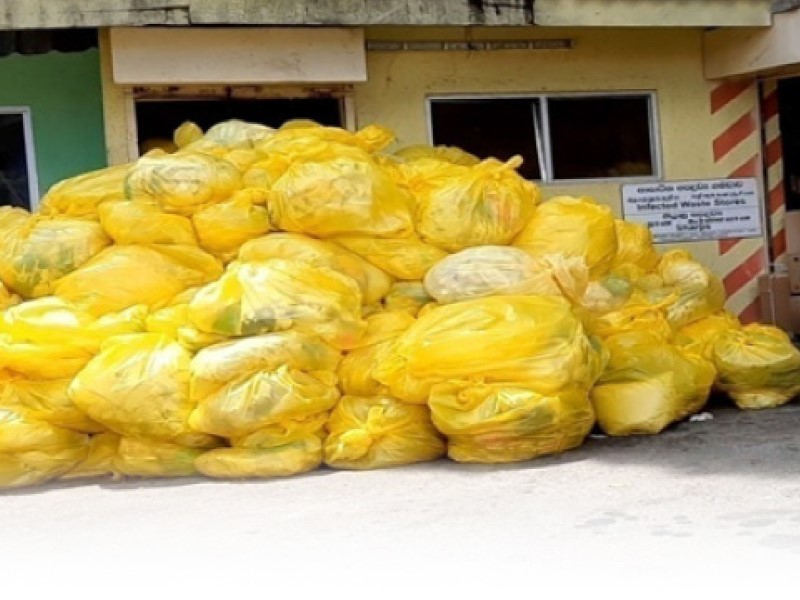
By the way, what the authorities might not be aware that, there is a law with regard to the disposal of clinical waste. It is the well-known yellow-coloured bags that have to be used to dispose clinical waste but lo and behold this hospital was not even aware of that such a thing is existed.

Cleaners unaware

Another astounding revelation was that  cleaners were unaware with regard to how clinical waste should be handled and disposed. Poor they! They just handled it as if it were handling  the usual domestic waste, not knowing that they were putting their lives on the line when handling this type of waste. These poor workers sans any protective clothing took sharp equipment and used gloves boxes away!

Meanwhile, the Kandy National Hospital stores a staggering 10 kg of clinical waste on a daily basis.

The Public Health Inspector who introduced himself as Thushara said “We have to store clinical waste because it is not taken away by Sisili Hanaro Encare Pvt Ltd.”

Implications

Knowing the implications of such an endeavour, he said  patients in hospital and everyone in that environment were at risk of being infected with pathogens by clinical waste collected over several days., so much so that, sodium hydrochloride (salt) was sprinkled to prevent 75% of pathogens.

This statement however was disclaimed by Director Dr. R.M.S.K.Rathnayake, National Hospital Kandy . He however said, the clinical waste that accumulates was a too a huge bulk and  sodium hydrochloride could not be used. He further said ” we don’t use chemical substances on this bulk”.

He was quick to point out that clinical waste had been stored at the hospital because the licence of Sisili Hanaro Encare Pvt Ltd’s incinerator station had been temporarily cancelled. But said the company was now operating and the waste was being disposed.

When asked about the harm caused to humans and the environment, he said,” This waste have a major impact on environmental pollution while at the same time humans are at high risk of infection. Because these clinical wastes have blood test specimens of patients with Infectious Diseases such as HIV/AIDS Dengue, Malaria.

Such clinical waste is hard to protect in the rainy season. Patients and people in that environment are at risk of being easily infected by pathogens. Human organs removed during surgery also among the clinical waste. Meanwhile, dogs, bats and crows could be seen hovering in the area and sometimes these animals  pull out human organs and could be seen scattered around the area emanating an unbearable stench.

Collected

Sisili Hanaro Encare Pvt Ltd collected clinical waste from the Kandy National Hospital, Colombo National Hospital,Lady Ridgeway Hospital, Castle Street Hospital for Women and Karapitiya Teaching Hospital. However, last September the Wattala Pradeshiya Sabha cancelled the licence of the Company. 

Meanwhile, the company’s  incinerator in Wattala was temporarily stopped as a result.

When the Chairman of the Wattala Pradeshiya Sabha,  R.A. Thyagaratna Alwis was asked, he said  Sisili Hanaro Encare Pvt Company’s documents were not in order and that was the reason for the cancellation. 

He further said Opposition members of the PS objected to the handing over of clinical waste to Sisili Hanaro Encare Pvt Ltd without prior approval of PS members. Therefore, the licence was cancelled.

Chairman, Udaya Abeysekera claims that  its Muthurajawela incinerator currently burns eight metric tons of clinical waste on a daily basis, where the temperature is kept  between 1000-1200 degrees celsius. 

However, he said, “Although we had all the documents, the Wattala Divisional Secretariat cancelled our temporary licence due to internal disputes between political parties, but the licence has now been renewed.”

Sisili Hanaro Encare commenced collecting clinical waste from health facilities in the Northern, Southern and Central Provinces after a tripartite agreement with the Ministry of Health and Environment in 2014.

However, due to the licence being cancelled, a staggering amout of clinical waste is being stored at various facilities. Here is a breakdown of how much is being stored in these hospitals– the Institute of Infectious Diseases (IDH) 1,57236 kg, Karapitiya Teaching Hospital 52,025 kg, Kalutara General Hospital 13,695 kg, Teaching Hospital Peradeniya 29,808 kg of clinical waste are kept in storage with no proper disposal mechanism in sight!.

[This report was produced under the CIR Investigative Journalism Fellowship Program 2019/2020]