
Speed Read
- TRCSL blocked 24 unlicensed gambling websites on 4 August, but 17 remained accessible through a major telecom provider the following day.
- Two days after the ban, Sri Lanka Cricket’s 5.75 million-subscriber YouTube channel carried 341 seconds of 1XBAT, Dafanews, BatSS and MelBat branding in a 22-minute highlights video.
- One arm of the Ministry of Digital Economy blocked betting websites while another continued broadcasting betting-linked branding, with no evidence of coordination between state institutions.
- An analysis of about 1,000 Facebook comments found support for the ban tempered by scepticism over mirror sites, mobile apps and surrogate advertising.
COLOMBO—On 4 August, the Telecommunications Regulatory Commission of Sri Lanka (TRCSL) blocked access to 24 unlicensed gambling and betting websites. When I checked the following day, however, 17 of those websites were still accessible through Dialog, one of the telecommunications providers regulated by the commission itself.
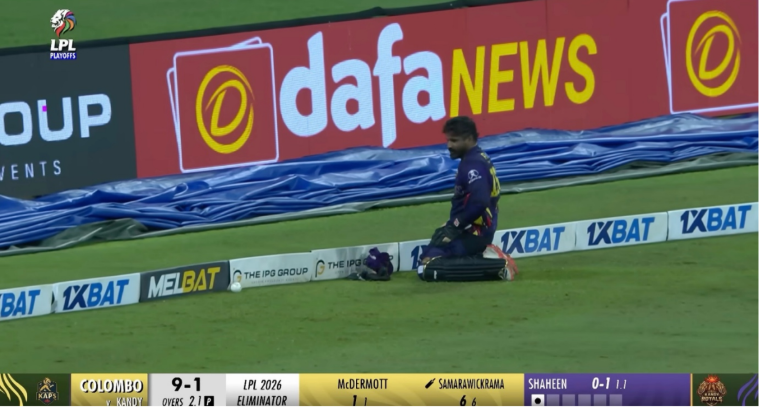
Two days after the block, Sri Lanka Cricket (SLC) uploaded match highlights to its official YouTube channel, which has 5.75 million subscribers. Across a video lasting 22 minutes and 36 seconds, the logos of 1XBAT, Dafanews, BatSS and MelBat remained visible for 341 seconds across 75 separate appearances—almost a quarter of the video’s running time.
The contrast is the finding. What the regulator blocked at the level of the domain, the State’s own sporting body continued to broadcast to millions of viewers. The website block therefore functioned less as governance than as gesture.
To understand how the public interpreted the ban, I examined around 1,000 Sinhala-language comments posted beneath five Facebook posts announcing the enforcement action. What emerges is neither uncomplicated approval nor outright opposition, but a blend of relief, ridicule and settled cynicism. In many respects, the public appears to be several steps ahead of officialdom in understanding how the offshore gambling ecosystem actually operates.
Most commenters welcomed the move, but their approval was frequently qualified by a recurring tax-based logic captured in dozens of near-identical formulations: “රජයට බදු ගෙවනවා නම් නීති විරෝධි නොවෙයි“ (if an operator pays taxes to the government, it is no longer considered illegal). Others immediately posted working .lk mirror domains as practical alternatives rather than political statements. Several argued that the vast majority of users gamble through mobile applications that remained untouched, while one commenter listed roughly two dozen offshore operators, from Bet365 and Stake to Parimatch, that did not appear on the government’s blocked list, inadvertently producing a crowd-sourced map of a market the state itself has neither comprehensively mapped nor measured.
One observation in particular anticipated the argument developed in my earlier research on surrogate gambling advertising. A commenter wrote: “උන් ස්පොන්සර් කරන්නෙ BET කියල නෙමේ BAT කියල“ which says they sponsor as “BAT”, not “BET”. In other words, banning one brand leaves its surrogate entirely untouched.
That interpretation is not speculation. In September 2023, Sri Lanka Cricket Secretary Mohan de Silva told The Morning, on the record, that 1XBAT was a subsidiary of a betting company operating under a surrogate structure. Surrogacy, therefore, was not a conclusion reached by researchers or journalists; it was a description volunteered by the cricket board itself.
The international response moved in a different direction. Within months, Pakistan’s Ministry of Information and Broadcasting described the same branding as unambiguous surrogate gambling advertising. Pakistan Television suspended broadcasts until clean feeds were supplied, the Pakistan Electronic Media Regulatory Authority prohibited such advertising outright, and Cricket Australia removed the branding after reputational concerns emerged. Those jurisdictions revisited their positions within days or weeks. Sri Lanka, by contrast, has had nearly three years to confront the same issue.
Yet the contradiction persists.
Peo TV, which carries the same betting-linked branding visible in Sri Lanka Cricket’s Lanka Premier League broadcasts, is owned by Sri Lanka Telecom. Sri Lanka Telecom falls under the Ministry of Digital Economy, as does the TRCSL. One arm of the same ministry blocked access to 24 gambling websites while another continued distributing the promotion of betting-linked brands to millions of viewers through state-linked broadcasting platforms.
I can find no evidence that these institutions coordinated their actions. Until enforcement extends beyond blocking domains to addressing surrogate advertising, broadcast promotion and institutional coherence, Sri Lanka’s response to offshore gambling will remain fragmented. The websites may disappear from search results, but the branding that drives people towards them continues to reach millions through the country’s most popular sporting broadcasts.
Download the report in full here.
Banner Image: Across a video lasting 22 minutes and 36 seconds, the logos of 1XBAT, Dafanews, BatSS and MelBat remained visible for 341 seconds across 75 separate appearances—almost a quarter of the video’s running time. Image via https://sanjanah.wordpress.com/
This report was produced by Dr. Sanjana Hattotuwa and was originally published on sanjanah.wordpress.com. Headline and content changed appropriately to give better context. He studies information disorders, influence operations, and information integrity in order to evaluate the impact on public opinion, political discourse and democratic institutions.