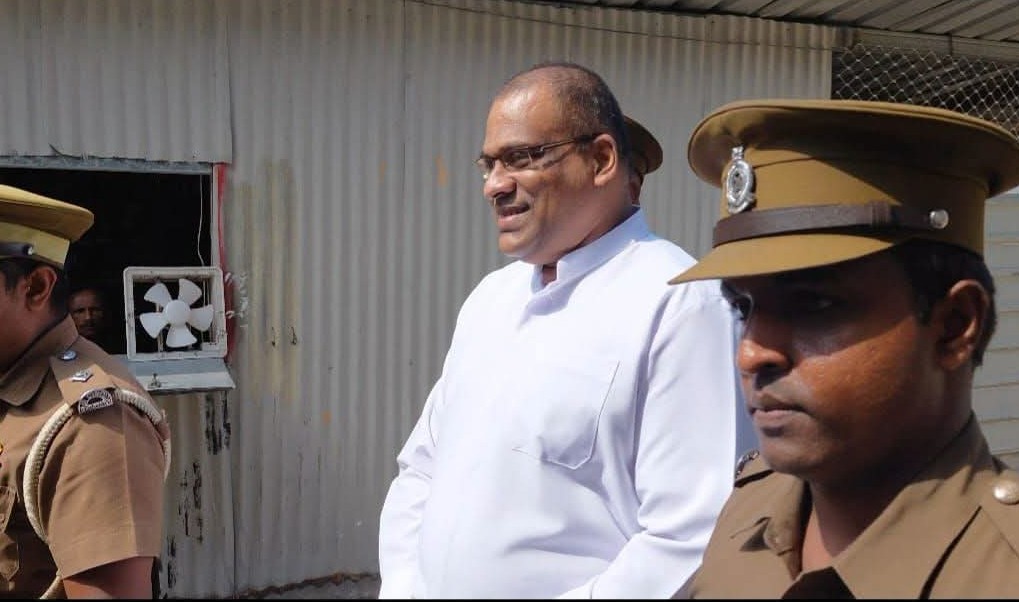

COLOMBO— Controversial Sri Lankan Buddhist monk and Bodu Bala Sena general secretary Galagodaaththe Gnanasara Thera’s appearance in court on Oct. 6 wearing prison-issued civilian clothing instead of his saffron robes has sparked a new controversy over whether prison authorities can require a priest to remove his robes.
Gnanasara Thera is currently serving a six-year prison sentence for contempt of court after the Supreme Court invalidated a presidential pardon granted to him by former President Maithripala Sirisena in 2019. He was originally sentenced in 2018 over his conduct during proceedings at the Homagama Magistrate’s Court concerning the case of missing journalist Prageeth Eknaligoda, but was released from prison after receiving the presidential pardon. The Supreme Court ruled in September 2026 that the pardon was arbitrary and invalid in law, paving the way for the sentence to be enforced.
Prison law
Cabinet spokesperson minister Nalinda Jayatissa fielding questions at the weekly cabinet briefing on October 6 said the removal of Gnanasara Thera’s robes and his being dressed in civilian clothing were carried out under the provisions of the Prisons Ordinance.
Prisons media spokesman and commissioner Senaka Palletenna said prison regulations require prisoners sentenced to more than three years to be produced before court in clothing issued by the Department of Prisons.
According to Pallathtenna, the rules distinguish between monks and priests serving simple imprisonment and those sentenced to rigorous imprisonment.
“A Buddhist monk serving a sentence of simple imprisonment may remain in saffron robes while in prison. However, where the sentence is rigorous imprisonment, the monk is required to wear prison-issued clothing,” he added.
The rules also provide discretion in cases involving shorter sentences. Where a prisoner has been sentenced to less than three years, the superintendent may permit the person to wear the civilian clothing worn before sentencing. “A Buddhist monk may similarly be allowed to appear in court in robes in such circumstances.”
For prisoners sentenced to more than three years, however, Palletenna said prison-issued clothing must be worn when they are produced before court.
Does this mean a monk has been disrobed?
Not necessarily.
This is one of the key distinctions in the controversy.
Being required to wear prison-issued or civilian clothing does not, by itself, determine whether a person remains a Buddhist monk under the Vinaya, the disciplinary code governing the Buddhist monastic community.
The question of whether a monk should be formally disrobed is a separate religious and disciplinary matter.
The Kotte Sangha Sabha has raised precisely this issue in its letter to the Commissioner General of Prisons. It said there were no records before the Sangha Sabha indicating that Gnanasara Thera had committed an offense under the Vinaya Pitaka that would warrant his disrobing.
The Sangha Sabha said responsibility for determining, from a Sasana perspective, whether the Thera should be disrobed or permitted to retain his robes rests with the Sangha.
It therefore asked the commissioner general of prisons not to remove his robes and to permit him to appear in court wearing them.
That is a question concerning Buddhist monastic discipline and the authority of the Sangha.
The current dispute arises because the two issues have become intertwined.
The Department of Prisons maintains that it is applying the same prison rules to convicted monks as it does to other prisoners. The Kotte Sangha Sabha, meanwhile, has objected to the removal of Gnanasara Thera’s robes on the grounds that disrobing is a matter that should be determined within the Buddhist monastic system.
Is Gnanasara Thera being treated differently?
The government says he is not.
Minister Jayatissa said more than 60 Buddhist monks are currently serving prison sentences for various offenses and that the same procedure has been applied to them.
He said no special exception was made for Gnanasara Thera and that the Department of Prisons acted according to prison law.
Palletenna, however, gave a broader figure, saying more than 63 members of the clergy from different religions are currently serving prison sentences in prisons across the country. He said religious figures serving prison sentences are also required to wear prison-issued clothing under the applicable regulations.
The government’s position, therefore, is that the clothing requirement is based on the prisoner’s sentence and prison regulations, rather than the person’s religious identity.
Why the controversy?
The controversy stems from the symbolic and religious significance of the robes.
For a Buddhist monk, the saffron robe is not simply ordinary clothing. It is an outward marker of monastic status. Seeing a prominent monk appear in court without his robes has therefore raised questions about whether the act amounted to, or implied, disrobing.
The prison authorities’ position is different: the clothing worn by a convicted prisoner being produced before court is governed by prison regulations.
The dispute is therefore not simply about clothing. It concerns the boundary between state authority over prisoners and the religious authority of the Sangha over monks.
Banner Image: Gnanasara Thera in lay clothing being escorted by prisons officials. Image via Facebook (Shantha Rathnayake).
This story was written and edited by Gagani Weerakoon. She leads the editorial at the Center for Investigative Reporting (CIR).