
Speed Read
- Saudi Arabia’s Supreme Court set aside the death sentence imposed on Sri Lankan migrant worker Sivarasa Anojan after an appeal filed on Oct. 11.
- Sri Lankan officials, lawyers, politicians and civil society members worked to challenge the sentence and seek a clemency.
- The ruling does not confirm whether Anojan will be released, whether his original prison sentence remains in force or when he could return to Sri Lanka.
- The case highlights the need for stronger consular support, timely access to legal representation and better communication with families of migrant workers detained overseas.
COLOMBO— When the news arrived on the morning of Oct. 14, Hamsithan watched his mother, Rasamanickam Yogalakshmi, finally release a breath she seemed to have been holding for months. She cried with relief as his father sank into a chair with a sigh.
Their son, Anojan Sivarasa, a 27-year-old Sri Lankan migrant worker facing execution in Saudi Arabia, had been given a reprieve.
Saudi Arabia’s Supreme Court overturned the death sentence imposed on Anojan, following an appeal filed on Oct. 11. The ruling, delivered on Oct. 13, came after weeks of diplomatic engagement, legal intervention and public appeals to save his life.
Announced by deputy foreign minister Arun Hemachandra on Oct. 14, the decision brought relief to Anojan’s family and the many people who had campaigned on his behalf. But, it did not settle the questions whether he will remain in prison, when he might return home and what Sri Lanka can do to protect other migrant workers facing serious criminal charges overseas.
The government has credited sustained diplomatic engagement and cooperation between Sri Lankan and Saudi Arabian legal teams for the outcome. Hemachandra thanked the Saudi government, Sri Lankan diplomatic officials, the Sri Lanka Bureau of Foreign Employment (SLBFE) and the lawyers involved.
The immediate threat of execution has receded, but the legal process is not necessarily over. The case is expected to return to a lower court, and the status of Anojan’s earlier conviction and prison sentence remains unclear.
“The Supreme Court has overturned the death sentence, and the case will now be referred to a lower court. We expect it to be taken up within two weeks. That court will decide whether to reinstate the original five-year prison sentence or issue a different ruling. Our mission was to secure clemency and ensure Anojan would not face the death penalty,” Faiszer Musthapha told CIR.
Mustapha was part of special legal delegation that went to Saudi Arabia to exhaust all possible legal avenues in seeking mercy for Anojan.
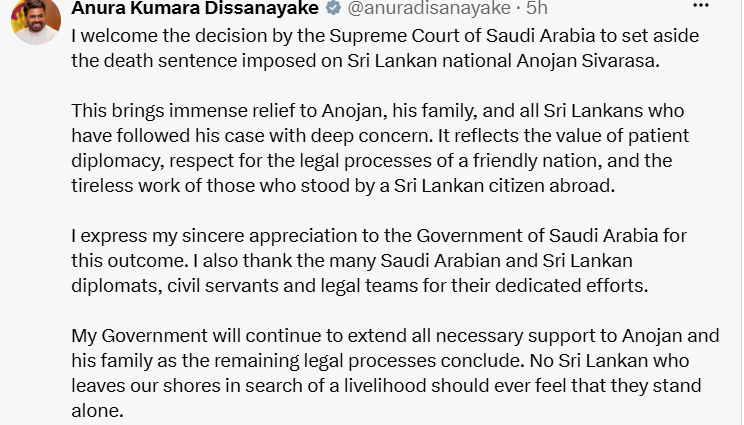
Meanwhile, President Anura Kumara Dissanayake welcomed the supreme court’s decision, describing it as a source of immense relief for Anojan, his family and Sri Lankans who had followed the case. He thanked Saudi authorities, diplomats, civil servants and legal teams for their efforts and pledged continued government assistance until the remaining proceedings are concluded.
“No Sri Lankan who leaves our shores in search of a livelihood should ever feel that they stand alone,” Dissanayake said.
Opposition lawmaker Shanakiyan Rasamanickam also welcomed the ruling but stressed that the campaign would continue until Anojan was safely reunited with his family in Sri Lanka.
“Our mission will only be complete when Sivarasa Anojan is safely brought back to Sri Lanka, following the completion of all necessary legal procedures and due process, and reunited with his family,” he said in a statement posted on X.
Deadly social media comment
Anojan’s case began with an online argument in late June 2026
A video showing a young Muslim man kicking a dog fondly called Subramani who accompanied Hindu foot pilgrims circulated on social media, prompting heated exchanges about religion. During the argument, a user has made derogatory remarks about a Hindu deity. Anojan responded in Tamil with remarks insulting the Prophet Muhammad.
He later deleted the comment and published an apology video. But a screenshot of the exchange allegedly reached his employer and Saudi authorities. He was arrested on July 1.
On July 27, the Al-Ahsa Criminal Court sentenced him to five years in prison and imposed a fine of three million Saudi riyals, equivalent to about $800,000.
An appellate court subsequently imposed the death penalty in September, finding him guilty of blasphemy against Islam and the Prophet Muhammad.
For Anojan’s family, the case became a fight to bring their son home alive. For Sri Lanka, it became an urgent diplomatic challenge involving another country’s criminal justice system and a punishment with irreversible consequences.
The case also underscored the potential consequences of online speech across borders. A comment made during an argument on social media could carry consequences far beyond the immediate exchange when the person involved was living and working under a different legal system.
A campaign reached beyond Sri Lanka
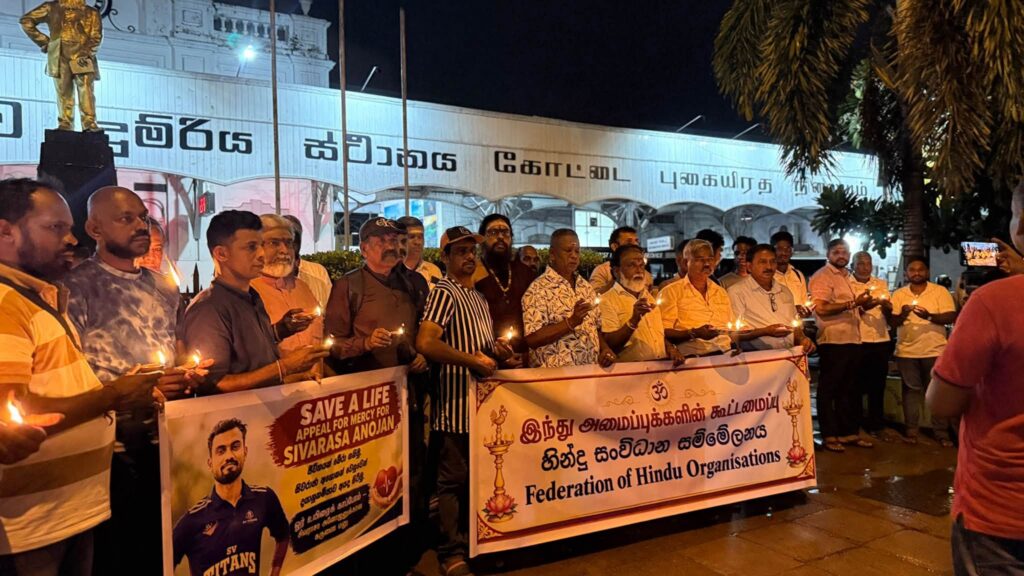
As news of the death sentence spread, politicians, civil society groups and members of the public called for intervention. Petitions and appeals urged the government to act, while Anojan’s family pleaded for mercy.
The government pursued diplomatic channels and assembled a legal team to challenge the sentence.
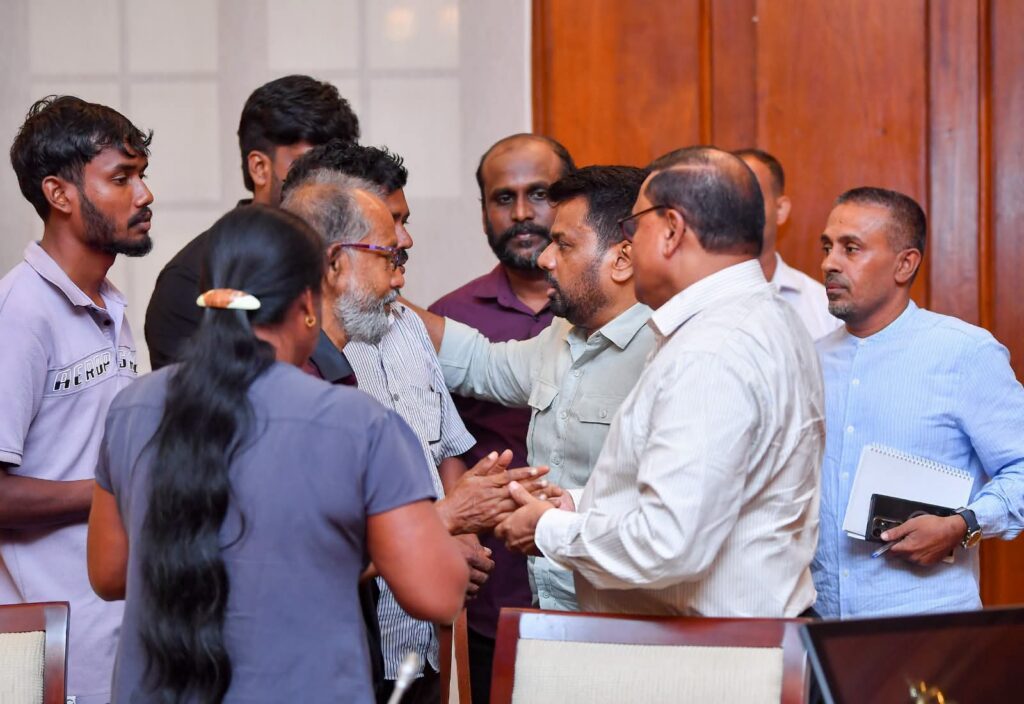
Former Maldivian president Mohamed Nasheed became one of the people approached for assistance. On Sept. 23, president’s counsel Faiszer Musthapha and president’s counsel Upul Kumarapperuma met Nasheed in the Maldives to discuss the case. Nasheed acknowledged that Anojan’s comments were offensive but said he would support efforts to save his life on humanitarian grounds.
His involvement was not to determine the outcome of the appeal. The legal process remained in Saudi Arabia, where the sentence had been imposed. But the effort illustrated how regional relationships can complement formal diplomacy when a citizen faces an urgent threat abroad.
Sri Lanka also sent a delegation to Saudi Arabia to work with local lawyers and establish the procedure for appealing to the Supreme Court.
The delegation included Musthapha, Kumarapperuma, president’s counsel Hafeez Azard Navavi, consul general in Jeddah M.T. Mohamed Laffar, attorney-at-law Hafeel Farisz and Mohamed Riyasdeen Silmy, a coordinating secretary to Musthapha.
Sri Lanka’s ambassador to Saudi Arabia, Ameer Ajwad, also took part in the effort. He visited Anojan at Dammam central prison on Oct. 8 to inquire about his welfare.
The Supreme Court’s decision followed the filing of the appeal on Oct. 11. The court’s reasoning, however, should be established from its written decision rather than inferred from the announcement.
Concerns remain
The reversal of Anojan Sivarasa’s death sentence is a significant reprieve, but his legal ordeal is not over. Sri Lanka must continue to pursue his release and return while keeping his family informed of every development.
The case also demands a broader response. Sri Lanka must strengthen consular support for citizens facing serious criminal charges abroad, ensuring timely legal assistance, clear communication and effective protection.
The death sentence has been overturned. The next test is whether Sri Lanka can bring Anojan home and ensure that other migrant workers are not left without support when they need it most.
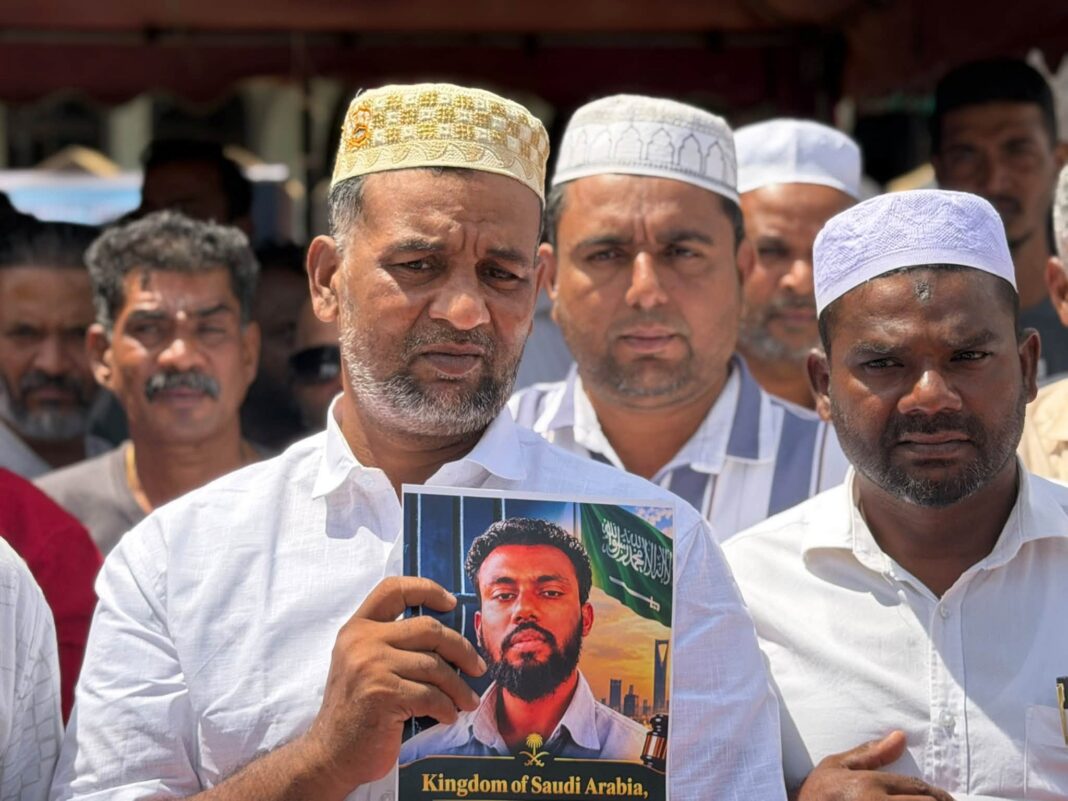
Banner Image: Sri Lanka united in calling authorities to intervene and seek clemency for Anojan and bring him home alive. Muslims in northern Sri Lankan city Vavunia are seen engaged in vigil in front of the grand jummah mosque after prayers. Image via Vavunia.net Facebook page.
This story was written and edited by Gagani Weerakoon. She leads the editorial at the Center for Investigative Reporting (CIR).
This story was produced with support from Report for the World, a global media service strengthening local independent journalism.