

By Gagani Weerakoon
Sri Lanka’s debate on women’s political representation has long revolved around quotas, party gatekeeping and media bias. Those battles are far from over. Yet, an even more consequential threat is gathering force. One that could shape not just who contests elections, but who wins them.
As the country looks ahead to future Provincial Council Polls and the pivotal General Election cycle expected in 2029, the conjunction of gendered hate and technologically amplified political disinformation poses a serious risk to democratic integrity. The danger is not abstract. It is accelerating.
For years, women in politics have endured reputational attacks grounded in misogyny. They are scrutinised for their morality rather than their manifestos or the capacity perform. Rumours about personal lives travel faster than policy speeches or a solid track record. Online abuse is routine. But the shift from crude trolling to AI-enhanced manipulation marks a turning point.
Digital hatred does not operate in isolation. It feeds on political polarisation and is boosted by algorithms designed to reward engagement. In highly contested electoral environments, falsehood travels not because it is credible, but because it is provocative and often click-baity.
When that falsehood is gendered, it becomes even more potent.
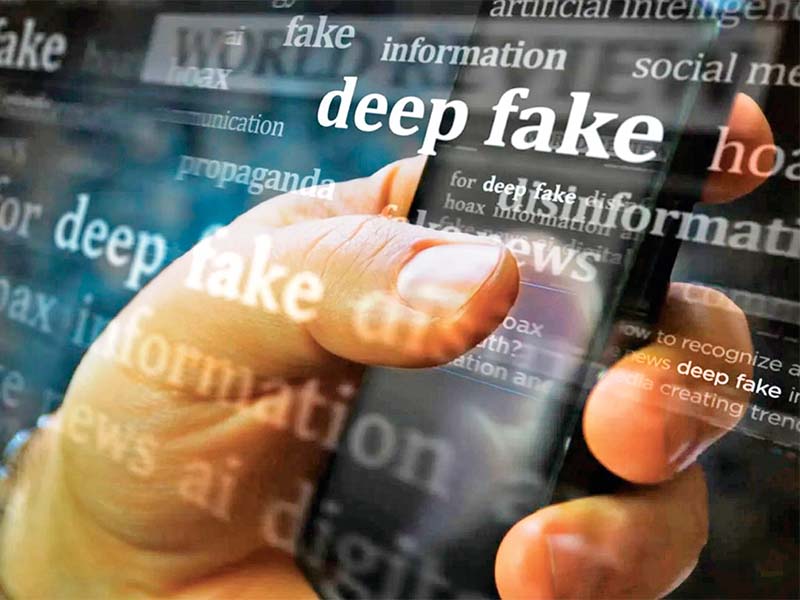
According to global warnings issued by the United Nations, digital technologies are increasingly used to harass and abuse women and girls. Generative AI tools now allow the creation of convincing deepfake images and videos. On platforms such as X, owned by Elon Musk, synthetic sexualised imagery has already targeted women without their consent.
In Sri Lanka’s socio-cultural context, where honour, family reputation and social respectability remain powerful determinants of ‘electability’, particularly for women, the weaponisation of fabricated intimate content can be politically fatal. A male politician accused of corruption may deny, litigate or outmanoeuvre. A woman targeted with a deepfake of a sexual nature faces a different terrain — one where the stigma itself can eclipse the truth and cost her the opportunity to get elected. The burden of proof shifts unfairly onto the victim. Legal redress is slow. Social media outrage is rapid and instant, proving the proverb “a lie can travel halfway around the world before the truth can get its boots on.”
The mechanics are chillingly simple. An AI-generated video appears days before polling. It is shared across Facebook groups, WhatsApp chains and partisan pages. Outrage fuels visibility. Screenshots circulate even after the original post is removed. By the time fact-checkers intervene, the narrative has embedded itself in public consciousness.
Even if debunked, the damage lingers. Voters may not fully believe the content, but doubt alone can be decisive in a tight race.
This is where hate and electoral disinformation interconnect most dangerously. Gendered hostility provides the emotional fuel; political actors or opportunists supply the disinformation; digital platforms supply the velocity.
Digital rights advocate, Dr. Sanjana Hattotuwa, recently warned that the scale and sophistication of deepfake production has grown exponentially between 2023 and 2025, with generational leaps in realism. The trajectory suggests that by 2029, distinguishing between authentic and synthetic political communication may become increasingly difficult for ordinary voters.
Elections amplify vulnerability, particularly of those who are systematically marginalised. Campaign periods compress time, heighten emotion and increase online traffic. In such environments, the ability to respond swiftly is critical. Yet Sri Lanka’s institutional architecture is not currently designed for real-time digital crisis management.
The Election Commission has made strides in overseeing campaign finance, nominations and traditional media regulations. However, it was never structured to monitor AI-driven disinformation campaigns operating across global platforms in multiple languages. Election observers, too, are trained primarily to assess physical polling stations, ballot processes and overt violations and not algorithmic manipulation or coordinated digital smear operations.
The gap is not merely technical; it is strategic.
Rapid-response digital forensic teams, platform liaison mechanisms and clear protocols for emergency takedowns during election periods remain underdeveloped. There is limited publicly visible capacity to identify deepfakes at scale, attribute coordinated campaigns or issue authoritative, trusted debunking within hours rather than days.
This institutional lag matters. Disinformation thrives in the window between publication and correction. The longer that window, the greater the amplification.
In future Provincial Council and General Elections, this delay could have a distinctly gendered impact. Women candidates, already fewer in number, may become targets for experimentation with synthetic attacks. Political actors seeking to tilt a race may calculate that targeting a female opponent with a reputational deepfake carries high impact and low immediate risk of accountability.
The consequences are layered.
First, there is personal harm. Beyond reputational damage, women subjected to sexualised deepfakes often experience severe psychological distress, threats of physical violence and harassment extending to family members. The digital attack bleeds into the physical world.
Second, there is electoral harm. A single viral fabrication can impact voter turnout among a candidate’s supporters, sway undecided voters or justify party leadership sidelining her ‘for the sake of stability.’
Third, there is systemic harm. As stories of such attacks spread, capable women observing from the sidelines may reconsider entering politics altogether. The chilling effect compounds existing financial and structural barriers. The quota may ensure nominations, but it cannot compel genuine participation if the personal cost becomes intolerable. Women’s engagement in politics will nosedive, and they can be invisibilised, voices silenced.
Moreover, persistent institutional inability to counter digital manipulation in real time risks normalising electoral misinformation. If voters repeatedly encounter sensational claims that are later disproven, but never fully erased, they may adopt a posture of cynical disengagement. In that climate, truth competes on equal footing with fabrication.
This erosion of epistemic trust threatens democracy itself. Elections depend on shared confidence that choices are informed by authentic information. When voters suspect that any video could be synthetic and any denial could be strategic, the informational ground shifts.
For women, whose legitimacy in politics is still contested in subtle and overt ways, this instability magnifies pre-existing prejudice. Doubt attaches more easily. Redemption is harder.
Addressing this looming crisis requires more than rhetorical concern.
Sri Lanka must invest urgently in digital monitoring capacities within election management bodies. That includes specialised technical units capable of identifying synthetic media, partnerships with independent cybersecurity researchers, and direct escalation channels with major technology companies during election periods.
Clear legal provisions criminalising malicious AI-generated electoral disinformation, particularly gendered content intended to intimidate or suppress candidates, must be accompanied by expedited judicial pathways during campaigns.
Election observers must expand their frameworks to include digital ecosystems. Monitoring online narratives, coordinated harassment, and platform responsiveness should become as routine as observing polling stations.
Political parties, too, bear strong responsibility. They must adopt internal codes rejecting the use of synthetic smear tactics and provide digital security support to their women candidates.
Ultimately, however, technology exposes societal fault lines rather than creating them. If misogyny remains politically expedient, digital tools will continue to weaponise it.
The next electoral cycles will test not only party strength and policy platforms, but the country’s capacity to defend truth in an age of artificial fabrication. If institutions remain reactive rather than anticipatory, electoral misinformation may escalate to levels that disproportionately sideline women from public life.
The question is no longer whether AI-driven disinformation will shape elections. It is whether Sri Lanka will allow it to become a gendered instrument of exclusion.
If the answer is complacency, the cost will not simply be a handful of lost seats. It will be a quieter Parliament, a narrower policy debate and a democracy diminished by the silencing of women before they ever reach the ballot box.
This Op-Ed was produced under the CIR– FACTUM Media Fellowship Program and was originally published in Ceylon Today on 21 February 2026.