
Speed read
- Mercury(hg) concerns linked to substandard coal at the Lakvijaya Coal Power Plant have raised fears of toxic exposure, with no national standards regulating mercury content in imported coal.
- Emission data suggests possible legal violations, while studies indicate mercury may already be entering the food chain through fish, putting coastal communities at risk.
- An official audit exposed major procurement failures, including weak supplier criteria, unverified quality checks and billions in financial losses due to inefficient coal use.
- The crisis now under a Presidential Commission probe has become a key test of the government’s pledge to ensure transparency, accountability and environmental protection.
COLOMBO – Increasing evidence suggest a potentially dangerous convergence of environmental exposure, public health risks and governance failures surrounding Sri Lanka’s coal-fired power generation.
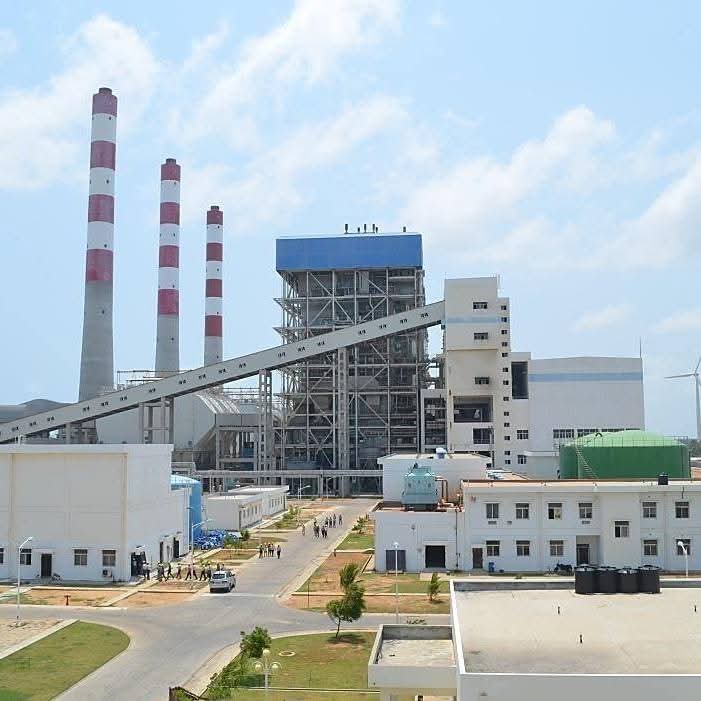
There are fresh concerns about recent coal consignments containing elevated mercury(mg) levels, resulting in intensified scrutiny of operations at the Lakvijaya Coal Power Plant, Sri Lanka’s largest power station located in northwestern Norochcholai, with environmentalists warning against toxic contamination of marine ecosystems and the human food chain.
The controversy erupts at a politically sensitive moment. The entire coal procurement process has become a litmus test for the ruling National People’s Power (NPP) Government, which swept into office in 2024 pledging transparency and an end to corruption. The resignation of energy minister Kumara Jayakody on April 17 and the appointment of a Presidential Commission of Inquiry chaired by Supreme Court Judge Gihan Kulatunga to probe more than a decade of coal imports underscores the gravity of the crisis. What began as a technical dispute over fuel quality has now evolved into a broader reckoning over weak accountability, regulatory failure and lack of environmental justice.
As the mercury levels in coal purchases give rise to fresh concerns, the Centre for Environmental Justice (CEJ) has claimed the lack of binding national standards for mercury content in imported coal, leaving a critical gap in Sri Lanka’s environmental safeguards. CEJ’s chairperson and environmental scientist Hemantha Withanage cautioned that, “International studies show that mercury content in coal can vary significantly. However, Sri Lanka has still not established a maximum permissible mercury level for imported coal.”
He noted that regulating emissions alone is not enough: “While the environmental protection license (EPL) allows mercury emissions of up to 0.01 mg/Nm³, regulating emissions alone is inadequate without controlling mercury levels at the source.
Mercury poses unique dangers. Released during combustion as vapor, it largely escapes conventional pollution controls such as electrostatic precipitators. While some is absorbed into seawater through flue gas desulfurization systems (to remove Sulphur dioxide), a significant portion is emitted into the atmosphere. Over time, mercury can transform into methylmercury, a potent neurotoxin that accumulates in fish and magnifies along the food chain.”
The CEJ referred to a 2018 study conducted in the Kalpitiya peninsula, near Puttalam, which found troubling levels of mercury exposure among coastal communities. “Twenty-eight out of 36 women, about 77 %, had mercury levels exceeding the internationally accepted safety threshold of 1 ppm,” Withanage told CIR, adding that “the most disturbing finding was a recorded level of 15.584 ppm in one individual.”
“These women were regular consumers of fish from the Puttalam lagoon, suggesting a bioaccumulation pathway,” he said, warning that coastal and fishing populations remain especially vulnerable.
According to Withanage, two separate environment and health tests should be conducted and residents should be compensated. Local legal jurisdiction limitations should not prevent people from being compensated. With wind patterns expected to be changed from next month, environment and health are to be greatly affected. If the North Western Provincial Environment Authority is unable to conduct monitoring based on EPL they issued or impact assessments, the provincial authority should let the Central Environment Authority (CEA) or the Industrial Technology Institute (ITI) to conduct tests, Withanage noted.
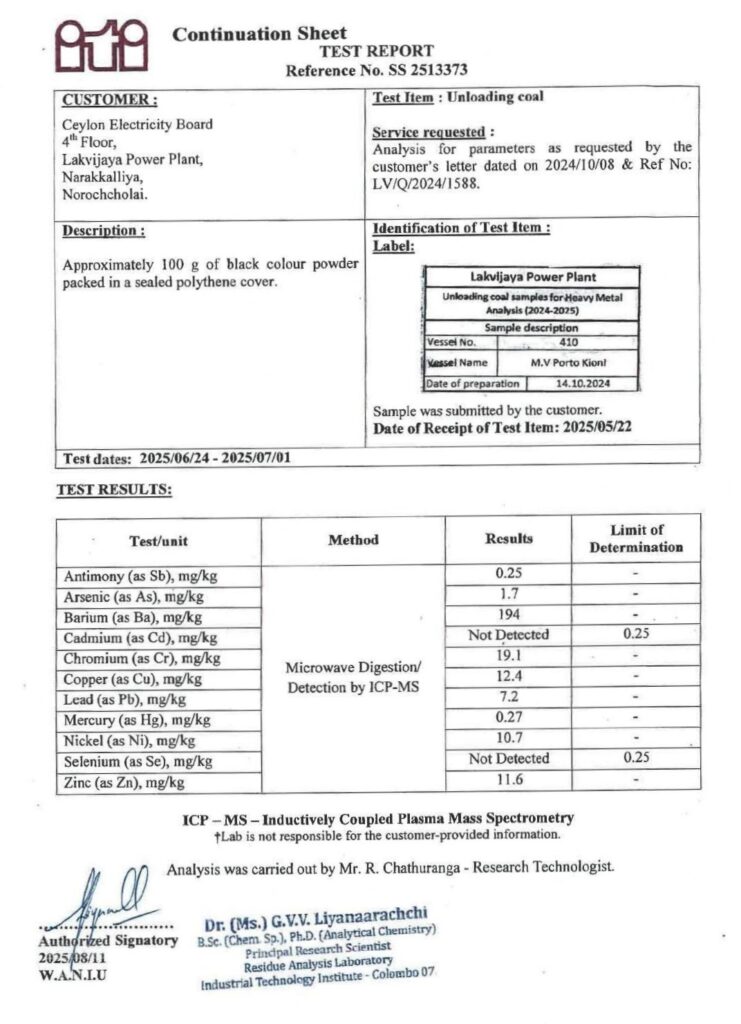
He also said that a test done in 2024 by ITI also proved the presence of heavy metals including mercury and arsenic.
Regulatory beaches
Sustainability specialist Vidhura Ralapanawe noted that between 600 and 650 kilograms of mercury could be released annually from coal combustion at Norochcholai. “Since we are using 2.2 to 2.5 million MT of coal a year, this comes to about 600–650 kilograms of mercury per annum,” he said.
Ralapanawe also pointed to emission data suggesting regulatory breaches. “The stack emission data shows a value of approximately 36 micrograms per Nm³ – or normal cubic meter – or 0.036 mg/Nm³,” he said, adding that “this is a clear violation” of the permitted 0.01 mg/Nm³ limit.
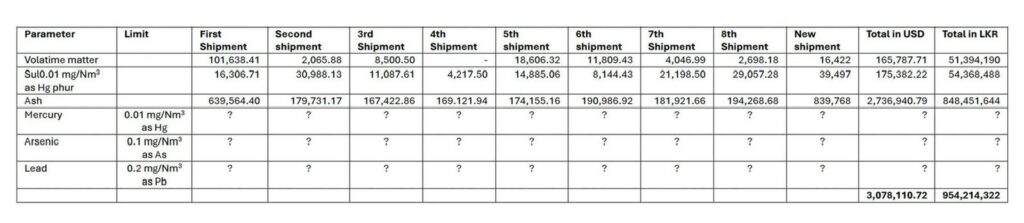
Recent coal shipments, particularly from South Africa, have significantly higher ash content, compounding environmental risks. Fly ash generation has reportedly surged from around 800 MT per day to between 1,500 and 1,800 MT.
“These numbers indicate the ash content is indeed above the 16 % limit,” Ralapanawe said. He cautioned that the plant has been forced to resume open dumping: “This practice has now come back due to the poor coal quality, and the community is the one paying the price.”
He added that the situation could worsen during seasonal shutdowns of cement plants: “The plant will have to dump the full amount of generated ash to the ash yard… this will increase community impact greatly.”
Environmental risks
Amid escalating concerns, the Sectoral Oversight Committee on Environment, Agriculture and Resource Sustainability has stepped in, directing authorities to urgently address the environmental risks linked to ash generated by the Lakvijaya Coal Power Plant.
Committee’s chairperson MP Hector Appuhamy told CIR that deteriorating coal quality had significantly increased ash volumes during power generation. The Committee which met on 17 March warned that failure to manage this waste properly could lead to long-term environmental damage, particularly in surrounding communities.
“Officials were instructed to immediately formulate an environmentally sustainable disposal plan under the leadership of Puttalam’s district secretary. The Committee also called for an assessment of whether the ash could be repurposed for industrial use, with any revenue directed toward welfare initiatives for communities affected by the plant’s operations,” he said while adding these reports will be taken up at the next meeting on May 5, 2026.
According to the chairperson Appuhami, the committee strongly believe the CEA should intervene in conducting comprehensive study and submitting a report on environmental impact as they (the SOC) does not believe the provincial environment authority is in possession of expertise required.
“Though Lakvijaya Plant is in NWP, the smoke once enters the atmosphere doesn’t stay in the province, the impact of pollutants discharged to the sea and coal fall into sea during the unloading process, is not restricted to NWP. This is why we thought on calling Health Ministry officials, CEA, all private and state environment and marine stakeholders who have carried out studies or made some kind of intervention regarding negative impact to health and environment of the people in the area to the SOC meeting on 5th May” Appuhami said.
Meanwhile, Sugath Emanuel, secretary of Kalpitiya Peninsula Tourism Association claimed they constantly lobbied with authorities and environmental groups to take necessary action to mitigate environment pollution caused as a result of coal power generation.
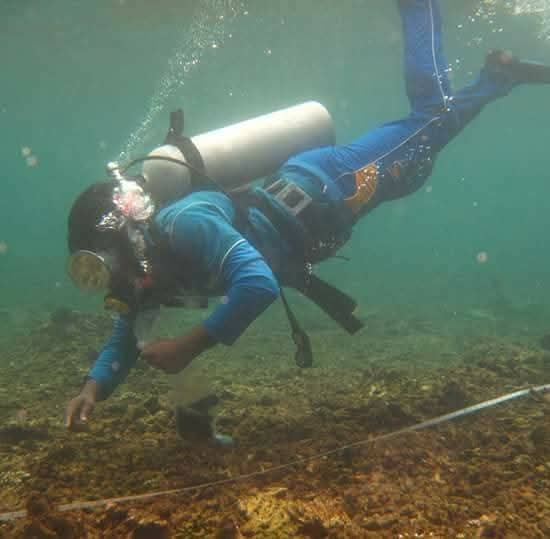
“The hot water discharged by the plant to the see from its cooling system creates hot waves in the seas affecting marine bio diversity. Over the years tons of call fell into the see while being unloaded and we have observed it affect our corals. This in return is affecting tourism in the peninsula,” Emmanuel told CIR.
The North Western Provincial Environmental Authority has also been given a two-week deadline to respond to a series of queries raised by NWP lawmakers.
While provincial officials maintained that existing filtration systems are capable of handling the increased ash output, the issue of environmental compliance, including the conditions tied to the plant’s environmental protection license, remains under close scrutiny.
The intervention signals growing institutional pressure to address both the immediate environmental risks and the systemic failures that have brought Sri Lanka’s coal dependency under renewed scrutiny.
Director of NWP environment authority, S. K. A. Wanniarachchi said they have conducted an immediate stack emission test at Lakvijaya power plant following SOC meeting.
“This was in addition to quarterly stack emission tests we conduct and we also convened a meeting of our experts panel to get their views and ideas and prepared a report as requested by the parliament committee,” he said
Meanwhile, a special audit by Sri Lanka’s National Audit Office painted a damning picture of systemic failures in the 2025/2026 coal procurement cycle. The state-owned Lanka Coal Company (LCC) is accused of diluting supplier criteria, allowing companies with questionable track records to qualify.
Independent inspectors tasked to verify coal quality at loading ports were found to be unaccredited or operating with expired licenses, rendering test reports unreliable.
The operational consequences were immediate. The plant, designed to generate 300 megawatts per unit, was frequently forced to run at reduced capacity. Lower-quality coal increased fuel consumption significantly, contributing to an estimated financial loss of Rs2.24 billion ($ 6,948,711) across nine shipments, according to the audit report.
The government’s decision to appoint a presidential commission to investigate coal imports dating back to 2009 signals that the crisis extends beyond a single procurement cycle. The probe will examine hundreds of shipments over 15 years, with authorities pledging legal action if wrongdoing is established.
Substandard shipments
Environmentalists argue that the absence of mandatory testing for toxic elements such as mercury, arsenic and lead at loading ports, combined with logistical constraints that prevent rejecting substandard shipments once unloaded, leaves Sri Lanka exposed to repeated failures.
With shifting wind patterns expected in the coming months, the dispersion of pollutants could intensify, expanding the zone of environmental and health impacts. For communities around Norochcholai, the risks are immediate, Withanage noted.
For the government, the implications are equally significant. The unfolding coal controversy has become a defining test of its commitment to transparency, environmental protection and accountability, one that may shape both the future of Sri Lanka’s energy sector and public trust in its institutions.
This story was written and edited by Gagani Weerakoon. She leads the editorial at the Center for Investigative Reporting (CIR).
This story was produced with support from Report for the World, a global media service strengthening local independent journalism.